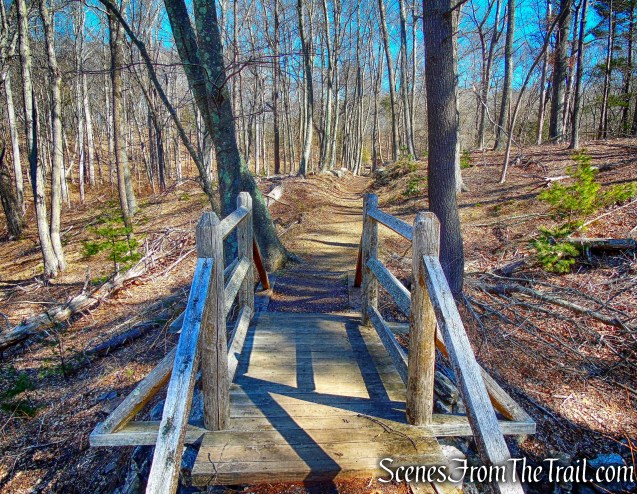
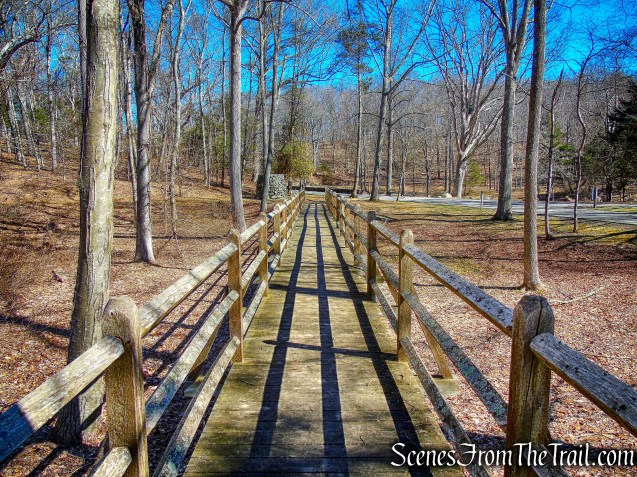
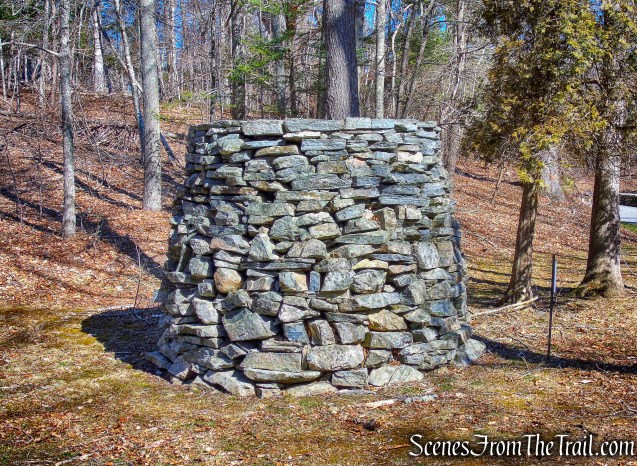
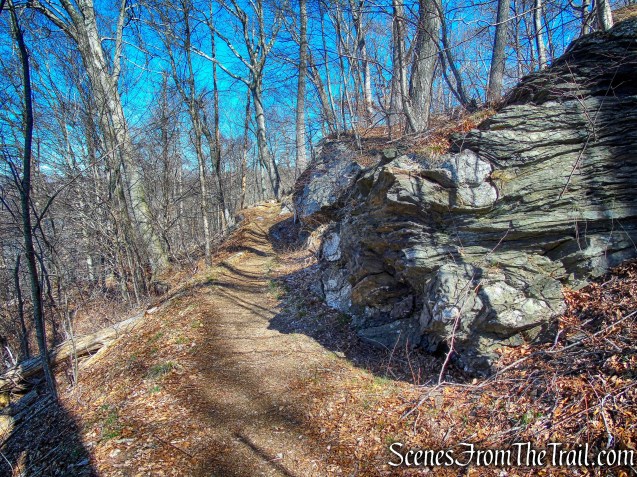
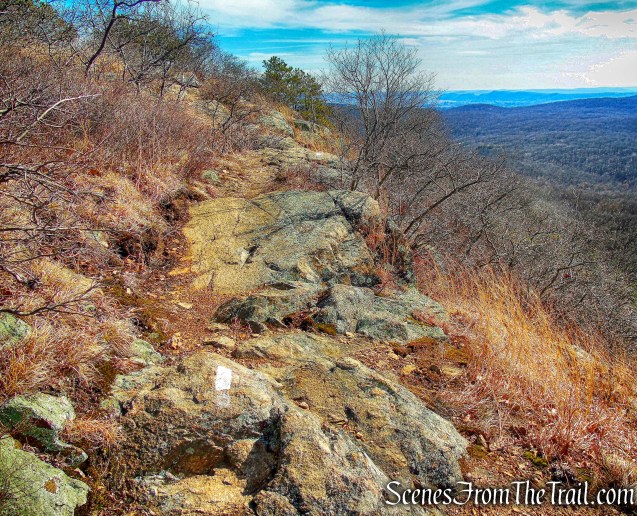
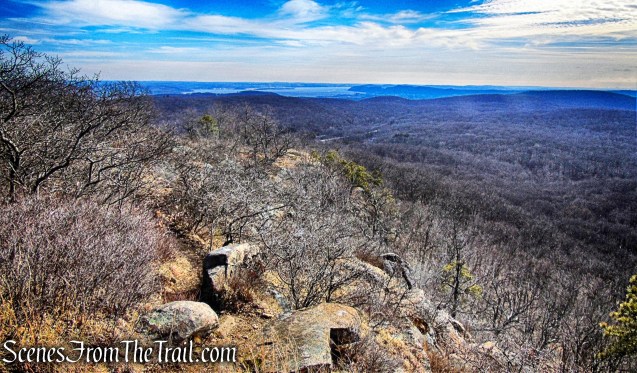
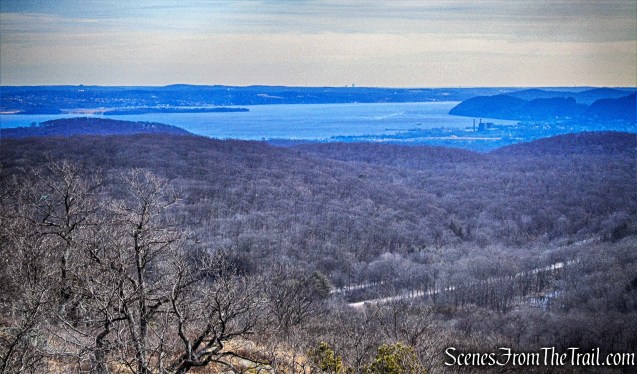
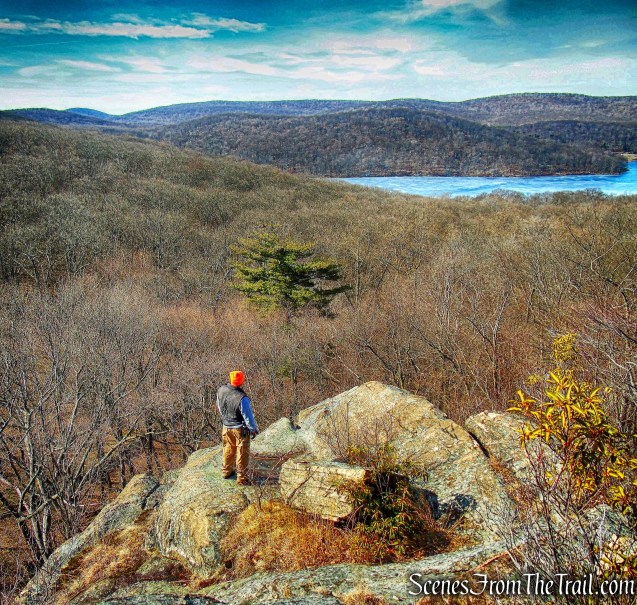
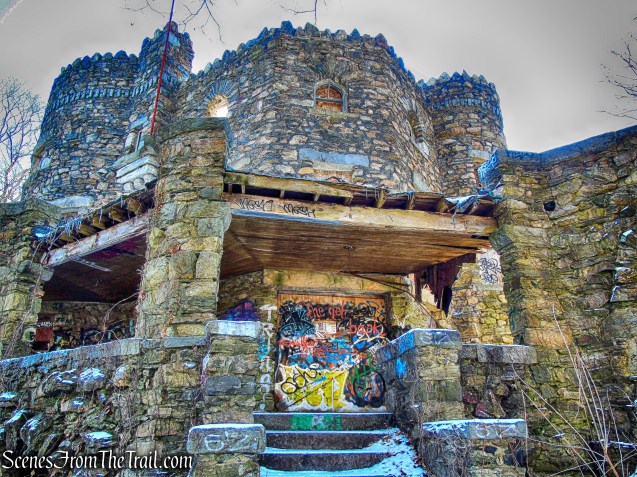
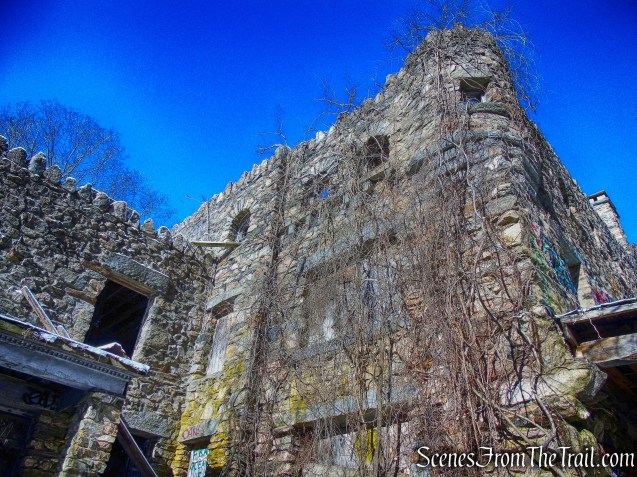
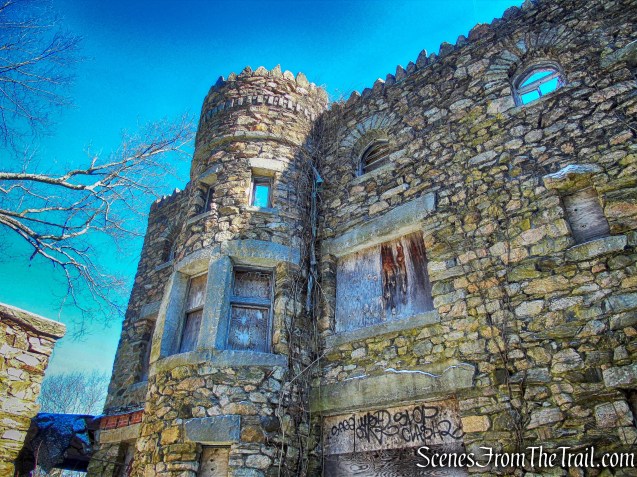
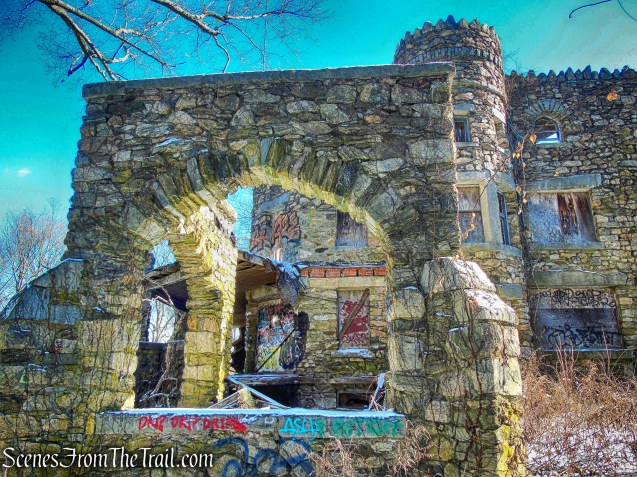
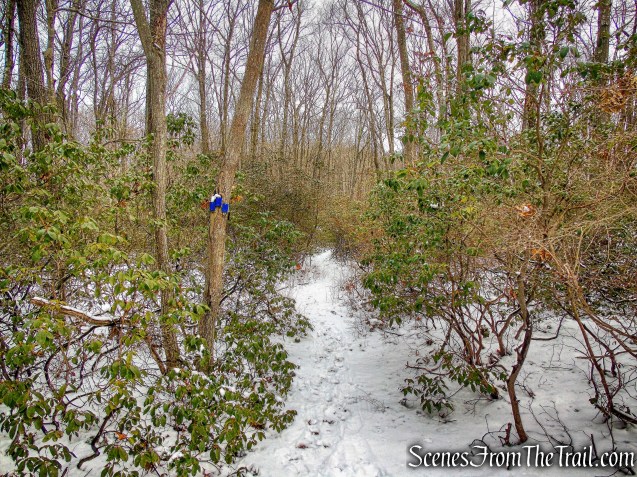
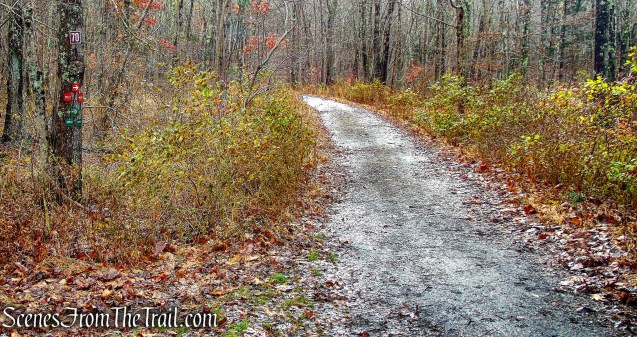
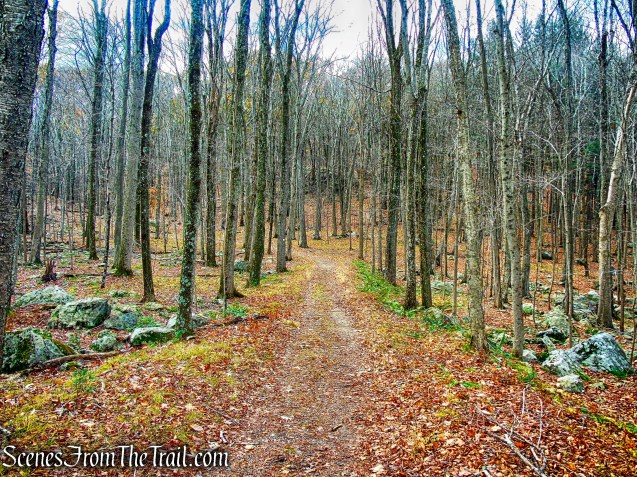
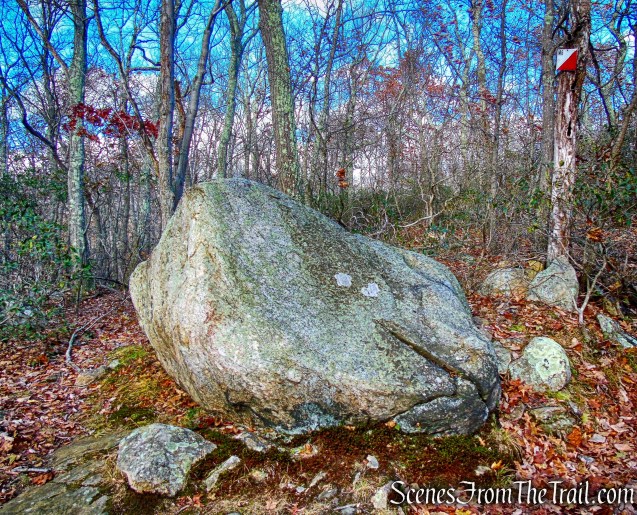
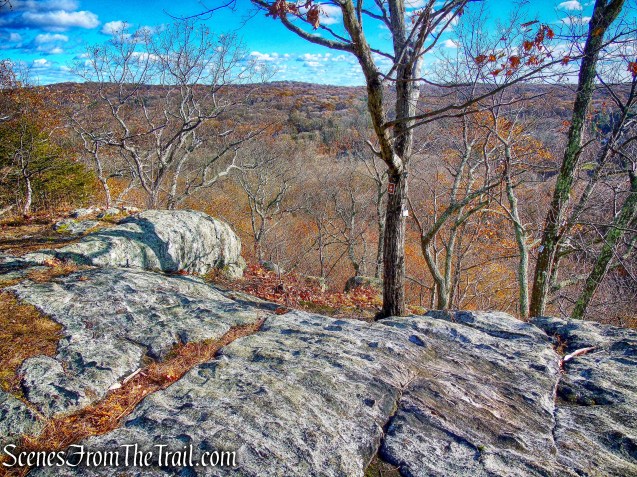
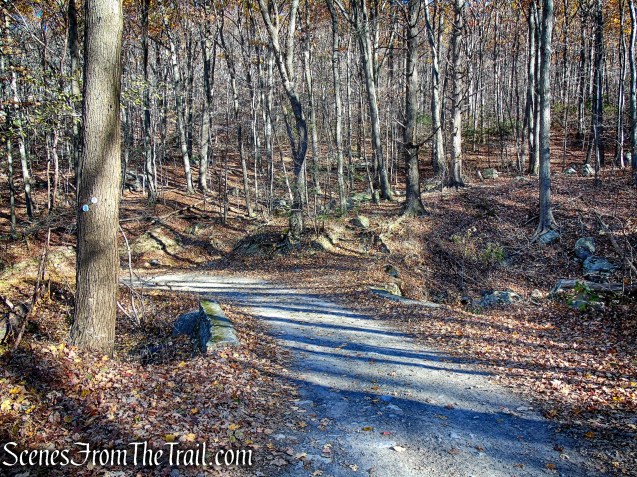
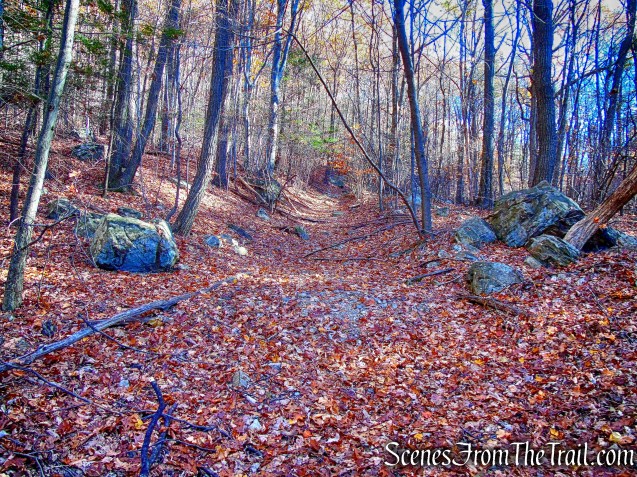
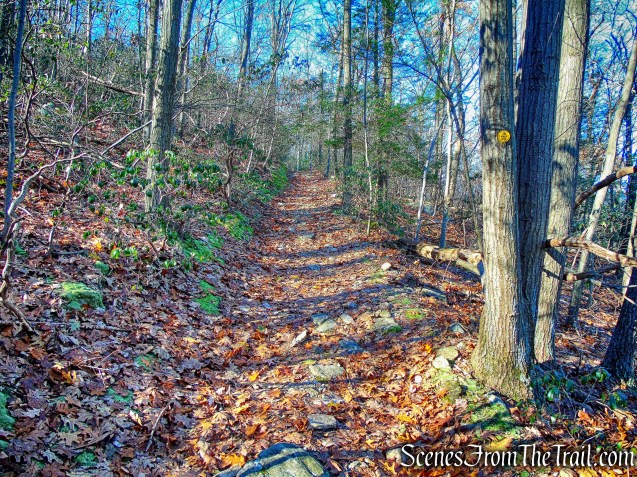
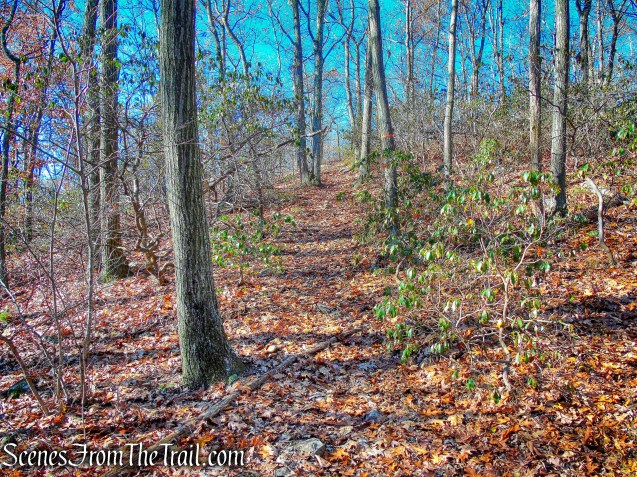
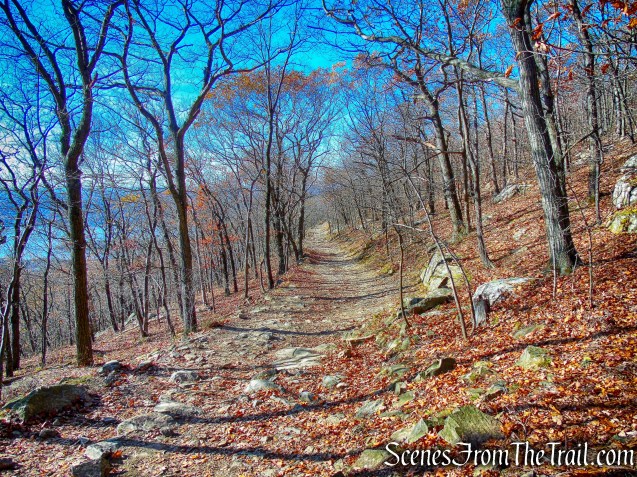
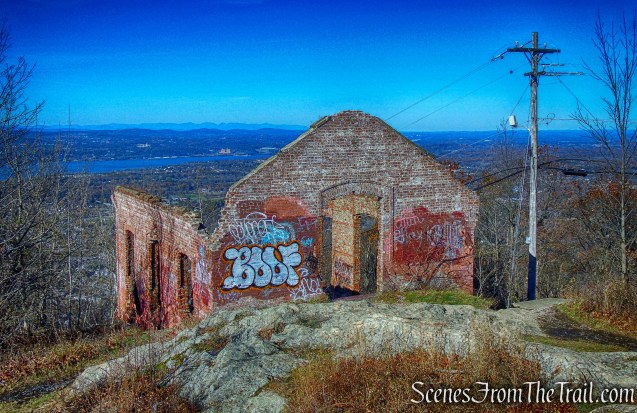
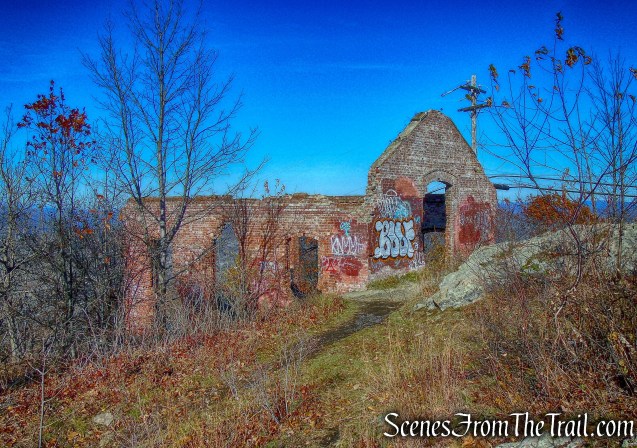
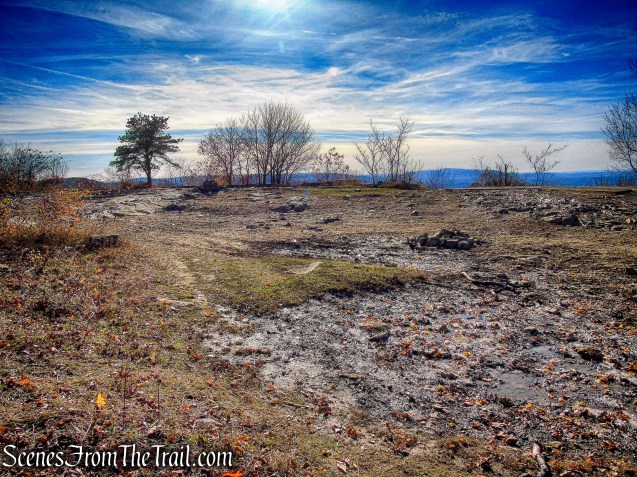
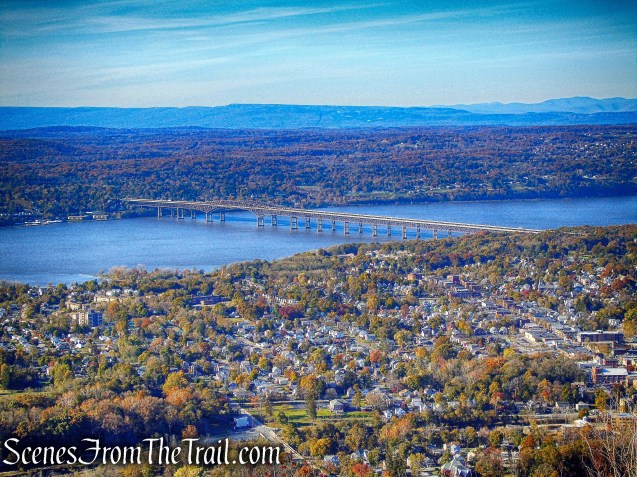
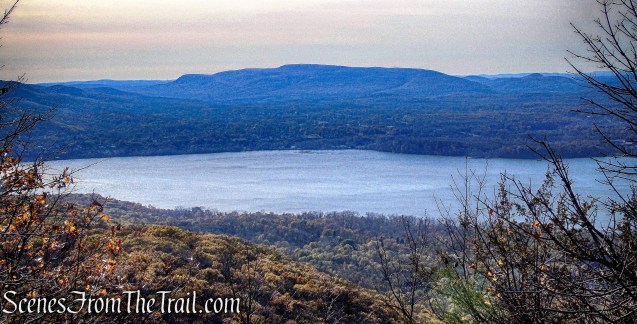
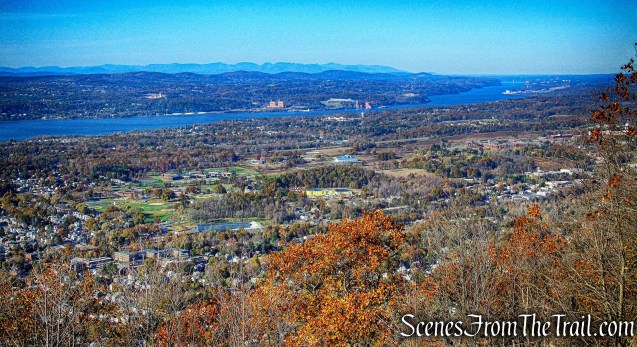
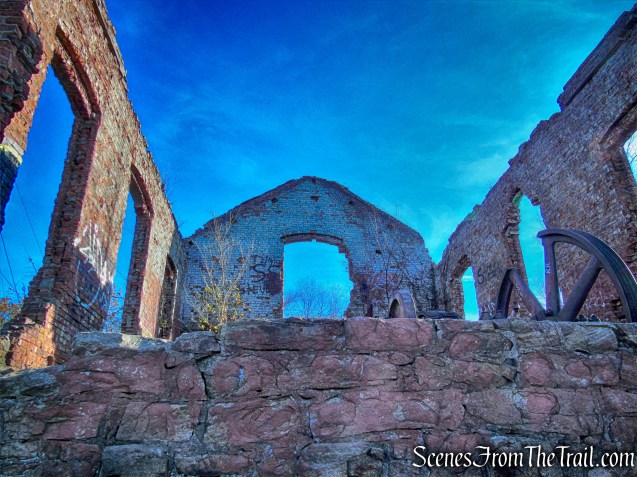
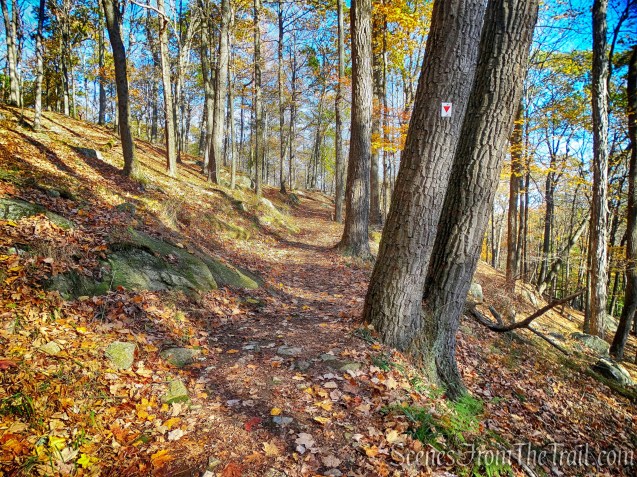
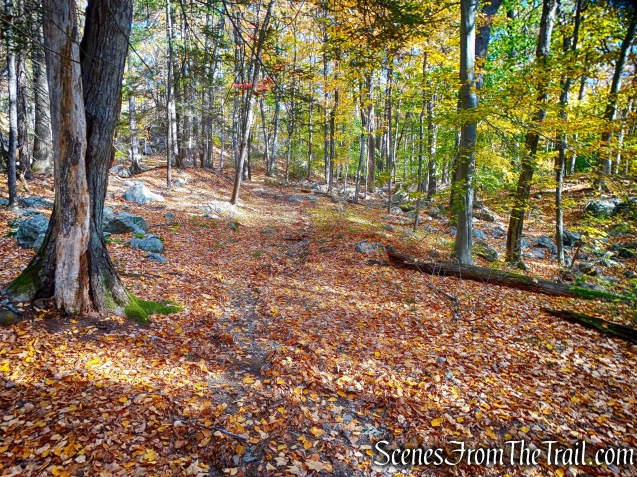
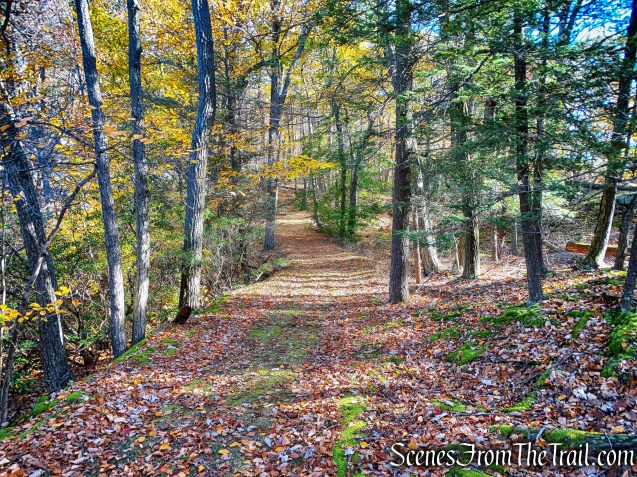
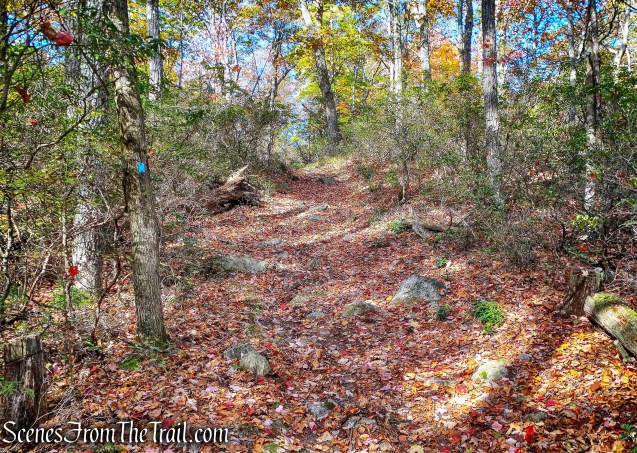
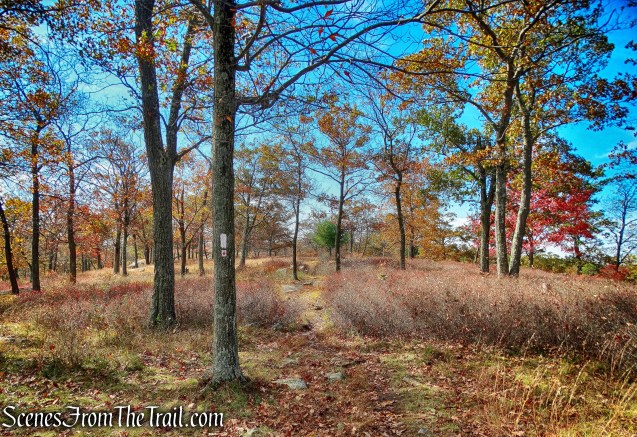
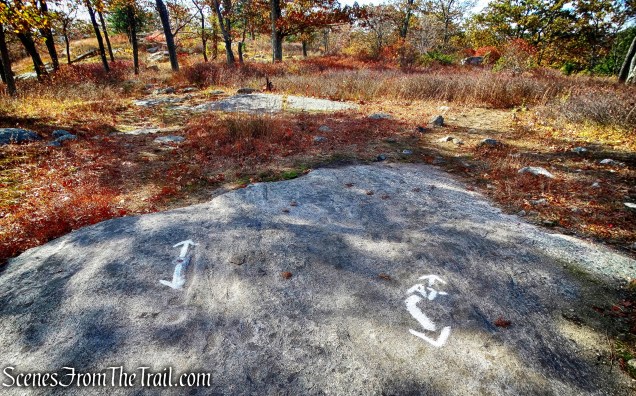
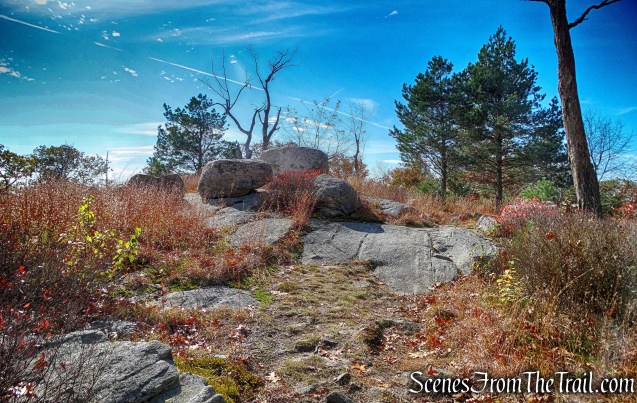
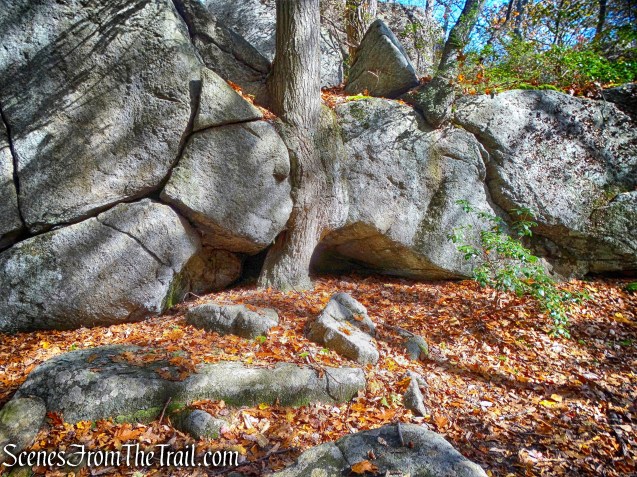
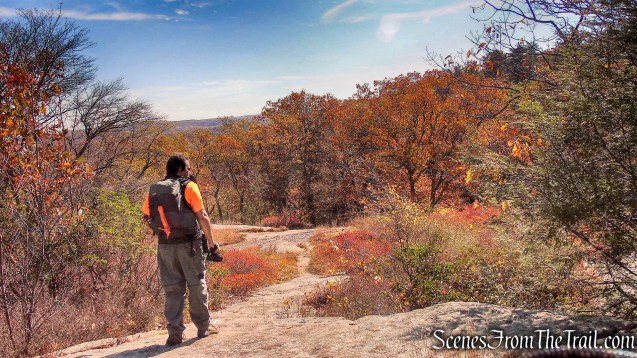
Yellow Trail Loop – Garret Mountain Reservation

An updated version of this hike can be found here: Yellow Trail Loop – Garret Mountain Reservation (2025)

April 14, 2018 – Woodland Park, New Jersey

Difficulty: Easy

Length: Approximately 3.4 miles

Max elevation: 520 ft.– total elevation gain approximately 321 ft.

Route type: Circuit

Map: Garret Mountain Reservation map

Trailhead parking: Park Rd, Woodland Park, NJ 07424

Garret Mountain, located in Paterson and Woodland Park, is divided into two separate Passaic County parks: Garret Mountain Reservation to the north and Rifle Camp Park to the south.
Garret Mountain Reservation

Garret Mountain Reservation

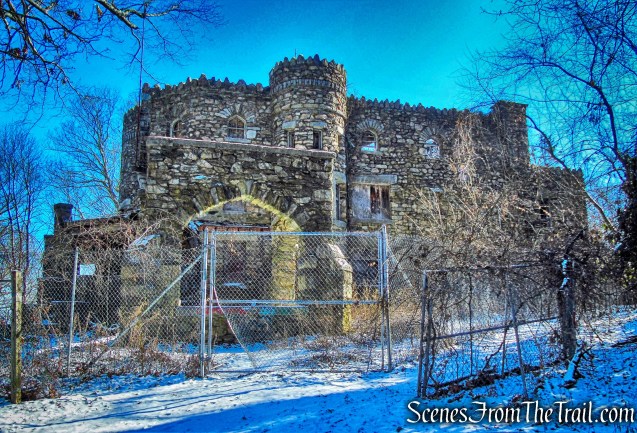
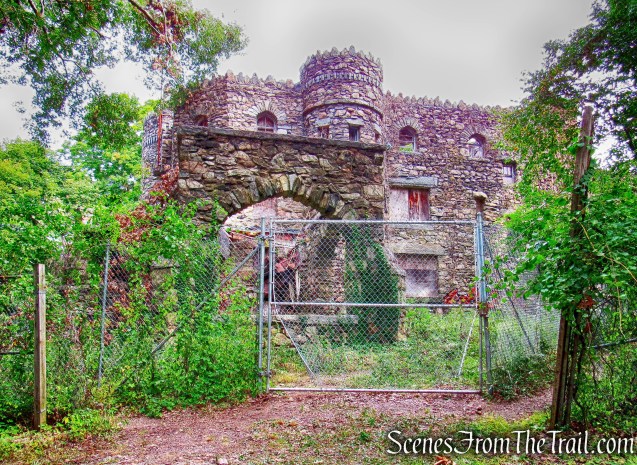
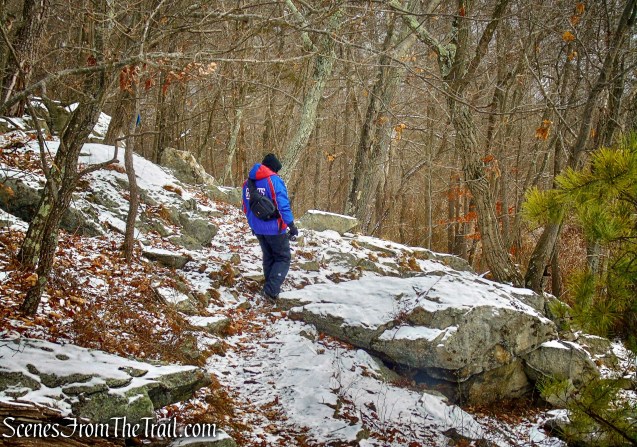
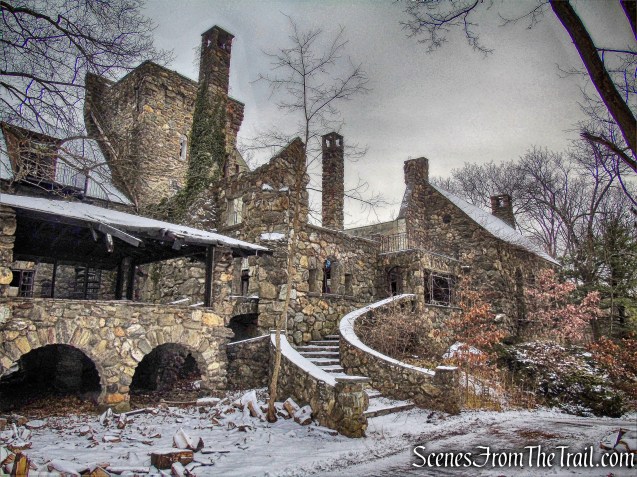
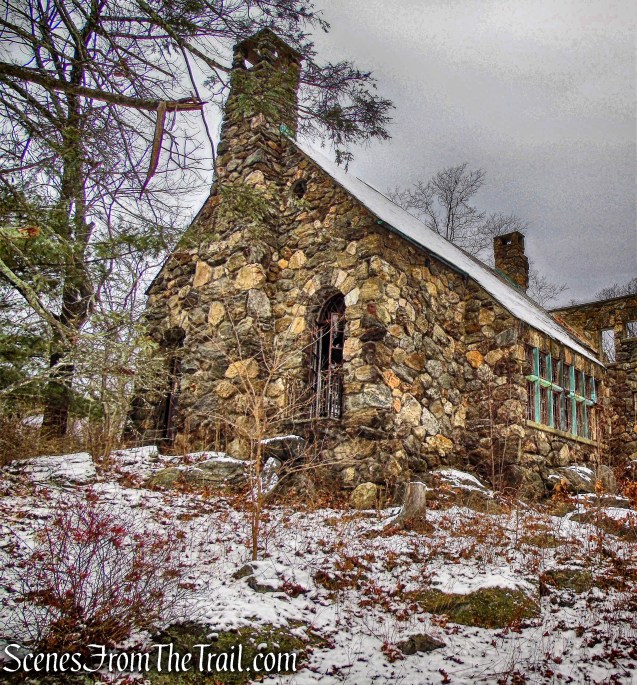
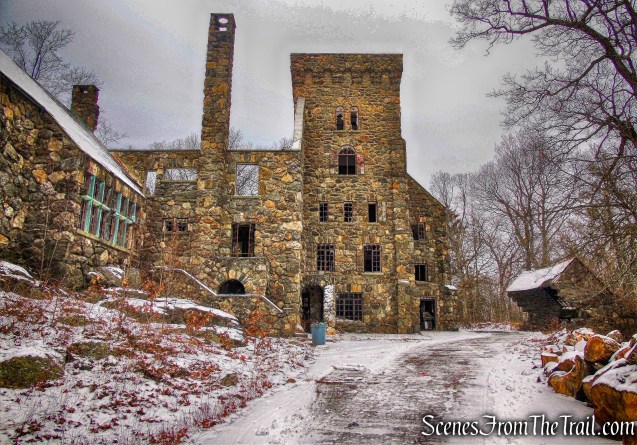
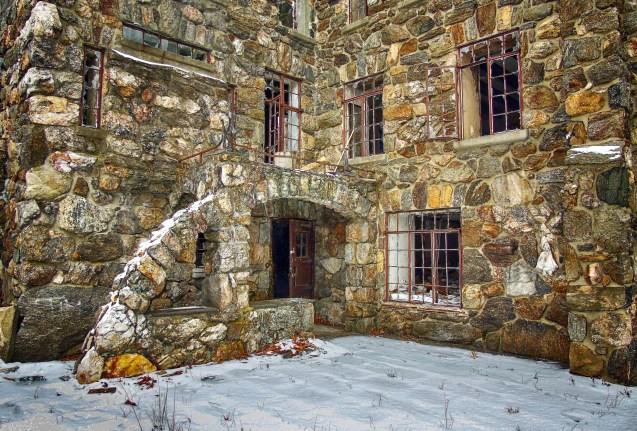
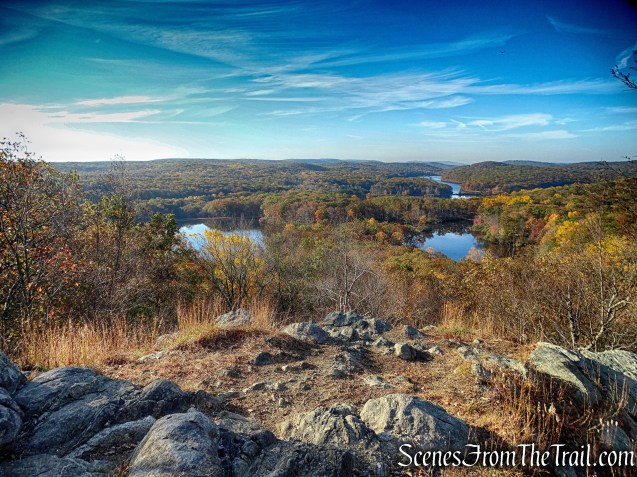
The 575-acre Garret Mountain Reservation includes Lambert Castle, built in 1893 by a wealthy silk manufacturer. The main portion of the park, on the ridge top above the castle, is encircled by a paved drive and has a variety of developed recreational facilities, but it also features two trails that traverse lesser-used areas and offer several panoramic overlooks. The New York City skyline can be seen from several overlooks along the Yellow Trail.
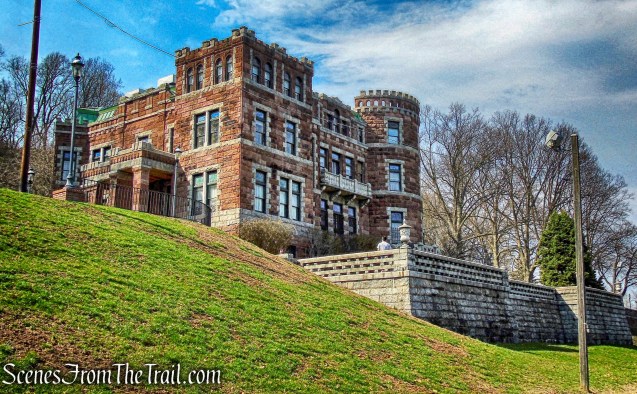
Lambert Castle

Lambert Castle

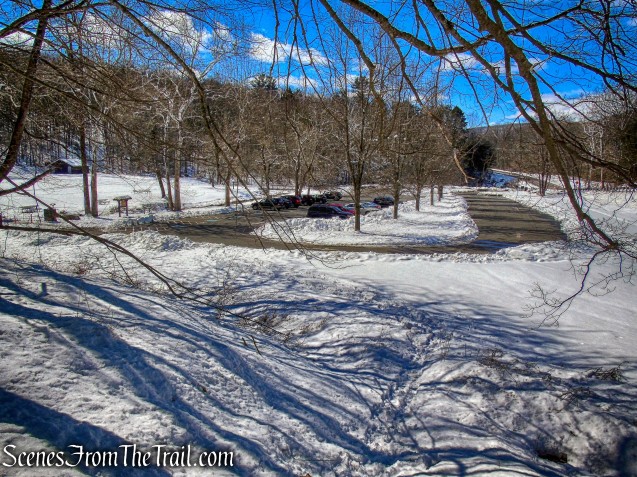
I had planned this hike out regardless of the weather, but when I saw that it was going to be in the high 70’s, I was a little hesitant. Being that this park is Passaic County’s major recreational area, I figured that on the first nice day after a rough winter, it would be crowded. We arrived shortly after 9:00 am and it was already bustling. We parked in the Stoney Brook Picnic Area which had quite a few cars. As it turned out, even though there were quite a few people here, it never felt crowded.

Yellow Trail Loop - Garret Mountain Reservation

Yellow Trail Loop – Garret Mountain Reservation

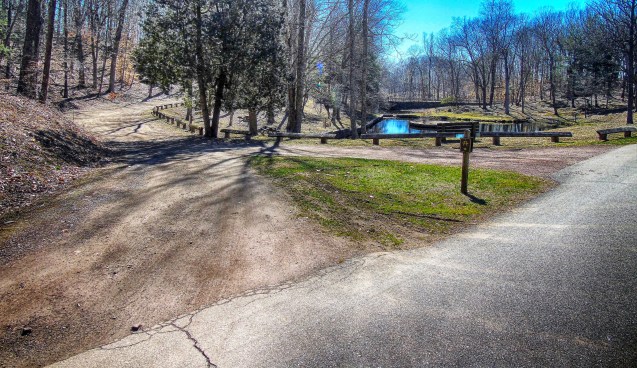
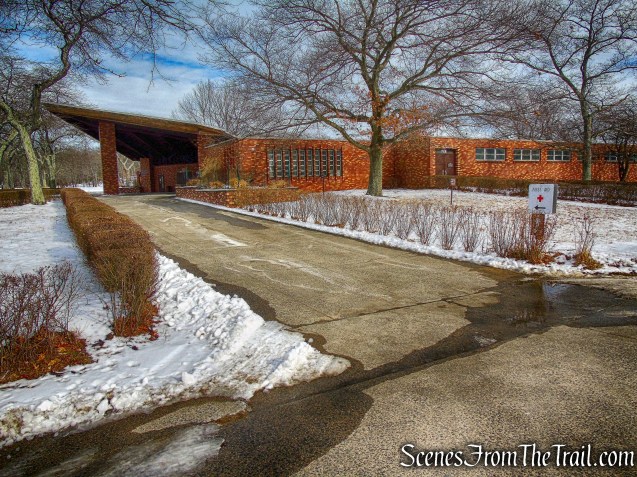
From the parking area, we followed the path downhill to the southern end of Barbour Pond and turned left onto a wide crushed stone path. We passed to the left of two park buildings.
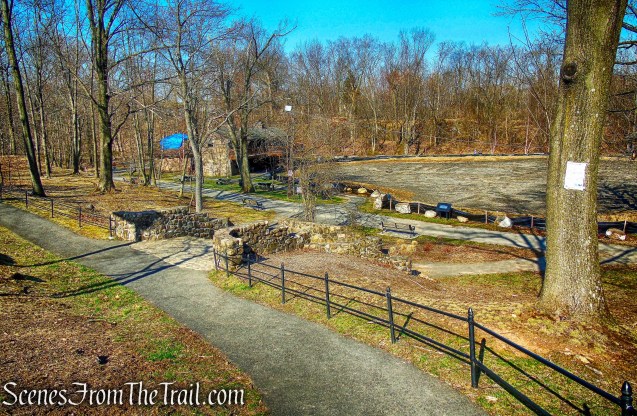
Stoney Brook Picnic Area

Stoney Brook Picnic Area

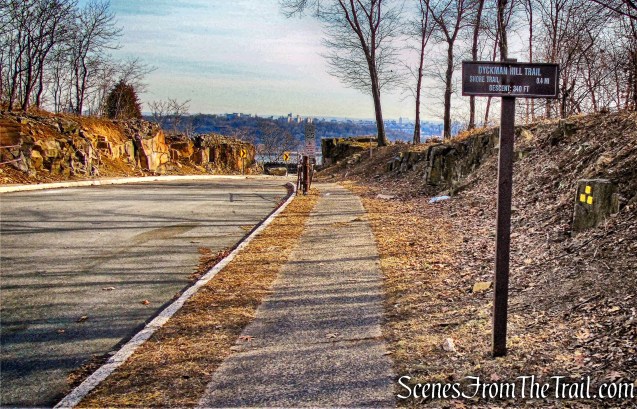
After the entrance to the second building, we reached the Yellow Trail. We turned left on the Yellow Trail, which we would follow for most of the hike.
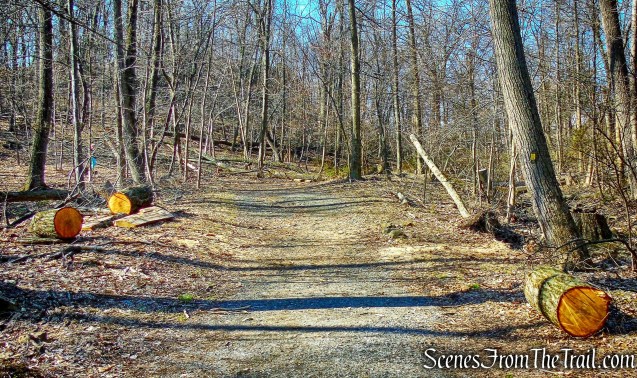
Yellow Trail

Yellow Trail

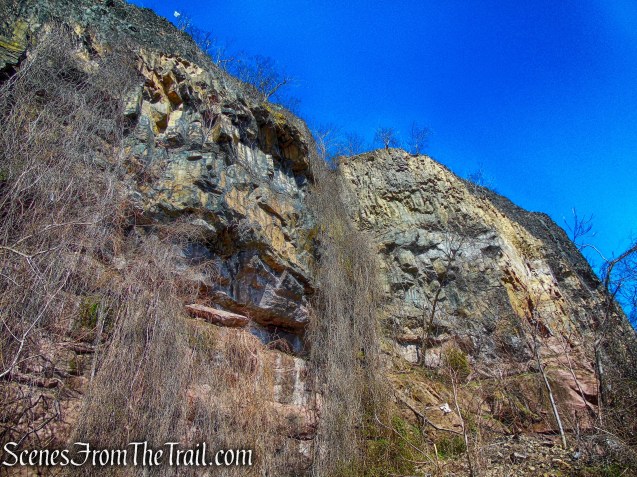
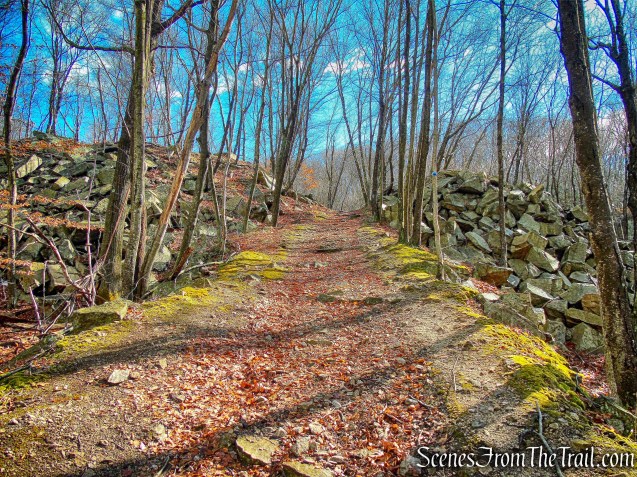
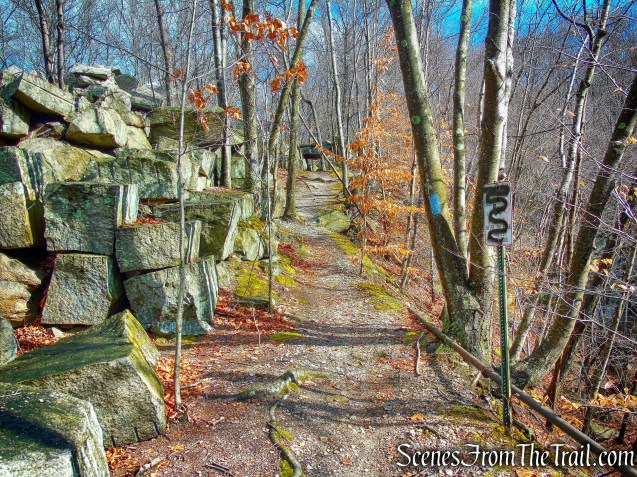
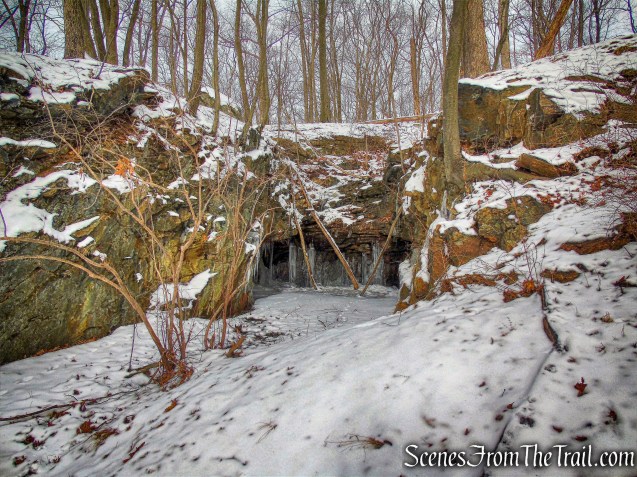
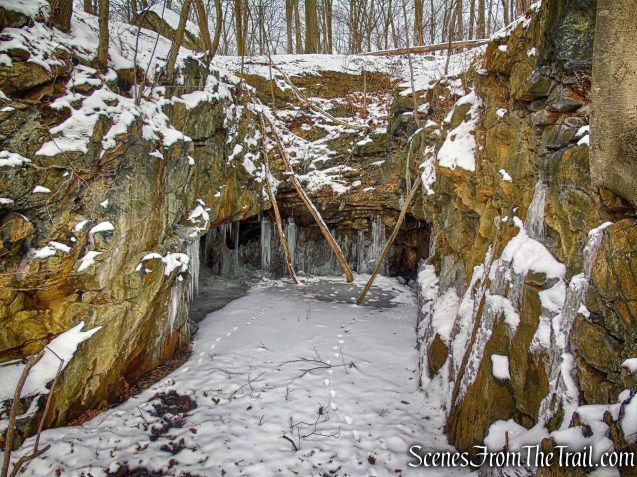
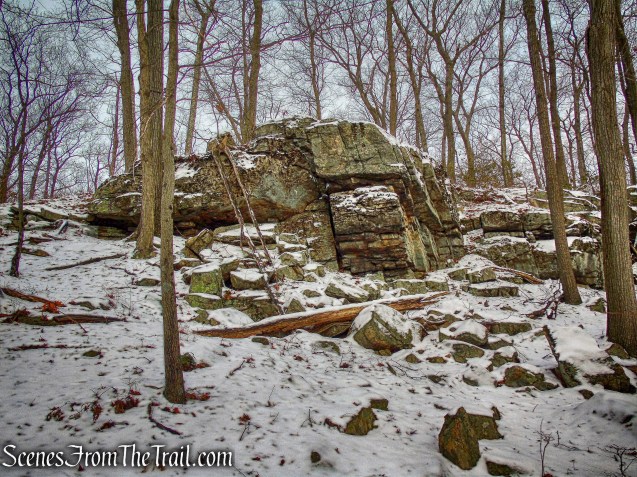
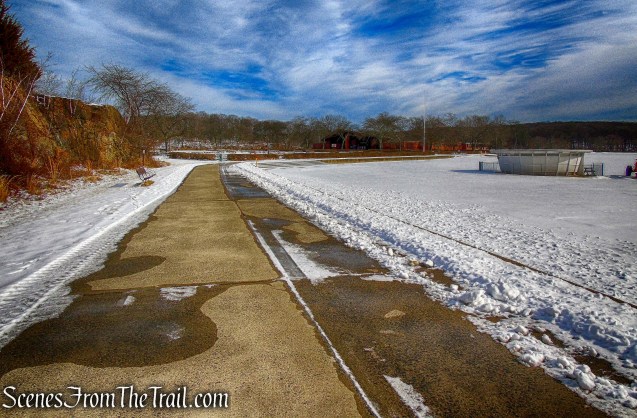
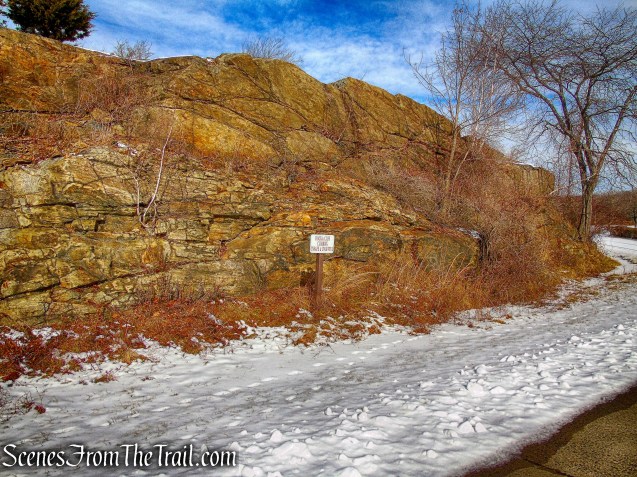
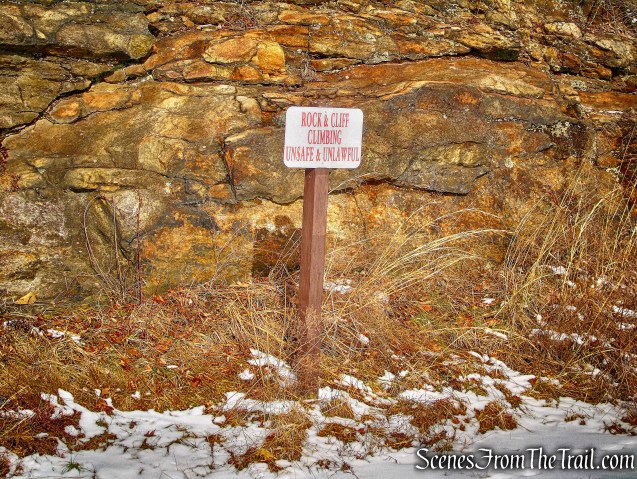
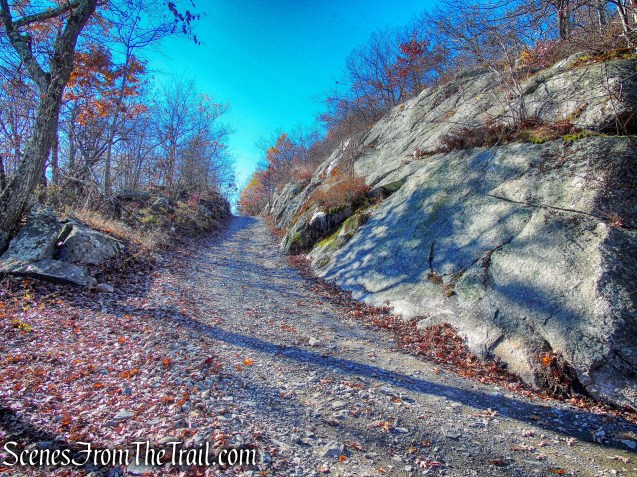
After paralleling a stream on the right, the trail turns left, away from the stream and begins to climb, passing some cliffs that appears to have been quarried.
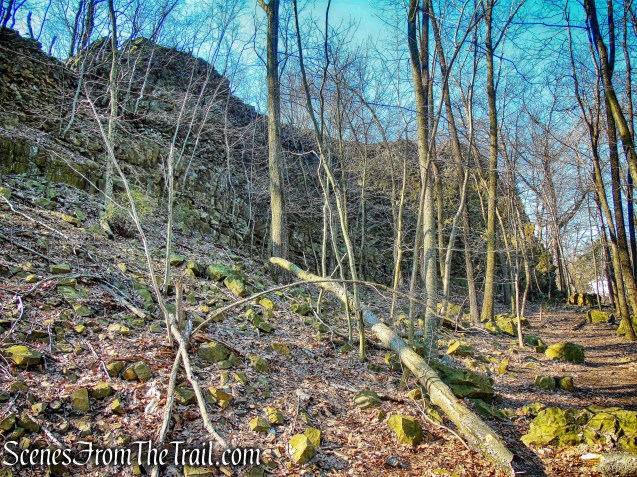
cliffs - Yellow Trail

cliffs – Yellow Trail

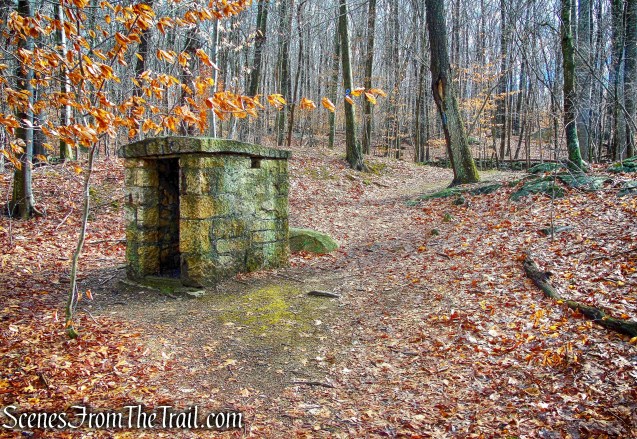
The trail then passes some abandoned concrete picnic tables on the left…….
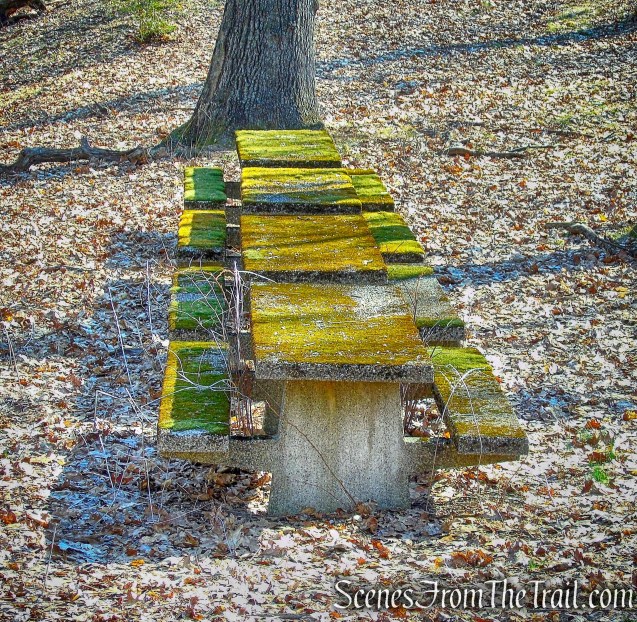
abandoned concrete picnic tables

abandoned concrete picnic tables

and an abandoned playground and shelter on the right.
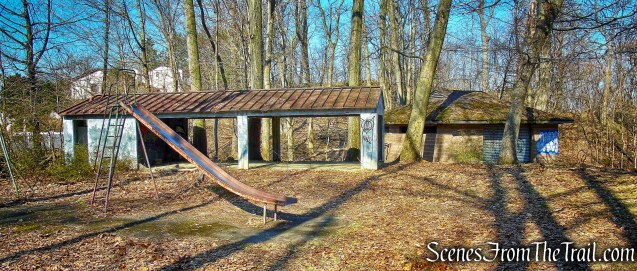
abandoned playground and shelter

abandoned playground and shelter

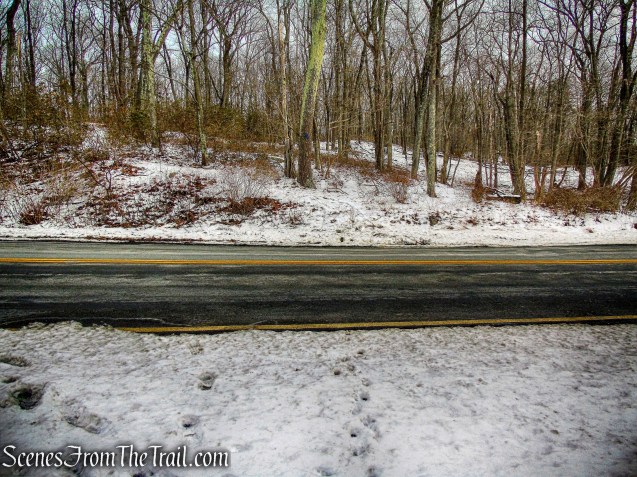
The trail climbs a rise and just before reaching a paved road, turns sharply left and descends to cross Park Road, the road that circles the park.
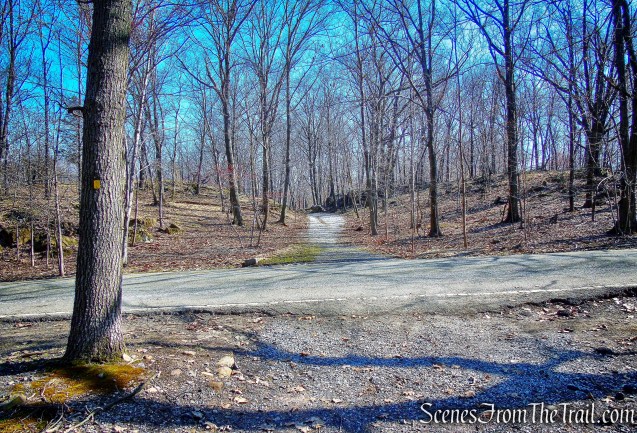
Park Road - Yellow Trail

Park Road – Yellow Trail

In a short distance, the Yellow Trail reaches a junction with the start of the White Trail. We turned right and continued following the yellow blazes, which turn right on a wide gravel path.

Turn right at the junction

Turn right at the junction

In about 250 feet, the gravel path bears left as the Yellow Trail continues straight ahead, climbing an embankment and crossing the paved road again. The Yellow Trail turns right at the entrance to the Garret Mountain Equestrian Center and runs along the road.
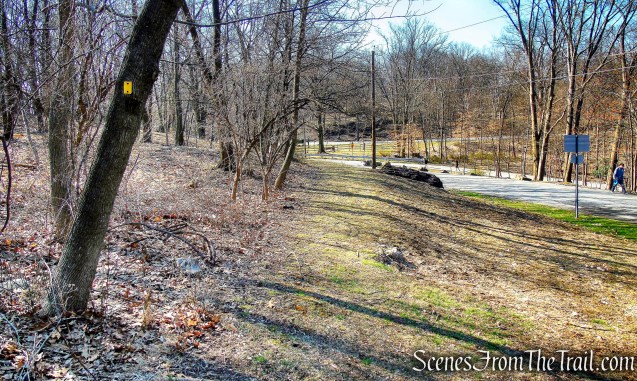
Yellow Trail

Yellow Trail

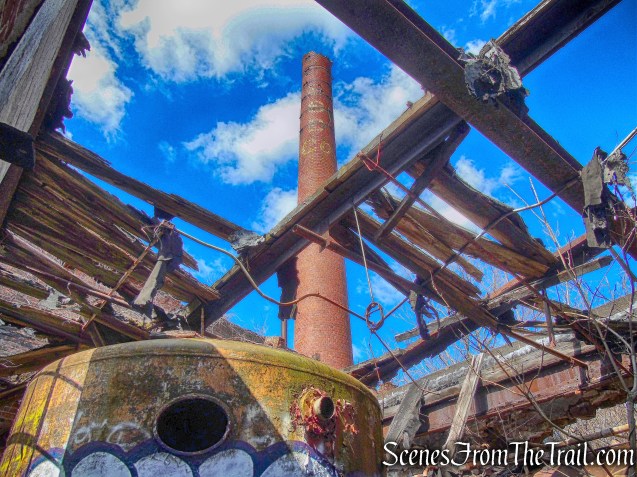
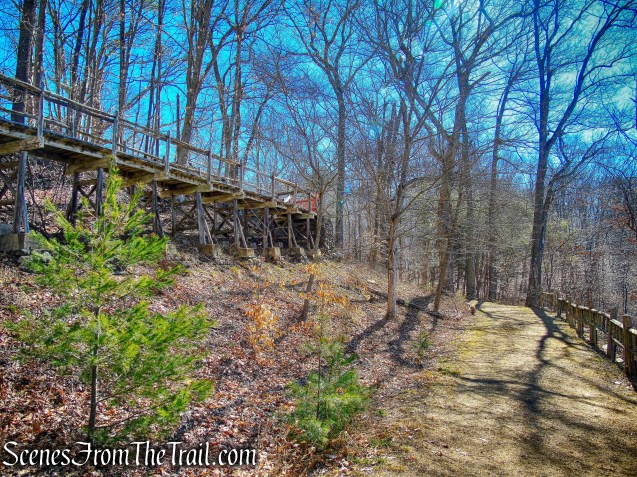
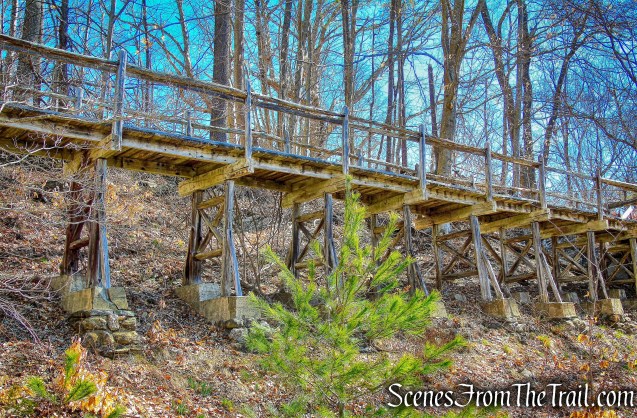
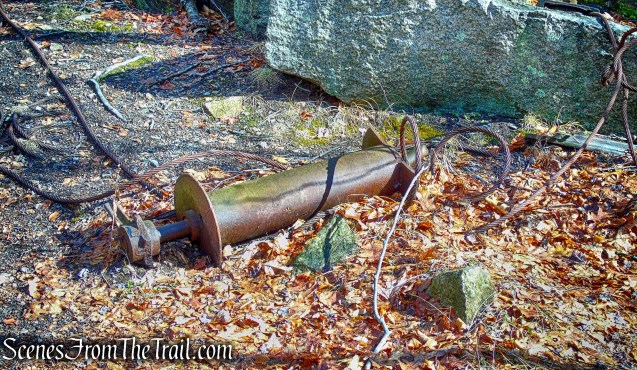
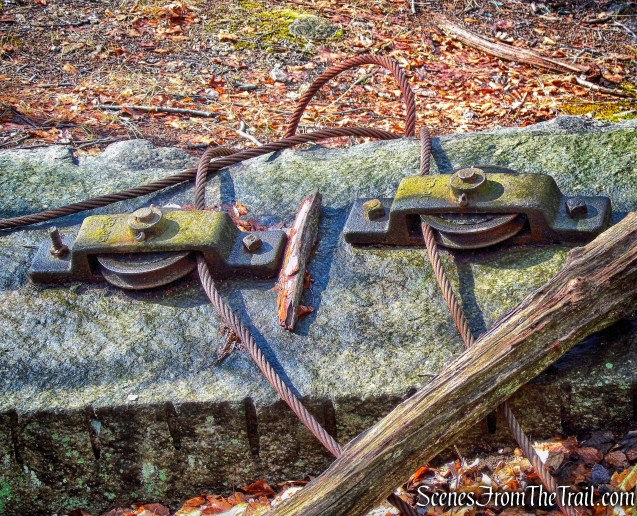
At the next intersection, the trail bears left and continues parallel to the paved Weasel Drift Road. Just before reaching the park boundary, the yellow blazes turn left, leaving the road and ascend into the woods on a footpath. With the access road to the stables visible ahead, the trail bears right and passes between abandoned concrete tank supports.
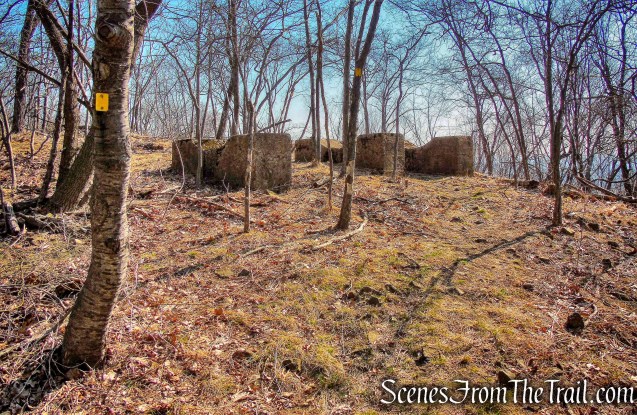
concrete tank supports - Yellow Trail

concrete tank supports – Yellow Trail

The trail then begins to run along the ridge of Garret Mountain, with the stables to the left.
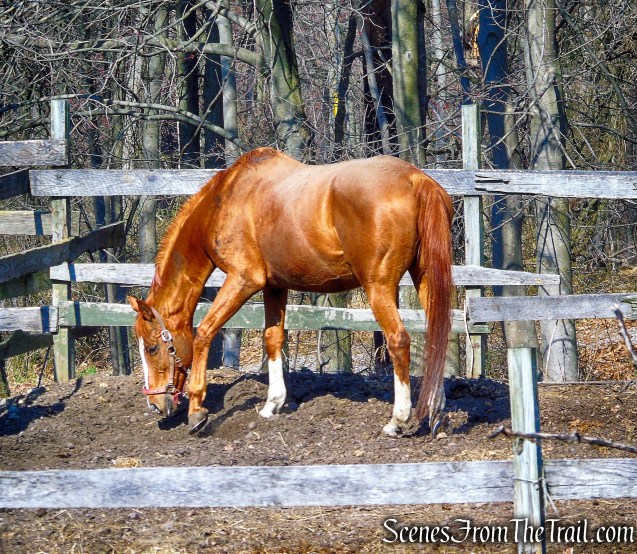
Garret Mountain Equestrian Center

Garret Mountain Equestrian Center

At the end of the stables, the trail bears left then turns right, continuing along the ridge.
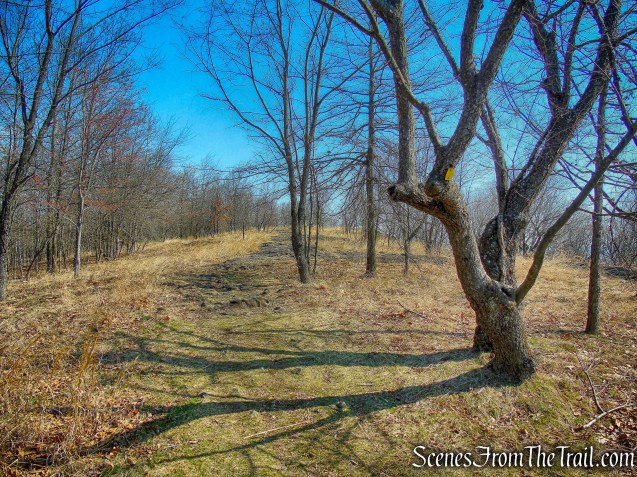
Yellow Trail

Yellow Trail

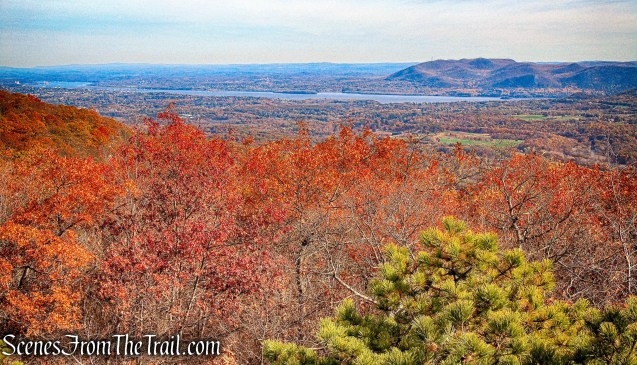
A short distance beyond the stables, the Yellow Trail reaches a viewpoint to the east from the edge of the ridge. Clifton, as well as the southern part of Paterson, may be seen directly below, with much of southern Bergen County beyond and the Manhattan skyline visible in the distance.

view east from the Yellow Trail

view east from the Yellow Trail

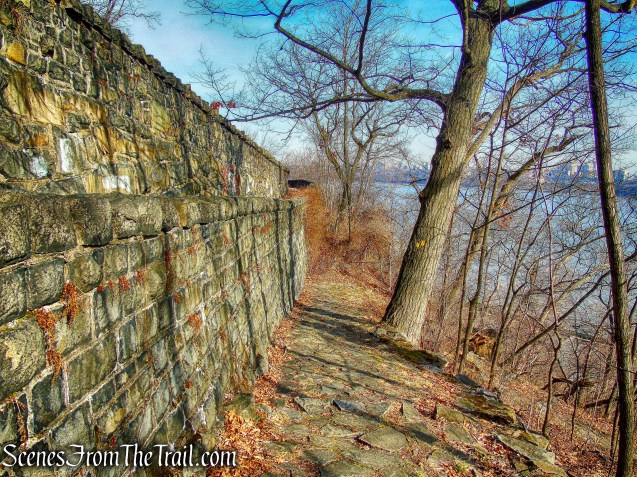
The trail continues north along the ridge, passing several more viewpoints.
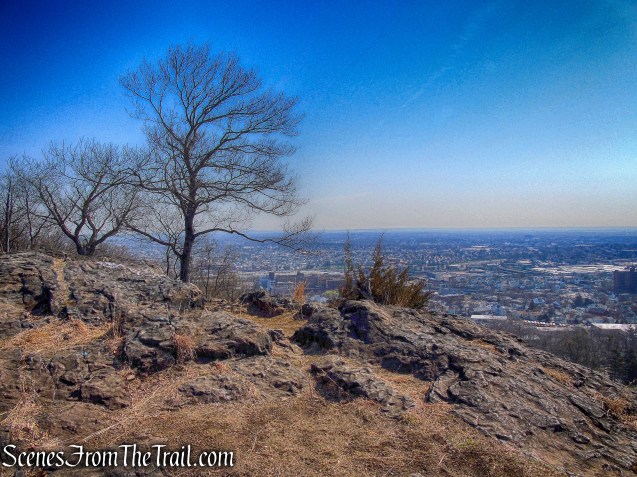
view from the Yellow Trail

view from the Yellow Trail

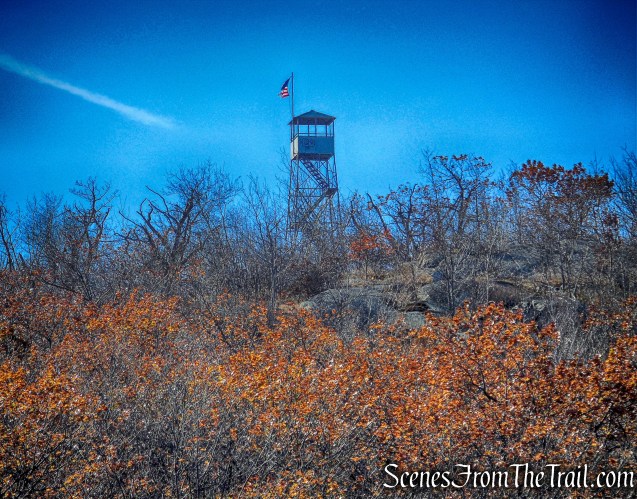
A short distance later Lambert’s Tower comes into view.
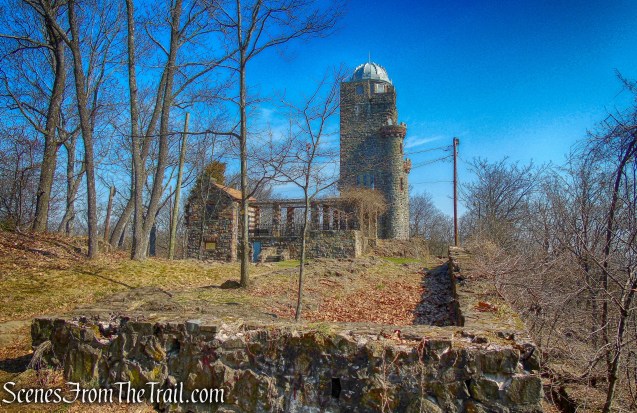
Lambert's Tower

Lambert’s Tower

Lambert’s Tower, a 70 foot stone observation tower, was constructed in 1896 by Catholina Lambert. The tower was built on the crest of the cliffs above Lambert Castle, which is visible through the trees below.
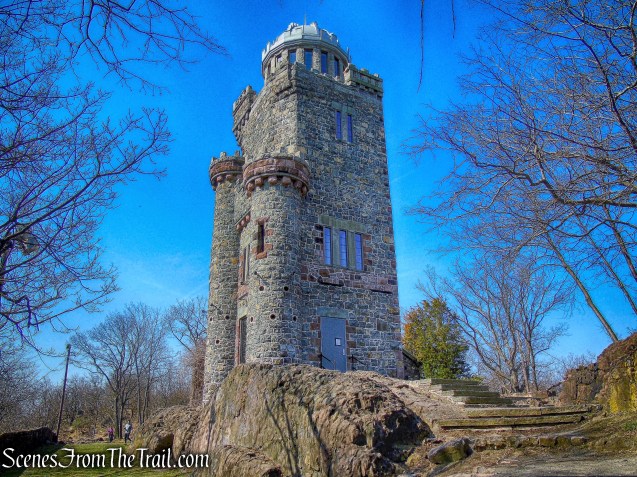
Lambert's Tower

Lambert’s Tower

The grounds around the tower and along the 150-foot sheer cliffs are open to visitors of the Garret Mountain Reservation.
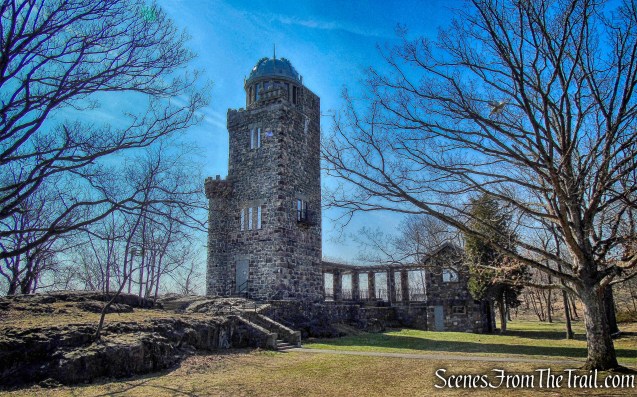
Lambert's Tower

Lambert’s Tower

The tower was not open on the day we visited, but the Passaic County Parks website states: It offers stunning views of the area from Bear Mountain NY, to Northern New Jersey, the George Washington Bridge and the New York City skyline all the way to the Verrazano Narrows Bridge and beyond to Sandy Hook, NJ.
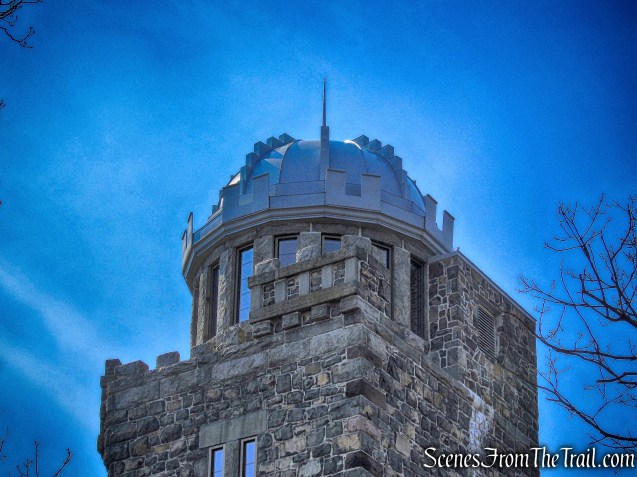
Lambert's Tower

Lambert’s Tower

The trail passes to the right of the tower along a stone wall. Just past the tower, the Morris Canal Greenway Trail (marked with canal-boat-logo-on-yellow blazes) joins. We continued to follow both the yellow and the Greenway logo blazes. The crushed stone path at a break in the stone wall leads downhill to Lambert Castle. There were quite a few cars in the in the parking lot of the castle so we decided not to walk down to it.
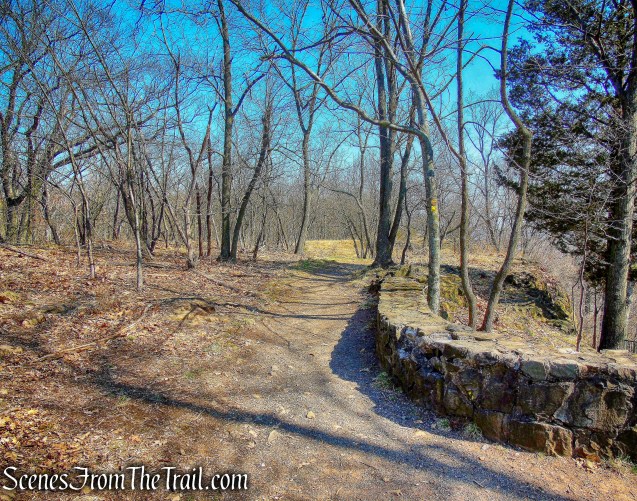
Yellow Trail

Yellow Trail

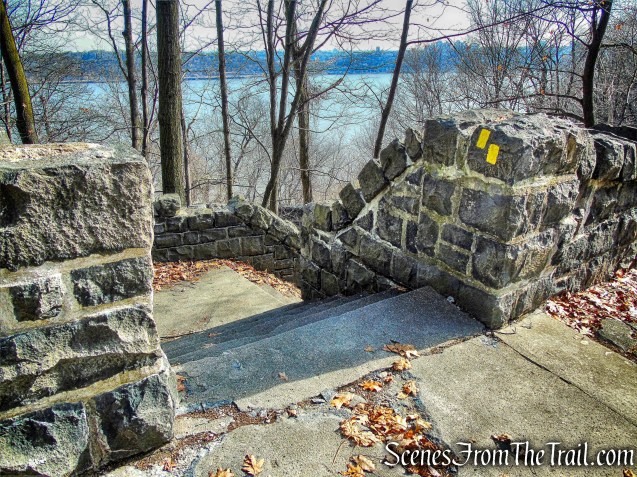
After curving to the right, the trail descends on a rocky path and stone steps, and it briefly parallels the paved park road.
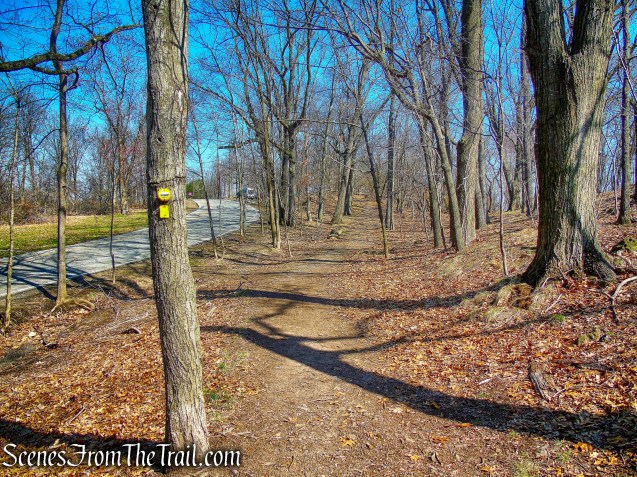
Yellow Trail

Yellow Trail

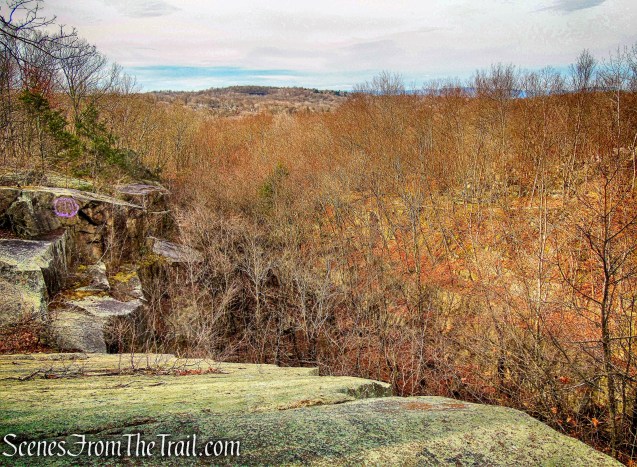
About 0.2 mile from the tower, a side trail to the right leads to another expansive viewpoint to the east from the edge of a cliff.
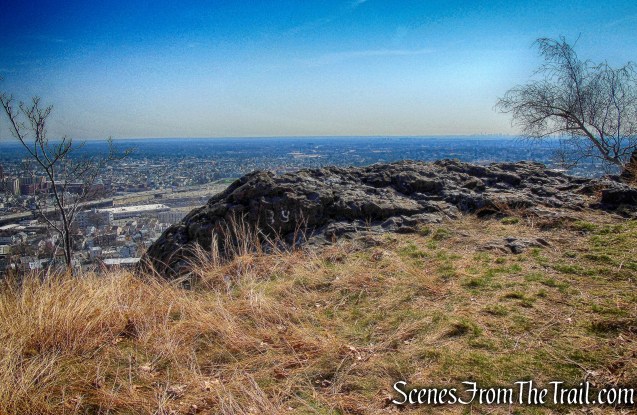
viewpoint - side trail

viewpoint – side trail

A police firing range is located directly below and we could hear gunshots.
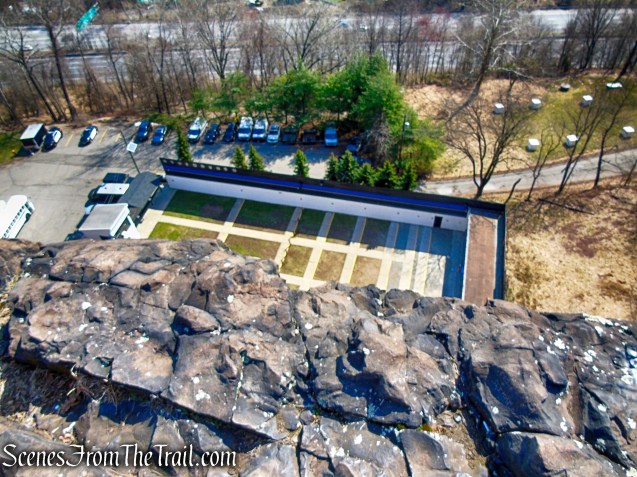
police firing range

police firing range

The trail soon passes a small gravel parking area on the left, follows a footpath into the woods, then emerges onto a grassy field and follows along its right side.
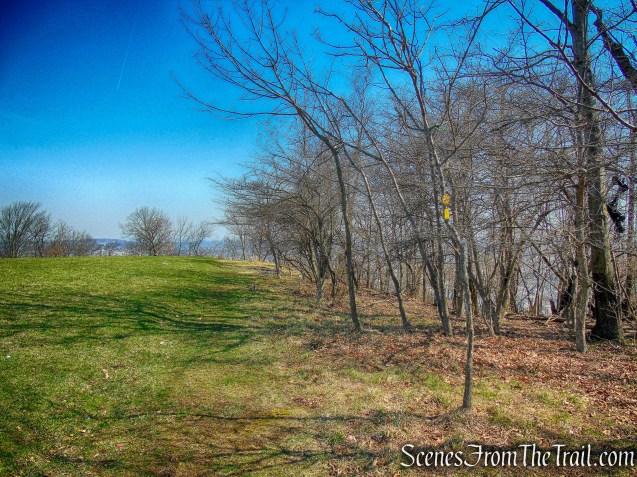
grassy field - Yellow Trail

grassy field – Yellow Trail

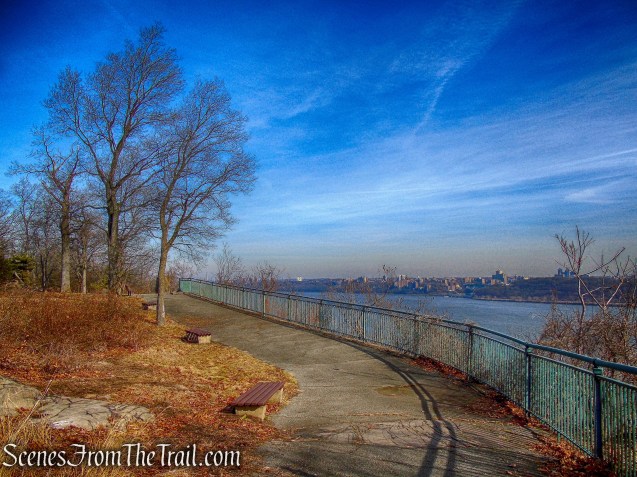
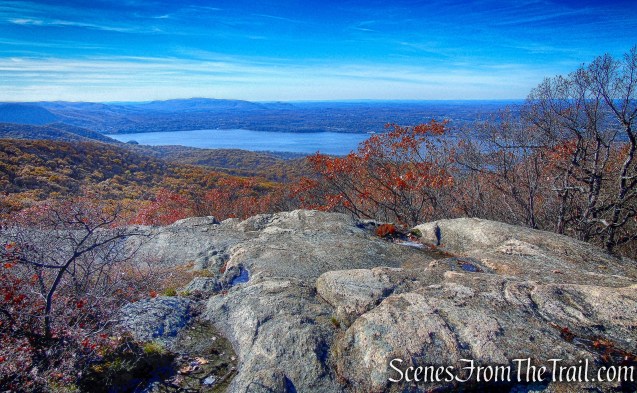
At the end of the field, the Yellow Trail, together with the Greenway Trail, descend on a footpath to the entrance of an overlook. Here, the White Trail and the Greenway Trail leave to the right. The overlook affords a panoramic view over downtown Paterson (directly below) and High Mountain to the north.
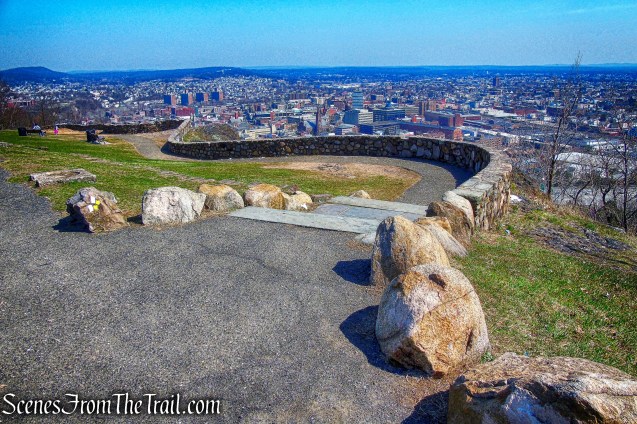
overlook

overlook

After taking in the view, we continued on the Yellow Trail, which follows Park Road, passing the Benson Memorial which honors the first president of the Passaic County Park Commission.
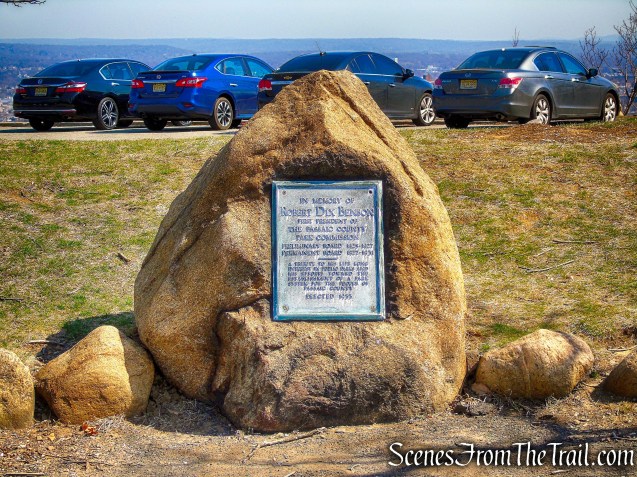
Benson Memorial

Benson Memorial

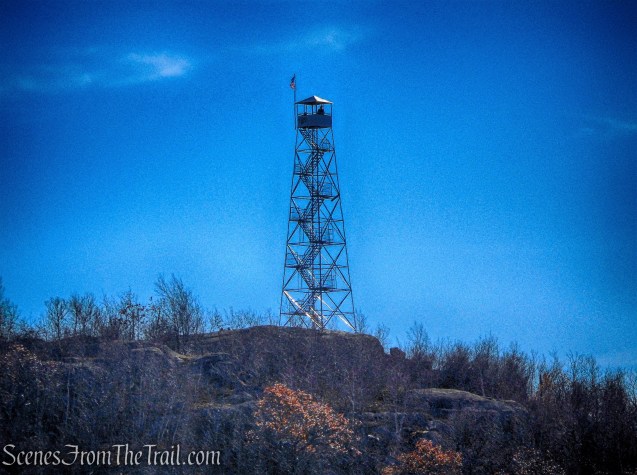
At the next junction, we followed the Yellow Trail as it bears right and climbs along a paved road that leads to Veterans Memorial Point, the site of a communications tower.
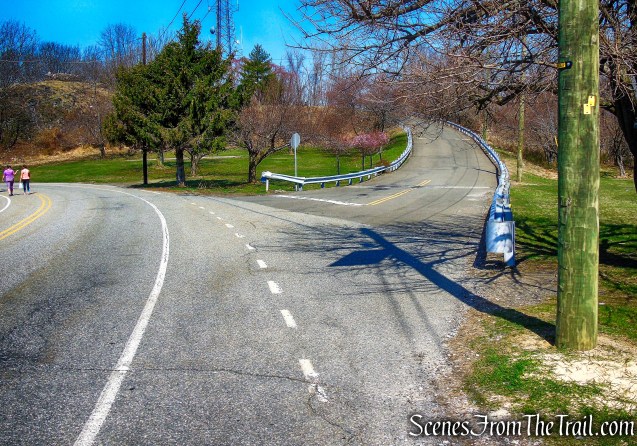
Yellow Trail

Yellow Trail

Just to the left of the trail is a round stone platform called the “Crow’s Nest.”
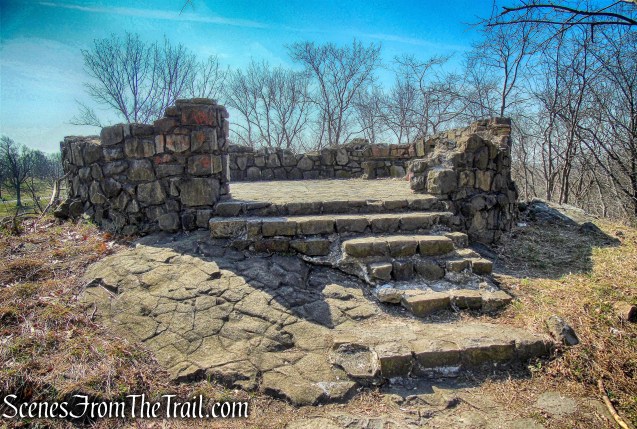
Crow's Nest

Crow’s Nest

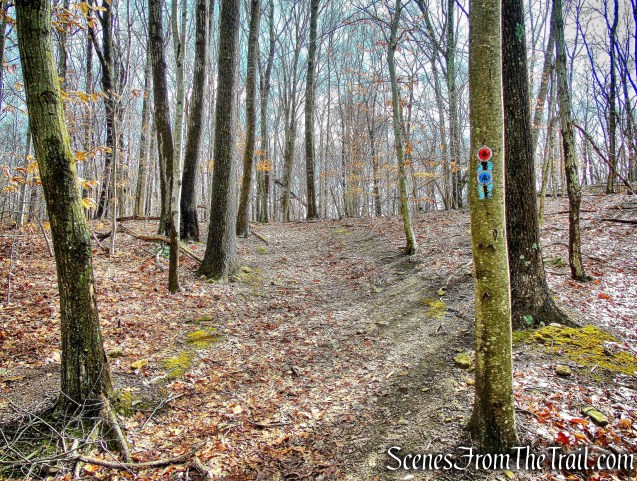
Just beyond a guardrail barrier at the end of the paved road, the trail bears left and descends into the woods. A quarter of a mile beyond, after crossing the White Trail, the Yellow Trail climbs over a small rise.
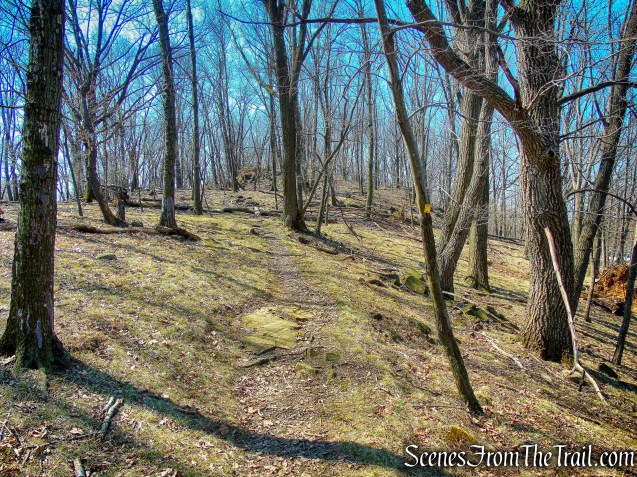
Yellow Trail

Yellow Trail

The trail then descends, first gradually, then more steeply on switchbacks. At the base of the descent, the trail turns right onto a path, then bears left and crosses the park entrance road. Here is where we lost the trail. The Yellow Trail bears right and travels alongside Mountain Avenue. We stayed to the left and began following a gravel road. At this point it didn’t make any difference. Instead of walking along the west side of Barbour Pond, we walked along the east side.
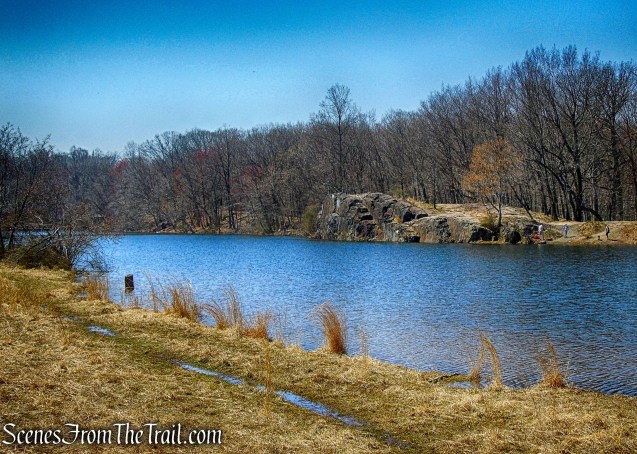
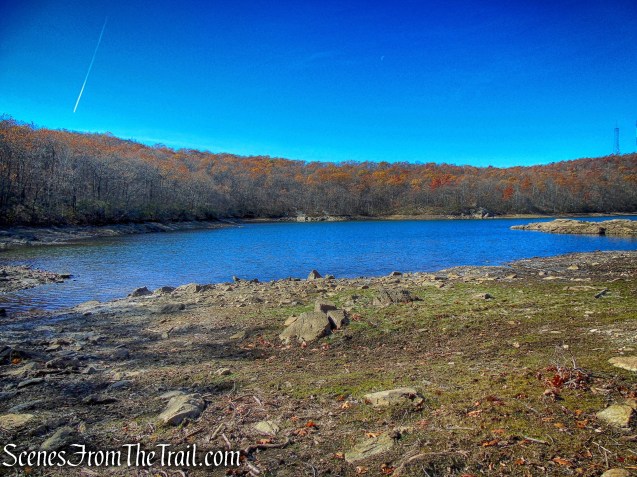
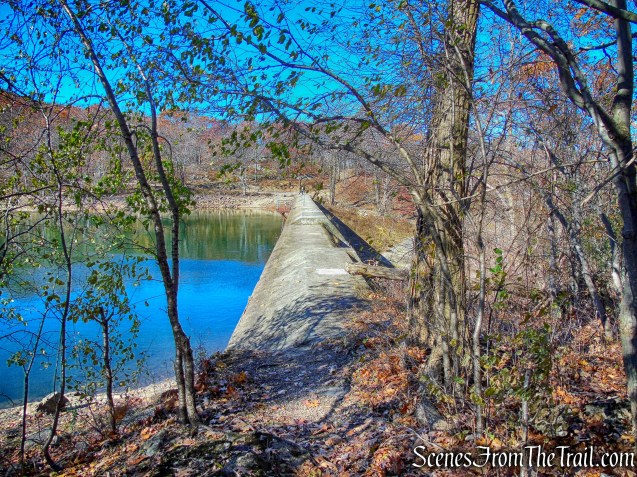
Barbour Pond

Barbour Pond

We walked along the pond, stopping occasionally to watch people fish. The pond is supposed to be stocked with fish and we saw a woman that caught a Large Mouth Bass. We then turned left and walked up the stone steps, back to the parking area, where our hike began.
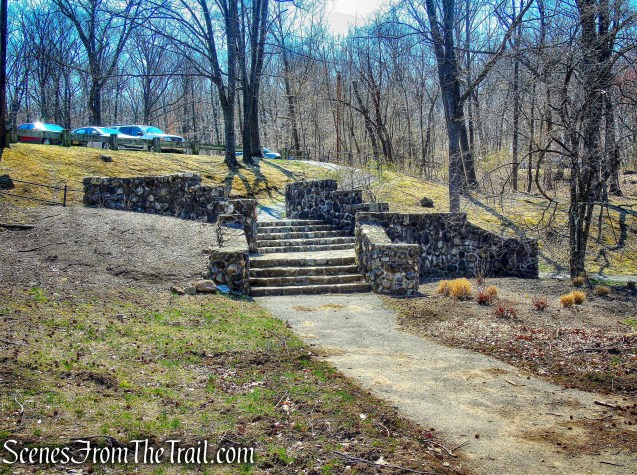
Garret Mountain Reservation

Garret Mountain Reservation

Since we had parked at the Stoney Brook Picnic Area, we were hoping that when we were done with the hike that there would be a table available not too far from the vehicle. Luckily, that was the case and we were able to relax, grill some steaks and enjoy the 76° sunny weather. When we were ready to go, we took a cruise by Lambert Castle.
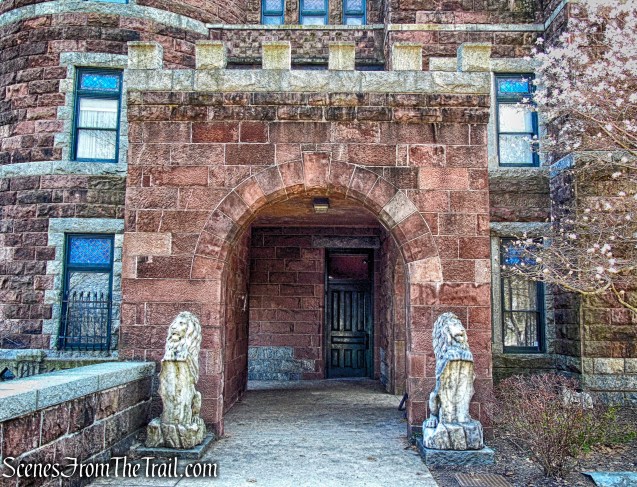
Lambert Castle

Lambert Castle

“The Castle,” a well-known landmark in Northern New Jersey, is located on Garret Mountain overlooking the City of Paterson. Once a private residence, the building is fashioned after an English castle. Catholina Lambert, an English immigrant who made his fortune in the silk industry, built the Castle in 1892-93. He named it “Belle Vista.” Many prominent individuals of that era, including President McKinley, visited the Lambert family in their luxurious residence.

Lambert Castle

Lambert Castle

Lambert’s son, Walter, sold the Castle to the City of Paterson in 1925. The city used the building as a Tuberculosis Hospital for several years. In 1928, the title was transferred to the Passaic County Park Commission as part of Garret Mountain Reservation.
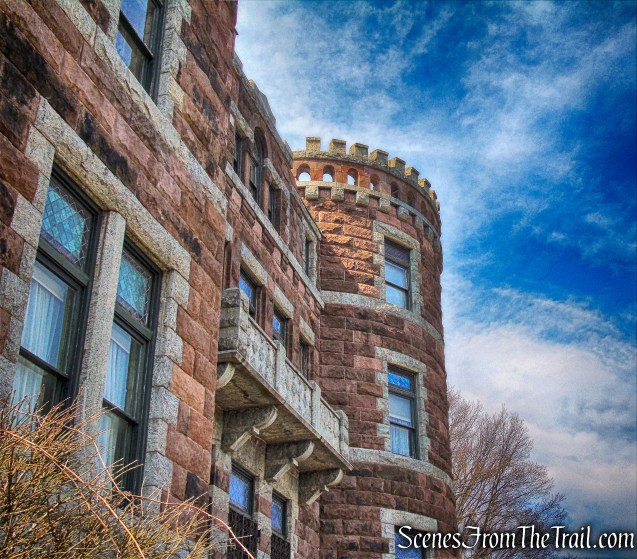
Lambert Castle

Lambert Castle

The New Jersey and National Registers of Historical Places awarded the Castle Landmark Designation in 1976.
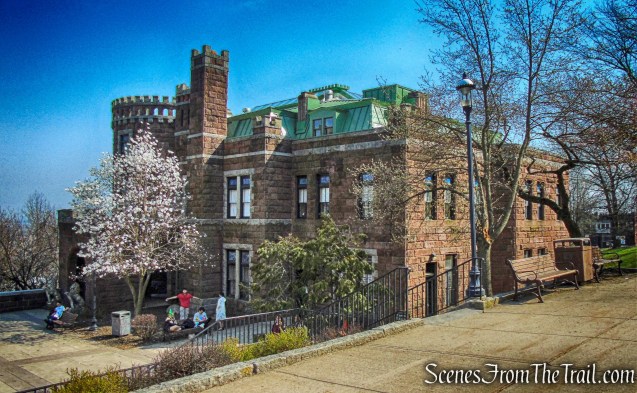
Lambert Castle

Lambert Castle

A nice hike in a very scenic area. Although the place was bustling, it didn’t feel overly crowded. It got a little busy at the points of interest that were near parking areas, but hardly a hiker on the trails. Since this is considered an important bird area, the song birds were serenading us throughout the hike. I doubt that I would return there, but I am glad that I did visit.

Pros: Castle, stone observation tower, scenic views, lots of birds, pond.

Cons: Tower was not open, crowds.

Garret Mountain Reservation

Garret Mountain Reservation

Sources:

Paterson Great Falls National Historical Park – Urban Loop

April 8, 2018 – Paterson, New Jersey

Difficulty: Easy

Length: Approximately 4.5 miles

Max elevation: 184 ft.– total elevation gain approximately 257 ft.

Route type: Circuit

Map: NPS Pictorial Map

Trailhead parking: 28 McBride Ave, Paterson, NJ 07501

Disclaimer: Exploring abandoned and/or ruined structures can be dangerous and you could be trespassing. Should you choose to enter the property of any of the places featured on this site, do so legally.

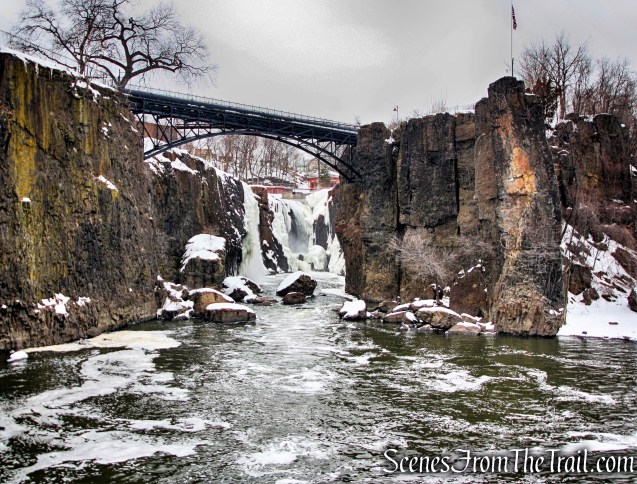
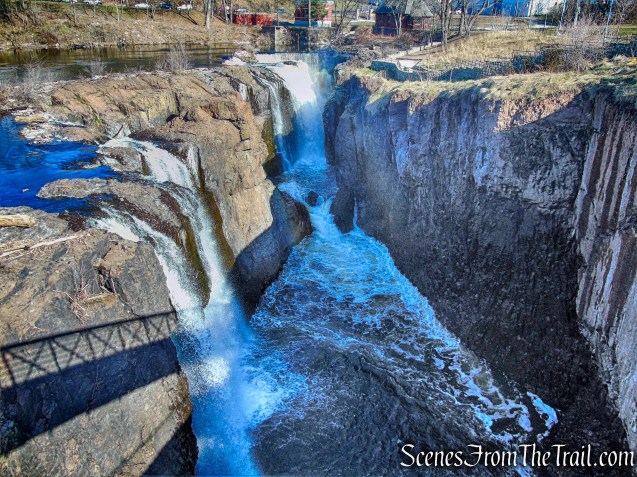
The Great Falls of the Passaic River is a 77 ft. high waterfall on the Passaic River in the city of Paterson, New Jersey. The falls and surrounding area are protected as part of the Paterson Great Falls National Historical Park, administered by the National Park Service. The Congress authorized its establishment in 2009.

Great Falls

Great Falls

Paterson Great Falls National Historical Park is site to one of the nation’s largest waterfalls. The Great Falls of the Passaic River and the surrounding historic buildings and raceways are the foundation for stories of Alexander Hamilton, the Industrial Revolution, the labor movement and the important contributions of immigrants to the making of America. Hamilton envisioned Paterson, with its water power provided by the Great Falls, as America’s counterpart and response to the industrial revolution occurring in England during the same period.

Paterson Great Falls National Historical Park

Paterson Great Falls National Historical Park

The various projects encompassed by the overall Great Falls Park plans, includes the redesign of Overlook Park, rehabilitation of Hinchcliffe Stadium and reuse of the ATP Quarry Lawn. The Quarry Lawn was known as Mount Morris in the 19th Century. The hill was quarried, leaving a 50-foot tall basalt wall that naturally enclosed a flat open space along the river, where textile dying mills sprouted on the small plateau in the early 20th Century. The site, now known as the Allied Textile Printing site (ATP) eventually became covered with mill buildings. The site now holds the ruins of many of those mill buildings, including the Colt Gun Mill.

Colt Gun Mill

Colt Gun Mill

With all the work being done to rehabilitate the decaying area around the falls, I wanted to pay it a visit and explore the ruins before they are demolished further and/or restored. The area around the falls is of great historic significance which makes it that much more interesting to explore. There is a lot to see and photograph on this “urban hike” so I will describe the route and include some images, but will also do separate posts to further illustrate the history and include more images. We arrived at the parking area at approximately 9:00 am on a chilly Sunday morning and eagerly began our hike.

Paterson Great Falls National Historical Park - Urban Loop

Paterson Great Falls National Historical Park – Urban Loop

Check out the Google Earth Fly-Through video of the hike below.


Overlook Park, probably the best spot to view the falls,  is currently fenced off during construction. The falls can be viewed from the sidewalk, but not as desirable as from the park. I knew that going in, but I had visited this spot in the past and was more interested in the surrounding area. Below is an image that I captured in March of 2015 from Overlook Park.

Great Falls of the Passaic River - March 7, 2015

Great Falls of the Passaic River – March 7, 2015

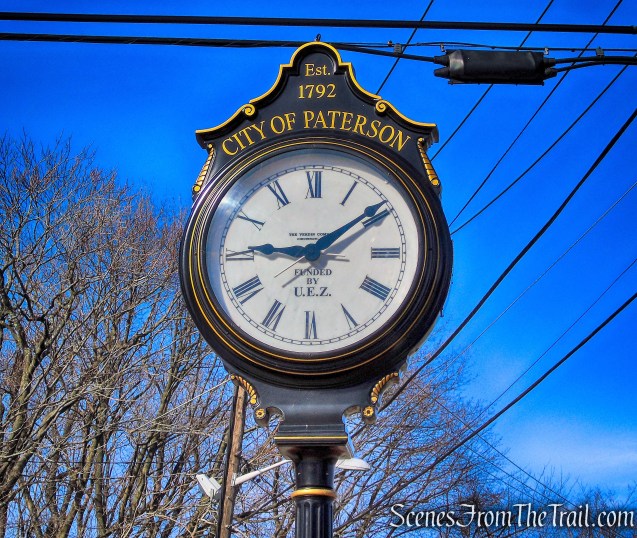
We walked southwest along the sidewalk on McBride Avenue past the clock.

clock - McBride Avenue

clock – McBride Avenue

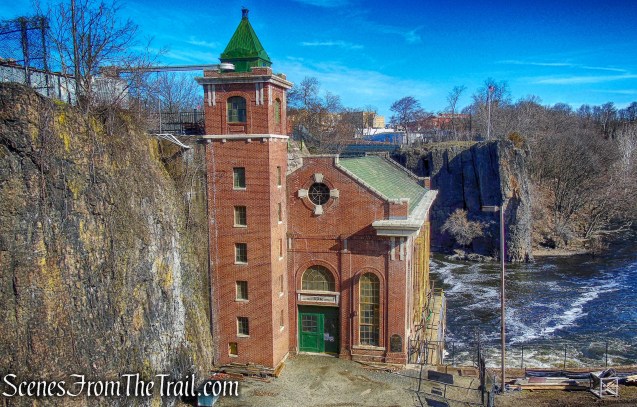
Located near the base of the falls is the Great Falls Hydroelectric Station. When electricity replaced waterwheels, Paterson built a hydroelectric plant opposite the Great Falls.

Great Falls Hydroelectric Station

Great Falls Hydroelectric Station

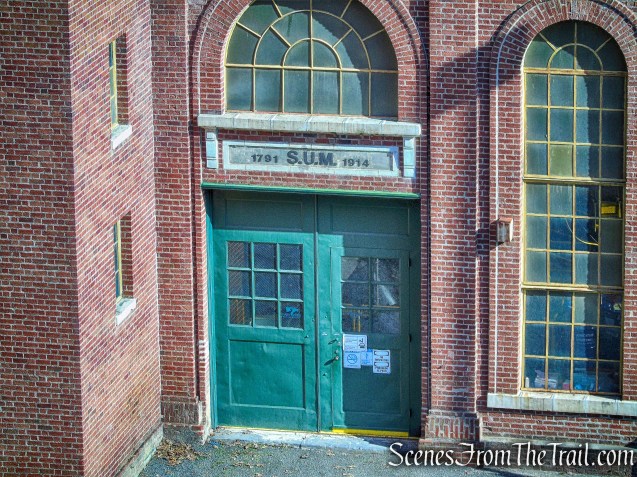
Above the door of the power plant are the initials “S.U.M.” and the dates 1791 and 1914. S.U.M. stands for the Society for Establishing Useful Manufactures. The S.U.M. built the plant in 1914, but the S.U.M. was established in 1791 during George Washington’s presidency to develop the power potential of the Great Falls.

Great Falls Hydroelectric Station

Great Falls Hydroelectric Station

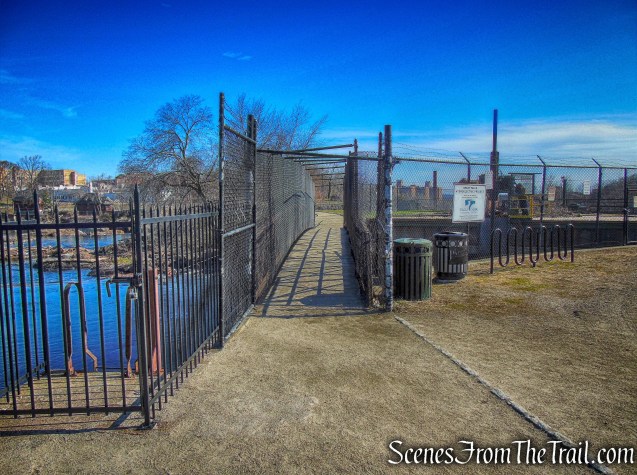
After passing the Hydroelectric Station, we turned right into a small parking area for the plant. We then proceeded across a catwalk that spans a section of the Passaic River.

catwalk

catwalk

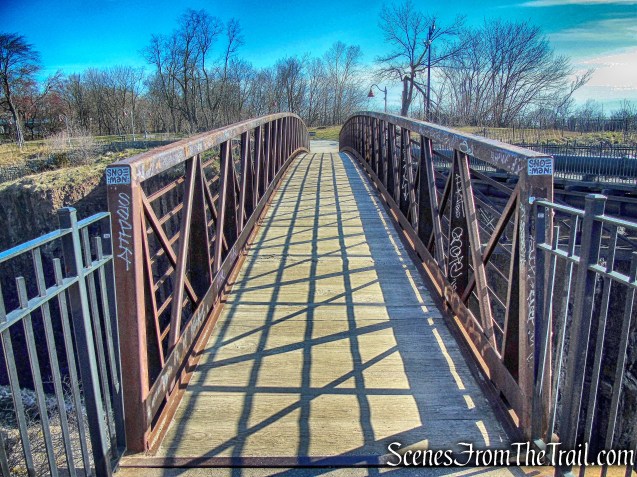
The catwalk leads to a paved walkway that in turn leads to the Great Falls Bridge.

Great Falls Bridge

Great Falls Bridge

The Great Falls Bridge spans the gorge, providing a great view and allows one to witness the power of the Great Falls.

view from Great Falls Bridge

view from Great Falls Bridge

On the other side of the bridge is Mary Ellen Kramer Park. This park is named after Mary Ellen Kramer, preservation activist and wife of former Paterson mayor Pat Kramer. In the 1970’s she launched the campaign to protect and restore the city’s historic district.

Mary Ellen Kramer Park

Mary Ellen Kramer Park

In 2015, the city completed a $2 million renovation on the Mary Ellen Kramer Park section of the Paterson Great Falls National Historical Park, that provides close-up views of the second largest waterfall east of the Mississippi River.

view of falls from Mary Ellen Kramer Park

view of falls from Mary Ellen Kramer Park

On July 10, 1778, a young Alexander Hamilton picnicked on cold ham, tongue and biscuits here with General George Washington and the French General the Marquis de Lafayette. It was then that Hamilton became acquainted with the setting of his future industrial city, one that would be powered by water and churn out everything from textiles and paper to locomotives and guns.

view of falls from Mary Ellen Kramer Park

view of falls from Mary Ellen Kramer Park

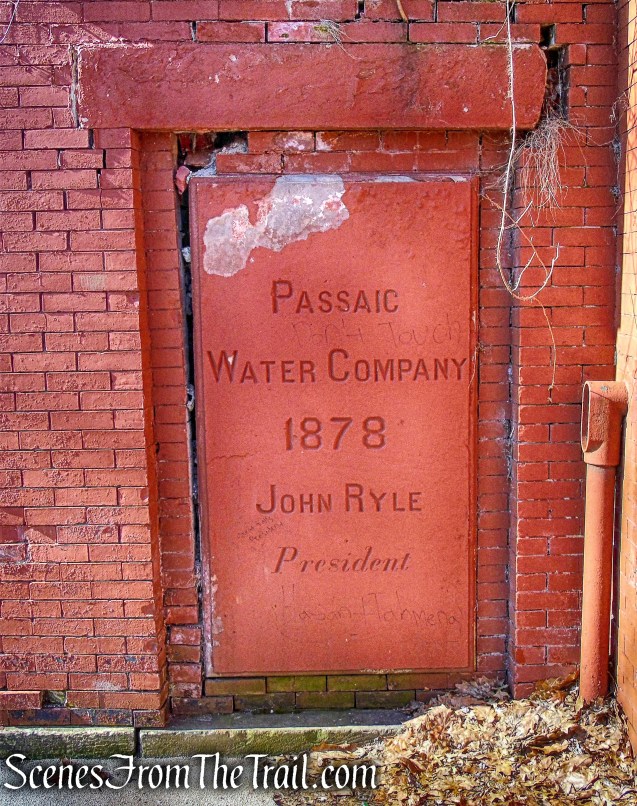
Although the land was used as a public park and for leisure visits to the waterfall since the 1770’s, it was closed during World War II for strategic reasons and remained closed until the 1970’s. Several brick structures in the park date back to the Passaic Water Company which was incorporated in 1849.

Mary Ellen Kramer Park

Mary Ellen Kramer Park

Mary Ellen Kramer Park

Mary Ellen Kramer Park

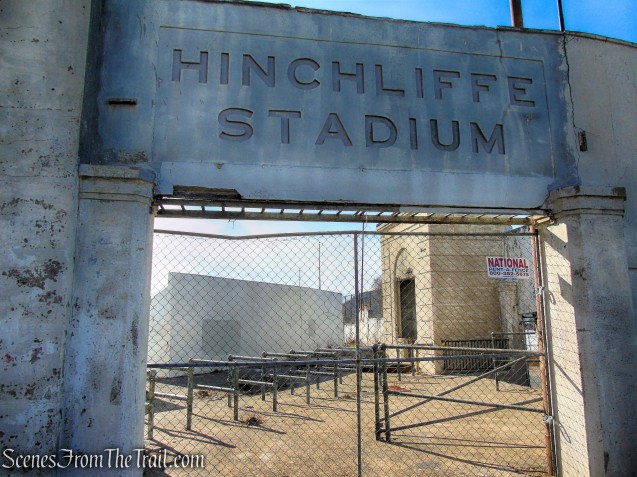
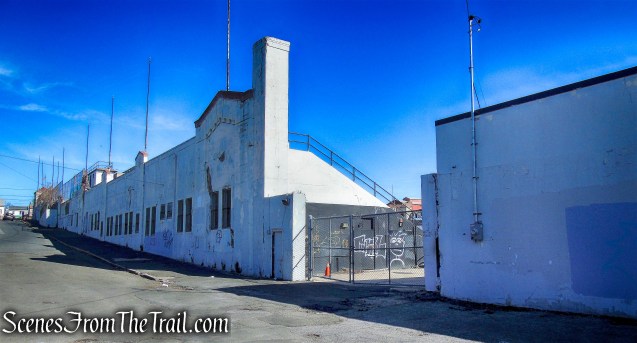
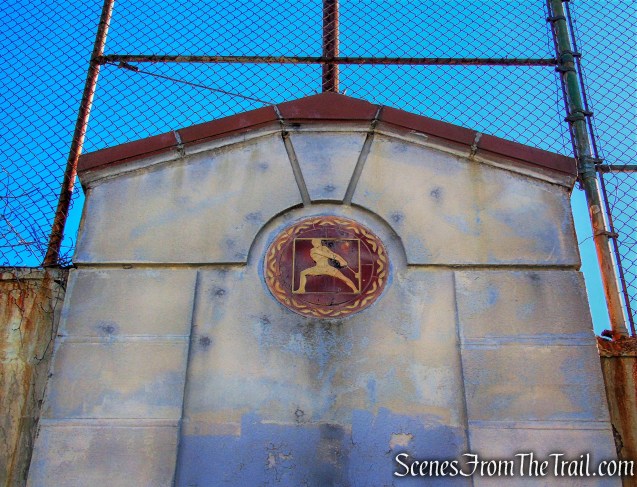
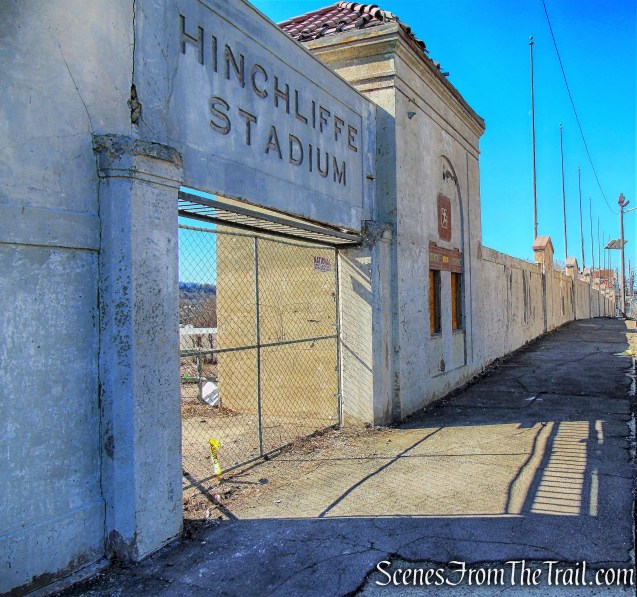
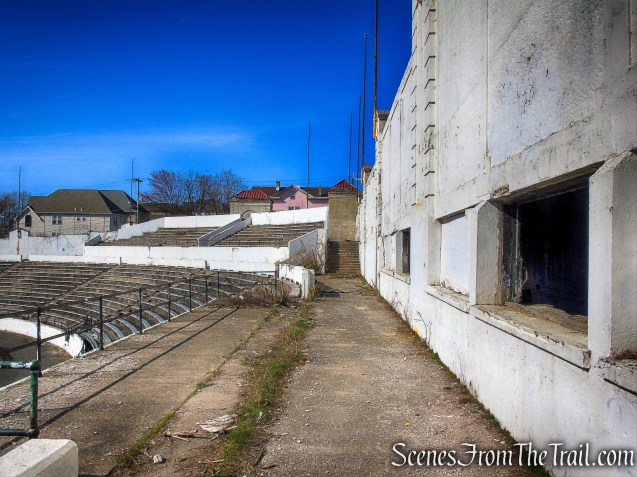
Adjacent to Mary Ellen Kramer Park is Hinchliffe Stadium, which was dedicated in 1932 and structurally completed in 1934. Hinchliffe Stadium served as the home field for the New York Black Yankees between 1933 and 1937, and then again from 1939 to 1945. Hinchliffe is possibly the sole surving regular home field for a Negro League baseball team in the Mid-Atlantic region.

Hinchliffe Stadium

Hinchliffe Stadium

The stadium was named after former Paterson City Mayor, John V. Hinchliffe, who served during planning and construction of the stadium between 1929 and 1932. The stadium was designated a National Historic Landmark in March 2013 and a Paterson Historic Landmark in May 2013. In December 2014 legislation passed in the United States Congress to include the stadium in the Paterson Great Falls National Historical Park.

Hinchliffe Stadium

Hinchliffe Stadium

We walked around the perimeter of the stadium, down Maple Street and then a right on Liberty Street. A separate post about Hinchliffe Stadium with interior and exterior images can be seen here. We then walked past the community garden and turned right on Jasper Street, which is closed off to vehicular traffic.

Jasper Street

Jasper Street

Since I wanted to make a loop of this hike, I was hoping that this road would lead us around and over the Passaic River.

Jasper Street

Jasper Street

Developers intended to construct 13 buildings containing 156 housing units called “The Vistas at the Great Falls” on this property. The state stepped in and purchased the 8.5-acre site for $5.7 million and plan to add it to the Great Falls National Historical Park. This property sits on a ridge 100 feet above the Passaic River providing a breathtaking view of the Great Falls Historic District below. Just across the river are the ruins of the ATP site and the mountain in the distance is Garret Mountain Reservation.

view from Jasper Street

view from Jasper Street

The New York City skyline is visible in the distance.

Manhattan skyline

Manhattan skyline

As it turns out, there is no way down to the street from up there that doesn’t include a very steep descent or climbing fences. We retraced our steps back to Mary Ellen Kramer Park and turned left on a paved park road that heads northeast and parallels the Passaic River.

Mary Ellen Kramer Park

Mary Ellen Kramer Park

A short distance down the road, we turned right and descended some railroad tie steps that lead to the edge of the river.

Mary Ellen Kramer Park

Mary Ellen Kramer Park

Now down in the Valley of the Rocks, we found a nice spot to sit and took a short break.

Valley of the Rocks

Valley of the Rocks

From here the ATP site ruins are visible and that was where I wanted go.

ATP site ruins

ATP site ruins

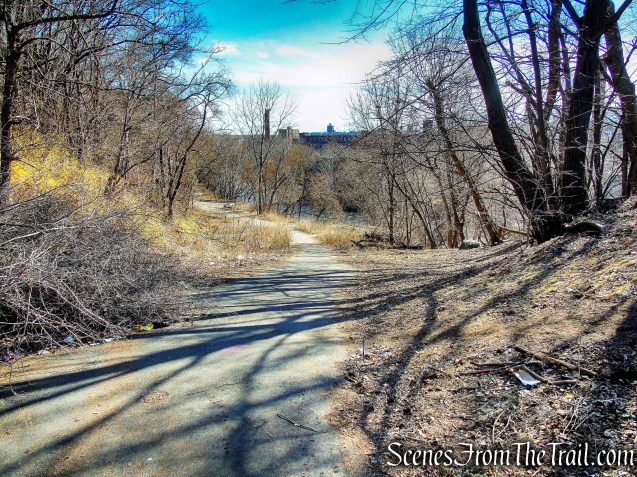
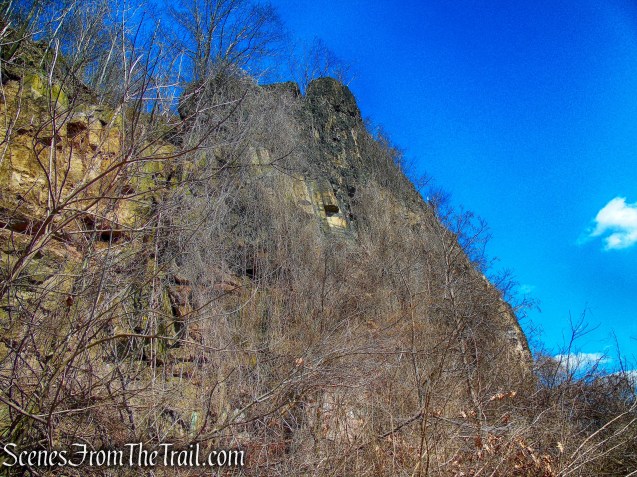
We walked back up to the park road which at some point turns into Ryle Road. We then passed some impressive cliffs, which happen to be where we were standing a short time earlier with the Manhattan views.

cliffs overlooking Ryle Road

cliffs overlooking Ryle Road

cliffs overlooking Ryle Road

cliffs overlooking Ryle Road

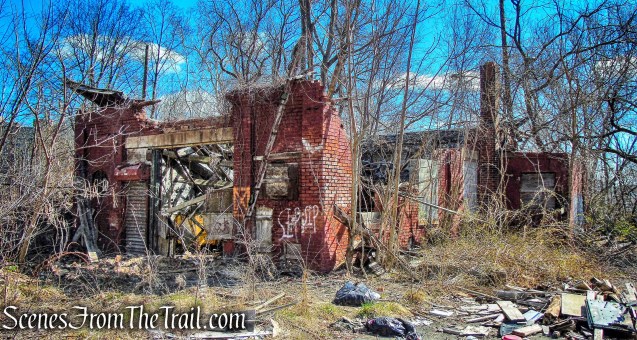
We then passed a dog pound and some ruined buildings alongside the road.

ruined building - Ryle Road

ruined building – Ryle Road

This road is desolate and I wouldn’t recommend walking this area alone. I saw some unsavory looking characters and evidence of squatters in the abandoned and ruined buildings.

Ryle Road

Ryle Road

Ryle Road

Ryle Road

After passing several more abandoned buildings, we walked to the end of Ryle Road and turned right onto West Broadway. There we crossed the road bridge which spans the Passaic River.

West Broadway

West Broadway

After crossing the bridge, we turned right on Mulberry Street which is closed off to vehicular traffic.

Mulberry Street

Mulberry Street

We walked alongside a 3–story brick building that at one time housed massive electrical generators which harnessed the rushing waters of the Passaic River’s Great Falls. It was the source of power for the entire city and beyond. Today, that same building now houses the Salvation Army’s Adult Rehabilitation Center (ARC).

Salvation Army

Salvation Army

We then turned right on Van Houten Street looking for a way to gain access to the ATP site which was between us and the river. We came to a couple of unlocked gates and went in. We couldn’t go too far in as the pile of rubble made it unsafe to climb over.

ATP site ruins

ATP site ruins

We continued on the sidewalk and came to an open gate.

ATP site ruins

ATP site ruins

The ruins here are quite extensive and definitely not a safe place to be alone or at night. It is a haven for squatters and I saw quite a few people coming and going. I spoke to a man who lives there and he told me where the majority of the squatters live so we avoided that area.

ATP site ruins

ATP site ruins

We wandered around the maze of ruins and came to the Colt Gun Mill.

Colt Gun Mill

Colt Gun Mill

One of Paterson’s most famous industries was the Patent Arms Manufacturing Company, begun by Samuel Colt. In 1836, the Colt Gun Mill, a magnificent four-story brownstone building, was built on an area directly below the waterfalls. Here, Colt first manufactured his newly patented repeating firearm, the revolver, with mother of pearl handles, which were essential in securing the American frontier. Between 1836 and 1841, approximately 5,000 muskets rifles, and revolvers were made here.

Colt Gun Mill

Colt Gun Mill

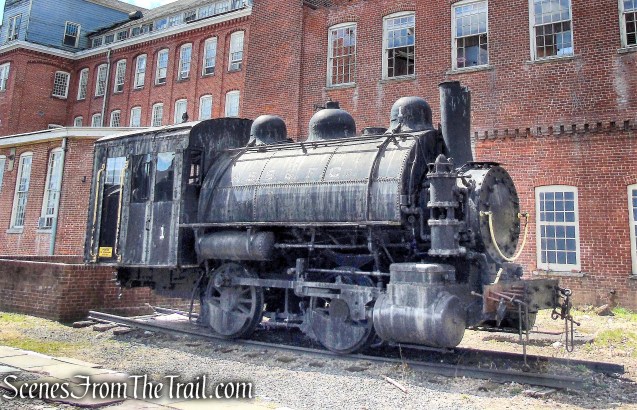
The Gun Mill was a four-story brownstone structure, with a central projecting stair tower. A weathervane in the shape of a gun capped the bell tower, and encircling the factory was a picket fence, in which each picket was shaped like a wooden gun.

Colt Gun Mill

Colt Gun Mill

A series of fires began in 1983 devastating the area around the Colt Mill on the ATP site. These buildings have been reduced to decaying brick shells. Demolition by neglect has been a tragic theme in Paterson, and in particular, the Great Falls Historic District.

ATP site ruins

ATP site ruins

The ATP site ruins stretch out over 7-acres and some are in worse shape than others. I will include another post dedicated to these ruins.

ATP site ruins

ATP site ruins

After exploring the ruins for quite some time, we continued southwest through the ATP site and came to a locked gate. This gate leads to Overlook Park which is closed off during construction. Not wanting to backtrack, I decided to climb the steep hillside that leads to the parking lot where the vehicle was located. Once at the car, we took a short break. Just across from the parking lot is an old wooden water tower.

old wooden water tower

old wooden water tower

I then headed to Raceway Park which is located diagonally across the street from Overlook Park, at the intersection of McBride Avenue and Spruce Street. Raceway Park is where the raceway system begins and travels throughout the Great Falls Historic District. The raceway brought water to each of the mills that housed waterwheels and turbines. The gatehouse regulates the amount of water from the Passaic River into the raceway.

gatehouse - Raceway Park

gatehouse – Raceway Park

The raceway is a three-tiered system that began in 1792 as a single canal and expanded into a complex system by 1838 as industry in the mill area grew. In the image below, the water would run to the right of the wall.

Upper Raceway

Upper Raceway

A king post truss bridge over the spillway on the Upper Raceway.

king post truss bridge - Raceway Park

king post truss bridge – Raceway Park

Between the tiers there are spillways that allow water to travel to the next level. This spillway leads to the raceway that travels under Spruce Street.

spillway - Raceway Park

spillway – Raceway Park

The Rogers Millwright Shop was built in 1869, partly with materials from its predecessor on the site, the Passaic Paper Mill. Millwright Shop built and maintained the machinery used in locomotive production. Originally built as almost a duplicate of the erecting shop, it took on its present appearance after a fire in 1879.

Rogers Millwright Shop

Rogers Millwright Shop

After crossing another king post truss bridge over the middle raceway, I headed towards Spruce Street and turned left. I then turned right on Market Street and stopped at the Paterson Museum. Since 1982 the museum has been housed in the Thomas Rogers Building on Market Street, the former erecting shop of Rogers Locomotive and Machine Works, a major 19th-century manufacturer of railroad steam locomotives.

Paterson Museum

Paterson Museum

Exhibits detail Paterson’s role as the nation’s first planned industrial city. A photograph collection of 200,000 negatives and prints, locomotive, rock and mineral specimens, art exhibits, the first practical submarine, Colt Firearms, silk. Paterson is remembered in history as the “Silk City.”

Paterson Museum

Paterson Museum

The museum opens at 12:30 on weekends and was not yet open when I was there.

Paterson Museum

Paterson Museum

From there, I walked back out to Spruce Street, turned right on McBride Avenue and crossed the street back to the parking lot where the hike began. It wasn’t a long hike, but as I stated at the beginning, there was a lot to see and photograph. It was a nice change of pace from the usual woods hike and packed with history.

Pros: Historical features, waterfall, baseball stadium, ruins, ruins, ruins.

Cons: Not the best part of town.

Now get out there and explore!

ATP site ruins

ATP site ruins

Sources:


Hinchliffe Stadium

April 8, 2018 – Paterson, New Jersey


Location: Maple Street, Paterson, NJ 07501


Hinchliffe Stadium, which was dedicated in 1932 and structurally completed in 1934, served as the home field for the New York Black Yankees between 1933 and 1937, and then again from 1939 to 1945. Hinchliffe is possibly the sole surviving regular home field for a Negro League baseball team in the Mid-Atlantic region.

Hinchliffe Stadium

Hinchliffe Stadium

The stadium was named after former Paterson City Mayor, John V. Hinchliffe, who served during planning and construction of the stadium between 1929 and 1932. The stadium was designated a National Historic Landmark in March 2013 and a Paterson Historic Landmark in May 2013. In December 2014 legislation was passed in the United States Congress to include the stadium in the Paterson Great Falls National Historical Park.

Hinchliffe Stadium

Hinchliffe Stadium

The stadium is situated on a bluff overlooking the Great Falls and in close proximity to Manhattan. Hinchliffe’s great location only added beauty to its magnetic pull in the 1930’s for a huge population of working-class fans, hungry for sports. It became the perfect venue for baseball invitationals and barnstorming games.

Hinchliffe Stadium

Hinchliffe Stadium

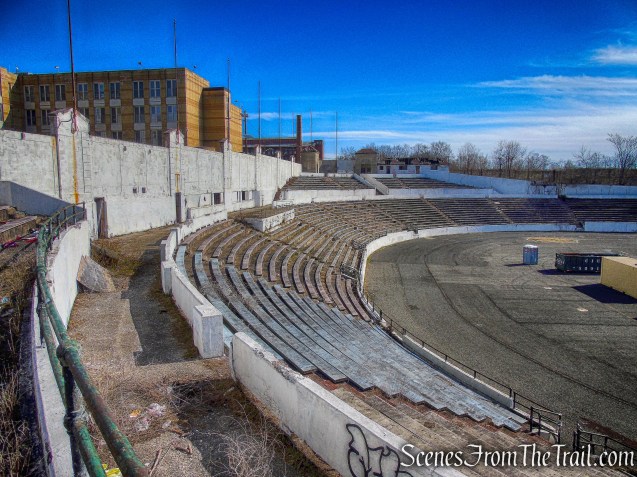
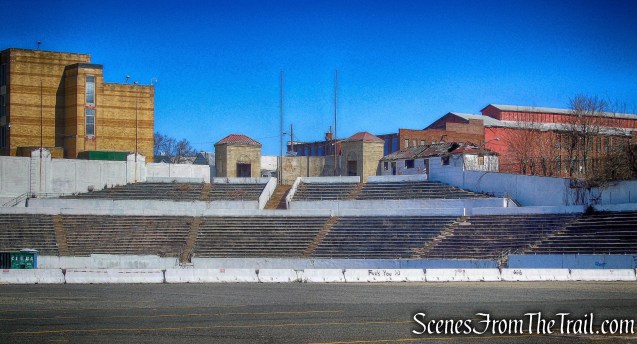
The cast-concrete, 10,000-seat Art Deco style stadium contains an athletic field and a running track. Hinchliffe has been used for sporting events such as exhibition, regular season, and champion baseball, football, boxing, track and field events and automotive and motorcycle racing. During the 1940’s, the Andrews Sisters and Abbott and Costello performed at Hinchliffe Stadium. Duke Ellington performed one of his last concerts here in 1971.

Hinchliffe Stadium

Hinchliffe Stadium

In September 1933 during their first Hinchliffe season, the New York Black Yankees played the Philadelphia Stars in the Colored Championship of the Nation. They lost the championship, but not their momentum. They opened the following season with an eight-game winning streak. The streak ending ninth game with the Pittsburgh Crawfords, came on July 28, 1934. A face-off that saw Hall of Famers Josh Gibson, Judy Johnson, James “Cool Papa” Bell, and Oscar Charleston all play in the regular season battle.

Hinchliffe Stadium

Hinchliffe Stadium

Paterson native and Hall-of-Fame baseball player Larry Doby was playing at Hinchliffe Stadium with the local high school team in 1942 when he was scouted for the Negro National League’s Newark Eagles. Later, when signed by the Cleveland Indians in 1947, Doby became the second black baseball player to break the major league color barrier, and first black player in the American League.

Hinchliffe Stadium

Hinchliffe Stadium

Doby, an all-around athlete at Eastside High School, had led his teammates to the Paterson baseball title in ’41 and ’42, all at Hinchliffe Stadium. And it was here in 1942 that he and his lifelong friend Monte Irvin, were scouted for the Newark Eagles, in what he himself recounted at his Hall-of-Fame induction in 1998, as one of the most memorable moments of his life.

Hinchliffe Stadium

Hinchliffe Stadium

The New York Cubans called Hinchliffe Stadium home in their second season in the Negro National League (1936). The team featured Cubans star Martin Dihigo (HOF 1977), a resourceful ballplayer who played all nine positions at various points in his career. He began as a second baseman, but found his true talents on the pitching mound. Paterson rooters came out on June 6, 1936 to marvel at his prowess as the Cubans faced their league rivals, the Newark Eagles, with two future Hall of Famers in the lineup: third baseman Ray Dandridge (HOF 1987) and shortstop Willie Wells (HOF 1997). The right-handed Dihigo struck out six Newark batters in the course of the game, and then proved he was a threat with the bat too by hitting a solo home run en route to a 12-5 victory for the Cubans.

Hinchliffe Stadium

Hinchliffe Stadium

Hinchliffe began a slow decline in the late ‘fifties, and was sold in 1963 for a single dollar to the Paterson Public Schools, which had managed it since 1932. After two overhauls (the first in ’63-’64 to enlarge the running track and outfield, the second in 1983 to put in itchy fiberglass seating and lay Astroturf) and many years of scrappy maintenance, it was officially closed in 1997.

Hinchliffe Stadium

Hinchliffe Stadium

Since then the city and the stadium’s friends have been working on a plan to bring back the stadium to its former glory. Work officially began in September 2017 on Phase 1 of the Hinchliffe Stadium Rehabilitation project.

Hinchliffe Stadium

Hinchliffe Stadium

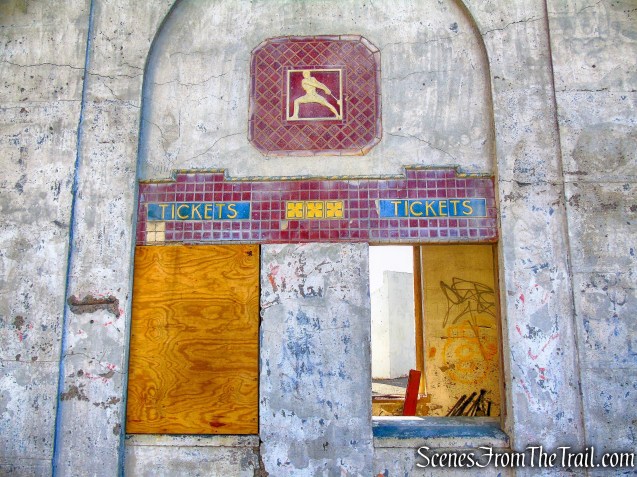
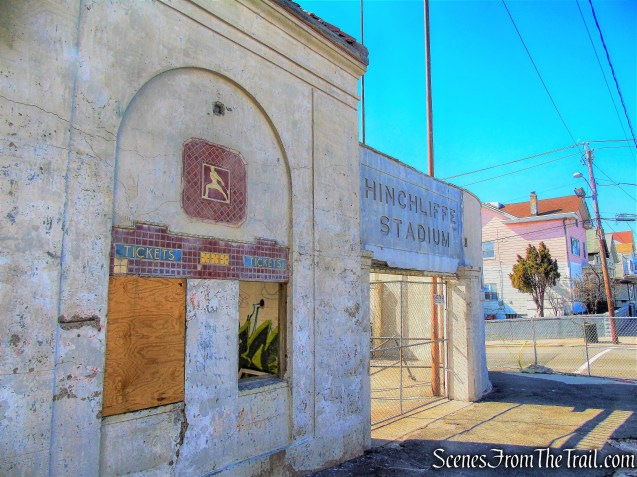
The first phase will rehabilitate the stadium’s facade along Liberty Street, restore four ticket booths and replace decorative features such as the old terracotta tiles and metal gates.

Hinchliffe Stadium

Hinchliffe Stadium

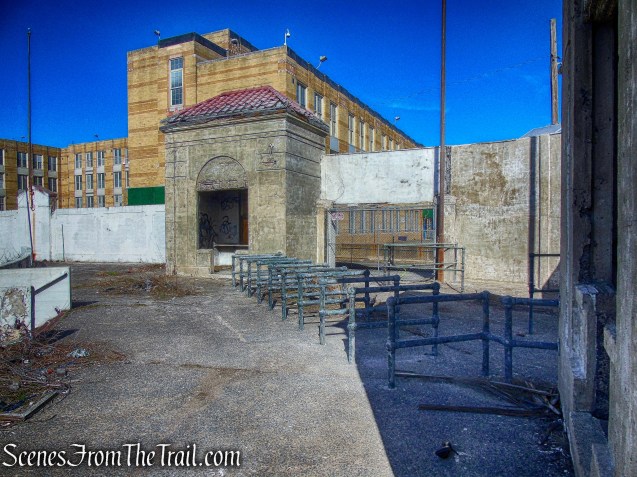
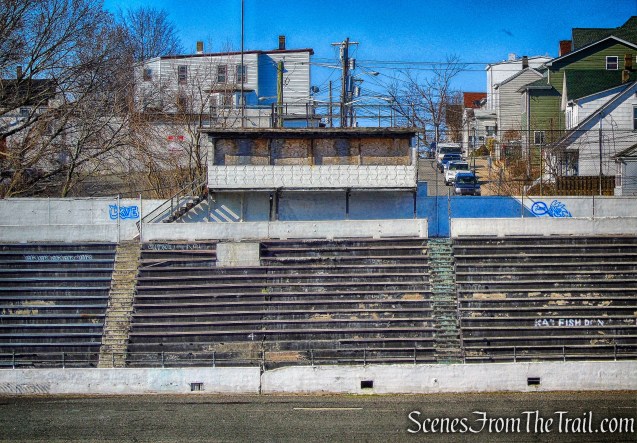
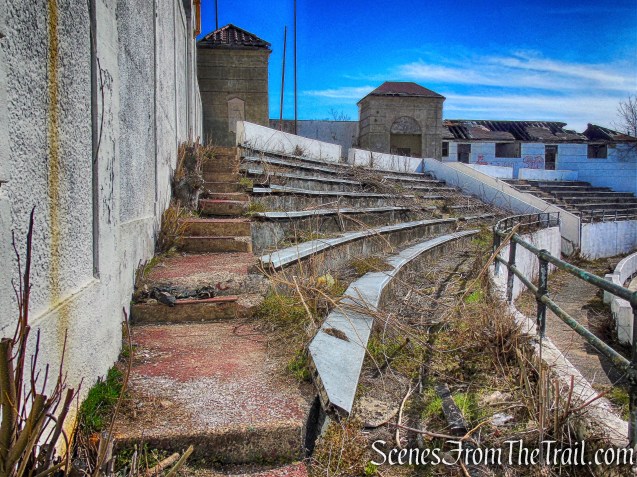
Once home to the NY Black Yankees and the NY Cubans of the Negro League, this once proud stadium sits in ruins in the middle of a city block.

Hinchliffe Stadium

Hinchliffe Stadium

On the stadium’s 70th anniversary in 2002, the “Friends of Hinchliffe Stadium” was formed to advocate for the redevelopment of the stadium, as the owner, Paterson Public Schools, was threatening its demolition. The Friends group, partially funded by the Paterson Historic Preservation Commission, was instrumental in listing the stadium in the National Register.

Hinchliffe Stadium

Hinchliffe Stadium

Hinchliffe Stadium is one of three Negro League ball parks still in existence. It has been designated as a national historic landmark, the only baseball stadium in the country with such a designation.

Hinchliffe Stadium

Hinchliffe Stadium

Although this stadium will probably never be restored to its former glory, one can only hope that it will be preserved. It is so rich in history, not just in sports, but in American history as well. I had never heard of Hinchliffe Stadium until doing research for a hike in the area. I am glad that I got a chance to learn of its history and also pay it a visit. Now PLAY BALL!

Sources:


Gillette Castle State Park

March 31, 2018 – East Haddam, Connecticut

Difficulty: Easy

Length: Approximately 2.5 miles

Max elevation: 213 ft.– total elevation gain approximately 138 ft.

Route type: Circuit

Map: Gillette Castle State Park Hiking Map

Trailhead parking: 67 River Rd, East Haddam, Connecticut 06423


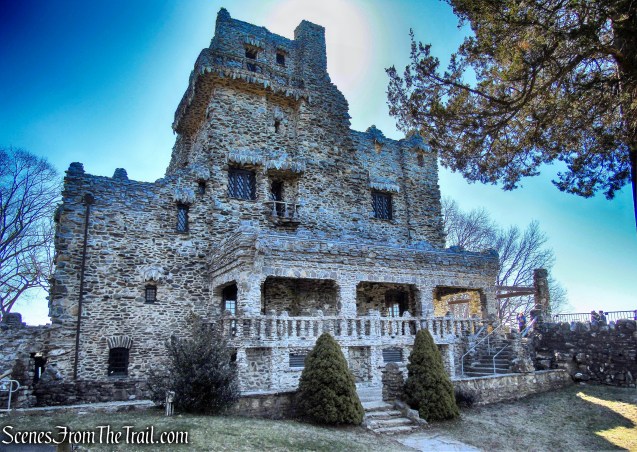
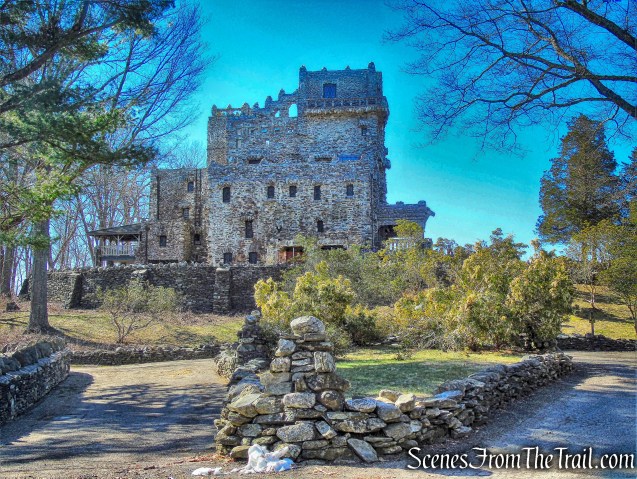
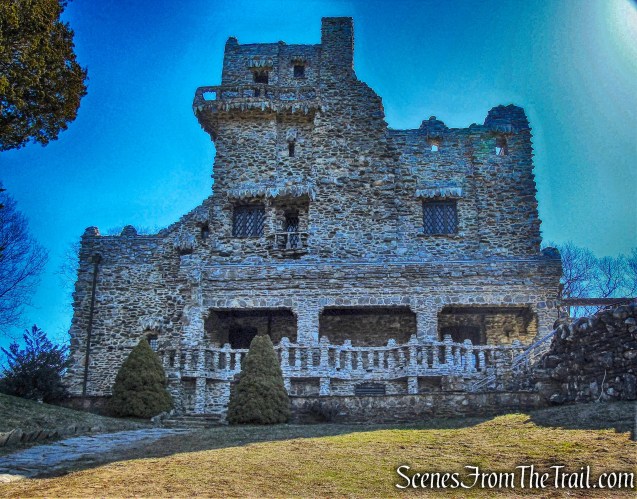
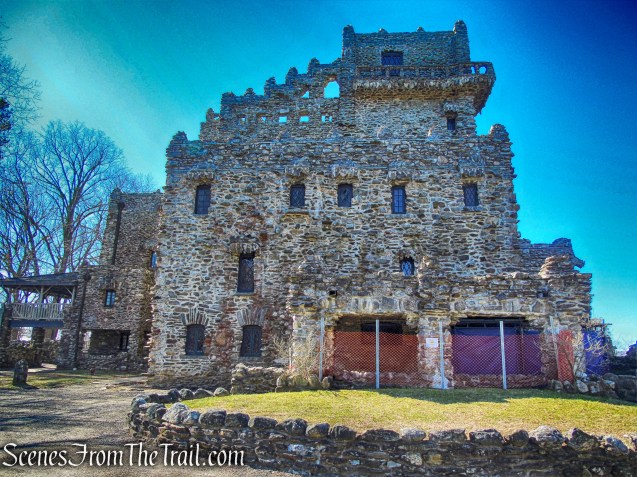
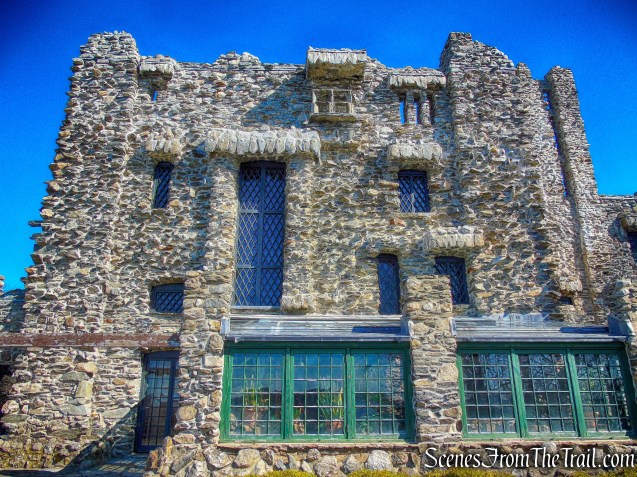
Atop the most southerly hill in a chain known as the Seven Sisters, William Hooker Gillette, noted actor, director, and playwright, he is most famous for his portrayal on stage of Sherlock Holmes, built this one hundred and eighty-four acre estate, the Seventh Sister. The focal point of his effort was a twenty four room mansion reminiscent of a medieval castle.

Gillette Castle

Gillette Castle

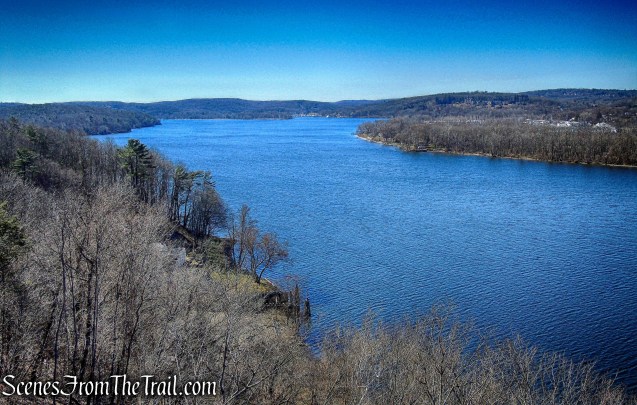
Purchased by the State of Connecticut in 1943 from the executors of Mr. Gillette’s will, Gillette Castle and the adjoining property with its fine woodlands, trails, and vistas are now administered for the enjoyment of present and future generations.

Connecticut River

Connecticut River

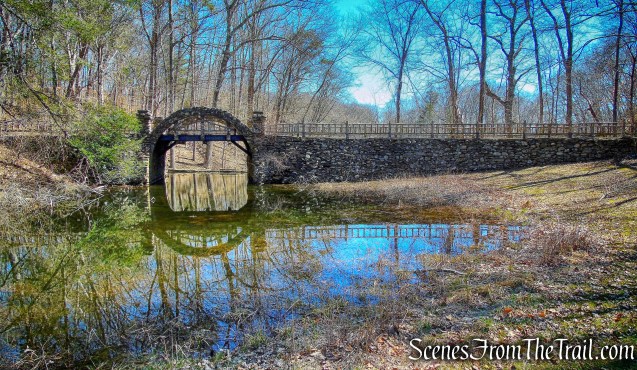
The trails often follow, over trestle and through tunnel on the actor’s three mile long narrow gauge railroad. Gillette’s own walking paths were constructed with near-vertical steps, stone-arch bridges, and wooded trestles spanning up to forty feet. Other outdoor attractions include a vegetable cellar, the railroad station (Grand Central), and Gillette’s goldfish pond.

stone-arch bridge - Gillette Castle State Park

stone-arch bridge – Gillette Castle State Park

I have visited Gillette Castle State Park several times in the past, but had never hiked the trails. Warm weather for the weekend was in the forecast and after all the snow storms, I wanted to take advantage of it. While researching places to hike where we can also barbecue, I happened to find out that there is a trail on the property which passes through a train tunnel. That was enough for me to plan a nice leisurely hike and then relaxing with the first post hike barbecue of the season. We mostly walked the narrow gauge railroad bed and tried to hit all the points of interest before settling in for an afternoon of grillin’ and chillin’.

The trails are not blazed and the map is difficult to decipher at times, but we were able to manage our way through. Hopefully this description of the hike will help others find their way.

Gillette Castle State Park

Gillette Castle State Park

Check out the Google Earth Fly-Through video of the hike below.


After an almost two hour drive from Westchester County, NY, we parked in the main lot by the visitor center. The visitor center and castle are open seven days a week beginning Memorial Day Weekend through Labor Day, but the grounds are open year round. This place does get crowded during the season, but a worthwhile place to visit during the off season as well. We headed towards the castle along the paved walkway.

Gillette Castle State Park

Gillette Castle State Park

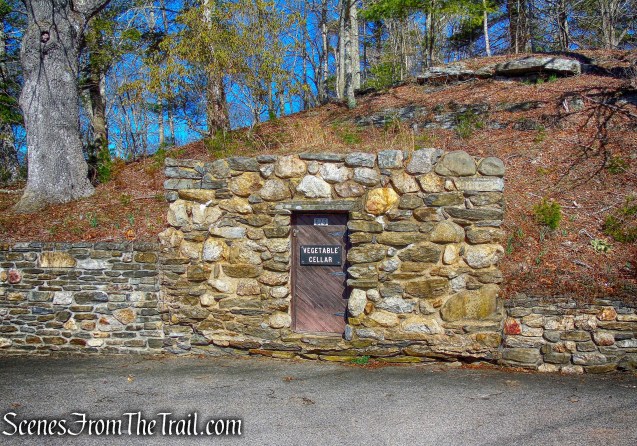
Just to the right is a vegetable cellar built into the side of the hill.

vegetable cellar - Gillette Castle State Park

vegetable cellar – Gillette Castle State Park

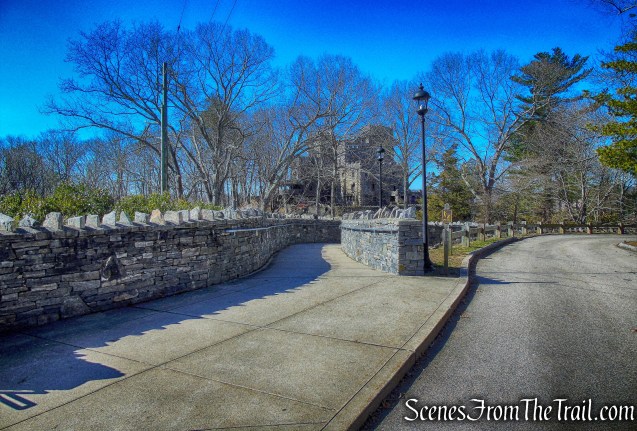
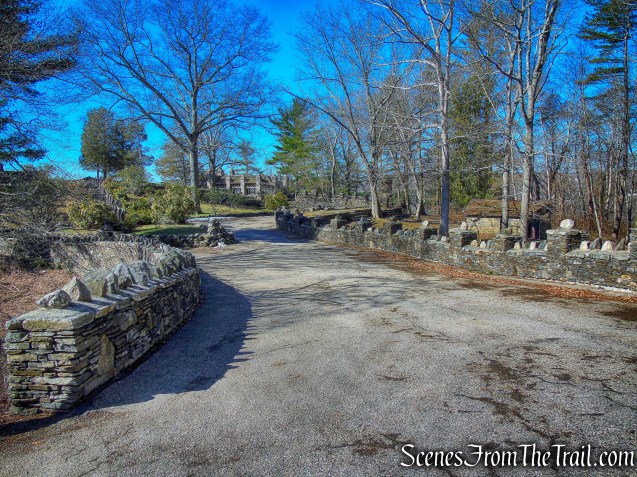
Walking along the park road, it immediately becomes evident the amount of labor involved in the stonework throughout the property.

Gillette Castle State Park

Gillette Castle State Park

Since it was still somewhat early, there were only a few people around as we walked towards the castle.

Gillette Castle State Park

Gillette Castle State Park

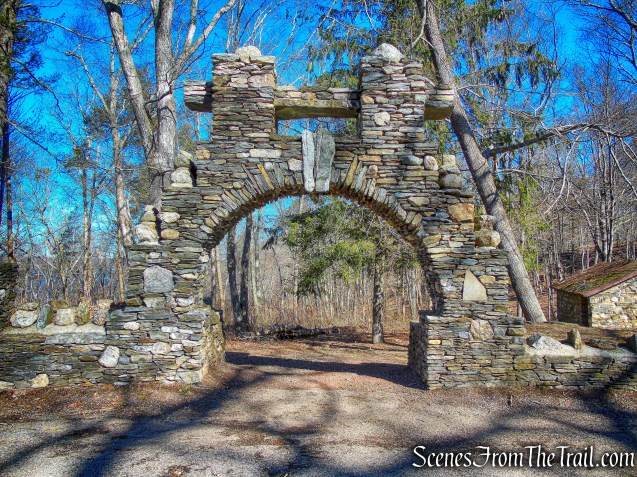
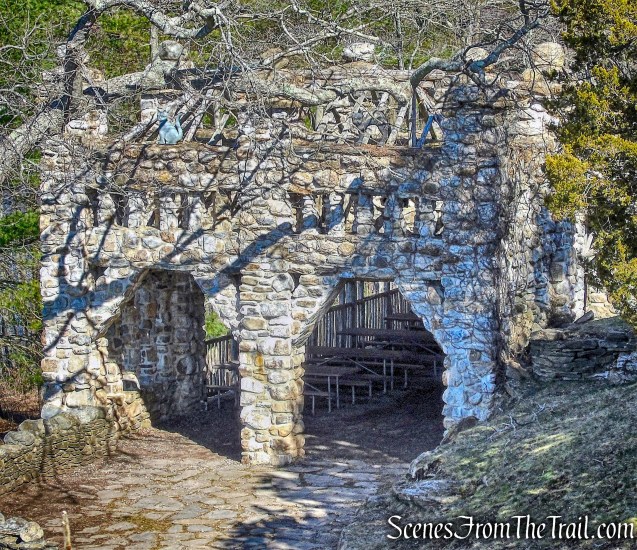
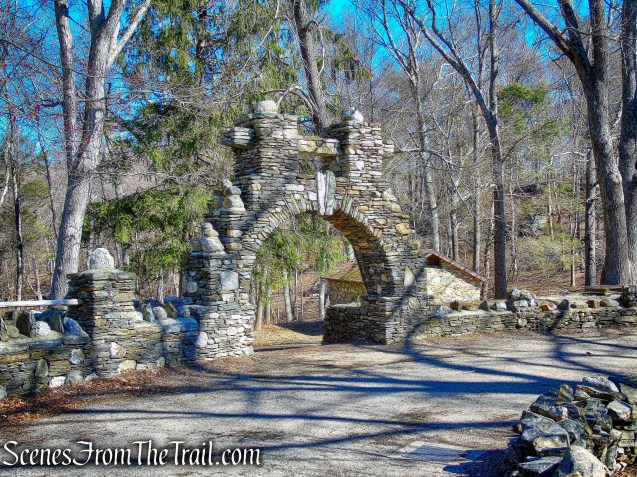
A beautiful stone arch provides entry to the woodlands and trails of the park.

stone arch - Gillette Castle State Park

stone arch – Gillette Castle State Park

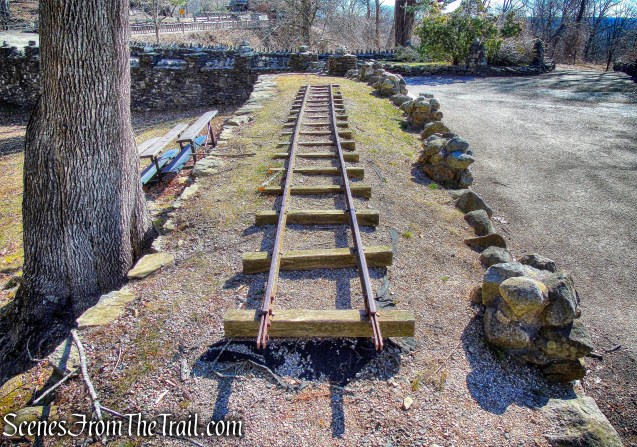
Just to the right of the stone arch is a remnant of the track from his railroad.

tracks - Gillette Castle State Park

tracks – Gillette Castle State Park

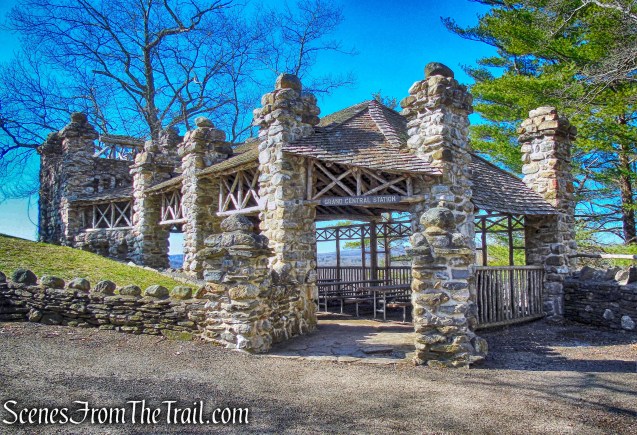
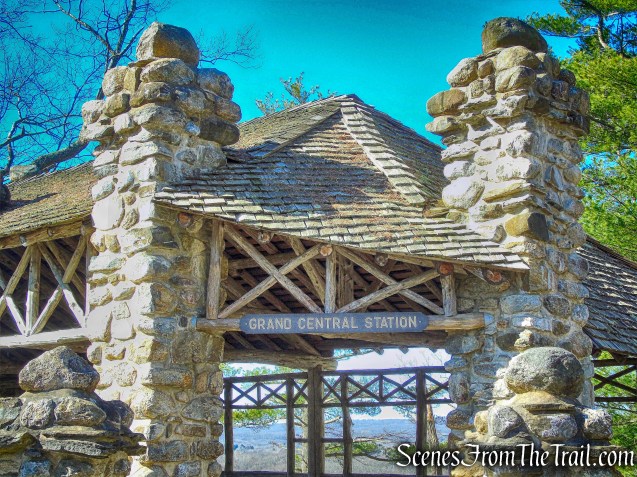
Across from the main entrance to the castle is “Grand Central Station,” the depot for Mr. Gillette’s narrow gauge railroad. It is now used as a picnic pavilion.

Grand Central Station - Gillette Castle State Park

Grand Central Station – Gillette Castle State Park

Grand Central Station - Gillette Castle State Park

Grand Central Station – Gillette Castle State Park

Grand Central Station - Gillette Castle State Park

Grand Central Station – Gillette Castle State Park

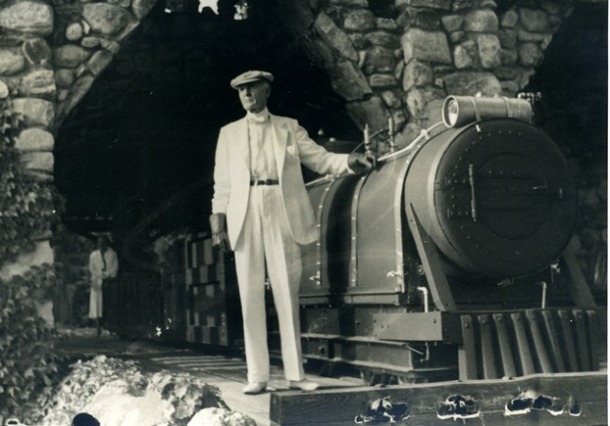
Below is an image of Mr. Gillette posing with his train in Grand Central Station.

William Gillette - image courtesy of Harriet Beecher Stowe Center and Connecticut State Library

William Gillette – image courtesy of Harriet Beecher Stowe Center and Connecticut State Library

Built of local fieldstone supported by a steel framework, it took twenty men five years (1914-1919), to complete the main structure.

Gillette Castle

Gillette Castle

Gillette was perturbed about the future of his estate, and in his will, he specifically charged executors of his will, “To see to it that the property did not fall into the hands of some blithering saphead who has no conception of where he is or with what surrounded.” The estate was eventually sold to the state for a public park for $5,000.

Gillette Castle

Gillette Castle

The castle has 24 rooms, with puzzle locks, secret doors, and even hidden mirrors that allowed Gillette to spy on his guests (including Albert Einstein and Calvin Coolidge) in order to time dramatic entrances for their amusement. The estate, now called Gillette Castle, is owned and maintained by Connecticut’s Department of Energy and Environmental Protection (DEEP).

Gillette Castle

Gillette Castle

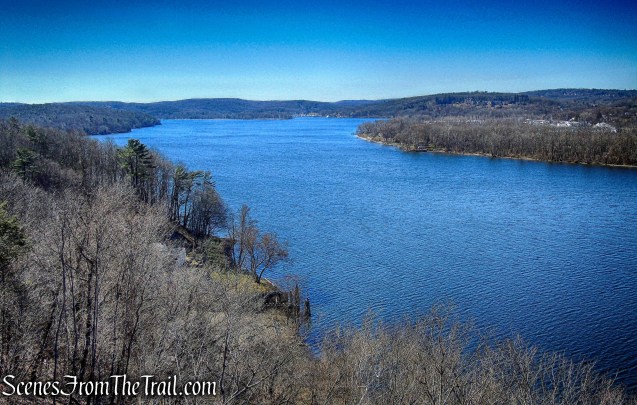
From the terrace, a spectacular view of the Connecticut River as it flows south into the Long Island Sound.

view of the Connecticut River - Gillette Castle

view of the Connecticut River – Gillette Castle

Once our sightseeing was concluded, we proceeded through the stone arch to get started on our hike.

stone arch - Gillette Castle State Park

stone arch – Gillette Castle State Park

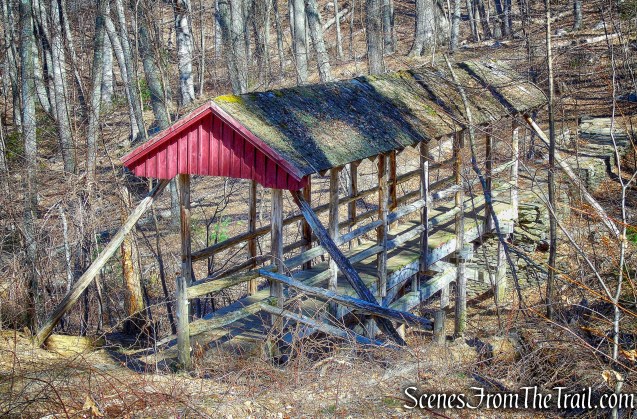
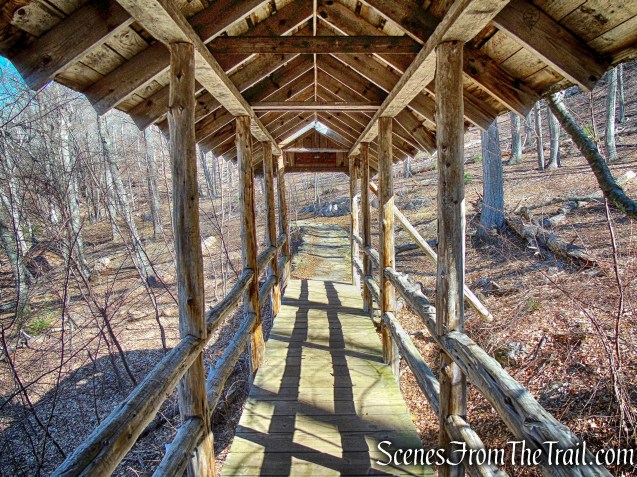
My intention for this hike was to walk a good portion if not all of the railbed of Mr. Gillette’s narrow gauge railroad. I also wanted to check out as many points of interest as possible. On our way to find the railbed, I saw what appears to be a covered bridge of sorts just down the hill. We walked towards it then across it.

covered bridge - Gillette Castle State Park

covered bridge – Gillette Castle State Park

covered bridge - Gillette Castle State Park

covered bridge – Gillette Castle State Park

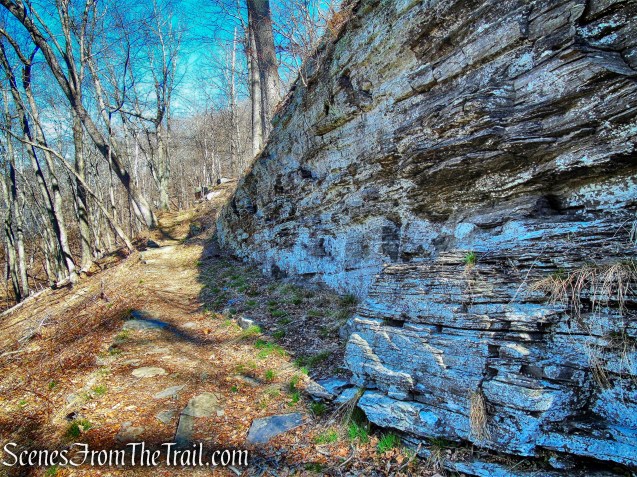
After crossing the bridge, we made our way back up the hillside to a trail that runs north to south along some shale-like Hebron rock formations.

Gillette Castle State Park

Gillette Castle State Park

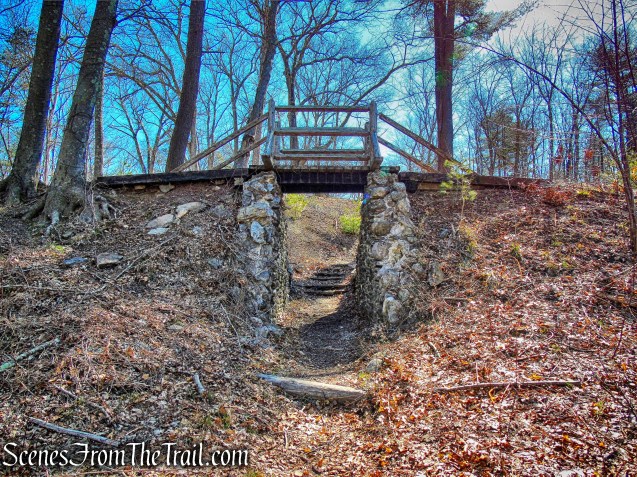
The trail comes to a junction where one trail makes a sharp right. We followed that trail uphill to a small bridge that the old railbed travels on.

Gillette Castle State Park

Gillette Castle State Park

Now on the railbed of Mr. Gillette’s beloved railroad, we began following it to see where it took us.

Gillette Castle State Park

Gillette Castle State Park

The trail continues over another longer wooden bridge that closely parallels the entrance road.

Gillette Castle State Park

Gillette Castle State Park

At the end of the bridge there is what remains of an old stone water tower.

Gillette Castle State Park

Gillette Castle State Park

The trail turns sharply left then turns right, sandwiched between some rock formations and the steep hillside.

Gillette Castle State Park

Gillette Castle State Park

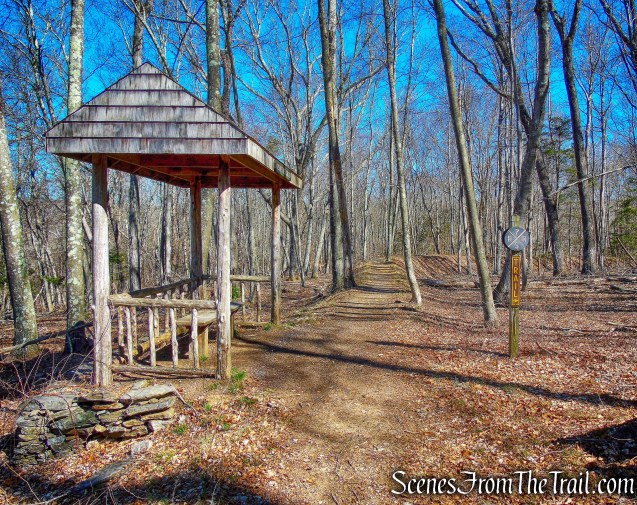
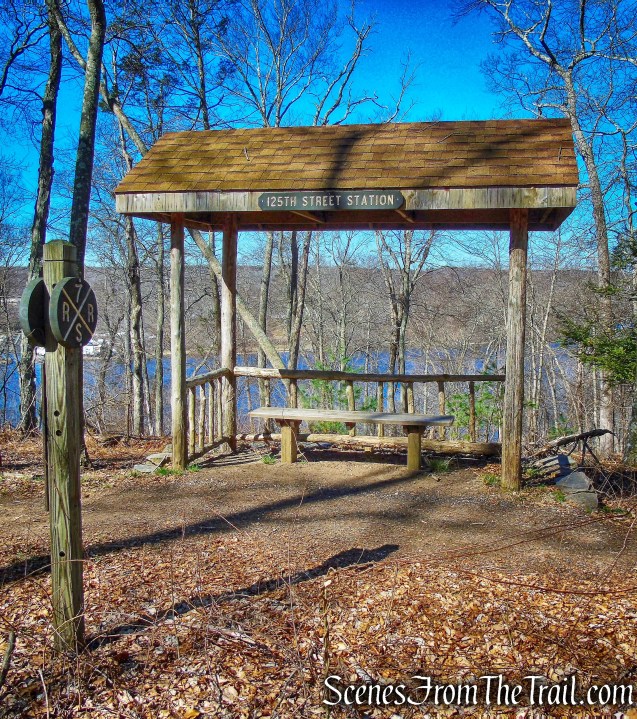
The trail then arrives at the 125th Street Station.

125th Street Station - Gillette Castle State Park

125th Street Station – Gillette Castle State Park

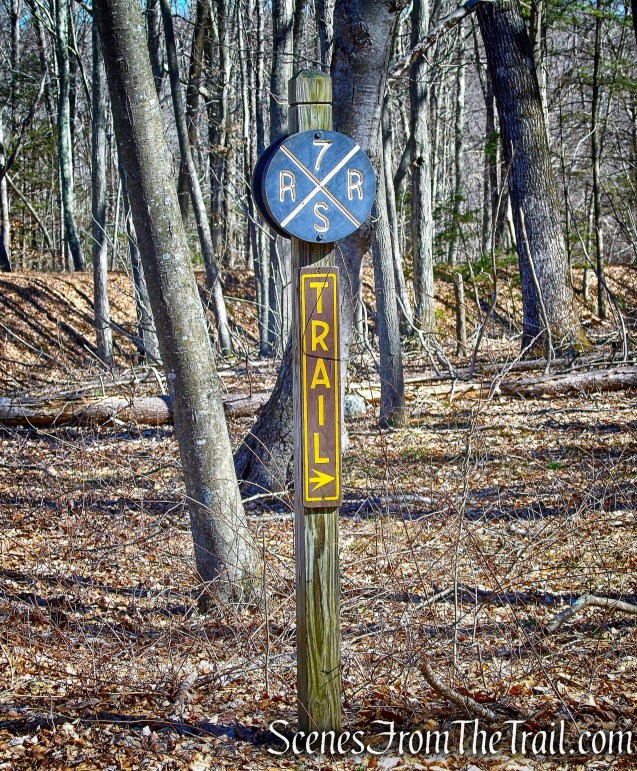
There were a few markers along the railbed signifying “Seventh Sister Railroad.”

Seven Sisters Railroad - Gillette Castle State Park

Seven Sisters Railroad – Gillette Castle State Park

This is a nice touch along the trail, with the Connecticut River just below.

125th Street Station - Gillette Castle State Park

125th Street Station – Gillette Castle State Park

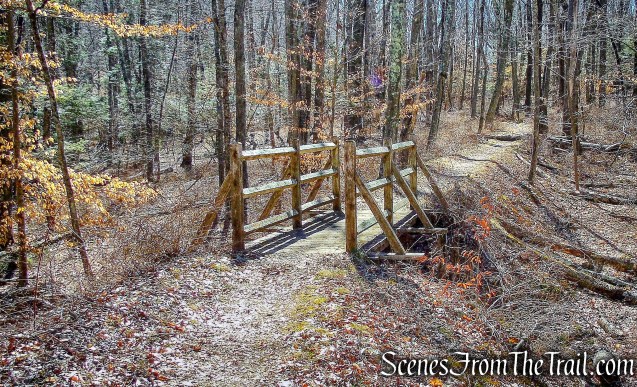
We stayed on the railbed, which travels north, then begins to curve to the east then heads southeast, crossing two small wooden bridges along the way.

wooden bridge - Gillette Castle

wooden bridge – Gillette Castle

The trail reaches the park entrance road, just across from Mr. Gillette’s goldfish pond. There is a small parking area there, along with some picnic tables near the edge of the pond. That is where we ended up grilling at the conclusion of our hike. We crossed over and began walking through the parking area.

goldfish pond parking area - Gillette Castle

goldfish pond parking area – Gillette Castle

There is a kiosk at the far end of the parking area and several ways to go from there.

goldfish pond parking area - Gillette Castle

goldfish pond parking area – Gillette Castle

I consulted the map trying to figure out which way to go to get to the tunnel. One of the few things labeled on the map is the tunnel. There are five trails which are closely aligned in this area, so we stopped momentarily on the stone arch bridge to figure things out.

stone arch bridge - Gillette Castle

stone arch bridge – Gillette Castle

The trail we took is directly behind the kiosk when walking from the entrance to the parking area. The trail just to the left of it has a gate across it and a sign that reads “bridge closed.” I knew beforehand that there is a train trestle that is part of the railroad trail and surmised that the sign referred to that. We took the wide woods road that heads southeast.

wide woods road - Gillette Castle

wide woods road – Gillette Castle

In a short distance, the trestle comes into view on the left.

trestle - Gillette Castle State Park

trestle – Gillette Castle State Park

The 40 ft. wooden trestle carried the tracks over rough terrain.

trestle - Gillette Castle State Park

trestle – Gillette Castle State Park

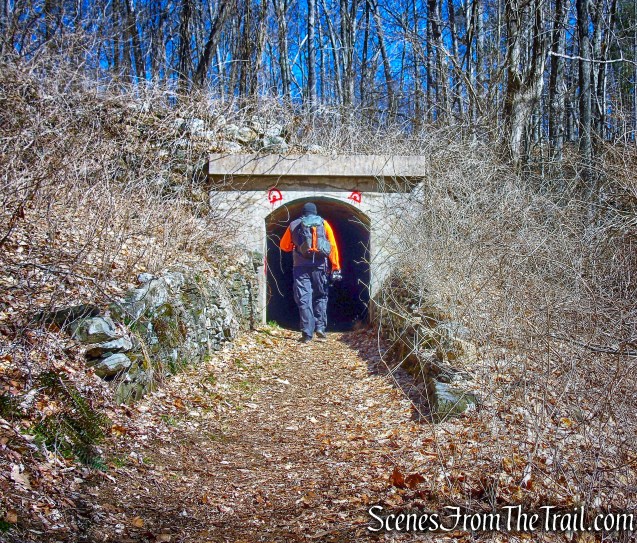
Just after passing the trestle, we walked up the hill to reach the same level as the railbed. That’s when the tunnel came into view and we made a beeline towards it. The tracks of the railroad were removed long ago and scenic walking trails were created in their place.

train tunnel - Gillette Castle State Park

train tunnel – Gillette Castle State Park

The 30th President of the United States, Calvin Coolidge Jr.; Albert Einstein; famed actress Helen Hayes and Yukio Ozaki, a mayor of Tokyo that brought the famed cherry trees to Washington, D.C., they all took a ride on the “Seventh Sister Short-line.”

train tunnel - Gillette Castle State Park

train tunnel – Gillette Castle State Park

Mr. Gillette’s 3-mile narrow-gauge railroad operated around his 184-acre estate in the 1920’s and 1930’s.

train tunnel - Gillette Castle State Park

train tunnel – Gillette Castle State Park

The 75-foot-long, slightly curved tunnel cuts through the hillside.

train tunnel - Gillette Castle State Park

train tunnel – Gillette Castle State Park

The other side of the tunnel offers a different look.

train tunnel - Gillette Castle State Park

train tunnel – Gillette Castle State Park

Mr. Gillette’s railroad, which he called the “Connecticut Nutmeg,” often whisked terrified guests from “Grand Central Station” along the winding 3-mile corridor of his wooded estate.

railbed - Gillette Castle State Park

railbed – Gillette Castle State Park

The railbed comes to an abrupt end at a point where there seemed to be a bridge that is no longer there except for a couple of support beams.

railbed - Gillette Castle State Park

railbed – Gillette Castle State Park

We climbed a few feet up the hill and jumped on a footpath that parallels the railbed. A little further down the trail, looking down at the railbed, is the roundabout. The place where the train would turn around and head back towards the tunnel. The roundabout is an interesting area to explore, with its huge stone walls.

roundabout - Gillette Castle State Park

roundabout – Gillette Castle State Park

roundabout - Gillette Castle State Park

roundabout – Gillette Castle State Park

Now heading west on the footpath, we came upon a stealth campsite and decided to take a break.

stealth campsite - Gillette Castle State Park

stealth campsite – Gillette Castle State Park

The trail we were on led us back to Mr. Gillette’s goldfish pond, where my colleagues stayed and saved a couple of tables for us. I headed back to the parking lot, crossing over the stone arch bridge.

stone arch bridge - Gillette Castle State Park

stone arch bridge – Gillette Castle State Park

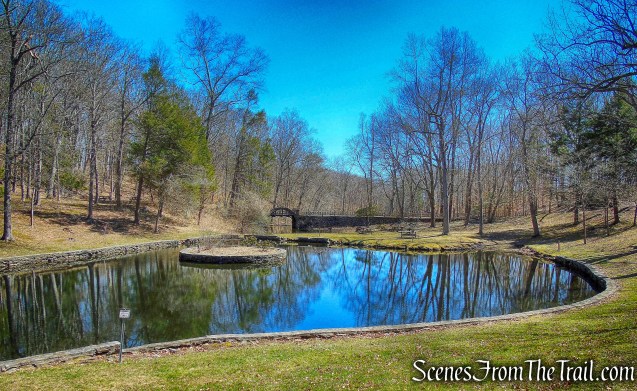
The view from the bridge, looking out at the goldfish pond.

goldfish pond - Gillette Castle State Park

goldfish pond – Gillette Castle State Park

After walking a short distance to the parking lot, I drove back to the parking area by the goldfish pond. We relaxed by the pond and grilled up some marinated Skirt Steak. That steak was delicious and the main reason why we kept the hike short. After enjoying some good eats, I took a walk around the pond to capture some images.

goldfish pond - Gillette Castle State Park

goldfish pond – Gillette Castle State Park

stone-arch bridge - Gillette Castle State Park

stone-arch bridge – Gillette Castle State Park

After a nice afternoon in the sun, it was time to head out. I wasn’t thrilled about the two hour drive, but it was totally worth it. We practically had the whole park to ourselves. This is a gorgeous place to spend a day and I would definitely visit again, just not during peak season. This is a great place to bring the kids or anyone as an introduction to hiking. The trails are easy to walk and it has enough points of interest to keep anyone engaged. And it has a castle and a tunnel!!

Pros: Gillette Castle, train tunnel, Connecticut River views, picnic tables and grills.

Cons: Two hour drive from Westchester County, big crowds in summer, map could be better detailed, trails not blazed.

Take a hike!

Gillette Castle State Park

Gillette Castle State Park

Sources:

Gillette Castle State Park

ConnecticutHistory.org


Dover Stone Church – Full Loop

March 24, 2018 – Dover Plains, NY

Difficulty: Moderate

Length: Approximately 4.2 miles

Max elevation: 841 ft.– total elevation gain approximately 770 ft.

Route type: Lollipop Loop

Map: Dover Stone Church Map

Map: Stone Church Trail Map

Trailhead parking: There is no public parking on property on or near the right-of-way off Route 22. Parking there may be subject to towing. Parking is allowable at Dover Elementary School (When School is NOT in Session) 9 School St, Dover Plains, NY 12522 or Freshco 22 Plaza (When School is IN Session) 3156 NY-22, Dover Plains, NY 12522.

There is an updated write-up from May, 2023 here: Dover Stone Church Preserve


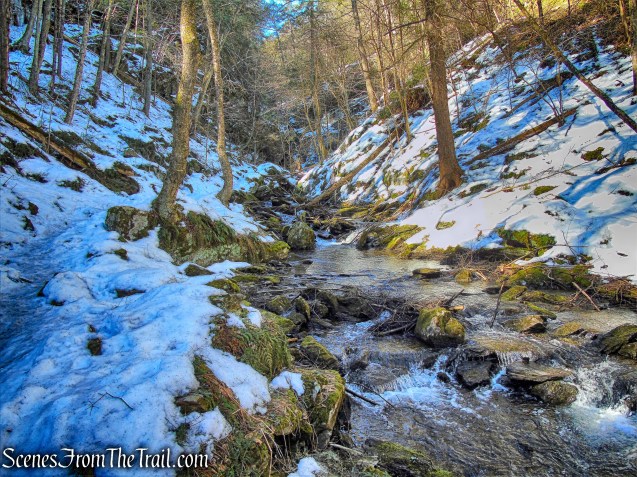
The “Stone Church” is an ancient cavern on the Stone Church Brook in Dover Plains, hewn by time in the formation similar to a church’s cathedral stained glass window. According to local legend, the site was a refuge for Pequot Sachem Sassacus and his warriors as they fled from the English Army in the 1600’s. In the 1800’s and early 1900’s, the Stone Church was a popular local attraction for New York City dwellers to visit and enjoy the recuperative fresh air and beauty of upstate New York. It was placed on the National Register of Historic Places in 2014.

Dover Stone Church

Dover Stone Church

A distinctive geological feature in eastern Dutchess County, it was a celebrated and much-visited tourist destination in New York State by the middle decades of the nineteenth century. The site was highlighted as a remarkable natural curiosity in published accounts as early as the 1830’s.

Dover Stone Church

Dover Stone Church

In 2015 three new trails were added. The hike to and from the “Stone Church” is about 1.2 miles round-trip from the parking area. The stone path along the brook to the cavern is delightful enough on its own, but it makes for a really short hike, especially when travelling just over an hour to get there. I wanted to traverse all of the marked trails on this visit and I am glad that I did. While there will always be plenty of people down near the brook, we only encountered a man and his dog while we hiked the other three trails.

Dover Stone Church

Dover Stone Church

Although it was a Saturday, we parked in the Freshco 22 Plaza, which is where I have always parked when I visit Dover Stone Church. I always park in the far corner of the lot, away from the business entrances and have never had any issues. We walked out to the traffic light on the corner of Route 22 and Mill Street and crossed the road. Turning left on the other side, we walked south a short distance until we came to the right-of-way, marked by the blue and gold historic marker. The entrance to Stone Church begins with a gravel driveway through private property. We proceeded to walk up the to the back of the driveway.

Dover Stone Church

Dover Stone Church

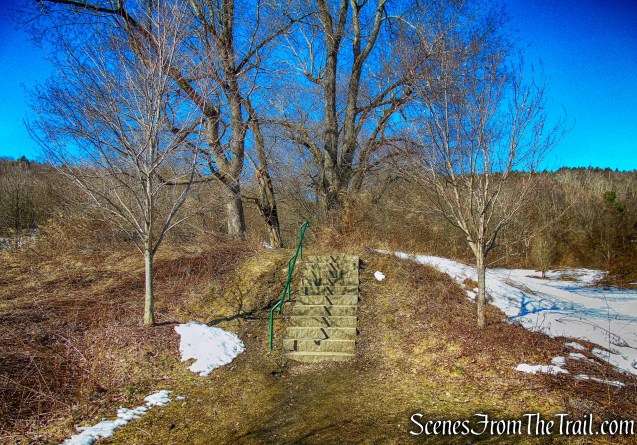
To the right of the sign, there are granite steps and railings. They were installed to create passage along a man-made valley.

Dover Stone Church

Dover Stone Church

granite steps and railings - Dover Stone Church

granite steps and railings – Dover Stone Church

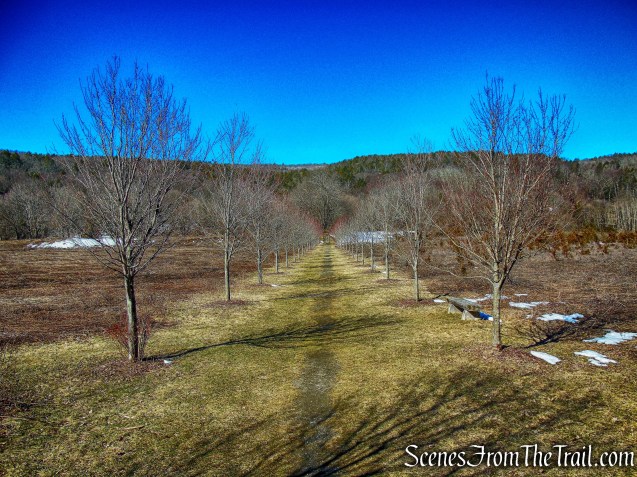
In 2010, the Town of Dover improved the right-of-way entrance with restoration of maple trees that lined the entrance for centuries.

maple trees - Dover Stone Church

maple trees – Dover Stone Church

This section is especially pretty during the fall season. The image below is from October 2014.

maple trees - Dover Stone Church - October 19, 2014

maple trees – Dover Stone Church – October 19, 2014

At the end of the row of maple trees, there is another set of granite steps.

granite steps - Dover Stone Church

granite steps – Dover Stone Church

The path continues west alongside Stone Church Brook, passes through two fence posts and approaches a large kiosk.

large kiosk - Dover Stone Church

large kiosk – Dover Stone Church

The kiosk has a lot of good information about this place, including a historical timeline, features of Stone Church and the ravine habitat.

large kiosk - Dover Stone Church

large kiosk – Dover Stone Church

Turning left at the kiosk takes us past another sign and on a wide path that heads back towards the brook.

Dover Stone Church

Dover Stone Church

I found there to be an inordinate amount of signs here, but I guess that too many is better than not enough.

Dover Stone Church

Dover Stone Church

In a short distance, the path arrives at a wooden footbridge that spans Stone Church Brook. This bridge has been recently upgraded with better railings installed.

wooden footbridge - Dover Stone Church

wooden footbridge – Dover Stone Church

The old bridge had only three posts on each side and a rope top rail.

wooden footbridge - Dover Stone Church - May 14, 2016

wooden footbridge – Dover Stone Church – May 14, 2016

I applaud their efforts for upgrading the bridge for safety reasons, but a little more care should have been taken, in my opinion. Since I have trust issues, I always check railings anywhere I go by giving them a shake and seeing what kind of hardware is employed. As I took a step up onto the bridge, I grabbed the left hand rail and gave it a little shake. As it turns out, it was never screwed in place. When I examined the rest of the railing, I noticed that only one screw was used in most places where several should have been. I removed the loose hand rail, fearing that someone unsuspectingly would fall and crack their skull, but on my way out, I saw that someone put it back unsecured. I removed it once again. This bridge sees a lot of foot traffic and I wouldn’t want anyone to take a tumble.

wooden footbridge - Dover Stone Church

wooden footbridge – Dover Stone Church

After crossing the footbridge, to the left there is a small meadow with three spring-fed ponds. We turned right and stopped at the bench with the sign next to it. Sign, sign, everywhere a sign! We put on our microspikes here, anticipating the icy trail alongside the brook that leads to the cavern.

Dover Stone Church

Dover Stone Church

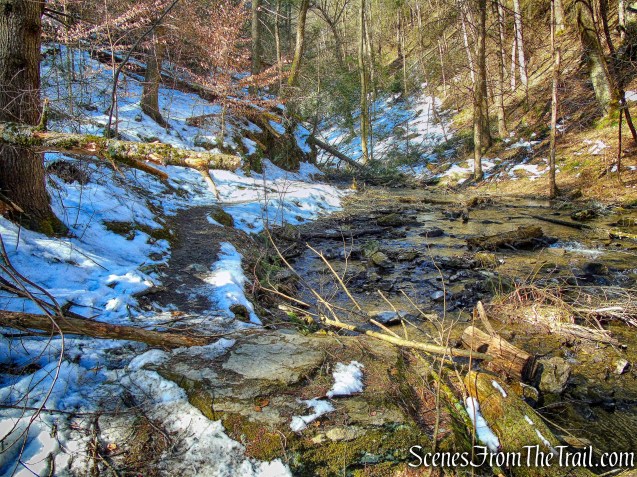
The three newer trails all start to the left, but the Stone Church Cave Trail begins on the right. It travels southwest along the edge of the brook.

Stone Church Cave Trail

Stone Church Cave Trail

Stepping stones have been placed in strategic places to avoid having to getting wet.

Stone Church Cave Trail

Stone Church Cave Trail

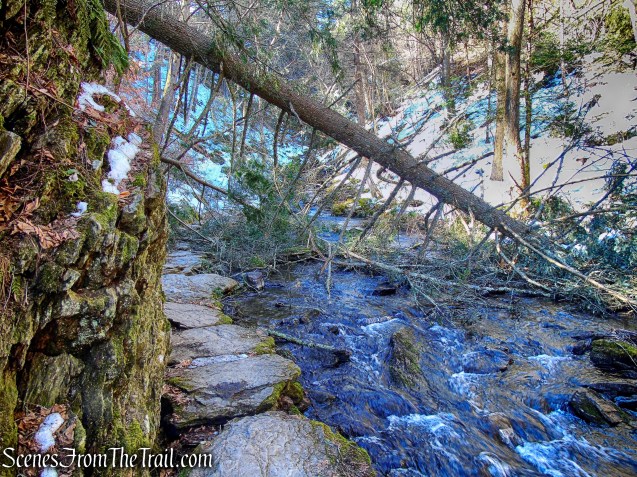
The trail continues up the picturesque gorge, giving you the feeling of being in the deep woods.

picturesque gorge - Dover Stone Church

picturesque gorge – Dover Stone Church

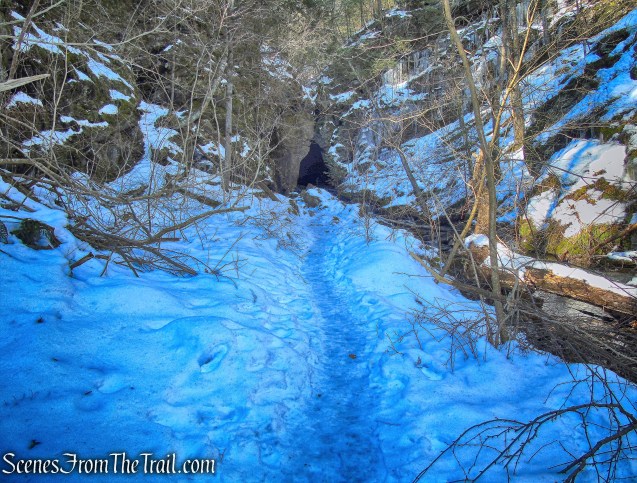
In no time at all, the opening of the cavern comes into view.

Dover Stone Church Trail

Dover Stone Church Trail

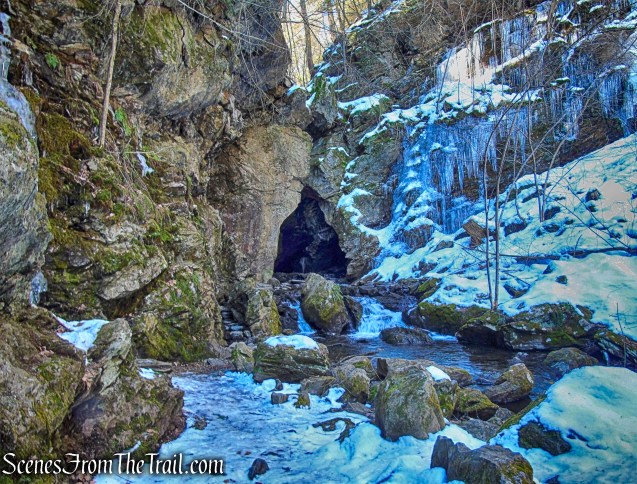
This place is very popular year round, even in winter. We were lucky this trip as there was no one around when we arrived. Large metamorphic rocks converge to form the entrance in the shape of a church’s cathedral window.

Dover Stone Church

Dover Stone Church

With its natural beauty and unique geological formation, it is no wonder that people flock here. The gothic (pointed arch) formation of the stones gave rise to the moniker, “Stone Church.”

Dover Stone Church

Dover Stone Church

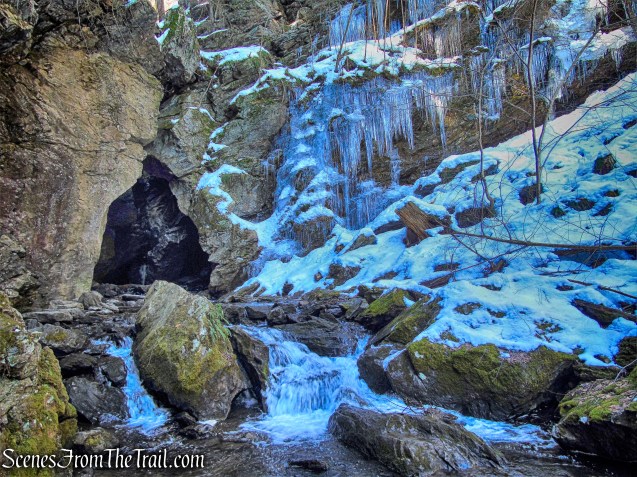
The Stone Church Brook, a tributary of the Ten Mile River, flows through and out the cavern entrance.

Dover Stone Church

Dover Stone Church

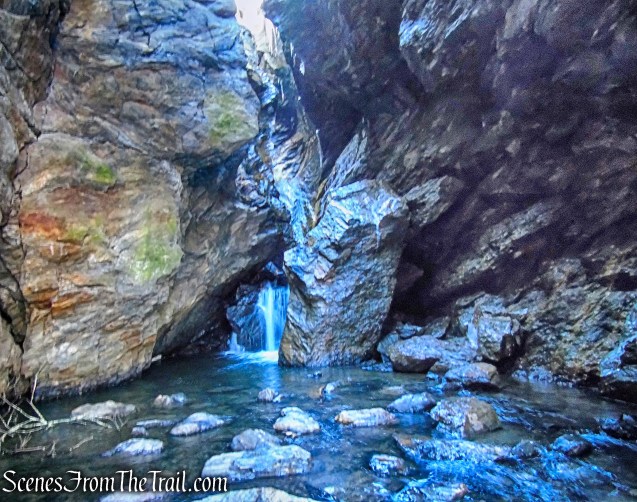
Inside the cavern, there is a waterfall cascading into a pool of water.

Dover Stone Church

Dover Stone Church

The cavern can be entered, but caution should be taken on the wet and slippery rocks. The view from the inside, looking out.

Dover Stone Church

Dover Stone Church

We stayed here for a little while, enjoying this glorious spot. It’s not often that one can visit here without encountering strangers, so we took advantage of it. I never get tired of this view.

Dover Stone Church

Dover Stone Church

We retraced our steps along the brook, making our way back to the bench where we put on our spikes.

Dover Stone Church

Dover Stone Church

Walking southeast past the sign, the three newer trails begin to climb the hillside.

start of the 3 newer trails - Dover Stone Church

start of the 3 newer trails – Dover Stone Church

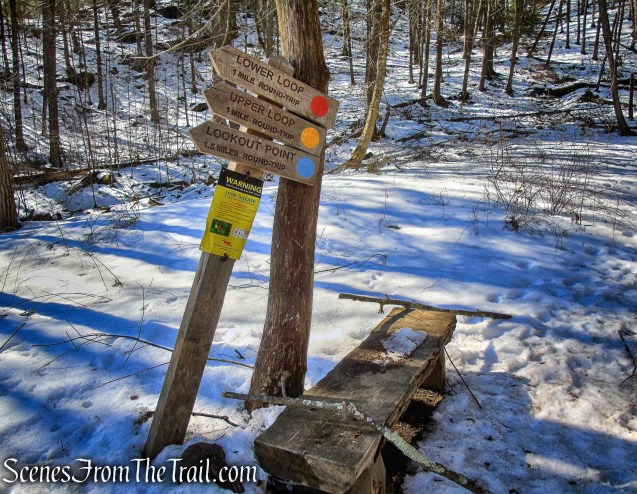
The three trails are co-aligned at the start, as they climb the hill and pass through a fence. The three trails then come to a woods road with another sign. We turned right to begin on the blue-blazed Lookout Point Trail. Whichever way one chooses to go, all three trails return to this point.

Turn right at the sign for the Lookout Point Trail

Turn right at the sign for the Lookout Point Trail

The beauty of this place is that one can opt to just hike to the cavern or extend the hike by doing one, two or all three of the newer trails. At this point, I wasn’t sure how many trails we would do, but my goal was to do them all. Immediately we came to a large blowdown blocking the trail, but that is to be expected along most any trail after all the storms recently.

blowdown - Lookout Point Trail

blowdown – Lookout Point Trail

The blue and yellow trails are co-aligned for about 0.3 mile from the sign as they ascend steadily on the woods road.

Lookout Point Trail

Lookout Point Trail

The co-aligned trail continues climbing and then levels off briefly, goes through a stone wall and skirts a meadow.

Lookout Point Trail

Lookout Point Trail

The two trails then reach a junction where they split and the blue-blazed Lookout Point Trail goes to the right, still following the woods road.

junction - Lookout Point Trail

junction – Lookout Point Trail

After turning right to continue following the blue blazes, we encountered a couple of blowdowns which were easy to get over.

blowdowns - Lookout Point Trail

blowdowns – Lookout Point Trail

The Lookout Point Trail continues its ascent, now heading northwest. It veers left, leaves the woods road and continues on a footpath. A blue marker can be seen to the left on a tree in the distance along the trail.

Lookout Point Trail

Lookout Point Trail

After leaving the woods road, the trail now curves towards the left and begins heading south. This trail is by no means difficult, but it is more challenging than the red or the yellow trails. It was in this area that the blazes on the trees were few and far between, making the trail a little difficult to follow. There were footprints in the snow, but I am a little wary of following a previous hiker’s path through the snow because that person could have been off the trail or lost. Turning around, I saw that the trail was marked well in the opposite direction, so I turned around several times to check the blazes and stay on the trail.

Lookout Point Trail

Lookout Point Trail

The trail then leads to some slanted rock slabs dotted with dwarf pines, which I believe is Lookout Point. I didn’t see three blazes which is normally used to mark the end or beginning of a trail, but I didn’t see any more blazes beyond there. Nevertheless, this was a good place to stop and enjoy the best hilltop view of the entire hike. Looking southeast towards Connecticut, the Litchfield Hills are visible in the distance.

Lookout Point

Lookout Point

We took a lengthy break here enjoying the sunny day. The view, looking a little more northeast.

Lookout Point

Lookout Point

We retraced our steps on the blue-blazed Lookout Point Trail to the junction with the yellow-blazed Upper Loop Trail. Here we had to look into the woods for yellow blazes because the sign isn’t pointing in the right direction. With no leaves on the trees it was relatively easy to spot, but one more yellow blaze closer to the junction would be helpful.

junction with the yellow-blazed Upper Loop Trail

junction with the yellow-blazed Upper Loop Trail

The Upper Loop Trail heads south into the woods towards a large rock formation.

Upper Loop Trail

Upper Loop Trail

The trail passes just to the right of the rock formation which is massive.

rock formation - Upper Loop Trail

rock formation – Upper Loop Trail

rock formation - Upper Loop Trail

rock formation – Upper Loop Trail

The Upper Loop Trail then wraps around the rock formation and begins to climb.

Upper Loop Trail

Upper Loop Trail

The trail proceeds to the other side of the rock formation where it extends outward at an angle, creating a natural stone shelter.

natural stone shelter - Upper Loop Trail

natural stone shelter – Upper Loop Trail

The trail continues its ascent……

Upper Loop Trail

Upper Loop Trail

with limited views through the trees.

Upper Loop Trail

Upper Loop Trail

The trail climbs some more…..

Upper Loop Trail

Upper Loop Trail

with more limited views.

Upper Loop Trail

Upper Loop Trail

After a few ups and downs, the Upper Loop Trail begins a steady descent.

Upper Loop Trail

Upper Loop Trail

As the trail continues to descend, it rejoins the blue-blazed Lookout Point Trail. Just before reaching the sign where all three trails meet, there is a clearing with a large glacial erratic. We jumped off the trail and headed towards it to take a break.

glacial erratic - Upper Loop Trail

glacial erratic – Upper Loop Trail

We sat down and relaxed for a bit while contemplating our next move. I wanted to hike the red-blazed Lower Loop trail in order to complete all the marked trails on the property. After a little debate and dissension, we embarked on the final remaining trail. It’s listed as 1 mile long on the map, but I think it’s just a little shorter. I did not realize it until we were ready to continue that we were sitting on the Lower Loop Trail and it passes between the two rock formations.

rock formation - Lower Loop Trail

rock formation – Lower Loop Trail

I borrowed a hiking pole for the last descent on the Upper Loop Trail and leaned it on a rock while we rested. It wasn’t until we were almost halfway done with the Lower Loop Trail that we realized that I had left it behind. I decided to keep moving because the trail would lead us right back to that same spot. Luckily it was still there when we completed the loop.

We continued to the sign where the three trails meet and turned right on the woods road which descends as it heads southeast.

Lower Loop Trail

Lower Loop Trail

The trail continues to descend then turns right and leaves the woods road onto a footpath.

Lower Loop Trail

Lower Loop Trail

At the top of the rise, the trail levels off and there are limited viewpoints through the trees. To be honest, from the moment we realized that I had left the hiking pole back by that rock, we raced through this trail and really didn’t get to enjoy it.

Lower Loop Trail

Lower Loop Trail

The trail then descends and we were keeping up a good pace. We finally made it back to the rock and the hiking pole was still there. We sat there for a few minutes trying to catch our breath then headed out by retracing our steps past the sign where all three trails meet, through the fence, down the hill, over the footbridge, across the field, up the stairs and across Route 22 to the parking area where our hike began.

Dover Stone Church

Dover Stone Church

This was a really good hike that got the blood pumping without being overly strenuous. I’m glad that we did all of the marked trails, but if I had to rate the three newer trails in order of enjoyment, I would pick the Upper Loop as the best because of the rock formations. The Lower Loop would be second with the Lookout Point Trail last. Don’t get me wrong, they are all worth hiking, but if I didn’t have enough time to hike all three, that would be my choice.

Pros: “Stone Church,” gorgeous gorge, rock formations, scenic views, little foot traffic above the gorge.

Cons: Crowds nearly year round to visit Stone Church, a few more blazes could be added in certain spots.
Now get out there and take a hike!

Dover Stone Church

Dover Stone Church

Source: Dover Stone Church

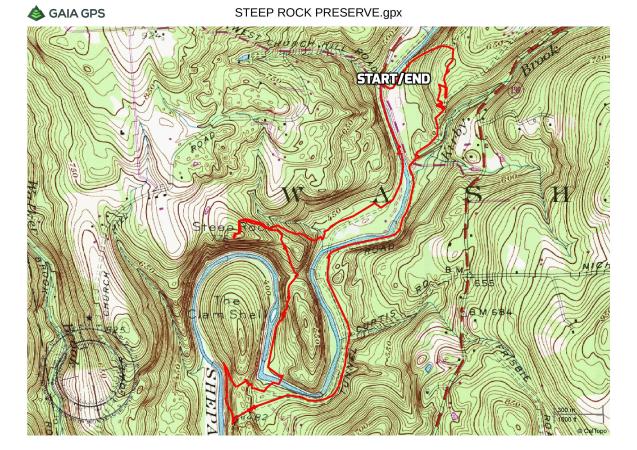
Steep Rock Preserve Loop

March 17, 2018 – Washington Depot, Connecticut

Difficulty: Moderate

Length: Approximately 5.7 miles

Max elevation: 776 ft.– total elevation gain approximately 742 ft.

Route type: Circuit

Map: Steep Rock Preserve Map

Trailhead parking: 2 Tunnel Road, Washington Depot, CT


Overview:

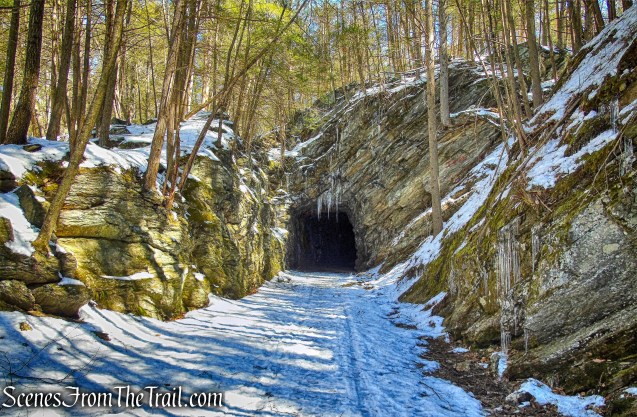
The 998-acre Steep Rock preserve offers hiking trails which follow the banks of the Shepaug River and provide access to the hillsides above. The Shepaug Valley Railroad which ran from 1872 to 1948, wound through the preserve alongside the river. After the railroad ceased operation, the 235-foot curved railroad tunnel became a section of a trail, a rough arch cut through a rock ledge.

I visited this place in January of 2016, prior to beginning this blog. I really enjoyed the area and decided to pay it a return visit. An 80 minute drive from Westchester County, but totally worth it. With over 20 miles of trails in the preserve, one can create any number of loop hikes. A map and a compass is strongly suggested since the vast network of trails and its numerous intersections can be confusing at times. I tried to incorporate as many points of interest as possible into this hike. We started by checking out the Holiday House ruins, which we missed on our prior visit, the train tunnel, the suspension bridge and the summit, in a clockwise fashion.

Steep Rock Preserve Loop

Steep Rock Preserve Loop

The Hike:

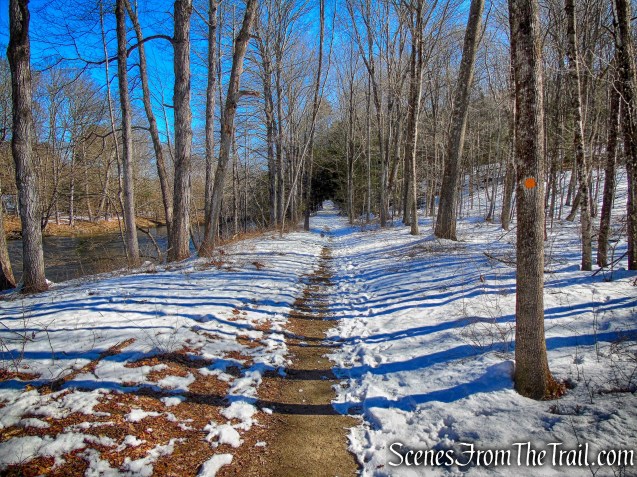
We parked in the riding ring parking area which is just over the the bridge that carries Tunnel Road over the Shepaug River. We began the hike by starting out on the orange-circle-blazed Northern Loop Trail. It starts out on a level woods road and parallels the Shepaug River as it heads northeast.

Northern Loop Trail

Northern Loop Trail

Soon the trail begins to climb and comes to a fork. The orange-circle-blazed Northern Loop Trail veers left and leaves the woods road, but we stayed to the right, now following the White Diamond Trail. The white-diamond-blazed trails are connector trails and are seen throughout the preserve.

take the right fork

take the right fork

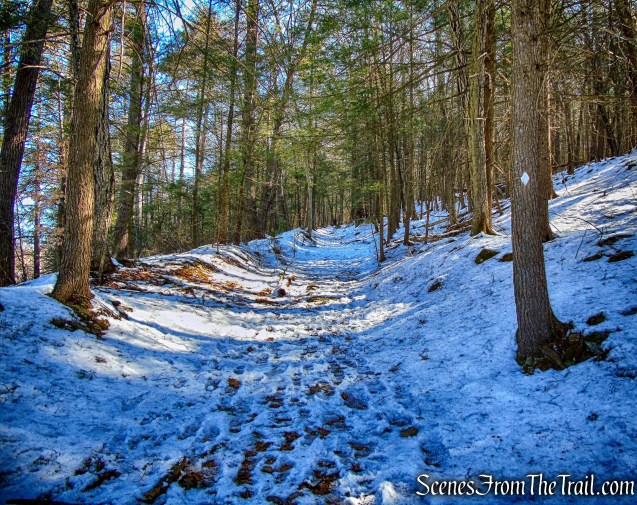
The White Diamond Trail continues its steady ascent through a forest of pine trees.

White Diamond Trail

White Diamond Trail

Near the top of the rise, the trail makes a sharp right turn and levels off. It then ends at a T-intersection with the blue-circle-blazed Holiday House Trail, which also travels on a woods road. We turned right, now following the blue circles and heading south.

Holiday House Trail

Holiday House Trail

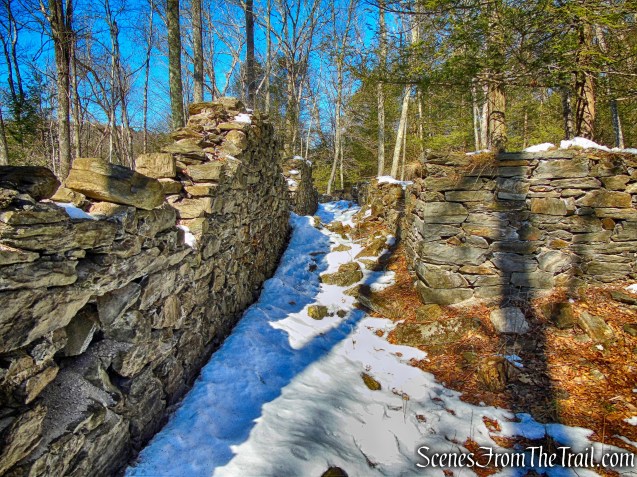
The trail descends gently and passes a stone foundation, cellar hole and stone walls on the left.

stone walls

stone walls

A little further down the trail are the ruins of the Holiday House. According to the Steep Rock Association, the hotel was built in 1893 by Edward Van Ingen, a wool importer. Van Ingen built the hotel as a memorial to his daughter, who had recently died of scarlet fever.

Holiday House - From the Collection of the Gunn Memorial Library and Museum

Holiday House – From the Collection of the Gunn Memorial Library and Museum

Completed in 1893, Holiday House was conceived as a vacation retreat for working-class women. Since there were no labor laws or protection against exploitation, the Van Ingens wanted to provide a space for gracious and simple living for these women to enjoy life and leave their sweatshop jobs behind for a few weeks”

Holiday House ruins

Holiday House ruins

After World War I, the family could no longer afford the upkeep of this summer getaway and closed the doors in 1918. Unable to sell or donate the building, the family chose to dismantle the house and donate the building parts and furnishings to the townspeople.

Holiday House ruins

Holiday House ruins

All that now remains on-site is the foundation of the original building.

Holiday House ruins

Holiday House ruins

The ruins of the Holiday House are quite extensive and we explored them for a while, visualizing this grand hotel that once stood on the hillside overlooking the Shepaug River.

Holiday House ruins

Holiday House ruins

We then continued walking downhill and reached a 4-way junction with the white-circle-blazed Trail. We turned left, now following the white circles, heading south.

White Circle Trail

White Circle Trail

The trail continues to descend and just before reaching Kirby Brook Road, makes a right turn, now heading southwest. The trail passes a fireplace and what looked like some stone benches, where we took a brief rest.

White Circle Trail

White Circle Trail

The trail ends at the junction with the yellow-circle-blazed Steep Rock Loop Trail and Kirby Brook Road. We walked onto the Steep Rock Loop Trail and turned left, now heading south, with the Shepaug River to our right.

Steep Rock Loop Trail

Steep Rock Loop Trail

The Steep Rock Loop Trail travels along the edge of the river on a mostly level grade. After just over 0.5 mile of walking alongside the Shepaug River, we left the Steep Rock Loop Trail and turned left onto the blue-square-blazed Pinney Loop Trail, a 2.4 mile loop trail that begins on a former rail bed.

Pinney Loop Trail

Pinney Loop Trail

The Pinney Loop Trail veers away from the river at first, but then travels mostly parallel to the Steep Rock Loop Trail. It then curves slightly southwest as it approaches the train tunnel. The trail then begins a straight run towards the tunnel which becomes visible in the distance. It’s about 0.9 mile to the tunnel from the start of the Pinney Loop Trail.

Pinney Loop Trail

Pinney Loop Trail

The tunnel was carved in 1871 to accommodate the Shepaug Valley Railroad. The Shepaug, Litchfield and Northern Railroad was a short independent railroad in western Connecticut that was chartered as the Shepaug Valley Railroad in 1868 and operated from 1872 to 1891 when it was taken over by the Housatonic Railroad.

railroad tunnel - Pinney Loop Trail

railroad tunnel – Pinney Loop Trail

The Shepaug Valley Railroad was renowned for its labyrinthine route. It was said that the line took 32 miles of track to travel a distance of only 18 miles.

railroad tunnel - Pinney Loop Trail

railroad tunnel – Pinney Loop Trail

As far as I’m concerned, this was the highlight of the hike. The Pinney Loop Trail travels right through the tunnel, which makes it even more interesting. We entered through the north end of the tunnel.

railroad tunnel - Pinney Loop Trail

railroad tunnel – Pinney Loop Trail

The 235 ft. long curved tunnel was cut through rock southwest of Washington Depot and is now part of the Pinney Loop Trail. A crew of coal miners from Pennsylvania constructed it over nine months between 1871 and 1872. The crew often worked by hand using picks and also employed dynamite and nitroglycerin to blast through the ridge.

railroad tunnel - Pinney Loop Trail

railroad tunnel – Pinney Loop Trail

In the winter time, large ice stalactites form on the ceiling, some reaching all the way to the floor creating thick ice columns.

railroad tunnel - Pinney Loop Trail

railroad tunnel – Pinney Loop Trail

The light at the end of the tunnel.

railroad tunnel - Pinney Loop Trail

railroad tunnel – Pinney Loop Trail

The view from the other end of the tunnel (southern end).

railroad tunnel - Pinney Loop Trail

railroad tunnel – Pinney Loop Trail

It was at this time that we saw two adult Bald Eagles through the trees, flying over the river.

railroad tunnel - Pinney Loop Trail

railroad tunnel – Pinney Loop Trail

After exiting the tunnel, we had the option of continuing on the Pinney Loop Trail which proceeds straight ahead on the abandoned railbed then turns left and travels over the top of the tunnel or take the shorter route by turning right just past the tunnel and taking the orange-square-blazed Trail. We opted for the shorter route. The Orange Square Trail descends towards the river and the “clam shell” section (named for the land’s clam-like appearance). The trail parallels the river as it heads towards the clam shell section. It was in this area that we saw a large bear print in the snow.

Orange Square Trail

Orange Square Trail

When we came to a junction with the White Diamond Trail, we made a hard right and ascended the hillside. We then came to a 5-way intersection which was confusing and I had to stop and consult both my map and compass to make sure we were on the correct route. Since the trails are near the double oxbows (where the river loops south, north, and then south again), using the river as a guide will not work here. We turned right, still following the White Diamond Trail which then ended at a T-intersection with the blue-square-blazed Pinney Loop Trail. We turned left and walked a short distance until we saw the yellow-circle-blazed Steep Rock Loop Trail on the left.

yellow-circle-blazed trail Steep Rock Loop Trail

yellow-circle-blazed trail Steep Rock Loop Trail

The trail heads towards the river then turns right. In a short distance the Hauser footbridge comes into view.

Hauser footbridge

Hauser footbridge

The Hauser footbridge, a wood and cable suspension bridge, was built in 1991 across the Shepaug River.

Hauser footbridge

Hauser footbridge

The Steep Rock Loop Trail crosses the bridge.

Hauser footbridge

Hauser footbridge

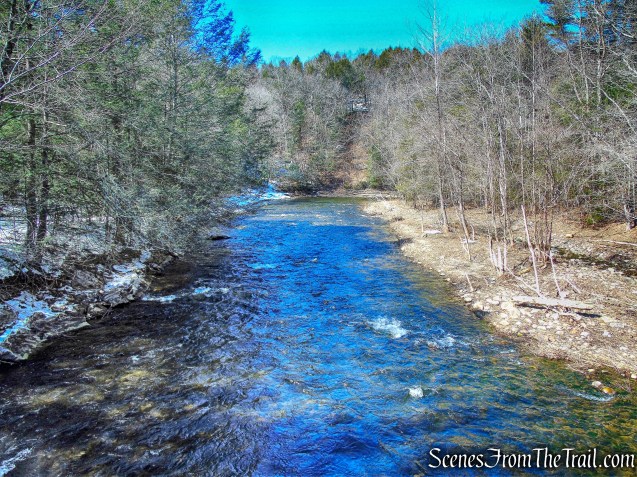
The suspension bridge shook slightly as we walked on it and it affords a delighful view from the center, of the Shepaug River. Deriving its name from the Mohegan word for “rocky water,” the Shepaug River extends for 26 miles across northwestern Connecticut.

Shepaug River

Shepaug River

The Shepaug River, is a serpentine waterway that twists through on its way from the Mohawk State Forest and the Shepaug Reservoirs to the Housatonic River.

Shepaug River

Shepaug River

After crossing the bridge, we turned left on the Green Circle Trail which heads west on a woods road along the river then turns right and heads north, just across the river from the clam shell section. This is a scenic section of trail with numerous spots along the river to relax.

Green Circle Trail

Green Circle Trail

The Green Circle trail then leaves the woods road and continues on a footpath, which climbs gradually at first, then more steeply.

Green Circle Trail

Green Circle Trail

In about 700 feet, which seemed longer, the Green Circle Trail joins the Steep Rock Loop Trail, on a woods road. We stopped briefly to catch our breath and resumed our ascent towards the summit.

joint Green Circle/Steep Rock Loop Trails

joint Green Circle/Steep Rock Loop Trails

In a short distance, the two trails split, with the Steep Rock Loop Trail turning left to continue ascending the mountain. It is only 0.4 mile to the summit from here, but it felt like much longer. They don’t call it Steep Rock for nothing.

Steep Rock Loop Trail

Steep Rock Loop Trail

As I was approaching the summit, several hikers were on their way down. When I got there, I had it all to myself for several minutes before I was joined by others.

Steep Rock summit

Steep Rock summit

At an elevation of 776 feet, Steep Rock Summit provides visitors with a picturesque view of the Clam Shell section of the Shepaug River Valley. The Turkey Vultures use the valley and ride the thermals up into the sky.

view of clam shell from Steep Rock summit

view of clam shell from Steep Rock summit

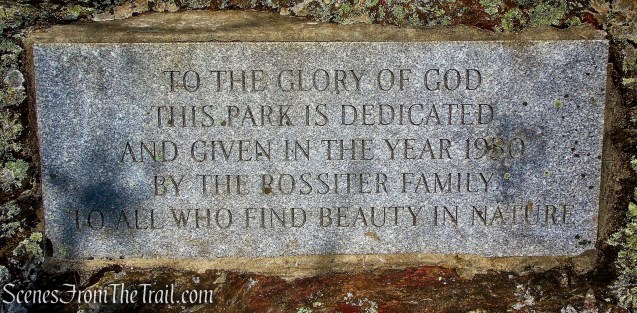
The plaque at the summit, from 1930, commemorates the gift of this land. In 1925 architect Ehrick Rossiter donated the land, which included the Steep Rock overlook, to a carefully chosen group of trustees, thus ensuring its preservation. Four years later the trustees purchased the area known as the Clam Shell, and in doing so preserved the view from Steep Rock.

plaque - Steep Rock summit

plaque – Steep Rock summit

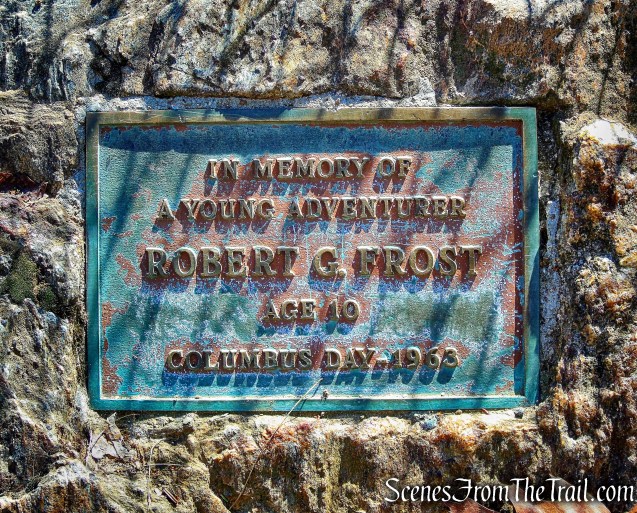
There is another plaque from 1963, memorializing a child who lost his life from falling off the cliff.

plaque - Steep Rock summit

plaque – Steep Rock summit

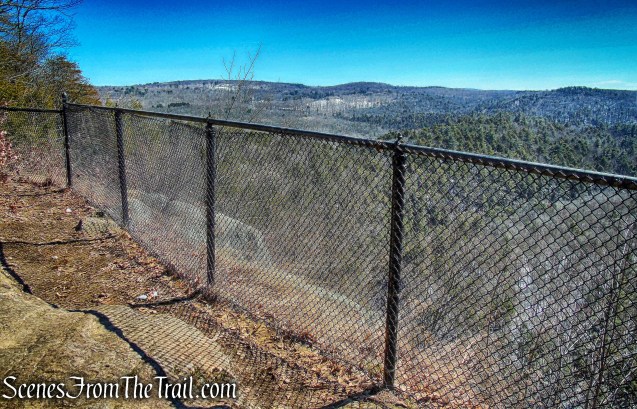
Since that accident, a fence has been erected at the summit, allowing hikers to get a great view while staying safe.

Steep Rock summit

Steep Rock summit

Enjoying the view and a snack while contemplating the rest of the hike, I was extremely pleased that the rest of the hike was all downhill from here.

Steep Rock summit

Steep Rock summit

We then retraced our steps on the Steep Rock Loop Trail for about 1,000 feet until we came to a fork. At this point the Steep Rock Loop Trail goes south (the way we came up) and also heads east and diagonally back towards the parking area (to the left). We veered left at the fork and began a steady descent.

Steep Rock Loop Trail

Steep Rock Loop Trail

This trail runs along the western slope of the mountain as it descends through a pine forest. I found this trail to be very tranquil and pleasant to travel on. Near the base of the descent, we crossed a stream.

Steep Rock Loop Trail

Steep Rock Loop Trail

The trail then levels off and travels on a woods road.

Steep Rock Loop Trail

Steep Rock Loop Trail

We passed an entrance to a campsite and in a short distance we took a short spur trail that leads to the Green Circle Trail and closer to the river. I wanted to conclude the hike with a nice scenic walk along the edge of the Shepaug River. Turning left and now heading north, this trail runs on a section of the abandoned railbed.

Green Circle Trail

Green Circle Trail

There are stone foundations for a pedestrian suspension bridge that allowed train passengers to disembark and make their way to the Holiday House just across the river.

stone foundations for a pedestrian suspension bridge

stone foundations for a pedestrian suspension bridge

An old image of the Railroad stop and suspension bridge for passengers destined for the grand Holiday House.

Railroad stop and suspension bridge - From the Collection of the Gunn Memorial Library and Museum

Railroad stop and suspension bridge – From the Collection of the Gunn Memorial Library and Museum

After a nice leisurely walk along the river, the Green Circle Trail ends at a kiosk by the bridge on Tunnel Road, that we drove over when entering the preserve. We crossed the bridge and made our way back to the parking area where our hike began.

Tunnel Road

Tunnel Road

An excellent hike that had many points of interest and was scenic throughout. I highly recommend this hike to everyone. You can follow the route that we took or create your own. From what I read, this is a popular place in the warm weather so don’t expect solitude if visiting. We started our hike at about 10:30 am and ran into about a 1/2 dozen people or so. With no snow on the ground I could only imagine that it would have been considerably more.

Pros: Historical features, train tunnel, ruins, views, Shepaug River, suspension bridge, scenic area, wildlife.

Cons: Long drive from Westchester (80 minutes).

Take a hike!

Steep Rock Preserve Loop

Steep Rock Preserve Loop

Source: 


Kent Falls State Park

March 11, 2018 – Kent, Connecticut

Difficulty: Easy

Length: Approximately 1.2 miles

Max elevation: 668 ft.– total elevation gain approximately 256 ft.

Route type: Circuit

Map: Kent Falls State Park Map

Trailhead parking: 462 Kent Cornwall Rd, Kent, CT 06757


Kent Falls State Park is a public recreation area located in the town of Kent, Connecticut, within the Litchfield Hills region of the southern Berkshires. The state park is home to Kent Falls, a series of waterfalls on Falls Brook, a tributary of the Housatonic River. The falls drop 250 feet in under a quarter mile. The largest cascade drops more than 70 feet into a reflecting pool, before traveling over the lesser falls.

Kent Falls

Kent Falls

Acquisition of the park began in 1919 with the gift of 200 acres by the White Memorial Foundation. Other parcels were donated or purchased until the present 295 acres were acquired. The area was developed in the 1930’s by the Civil Works Administration. In the mid 1970’s, considerable trail reconstruction was done by the Youth Conservation Corps of Connecticut. The covered bridge is an authentic reproduction built in 1974 by a park employee, Edmund Palmer.

Kent Falls Covered Bridge

Kent Falls Covered Bridge

I was looking to get out of New York for the day and decided to take a cruise into Connecticut. There are many great state parks in Connecticut and I have visited a few of them. With all the snow on the ground, I wanted to keep the hike short, but interesting. Kent Falls State Park has two short marked trails and a series of steps that climb steeply along the falls. On the way there I made a couple of stops to view two historic covered bridges. The first bridge I saw was Bull’s Bridge, which was built in 1842.

Bull's Bridge

Bull’s Bridge

The 109 ft. bridge was built with a Town lattice design and has reinforced trusswork visible on the interior.

Bull's Bridge

Bull’s Bridge

Bull’s Bridge spans the Housatonic River and the view through one of the portals shows the the waterfalls and rapids created by the hydro-electric power plant upstream.

waterfalls and rapids - Housatonic River

waterfalls and rapids – Housatonic River

We then continued on our way, driving past Kent Falls State Park and visiting West Cornwall Covered Bridge, which after earlier versions were destroyed, was constructed circa 1864.

West Cornwall Covered Bridge

West Cornwall Covered Bridge

The bridge’s Town lattice truss is constructed of red-spruce timbers secured by treenails (a hard wooden pin used for fastening timbers together) and the span is made of native oak.

West Cornwall Covered Bridge

West Cornwall Covered Bridge

The West Cornwall Covered Bridge, which spans the Housatonic River, is 172 feet long, 15 feet wide and supports one lane of vehicle traffic for the Sharon-Goshen Turnpike (Connecticut Route 128).

West Cornwall Covered Bridge

West Cornwall Covered Bridge

Check out the Google Earth Fly-Through video of the hike below.

The cool thing about these two bridges is that they are both open to vehicular traffic. After the slight detour, I then turned around, drove through the bridge again and made my way to Kent Falls State Park where I was greeted with yet another covered bridge.

covered bridge - Kent Falls State Park

covered bridge – Kent Falls State Park

The hike begins by walking through the bridge that spans Kent Falls Brook. The Kent Falls Covered Bridge is a one span Town Lattice Truss with a total length of 37 feet.

covered bridge - Kent Falls State Park

covered bridge – Kent Falls State Park

The covered bridge is an authentic reproduction, built in 1974 by a park employee, Edmund Palmer.

Kent Falls Covered Bridge

Kent Falls Covered Bridge

I proceeded ahead towards the falls on the freshly packed path. I was wearing Hillsound Trail Crampons for better traction since I knew I would be ascending steeply along the side of the falls. The spikes are just a little longer and much sharper than the Kahtoola MICROspikes, which I normally wear.

Kent Falls State Park

Kent Falls State Park

After a short walk, I arrived at the base of the falls which is quite stunning in any season. Like most waterfalls, the flow is normally heaviest in the spring when the winter snow is melting.

Kent Falls

Kent Falls

After admiring the falls for a few minutes, I proceeded up the stone steps past a stone viewing platform.

stone steps - Kent Falls State Park

stone steps – Kent Falls State Park

I then began to tackle the steep steps alongside the falls. It is steep, but the stairs and the railings make it less challenging.

Kent Falls Trail

Kent Falls Trail

In the next 0.3 mile, the elevation gain is just over 200 feet.

Kent Falls Trail

Kent Falls Trail

The well constructed viewing platforms along the way are a nice touch and also gave me an excuse to stop.

viewing platform - Kent Falls Trail

viewing platform – Kent Falls Trail

There are several platforms on the way up which afford a nice view of the different cascades as they drop into the different pools.

Kent Falls

Kent Falls

A few of the pools look like great wading holes, in the warmer weather of course.

Kent Falls

Kent Falls

As I neared the top, I found this snowman that someone had built, on one of the platforms.

snowman

snowman

The steep climb is definitely worth the payoff, as each cascade is different and the area along the falls very scenic.

Kent Falls

Kent Falls

When I reached the top, there were two young ladies having a picnic on the viewing platform. I thought that it was pretty cool.

viewing platform - Kent Falls

viewing platform – Kent Falls

Another nice cascade can be seen from the uppermost viewing platform.

Kent Falls

Kent Falls

After enjoying every cascade that Kent Falls has to offer, I proceeded up the hill to find my way to the other side of the falls. There are no blazes to lead the way, but I followed the trail left behind by a previous hiker.

Kent Falls Trail

Kent Falls Trail

Kent Falls Trail

Kent Falls Trail

The trail travels around a large rock formation then leads back towards Kent Falls Brook (which feeds the waterfall) and to Dugan Road.

Kent Falls Trail

Kent Falls Trail

I continued towards the road and there is a wooden post indicating the direction of the North Ridge Trail. According to the map, the Kent Falls Trail ends here.

trail junction

trail junction

I crossed over to the other side of the brook on a bridge on Dugan Road.

Dugan Road

Dugan Road

I stopped on the bridge for a minute to check out Kent Falls Brook before it flows under the bridge and over the falls.

Kent Falls Brook

Kent Falls Brook

Immediately after crossing the bridge, there is a red blaze on a tree that marks the start of the red-blazed North Ridge Trail. The trail descends gradually along the north side of Kent Falls. There are no views of the falls from this trail.

red-blazed North Ridge Trail

red-blazed North Ridge Trail

The North Ridge Trail begins heading north through the woods then veers slightly to the west. There is a yellow-blazed trail that goes off to the right, but I didn’t see it. I wasn’t planning to hike that trail anyway. According to the map, the Yellow Trail heads northeast then veers to the left and heads southwest to meet up with the North Ridge Trail (red) as it nears the parking area.

North Ridge Trail

North Ridge Trail

The blazes are rather sparse in this area and I got so caught up following the tracks through the snow that I lost sight of the blazes a couple of times. It appears that the previous hiker wandered off the trail several times and I followed right along. Nevertheless, I wasn’t worried and found my way back to the trail. The trail follows the edge of a steep drop off at times, but nothing severe.

North Ridge Trail

North Ridge Trail

The trail then descends more steeply as it nears its terminus at the northeast end of the parking area.

North Ridge Trail

North Ridge Trail

Although it was a short hike, it got my blood pumping. The extra effort that I had to put in walking in the snow was enough exercise for one day. I took a short rest enjoying my surroundings before I hit the road.

Kent Falls State Park

Kent Falls State Park

All in all it was just the hike I was looking for. The scenic ride on the way here made it that much more enjoyable. I love covered bridges and their historical past and always worth visiting, if in the area. On my way back to Westchester County, I stopped at an antique locomotive that was parked on the tracks by the side of the road.

Argent Lumber Co. Engine #4

Argent Lumber Co. Engine #4

Argent Lumber Co. Engine #4 is a narrow gauge (3-foot) steam engine built by Porter in 1909 for the Dennis-Simmons Lumber Co. in Wilson, NC, later sold to the Argent Lumber Co., in Hardeeville, SC. In 1960 it was sold to Edaville Corp. This locomotive was purchased from Edaville by Dr. Richard May in 1991 and later sold to Connecticut Antique Machinery Association (CAMA) in 1994.

Argent Lumber Co. Engine #4

Argent Lumber Co. Engine #4

As it turned out, this was basically a cruise in the country with a hike thrown in to stretch the old legs. I subscribe to the theory that if in the area, you might as well visit it because you never know when you’ll be back there, if at all. I accomplished that on this day. I hope that you enjoyed my journey in Connecticut and don’t forget to get out there and take a hike!

Pros: covered bridges, waterfall, antique train.

Cons: trails could be better blazed.

West Cornwall Covered Bridge

West Cornwall Covered Bridge


Mohegan Farm Ruins from Old Farm Trailhead

March 4, 2018 – Mohegan Lake, NY

Difficulty: Easy

Length: Approximately 4 miles

Max elevation: 683 ft.– total elevation gain approximately 254 ft.

Route type: Out and back

Map: Sylvan Glen Nature Preserve Map (Only for the start of the hike)

Trailhead parking: 2749 Stoney St. Mohegan Lake, NY 10547

Disclaimer: Exploring abandoned and/or ruined structures can be dangerous and you could be trespassing. Should you choose to enter the property of any of the places featured on this site, do so legally.

During the late 1800’s, the Mohegan Farm was a local landmark. Located at the South and East side of the lake, from Christine Road to Judy Road, to Sylvan Road, the farm covered 300 acres and produced dairy products, fruit and grains. According to the Yorktown Historical Society, it was owned and operated by William Baker, owner of Baker’s Chocolates, for whom Baker Street is named. Upon doing some research of the history of Baker’s Chocolates, I saw no mention of a William Baker or the Mohegan Dairy Farm. Baker’s Chocolates was founded in Dorchester Massachusetts. Nevertheless there are many old stone walls still standing, the remains of the once great farm are extensive and well worth the visit.

I wanted to check out these ruins last week prior to hiking Sylvan Glen Nature Preserve, but there is no place to park close to the farm ruins. I did a little research using some maps and discovered that by parking at the Stoney Street trailhead, I could use marked trails to get close and then bushwack the rest of the way. With the Nor’easter the previous day, there was still some snow on the trails and the felled trees from the storm had us climbing over and crouching under some huge blowdowns. A relatively easy out and back hike, but better done in the cooler months, when there is less foliage, due to the bushwacking.

Mohegan Farm Ruins from Old Farm Trailhead

Mohegan Farm Ruins from Old Farm Trailhead

We began our hike on the green-blazed Old Farm Trail, located just off Stoney Street. It is another entrance to the Sylvan Glen Nature Preserve, on its eastern boundary. There were no other cars there as we arrived just after 9:00 am. At the conclusion of the hike, there was one other car in the lot.

Old Farm Trail

Old Farm Trail

Immediately after the kiosk, the trail travels over a wet area on wooden planks. There was a tree blocking the way, but it was easy to get over it.

Old Farm Trail - Sylvan Glen Nature Preserve

Old Farm Trail – Sylvan Glen Nature Preserve

Following the Old Farm Trail in a westerly direction, it was mostly free of snow, but there were some blowdowns along the trail.

Old Farm Trail - Sylvan Glen Nature Preserve

Old Farm Trail – Sylvan Glen Nature Preserve

The Old Farm Trail heads uphill and passes an orange blazed trail to Quarry Drive (no parking). After going through a stone wall, it turns right onto the Ring Trail (yellow), an old riding ring.

Old Farm Trail - Sylvan Glen Nature Preserve

Old Farm Trail – Sylvan Glen Nature Preserve

In about 100 feet, the Old Farm Trail, departs from the Ring Trail, turns right and passes through the stone wall a second time.

Old Farm Trail - Sylvan Glen Nature Preserve

Old Farm Trail – Sylvan Glen Nature Preserve

The trail continues in a westerly direction and crosses a wooden footbridge over a large ditch. We had to make our way around the large blowdown on the other side.

Old Farm Trail - Sylvan Glen Nature Preserve

Old Farm Trail – Sylvan Glen Nature Preserve

Almost immediately after crossing the bridge, we crossed a small stream and came to a junction with the start of the pink-blazed Taconic Bridge Trail. This trail heads towards Granite Knolls Park and the bridge over the Taconic State Parkway.

Taconic Bridge Trail

Taconic Bridge Trail

The Taconic Bridge Trail travels north through stone walls then over a large wet area on wooden planks. We were the first to trek through here on this day except for some wildlife.

Taconic Bridge Trail

Taconic Bridge Trail

Taconic Bridge Trail

Taconic Bridge Trail

The mostly level trail passes a water-filled quarry.

water-filled quarry - Taconic Bridge Trail

water-filled quarry – Taconic Bridge Trail

water-filled quarry - Taconic Bridge Trail

water-filled quarry – Taconic Bridge Trail

The trail turns left at the northern end of the quarry where we encountered some serious blowdowns. We ducked under some and walked around others.

blowdown - Taconic Bridge Trail

blowdown – Taconic Bridge Trail

A massive uprooted tree blocked our path, but we made our way around it.

uprooted tree - Taconic Bridge Trail

uprooted tree – Taconic Bridge Trail

On the other side of the uprooted tree, the Taconic Bridge Trail turns right and joins the start of the white-blazed Seminary Ridge Trail.

co-aligned Seminary Ridge/Taconic Bridge trails

co-aligned Seminary Ridge/Taconic Bridge trails

The ground in this area was saturated and the trail was swampy. Some fairly new wooden planks along some sections of the trail, made the going easier.

co-aligned Seminary Ridge/Taconic Bridge trails

co-aligned Seminary Ridge/Taconic Bridge trails

We then came to a gas pipeline cut and the two trails split. The Taconic Bridge Trail turns right on the pipeline cut and heads east to Granite Knolls Park. The Seminary Ridge Trail continues straight and reenters the woods. We continued ahead, following the white blazes of the Seminary Ridge Trail.

pipeline cut

pipeline cut

Seminary Ridge Trail

Seminary Ridge Trail

The Seminary Ridge Trail begins to veer slightly to the east and skirts the former Phoenix Academy. It then enters the property and ends.

terminus of the Seminary Ridge Trail

terminus of the Seminary Ridge Trail

The trail ends by what appears to be a handball court. It was here that we saw the only other person on our hike, a guy on a mountain bike.

handball court - Phoenix Academy

handball court – Phoenix Academy

After passing a vacant house and an abandoned inground pool, we then continued heading north on a paved campus road.

paved campus road - Phoenix Academy

paved campus road – Phoenix Academy

We passed what might have been a staff residence and an outbuilding along the way.

staff residence - Phoenix Academy

staff residence – Phoenix Academy

outbuilding - Phoenix Academy

outbuilding – Phoenix Academy

This 140-acre hilltop property was most recently the Shrub Oak campus of Phoenix Academy, a substance abuse rehabilitation program for teenagers. Phoenix House acquired it in an auction in 1983 for 3 million dollars. It has been closed since 2015 and it has remained vacant since that time. The campus includes a five-story, 270,000-square-foot building, six houses used for staff residences and several other outbuildings. The main building below, houses dormitories, classrooms, offices and a bomb shelter.

Phoenix Academy

Phoenix Academy

The campus was built in 1954 as the site of Loyola Seminary, which was owned by the Jesuits. The property was later sold to a Bible college before Phoenix House acquired it in 1983.

Loyola Seminary

Loyola Seminary

Shrub Oak International School, a private day school and boarding program for people with autism is scheduled to open here in the fall of 2018.

Loyola Seminary

Loyola Seminary

We walked down behind the building to where there are some basketball courts. I noticed what appears to be an old unpaved road that descends to the west. We walked down that road to see if there were any trails that led north.

unpaved road

unpaved road

The road reaches a small level area, where through the trees, I saw an opening in a stone wall. That was as good a place as any to begin our bushwack north to the farm ruins. As far as bushwacks go, this wasn’t too bad. The occasional massive downed tree and thorn bushes made us change directions and detoured us several times, but it was manageable. We did see a Barred Owl flying through the woods. Much to our delight, it landed in a tree where we could photograph it, as it sat on its perch.

DSC04502 (2)_HDR_marked

Barred Owl

A little further north, sitting on the hillside, are the ruins of a small stone house……

ruins of a small stone house

ruins of a small stone house

fireplace and chimney still intact.

fireplace

fireplace

While sitting by these ruins, I looked to my right (north) and I could make out some stone walls in the near distance. The stone arch of the dairy building came into view as we approached the focus of our hike.

Dairy building - Mohegan Farm ruins

Dairy building – Mohegan Farm ruins

Dairy building - Mohegan Farm ruins

Dairy building – Mohegan Farm ruins

These farm ruins are quite impressive. The closer we got the more striking they became. We walked through the stone arch to get a peek at what remained of this 19th century dairy farm. The walls on either side of the Dairy building extend for a considerable distance.

Dairy building - Mohegan Farm ruins

Dairy building – Mohegan Farm ruins

We walked to the other end and found another ruined structure close by. I believe that this was a general purpose building as it sits near the road.

general purpose building - Mohegan Farm ruins

general purpose building – Mohegan Farm ruins

Although we didn’t see any signs, I am not sure if we were allowed to be there.

general purpose building -  Mohegan Farm ruins

general purpose building – Mohegan Farm ruins

An odd sight was the way a tree grew up and around the arch.

general purpose building - Mohegan Farm ruins

general purpose building – Mohegan Farm ruins

general purpose building -  Mohegan Farm ruins

general purpose building – Mohegan Farm ruins

Since this was our turnaround spot, when we were done exploring, we began to retrace our steps back through the ruins.

Dairy building - Mohegan Farm ruins

Dairy building – Mohegan Farm ruins

It was a quiet walk back through the woods and through the old Loyola Seminary grounds. Back at the handball court, we took the white-blazed Seminary Ridge Trail south to the pink-blazed Taconic Bridge Trail and turned left (east) on the green-blazed Old Farm Trail. We followed the green blazes back to the parking area on Stoney Street, where our hike began. Lucky for us, someone cleared the tree that blocked the trail when we began our hike.

Old Farm Trail

Old Farm Trail

This turned out to be a pretty good hike considering I slapped it together at the last minute. It had plenty of interesting sights along the way and the sloppy trail conditions made it fun.

Pros: historical features, Mohegan Farm ruins, Barred Owl, bushwacking.

Cons: Thorn bushes.

Take a hike!

Mohegan Farm ruins

Mohegan Farm ruins


Mohegan Quarry Ramble – Sylvan Glen Park Preserve

February 24, 2018 – Mohegan Lake, NY

Difficulty: Easy – Moderate

Length: Approximately 5 miles

Max elevation: 616 ft.– total elevation gain approximately 576 ft.

Route type: Lollipop Loop

Map: Sylvan Glen Park Preserve Map

Trailhead parking: 2857 Grant Ave. – Mohegan Lake, NY 10547


Sylvan Glen Park Preserve is the site of The Mohegan Lake Quarry which operated from the 1890’s to 1940. It provided granite for St. John the Divine Cathedral, the New York State Office Building in NYC, the Schwab mansion, the State Armory and the Roosevelt Memorial in New York. It is also written that Mohegan Lake Quarry provided the granite blocks used in the construction of the Shrub Oak Methodist Church. Ornamental pieces, such as the eagles on the Arlington Memorial Bridge in Washington, D.C., were carved with finger-grip hammers by quarry workers. Columns and cornices were carved with the aid of steel shot and water, shaped with pneumatic hammers and polished with steel discs at the site. Some equipment, cables, building foundations, discarded columns and polished blocks remain at the quarry site for hikers to view.

Sylvan Glen Park Preserve

Sylvan Glen Park Preserve

The 408 acre park has 6.2 miles of trails and is located in northern Westchester County, NY. The property was purchased in 1981 and was opened as a park when additional adjoining properties were acquired. Quarries of various sizes and remnants of the operations are located throughout the western portion of the park. Subsequent acquisition of adjacent land extended the park onto former farmland and provided another entrance to the park. The trails traverse a variety of terrain, from steep climbs to gentle woods roads. Interpretive signs, near the quarry operations that ceased at the beginning of World War II, provide an insight into the Town of Yorktown’s largest employer at the time. The trails through the former farmland offer a different perpective of land use, including a 0.25 mile riding ring and large ditches dug to drain wetlands.

Mohegan Quarry Ramble - Sylvan Glen Park Preserve

Mohegan Quarry Ramble – Sylvan Glen Park Preserve

The forecast called for rain in the early afternoon and I wanted to get a hike in before the skies opened up. I figured that this was a hike that could be completed in a few hours. We were able to complete the hike in about 2 hours and 40 minutes and just as we began to drive away, it began to rain. Perfect timing.

From the kiosk at the end of the parking area, we proceeded ahead on the white-blazed Turtle Pond Trail.

Sylvan Glen Park Preserve

Sylvan Glen Park Preserve

The Turtle Pond Trail follows a woods road and passes a pond on the right.

white-blazed Turtle Pond Trail

white-blazed Turtle Pond Trail

After passing a fenced-in dog park on the left, the trail bears right, then turns left as it heads uphill.

white-blazed Turtle Pond Trail

white-blazed Turtle Pond Trail

At the top of the climb, three yellow blazes on a tree to the left mark the start of the Snake Hill Trail and almost immediately the end of the blue-blazed High Quarry Trail. We continued on the Turtle Pond Trail which descends to cross a gas pipeline and reenters the woods on a footpath.

white-blazed Turtle Pond Trail

white-blazed Turtle Pond Trail

white-blazed Turtle Pond Trail

white-blazed Turtle Pond Trail

After reentering the woods, the Turtle Pond Trail passes through white pines and crosses Sylvan Brook.

Sylvan Brook

Sylvan Brook

Foundations and remnants of quarrying operations along with interpretive signs are along the trail. The trail turns, passes the High Quarry Trail (blue) to the left and turns right. At 1.1 miles, the trail turns left, passes the end of the Sylvan Glen Trail (red), and ascends. The Turtle Pond Trail ends at the blue-blazed High Quarry Trail, here we turned right and headed steeply uphill.

blue-blazed High Quarry Trail

blue-blazed High Quarry Trail

At the top, pieces of abandoned quarry machinery and cables are scattered along the trail.

abandoned quarry machinery - Sylvan Glen Park Preserve

abandoned quarry machinery – Sylvan Glen Park Preserve

abandoned quarry machinery - Sylvan Glen Park Preserve

abandoned quarry machinery – Sylvan Glen Park Preserve

abandoned quarry machinery - Sylvan Glen Park Preserve

abandoned quarry machinery – Sylvan Glen Park Preserve

The High Quarry Trail ascends along the edge of the quarry pit, with slabs of granite to the left.

blue-blazed High Quarry Trail

blue-blazed High Quarry Trail

At the top of the rise, the trail goes under a rock bridge.

rock bridge - High Quarry Trail

rock bridge – High Quarry Trail

rock bridge - High Quarry Trail

rock bridge – High Quarry Trail

rock bridge - High Quarry Trail

rock bridge – High Quarry Trail

The High Quarry Trail begins to descend, passes a water-filled quarry and then a stone shed that housed explosives.

water-filled quarry - High Quarry Trail

water-filled quarry – High Quarry Trail

explosives shed - High Quarry Trail

explosives shed – High Quarry Trail

At approximately 1.7 miles, we took a side trail to a view into the quarry pit and to the west. Making sure to observe caution and staying back from the edge.

view over the quarry

view over the quarry

caution sign

caution sign

After taking a short break at the view, we returned to the blue-blazed High Quarry Trail and turned right. Almost immediately, the red-blazed Sylvan Glen Trail comes in from the right and joins the High Quarry Trail. We followed the co-aligned High Quarry (blue) and Sylvan Glen (red) trails east, away from the quarry operations.

co-aligned High Quarry and Sylvan Glen trails

co-aligned High Quarry and Sylvan Glen trails

When the trails split, we veered right and began following the red blazes of the Sylvan Glen Trail.

veer right onto the red-blazed Sylvan Glen Trail

veer right onto the red-blazed Sylvan Glen Trail

The Sylvan Glen Trail crosses wet areas on wooden planks.

wooden planks - Sylvan Glen Trail

wooden planks – Sylvan Glen Trail

DSC04339_HDR_marked

wooden planks – Sylvan Glen Trail

The Sylvan Glen Trail passes through and by numerous stone walls and then crosses a stream.

stream crossing - Sylvan Glen Trail

stream crossing – Sylvan Glen Trail

The trail passes through another wet area and goes up and over a knoll.

wet area - Sylvan Glen Trail

wet area – Sylvan Glen Trail

knoll - Sylvan Glen Trail

knoll – Sylvan Glen Trail

After going through several stone walls, the Sylvan Glen Trail passes a pond on the right.

pond - Sylvan Glen Trail

pond – Sylvan Glen Trail

After passing the pond, the red-blazed Sylvan Glen Trail ends at a junction with the green-blazed Old Farm Trail. This junction is approximately the midpoint of the hike at 2.5 miles. To the right are wooden planks that lead towards another trailhead and parking area on Stoney Street. We turned left onto the Old Farm Trail and began heading west.

green-blazed Old Farm Trail

green-blazed Old Farm Trail

The Old Farm Trail heads uphill and passes an orange blazed trail to Quarry Drive (no parking). After going through a stone wall, it turns right onto the Ring Trail (yellow), an old riding ring.

co-aligned Ring and Old Farm trails

co-aligned Ring and Old Farm trails

In about 100 feet, the Old Farm Trail, departs from the Ring Trail, turns right and passes through the stone wall a second time.

Old Farm Trail

Old Farm Trail

The trail continues in a westerly direction and crosses a wooden footbridge over a large ditch. It then passes the end of the pink-blazed Taconic Bridge Trail that heads to Granite Knolls Park and the bridge over the Taconic State Parkway. After following a woods road, the Old Farm Trail ends at the blue-blazed High Quarry Trail at approximately 3.0 miles. We turned left onto the High Quarry Trail, now heading south.

blue-blazed High Quarry Trail

blue-blazed High Quarry Trail

In approximately 360 yards, the blue-blazed High Quarry Trail turns right, joins the red-blazed Sylvan Glen Trail and heads towards the view over the quarry (from earlier in the hike). In about 400 feet, just before reaching that viewpoint, the trails split and we turned left now following the red blazes.

turn left on the red-blazed Sylvan Glen Trail

turn left on the red-blazed Sylvan Glen Trail

The Sylvan Glen Trail turns left at a huge rock pile and then begins to border it.

Sylvan Glen Trail

Sylvan Glen Trail

Sylvan Glen Trail

Sylvan Glen Trail

The Sylvan Glen Trail heads left uphill along a narrow path and turns around at the end of the knob of the hill. It descends gradually at first and then turns to descend steeply. At approximately 3.8 miles the trail reaches and steeply descends stone steps. These steps were built by the Jolly Rovers, a highly skilled group of Trail Conference volunteers who specialize in rock work. They spent 706 hours to build the 36 steps, moving 21 tons of stone in the process.

stone steps - Sylvan Glen Trail

stone steps – Sylvan Glen Trail

A side trail at the bottom of the steps leads 200 feet to the 18-foot circumference Quarry Oak.

Quarry Oak

Quarry Oak

yellow-blazed Quarry Oak Trail

yellow-blazed Quarry Oak Trail

yellow-blazed Quarry Oak Trail

yellow-blazed Quarry Oak Trail

This Oak tree is quite impressive and is also Westchester’s largest aquifer.

Quarry Oak

Quarry Oak

After taking a short break by the Quarry Oak, we walked back out to the Sylvan Glen Trail and turned left, now heading northwest. The Sylvan Glen Trail passes through a large rock pile and enters the quarry.

Sylvan Glen Trail

Sylvan Glen Trail

Sylvan Glen Trail

Sylvan Glen Trail

The trail leaves the quarry and ends at the Turtle Pond Trail. From there we retraced our steps back along the white-blazed trail. When we arrived at the crossing of Sylvan Brook, I noticed an attractive cascade just upstream which I had missed earlier. We bushwacked a short distance to get a closer look.

Sylvan Brook cascade

Sylvan Brook cascade

Back out to the Turtle Pond Trail, it was an easy and uneventful walk back to the parking area, where the hike began.

A very nice hike which was full of historical features and tranquil woods. A good hike to do when you are short on time or just want some alone time. We passed several hikers going in the opposite direction, but other than that we had the woods all to ourselves. There are a lot of intersecting trails which can be used to form different loop hikes. I would suggest that you print a copy of the map and carry a compass.

Pros: Historical features, well marked trails, not much foot traffic.

Cons: Barking dogs as you pass the dog park at the start of the hike.

Take a hike!

Sylvan Glen Park Preserve

Sylvan Glen Park Preserve


Cranberry Mine and Black Mountain Loop – Harriman State Park

February 17, 2018 – Woodbury, NY

Difficulty: Moderate

Length: Approximately 6 miles

Max elevation: 1,200 ft.– total elevation gain approximately 898 ft.

Route type: Lollipop Loop

Map: Harriman-Bear Mountain Trails Map #119

Trailhead parking: Silver Mine Picnic Area, Woodbury, NY 10980


This hike was originally slated for Sunday, but I rescheduled it to a day earlier in order to beat the snow. Since this hike consists of unmarked roads and some bushwacking it is best done when the leaves are off the trees. I visited Cranberry Mine a year earlier and decided to incorporate it into a longer loop hike and search for an obscure mine that sits hidden among the cliffs of Black Mountain.

Cranberry Mine and Black Mountain Loop

Cranberry Mine and Black Mountain Loop

Check out the Google Earth Fly-Through video of the hike below.


We parked at the Silver Mine Picnic Area on Seven Lakes Drive. There are plenty of parking spots available there and access to several trails as well.

Silver Mine Picnic Area

Silver Mine Picnic Area

Once parked and geared up, we crossed Seven Lakes Drive and headed for the sign just across the road. Just beyond the sign, there is an old woods road that parallels Seven Lakes Drive. We turned right and began heading east along this road.

old woods road

old woods road

The road gradually ascends then levels off as it veers north. This road was lined with telephone poles, which gave me the impression that at one time it was a main road, possibly used for transporting mining materials. This road is not maintained by the park and it appeared to be seldom traveled. It was swampy in some sections.

old woods road

old woods road

After approximately 0.7 miles, we arrived at a stream that flows from north to south. This stream flows downhill, under Seven Lakes Drive and into Queensboro Brook. Here we turned left and began bushwacking north along the western side of the stream.

bushwacking north along the western side of the stream

bushwacking north along the western side of the stream

It is a relatively easy 0.3 mile bushwack, although there are numerous downed trees and barberry bushes along the way.

bushwacking north along the western side of the stream

bushwacking north along the western side of the stream

In a short distance, there is a woods road that runs from east to west and crosses the stream. We turned left (west) onto this road and walked uphill towards Cranberry Mine.

Cranberry Mine

Cranberry Mine

In the late 19th and early 20th centuries, extensive iron mining and exploration activity took place along the southeast side of Cranberry Hill in present-day Woodbury Township, New York.

Lenik, Edward J.. Iron Mine Trails (Kindle Locations 1568-1569). New York – New Jersey Trail Conference. Kindle Edition.

Cranberry Mine

Cranberry Mine

The principal feature of this complex is a horizontal shaft that extends into the hillside for about 200 feet. This mine opening or adit is twenty-two feet wide and about twelve feet high, while the interior shaft is twelve feet wide.

Cranberry Mine

Cranberry Mine

A cut stone wall, bonded with cement and containing an iron plate door, was built across the entrance to the mine around 1920. The mine was used to store dynamite by park officials until the 1930’s. The iron door at the mine entrance has been torn open.

Cranberry Mine

Cranberry Mine

The iron door has been replaced with a bat gate. Due to declining bat populations over the years, caused by a disease known as WNS or White Nose Syndrome, some mines have been closed to visitors during hibernating months.

Cranberry Mine

Cranberry Mine

There is a powder storage magazine which is located about 350 feet north of the mine shaft entrance. This former magazine is a banked earth-covered structure with interior dry-laid stone walls, a stone front with an iron door, and a domed corrugated metal roof. The interior chamber measures fourteen feet in length and five feet in width. This powder magazine was built and used for powder storage during the period of mining activity and later was adapted for dynamite storage by the park.

powder storage magazine

powder storage magazine

When we were ready to move on, we debated whether we should bushwack back down the hill the way we came or venture down the old woods road that leads east from the mine. Not knowing the condition of the road or if it was even passable, led to some apprehension, but in the end, we chose the woods road.

woods road

woods road

This woods road was very swampy soon after crossing the stream, but then cleared up. Surprisingly, it is easy to follow and except for a few blowdowns across the road, is quite clear for an old unmaintained road.

old woods road

old woods road

The road veers southeast and approaches Seven Lakes Drive. A huge blowdown blocked the road so we bushwacked to the right and came to the continuation of the woods road where we began our hike. We then bushwacked a short distance out to Seven Lakes Drive.

Seven Lakes Drive just ahead

Seven Lakes Drive just ahead

We then walked along Seven Lakes Drive for about 300 yards until we came to Silvermine Road, marked by a cable hung between two boulders on the south side of the road.

Silvermine Road

Silvermine Road

Silvermine Road heads south towards Queensboro Brook then turns right and skirts the edge of the brook. It then veers to the left and crosses Queensboro Brook on a wooden bridge.

Silvermine Road

Silvermine Road

Queensboro Brook

Queensboro Brook

This woods road was built in 1934 by workers of the Temporary Emergency Relief Administration. The road begins a steady climb and then levels off as it travels between Black Mountain and Silver Mine Lake.

Silvermine Road

Silvermine Road

There ARE many places along the lake to take a break and have a snack, and we did just that.

Silver Mine Lake

Silver Mine Lake

Silvermine Road then climbs again and reaches an intersection with the joint Appalachian and Ramapo-Dunderberg Trails, at the notch between Black Mountain and Letterrock Mountain. We turned left (east) on the joint AT/R-D trail, which climbs steeply to Black Mountain.

joint AT/R-D trail

joint AT/R-D trail

The climb is rather steep, but short lived. This was the toughest part of the hike, but doable by most hikers.

joint AT/R-D trail

joint AT/R-D trail

After a short climb, the trail comes out to a rock ledge with a great western view of Silver Mine Lake and the Harriman Hills.

western view from Black Mountain

western view from Black Mountain

western view from Black Mountain

western view from Black Mountain

We took a break here to enjoy the view, but we weren’t quite at the summit yet. We had about 100 vertical feet and about 500 yards to go. The trail is rather steep in spots and requires slight scrambling, but nothing too difficult.

joint AT/R-D trail on Black Mountain

joint AT/R-D trail on Black Mountain

The trail levels off and continues southeast along the edge of the cliffs.

joint AT/R-D trail on Black Mountain

joint AT/R-D trail on Black Mountain

Continuing along the ridge, the Hudson River comes into view.

view of the Hudson River from Black Mountain

view of the Hudson River from Black Mountain

We made it to the 1200 ft. summit and just beyond, where we sat and rested while enjoying the view. Looking southeast, the Palisades Parkway is visible below and the Hudson River in the distance.

view of the Hudson River from Black Mountain

view of the Hudson River from Black Mountain

We then began retracing our steps along the ridge and in search of the Silver Mine. I wasn’t exactly sure of its location, but I had an idea of the general vicinity. The Spanish Mine sits atop the mountain and consists of two shallow pits which are not very impressive. The mine that I was looking for is more intriguing.

Facts regarding the ownership and operation of this mine, also known as the Spanish Silver Mine or the Silver Mine, are lacking, but mystery and legend abound. It was the reported burial place of Captain Kidd’s treasure. Another legend, attributed to R.H. Torrey, a founder of the New York-New Jersey Trail Conference, states that the mine was dug by Spanish miners in the 18th century.

Lenik, Edward J.. Iron Mine Trails (Kindle Locations 1653-1654). New York – New Jersey Trail Conference. Kindle Edition.

Where the trail descends steeply for about twenty vertical feet, we turned left, leaving the trail, and continued in an easterly direction around the face of the cliff. The mine shaft is located about 100 vertical feet below the summit and the footing can be quite treacherous in this area. I climbed down the steep slope with hopes of finding the mine. I could have used some hiking poles in this area as I kept sliding. Since I wasn’t quite sure if I was even in the right area, I decided to give up. I did not want to continue as I was wearing down a bit and the climb back up to the trail was not easy. While doing more research, post hike, I found the possible GPS location of the elusive mine and according to the coordinates, I came within 50 feet of it. I won’t be satisfied until I can find it.

After huffing and puffing back up to the joint AT/R-D, we retraced our steps back to Silvermine Road and turned right, heading north, back to Seven Lakes Drive. We turned left on Seven Lakes Drive and walked 0.4 miles back to the Silver Mine Picnic Area, where the hike began.

This is a nice moderate hike that incorporates a lot of the things I love about Harriman State Park. I highly recommend this hike to everyone.

Pros: Cranberry Mine, seldom used woods roads, not much foot traffic, Silver Mine Lake, scenic views, Appalachian Trail.

Cons: I didn’t find Spanish Silver Mine.

Now get out there and take a hike!

Black Mountain

Black Mountain


Hearthstone Castle

February 3, 2018 – Danbury, Connecticut

Difficulty: Easy

Map: Tarrywile Park Trails map

Parking: 18 Brushy Hill Rd, Danbury, CT 06810


Hearthstone Castle in Danbury, Connecticut was constructed in 1897. It was listed on the National Register of Historic Places in 1987. It has also been known as Parks’ Castle and as The Castle. Today, the castle is owned by the City of Danbury and is located in Tarrywile Park. Hearthstone Castle is slated to be demolished due to safety concerns.

Hearthstone Castle

Hearthstone Castle

I visited this castle in 2015 and hiked several of the trails that surround the property. I had recently read that this castle is slated for demolition sometime in 2018. I wanted to pay it another visit before it is torn down.

Hearthstone Castle - September 26, 2015

Hearthstone Castle – September 26, 2015

The temperature on the day that we visited was in the single digits to low teens so we walked around a bit, but didn’t do a real hike and just walked to the castle. We parked at Tarrywile Park & Mansion, which is right across the street. We then crossed the road and proceeded past the gate and up the driveway a short distance to the castle.

entrance - Hearthstone Castle

entrance – Hearthstone Castle

With more than 21 miles of trails over varied terrain, hiking is one of the major attractions of Tarrywile Park. In my opinion, the castle is the main reason to visit, but I do look forward to exploring more of the trail system when it is a little warmer.

Hearthstone Castle

Hearthstone Castle

Originally known as the “Sanford Castle”, the castle was constructed in 1897 to serve as a summer home for noted photographer E. Starr Sanford. Sanford’s success allowed him to build the fanciful and romantic summer home in his beloved hometown of Danbury. Sanford hired New York architect Earnest George Washington Dietrich (1857-1924) to design his castle.

Hearthstone Castle

Hearthstone Castle

In his Danbury castle design, Dietrich brought Sanford’s romantic vision to life, creating a three-story fairy tale castle consisting of seventeen rooms, including nine bedrooms, kitchen, library and a billiards room. Accessory structures included a large carriage house, caretaker’s cottage, pump house, water tower and machine shop.

Hearthstone Castle

Hearthstone Castle

The stone used for the exterior castle walls was quarried on site, along with the stone for the eight magnificent fireplaces that warmed the castle on Autumn and Winter evenings when the family was in residence.

Hearthstone Castle

Hearthstone Castle

Sanford enjoyed his hometown castle for only five years. After retiring from Davis & Sanford in 1901, Sanford sold the property in 1902 to New York financial mogul Victor Buck. Buck, re-naming the property “Buck Castle,” utilized the property as a retirement residence, mostly visiting during the summer months over the next two decades.

Hearthstone Castle

Hearthstone Castle

In 1918 Buck sold the castle and surrounding property to Charles Darling Parks, who had previously purchased the Tarrywile Mansion and property across the street from the castle on Brushy Hill Road in 1910.

Hearthstone Castle

Hearthstone Castle

Already showing signs of deterioration at the time of the City of Danbury’s purchase, the Castle has badly deteriorated over the ensuing years due to water damage that has caused the structure to be boarded up and declared unsafe for entry by visitors.

Hearthstone Castle

Hearthstone Castle

While the exterior walls remain largely intact, the roof and floor have been structurally undermined leaving the interior in need of total renovation.

Hearthstone Castle

Hearthstone Castle

In November of 2016, city voters approved two $10 million bond packages that will fund a controversial partial demolition of the historic Hearthstone Castle.

Hearthstone Castle

Hearthstone Castle

When plans to tear down parts of the “dangerous” castle surfaced, residents who felt the city was not doing enough to save the structure, protested.

Hearthstone Castle

Hearthstone Castle

State officials have said they could save some of the structure listed on the National Register of Historic Places. The state may also provide funding to help Danbury preserve as much of the ruins as possible.

Hearthstone Castle

Hearthstone Castle

I have read that there is a plan outlined to gut the interior, stabilize and lower the walls in order to make the structure safer. The end result may be that only the foundations or possibly the first floor remain. Whatever their plans are, when all is said and done, it will undoubtedly look different than it does now. My advice is to visit this historic castle before it is gone.

Now get out there and explore!

Hearthstone Castle

Hearthstone Castle

Sources:

Friends of Tarrywile Park

Danbury News Times


Dyckman Hill Loop from Fort Lee Historic Park – Hudson River Palisades

January 27, 2018 – Fort Lee, New Jersey

Difficulty: Moderate

Length: Approximately 7.5 miles

Max elevation: 344 ft.– total elevation gain approximately 559 ft.

Route type: Circuit

Map: Hudson Hudson Palisades Trails Map #108Free map

Trailhead parking: Hudson Terrace, Fort Lee, NJ 07024


Fort Lee Historic Park is a 33-acre cliff-top park area with scenic overlooks, a reconstructed Revolutionary War encampment, and a Visitor Center. It was named for General Charles Lee, who aided in the defense of New York City. It is managed by the Palisades Interstate Park Commission.

Fort Lee Historic Park

Fort Lee Historic Park

At the north end of the park there are two overlooks with views of the George Washington Bridge, the Hudson River, and the skyline of upper Manhattan.

overlook - Fort Lee Historic Park

overlook – Fort Lee Historic Park

Fort Lee, originally Fort Constitution, was an American Revolutionary War fort located on the crest of the Hudson Palisades in what was then Hackensack Township, New Jersey.  Selected as a site to help defend New York City and the Hudson Valley against the onslaught of the British during the Revolution, Fort Lee Historic Park today stands as a monument to those who battled for independence.

Fort Lee Historic Park

Fort Lee Historic Park

The New Jersey section of the Palisades Interstate Park encompasses about 2,500 acres along the Hudson River from Fort Lee to the New Jersey state line, where it continues into New York State. It is a long narrow park averaging less than an eighth of a mile wide. Loop hikes are possible for hikers willing to ascend/descend 300 feet in a short distance on marked trails.

The Long Path (13 miles in NJ; aqua blaze) extends north from the George Washington Bridge and follows the level cliff-top of the Palisades. For most of the way to the State Line Lookout it runs along a narrow strip of the land between the four-lane Parkway and the cliff edge. As a result the sounds of traffic can be heard along the trail.

The Shore Trail (12.2 miles; white blaze) runs along the Hudson River from Fort Lee Historic Park to 0.7 mile beyond the New Jersey-New York state line. For most of its route, it follows a nearly-level path that closely hugs the shoreline.

I had visited Fort Lee Historic Park several times in the past and found it an interesting place. Since it was going to be a warm day for January, I decided to head a little further south than usual to take advantage of the warmer temps. The hike begins in Fort Lee Historic Park, where we explored the historic features and views. We then proceeded to follow the Long Path north along the top of the cliffs, with yet more views. We then descended on the Dyckman Hill Trail to the river and returned on the Shore Trail along the edge of the Hudson River.

Dyckman Hill Loop from Fort Lee Historic Park

Dyckman Hill Loop from Fort Lee Historic Park

Before we began the actual hike, we walked over to the northern end of the park to check out the view. This giant bridge has a 3,500-foot center span and its towers are 570 feet tall. The George Washington Bridge connects Fort Washington Park in Manhattan to New Jersey’s Fort Lee Historic Park and the Palisades. The bridge first opened in 1931.

George Washington Bridge

George Washington Bridge

Just under the bridge on the Manhattan side, is the Little Red Lighthouse (AKA Jeffrey’s Hook), Manhattan island’s only lighthouse. This 40-foot-high structure had been erected on Sandy Hook, New Jersey in 1880, where it used a 1,000 pound fog signal and flashing red light to guide ships through the night. It became obsolete and was dismantled in 1917. In 1921, the U.S. Coast Guard reconstructed this lighthouse on Jeffrey’s Hook in an attempt to improve navigational aids on the Hudson River. When the George Washington Bridge opened in 1931, the brighter lights of the bridge again made the lighthouse obsolete. In 1948, the Coast Guard decommissioned the lighthouse, and its lamp was extinguished.

Little Red Lighthouse

Little Red Lighthouse

In the southern portion of the Historic Park, winding pathways lead past a reconstructed blockhouse to gun batteries and firing steps.

Fort Lee Historic Park

Fort Lee Historic Park

blockhouse - Fort Lee Historic Park

blockhouse – Fort Lee Historic Park

Fort Lee Historic Park

Fort Lee Historic Park

firing steps - Fort Lee Historic Park

firing steps – Fort Lee Historic Park

At the southernmost end of the park, the Manhattan skyline is clearly visible.

view of NYC - Fort Lee Historic Park

view of NYC – Fort Lee Historic Park

There are authentically recreated eighteenth-century soldiers’ and officers’ huts, with a well, woodshed, and baking oven. They serve as the focal point for interpretive programs.

soldier's hut - Fort Lee Historic Park

soldier’s hut – Fort Lee Historic Park

Fort Lee Historic Park

Fort Lee Historic Park

When we were done exploring the park, we headed back towards the entrance road. The sign near the visitor center indicates the start of the Long Path (in New Jersey) and the distances to the other trails.

trail sign - Fort Lee Historic Park

trail sign – Fort Lee Historic Park

Since we would be using the Long Path for the first part of the hike, we began following the aqua blazes. The Long Path and the Shore Trail are co-aligned at the start. The Shore Trail would be our return route.

Long Path

Long Path

The Long Path travels on the paved walkway out of the park and onto Hudson Terrace, where it turns right, heading north. The two trails split when they reach Hudson Terrace, with the Shore Trail going left.

Long Path

Long Path

The Long Path continues along Hudson Terrace towards the George Washington Bridge.

Hudson Terrace - Long Path

Hudson Terrace – Long Path

After passing beneath the I-95 overpass, the Long Path turns right and climbs two sets of steps alongside the GW Bridge.

Long Path

Long Path

The trail leads up the stairs, turns left and crosses a pedestrian bridge.

pedestrian bridge - Long Path

pedestrian bridge – Long Path

After crossing the pedestrian bridge, the Long Path enters the woods on a broad gravel track.

Long Path

Long Path

The views open up almost immediately. Looking north, the Ross Dock Picnic Area is visible jutting out into the Hudson River. We would pass through there on our way back.

view north - Long Path

view north – Long Path

There are short spur trails that lead to views over the river, this one has a bench.

Long Path

Long Path

The Long Path then arrives at a junction with the blue-blazed Carpenter’s Trail, which turns right and descends to the river. We had now hiked just under a mile (not including the walk around the park). We continued straight, still following the aqua blazes of the Long Path.

Long Path

Long Path

It is easy walking on this section of the Long Path, as it is very level with many views along the way. The Manhattan skyline is visible through the GW Bridge.

view south - Long Path

view south – Long Path

It wouldn’t be a hike without a blowdown blocking the trail.

blowdown - Long Path

blowdown – Long Path

We then entered Allison Park, marked by the iron fence surrounding it that was erected in the 1930’s. Allison Park was named for William O. Allison (1849–1924), the first mayor of Englewood Cliffs and a leader in preserving Palisades lands. Allison once had an estate here.

Allison Park - Long Path

Allison Park – Long Path

Allison’s picturesque Colonial Revival Mansion burned in 1903, but there is a small stone building along the edge of the cliffs.

Allison Park

Allison Park

We sat on the porch of this old house and took a short break as we looked out over the Hudson.

Allison Park

Allison Park

Allison Park is an 8-acre scenic cliff-top park area overlooking the Hudson River in Englewood Cliffs, New Jersey.

Allison Park

Allison Park

At the northern end of the park is a boulder with a plaque for William Outis Allison.

Allison Park

Allison Park

Leaving the park, the Long Path continues along the paved access road, passes the entrance road to St. Peter’s College, and enters a narrow strip of woods near the Parkway before heading back toward the edge of the Palisades’ cliffs.

Long Path

Long Path

Back near the edge of the cliffs, there are some stone ruins. This building more likely housed equipment for the antenna, that lays alongside it. I believe it was for relaying the signal for the Park Police and/or maintenance dept.

stone ruins - Long Path

stone ruins – Long Path

According to Eric Nelsen, Palisades Interstate Park Museum Technician, this site was owned and operated by the park as a campground through the late twenties and the 1930’s. It was called “Camp Palisades” and was mostly for RV and car campers.

stone ruins - Long Path

stone ruins – Long Path

It was in this area that I spotted a Peregrine Falcon sitting in a tree.

Peregrine Falcon

Peregrine Falcon

There were a number of buildings, like restrooms, camp store, etc., but all were torn down. I think a big piece of it is buried by the Parkway.

abandoned emergency call box - Long Path

abandoned emergency call box – Long Path

The Long Path comes out on Palisades Avenue and continues north. To the right is the start of the yellow-blazed Dyckman Hill Trail, which starts down the Palisades to the Englewood Boat Basin This was as far north as we would go today and were now approximately at the halfway point.

Start of Dyckman Hill Trail

Start of Dyckman Hill Trail

We walked down the hill on the sidewalk, following the yellow blazes. In 1912 the Interstate Commission first proposed a road from the “top of the Cliffs at the head of Palisades Avenue at Englewood, running down the face of the Palisades” to Englewood Landing to connect with a ferry that would cross the river from the base of Dyckman Street in Manhattan.

Dyckman Hill Trail

Dyckman Hill Trail

In 0.4 mile, the Dyckman Hill Trail descends 340 feet to the Englewood Boat Basin.

Englewood Boat Basin

Englewood Boat Basin

Known as Dyckman Hill Road, this steep and winding section of the Drive follows a carriage road, which had in turn been built around 1870 for the Palisades Mountain House, a grand hotel on the summit (the Mountain House burned down in 1884). Workers spent two years widening and improving the old road, cutting into the cliff face, building the tall gray stone walls alongside the roadway.

Dyckman Hill Trail

Dyckman Hill Trail

Just beyond a waterfall on the right, the yellow blazes turn left and descend stone steps,

stone steps - Dyckman Hill Trail

stone steps – Dyckman Hill Trail

stone steps - Dyckman Hill Trail

stone steps – Dyckman Hill Trail

passing by another waterfall

waterfall - Dyckman Hill Trail

waterfall – Dyckman Hill Trail

and then going through an underpass beneath the entrance road.

underpass - Dyckman Hill Trail

underpass – Dyckman Hill Trail

The Dyckman Hill Trail then turns right and continues to descend on stone-paved switchbacks and stone steps.

stone-paved switchbacks - Dyckman Hill Trail

stone-paved switchbacks – Dyckman Hill Trail

Caution should be exercised in this area, as the stone paving may be uneven, and the route may be slippery when wet or covered by leaves.

stone-paved switchbacks - Dyckman Hill Trail

stone-paved switchbacks – Dyckman Hill Trail

At the base of the descent, we followed the road towards the river. The Dyckman Hill Trail ends near the river, at the Englewood Picnic Area.

Dyckman Hill Trail

Dyckman Hill Trail

We sat at a picnic table, relaxing and enjoying the warm January weather. To the south, we had a nice view of the George Washington Bridge and the Manhattan skyline just beyond.

George Washington Bridge from the Englewood Boat Basin

George Washington Bridge from the Englewood Boat Basin

Aptly named, the Shore Trail runs along the edge of the Hudson River.

Shore Trail

Shore Trail

The Shore Trail passes numerous small beach areas along the way that make great places to stop and take in the scenery.

Shore Trail

Shore Trail

In warm weather, this trail sees a lot of foot traffic, but on this day there were few people along the trail. Walking south, we had a constant view of the GW Bridge. The land mass at the bottom is the Ross Dock Picnic Area.

GW Bridge - Shore Trail

GW Bridge – Shore Trail

We arrived at the Ross Dock Picnic Area and there were plenty of people out and about, enjoying the day. During the early 1900’s, Ross Dock was a summer camp for families from New York City.

Ross Dock Picnic Area

Ross Dock Picnic Area

Much of the present-day picnic area was built on sunken barges and other landfill from the quarry days.

Ross Dock Picnic Area

Ross Dock Picnic Area

The Shore Trail has various access points and is a great place to take a walk by the Hudson River.

Shore Trail

Shore Trail

Carpenter’s Grove, just south of the main Ross Dock picnic area, is a picnic grove that is set aside for the use of groups by permit.

Carpenter’s Grove

Carpenter’s Grove

The Shore Trail passes beneath the GW Bridge.

Shore Trail

Shore Trail

A river level view of the Little Red Lighthouse.

Little Red Lighthouse

Little Red Lighthouse

The Shore Trail then arrives at another nice sitting area, then climbs a series of stone steps.

stone steps - Shore Trail

stone steps – Shore Trail

The trail then emerges on Henry Hudson Drive where we took a short break from climbing all those steps.

Shore Trail

Shore Trail

We followed the white blazes which turned right onto Hudson Terrace, now heading north, back to the entrance of Fort Lee Historic Park.

Hudson Terrace - Shore Trail

Hudson Terrace – Shore Trail

Across the street from the park there is an interesting stone arch. If I wasn’t so tired, I would have crossed the street to check it out, but there was a lot of traffic and I wasn’t in the mood to dodge cars at this point.

stone arch

stone arch

The Shore Trail then reaches the entrance to the park, and turns right.

Hudson Terrace - Shore Trail

Hudson Terrace – Shore Trail

Entering the park, we began to retrace our steps back on the paved walkway.

Fort Lee Historic Park - Shore Trail

Fort Lee Historic Park – Shore Trail

We then reached the terminus of the Shore Trail and back to the parking area, where our hike began.

terminus of the Shore Trail

terminus of the Shore Trail

Another terrific hike with lots to see. There is only one noteworthy descent and ascent on the entire hike. For the majority of the route it was mostly level with plenty of views along the way. A great hike atop the cliffs and a nice return walk along the Hudson.

Pros: Historical features, scenic views, Hudson River, lighthouse, Long Path.

Cons: Road walk.

Take a hike!

Dyckman Hill Loop from Fort Lee Historic Park

Dyckman Hill Loop from Fort Lee Historic Park

Sources:
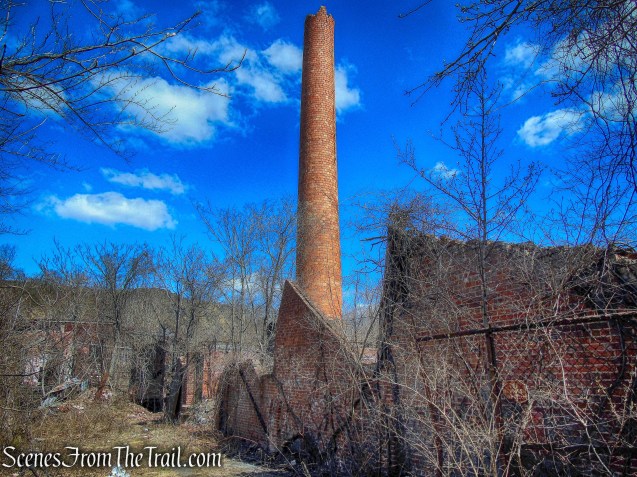
Palisades Interstate Park

New York-New Jersey Trail Conference


Barnes Mine and Lake Welch Loop – Harriman State Park

January 20, 2018 – Stony Point, NY

Difficulty: Moderate

Length: Approximately 5.3 miles

Max elevation: 1,161 ft.– total elevation gain approximately 412 ft.

Route type: Figure 8 Loop

Map: Harriman-Bear Mountain Trails Map #118

Trailhead parking: 14-32 St Johns Rd – Stony Point, NY 10980

Please note: Hikers should use caution in the vicinity of the mines, as their deep water filled pits and unstable overhanging rocks can be dangerous. 

Barnes Mine is located on the southern slope of Pole Brook Mountain and is on the north side of Lake Welch Drive in Harriman State Park. The mine is on a 17-acre parcel bought in 1846 by Isaac Barnes. Barnes Mine ceased operating about 1880. This mine does not appear to have been extensively worked.

Barnes Mine

Barnes Mine

Lake Welch was started in 1928 on what was then known as Beaver Pond. Sandyfield was a settlement of about 30 houses that was submerged when swampy Beaver Pond was dammed to create the 216-acre lake by the Palisades Interstate Park Commission.

Lake Welch

Lake Welch

While planning a hike when there is snow on the ground, I try to be reasonable about the distance and difficulty of the trail. While it might be a breeze to do a 8-mile loop in warm weather, hiking in snow has its issues. It is far easier to walk in the tracks of someone else who has already “broken” the trail than on virgin snow. I chose this hike because of the minimal elevation gain while keeping it at a tolerable distance.

Barnes Mine and Lake Welch Loop

Barnes Mine and Lake Welch Loop

Below is a map of the same area from 1930, notice that there is no Lake Welch.

1930 map of Sandyfield area

1930 map of Sandyfield area

We arrived shortly before 9:30 am on a crisp, but clear Saturday morning with temps in the low-mid 30’s. We parked in the hikers parking lot on St. Johns Road.

hikers parking - St. Johns Road

hikers parking – St. Johns Road

The lot has room for about 6-8 cars and was empty when we arrived. The image below shows how it looked like shortly before 2:00 pm as we concluded the hike.

hikers parking - St. Johns Road

hikers parking – St. Johns Road

At the far end of the driveway, facing northwest, where there are two boulders, is where we began our hike.

start of hike - hikers parking

start of hike – hikers parking

We proceeded on the unmarked woods road that heads northwest towards Lake Welch Drive.

unmarked trail

unmarked trail

The stone foundation ruins in the overgrown field were part of the Charleston Homestead, the 17-acre parcel that includes Barnes Mine. The Barnes Mine is inextricably linked to the Charleston family, which once lived in the Sandyfields-Johnsontown area near what is now Lake Welch and St. John’s-in-the-Wilderness Church. The trail leads around to the left of the stone foundation.

ruins

ruins

The old road then leads out to Lake Welch Drive which is closed in winter.

Lake Welch Drive

Lake Welch Drive

Across Lake Welch Drive is the base of Pole Brook Mountain and where we were headed.

cross Lake Welch Drive

cross Lake Welch Drive

We walked up the hill and then veered left onto an old overgrown road. I can only imagine that the old road would have been more discernible if there was no snow on the ground. Since I did some research prior to the hike, I knew the general direction that we had to go.

unmarked woods road

unmarked woods road

We had to maneuver around a large blowdown that was blocking the trail.

large blowdown

large blowdown

In a short distance we came to a rock cut along the woods road that leads to the mine.

rock cut along the road

rock cut along the road

We walked through the cut and there it was. Barnes Mine is on a 17-acre parcel bought in 1846 by Isaac Barnes. It probably was he who first opened a mine there. By 1864, it belonged to John Charleston. In 1871, he leased the mine to the Rockland Nickel Company, which operated the Nickel Mine on nearby Grape Swamp Mountain.

Barnes Mine

Barnes Mine

The main feature of this mine is a large cruciform-shaped open pit from which rock and ore have been extracted. This north-to-south cut measures eighty-three feet in length and varies in width from ten to thirteen feet.

Barnes Mine

Barnes Mine

At the extreme north end of this cut, the excavation is somewhat wider and deeper. Here the mine pit undercuts the rock ledge and contains water. The east-to-west crossing mine cut is 113 feet in total length, and thirteen to seventeen feet wide.

Barnes Mine

Barnes Mine

The mine was filled with water, frozen over and a blanket of snow covered the ground and ice. It was hard to determine what was solid ground and what was ice so we took great caution in this area. Some of these water filled pits can be extremely deep and there could be multiple pits in the area which may be covered with leaves and look like puddles.

Barnes Mine

Barnes Mine

Once done exploring the mine, we headed back out to the old road and turned right, heading southwest. The road is easily followed at this point, but it doesn’t stay that way. It soon becomes wildly overgrown and kind of disappears so we ended up bushwacking. It was short lived though because the Long Path was just ahead. We turned right on the aqua-blazed Long Path. The trail goes northwest along a farm road, this farm, part of the Sandyfield community, was the home of Charles Conklin until September 1938.

Long Path

Long Path

In a short distance, the Long Path turns right and leaves the farm road onto a footpath, now heading northeast.

Long Path

Long Path

Along the way, we passed a cellar hole by the side of the trail.

cellar hole - Long Path

cellar hole – Long Path

After 0.4 mile, we came to a junction with the start of the blue-blazed Beech Trail.

junction - Beech Trail

junction – Beech Trail

The Beech Trail starts out as a footpath and at times widens to a woods road then narrows again. The blazes also vary in shades of blue. Sometimes dark blue, light blue or just faded blue. Nevertheless, they are blue and it wasn’t confusing. This is one of the newer trails, blazed in 1972. It was during the construction of this trail that the method of using offset double blazes to show the direction in which the trail turns was invented.

Beech Trail

Beech Trail

The trail goes northeast on a woods road (the old Green Swamp Trail). The Beech Trail passes Green Swamp on the right and impressive boulders and cliffs on the left.

Beech Trail

Beech Trail

I’ve hiked this trail before, it is quite scenic in a less traveled area.

Beech Trail

Beech Trail

We followed the blue blazes of the Beech Trail until it reaches CR 106. The Beech Trail crosses the road and reenters the woods, but we turned right and began walking along the road.

CR 106

CR 106

We walked along County Route 106 for about 600 yards. Several cars drove by on this day, but I could imagine it being a little busier in the warmer weather.

CR 106

CR 106

After walking under Lake Welch Drive, we turned left into the entrance to the Lake Welch Boat Launch.

Lake Welch Boat Basin

Lake Welch Boat Basin

Just past the entrance, we turned right and began walking down the boat ramp towards Lake Welch. On the left, there is a boulder with a plaque to commemorate the Sandyfield School Site.

Sandyfields School Site plaque

Sandyfields School Site plaque

The community of Sandyfield, where there were about 25 homes, with about 100 residents, was located on high ground to the north and west of the swamp (now Lake Welch). Sandyfield had been founded about 1760 when the first road through the hills had been built from Stony Point to Central Valley. Hikers now know this road as the Hasenclever Road.

Sandyfields School Site plaque

Sandyfields School Site plaque

In 1910, when the state park was created, the residents were notified that they would have to leave their homes. There was an attempt to resist through political channels, but in 1939 the last residents were ordered to leave.

Sandyfield School 1946

Sandyfield School 1946

By 1942, the lake was completed using workers from the Civilian Conservation Corps that was building the park. The new lake was named in honor of William A. Welch the first chairman of the Palisades Interstate Park Commission that built Harriman.

Lake Welch

Lake Welch

Down at the edge of the boat launch, the  Jackie Jones Fire Tower is visible to the southeast.

Jackie Jones Fire Tower

Jackie Jones Fire Tower

We then jumped on a park road that runs along the west side of the lake, now heading northeast.

park road - Lake Welch

park road – Lake Welch

We saw a lot of different animal tracks along this road, I wasn’t sure what any of them were, but some were pretty large. We proceeded up a road on the left and visited what is referred to as the Odell Cemetery, but is officially named  Lake Welch Burials.

Odell Cemetery

Odell Cemetery

We paid our respects to those that are interred here who at one time lived on this land. In 1939, the Park ordered residents Fred Odell, Albert and Aaron Baisley, and Sarah Benson to move out. The residents finally moved out in 1942.

Odell Cemetery

Odell Cemetery

We walked back out to the park road and turned left, continuing our walk around Lake Welch and arrived at the beach area. We stopped at the beach, but unfortunately there were no lifeguards on duty.

Lake Welch

Lake Welch

We took a short break here and had a snack. We saw several people walk by, the only people we saw on the hike.

Lake Welch

Lake Welch

We continued on the road around the beach which brought back many childhood memories.

Lake Welch

Lake Welch

I remember climbing up and down this rock formation when I was very young. I also remember be yelled at to stop. It seemed as big as a mountain back then.

Lake Welch

Lake Welch

Lake Welch

Lake Welch

It was about this point where my friend realized that she had lost one of her microspikes. She walked back looking for it, to no avail. If found, please let me know.

Lake Welch

Lake Welch

I remember running across the grass here and yes, I got yelled at for that as well.

Lake Welch

Lake Welch

Looking southwest from the beach.

Lake Welch

Lake Welch

Heading towards the dam at the northeast end of the lake.

Lake Welch

Lake Welch

The dam was completed in 1929. Apparently, it was not high enough, because a new dam was started in 1934 using workers from CCC Camp SP-26.

Lake Welch dam

Lake Welch dam

Sandyfield residents, who opposed the construction of the dams, petitioned Governor Lehman and President Roosevelt to abolish the Park Commission (N.Y. Times, 11/22/34).

Lake Welch dam

Lake Welch dam

Lake Welch

Lake Welch

Lake Welch dam

Lake Welch dam

There are no real good places to walk along the east side of the lake, at least not in the snow. We began a road walk along CR 106.

CR 106

CR 106

There weren’t many cars driving by on this chilly Saturday so it was an easy and scenic walk along the road.

the southwest section of Lake Welch as it flows towards Beaver Pond Brook

the southwest section of Lake Welch as it flows towards Beaver Pond Brook

Lake Welch as viewed from CR 106

Lake Welch as viewed from CR 106

We got to St. Johns Road and turned left.

St. Johns Road

St. Johns Road

We then walked down the road and turned right towards the hikers parking area where our hike began.

St. Johns Road

St. Johns Road

We then got in the car and drove a very short distance on St. Johns Road to visit the church. Mrs. Margaret Elizabeth Zimmerman built this memorial to her late husband after he passed away on their honeymoon. The cornerstone was laid on June 23, 1880. Read the full history of St. John’s in the Wilderness.

St. John's in the Wilderness Episcopal Church

St. John’s in the Wilderness Episcopal Church

A Memorial to Lost Love.

St. John's in the Wilderness

St. John’s in the Wilderness

A visit to St. John’s is a walk through another place in time.

St. John's in the Wilderness

St. John’s in the Wilderness

Behind the church is a ruined structure with a doorway.

ruins behind St. John's in the Wilderness

ruins behind St. John’s in the Wilderness

This cemetery was used by the old families from the Sandyfield, Johnsontown, plus the other old hamlets of the Harriman State Park area.

St. John's Cemetery

St. John’s Cemetery

Thank you for your service Mr. Conklin.

Frank Conklin - St. John's Cemetery

Frank Conklin – St. John’s Cemetery

I hope that you enjoyed the hike and please don’t forget to follow my blog. Feel free to share my posts with your friends as well. As always, I welcome any comments or suggestions regarding past or future hikes.

Pros: Barnes Mine, Lake Welch, historic features, scenic area, lesser traveled area.

Cons: My friend lost her microspikes.

Take a hike!

Barnes Mine - Lake Welch Loop

Barnes Mine – Lake Welch Loop

Sources:
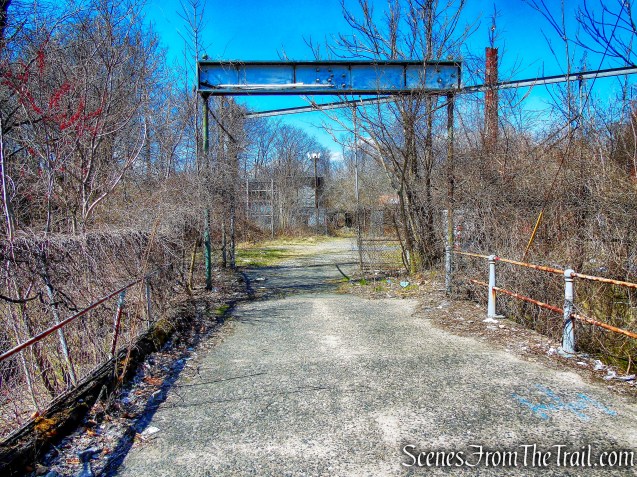
Myles, William J.. Harriman Trails: A Guide and History (Kindle Location 5906). New York – New Jersey Trail Conference. Kindle Edition.

Lenik, Edward J.. Iron Mine Trails (Kindle Location 1780). New York – New Jersey Trail Conference. Kindle Edition.

St. John’s in the Wilderness Church Cemetery


Constitution Marsh and Indian Brook Falls

December 31, 2017 – Garrison, NY

Difficulty: Easy

Length: Approximately 2.1 miles

Max elevation: 237 ft.– total elevation gain approximately 253 ft.

Route type: Out and back

Map: East Hudson Trails Map #101

Trailhead parking: 113 Indian Brook Rd, Garrison, NY 10524 (room for 8 cars)


Constitution Marsh Audubon Center and Sanctuary is a unique and beautiful tidal marsh. It is located in Putnam County, New York on the east shore of the Hudson River, just south of the village of Cold Spring. The hiking trail leads to a boardwalk and there are benches to take in the marsh habitat, it’s wildlife, and an unmatched view of the surrounding Hudson River Highlands.

Constitution Marsh Audubon Center and Sanctuary

Constitution Marsh Audubon Center and Sanctuary

Indian Brook Falls is where the Indian Brook plunges from a 40 ft. cliff into a rocky pool nestled in a small gorge. The picturesque waterfall then flows southwest and joins the Hudson River near Constitution Marsh.

Indian Brook Falls

Indian Brook Falls

I have visited both the falls and Constitution Marsh on numerous occasions. I have always enjoyed the walk to the Hudson River and the boardwalk over the marsh, with its views of the Hudson Highlands it’s a nice payoff with little effort. Since this would be our last hike of 2017 and the temperature was in the mid teens, I thought that we should keep it short, but with some inducements to make us brave the frigid weather. At just over 2 miles, it was the perfect hike to do on an extremely cold day.

Constitution Marsh and Indian Brook Falls

Constitution Marsh and Indian Brook Falls

View the Google Earth Fly-Through video of the hike below.

We got a late start due to the cold. It was in the single digits early on, so we waited until it warmed up to a blistering 12 degrees and arrived at the parking area at around 11:30 am.

Constitution Marsh Audubon Center and Sanctuary

Constitution Marsh Audubon Center and Sanctuary

There is only room for eight cars and in warm weather the lot can fill up quickly. There is no parking along the road anywhere else and cars will be ticketed and/or towed.

parking - Constitution Marsh Audubon Center and Sanctuary

parking – Constitution Marsh Audubon Center and Sanctuary

The ground was slick and icy so we wore our microspikes for better traction. We began by walking down the entrance road of Constitution Marsh.

Constitution Marsh Audubon Center and Sanctuary

Constitution Marsh Audubon Center and Sanctuary

The road is closed to vehicular traffic from visitors and is the start of the blue-blazed trail, note the blue markers on the sign.

blue trail - Constitution Marsh Audubon Center and Sanctuary

blue trail – Constitution Marsh Audubon Center and Sanctuary

The trail winds down the hill, with several private residences on the right and the ravine with Indian Brook to the left.

blue trail - Constitution Marsh Audubon Center and Sanctuary

blue trail – Constitution Marsh Audubon Center and Sanctuary

In a short distance, the trail passes through the actual entrance to Constitution Marsh.

blue trail - Constitution Marsh Audubon Center and Sanctuary

blue trail – Constitution Marsh Audubon Center and Sanctuary

After passing the entrance, the trail begins a steady descent towards the Hudson River. It’s a nice walk down, but the walk back up the hill will get your blood pumping.

blue trail - Constitution Marsh Audubon Center and Sanctuary

blue trail – Constitution Marsh Audubon Center and Sanctuary

At the bottom of the hill, the blue trail turns right just before the nature center.

blue trail - Constitution Marsh Audubon Center and Sanctuary

blue trail – Constitution Marsh Audubon Center and Sanctuary

The trail then passes an informational kiosk.

blue trail - Constitution Marsh Audubon Center and Sanctuary

blue trail – Constitution Marsh Audubon Center and Sanctuary

The blue trail then crosses a small wooden footbridge and turns left and begins to head in a westerly direction.

blue trail - Constitution Marsh Audubon Center and Sanctuary

blue trail – Constitution Marsh Audubon Center and Sanctuary

The trail is well marked and in a short distance, the Hudson River is visible through the trees.

blue trail - Constitution Marsh Audubon Center and Sanctuary

blue trail – Constitution Marsh Audubon Center and Sanctuary

The trail then curves around the base of a rock formation, climbs a few stone steps and continues to climb over rocks……

blue trail - Constitution Marsh Audubon Center and Sanctuary

blue trail – Constitution Marsh Audubon Center and Sanctuary

as it curves around and makes its way up the rocky hill.

blue trail - Constitution Marsh Audubon Center and Sanctuary

blue trail – Constitution Marsh Audubon Center and Sanctuary

At the top of the brief climb, there is a wooden bench to sit and enjoy the view.

blue trail - Constitution Marsh Audubon Center and Sanctuary

blue trail – Constitution Marsh Audubon Center and Sanctuary

The trail then continues north as it descends towards the marsh.

blue trail - Constitution Marsh Audubon Center and Sanctuary

blue trail – Constitution Marsh Audubon Center and Sanctuary

At the base of the descent, the trail reaches the start of the boardwalk.

blue trail - Constitution Marsh Audubon Center and Sanctuary

blue trail – Constitution Marsh Audubon Center and Sanctuary

As we stepped out on the boardwalk, the Hudson Highlands come into full view, with Storm King Mountain on the left and Breakneck Ridge on the right, visible in the distance.

blue trail - Constitution Marsh Audubon Center and Sanctuary

blue trail – Constitution Marsh Audubon Center and Sanctuary

The boardwalk weaves through the marsh, branching off in different directions with viewing platforms in several spots.

blue trail - Constitution Marsh Audubon Center and Sanctuary

blue trail – Constitution Marsh Audubon Center and Sanctuary

I have been here before and have seen giant Snapping Turtles, Great Blue Herons, Egrets, Bald Eagles and hawks. On this day all we saw was the frozen marsh.

blue trail - Constitution Marsh Audubon Center and Sanctuary

blue trail – Constitution Marsh Audubon Center and Sanctuary

After enduring the bitter cold for a while, we began heading back. Just before crossing the small footbridge near the nature center, I saw a yellow-blazed trail that began there. I followed it up a short distance until it ended near a stone wall by private property. I retraced my steps back to the footbridge and then began the steep walk up the road. My usual thought whenever I walk up this hill is, “I don’t remember it being this steep.”

blue trail - Constitution Marsh Audubon Center and Sanctuary

blue trail – Constitution Marsh Audubon Center and Sanctuary

Back at the car, we warmed up with a little hot chocolate and I was ready to check out Indian Brook Falls. My colleagues were too cold and didn’t want to get out of the warm car. I was on my own for this portion of the hike. I then walked east, up Indian Brook Road.

Indian Brook Road

Indian Brook Road

After walking under the bridge that carries NY 9D above, I walked over to the two stone columns with the rusty gate and walked around.

Indian Brook Road

Indian Brook Road

Part of the Hudson Highlands State Park, Indian Brook Falls gets a lot of visitors in warm weather. Neighbors have complained about the crowds, illegal parking and trash for years. Some have even called for the falls to be fenced off and closed to the public. If visiting here, please obey all rules that are posted and please respect this beautiful place or we may lose it.

Indian Brook Falls

Indian Brook Falls

The trail to the falls travels on an old road that curves to the right.

Indian Brook Falls Trail

Indian Brook Falls Trail

Down in the ravine, near the edge of Indian Brook, there is a ruined structure.

Indian Brook Falls Trail

Indian Brook Falls Trail

After crossing the stone bridge over Indian Brook, I turned left and descended towards the brook. Here is where the green blazes appear. I didn’t see any prior blazes, but I could have missed them.

Indian Brook Falls Trail

Indian Brook Falls Trail

The trail follows the edge of the brook as it heads east.

Indian Brook Falls Trail

Indian Brook Falls Trail

In one spot the trail seemed to disappear. I couldn’t remember if it went up the hillside or continued ahead. As it turned out, the water level rose and froze over so I had to walk on the ice. I was wearing my microspikes so I felt secure as walked on the ice by the edge of the gorge.

Indian Brook Falls Trail

Indian Brook Falls Trail

The Indian Brook Falls Trail ends near the falls and as I approached its terminus, there was a photographer with his tripod capturing some images.

Indian Brook Falls

Indian Brook Falls

There is a Native American tale about Indian Brook Falls involving the Wappingers tribe. A Wappinger named Manteo fell in love with a captured Dutchman and pleaded he be spared so she could marry him. But one day he saw a Dutch-flagged ship and made a swim for it. Bereft Manteo eventually flung herself from the top of Indian Brook Falls, drowning in the pool below.

Indian Brook Falls

Indian Brook Falls

In August 1834, Washington Irving led an evening jaunt here after a dinner party at the Cold Spring home of his friend Gouverneur Kemble. As one guest later recalled, Irving provided “elegant and playful” commentary as they “wandered among the rocks of that beautiful and secluded dell.”

Indian Brook Falls

Indian Brook Falls

I stood admiring the falls for a little while, forgetting all about the frigid temps. I suddenly thought to myself, “this is why I love the Hudson Valley.”

Indian Brook Falls

Indian Brook Falls

Several couples came along as I stood there, so I decided to leave and let them have this idyllic spot to themselves. I retraced my steps along the brook, glad that the ice was solid enough that I didn’t fall through.

Indian Brook Falls Trail

Indian Brook Falls Trail

Walking back along Falls Brook, I got a good view of the stone bridge over the brook. The road that travels over that bridge heads southwest up the hill to Saint Basil Academy.

stone bridge over Falls Brook

stone bridge over Falls Brook

I climbed back up to the road and turned right and crossed back over the bridge.

Indian Brook Falls Trail

Indian Brook Falls Trail

I headed out to Indian Brook Road and began walking down the hill. Through the trees up on a hill, I saw an odd looking structure. I decided to bushwack up the hill to check it out. It turned out to be the ruins of an old wooden water tank/cistern.

wooden water tank

wooden water tank

I then proceeded down the hill to the road and back to the parking area where the hike began.

Indian Brook Road

Indian Brook Road

If you visit Indian Brook Falls, please be mindful of the limits of this treasured place. We can continue to enjoy this place responsibly by keeping our visit fairly short to allow others to park in the limited spaces available.

Pros: Waterfall, Hudson River views, scenic Hudson Valley.

Cons: Gets crowded in warmer weather.

Take a hike!

Constitution Marsh and Indian Brook Falls

Constitution Marsh and Indian Brook Falls


Elda Castle

December 17, 2017 – Westchester County, NY

Difficulty: Easy


Disclaimer: Exploring abandoned and/or ruined structures can be dangerous and you could be trespassing. Should you choose to enter the property of any of the places featured on this site, do so legally.

Completed in 1928 and named Elda Castle after the first letter of each of their four children’s names, in birth order, the ruinous estate sits on a rocky promontory in Westchester County, NY. The 4,337-square-foot castle was formed by a steel skeleton and a facade of granite and fieldstone, much of which was sourced from the property. Elda once boasted 25 rooms over two stories, arched doorways, a cast iron spiral staircase, courtyards, patios, and a wealth of other romantic elements.

Elda Castle

Elda Castle

I had read about this castle and thought it would be an interesting place to visit. Since it sits adjacent to a nature preserve, I figured that I would include that as well. We were looking to do a short hike on a cold December morning and this one fit the bill. This hike would require some bushwacking and with the snow, we wore our microspikes for better traction.

After a little bushwacking we made our way uphill on the estate road. I found it curious that the road was plowed on an abandoned estate. I had read that the property is for sale, so that may have been the reason.

estate road

estate road

After passing what looked like a fountain on the right, in the woods, the castle came into view.

Elda Castle

Elda Castle

The road circles around the castle and we stayed to the right.

Elda Castle

Elda Castle

Elda Castle was once the home of David Thomas Abercrombie, the founder of the Abercrombie & Fitch Company, and his wife, Lucy Abbott Cate.

Elda Castle

Elda Castle

Elda, the name they gave to the estate, is derived from the first letter of the names of each of their four children, in birth order: Elizabeth, Lucy, David and Abbott.

Elda Castle

Elda Castle

Work on Elda began in 1925 and was completed two years later. It was first occupied in late January 1928.

Elda Castle

Elda Castle

We walked around the castle in awe of this architectural marvel. The house has a number of arched and squared doorways and windows, curved stone and iron circular staircases, exposed stone chimneys, and vaulted spaced masonry porches.

Elda Castle

Elda Castle

There is a covered patio with a hipped roof with supporting stone arches reminiscent of the other gothic architectural elements of the building.

Elda Castle

Elda Castle

Tiles with whimsical heraldic and other images decorate its walls and fireplace chimney.

Elda Castle

Elda Castle

The main entrance of the house is on the west side and is accessed by a flight of curving stone steps that lead into a glass-enclosed vestibule that also served as a conservatory for Mrs. Abercrombie’s plants.

Elda Castle

Elda Castle

Elda Castle

Elda Castle

There is an open court yard or patio area that was intended, in part, to look like a ruin and in that section the windows are cut into the wall but not glazed.

Elda Castle

Elda Castle

Elda Castle

Elda Castle

Elda Castle

Elda Castle

After Mr. Abercrombie died, Mrs. Abercrombie moved in with her daughter, Elizabeth, who lived in New Jersey and Elda was unoccupied for several years until it was sold in the early 1940’s to a firm doing research on paints. After WWII the building remained empty for more than a decade and became the target of vandals.

Elda Castle

Elda Castle

The property has had numerous owners since then who have tried to rehabilitate it, but it has been mostly vacant for decades.

Elda Castle

Elda Castle

Vandals and squatters have destroyed the interior and ripped from it anything of value.

Elda Castle

Elda Castle

Across from the main entrance, are a pair of stone arches on either side of a deep ravine. They may have been abutments for a footbridge that at one time spanned the ravine.

bridge abutments - Elda Castle

bridge abutments – Elda Castle

Just to the north of the castle, there is another sizable building which at one time was the garage. At some point it was converted to a residence.

garage - Elda Castle

garage – Elda Castle

garage - Elda Castle

garage – Elda Castle

With the exception of the roof, the structure appears solid. The interior is another story, it’s in shambles. The upstairs was full of junk.

garage - Elda Castle

garage – Elda Castle

A spiral staircase leads down to the lower floor.

garage - Elda Castle

garage – Elda Castle

garage - Elda Castle

garage – Elda Castle

We retraced our steps back down the driveway and veered off onto an overgrown road that I had seen on an old map and headed towards the pond. Built into the hillside is an outhouse made of stone, complete with a metal toilet.

outhouse - Elda Castle

outhouse – Elda Castle

The stone steps to the left, lead to what appears to be a patio with a fireplace.

fireplace - Elda Castle

fireplace – Elda Castle

A few feet away, on the edge of the pond, there is what may have been a stone changing room for when they swam in the pond.

changing room - Elda Castle

changing room – Elda Castle

changing room - Elda Castle

changing room – Elda Castle

We continued on, bushwacking through the woods, back to the nature preserve where we began our hike. We hiked several of the trails there just to add some mileage to our hike, but there wasn’t much to see except for a few stone walls and lots of trees. We made our way back to where we had parked and called it a day.

This was a short hike with a big payoff. The castle is very impressive as are the grounds. I did not post the location for obvious reasons, but it is not that difficult to find. I hope that you enjoyed the hike, now get out there and explore!

Source: New York History Blog

Elda Castle

Elda Castle


Hessian Lake and Hudson River Dock Loop – Bear Mountain State Park

December 10, 2017 – Tomkins Cove, NY

Difficulty: Easy

Length: Approximately 4.1 miles

Max elevation: 193 ft.– total elevation gain approximately 485 ft.

Route type: Circuit

Map: Harriman-Bear Mountain Trails Map #119

Trailhead parking: Bear Mountain Ice Rink – Tomkins Cove, NY 10986

Bear Mountain State Park is a 5,205-acre state park in Rockland and Orange Counties, New York. It is situated in rugged mountains rising from the west bank of the Hudson River. It also includes several facilities such as the Perkins Memorial Tower, the Trailside Museum and Zoo, the Bear Mountain Inn, a merry-go-round, pool, and a skating rink. It is managed by the Palisades Interstate Park Commission. The park opened in June 1913.

There are over 50 official trails covering 235 miles, featuring a wide range of difficulties and elevation changes. The first section of the Appalachian Trail, taking hikers from Bear Mountain, south to the Delaware Water Gap, opened on October 7, 1923. The Bear Mountain Zoo, through which the Appalachian Trail passes, is the lowest elevation on the 2,100-mile trail.

The pond at the foot of Bear Mountain had been known since 1740 as Lake Sinnipink, from the Indian name of the nearby creek—Assinapink. When the British attacked Fort Clinton on October 6, 1777, there was a wall of sharpened logs between the pond and the edge of the cliff overlooking the Hudson River. After the battle, because many bodies of Hessian chasseurs had been thrown into the pond, it became known as Bloody Pond. In later years, it was given more genteel names—Highland Lake, then Hessian Lake.

Hessian Lake

Hessian Lake

I have wanted to hike the area around Hessian Lake for some time, but it is such a  popular spot in warm weather that it gets overcrowded. With snow and ice on the ground, I figured it would be the right time to pay it a visit. We made sure to bring our traction devices along as they would be needed. We parked in the skating rink parking lot and hiked clockwise around the lake. We also walked down to Hudson River Dock and visited the zoo as well.

Hessian Lake and Hudson River Dock Loop

Hessian Lake and Hudson River Dock Loop

Check out the Google Earth Fly-Through video of the hike below.

From the parking lot, we walked towards the skating rink with Bear Mountain in the background.

Bear Mountain State Park

Bear Mountain State Park

We turned right at the ice rink, heading north towards Hessian Lake.

ice rink - Bear Mountain State Park

ice rink – Bear Mountain State Park

ice rink - Bear Mountain State Park

ice rink – Bear Mountain State Park

As we neared the southwest end of the lake, we came to an intersection of three major trails, The Major Welch Trail, the Suffern-Bear Mountain Trail and the Appalachian Trail. The AT would be our return route, but for now, we would start on the red-ring-on-white-blazed Major Welch Trail and follow it along the west side of Hessian Lake. The Major Welch Trail, named in 1944 in memory of Major William A. Welch, the first General Manager of the Park, starts behind the Bear Mountain Inn, and follows the paved path along the west side of Hessian Lake.

trail junction

trail junction

We walked on the paved park road which was plowed at the beginning.

Major Welch Trail

Major Welch Trail

Then we arrived at a wooden road barrier that blocked the trail due to icy conditions. We were wearing our microspikes so we walked around the barrier.

Major Welch Trail

Major Welch Trail

The trail was icy as we made our way up the trail at the base of Bear Mountain.

Major Welch Trail

Major Welch Trail

We stopped many times along the trail to take in the scenery. Looking east, Anthony’s Nose stands out proudly just across the Hudson River. During the nineteenth century, ice was cut from the lake by the Knickerbocker Ice Company and shipped to New York City.

view of Anthony's Nose from Hessian Lake

view of Anthony’s Nose from Hessian Lake

The Bear Mountain Bridge is also visible from the edge of the lake.

view of Bear Mountain Bridge from Hessian Lake

view of Bear Mountain Bridge from Hessian Lake

The trail ascends slightly and passes by some rock formations.

Major Welch Trail

Major Welch Trail

After the slight ascent, the Major Welch Trail levels off with some rock formations that overlook the lake. The Major Welch Trail then turns left and leaves the road. We stayed on the road that circles the lake.

Major Welch Trail

Major Welch Trail

The Major Welch Trail climbs steeply to Perkins Memorial Tower and the sign made it enticing, but not on this day.

Major Welch Trail

Major Welch Trail

So we continued on the park road as we made our way around the lake.

park road - Bear Mountain State Park

park road – Bear Mountain State Park

Now on the east side of Hessian Lake, Bear Mountain is clearly visible.

view of Bear Mountain from Hessian Lake

view of Bear Mountain from Hessian Lake

We veered left towards the restrooms (which were closed) and away from the lake. We were now headed to Hudson River Dock which is easy to find because there are plenty of signs pointing the way.

Bear Mountain State Park

Bear Mountain State Park

We turned left and walked down the stairs, now traveling on the Appalachian Trail.

Appalachian Trail

Appalachian Trail

The AT travels through a tunnel under US 9W.

Appalachian Trail

Appalachian Trail

On the other side of the tunnel, the AT turns right.

Appalachian Trail

Appalachian Trail

The AT now travels south for a short distance and towards some park buildings as it briefly parallels US 9W.

Appalachian Trail

Appalachian Trail

stone building - Bear Mountain

stone building – Bear Mountain

The AT then turns left and passes by the concession stands and the pool.

concession stands - Bear Mountain State Park

concession stands – Bear Mountain State Park

pool - Bear Mountain State Park

pool – Bear Mountain State Park

After passing the concession stands, the AT turns left and enters the zoo. We turned right to continue heading down to the river.

Bear Mountain State Park

Bear Mountain State Park

We walked downhill as we headed to Hudson River Dock.

Bear Mountain State Park

Bear Mountain State Park

Off the left side of the path leading down to Hudson River Dock, and mounted on a projecting rock overlooking the River and the Hudson Highlands, is a sculpture of an elk’s head.

elk’s head - Bear Mountain State Park

elk’s head – Bear Mountain State Park

The larger than life bronze sculpture was presented to the Palisades Interstate Park by Commissioner Victor Berman in 1935.

elk’s head - Bear Mountain State Park

elk’s head – Bear Mountain State Park

There is a great view of the Bear Mountain Bridge from this spot. When the bridge formally opened on November 27, 1924, it was the longest suspension bridge span in the world at 2,257 feet, and the first of its type to have a concrete deck. It also carries the Appalachian Trail across the Hudson River.

Bear Mountain Bridge

Bear Mountain Bridge

We continued towards the river and walked through a tunnel under the railroad tracks.

Bear Mountain State Park

Bear Mountain State Park

Arriving at Hudson River Dock, we were just across the river from Anthony’s Nose. The park operated a fleet of steamers that brought millions of NYC people to Bear Mountain for recreation during the 1920’s and 1930’s. The docks burned in the 1960’s and 1970’s. This dock was rebuilt in the early 1990’s.

view of Anthony's Nose from Hudson River Dock

view of Anthony’s Nose from Hudson River Dock

This is a great spot for some really good Hudson River views. Looking north, the Bear Mountain Bridge is visible.

view of Bear Mountain Bridge from Hudson River Dock

view of Bear Mountain Bridge from Hudson River Dock

We walked north along the river to a picnic area and took a short break. Looking south, on the right is Hudson River Dock, where we were just at.

Looking south

Looking south

We stopped inside a shelter for a moment where I captured this shot of Anthony’s Nose.

Bear Mountain State Park

Bear Mountain State Park

The American Flag atop Anthony’s Nose was visible from this spot as well.

Flag atop Anthony's Nose

Flag atop Anthony’s Nose

We then retraced our steps back to the elk’s head where I just had to capture another image.

elk’s head - Bear Mountain State Park

elk’s head – Bear Mountain State Park

We continued ahead to the Bear Mountain Zoo. The Trailside Museums and Zoo, was built during the years 1932-35 by the Works Progress Administration (WPA). They expanded an earlier Trailside Museum in the park that dated to the 1920’s.

Trailside Museum and Zoo - Bear Mountain State Park

Trailside Museum and Zoo – Bear Mountain State Park

The Trailside Museums and Zoo are located at the former site of Fort Clinton. Its name is a reference to the Appalachian Trail that runs through the complex.

Appalachian Trail - Trailside Museum and Zoo

Appalachian Trail – Trailside Museum and Zoo

Shortly after the entrance to the Zoo is the striding statue of Walt Whitman, sculpted by Jo Davidson. The Harriman family presented the statue in 1940 to commemorate the 1910 gift of land and money by Mary W. Harriman that made the Park a reality.

statue of Walt Whitman

statue of Walt Whitman

This famous statue depicts the poet and newspaper editor in a pose that portrays the image created by his “Song of the Open Road.”

statue of Walt Whitman

statue of Walt Whitman

Continuing through the zoo, we viewed some of the animals that are in captivity. The zoo began as a bear den in 1926 and is currently the home of a wide variety of local injured or rehabilitating animals, including bears, otters, deer, bald eagles, and owls.

Red Fox - Trailside Museum and Zoo

Red Fox – Trailside Museum and Zoo

Bobcat - Trailside Museum and Zoo

Bobcat – Trailside Museum and Zoo

Bears - Trailside Museum and Zoo

Bears – Trailside Museum and Zoo

We then arrived at the lowest spot on the entire Appalachian Trail, at an elevation of 120 feet.

Appalachian Trail

Appalachian Trail

We took a walk down a side path that leads to an overlook.

overlook - Trailside Museums and Zoo

overlook – Trailside Museums and Zoo

This is a good spot to take a break and take in the scenery, which is exactly what we did.

overlook - Trailside Museums and Zoo

overlook – Trailside Museums and Zoo

Aside from the fabulous views from this spot, there are small informational signs on the railings. I found this one to be quite interesting.

overlook - Trailside Museums and Zoo

overlook – Trailside Museums and Zoo

overlook - Trailside Museums and Zoo

overlook – Trailside Museums and Zoo

We retraced our steps back to the AT and walked up to the Coyote Den. Just prior to us getting there, they were making quite a racket. Usually a sign that they just killed something.

Coyote Den - Trailside Museums and Zoo

Coyote Den – Trailside Museums and Zoo

We wandered around a bit and then began retracing our steps on the AT, once again passing by the Bear Den to have one last look at the bears and of course the Black Vultures that are all over the place in this area.

Bear Den - Trailside Museums and Zoo

Bear Den – Trailside Museums and Zoo

Back at Hessian Lake, we headed to the southern end of the lake to get one last look. Spring-fed Hessian Lake, named for the bloody events of the British attack on Fort Clinton in 1777, when many of the Hessian chasseurs (soldiers) were thrown into the Lake.

Hessian Lake - Bear Mountain State Park

Hessian Lake – Bear Mountain State Park

We decided to walk across the snow covered field back to the parking area. Visible just ahead is the merry-go-round building which is beautifully constructed of stone and wood in a traditional style that complements the adjacent historic Administration Building and Bear Mountain Inn. It includes 38 carved animals that are native to the Hudson River Valley, as well as two chariots for accessible seating.

merry-go-round building - Bear Mountain State Park

merry-go-round building – Bear Mountain State Park

Looking to our left, We could see the Bear Mountain Inn with Anthony’s Nose just beyond. Originally completed in 1915, the Bear Mountain Inn is an early example of the rustic lodge style influenced by the Adirondack Great Camps and later used extensively in the National Park System. It closed in 2005 for extended renovations, reopening in 2011.

Bear Mountain Inn - Bear Mountain State Park

Bear Mountain Inn – Bear Mountain State Park

We then made our way to the skating rink parking area, where our hike began.

skating rink parking area - Bear Mountain State Park

skating rink parking area – Bear Mountain State Park

Some tidbits that I dug up about Bear Mountain State Park:

  • Bear Mountain was historically known as “Bear Hill” and “Bread Tray Mountain”.
  • Franklin D. Roosevelt’s paralytic illness developed in the summer of 1921, two weeks after he visited a Boy Scout camp at Hessian Lake on the eastern edge of Bear Mountain. It is possible the illness was related to exposure at the camp.
  • Bear Mountain was once the premier ski jumping site in the United States. Because of its notoriety as a ski jumping location, Bear Mountain was considered as a possible site for the 1932 Winter Olympics, which were held in Lake Placid, New York. The ski jump run has not been used in decades, and its stone steps built into the eastern side of the mountain are now crumbling.
  • During World War II, the Brooklyn Dodgers held their spring training here.

This was a fun hike packed with points of interest and history. I recommend doing this hike in the winter months to avoid the crowds. Definitely worth the visit with all that there is to see.

To get a better idea of what the hike is like, view the short video below, with additional images added.

Pros: Historical features, scenic views, Trailside Museums and Zoo, lake, Appalachian Trail.

Cons: Overcrowded in the warmer months.

Take a hike!

Hessian Lake and Hudson River Dock Loop - Bear Mountain State Park

Hessian Lake and Hudson River Dock Loop – Bear Mountain State Park


Lake Minnewaska and Millbrook Mountain Loop – Minnewaska State Park Preserve

December 3, 2017 – Kerhonkson, NY

Difficulty: Moderate

Length: Approximately 6.5 miles

Max elevation: 1,781 ft.– total elevation gain approximately 748 ft.

Route type: Circuit

Map: Shawangunk Trails

Fee: $10.00 per vehicle – Empire Pass Accepted

Trailhead parking: 5281 Route 44-55, Kerhonkson, NY 12446


Whenever I do a hike that I truly enjoy, I instinctively want to go back and explore different parts of the area. “The Gunks” is one of those places. With its sky lakes, waterfalls, Carriage roads, rugged terrain and sheer white cliffs, it’s easy to fall in love with the Shawangunk Ridge. It is well worth the hour and a half hour drive from Westchester County to take in its splendor. This hike combines easy walking carriage roads, a gorgeous lake, a steep climb on a rugged trail and views that last for days. We did the hike clockwise from the northern end of Lake Minnewaska where there is a sizable parking area that fills up really early.

Lake Minnewaska and Millbrook Mountain Loop

Lake Minnewaska and Millbrook Mountain Loop

View the Google Earth Fly-Through video of the hike below.

Once geared up, we headed towards Lake Minnewaska.

Lake Minnewaska

Lake Minnewaska

The 34-acre “sky lake” is approximately one mile long by one-quarter mile wide at its widest point.

Lake Minnewaska

Lake Minnewaska

A sky lake is a pristine and often unusually clear lake that is fed only from rain water.

Lake Minnewaska

Lake Minnewaska

We began our hike on the red-diamond-blazed Lake Minnewaska Carriage Road. This carriage road is 2 miles long with moderate changes in elevation as it circles the lake. On a nice day there is a lot of foot traffic on this road.

Lake Minnewaska Carriage Road

Lake Minnewaska Carriage Road

The Lake Minnewaska Carriage Road climbs gradually along the eastern side of the lake.

Lake Minnewaska Carriage Road

Lake Minnewaska Carriage Road

In a short distance, we came to a nice viewpoint from the cliffs and hadn’t even broken a sweat yet. The cliffs on the other side of the lake is where we began our hike.

Lake Minnewaska

Lake Minnewaska

We wandered off the road and walked along the cliffs enjoying the scenery. We found our way back to the carriage road and walked over a picturesque wooden footbridge, known as the “Dry Bridge.”

Dry Bridge

Dry Bridge

Continuing uphill, the road leads up to the former site of the Cliff House, now a picnic area, that overlooks the lake. Opened in 1879 at an elevation greater than that of the Lake Mohonk Mountain House, Cliff House boasted even more expansive valley and mountain views.

view northwest from near the site of the Cliff House

view northwest from near the site of the Cliff House

After a long decline, Cliff House was abandoned in 1972 due to disrepair and soaring maintenance costs. At the New Year in 1978, Cliff House burned to the ground in a spectacular fire.

view south from near the site of the Cliff House

view south from near the site of the Cliff House

We continued on the Lake Minnewaska Carriage Road as it heads south and gently descends. Just before the trail turns right, there is panoramic east-facing view from a rock ledge to the left of the trail.

east-facing view - Lake Minnewaska Carriage Road

east-facing view – Lake Minnewaska Carriage Road

The Lake Minnewaska Carriage Road continues downhill to the southern end of Lake Minnewaska.

southern end of Lake Minnewaska

southern end of Lake Minnewaska

Just to the left is the start of the red-blazed Millbrook Mountain Footpath. It is a 1.2 mile long somewhat rugged trail.

Millbrook Mountain Footpath

Millbrook Mountain Footpath

This trail begins by descending 160 feet in elevation along bedrock terrain.

Millbrook Mountain Footpath

Millbrook Mountain Footpath

This trail is narrow in places, often wet, muddy and the rocks slippery.

Millbrook Mountain Footpath

Millbrook Mountain Footpath

At the base of the descent, the trail reaches the Coxing Kill, the lowest elevation on the trail.

Coxing Kill - Millbrook Mountain Footpath

Coxing Kill – Millbrook Mountain Footpath

After rock hopping over the Coxing Kill, the Millbrook Mountain Footpath enters the Mohonk Preserve. Once at the summit and heading a few feet to the west, we would be back in Minnewaska State Park Preserve.

Mohonk Preserve - Millbrook Mountain Footpath

Mohonk Preserve – Millbrook Mountain Footpath

The trail now ascends steeply, gaining 220 feet of elevation in the next 0.4 mile, ending at the summit of Millbrook Mountain. The trail is rocky and often wet.

Millbrook Mountain Footpath

Millbrook Mountain Footpath

Along the way, the trail passes the start of the blue-blazed Coxing Trail that heads northeast to the Mohonk Preserve. We continued following the red blazes of the Millbrook Mountain Footpath until its terminus at the summit of Millbrook Mountain. Here we took a well deserved break.

view from Millbrook Mountain

view from Millbrook Mountain

We wandered along the edge of the cliffs for a little while, taking in the different views.

view from Millbrook Mountain

view from Millbrook Mountain

We then walked down a few feet and hopped on the Millbrook Mountain Carriage Road.

Millbrook Mountain Carriage Road

Millbrook Mountain Carriage Road

The Millbrook Mountain Carriage Road heads southwest and snakes its way gently down the mountain. It begins close to the cliffs then veers away at times and then back again.

Millbrook Mountain Carriage Road

Millbrook Mountain Carriage Road

After about 1.3 miles on the Millbrook Mountain Carriage Road, we came to the start of the red-blazed Gertrude’s Nose Footpath. According to my map there is a viewpoint a short distance down the trail, so we decided to have a look.

Gertrude's Nose Footpath

Gertrude’s Nose Footpath

There are short spur trails that lead to rock ledges.

rock ledges just off the Gertrude's Nose Footpath

rock ledges just off the Gertrude’s Nose Footpath

Looking southwest, Hamilton Point is visible in the distance. We stopped here and had a snack while enjoying the view.

view of Hamilton Point - Gertrude's Nose Footpath

view of Hamilton Point – Gertrude’s Nose Footpath

We retraced our steps back to the Millbrook Mountain Carriage Road, turned left and continued our descent. The views begin to open up in this area with many ledges to the left of the road.

Millbrook Mountain Carriage Road

Millbrook Mountain Carriage Road

We then reached one of the interesting geologic features at the park, Patterson’s Pellet.

Patterson's Pellet - Millbrook Mountain Carriage Road

Patterson’s Pellet – Millbrook Mountain Carriage Road

It is a large glacial erratic perched atop the cliffs above Palmaghatt Ravine.

Patterson's Pellet - Millbrook Mountain Carriage Road

Patterson’s Pellet – Millbrook Mountain Carriage Road

Patterson's Pellet - Millbrook Mountain Carriage Road

Patterson’s Pellet – Millbrook Mountain Carriage Road

Continuing down the Millbrook Mountain Carriage Road, we stayed right at a Y-intersection with the Hamilton Point Carriage Road. We then came to a T-intersection with the Lake Minnewaska Carriage Road and turned left.

T-intersection with the Lake Minnewaska Carriage Road

T-intersection with the Lake Minnewaska Carriage Road

The Lake Minnewaska Carriage Road travels along the western side of Lake Minnewaska. Since it was early afternoon, there was considerable foot traffic in this area. We passed several carriage roads that began on the left, but continued following the red-diamond-blazes until I saw a grassy woods road that went to the left. I decided that we would take a detour and avoid the crowds.

Lake Minnewaska Carriage Road

Lake Minnewaska Carriage Road

Turns out there were several grassy roads that went in different directions. Luckily I have a great sense of direction and a GPS device. We ended up on the Upper Lake Awosting Carriage Road. We turned right and in a short distance we were treated to west-facing view of the Catskill Mountains.

view west - Upper Lake Awosting Carriage Road

view west – Upper Lake Awosting Carriage Road

We then ended back at the Lake Minnewaska Carriage Road and walked over to the edge of the lake. At this point my fellow hikers were tired and a bit cranky, but we were near the finish line.

Lake Minnewaska

Lake Minnewaska

The sun came out and Lake Minnewaska looked spectacular.

Lake Minnewaska

Lake Minnewaska

Lake Minnewaska

Lake Minnewaska

Lake Minnewaska

Lake Minnewaska

A dirt path that leads to a rock outcrop offers a great view of the lake looking south.

Lake Minnewaska

Lake Minnewaska

We then continued on the red-diamond-blazed Lake Minnewaska Carriage Road back to the parking area, where our hike began.

Minnewaska State Park Preserve

Minnewaska State Park Preserve

To get a better idea of what the hike is like, view the short video below, with additional images added.


A truly great hike that had plenty of highlights. I highly recommend this hike to everyone.

Pros: Carriage roads, Lake Minnewaska, Millbrook Mountain, Patterson’s Pellet, great views, The Gunks!

Cons: None.

Take a hike!

Patterson's Pellet

Patterson’s Pellet


Mossy Glen, Jenny Lane, Wawarsing Turnpike Loop – Minnewaska State Park Preserve

November 24, 2017 – Kerhonkson, NY

Difficulty: Moderate

Length: Approximately 5 miles

Max elevation: 1,706 ft.– total elevation gain approximately 602 ft.

Route type: Circuit

Map: Shawangunk Trails #104

Fee: $10.00 per vehicle – Empire Pass Accepted

Trailhead parking: Lower Awosting Lot – Kerhonkson, NY 12446


The Shawangunk Ridge has become one of my favorite places to hike. “The Gunks” contain mainly public lands that are open to hikers. Most of the northern Ridge is protected by Minnewaska State Park Preserve, which also now manages Sam’s Point Preserve with more than 100 miles of hiking trails. With the network of trails and carriage roads available in Minnewaska State Park Preserve, hikers can connect to the various other preserves on the ridge.

I wanted to do a moderate hike the day after stuffing myself with Thanksgiving turkey and burn off some calories. Being that it was Black Friday, I was hoping that there would be more people in the malls than on the trails. Normally, I like to map out my own hikes, but I found a good hike on the NY/NJ Trail Conference and decided to follow it. The four trails described below are the trails that we used on this hike.

Mossy Glen Footpath (1.7 miles) – This yellow-blazed trail travels near the scenic Peters Kill and is accessed from the Lower Awosting Carriage Road parking area.

Mossy Glen Footpath

Mossy Glen Footpath

Blueberry Run Footpath (2.2 miles) – This blue-blazed trail ends at the crest of scenic Castle Point at the junction of the Long Path/Castle Point Carriage Road. The interior trail starts off the Jenny Lane Trail.

Blueberry Run Footpath

Blueberry Run Footpath

Jenny Lane Footpath (2.9 miles) – This blue-blazed trail features part of the famous Long Path that coincides with the trail.

Jenny Lane Footpath

Jenny Lane Footpath

Wawarsing Turnpike Footpath  (1.7 miles) – This pink-blazed trail follows follows a portion of the original toll road built to cross over the Shawangunk Ridge from New Paltz to Kerhonkson, called the New Paltz-Wawarsing Turnpike.

Wawarsing Turnpike Footpath

Wawarsing Turnpike Footpath

We hiked the full length of the Mossy Glen Trail and used parts of the other three to complete the loop.

Mossy Glen, Jenny Lane, Wawarsing Turnpike Loop - Minnewaska State Park Preserve

Mossy Glen, Jenny Lane, Wawarsing Turnpike Loop

View the Google Earth Fly-Through video of the hike below.


I love to hit the trails early, but like most of the preserves in The Gunks, Minnewaska doesn’t open until 9:00 am. Nevertheless, we got there just as they opened and there were only several cars in the lower lot, where we parked. From the kiosk at the rear of the parking area, we walked past the gate onto the Lower Awosting Carriage Road.

Lower Awosting Carriage Road

Lower Awosting Carriage Road

Almost immediately, we turned left onto the yellow-blazed Mossy Glen Footpath.

Mossy Glen Footpath

Mossy Glen Footpath

The trail travels southwest through the forest, paralleling the Lower Awosting Carriage Road.

Mossy Glen Footpath

Mossy Glen Footpath

Approximately 0.53 miles from the start of the trail, the Mossy Glen Footpath crosses the Peters Kill on a log footbridge.

log footbridge - Mossy Glen Footpath

log footbridge – Mossy Glen Footpath

After crossing the bridge, the trail turns right and continues southwest, along the Peters Kill. For the next mile or so, it hugs the stream and comes out on rock slabs near the edge of the water. On the day of this hike, some of the rock slabs were coated with a thin sheet of ice.

Mossy Glen Footpath

Mossy Glen Footpath

After about 1.7 miles from the start, the Mossy Glen Footpath ends at a T-intersection with the blue-blazed Blueberry Run Footpath. We turned right and began heading northwest, now following the blue blazes.

Mossy Glen and Blueberry Run junction

Mossy Glen and Blueberry Run junction

The Blueberry Run Footpath descends slightly and crosses the Peters Kill on another log footbridge, just below an attractive cascade.

log footbridge - Blueberry Run Footpath

log footbridge – Blueberry Run Footpath

Peters Kill

Peters Kill

The trail climbs some rock steps and crosses the Lower Awosting Carriage Road, reenters the woods and soon climbs steeply to the crest of the ridge.

Blueberry Run Footpath

Blueberry Run Footpath

After traveling on the Blueberry Run Footpath for about 0.4 miles, the trail ends at a junction with the blue-blazed Jenny Lane Footpath (also the route of the Shawangunk Ridge Trail). We turned right and began heading northeast on the Jenny Lane Footpath, which proceeds across rock slabs through an attractive forest of pitch pines.

Jenny Lane Footpath

Jenny Lane Footpath

Jenny Lane Footpath

Jenny Lane Footpath

After following the Jenny Lane Footpath for almost two miles, we crossed the Sanders Kill on a wooden footbridge and a wet area on puncheons. The trail then descends steeply, levels off and soon crosses a tributary stream on stepping stones, with a nice cascade on the left.

cascade - Jenny Lane Footpath

cascade – Jenny Lane Footpath

A short distance beyond, the Jenny Lane Footpath crosses Route 44/55 and reenters the woods. In about 0.4 miles, the Jenny Lane Footpath ends at a junction with the pink-blazed Wawarsing Turnpike Footpath.

junction with the pink-blazed Wawarsing Turnpike Trail

junction with the pink-blazed Wawarsing Turnpike Trail

We turned right, now following the pink blazes of the Wawarsing Turnpike Footpath. This trail follows follows a portion of the original toll road, built in 1856 to cross over the Shawangunk Ridge from New Paltz to Kerhonkson, called the New Paltz-Wawarsing Turnpike. It was replaced in 1929 by Route 44/55.

Wawarsing Turnpike - New Paltz Historic Preservation Commission

Wawarsing Turnpike – New Paltz Historic Preservation Commission

Wawarsing Turnpike Footpath

Wawarsing Turnpike Footpath

The trail descends and crosses the Sanders Kill on stepping stones.

Wawarsing Turnpike Footpath

Wawarsing Turnpike Footpath

The trail climbs steadily on the eroded and rocky woods road, with a massive blowdown blocking the trail.

Wawarsing Turnpike Footpath

Wawarsing Turnpike Footpath

As it travels uphill, the trail gradually gets closer to Route 44/55, which can be heard and seen through the trees on the right.

Wawarsing Turnpike Footpath

Wawarsing Turnpike Footpath

The Wawarsing Turnpike Footpath exits the woods as it reaches Route 44/55 and turns left along the road. In about 100 feet, it ends at a junction with the blue-blazed High Peters Kill Trail. Here we crossed the road and walked to the parking area, where our hike began.

To get a better idea of what the hike is like, view the short video below, with additional images added.

This was a nice hike, although not one of the better ones at Minnewaska State Park Preserve. The Mossy Glen Footpath was the highlight of the hike which I would gladly hike again, but I would incorporate other trails.

Pros: Mossy Glen Footpath, Peters Kill, lesser traveled trails.

Cons: No mountaintop views, rock slabs on Mossy Glen Footpath get icy in cold weather.

Take a hike!

log bridge - Mossy Glen Footpath

log bridge – Mossy Glen Footpath


Clove Furnace Historic Site

November 26, 2017 – Arden, NY

Location: 21 Clove Furnace Drive – Arden, NY 10910


The Clove Furnace Ruin in Arden, NY was a longtime smelting site for iron ore mined from nearby veins in what is now Harriman State Park. It is located in Arden, NY,  just east of the New York State Thruway, and can easily be seen from the highway. It was built in 1854 by Robert & Peter Parrott, who also owned and operated numerous mines in the area, known collectively as the Greenwood Iron Works. Together with the Greenwood Furnace (circa 1810), located roughly one half mile east of Clove, these two furnaces produced iron which supplied the Parrott’s West Point Foundry at Cold Spring, NY. The foundry produced the famous and highly effective Parrott Rifle (cannon) utilized by the Union army during the Civil War.

Clove Furnace Historic Site

Clove Furnace Historic Site

On my many travels on the New York State Thruway, I have passed this site and always wanted to stop and check it out. I wasn’t quite sure of its historical significance, but it seemed interesting enough to do a little research. Since I love to hike in Harriman State Park and visit the numerous mines that are scattered throughout the park, I thought it would be a good idea to include it here.

Clove Furnace Historic Site

Clove Furnace Historic Site

The primary difference between the original Greenwood Furnace and the newer Clove Furnace was that the latter used anthracite coal rather than charcoal as fuel. It was constructed of stone and measured 54 feet high, 37 feet square at the base and was open at the top.

Clove Furnace

Clove Furnace

The ore used in this furnace was mined primarily in the Greenwood group of mines, including the Black Ash Mine, Harris MineBoston Mine, Hogencamp MinePine Swamp Mine and Bradley Mine. Clove Furnace opened in 1854 and it produced 5,000 tons of iron by the following year.

Clove Furnace

Clove Furnace

The West Point Foundry at Cold Spring depended upon pig iron from Clove Furnace for the manufacture of gun barrels.

Clove Furnace

Clove Furnace

The famous Parrott Rifle, designed by Robert Parrott, was one of the most effective pieces of armament produced for the Union forces during the Civil War.

Parrott Rifle - Gettysburg National Military Park - June 16, 2016

Parrott Rifle – Gettysburg National Military Park – June 16, 2016

Parrott Rifle - Gettysburg National Military Park - June 16, 2016

Parrott Rifle – Gettysburg National Military Park – June 16, 2016

Clove Furnace continued producing high quality pig iron after the close of the Civil War. It gained fame for one continuous blast running from May 26, 1871 to June 14, 1881. During this period 101,245 gross tons of pig iron were produced.

Clove Furnace

Clove Furnace

Clove Furnace was finally closed down in 1885 when iron ore from the West became more economical. It was allowed to die out even though the furnace was still filled with coal and ore. The site of Clove Furnace today looks vastly different from the way it looked on that fateful day when it closed in 1885.

Clove Furnace Historic Site

Clove Furnace Historic Site

The 54-foot tall stack has been restored and is open to the public, along with the spillway and other buildings. There is also a museum onsite that details the nature of nineteenth century mining.

Clove Furnace Historic Site

Clove Furnace Historic Site

The site is also home to the Orange County Historical Society, and is listed on the National Register of Historic Places.

Clove Furnace Historic Site

Clove Furnace Historic Site

Clove Furnace Historic Site

Clove Furnace Historic Site

Clove Furnace Historic Site

Clove Furnace Historic Site

Source: Orange County Historical Society


Camp Bluefields – Blauvelt State Park

November 23, 2017 – Blauvelt, NY

Difficulty: Easy

Length: Approximately 3.2 miles

Max elevation: 344 ft.– total elevation gain approximately 249 ft.

Route type: Out and back

Map: Hudson Palisades Trails Map #109

Trailhead parking: Tackamack Town Park Clausland Mountain Road – Blauvelt, NY 10913

Prior to becoming Blauvelt State Park, the property was known as Camp Bluefields, a large rifle range used primarily to train members of the New York National Guard. The rifle range occupied 335 acres of land and was touted in 1910 as being the largest in the country. The range’s location was criticized almost immediately, and complaints of stray bullets being encountered in nearby residential areas were registered even before the range’s official completion. The rifle range operated from soon after the state’s initial purchase of the land in 1909 until its administration was transferred to the Palisades Interstate Park Commission in 1913.

In the years that followed, Camp Bluefields was used as a YWCA summer camp for New York City working women, an ROTC training camp, a Columbia University summer camp, and as a destination for participants in the Fresh Air Fund. In 1930, the camp resumed military use by the U.S. Army, who used the property for training programs that year. In 1942, soldiers from Camp Shanks used the property as a training grounds, and it was used as an air raid post during World War II.

Blauvelt State Park (536 acres) is a largely undeveloped park with no facilities other than hiking trails and limited parking. “Blauvelt” is Dutch for “Blue Field” or “Blue Grassland.” The park links with several other town and county parks, including Clausland Mountain County Park, Buttermilk Falls County Park, Tackamack Park and Schuyler/Bradley Town Park, creating a largely seamless park range on the Hudson Palisades.

I wanted to do a short hike/exploration on Thanksgiving morning that wasn’t too far away and this one fit the bill. I visited Camp Bluefields before and it was worth a return visit. Long the source of rumors of demonic goings on and horror stories, I was not deterred. I have read that dead bodies, victims of homicide and/or suicide, have been discovered in the area. Satanic rituals were commonplace at one time and the graffiti covered walls and tunnels seem to reflect that. I have also heard that the police don’t like to go up there. The Long Path travels through the area and actually passes right over one of the tunnels. There are numerous unmarked or unofficial trails that branch out from the Long Path, that one could explore. On this day we did a short 3 mile out and back hike and spent more time exploring the area around the tunnels than actual hiking.

Camp Bluefields
Camp Bluefields

The hike started at Tackamack Town Park where there is ample parking. The Long Path crosses Clausland Mountain Road (Rockland County Route 28) and continues through the parking lot and into the woods.

Tackamack Town Park
Tackamack Town Park

The aqua-blazed Long Path is the only official trail in the park and it leads right to the tunnels. In fact, it passes right over one of them. It starts off on an old woods road, descends and crosses a pond on a wooden footbridge then climbs slightly and reaches Marsico Court, leaving  Tackamack Town Park. After crossing the road, the trail ducks into the woods and enters Blauvelt State Park. The Long Path then passes several junctions, including a bike path and it’s pretty much a straight shot until reaching the tunnels.

Long Path - Blauvelt State Park
Long Path – Blauvelt State Park

These concrete tunnels were originally used to get around the rifle range without being shot.

Camp Bluefields
Camp Bluefields

The tunnels are long and quite dark, but we brought our headlamps with us to light the way.

Camp Bluefields
Camp Bluefields

The spider crickets were huddled together, possibly to stay warm, but they were also spread out along the ceiling. Given their limited vision, spider crickets will often jump towards any perceived threat in an attempt to frighten it away. They were a little jumpy as we walked by.

spider crickets - Camp Bluefields
spider crickets – Camp Bluefields

The tunnels seem to spread out for miles and there are some free standing buildings as well.

Camp Bluefields
Camp Bluefields

Of all the tunnel entrances, the one with the tree growing around it, is the most interesting.

Camp Bluefields
Camp Bluefields

The walls that held the targets are about 10 feet high and about a foot thick.

Camp Bluefields
Camp Bluefields

Overlooking the Hudson River meant shooting east, into the rising sun. The shooters often missed the targets, sending stray bullets over a ridge and hitting houses in the villages of Grand View and South Nyack.

Camp Bluefields
Camp Bluefields

Some of the tunnels are below ground and appear as a berm that serve as a path.

underground tunnel - Camp Bluefields
underground tunnel – Camp Bluefields

Others are above ground and are just over 6 feet in height on the inside.

above ground tunnel - Camp Bluefields
above ground tunnel – Camp Bluefields

We spent a few hours walking around and exploring the area. We didn’t encounter anyone while we were there either, but then again, we were there early. Please remember: Exploration of abandoned places always has its dangers. These dangers include squatters, critters, collapsed floors and ceilings, toxic mold, and carcinogenic fibers from old insulation. Please take the proper safety precautions if you decide to explore and don’t go alone.

To get a better idea of what the hike is like, view the short video below, with additional images added.

Take a hike!

Camp Bluefields
Camp Bluefields

Leatherman’s Loop and Rocks Trail – Ward Pound Ridge Reservation

November 19, 2017 – Pound Ridge, NY

Difficulty: Moderate – strenuous

Length: Approximately 8.0 miles

Max elevation: 823 ft.– total elevation gain approximately 1,183 ft.

Route type: Circuit

Map: Web map – Map available at kiosk with admission

Parking fees: $5.00 with Westchester County Park Pass, $10.00 without Park Pass – daily May through mid-Oct; weekends only mid-Oct. through mid-May.
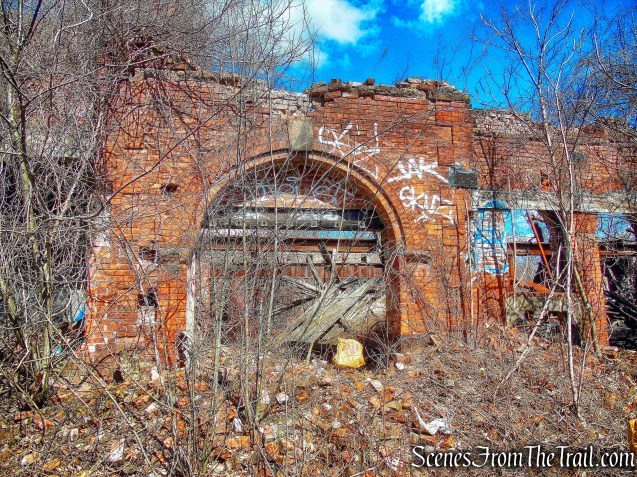
Trailhead parking: Michigan Road Parking Area – Pound Ridge, NY 10576


Ward Pound Ridge Reservation encompasses 4,315-acres and is Westchester County’s largest park. The name Pound Ridge is credited to the Indians who originally lived in the area. They had a local pound in which they kept game on the hoof until they needed it for food. The Indians built an enclosure of saplings driven into the ground and drove their game into the pound. The name was spelled “Poundridge” until 1938.

The reservation features 35 plus miles of hiking trails through various habitats. The many carriage road trails and stone walls meandering through the park are a testament to farming days gone by. More than thirty farms once existed within the park’s boundaries. The secondary trails are often less conspicuous and fun to explore.

Most trail intersections are marked by numbered signs posted on trees. These numbers are shown on the park map. Since the trail system in the park is complex, hikers should obtain a free park map before beginning the hike.

When I was a kid, we would go to Pound Ridge, as it was known then, and spend the night in one of the many lean-tos, with a bonfire and drinking warm beer until daylight. Away from the watchful eyes of adults, we were in heaven. Since those bygone days, I have never returned to the area. Fast forward many years later, I decided to map out a hike and revisit the park. If only it was that easy to revisit my youth, but I digress. I wanted to pack in as many points of interest as possible on the hike, but with its network of trails, I knew that I could bailout and shorten the hike if necessary. Having just done Breakneck Ridge and Sugarloaf Mountain two days earlier, I was not sure if I could do the entire loop that I had planned.

From the Michigan Road picnic area, the red trail offers access to the greatest variety of scenery along its 5.6 mile loop. The Leatherman’s Loop Trail travels to an overlook over the Cross River Reservoir and passes near the legendary Leatherman’s Cave on its 1.25 mile loop. The Rocks Trail takes hikers on a 4.9-mile circuit into the heart of Ward Pound Ridge to pass Indian Rock Shelter, Raven Rock, Castle Rock, Spy Rock, Bear Rock and Dancing Rock. Combining portions of these three main trails, along with some secondary trails (connector trails), this hike covers a good portion of the southwest section of the park.

Ward Pound Ridge Reservation

Ward Pound Ridge Reservation

From the circle at the end of the Michigan Road parking area, we turned right and followed a road blocked by a wooden gate.

road blocked by a wooden gate

road blocked by a wooden gate

There are numerous junctions and intersections, but we ignored them and focused on the red and green blazes. The numbered intersections are quite useful and help to determine where exactly you are on the map. Hiking without a map and a compass in this park would be unwise. After passing the kiosk, we came to a fork, junction 70, and veered right, following the red and green blazes.

Start of the Red/Green Trail

Start of the Red/Green Trail

The Red/Green Trail follows a woods road and is relatively level at this point.

Red/Green Trail

Red/Green Trail

After approximately 0.5 miles from the start, we arrived at junction 31. Here the Red/Green Trail goes to the left. We turned right onto the L-on-white-blazed Leatherman’s Loop Trail.

junction 31

junction 31

The three blazes on a tree mark the start of the Leatherman’s Loop.

Leatherman's Loop Trail

Leatherman’s Loop Trail

The Leatherman’s Loop Trail climbs gently through the woods and passes several other junctions. The trail is well marked and easy to follow.

Leatherman's Loop Trail

Leatherman’s Loop Trail

Turning left at a T-intersection (junction 27), still following the “LL” blazes, the trail proceeds along a winding route to the top of a hill. Just to the right of the trail, rock ledges provide a west-facing viewpoint of the Cross River Reservoir.

west-facing viewpoint of the Cross River Reservoir

west-facing viewpoint of the Cross River Reservoir

We stopped here briefly to take in the view, but it was so cold and windy that we didn’t stay long.

west-facing viewpoint of the Cross River Reservoir

west-facing viewpoint of the Cross River Reservoir

We Continued heading south along the Leatherman’s Loop Trail, which descends steeply at times, on a footpath.

Leatherman’s Loop Trail

Leatherman’s Loop Trail

After passing a large rock overhang, we reached junction 29. Here we strayed a bit because there is supposed to be a sign  on a tree that reads “Leatherman’s Cave.” We didn’t see a sign and we didn’t see any blazes. This area is just below the scenic overlook we were at, just moments before and there are numerous rock formations and cliffs. On top of that, there seems to be caves everywhere and not knowing what the Leatherman’s Cave looked like, made it that much more difficult.

Ward Pound Ridge Reservation

Ward Pound Ridge Reservation

After searching for a little while, I found what looked like a footpath and what I assumed was the cave in question. I was able to confirm (after the hike) that this was indeed the Leatherman’s Cave.

Leatherman’s Cave

Leatherman’s Cave

Attired in a patchwork of leather from head to toe, The Leatherman traveled a continuous 365 mile circuit in Connecticut & New York. The Leatherman’s timetable was set up so that he arrived in a separate locality each day, and his timing was so exact that housewives along his path “could set their clocks by him.” Some of the more well known caves that he used in Westchester include Bull’s Hill Cave in Bedford Hills, Helicker’s Cave in Armonk and the Leatherman’s Cave at Ward Pound Ridge Reservation.

Leatherman’s Cave

Leatherman’s Cave

Once we got our fill of the cave, we retraced our steps back to the Leatherman’s Loop Trail and began heading east.

Leatherman's Loop Trail

Leatherman’s Loop Trail

In a short distance, we came to junction 28 and turned right leaving the Leatherman’s Loop Trail. Along with the rest of the “secondary trails” that are listed on the map, it is marked with plain white blazes. The secondary trails are used to connect the main trails in the park.

secondary trail from junction 28

secondary trail from junction 28

This trail passes through an area known as Honey Hollow on the map. It is very quiet and secluded.

Honey Hollow

Honey Hollow

After just under 0.5 miles, this trail ends at junction 30, at a Y-intersection with the Red/Green Trail. To the left, the Red/Green Trail heads north towards the parking area where we began our hike. We veered right, heading east on the Red/Green Trail.

Red/Green Trail

Red/Green Trail

We stayed on Red/Green Trail for approximately 0.5 miles until we reached junction 34 and turned left. This trail winds through the woods on a footpath in an easterly direction.

secondary trail from junction 34

secondary trail from junction 34

We stayed on this trail for approximately 0.42 miles until we reached junction 36. Here we turned right onto the Rocks Trail, marked with the letters “RT” on a white background.

Rocks Trail

Rocks Trail

The Rocks Trail proceeds uphill on a woods road. In about 0.5 miles at junction 37, a white-blazed trail begins to the left. Turning left and following this white secondary trail uphill, we came to Dancing Rock, a large flat rock where farmers used to dance to celebrate the conclusion of the harvest season.

Dancing Rock

Dancing Rock

The trail loops around and rejoins the Rocks Trail at junction 60. Turning left, we continued along the Rocks Trail, which climbs a little and crosses under power lines. It briefly parallels the power lines then bears left. As it descends through the woods, it passes Bear Rock to the right of the trail.

Bear Rock

Bear Rock

Bear Rock is named for a petroglyph, a carving in the shape of a bear, on the west side of the rock.

Bear Rock petroglyph

Bear Rock petroglyph

After paralleling the power lines again, the trail reaches junction 39 and turns left. The Rocks Trail then passes through two sets of stone walls.

Rocks Trail

Rocks Trail

Rocks Trail

Rocks Trail

We continued following the Rocks Trail, which turns left and descends. At the base of the descent, we turned right and cross a seasonally wet area on puncheons and rocks. After crossing two more stone walls, the Rocks Trail turns sharply left and parallels a stone wall.

Rocks Trail

Rocks Trail

The Rocks Trail soon bears right, away from the stone wall and climbs to Spy Rock, with south-facing views through the trees.

Spy Rock

Spy Rock

During the Revolutionary War, this rock ledge was used by the Americans to observe the movements of British troops.

Spy Rock

Spy Rock

Now descending, steeply in spots, the Rocks Trail continues down into a gully, with impressive cliffs to the right.

Rocks Trail

Rocks Trail

Rocks Trail

Rocks Trail

The trail then climbs out of the gully and crosses a level area. It soon begins a steady descent, first gradually, then more steeply on a series of about 80 rock steps and continues through a mixed forest of fir and beech trees.

rock steps - Rocks Trail

rock steps – Rocks Trail

At the base of the descent, the Rocks Trail heads northeast on a level woods road through a scenic valley. After crossing an intermittent stream and an old stone wall, the trail climbs more steeply. It levels off, then continues on an undulating route along the side of the hill, with several rather steep ups and downs. After briefly joining an old woods road, the Rocks Trail climbs and passes beneath the power lines. Just beyond the power lines, it passes a huge boulder to the left, known as Castle Rock.

Castle Rock

Castle Rock

At this point, we were starting to wear down and decided to shorten the hike a little. I was a little disappointed because we skipped Raven Rock and Indian Rock, but we still had almost 1.75 miles to go in order to get back to where we started. At this point we had hiked over 6 miles and began to head back. At junction 59 we made a left and followed the white blazes to its terminus at junction 47 where we turned left on the Red Trail, which follows a woods road.

Red Trail

Red Trail

At junction 36, we turned right onto the Rocks Trail and walked a short distance to a Y-intersection with the Yellow Trail. We stayed left and began heading north, now following the yellow-blazed trail on a woods road.

Yellow Trail

Yellow Trail

We took the Yellow Trail for about 0.6 miles until we reached junction 24 and turned left. In a short distance, we reached junction 70, near the kiosk where we began our hike and turned right.

junction 70

junction 70

We then walked past the kiosk, the wooden gate and back to the parking area where our hike began.

Ward Pound Ridge Reservation

Ward Pound Ridge Reservation

This was a great hike and much more rugged than I had envisioned. The woods roads were easy going, but the footpaths provided enough ups and downs to wear us down. I would like to return at some future date and explore other areas of this park as it has enough points of interest to merit a return visit. The rock formations and cliffs are reminiscent of Harriman State Park and the section that we hiked is secluded and doesn’t seem to get a lot of foot traffic. Totally enjoyable and I highly recommend it.

To get a better idea of what the hike is like, view the short video below.

Pros: Leatherman’s Cave, massive rock formations and cliffs, secluded trails, scenic views, woods roads, rugged trails.

Cons: Parking fee
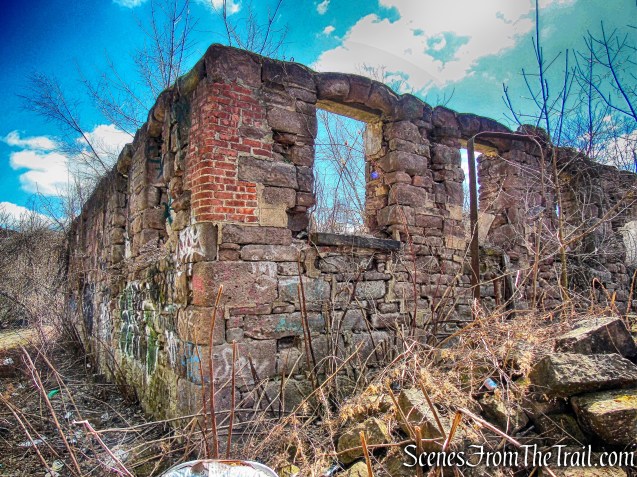
Take a hike!

Leatherman's Cave

Leatherman’s Cave


Breakneck Ridge and Sugarloaf Mountain Loop

November 17, 2017 – Cold Spring, NY

Difficulty: Strenuous

Length: Approximately 6.5 miles

Max elevation: 1,240 ft.– total elevation gain approximately 2,166 ft.

Route type: Circuit

Map: East Hudson Trails Map #102

Trailhead parking: Breakneck Ridge Trailhead – Cold Spring, NY 10516

Breakneck Ridge is a mountain along the Hudson River between Beacon and Cold Spring, straddling the boundary between Dutchess and Putnam counties. Until the early 20th century, the mountain was also known as St. Anthony’s Face or Turk’s Face, after a facelike stone formation on the southern cliffs that was destroyed by quarrymen in 1846. It has several summits, the highest, some distance inland, reaching approximately 1,260 feet above sea level. The southern face of the peak is remarkable for its striking cliffs, the result of quarrying in past years.

Breakneck Ridge as viewed from Storm King Mountain

Breakneck Ridge as viewed from Storm King Mountain

Sugarloaf is one of several mountains in the state of New York with that name. It is located in the town of Fishkill near the Hudson River and Breakneck Ridge. It is part of the Hudson Highlands and its summit is 900 feet above sea level. The summit provides views up and down the Hudson River.

Breakneck Ridge is considered one of the best and toughest day hikes in the country. The steep ascent up its western face involves climbing over rock ledges, using both hands and feet. This rock scramble attracts hikers from all over and is one of the most popular hikes in the region. With popularity comes overuse and to some extent abuse. Litter, graffiti and broken glass are a common sight on Breakneck. As of January 1, 2018, the Breakneck Ridge trailhead and train stop will close temporarily to allow for restoration of the trails and construction of new safety measures along the road. It is not scheduled to reopen until mid 2019 and I wanted to hike it before it closed.

Update: December 2, 2017 – “The bids for the Breakneck Connector project came in higher than anticipated and the project is reviewing next steps. Our advice is to stay tuned to website info (NYNJTC or Hudson Highlands Fjord Trail or NYS Parks – Fahnestock/Hudson Highlands) as to when the construction project may temporarily close the access trailheads and parking in the vicinity of Breakneck Ridge. The whole trail is not closing just the areas around the construction activity for the duration of the project, whenever it begins.”

Update: March 2018 – The Trail Conference and our partners behind the Breakneck Connector project can confirm that Breakneck Ridge is open and will remain open through the 2018 hiking season. When the project is set to begin, we will provide ample notice regarding any closures or changes to the trails. Project improvements include the creation of a shared-use path connecting the Breakneck train stop and parking area to the Breakneck Ridge trailhead. It will also add new train platforms, pave the parking area, and add a new welcome center. Find more info at hudsonfjordtrail.org.

I did the 3 mile loop hike in July of 2015 and it kicked my ass. With many more miles under my boots, I wanted a do-over, and hopefully fare better. I was feeling ambitious and planned a longer hike that included Sugarloaf Mountain as well. There are several bailout options along the way, so energy level and exhaustion would determine the actual length of the hike.

Trails followed: white-blazed Breakneck Ridge Trail, blue-blazed Notch Trail and yellow-blazed Wilkinson Memorial Trail

Breakneck Ridge and Sugarloaf Mountain Loop

Breakneck Ridge and Sugarloaf Mountain Loop

This place gets so crowded on weekends, so we decided to hike it on a Friday. It just so happens that it was “National Take A Hike Day.” Trying to beat the crowds, we arrived before the train rolled in on a chilly and breezy morning. I was pleasantly surprised that there were only a few cars there and we did not waste any time to get our hike on. We walked south along Route 9D towards the trailhead, eager to begin our climb.

Walking south on Route 9D towards the Breakneck Ridge Trailhead

Walking south on Route 9D towards the Breakneck Ridge Trailhead

The white-blazed Breakneck Ridge Trail begins just north of the tunnel.

Breakneck Ridge Trailhead

Breakneck Ridge Trailhead

Breakneck Ridge Trailhead

Breakneck Ridge Trailhead

The Breakneck Ridge Trail heads south then turns left as it heads east and begins a steep climb. Using both hands and feet, we scrambled up the ridge. The trail is well marked, with arrows painted on rocks directing the way.

Breakneck Ridge Trail

Breakneck Ridge Trail

On the way up there are views of the Hudson River from the rocks.

Storm King Mountain and Hudson River as viewed from the Breakneck Ridge Trail

Storm King Mountain and Hudson River as viewed from the Breakneck Ridge Trail

After climbing steeply up the rocky face, we came to a rock ledge with a flagpole.

Breakneck Ridge

Breakneck Ridge

I was pleased with myself at this point. Two years previous, I was pretty much worn out by the time I reached this section. I did this hike in July of 2015 on one of the hottest and most humid days of the year and now it was a cold and breezy November morning. On this day, I felt good and was ready for some more. Since we got an early start, along with it being a Friday and quite brisk, we had the ridge all to ourselves. The view is quite nice and we earned it.

Looking south from Breakneck Ridge

Looking south from Breakneck Ridge

Pollepel Island

Pollepel Island

After admiring the view for a short while, we continued our ascent of Breakneck. We were far from done and still had quite a bit of climbing to do.

Breakneck Ridge

Breakneck Ridge

Breakneck Ridge

Breakneck Ridge

We continued up the white-blazed Breakneck Ridge Trail, passing junctions for the yellow-blazed Undercliff Trail and the red-blazed Breakneck Bypass Trail, both of which can be used as a bailout option. There are numerous views throughout, up to this point. As we continued walking the ridge, the blue-blazed Notch Trail (another bailout option) comes in from the right and and joins the white-blazed Breakneck Ridge Trail. I imagined the ridge as a somewhat level walk, but I was mistaken. There are numerous ups and downs with some more rock scrambling.

Joint Breakneck Ridge and Notch Trails

Joint Breakneck Ridge and Notch Trails

The Notch Trail then leaves to the left as the Breakneck Ridge Trail continues northeast towards the Mount Beacon Fire Tower. We turned left and followed the blue blazes for about .25 miles. In a short distance, the yellow-blazed Wilkinson Memorial Trail joins the Notch Trail briefly. We then came to a Y-intersection where the blue blazes veer right and the yellow-blazes veer left.

Y-intersection

Y-intersection

There are several views along the way, but at this point we were tired and just wanted to complete the hike. The climb up Sugarloaf Mountain wasn’t too bad, but we were feeling it nonetheless. We arrived at the summit and took a short break to enjoy the view with the sun in our faces.

Sugarloaf Mountain

Sugarloaf Mountain

The climb down Sugarloaf on the Wilkinson Memorial Trail, is very steep. A little downward scrambling over loose rocks and dirt, but manageable. The Wilkinson Memorial Trail ends on Route 9D and just down the road from where we parked. At this point we were all exhausted and glad it was over. This is the most total elevation gain of any hike I have ever done and I was quite proud of myself. It was a tough and challenging hike, but it was also very rewarding. I felt that I had redeemed myself and that felt pretty good.

To get a better idea of what the hike is like, view the short video below.

Pros: Rock scrambling, great Hudson Valley views, challenging hike.
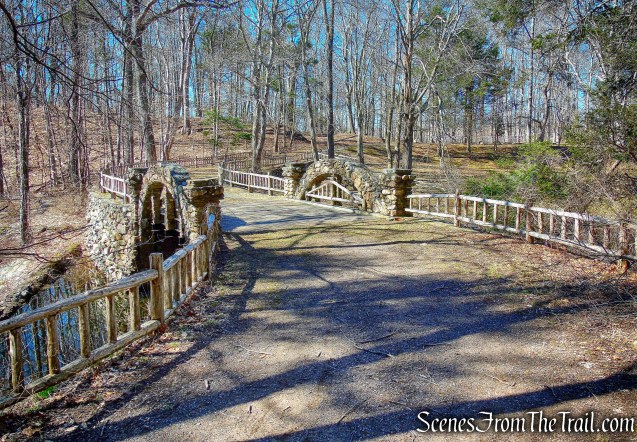
Cons: Breakneck gets overcrowded on weekends.
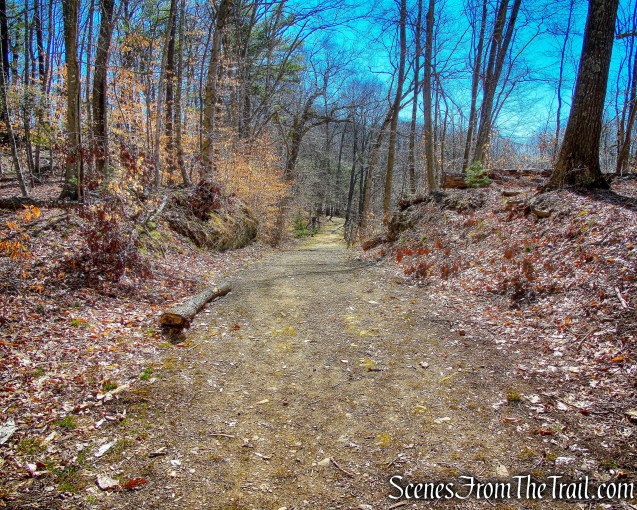
Take a hike!

Breakneck Ridge

Breakneck Ridge

Cronomer Hill Park

November 12, 2017 – Newburgh, NY

Difficulty: Easy

Length: Approximately 2 miles

Max elevation: 755 ft.– total elevation gain approximately 357 ft.

Route type: Circuit

Map: Cronomer Hill Park Map

Trailhead parking: 209 North Plank Road – Newburgh, NY 12550

Cronomer Hill Park opens in the beginning of April and closes mid November 

The most prominent elevation in the town of Newburgh, due to its central location, is Cronomer Hill. The summit of Cronomer Hill, the name of which derives from an Indian chief who allegedly lived atop the hill during Revolutionary War times, is 725 feet above sea level. Most of Cronomer Hill is now a park owned and maintained by Orange County and remains heavily forested. The summit, accessible by auto via a road intersecting with Route 32, features an observation tower which provides views of major portions of the mid Hudson Valley, including the Newburgh-Beacon Bridge, much of Dutchess County across the Hudson, and major portions of Stewart Airport to the southwest, as well as much of the city of Newburgh and town of New Windsor. A cell phone tower is at the summit of Cronomer Hill.

Cronomer Hill Park

Cronomer Hill Park

After an easy walk through Algonquin Park, I decided to check out the observation tower at the summit of Cronomer Hill. From what I read, there is a network of unmarked trails that criss-cross the park. With no map at hand, I decided to just wander my way to the summit and check out the view.

Cronomer Hill Park

Cronomer Hill Park

Upon arriving at the entrance on Route 32, the gate was down with a sign that reads “Park Closed.” Another sign reads “Park Closes At Dusk.” I was a bit confused and surmised that the park was closed to vehicles, but open to foot traffic. I did see a jogger and his dog, so I decided to enter. I later learned (while writing this post) that the park is closed from mid November to April. Now I know why it was so secluded in there.

Cronomer Hill Park

Cronomer Hill Park

The paved park road, just past the entrance, goes left and right. I turned right and began walking on the paved road as it heads uphill.

Cronomer Hill Park

Cronomer Hill Park

The road turns and comes to a fork, where I veered right and passed some large boulders.

DSC00777_HDR_1_marked

Cronomer Hill Park

Cronomer Hill Park

Cronomer Hill Park

The paved road switchbacks as it continues to climb and then I saw a footpath and I left the road.

Cronomer Hill Park

Cronomer Hill Park

This footpath has several junctions, but since I was heading towards the summit, I stayed on the path that leads uphill. In a short distance, the trail ends at the main paved park road. I checked my GPS to verify that I was on the right track, then continued northeast on the paved road. The road switchbacks up the hill and comes out to a clearing on the summit, where the observation tower is located.

Observation Tower - Cronomer Hill Park

Observation Tower – Cronomer Hill Park

The tower is built strong and sturdy. There was no shake at all as I climbed the steps. The view from the top of the 30 ft. tower is quite nice. Unfortunately, the sun was directly in my face as I tried to capture a few images. Looking southeast from the tower, the Hudson River and the Hudson Highlands are visible.

View from Observation Tower - Cronomer Hill Park

View from Observation Tower – Cronomer Hill Park

The Newburgh-Beacon Bridge sits just east of the park.

View of Newburgh-Beacon Bridge from Observation Tower - Cronomer Hill Park

View of Newburgh-Beacon Bridge from Observation Tower – Cronomer Hill Park

The view is much nicer than represented in the images above. Well worth the walk up the hill. When the park is open, one can drive right up to the tower, but I prefer to earn the view. There is a cell tower at the summit as well, but it is off limits. I then took a footpath down the hill to the main road as I descended Cronomer Hill. Along the way there are some old stone walls and giant boulders that border the trail.

Cronomer Hill Park

Cronomer Hill Park

Cronomer Hill Park

Cronomer Hill Park

Cronomer Hill Park

Cronomer Hill Park

Cronomer Hill Park

Cronomer Hill Park

I passed several footpaths and woods roads on my way down the hill, but I just stayed on the paved park road. In a few minutes, I was back at the front gate, where I began my hike.

Cronomer Hill Park

Cronomer Hill Park

I could have spent hours wandering the many trails in this park. It was nice and quiet and with the exception of the dog runner at the start, there wasn’t another soul to be seen. I would come back if only for the view from the tower.

Take the virtual hike below, with additional images added.

Pros: Observation tower, nice views, secluded trails, myriad of trails available.

Cons: Trails are not marked, no trail map available.

Algonquin Park

November 12, 2017 – Newburgh, NY

Difficulty: Easy

Length: Approximately 1.5 miles

Max elevation: 318 ft.– total elevation gain approximately 39 ft.

Route type: Circuit

Map: Algonquin Park Map

Trailhead parking: 34-58 Powder Mill Road – Newburgh, NY 12550

Algonquin Park is located at the site of a black powder manufacturing complex that operated throughout the 19th century. The powder produced was mainly for hunting and sporting purposes, although some powder of “good quality” was provided to the military during the Civil War. When the mill was closed in the early 1900s, the land was purchased by a developer and divided into building lots. Subsequently, the part of the property that comprised the main part of the powder manufacturing complex was purchased by Colonel Frederic Delano and given to the City of Newburgh for a park. Many of the old stone buildings were incorporated into the plans for the park and the rustic, natural beauty of the site was retained. It is the only remaining nineteenth century gun powder manufacturing site in New York State and, along with several surrounding properties, has been listed on the National Register of Historic Places. It is part of the Town of Newburgh’s Orange Mill Historic District. Algonquin Powder Mill Park is located at Powder Mill and South Plank Roads and is open to the public.

Algonquin Park

Algonquin Park

The park is 42 acres of history and natural beauty with 3 ponds, a stream, picnic areas and a children’s playground. There are footpaths and wide gravel roads that make for an easy walk throughout the park.

Algonquin Park

Algonquin Park

I decided to take a ride to Newburgh and check out the interesting ruined stone buildings in this park and was pleasantly surprised at all it has to offer. It is a small park that is located at a corner intersection, but it is worth a visit for its history and natural beauty. The only thing missing is informational signs that detail what the buildings were used for. Nevertheless, a walk around the park will lead you to many points of interest.

ruined stone building - Algonquin Park

ruined stone building – Algonquin Park

cascading stream - Algonquin Park

cascading stream – Algonquin Park

One of three ponds in Algonquin Park

One of three ponds in Algonquin Park

dam waterfall - Algonquin Park

dam waterfall – Algonquin Park

The main powder mill building - Algonquin Park

The main powder mill building – Algonquin Park

ruined stone building - Algonquin Park

ruined stone building – Algonquin Park

ruined stone building - Algonquin Park

ruined stone building – Algonquin Park

ruined stone buildings - Algonquin Park

ruined stone buildings – Algonquin Park

Unnamed Orange Lake outlet brook which flows through the park just above its outlet at Quassaick Creek.

Unnamed brook - Algonquin Park

Unnamed brook – Algonquin Park

Unnamed brook - Algonquin Park

Unnamed brook – Algonquin Park

Visiting on a Sunday morning, there wasn’t anyone else there, just some park maintenance workers blowing leaves. Algonquin Park is a nice place to take a walk and go back in time. There are several other parks in close proximity that can be visited on the same day to make it a longer walk. Don’t forget to bring a camera.

Take the virtual hike below, with additional images added.

Pros: Historic ruined buildings, ponds, cascades and waterfall, natural setting.

Cons: Not much info available on the structures.

Darcy’s Ridge and North Beacon Mountain Loop

November 11, 2017 – Beacon, NY

Difficulty: Strenuous

Length: Approximately 6 miles

Max elevation: 1,540 ft.– total elevation gain approximately 1,731 ft.

Route type: Circuit

Map: East Hudson Trails Map #102

Trailhead parking: Pocket Road Beacon, NY 12508


Darcy’s Ridge is not the official name, although it should be. It is located in the Fishkill Ridge mountain range, near Mount Beacon. Located there is an American Flag on a makeshift pole, which has been maintained by the Darcy family since 1988. Every Memorial Day and Veterans Day, a hike led by the Mid-Hudson Adirondack Mountain Club, leads hikers to this spot where they hold a small ceremony to honor those that have served in the military. It is always a great honor to visit this spot knowing the story behind the flag.

Darcy’s Ridge

Darcy’s Ridge

It’s a relatively short 1.5 miles to the flag from the Pocket Road Trailhead. It is not an easy hike up the steep and rocky trail. Since I have visited the flag before, I wanted to extend the hike somewhat and explore other trails in the area. I am familiar with the area, having hiked the ridge searching for the flag several years ago. Energy level and temperature, which was in the high 20’s – low 30’s and a little windy on this Veterans Day, would be a determining factor of the length and route of our hike.

Darcy's Ridge and North Beacon Mountain Loop

Darcy’s Ridge and North Beacon Mountain Loop

Upon arriving at the Pocket Road trailhead, there were quite a few people there already. There is room for about 6 cars at the end of Pocket Road. We got our gear together and began our hike ahead of the others. We timed it so that we would arrive just ahead of the group so that we would not have to wait too long in the cold. The three white discs on a tree, mark the beginning of the white-blazed Fishkill Ridge Trail.

Fishkill Ridge Trail

Fishkill Ridge Trail

Passing to the right of the water tower, we walked on the paved road as it turns to gravel and began heading southeast.

Fishkill Ridge Trail

Fishkill Ridge Trail

In a short distance, the trail passes a small reservoir on the left, then enters the woods. The trail becomes rockier as it climbs and parallels Dry Brook.

Fishkill Ridge Trail

Fishkill Ridge Trail

In about 0.5 miles, the yellow-blazed Dry Brook Connector Trail comes in from the right. That would be our return route, but for now, we continued following the white blazes. In about 0.85 miles, we crossed Dry Brook on rocks.

Fishkill Ridge Trail

Fishkill Ridge Trail

The trail continues to climb, now more steeply, as it passes by the multi-tiered Dry Brook Falls.

Dry Brook Falls

Dry Brook Falls

The trail continues climbing and at about 1.1 miles, it comes to a gravel road, known as Mount Beacon Monument Road.

Mount Beacon Monument Road

Mount Beacon Monument Road

Turning left on the gravel road, we walked a few feet then turned right into the woods to continue on the Fishkill Ridge Trail. Almost immediately upon re-entering the woods, we left the Fishkill Ridge Trail and turned right, heading uphill on an unmarked old woods road. The road is eroded and looks more like a gully than a road at first. I have walked it before and was a little unsure, but after a short distance, it begins to resemble a woods road.

unmarked old woods road

unmarked old woods road

The woods road climbs moderately and passes some old stone walls. After about 500 yards, the Blue Connector Trail joins from the left at a T-intersection. Here we turned right and followed the blue blazes for about 422 yards until its terminus. Straight ahead is another woods road, but we turned right.

Terminus of Blue Connector Trail

Terminus of Blue Connector Trail

We then began following the yellow-blazes of the Wilkinson Memorial Trail, which climbs steeply on switchbacks. We followed the yellow blazes for about 560 yards.

Wilkinson Memorial Trail

Wilkinson Memorial Trail

At the top of the rise, the Wilkinson Memorial Trail makes a sharp left. To the right is an unmarked footpath that leads up a small hill. I tend to call this the Flag Trail.

Flag Trail

Flag Trail

After a short hike up the Flag Trail and gaining approximately 1380 feet, we arrived at Darcy’s Ridge.

Darcy's Ridge

Darcy’s Ridge

We sat and caught our breath for a few minutes, knowing that the group would be arriving shortly. The flag that flies here was first erected by the Darcy family on May 31, 1988 and continues to be maintained by them. You can read about it here.

Darcy's Ridge

Darcy’s Ridge

Not long after we arrived, the rest of the hikers began to trickle in. Once they were all there, I was able to capture an image of the group, said to be the most people to ever attend the ceremony.

Darcy's Ridge

Darcy’s Ridge

A pair of musicians played the National Anthem, Taps and the anthems for each branch of the service.

Darcy’s Ridge

Darcy’s Ridge

After the ceremony was over, people started to leave. We stayed back to enjoy the view along with some hot chocolate as we took in the sanctity of this place. We then retraced our steps back down the Flag Trail and turned right onto an old woods road.

old woods road

old woods road

Unlike the other woods road that we traveled on earlier, this one looked abandoned rarely traveled. At times it was hard to follow, but my trusty GPS device kept me on the right path.

old woods road

old woods road

After about 0.5 miles, we came to the Beacon Reservoir.

Beacon Reservoir

Beacon Reservoir

We then left the woods road and came to the bank of the Beacon Reservoir. The reservoir supplies water to the city of Beacon. It is located at 1,285 feet above sea level in a hollow between Beacon Mountain and Scofield Ridge, in the neighboring Town of Fishkill, very close to the Putnam County line. It was created in 1922 by damming Dry Brook, a tributary of Fishkill Creek.

Beacon Reservoir

Beacon Reservoir

Visible from the reservoir is the Mount Beacon Fire Tower, which was built in 1931 and restored in 2013.

Mount Beacon Fire Tower

Mount Beacon Fire Tower

We headed north along the eastern side of the reservoir until we came to the dam. There we crossed over to the western side of the reservoir and onto North Beacon Mountain.

Beacon Reservoir dam

Beacon Reservoir dam

We walked through the woods briefly and came to a gravel road. The same road we crossed earlier, lower on the mountain, Mount Beacon Monument Road. We followed the road as it ascends along the shoulder of North Beacon Mountain.

Mount Beacon Monument Road

Mount Beacon Monument Road

Along the way, I saw a rock outcrop just off the trail that looked interesting. We took a detour and were rewarded with a perfect view of the Mount Beacon Fire Tower as it sits on South Beacon Mountain at 1650 feet above sea level.

Mount Beacon Fire Tower

Mount Beacon Fire Tower

A few feet further, we were greeted with a nice view of the Hudson River.

view of the Hudson River

view of the Hudson River

We stayed here a while and relaxed while enjoying the view. Mount Beacon is a popular hiking destination, but this spot was desolate. We then returned to Mount Beacon Monument Road and headed downhill with the Hudson River visible through the trees.

Mount Beacon Monument Road

Mount Beacon Monument Road

The road leads to the ruins of the wheel house that powered the Mount Beacon Incline Railway up the mountain from 1901 to 1978.

wheel house ruins

wheel house ruins

wheel house ruins

wheel house ruins

When we first got to the site of the old casino, there was no one in sight. Minutes later, the place was crowded with people.

site of the Casino

site of the Casino

The views as always are quite grand from here. The Newburgh–Beacon Bridge is visible just below, with the Gunks and the Catskills just beyond.

Newburgh–Beacon Bridge

Newburgh–Beacon Bridge

Across the Hudson River, Schunemunk Mountain is visible to the southwest.

Schunemunk Mountain

Schunemunk Mountain

We hung out here for a short while, fully appreciating these Hudson Valley views.

Hudson Valley view

Hudson Valley view

We walked by the the ruins of the wheel house on our way out for a different perspective.

the ruins of the wheel house

the ruins of the wheel house

We then took the red-blazed Casino Trail to make our way down North Beacon Mountain.

Casino Trail

Casino Trail

The Casino Trail descends steeply on switchbacks and since the day warmed up a bit, we passed countless people making their way up. After about 0.6 miles on the Casino Trail, we took the yellow-blazed Dry Brook Connector Trail.

Dry Brook Connector Trail

Dry Brook Connector Trail

The Dry Brook Connector Trail travels on an old woods road for almost a mile. An abandoned jeep sits alongside the trail.

Dry Brook Connector Trail

Dry Brook Connector Trail

The trail gains about 200 feet of elevation before it levels off and then descends. At this point in the hike, it felt like a whole lot more. The Dry Brook Connector Trail ends at a T-intersection with the white-blazed Fishkill Ridge Trail.

Dry Brook Connector Trail

Dry Brook Connector Trail

Turning left onto the Fishkill Ridge Trail, we walked another 0.5 miles to the Pocket Road Trailhead, where our hike began.

Pocket Road Trailhead

Pocket Road Trailhead

An exhausting, yet fulfilling Veterans Day hike. For the most part, we had the trails to ourselves on a chilly day. I enjoy hiking the Hudson Highlands and will be back soon for another challenging hike.

Take the virtual hike below, with additional images added.


Pros: Darcy’s Ridge and the flag, Hudson Valley views, challenging trails.

Cons: Crowds on Mount Beacon.

Take a hike!

Darcy's Ridge

Darcy’s Ridge


Schunemunk Mountain Loop from Taylor Road

Please Note: Due to recent rail corridor crossing closures in Schunemunk State Park the hike described below is no longer possible. The Metropolitan Transportation Authority (MTA) forbids crossing its rail corridor in Schunemunk State Park. Trespassers may be fined or subject to arrest by MTA police. There are currently no trail connections within the park between the east and west sides of the tracks.

These closures are due to an increase in trespassing at the Moodna Viaduct Trestle. Anyone crossing the railroad tracks will be ticketed by MTA Police, who are actively monitoring the area. A solution for re-opening access is being sought but it will take some time.

Please utilize the Otterkill Road parking lot to access the west side of the park.

November 4, 2017 – New Windsor, NY

Difficulty: Strenuous

Length: Approximately 6.5 miles

Max elevation: 1,664 ft.– total elevation gain approximately 1,481 ft.

Route type: Circuit

Map: West Hudson Trails Map #114

Trailhead parking: 76 Taylor Road New Windsor, NY 12553

Schunemunk (pronounced “skun-uh-munk”) means “excellent fireplace” in the Algonquin tongue of the Leni Lenape tribe that originally inhabited the area. Schunemunk Mountain is the highest point in Orange County. An interesting feature of the mountain is its double crest. For nearly three miles, there are two ridges running parallel to each other. During the American Revolution, the mountain was often the site of skirmishing between Tory and Patriot irregulars.

Schunemunk Mountain as viewed from Black Rock Mountain

Schunemunk Mountain as viewed from Black Rock Mountain

Schunemunk Mountain State Park has over 2700 acres of rolling meadows and a spectacular mountain top. Steep climbs to the mostly level ridges, greets hikers with thrilling panoramic views of adjacent valleys, portions of the distant Hudson River and surrounding forest and farm lands. The eight marked trails include the Long Path, Jessup, Western Ridge, Trestle, Sweet Clover, Otterkill, Dark Hollow and Barton Swamp Trails totaling over 25 miles which traverse the mountain and glades.

Schunemunk Mountain Loop from Taylor Road

Schunemunk Mountain Loop from Taylor Road

Check out the Google Earth Fly-Through video of the hike below.

The Megaliths is the most popular hike on the mountain, so of course I had to check it out. I hiked the southern end of Schunemunk Mountain a year earlier and was ready to come back for some more. We tried to get an early start to beat the crowds on a Saturday morning, but I overslept. We arrived at the trailhead shortly before 9:00 am and there were a lot of cars already there. Turns out that there were several “Meetups” hiking there on the same day. The Chinese Mountain Club also had an outing there and had arrived shortly before us and were getting ready to hit the trail. They had a contingent of about twenty that were gearing up as we pulled in. We hurriedly got ourselves together, wanting to put some distance between us and the group. A large group like that spread out on a narrow trail would cause a logjam. Anyway, we began our hike on on the joint Jessup (yellow), Sweet Clover (white) and Highlands (teal diamond) Trails, which is directly across the street from the kiosk.

kiosk

kiosk

joint Jessup (yellow), Sweet Clover (white) and Highlands (teal diamond) Trails

joint Jessup (yellow), Sweet Clover (white) and Highlands (teal diamond) Trails

Although the three trails run together at the start, for the first 2.2 miles, we would only concern ourselves with the white-blazed Sweet Clover Trail. The trail starts off climbing a grassy hill.

Sweet Clover Trail

Sweet Clover Trail

Upon reaching the crest of the hill, the trail heads northwest through a field with Schunemunk Mountain on the right.

Sweet Clover Trail

Sweet Clover Trail

When the trails split, we went left to remain on the white-blazed Sweet Clover Trail.

Sweet Clover Trail

Sweet Clover Trail

The trail continues on a grassy road through a field, with a lone tree in the middle of it.

Sweet Clover Trail

Sweet Clover Trail

At the end of the field, the Sweet Clover Trail enters the woods, turns right and passes some old stone walls. We followed the white blazes on an old woods road as it climbs gently.

Sweet Clover Trail

Sweet Clover Trail

The trail climbs and crosses railroad tracks. This is an active rail line, so we looked and listened for approaching trains before crossing.

Cross the tracks on the Sweet Clover Trail

Cross the tracks on the Sweet Clover Trail

On the opposite side of the tracks, the trail briefly turns left, then immediately turns right and begins a steady climb of the mountain.

Sweet Clover Trail

Sweet Clover Trail

After a while, the trail levels off and emerges at the edge of a ravine, with views to the east. It then bears right and climbs more steeply, passing several viewpoints along the way. We were racing up the hill in order to beat the large group of hikers to the Megaliths. After approximately 2.2 miles, we reached Sweet Clover Junction. The sign faces the opposite direction if approaching from the east, but is visible if you are looking for it. We had now gained about 1200 feet of elevation.

Sweet Clover Junction

Sweet Clover Junction

We then began following the yellow-blazed Jessup Trail as it runs along the eastern ridge (also the route of the teal-diamond-blazed Highlands Trail).

Jessup Trail

Jessup Trail

The ridge is formed of conglomerate rock, sometimes called puddingstone, studded with pebbles of white quartz and pink sandstone. The trees grow out of cracks in the rock.

Jessup Trail

Jessup Trail

Along the way, there are several nice east-facing viewpoints. Visible to the right are the East Hudson Highlands. North and South Beacon Mountains can be identified by the towers on their summits and Breakneck Ridge by its bald western face.

east-facing viewpoint - Jessup Trail

east-facing viewpoint – Jessup Trail

Along the Jessup Trail, there are rock cairns that serve as a guide to keep you on the trail. The cairns appear more frequently as we approached the Megaliths. I had viewed images online of “Megaliths” with an arrow, written in white paint, pointing the way. I did not see that or any white blazes, but the cairns steered us in the right direction.

cairns on Jessup Trail

cairns on Jessup Trail

The only white blaze that I saw was on a tree just feet from the Megaliths, but I did see the white blazes on my way back. Nevertheless, it’s a short walk from the Jessup Trail and the cairns lead the way.

Megaliths Trail

Megaliths Trail

We arrived at the Megaliths and much to my dismay, the group of hikers that I was trying to beat to the top, was already there. Not only were they already there, but they were finishing up their lunch. I was a bit bewildered because we practically ran up the mountain and basically wore ourselves out for naught. It was a semi-comical moment and we just had to laugh. We plopped ourselves down and enjoyed the view.

The Megaliths

The Megaliths

The Megaliths are a group of massive blocks that have broken off from the bedrock. It is a point of interest on this hike so don’t expect solitude if you visit on the weekend.

The Megaliths

The Megaliths

From this western facing viewpoint, the Shawangunks and the Catskill Mountains are visible. A very cool spot to have lunch and relax for a while. We lucked out while we were here. Everyone left and we had the place to ourselves for a few minutes until we were joined by several large groups of hikers.

The Megaliths

The Megaliths

The summit is nearby and since we climbed this far, we decided to visit the the highest point in Orange County. Retracing our steps on the white-blazed Megaliths Trail, then turned right on the Jessup Trail and walked a short distance to the summit. The summit of Schunemunk Mountain is marked with white paint, “1664.”

summit of Schunemunk Mountain

summit of Schunemunk Mountain

There isn’t much of a view from the summit, but it is worth visiting.

summit of Schunemunk Mountain

summit of Schunemunk Mountain

We then retraced our steps along the Jessup Trail, heading northeast until we came to a junction with the Dark Hollow Trail and turned right.

Dark Hollow Trail

Dark Hollow Trail

We followed the black-on-white blazes as it begins a gradual descent of the mountain.

Dark Hollow Trail

Dark Hollow Trail

The descent steepens and passes a cave to the right of the trail.

Cave on Dark Hollow Trail

Cave on Dark Hollow Trail

The trail curves to the right and passes a rock ledge. We ventured up to the top of the ledge and were rewarded with another great east facing viewpoint.

east facing viewpoint

east facing viewpoint

After another steep stretch, we crossed a brook and soon the trail joins a woods road, which it follows for most of the remainder of the way down.

Dark Hollow Trail

Dark Hollow Trail

The Dark Hollow Trail ends at the base of the descent by the railroad tracks. We crossed the tracks and followed the white-blazed Sweet Clover Trail back to the parking area where our hike began.

This was a tough hike, but I thoroughly enjoyed it. There were views galore and the trails kept me on my toes. There are different approaches to the summit and I hope to get back there soon and give them a try.

Take the virtual hike below, with additional images added.

Pros: Megaliths, Jessup Trail is quite scenic, Outstanding views.

Cons: Popular hike and gets a little crowded on weekends.

Take a hike!

Schunemunk Mountain Megaliths

Schunemunk Mountain Megaliths

Fingerboard Mountain loop from Lake Skannatati – Harriman State Park

October 28, 2017 – Southfields, NY

Difficulty: Moderate

Length: Approximately 6.2 miles

Max elevation: 1,354 ft.– total elevation gain approximately 1,005 ft.

Route type: Circuit (Lollipop Loop)

Map: Harriman-Bear Mountain Trails Map #119

Trailhead parking: Lake Skannatati Parking, Southfields, NY 10975


I love hiking in Harriman State Park, but tend to avoid the area during Octoberfest, which is held at the Anthony Wayne Recreation Area. I’m not a big fan of sitting in traffic after spending the day on the trails. With that being said, I decided to hike an area of the park that that I have been in before and throw in some sections of trails that I haven’t hiked.

Fingerboard Mountain loop from Lake Skannatati

Fingerboard Mountain loop from Lake Skannatati

Check out the Google Earth Fly-Through video of the hike below.

Lake Skannatati is quite scenic and attracts lots of visitors throughout the seasons. The parking area fills up quickly on weekends and getting there early ensures a parking spot and not running into too many people on the trails.

Lake Skannatati

Lake Skannatati

Arriving shortly before 9:00 am, the lot had quite a few cars there already. At the northwest end of the parking area, to the right of the kiosk, is the start of the inverted-red-triangle-on-white blazed Arden-Surebridge (A-SB) Trail.

Start of the Arden-Surebridge (A-SB) Trail

Start of the Arden-Surebridge (A-SB) Trail

The A-SB Trail begins a rather steep climb of Pine Swamp Mountain.

Arden-Surebridge (A-SB) Trail

Arden-Surebridge (A-SB) Trail

In about 300 yards, after passing some large rock formations on the left, there are some stone steps on the trail. Just prior to reaching those steps, we left the trail and began to bushwack west, up Pine Swamp Mountain.

Pine Swamp Mountain

Pine Swamp Mountain

The Arden-Surebridge Trail was first blazed during the summer of 1921 by J. Ashton Allis. In December of 2014 the trail was rerouted from the summit, to the shoulder of  Pine Swamp Mountain to alleviate erosion and ongoing impacts to sensitive habitats. The trail no longer passes a rock outcrop at the summit with a great view. It’s an easy bushwack up the mountain, heading west.

Pine Swamp Mountain

Pine Swamp Mountain

In about 400 yards, we arrived at a rock outcrop with a west facing viewpoint. Lake Skanatati and Lake Kanawauke from the summit of Pine Swamp Mountain.

Lake Skanatati and Lake Kanawauke from the summit of Pine Swamp Mountain.

Lake Skanatati and Lake Kanawauke from the summit of Pine Swamp Mountain.

After taking in the view, we bushwacked northeast until we caught up with the A-SB Trail and then continued heading north. The trail continues climbing, then descends Pine Swamp Mountain.

Arden-Surebridge (A-SB) Trail

Arden-Surebridge (A-SB) Trail

Approximately 0.7 miles after rejoining the A-SB Trail, there is a an old fire road on the right. We passed the fire road and continued about 400 feet to a large rectangular cut in the hillside that is 118 feet long and twenty-nine feet wide, with vertical rock walls that are about twenty-two feet deep. This excavation is part of the Pine Swamp Mine complex. There are other workings in the immediate vicinity of this mine complex and we took a little time to explore them.

Pine Swamp Mine complex

Pine Swamp Mine complex

We then retraced our steps 400 feet back to the fire road we passed just moments earlier and turned left. This road can be easily missed if you’re not looking for it.

fire road

fire road

The fire road is heavily eroded and quite rocky at first, as it heads uphill. Once it levels off, it becomes much easier to walk on.

fire road

fire road

The road less traveled, my favorite kind. We saw a couple of hikers walk past as we sat and took a short break. Other than that it was quiet and peaceful.

fire road

fire road

Just before the fire road ends at Seven Lakes Drive, we turned left onto the blue-blazed Hurst Trail.

Hurst Trail

Hurst Trail

The Hurst Trail was first blazed in November 1922 by Haven C. Hurst, a member of the Green Mountain and Sierra Clubs. The trail is only 0.5 miles long and climbs Fingerboard Mountain on a moderate grade.

Hurst Trail

Hurst Trail

In a short distance the Hurst Trail reaches the Fingerboard Shelter, which was built in 1928.

Fingerboard Shelter

Fingerboard Shelter

The Fingerboard Shelter is equipped with two fireplaces, one on each side wall, and sleeps roughly 8 people.

Fingerboard Shelter

Fingerboard Shelter

Fingerboard Shelter

Fingerboard Shelter

There have been repeated bear sightings at this shelter in the past year and a sign warns hikers.

Bear warning - Fingerboard Shelter

Bear warning – Fingerboard Shelter

We didn’t spend too much time at the shelter because we didn’t want to run into any bears. We continued on the Hurst Trail as it climbs to the ridge of Fingerboard Mountain. It ends at a T-intersection with the joint Appalachian/Ramapo-Dunderberg Trails.

Terminus of the Hurst Trail

Terminus of the Hurst Trail

We turned left and began heading southwest on the joint Appalachian/Ramapo-Dunderberg Trails.

joint Appalachian/Ramapo-Dunderberg Trails

joint Appalachian/Ramapo-Dunderberg Trails

In about 400 feet, the two trails split. We stayed left, now following the red-dot-on-white blazes of the Ramapo-Dunderberg (R-D) Trail.

Veer left to stay on Ramapo-Dunderberg (R-D) Trail

Veer left to stay on Ramapo-Dunderberg (R-D) Trail

The Ramapo-Dunderberg Trail (R-D) was the first trail in Harriman State Park to be built by the New York hiking clubs, organized in October 1920 as the Palisades Interstate Park Trail Conference.

Ramapo-Dunderberg Trail

Ramapo-Dunderberg Trail

There are numerous interesting features along the trail, including this tree squeezing through a rock formation.

Ramapo-Dunderberg Trail

Ramapo-Dunderberg Trail

The R-D Trail is 23 miles long and traverses the park from west to east. It is one of my favorite trails in the park. It climbs and descends rock ledges and travels over open rock, with an abundance of color throughout the trail.

Ramapo-Dunderberg Trail

Ramapo-Dunderberg Trail

After approximately 1.5 miles and numerous ups and downs on the R-D Trail, we arrived at Times Square. Times Square got its name because it is located at the junction of three trails and serves as a popular meeting place for hikers.

Times Square

Times Square

We then took the inverted-red-triangle-on-white blazed Arden-Surebridge (A-SB) Trail, that is just to the right of the Times Square boulder. This section of the A-SB Trail runs on an old mining road, called Surebridge Mine Road.

Arden-Surebridge (A-SB) Trail

Arden-Surebridge (A-SB) Trail

Now heading southeast, in about 0.5 miles, we arrived at the cut in the hillside, which is part of the Pine Swamp Mine Complex, from earlier in the hike. From this point on we would be walking the “stick” of our lollipop loop. For the next 1.2 miles, the trail climbs Pine Swamp Mountain, levels off a little and then descends towards the parking area where our hike began.

Arden-Surebridge (A-SB) Trail

Arden-Surebridge (A-SB) Trail


This was another great hike in Harriman State Park. We encountered very few people along the trails and it was a beautiful October day in the woods. I highly recommend this hike to one and all, just be careful of the bears near the Fingerboard Shelter if you stop there for lunch.

Take the virtual hike below, with additional images added.


Take a hike!

Ramapo-Dunderberg Trail - Fingerboard Mountain loop from Lake Skannatati

Ramapo-Dunderberg Trail – Fingerboard Mountain loop from Lake Skannatati