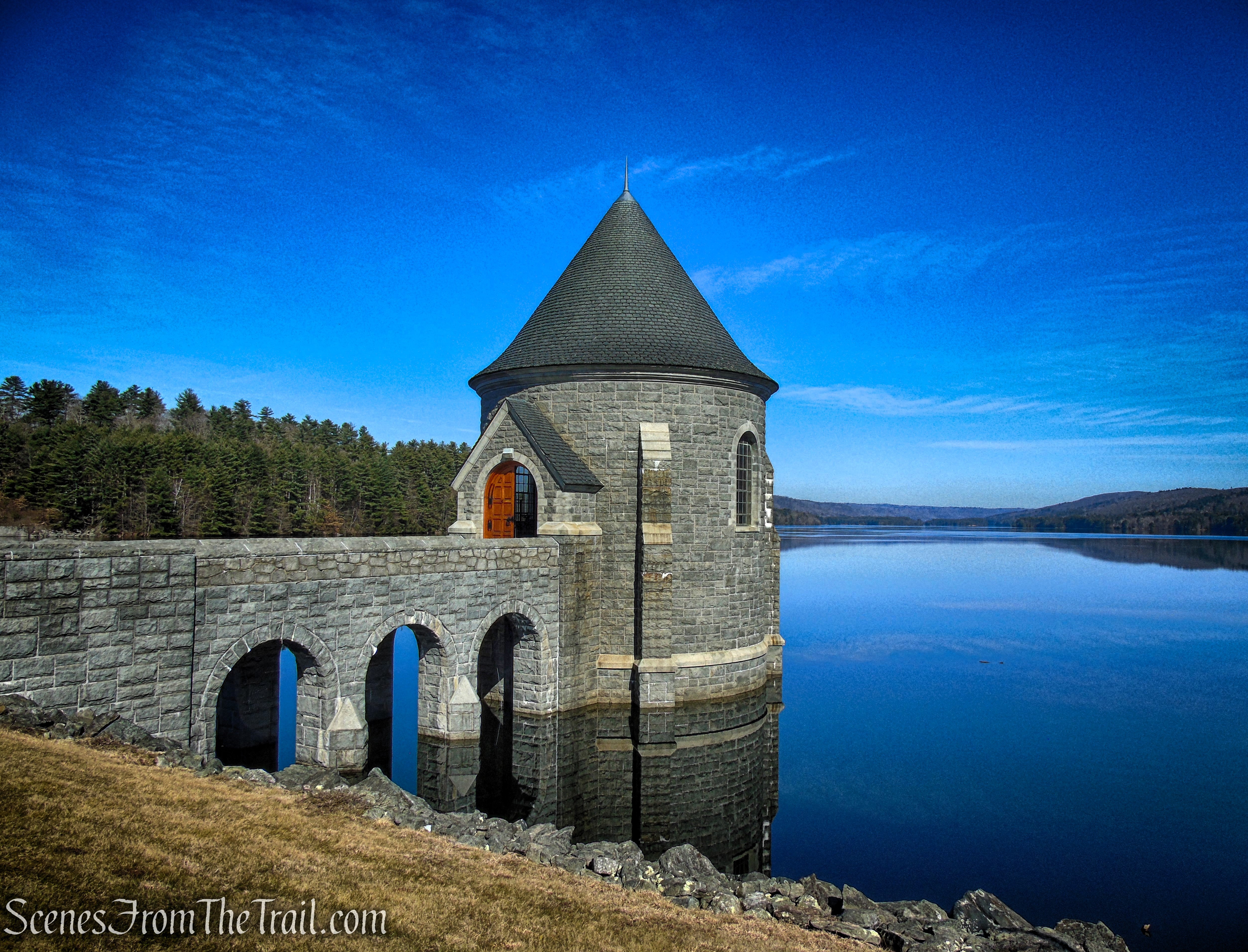
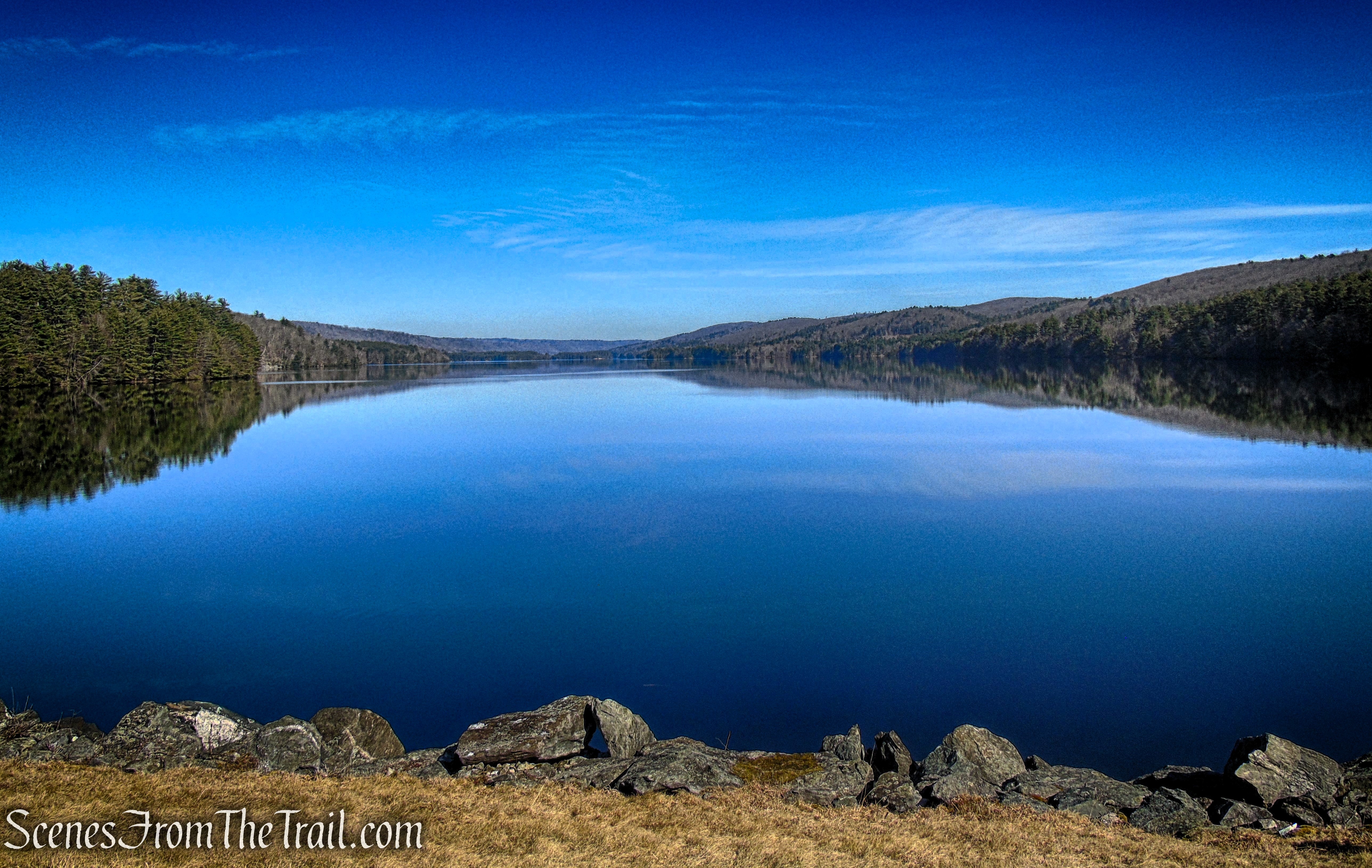
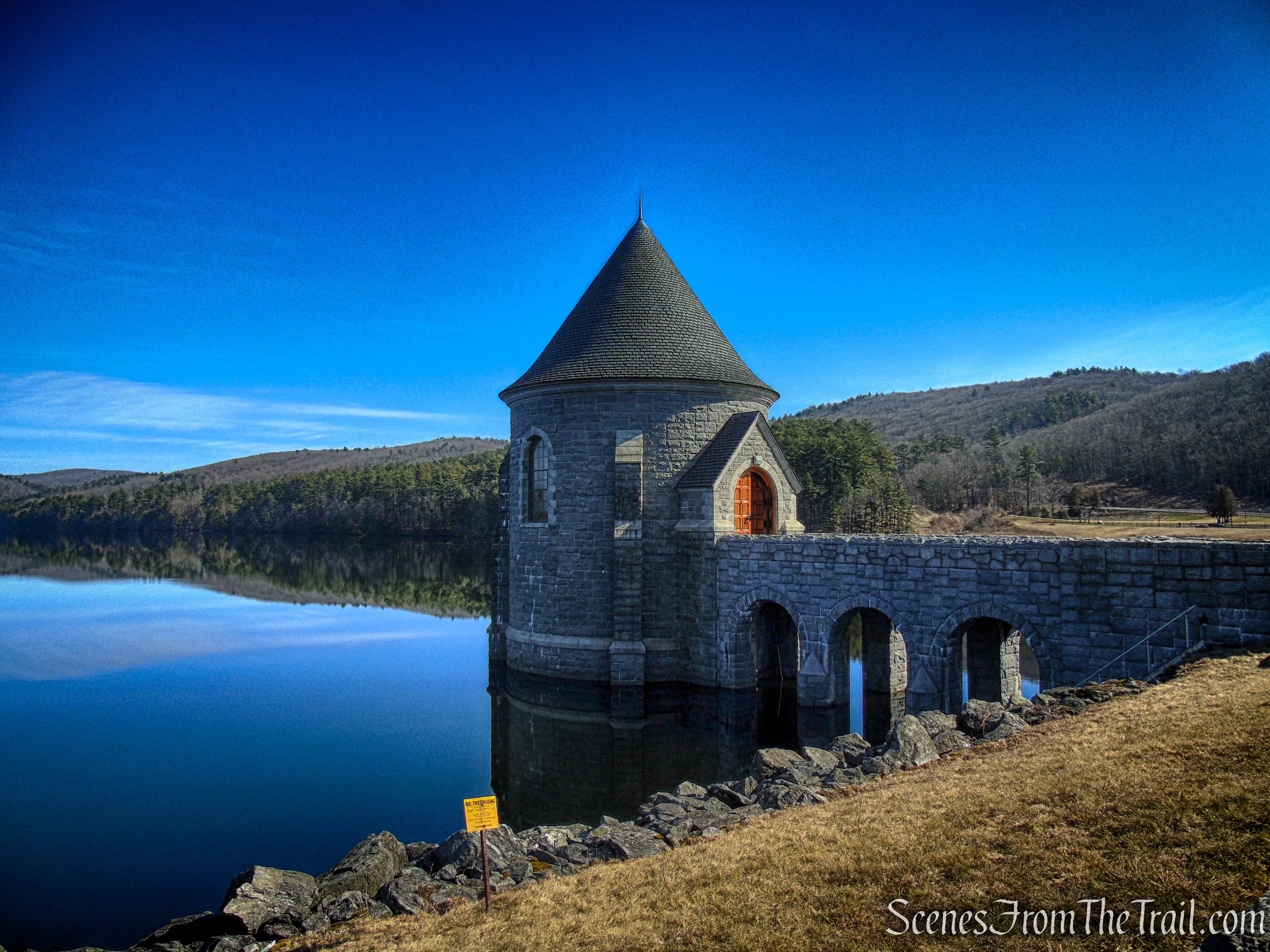
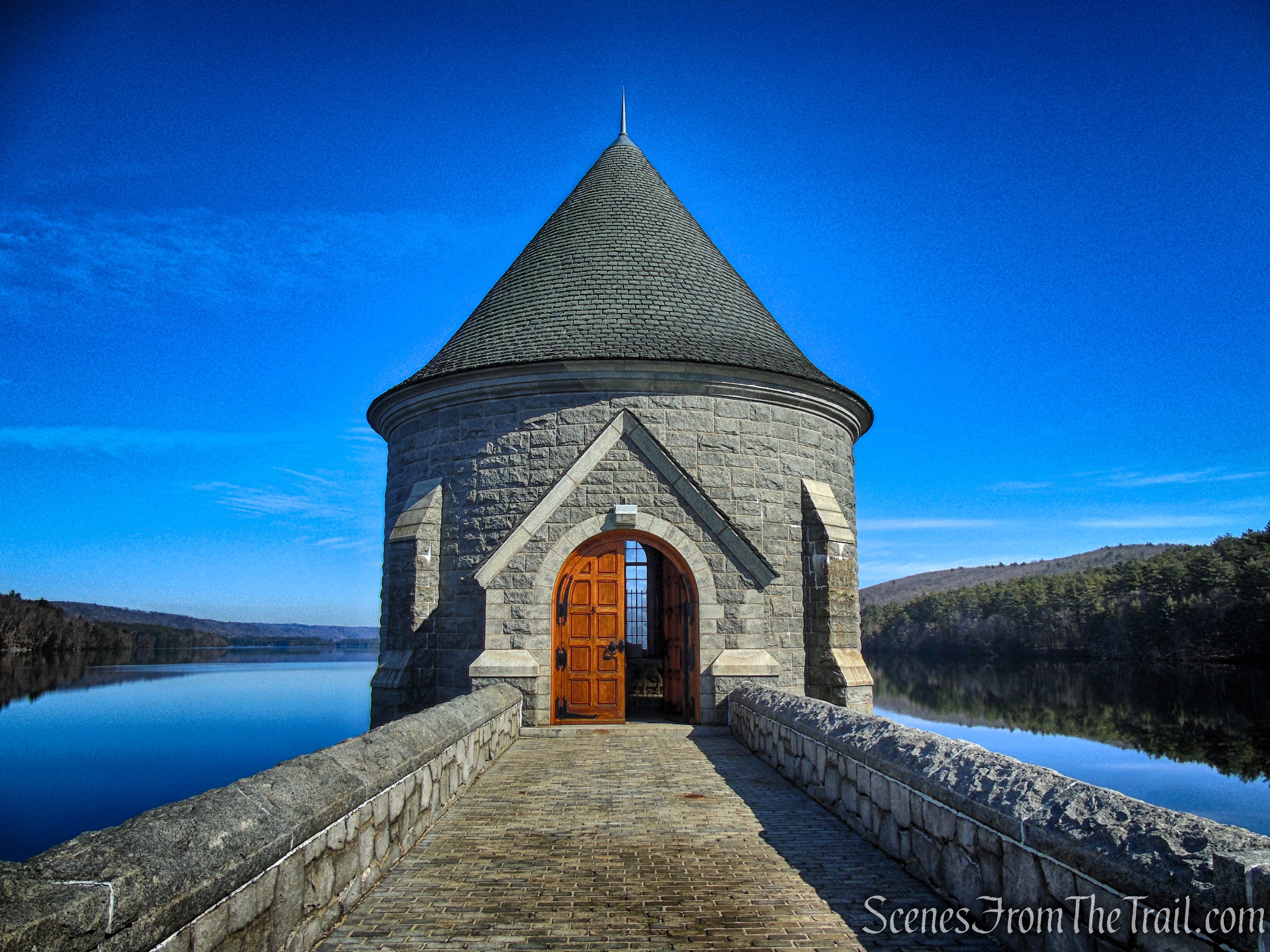
Ashokan Reservoir Promenade

June 2, ‎2024 – Olivebridge, NY

June 5, 2024 – Kingston, NY

Difficulty: Easy

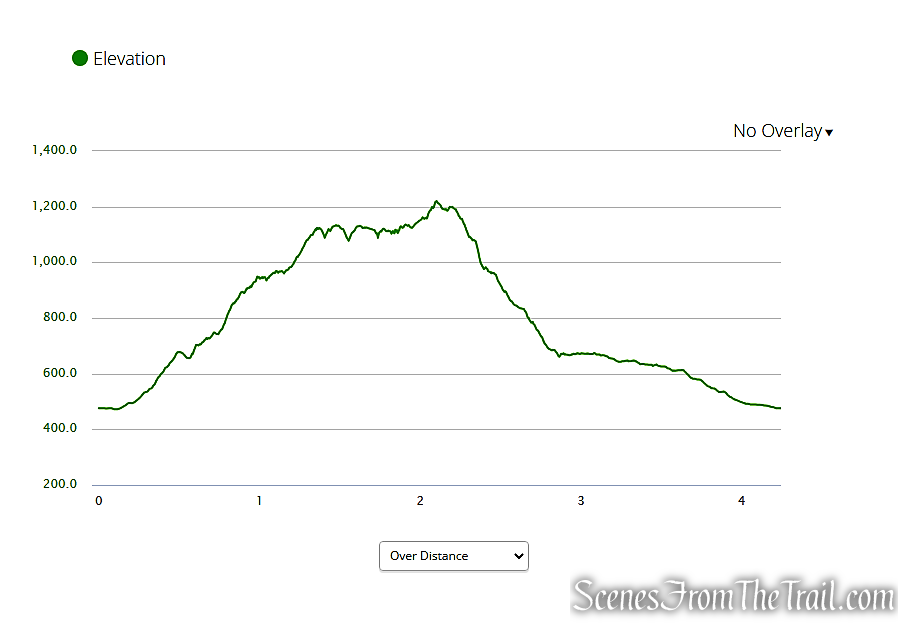
Length: Approximately 5.8 miles – total elevation gain approximately 180 ft.

Route type: Out and Back

Map: Ashokan Day Use Area

Ashokan Reservoir Promenade East Parking Lot: 27 B W S Rd, Kingston, NY 12401
Room for 30 vehicles

Ashokan Reservoir Promenade West Parking Lot: Olivebridge, NY 12461
Room for 20 vehicles

Portable Toilets on site

No dogs allowed

Please be advised that there is no tree cover and you will be fully exposed to the elements, including the hot sun.


Overview:

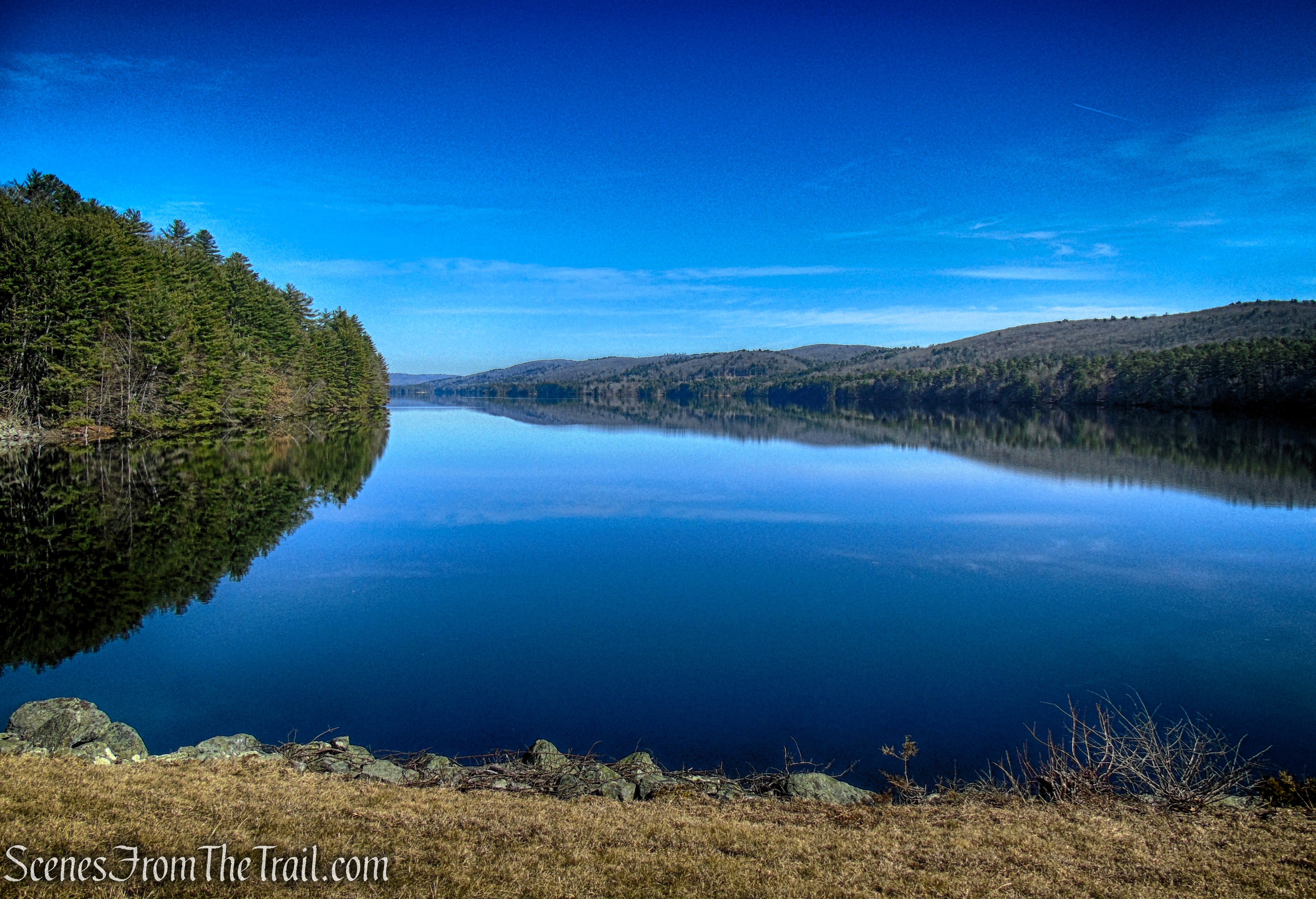
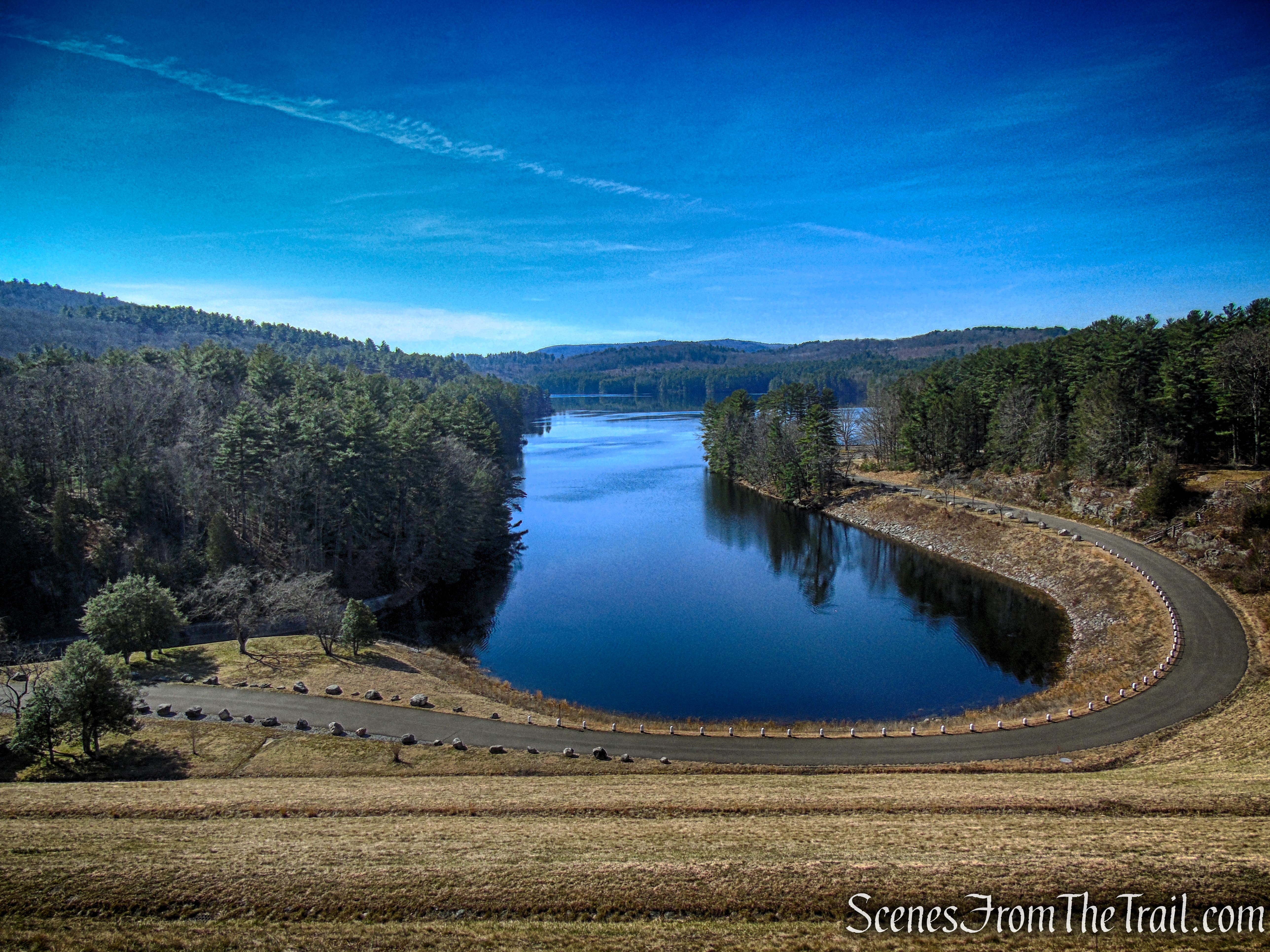
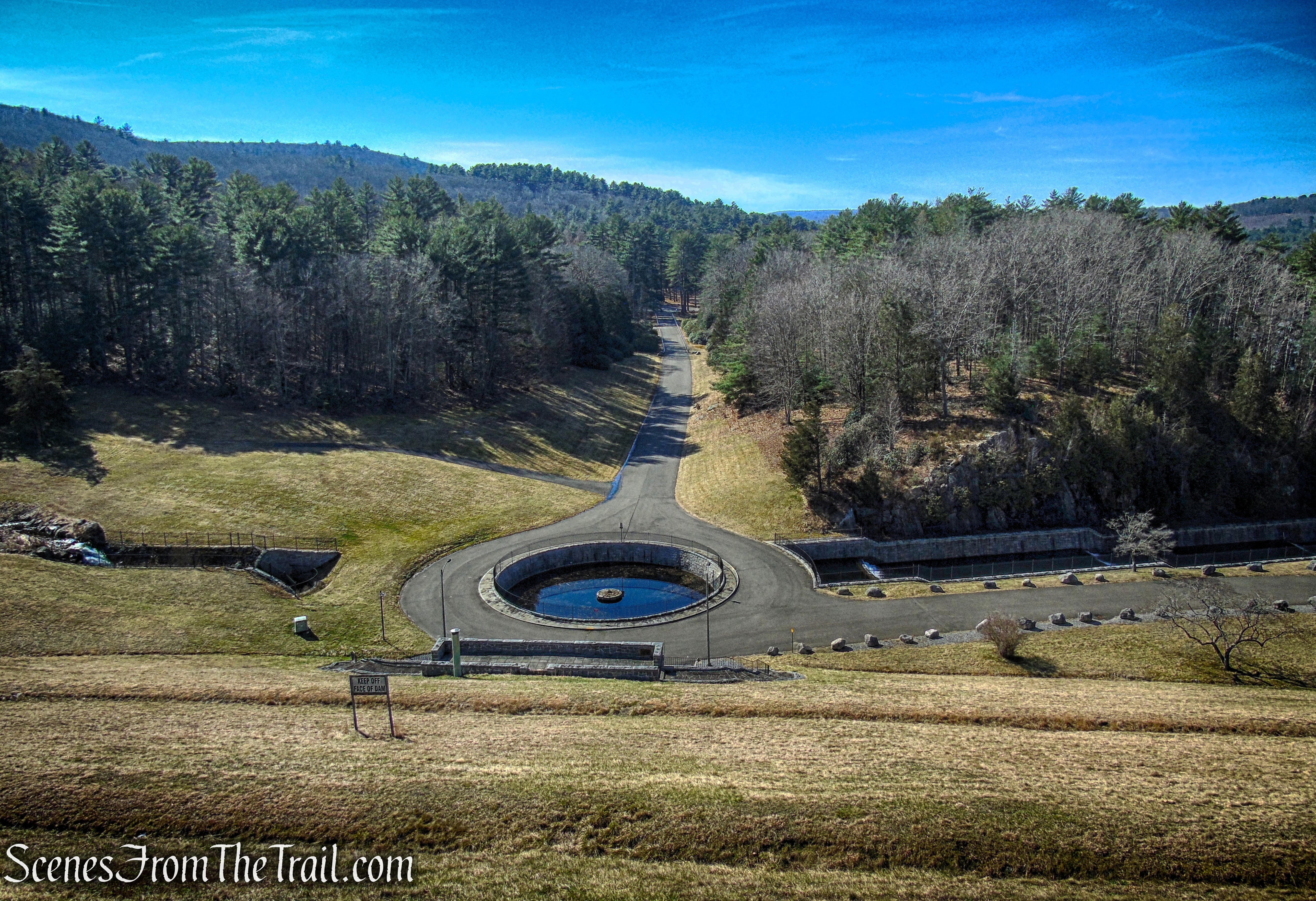
Ashokan Reservoir, located 14 miles west of the City of Kingston in Ulster County, was created in 1915 by the construction of 5-1/2 miles of dams and dikes within the Esopus Creek drainage. This 8,315 acre reservoir is a major component of the Catskill System of the New York City Water supply. The reservoir is broken into two basins by a dividing weir near its center. The Dividing Weir, pinches and separates the upper west basin from the lower east basin.

Dividing Weir - Ashokan Reservoir

Dividing Weir – Ashokan Reservoir

Aside from being a valuable freshwater resource, the Ashokan Reservoir is also an enjoyable recreational site seeing about 75,000 local visitors and tourists annually. The day use areas on the south side of the reservoir feature spectacular views and natural beauty.

Ashokan Reservoir Promenade East

Ashokan Reservoir Promenade East

There are some very specific rules and regulations in place regarding the use of the reservoir though. The reservoir is heavily monitored to ensure that it isn’t contaminated, and visitors need to follow specific guidelines and rules to enjoy the area around the reservoir safely.

DSC02949_marked

Ashokan Reservoir Promenade West

Take note that recreational users of NYC DEP trails are required to closely observe usage limitations and may incur fines for non-compliance with posted rules.

Ashokan Reservoir Promenade

Ashokan Reservoir Promenade

There is no swimming allowed at Ashokan Reservoir.

Ashokan Reservoir Promenade

Ashokan Reservoir Promenade

A paved handicap accessible path along the southern edge of the Ashokan Reservoir offers beautiful views and multiple recreational opportunities. The path is 2.9 miles one way and 5.8 roundtrip. The two parking areas are on either side of the walking path: one in Olivebridge, and the other in Kingston.

Ashokan Reservoir Promenade East

Ashokan Reservoir Promenade East

A tranquil area within the Catskill Park and Catskill Forest Preserve, it is filled with wildlife, majestic mountain peaks, and unlimited opportunities for the outdoor lover. Visitors can walk, ride bikes, rollerblade, or cross-country ski in the wintertime. With a DEP Access Permit, fishing is permitted on the reservoir.

Ashokan Reservoir Promenade West

Ashokan Reservoir Promenade West

Public access to the Day Use Areas along the reservoir is provided for free by the New York City Department of Environmental Protection (NYC DEP).


History:

Ashokan, meaning “Place of Fish” is aptly named given the recreational fishing opportunities for both coldwater and warm water fish that the reservoir provides.

The Ashokan Reservoir was constructed between 1907 and 1915, by the New York City Board of Water Supply, by impounding the Esopus Creek. Thousands of acres of farmland were submerged. The impoundment covered twelve communities located in a valley where farming, logging, and quarrying prevailed. The area that became the West Basin of the reservoir contained 504 dwellings, nine blacksmith shops, 35 stores, 10 churches, 10 schools, seven sawmills and a gristmill. Several of these communities were re-established in nearby locations. The dam was mainly built by local laborers, but also attracted an influx of itinerant workers from outside of the Hudson Valley, including a number of Italian immigrants. In addition to construction, these laborers also did the job of razing most of the trees and buildings in the area. A police force was formed to keep watch over the construction site, which would later become the New York City Department of Environmental Protection Police, an agency that today is charged with protecting and preserving the New York City water supply system.

At over 8300 acres, it was the world’s largest at the time and the first of six to be built in the Catskills between 1907 and 1965. It can hold 122.9 billion gallons at full capacity. Impressively, all the water flows by gravity through more than 100 miles of underground piping to reach New York City. In sheer scale, ingenuity, and functionality, the achievement was considered on a par with the building of the Panama Canal, which opened just one year earlier.

Today, more than a billion gallons of Catskills water reaches New York City per day.

After the September 11 attacks, the city and state decided to permanently close the spillway road to vehicular traffic as a security precaution.

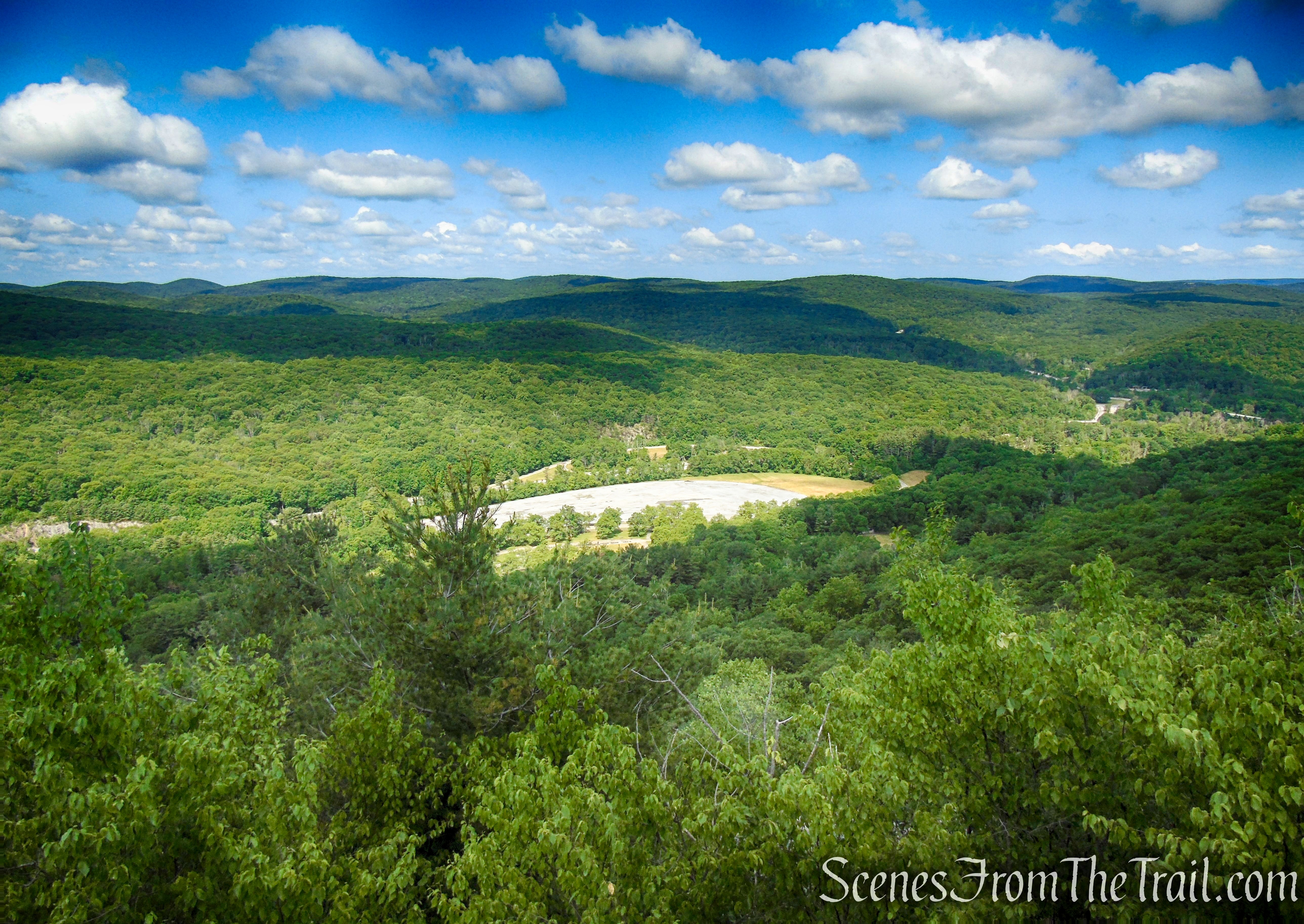
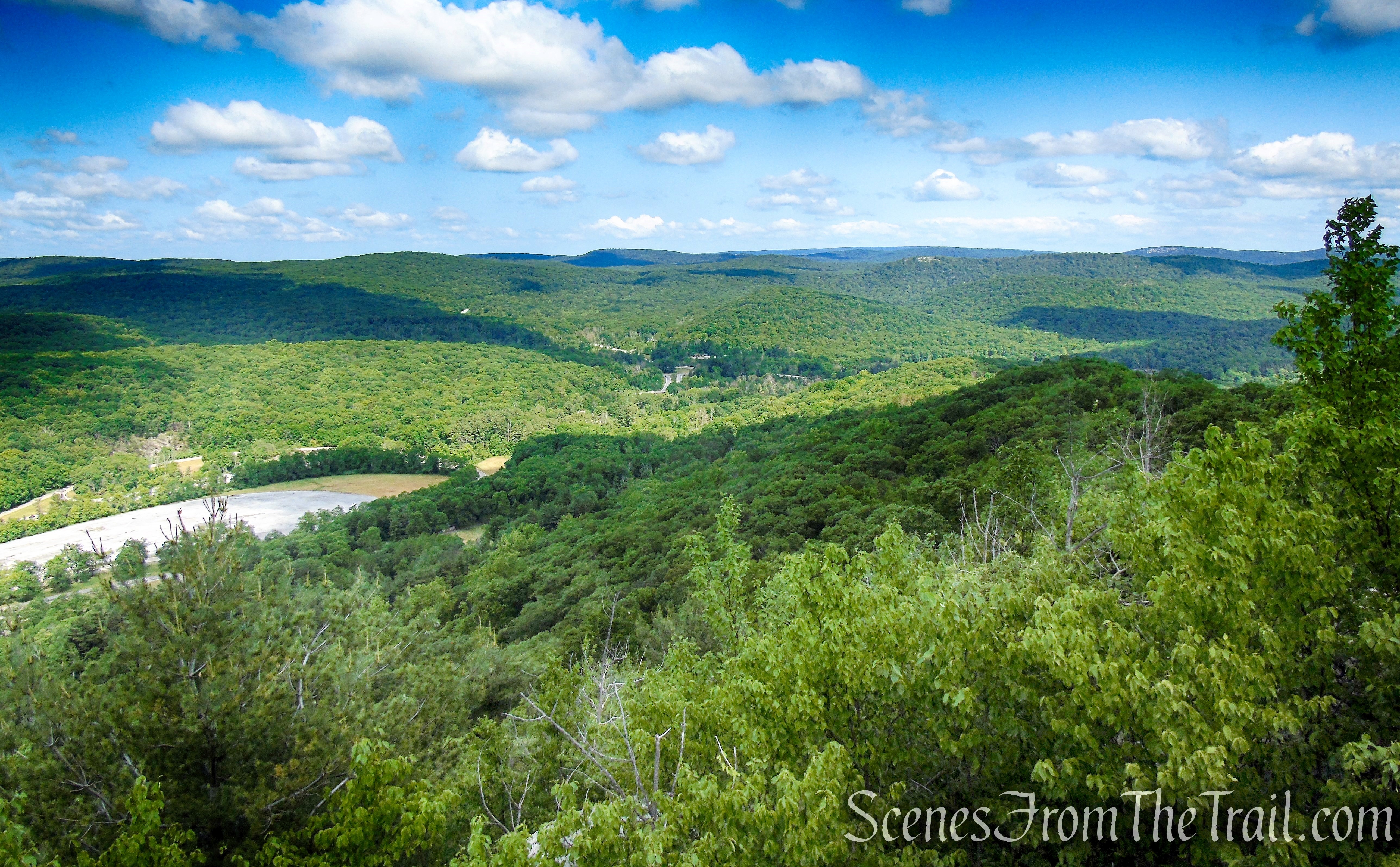
The closed roadway was turned into a muti-use pedestrian pathway known as the Ashokan Reservoir Promenade. The paved walkway provides visitors with panoramic views of the Catskill Mountains.


Walk Overview:

Visiting the Catskills is always fun and quite scenic. Dealing with some leg issues, but still wanting to enjoy the outdoors, this place was perfect. Since the entire paved path is relatively flat, it allowed me to log some miles without the elevation. The scenery is absolutely gorgeous and on a beautiful Sunday morning in June, there weren’t too many people on the promenade.

I visited the Ashokan Reservoir Promenade twice in three days and started from opposite ends on each visit.

On my first visit, I parked at the Five Pines Parking Area at the West Basin entrance in Olivebridge. The out and back mileage was about 3.3 miles.

Ashokan Reservoir Promenade West

Ashokan Reservoir Promenade West

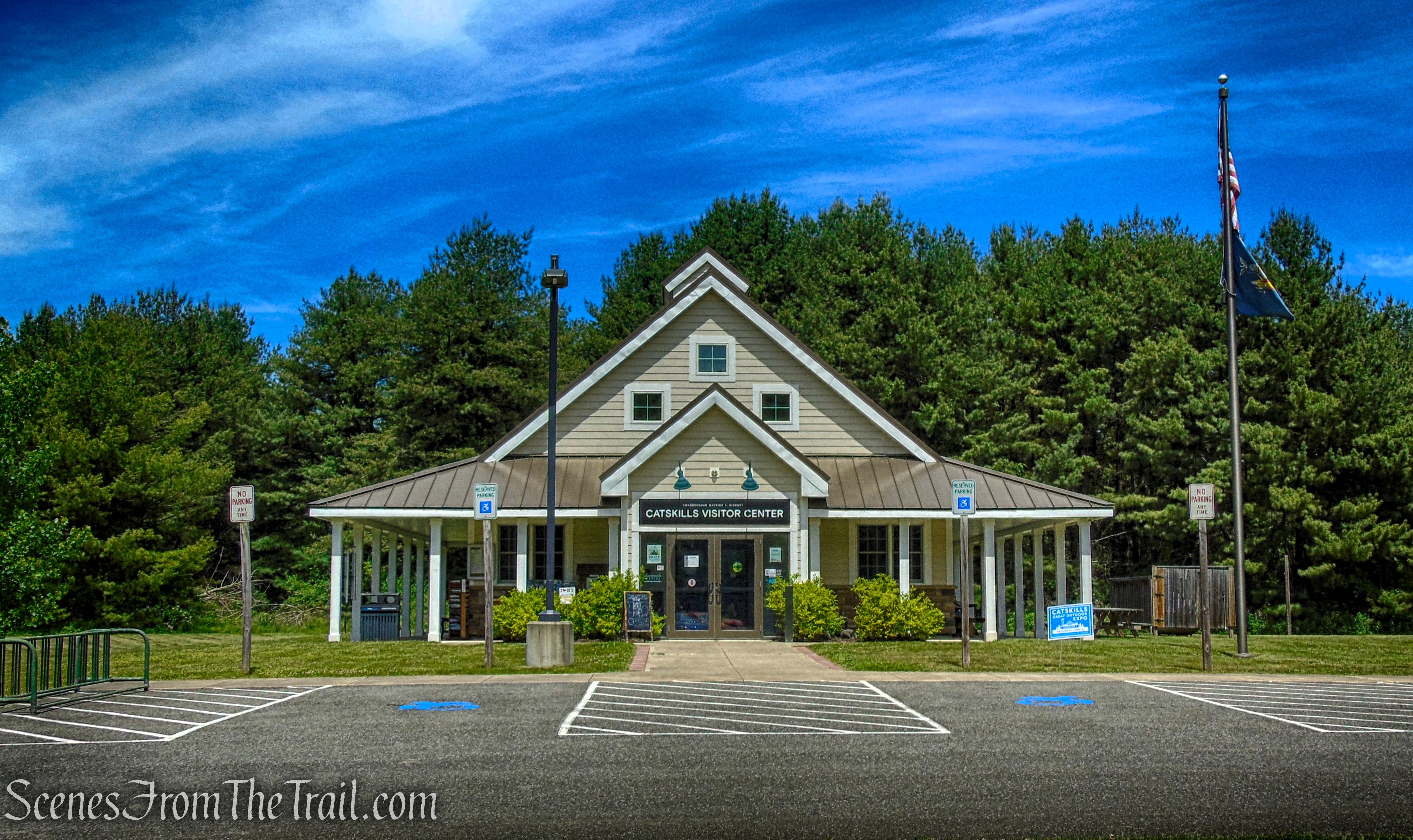
When I was done, I also visited the Catskills Visitor Center which is about 10 miles away (15 minute drive) and climbed their fire tower.

When I returned three days later, I parked at the Frying Pan parking area in Kingston, at the East Basin entrance.

I will describe the two separate walks the way they were done. You can choose to do this walk as an out and back, park a vehicle at each end, or do it as two separate walks.


From the Olivebridge Parking Area:

The western section of the Ashokan Reservoir Promenade is referred to as the Olivebridge Dam. This parking area is also known as the Five Pines Parking Area.

Five Pines Parking Area - Ashokan Reservoir Promenade

Five Pines Parking Area – Ashokan Reservoir Promenade

Proceed past the retractable bollards to begin your walk along the Ashokan Reservoir Promenade West.

Ashokan Reservoir Promenade West

Ashokan Reservoir Promenade West

Signs like this around the Ashokan Reservoir mark the sites of former communities that were displaced or submerged by its construction.

Ashokan Reservoir Promenade West

Ashokan Reservoir Promenade West

The paved path along the Olivebridge Dam provides beautiful views of the reservoir.

Ashokan Reservoir Promenade West

Ashokan Reservoir Promenade West

Ashokan Reservoir Promenade West

Ashokan Reservoir Promenade West

Ashokan Reservoir Promenade West

Ashokan Reservoir Promenade West

Ashokan Reservoir Promenade West

Ashokan Reservoir Promenade West

There are interpretive signs spread out along the promenade that detail the Ashokan Reservoir’s history.

Ashokan Reservoir Promenade West

Ashokan Reservoir Promenade West

The promenade continues across a section of the dam under which water can be released into the Esopus Creek.

Ashokan Reservoir Promenade West

Ashokan Reservoir Promenade West

Ashokan Reservoir Promenade West

Ashokan Reservoir Promenade West

The Olivebridge Dam is the main structure that forms the Ashokan Reservoir by impounding water from the Esopus Creek. The dam is 4,650 feet long. It’s 1,000-foot main section is made of concrete and large blocks of Bluestone harvested from local quarries. Its two wings are made of earth tightly compacted around concrete cores.

Ashokan Reservoir Promenade West

Ashokan Reservoir Promenade West

Ashokan High Point dominates the landscape on the western section of the Ashokan Reservoir Promenade.

Ashokan Reservoir Promenade West

Ashokan Reservoir Promenade West

The Slide Mountain Wilderness to the west of the promenade.

Ashokan Reservoir Promenade West

Ashokan Reservoir Promenade West

Ashokan Reservoir Promenade West

Ashokan Reservoir Promenade West

As you are walking on the promenade, look around. Deer can often be seen grazing on the grassy slope.

Ashokan Reservoir Promenade West

Ashokan Reservoir Promenade West

Benches are provided for visitors to take a rest and soak in the views.

Ashokan Reservoir Promenade West

Ashokan Reservoir Promenade West

Ashokan Reservoir Promenade West

Ashokan Reservoir Promenade West

Ashokan Reservoir Promenade West

Ashokan Reservoir Promenade West

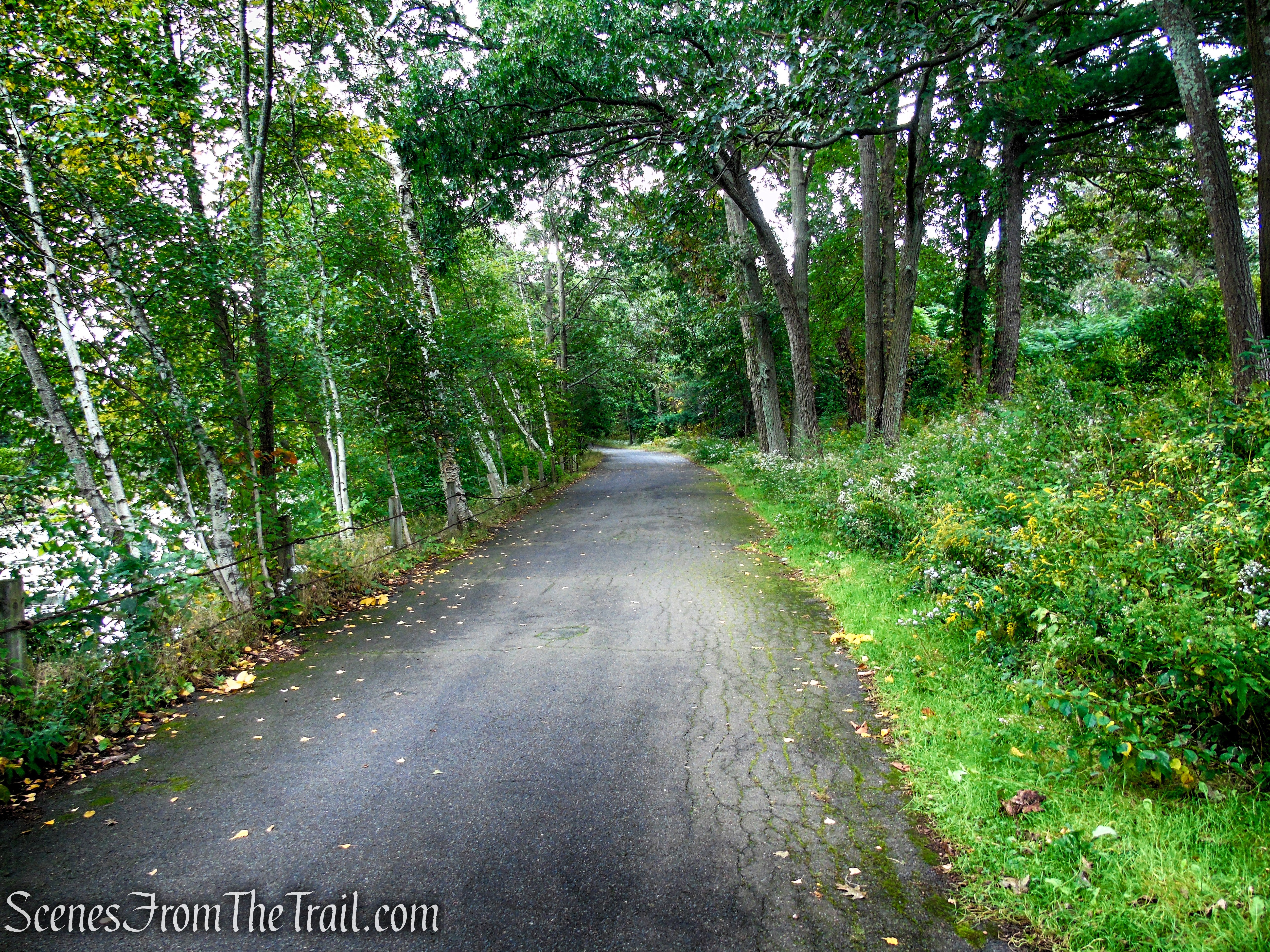
This section of the promenade goes along the reservoir and then enters a wooded section passing a monument dedicated to J. Waldo Smith, engineer of the New York City water supply system.

Ashokan Reservoir Promenade West

Ashokan Reservoir Promenade West

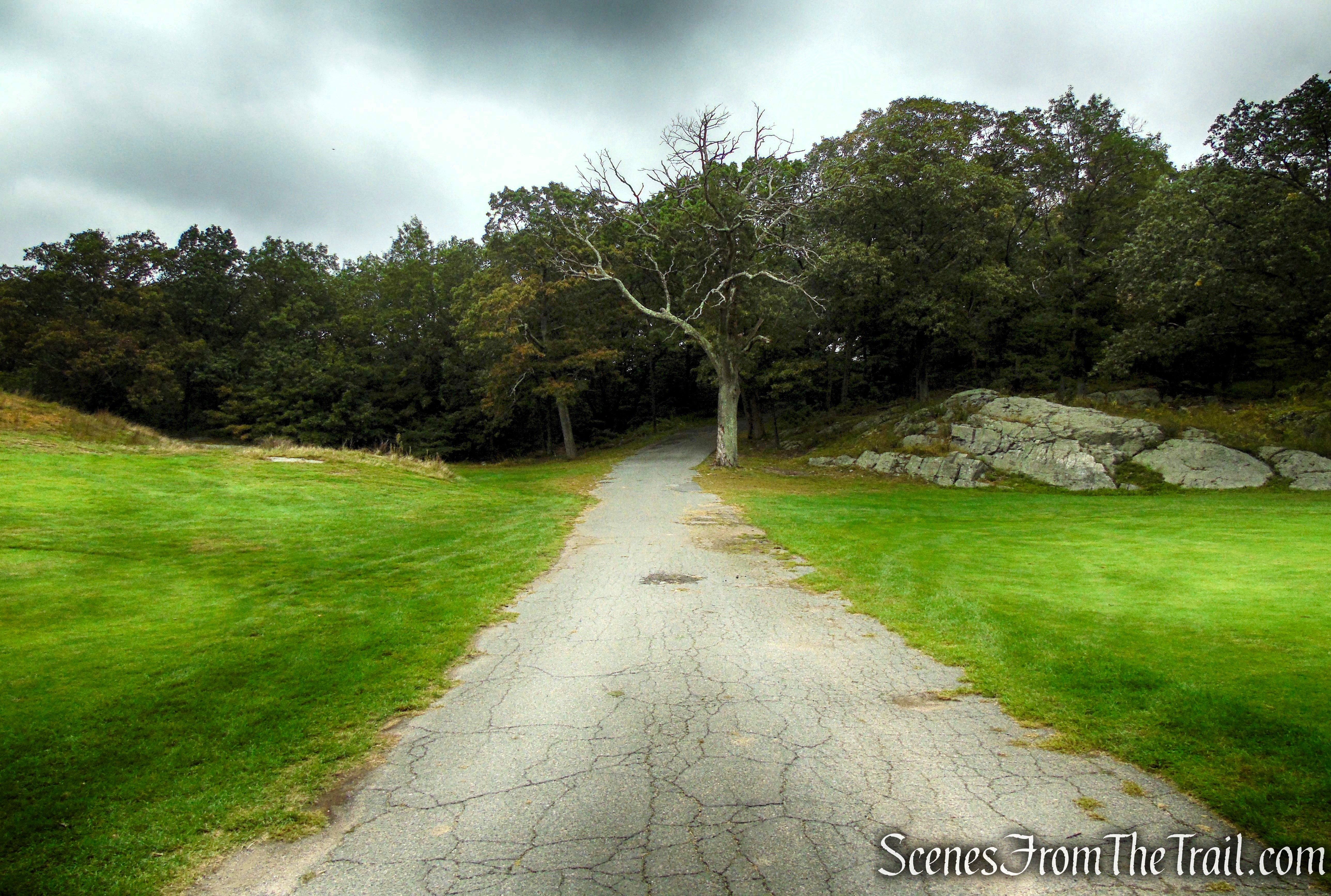
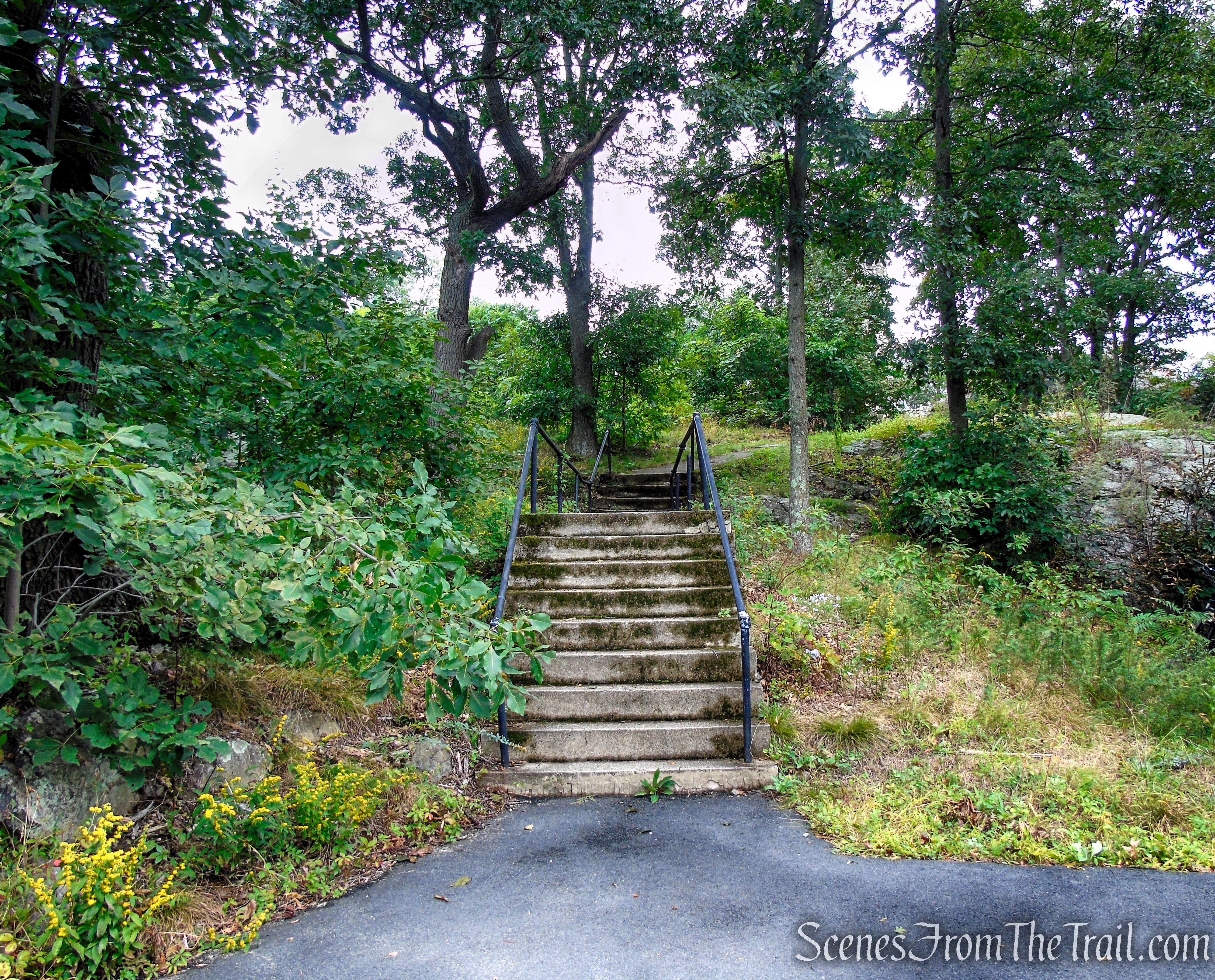
After about a mile from the Five Pines Parking Area, there is a road on the right. Turn right and follow the road a short distance up to Winchell Hill

Ashokan Reservoir Promenade West

Ashokan Reservoir Promenade West

Road to Winchell Hill

Road to Winchell Hill

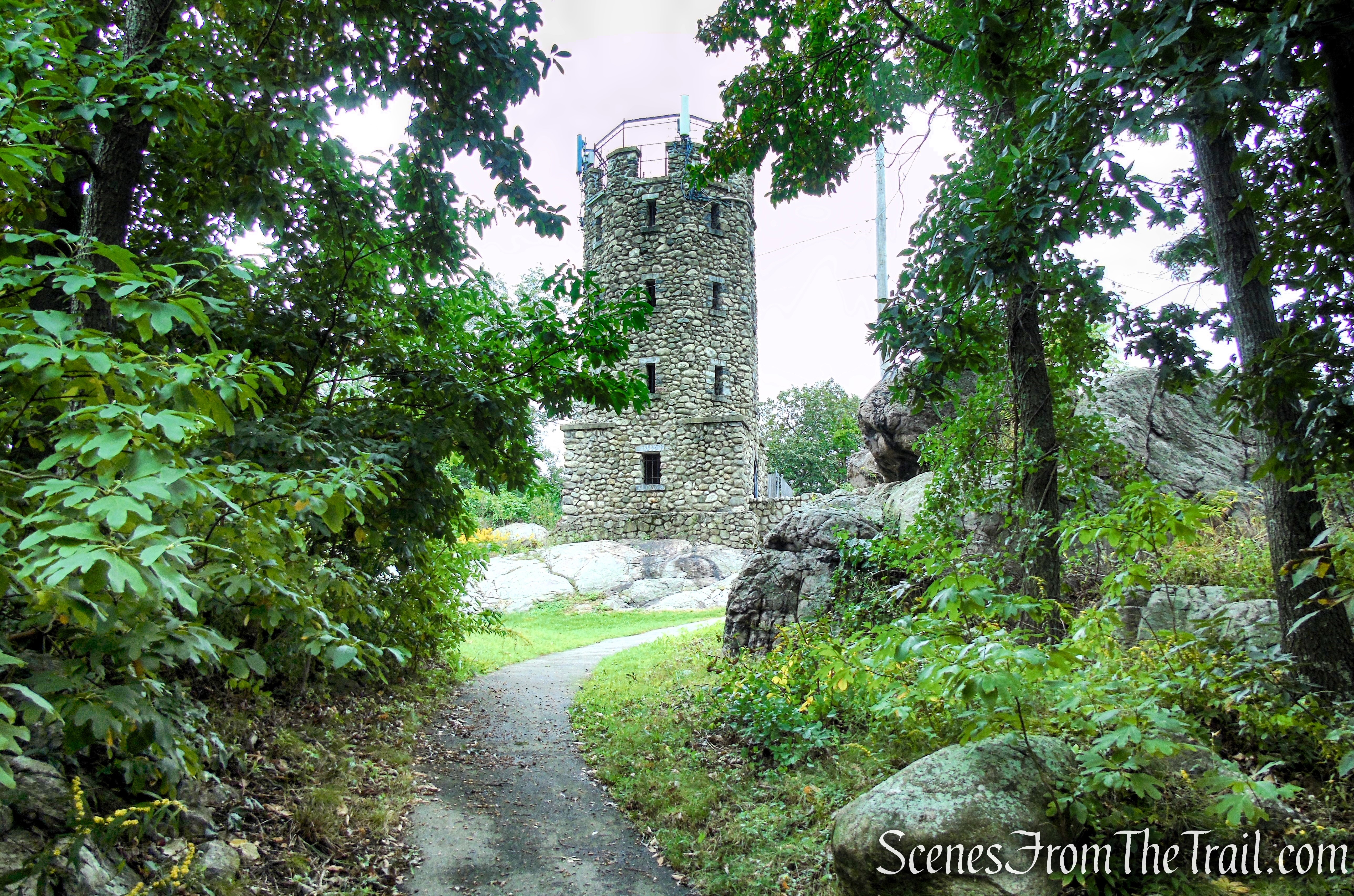
The historic monument was built in 1908 as hundreds of workers constructed the dam, dikes, chambers and tunnels that would become Ashokan Reservoir. It was built atop Winchell Hill, a high point in the vicinity of the construction and used as a triangulation tower to provide surveyors with an elevated and unimpeded view from which to take measurements.

J. Waldo SmithMonument - Winchell Hill

J. Waldo Smith Monument – Winchell Hill

On Nov. 11, 1908, the tower was dedicated as the McClellan Monument. It was named after New York City Mayor George B. McClellan, who successfully pushed for the construction of Ashokan Reservoir, the Catskill Aqueduct, and the other reservoirs and infrastructure that comprise NY City’s Catskills Water Supply System.

J. Waldo Smith Monument - Winchell Hill

J. Waldo Smith Monument – Winchell Hill

J. Waldo Smith Monument - Winchell Hill

J. Waldo Smith Monument – Winchell Hill

In 1936, a memorial tablet was added to the monument in memory of J. Waldo Smith, the chief engineer for the Board of Water Supply, who directed construction of the Catskill System.

J. Waldo Smith Monument - Winchell Hill

J. Waldo Smith Monument – Winchell Hill

Continuing east along the promenade.

Ashokan Reservoir Promenade West

Ashokan Reservoir Promenade West

Ashokan Reservoir Promenade West

Ashokan Reservoir Promenade West

The Dividing Weir Bridge, which carries Reservoir Road over Ashokan Reservoir.

Dividing Weir Bridge - Ashokan Reservoir Promenade West

Dividing Weir Bridge – Ashokan Reservoir Promenade West

Dividing Weir - Ashokan Reservoir

Dividing Weir – Ashokan Reservoir

The Dividing Weir, atop which Reservoir Road crosses the reservoir, functions to abate sedimentation that periodically occurs in waters that enter the upper reservoir basin. The weir slows the flow of water between the basins so that the sediment is allowed to settle before the less turbid water is release from the lower basin to begin its journey to the taps of New York City. The dividing weir offers spectacular views of the reservoir and the backdrop of forested mountains.

Dividing Weir - Ashokan Reservoir

Dividing Weir – Ashokan Reservoir

The Fountain Day Use Area is located south of the reservoir wall and midway along the promenade, near Reservoir Road. Water that runs through the decorative fountain is also used to turn two turbine generators situated below the ground to produce a total of 4,750 kilowatts. The small hydroelectric plant was installed in 1982 and is operated by the New York Power Authority.

Brown's Station Fountain - Ashokan Reservoir

Brown’s Station Fountain – Ashokan Reservoir

Take time to read about Ashokan Reservoir’s history along the way.

Ashokan Reservoir Promenade West

Ashokan Reservoir Promenade West

Dividing Weir - Ashokan Reservoir

Dividing Weir – Ashokan Reservoir

Here the western section of the promenade ends to allow vehicular traffic to pass from Reservoir Road along a NYC Board of Water Supply (BWS) Road to Route NY-28A. If you decide to proceed past this point, use caution while walking along the road.

Terminus of Ashokan Reservoir Promenade West

Terminus of Ashokan Reservoir Promenade West

The concrete Dividing Weir on Reservoir Road. The Ashokan Reservoir is separated into two basins by Reservoir Road. Water does not pass freely between the two basins, and the eastern basin is seven inches lower than the western basin.

Dividing Weir Bridge - Ashokan Reservoir

Dividing Weir Bridge – Ashokan Reservoir

The Dividing Weir Bridge, as it is called, is made up of concrete arches that carry Reservoir Road between the north and south sides of the Ashokan Reservoir.

Dividing Weir Bridge - Ashokan Reservoir

Dividing Weir Bridge – Ashokan Reservoir

From the Dividing Weir Bridge, there are great views over both basins of the reservoir.

View of East Basin from Dividing Weir Bridge.

View of East Basin from Dividing Weir Bridge.

This yellow device is a robotic monitoring buoy. This particular buoy at Ashokan Reservoir is part of a network that transmits real-time data back to their water supply operations center, providing DEP with key information to ensure the best quality water is always sent from the reservoir system to the City. The artificial owl on top of the buoy is utilized to scare away cormorants, preventing them from fouling the buoy.

A robotic water quality monitoring buoy in the east basin.

A robotic water quality monitoring buoy in the east basin.

Looking west towards Ashokan High Point.

View of Ashokan High Point from the Dividing Weir Bridge.

View of Ashokan High Point from the Dividing Weir Bridge.

Zoomed in view of Ashokan High Point from the Dividing Weir Bridge.

Zoomed in view of Ashokan High Point from the Dividing Weir Bridge.

A concrete Dividing Weir on Reservoir Road.

Dividing Weir - Ashokan Reservoir

Dividing Weir – Ashokan Reservoir

Keep an eye out for passing traffic as you make your way back to the promenade.

Reservoir Road - Ashokan Reservoir

Reservoir Road – Ashokan Reservoir

When you return to the western section of the promenade, retrace your steps along the paved path, back to the Five Pines Parking Area, where the walk began.

Ashokan Reservoir Promenade West

Ashokan Reservoir Promenade West

Ashokan Reservoir Promenade West

Ashokan Reservoir Promenade West

From the Kingston Parking Area:

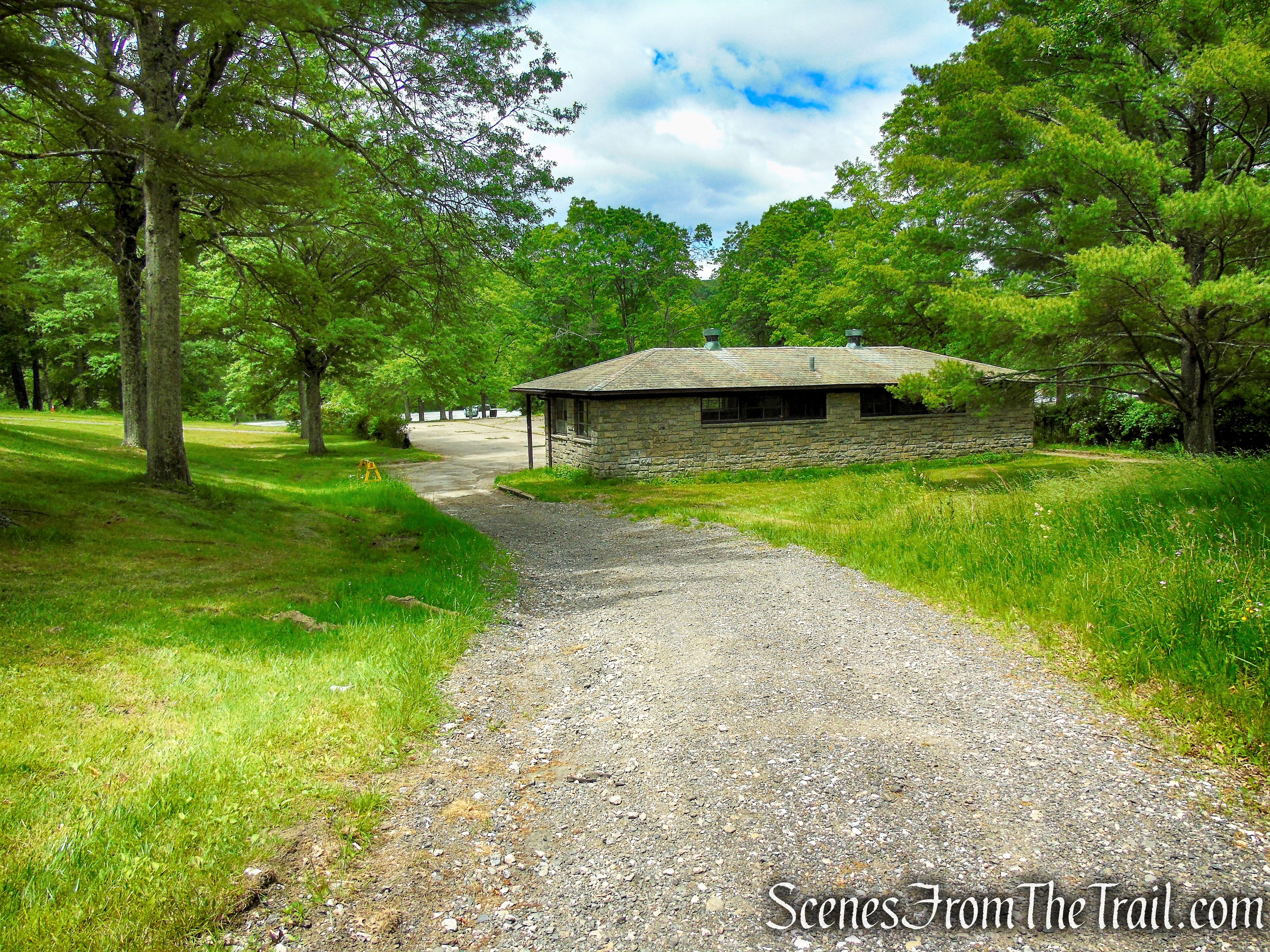
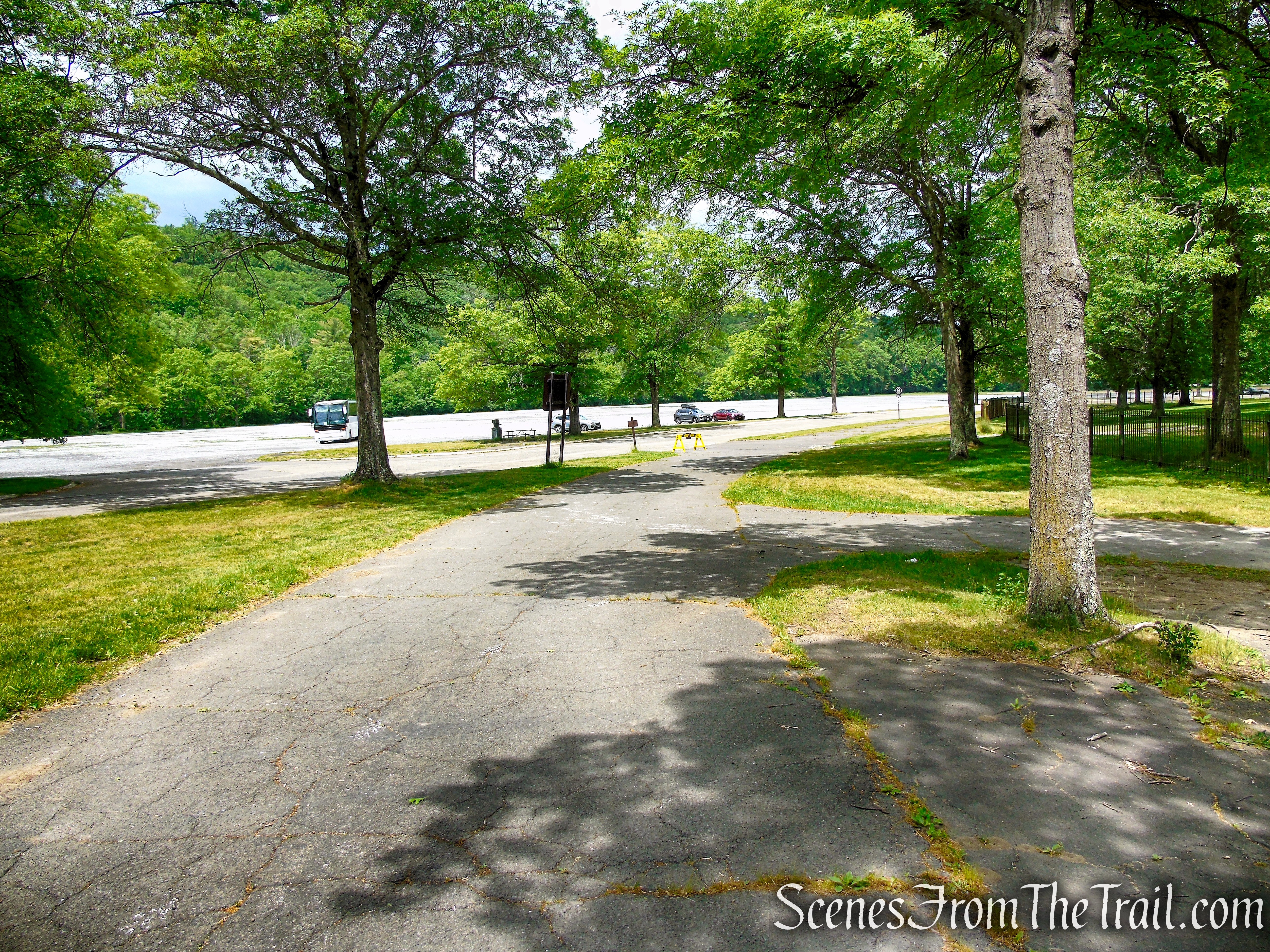
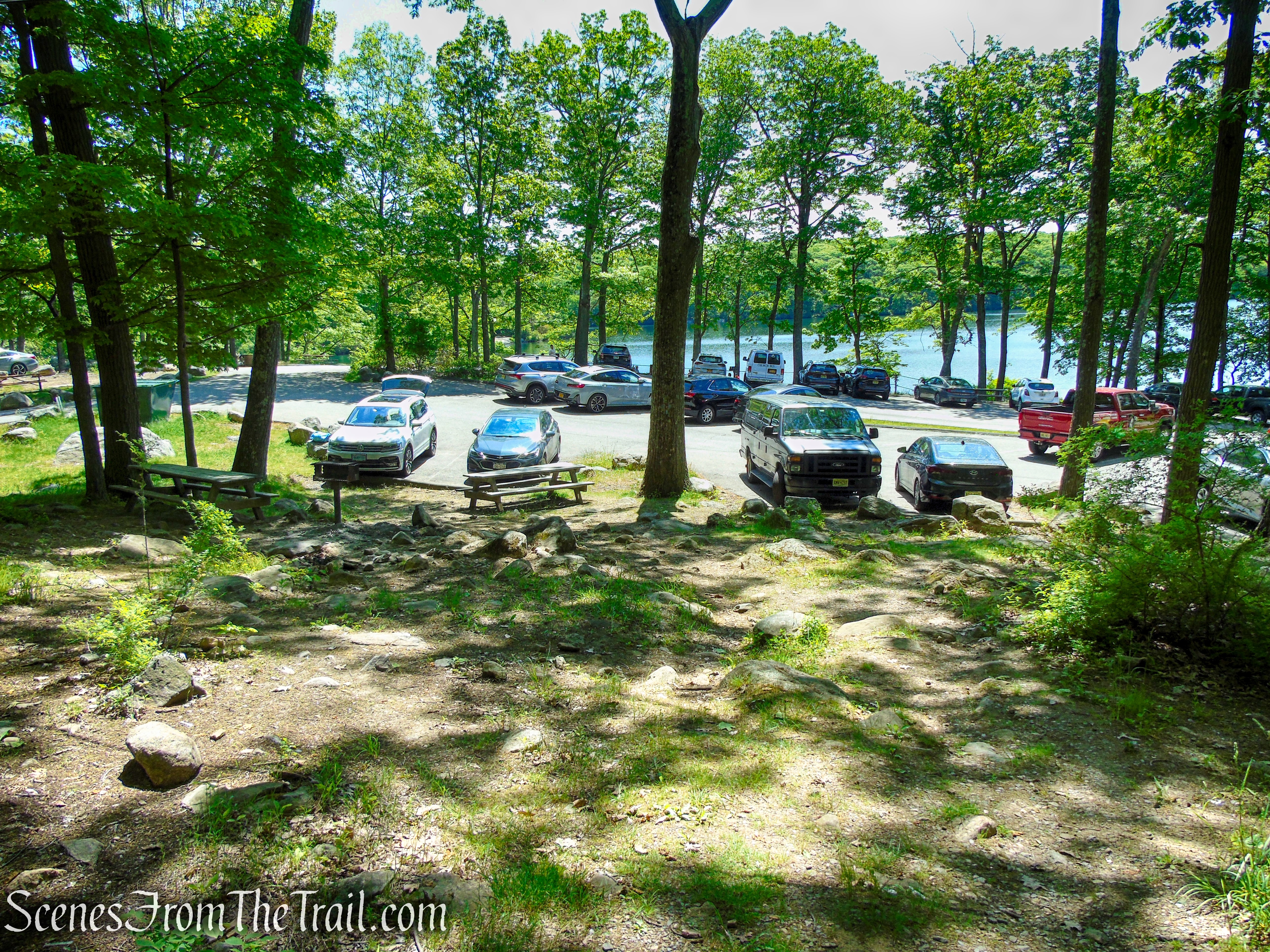
The Frying Pan area forms the eastern entrance and exit point to the reservoir’s pedestrian-only promenade. The site is defined by a flat, circular lawn with a central cluster of tall, old pines surrounded by a drainage ditch and road. Visitors primarily use this space to rest and picnic before and/or after biking, walking, or jogging on the promenade. It sees use by visitors in all seasons. The circular lawn features an information kiosk that is connected to the road by a flat path and a scattered arrangement of picnic tables that are placed or removed seasonally.

Frying Pan area – Ashokan Reservoir Promenade East

Frying Pan area – Ashokan Reservoir Promenade East

This gathering space provides visitors with a pleasing view to the west that captures the vastness of the promenade and reservoir. Limited vegetation provides minimal shade and leaves most of the site exposed to the sun. Parking for vehicles is concentrated along the outer perimeter of the road, in parallel fashion.

Ashokan Reservoir Promenade East is about 2.5 miles if doing an out and back. It is totally flat, with only about 8 feet of elevation gain.

Ashokan Reservoir Promenade East

Ashokan Reservoir Promenade East

At the western end of the parking area, proceed past the retractable bollards onto the promenade. The open, paved path runs westerly along the edge of the reservoir for approximately 1.25 miles.

Frying Pan area - Ashokan Reservoir Promenade East

Frying Pan area – Ashokan Reservoir Promenade East

The eastern section of the Ashokan Reservoir Promenade is known as the Middle Dike.

Ashokan Reservoir Promenade East

Ashokan Reservoir Promenade East

Almost immediately you will be greeted with views of the Ashokan Reservoir and some of the Catskill Mountains to the north, across the reservoir.

Ashokan Reservoir Promenade East

Ashokan Reservoir Promenade East

From left to right: Sugarloaf Mountain (3,810′), Twin Mountain (3,557′ South Summit – 3,643′ North Summit), Indian Head (3,573′), and Overlook Mountain (3,140′).

View north - Ashokan Reservoir Promenade East

View north – Ashokan Reservoir Promenade East

From left to right: Ticetonyk (2,509′), Little Tonshi (1814′), Tonshi Mountain (1991′).

View north – Ashokan Reservoir Promenade East

View north – Ashokan Reservoir Promenade East

As you proceed west along the Ashokan Reservoir Promenade, you will see the Slide Mountain Wilderness in front of you.

Ashokan Reservoir Promenade East

Ashokan Reservoir Promenade East

Ashokan High Point (3081′) totally dominating the view south and west, with South Mountain, Balsam Cap, Friday Mountain, Cornell Mountain and Wittenberg Mountain trailing off to its right.

Ashokan Reservoir Promenade East

Ashokan Reservoir Promenade East

View of the Slide Mountain Wilderness from the Ashokan Reservoir Promenade East.

Ashokan Reservoir Promenade East

Ashokan Reservoir Promenade East

The Dividing Weir Bridge, which carries Reservoir Road over Ashokan Reservoir, and separates the east and west basins.

Ashokan Reservoir Promenade East

Ashokan Reservoir Promenade East

Lots of Geese can be seen along the way.

Ashokan Reservoir Promenade East

Ashokan Reservoir Promenade East

The panoramic views of the Catskill Mountains are magnificent.

Ashokan Reservoir Promenade East

Ashokan Reservoir Promenade East

Ashokan Reservoir Promenade East

Ashokan Reservoir Promenade East

The Dividing Weir Bridge, also known as the 15 Arch Bridge was built in 1915.

Ashokan Reservoir Promenade East

Ashokan Reservoir Promenade East

The eastern end of the promenade ends at the retractable bollards, then runs alongside the shoulder of NY-28A, crosses Reservoir Road then connects to the western end of the promenade.

Ashokan Reservoir Promenade East

Ashokan Reservoir Promenade East

Ashokan Reservoir Promenade East

Ashokan Reservoir Promenade East

Ashokan Reservoir Promenade East

Ashokan Reservoir Promenade East

NYCDEP hard at work. On the boat is Field Supervisor Paul Perri, intern Emily Beeler, and Scientist Water Ecologist Caitlyn Korren.

NYCDEP boat in the East Basin - Ashokan Reservoir

NYCDEP boat in the East Basin – Ashokan Reservoir

Even though it’s only a short stretch along the shoulder, stay alert for vehicles in both directions.

Ashokan Reservoir Promenade East

Ashokan Reservoir Promenade East

Heading back the way you came.

Ashokan Reservoir Promenade East

Ashokan Reservoir Promenade East

Optical Rain Gauge, a tool used for rain measurement.

Ashokan Reservoir Promenade East

Ashokan Reservoir Promenade East

Back at the Frying Pan Parking Area.

Ashokan Reservoir Promenade East

Ashokan Reservoir Promenade East

Frying Pan area – Ashokan Reservoir Promenade East

Frying Pan area – Ashokan Reservoir Promenade East


Review:

A splendid way to stretch your legs and enjoy the mountain air and views. I would not suggest to do this walk in hot weather as there is no shade anywhere on the promenade. Nevertheless, it’s worth a visit on it’s own or to wind down after doing a hike in the area.

Pros:

Scenic area in the Catskills, easy paved walking path, wildlife viewing.

Cons:

No shade.


Sources:


World War II Lookout Tower – Cape May Point State Park

May 22, 2024 – Cape May, NJ

Difficulty: Easy

Map: Cape May Point State Park Area Map

Parking: 536 Sunset Blvd, Cape May, NJ 08204


Overview:

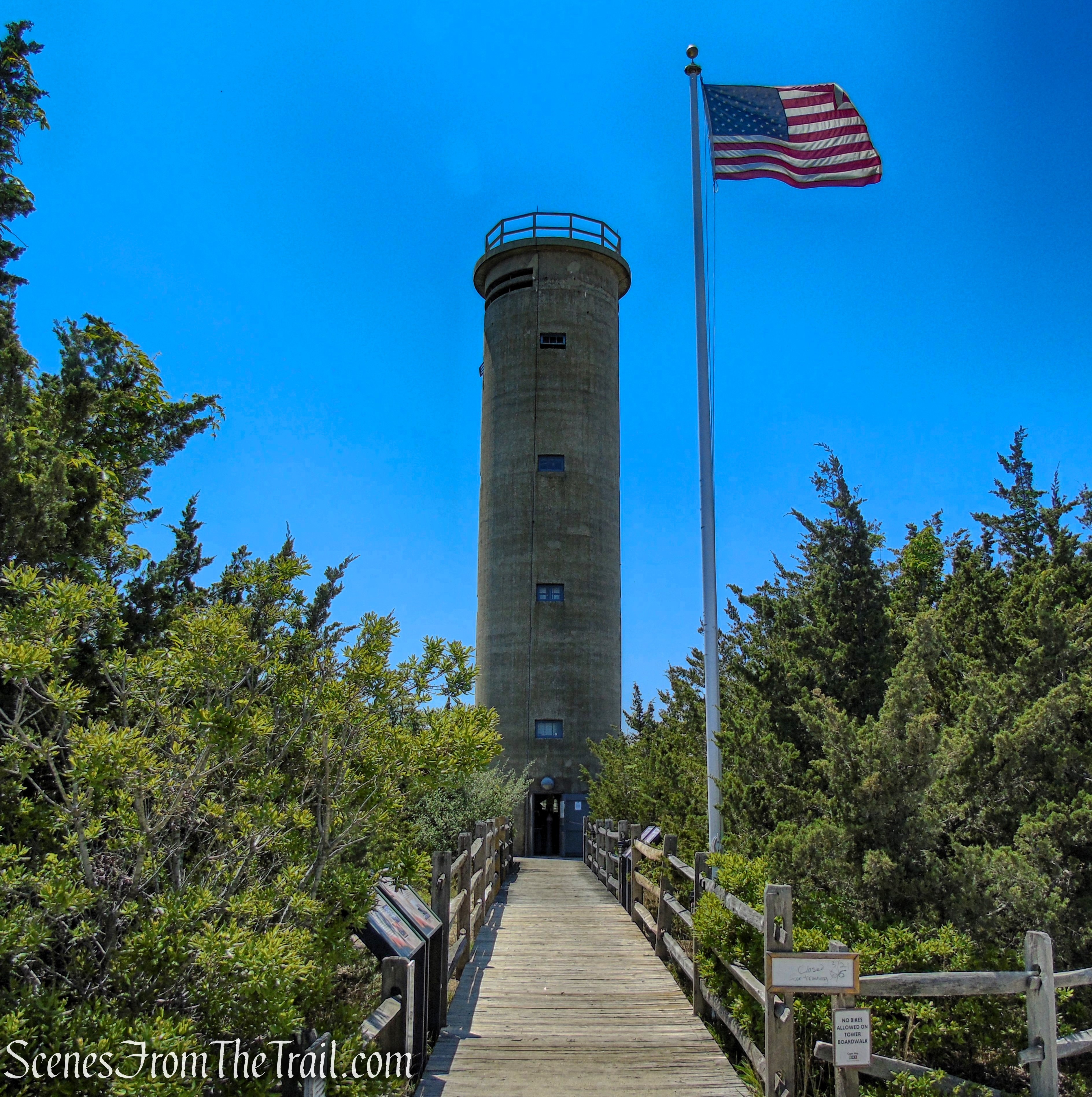
Officially known as Fire Control Tower No. 23, this lookout tower is New Jersey’s last remaining restorable World War II tower. It was a component of the immense Harbor Defense of the Delaware system known as Fort Miles, playing a major role in coastal defenses.

Fire Control Tower No. 23

Fire Control Tower No. 23

Fort Miles was a collection of fire control towers and gun batteries, plus barracks and support buildings, on both sides of the Delaware Bay. By World War II the military used a spread-out series of towers and batteries, whose firing ranges overlapped, to protect a large territory. Its largest guns and headquarters were located on the Delaware side, in what is now Cape Henlopen State Park, since the shipping channel hugs the Southern shore of Delaware Bay.

Designed by the Army Corps of Engineers, the Tower was built here in June, 1942 (after the bombing of Pearl Harbor) by using a sliding tube-shaped form. A ring of reinforced concrete was poured. When that solidified, the form was slid up and more concrete was poured. The whole Tower was formed this way except for the top, which required a form of its own. The whole process took only 2-1/2 days. The Tower is 71 feet tall and 17 feet in diameter and consists of six levels.

Fire Control Tower No. 23

Fire Control Tower No. 23

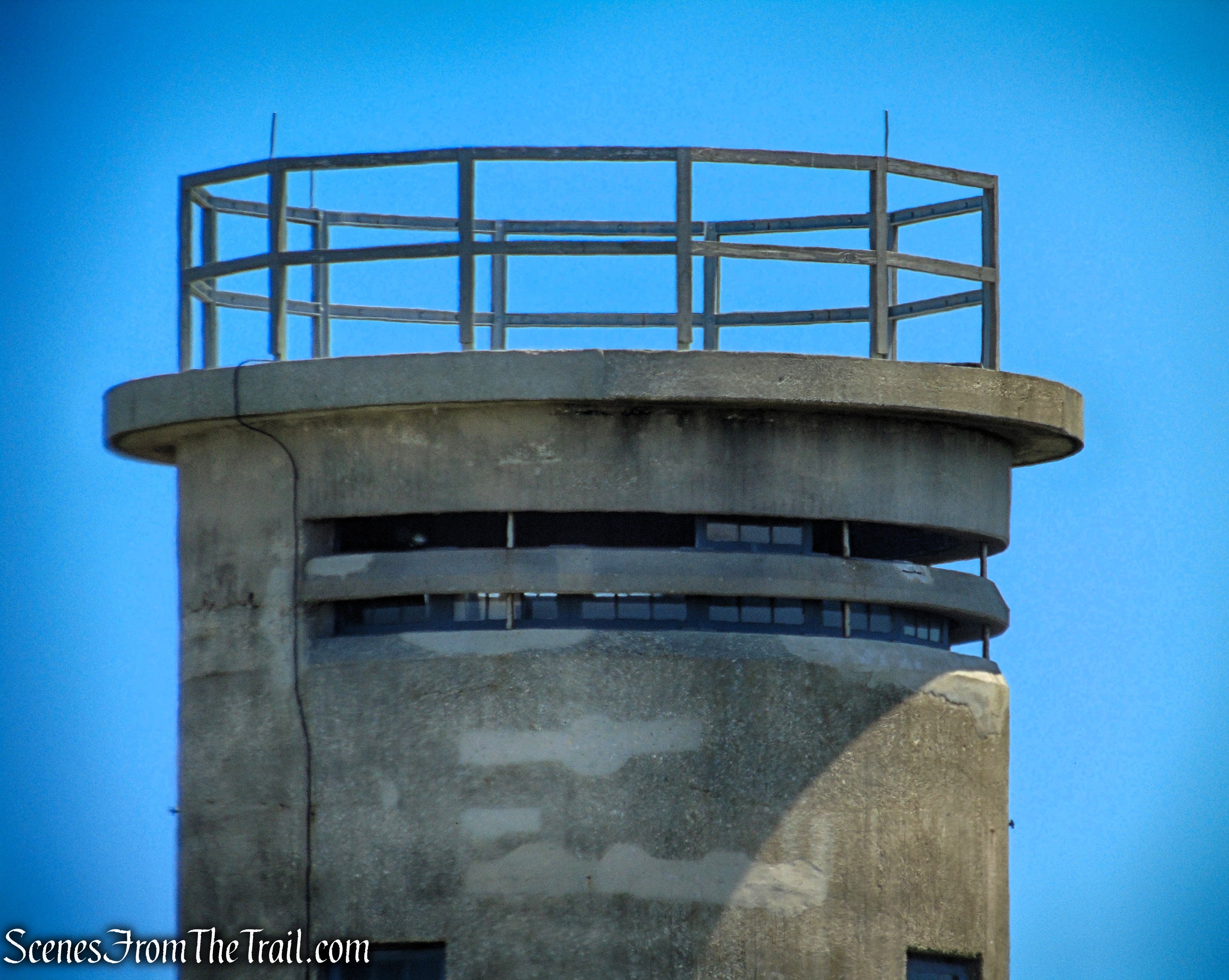
Soldiers stationed in the tower peered through its eye-like slits, scanning the ocean and bay for German warships and submarines.

Fire Control Tower No. 23

Fire Control Tower No. 23

This Azimuth instrument is a telescope-like device used by the United States to triangulate the positions of German vessels during World War II.

Azimuth instrument - Fire Control Tower No. 23

Azimuth instrument – Fire Control Tower No. 23

Had any been noticed, the lookouts would transmit information to the Battery 223, located along the shore at Cape May Point State Park. Battery 223’s guns were never fired at an enemy, though there were drills and live fire tests.

Telephone Box - Fire Control Tower No. 23

Telephone Box – Fire Control Tower No. 23


Recent History:

Like the Cape May Lighthouse, Fire Control Tower No. 23 is owned by the State of New Jersey, specifically, the Department of Environmental Protection, Division of Parks & Forestry. As was the case with the Cape May Lighthouse, the State sought to transfer administration of certain historic sites to non-profits and organizations that were in a good position to restore, maintain and operate them.

Fire Control Tower No. 23 was listed on the National Register of Historic Places on Nov. 17, 2003. In 2004, the Mid-Atlantic Center for the Arts & Humanities (MAC) — now Cape May MAC (Museums+Arts+Culture) — signed a 20-year lease for the tower after raising $1 million and receiving public grant funding. Cape May MAC restored the tower in 2008–09 and opened it to the public in April 2009.

The award-winning restoration project included: building spiral staircases in the Tower so that the public can safely climb to the top; construction of a wooden walkway from the street to the Tower, and a deck around its base, to preserve the fragile dune environment; replacing the missing windows and doors; recreating historical details, such as the original wooden ladders, and outfitting the watch room and viewing platform at the top; installing interpretive panels along the walkway and at every level in the Tower; introducing lighting and safety alarms; and upgrading the existing parking lot across Sunset Boulevard and connecting it with a cross-walk to the Tower.

The organization continues to maintain and interpret the site for members of the public.

Cape May MAC is currently raising funds to construct a visitors welcome center for the site.


Visiting the tower:

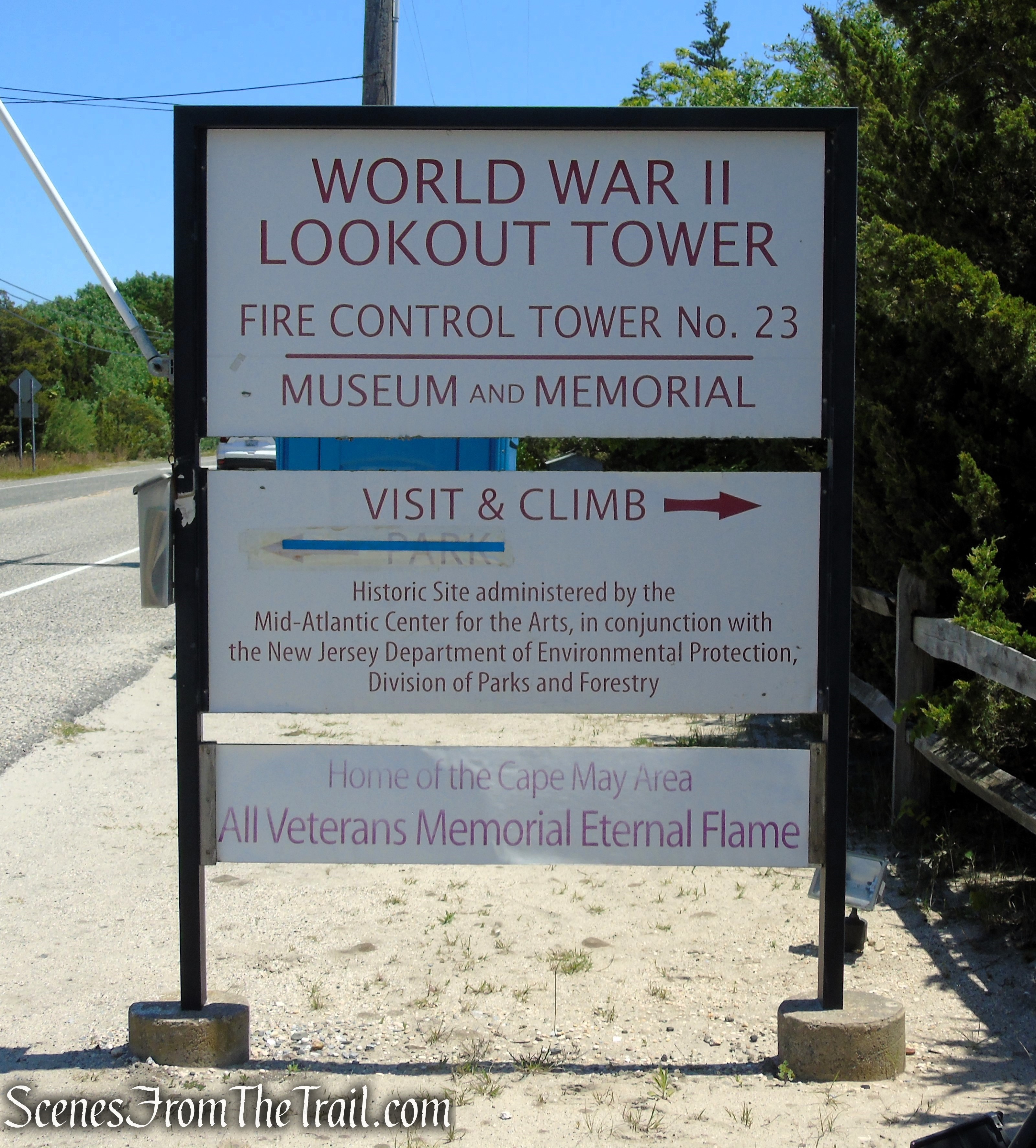
Although the World War II Lookout Tower is part of Cape May Point State Park, it’s on a separate parcel of land, located on Sunset Blvd, near Sunset Beach.

They sell shirts, hats and other souvenirs (available online also) that help support its maintenance. I purchased a nice t-shirt for $16.00.

T-shirt - World War II Lookout Tower

T-shirt – World War II Lookout Tower

If you are interested in visiting this World War II Lookout Tower, please call ahead (609) 884-5404 or check their calendar to insure that they are open. Currently, admission to climb the tower is $8 for adults and $5 for children (ages 3-12). It is FREE for Active Military & Veterans.

World War II Lookout Tower - Cape May Point State Park

World War II Lookout Tower – Cape May Point State Park

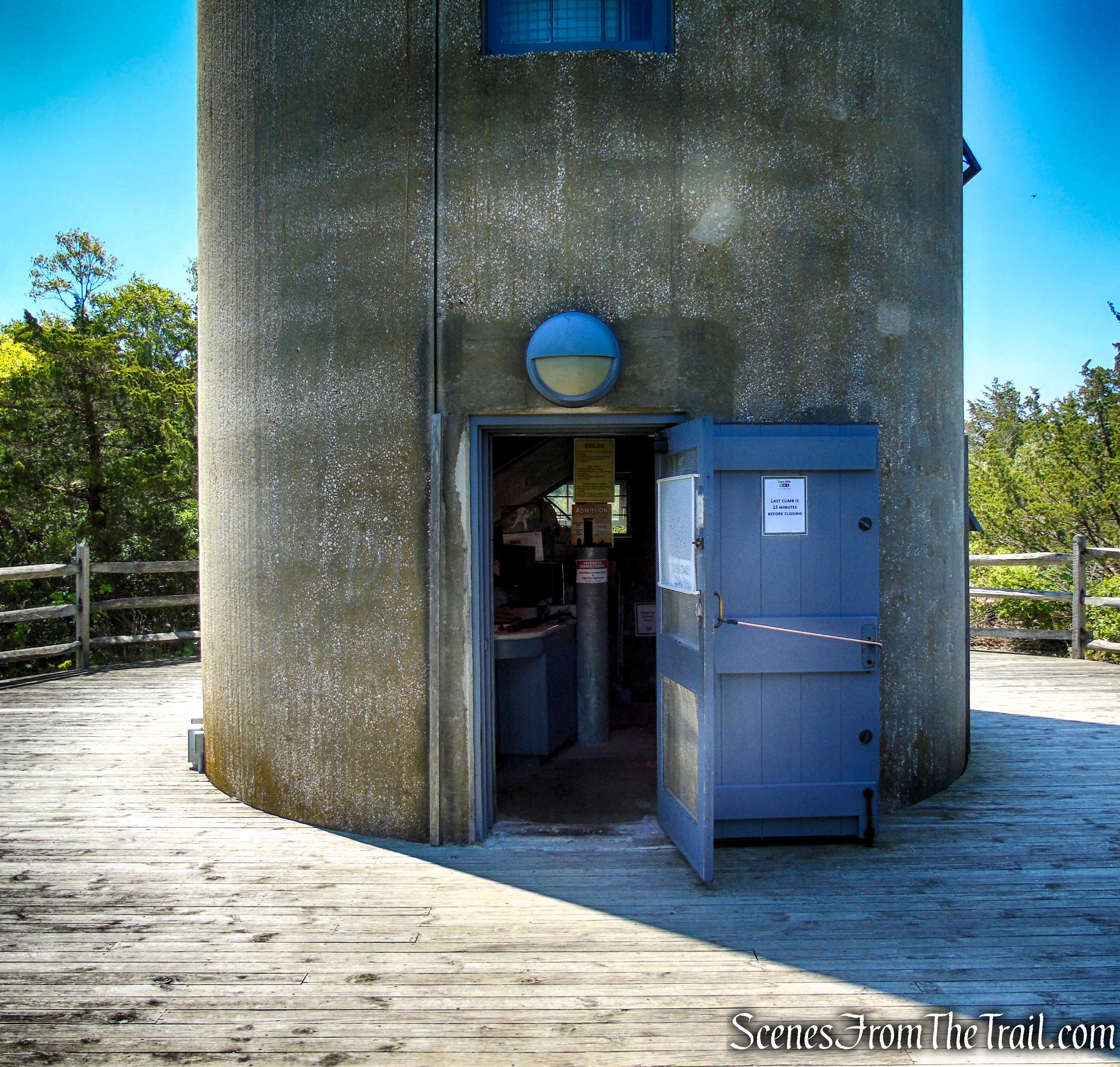
The Tower can be reached by way of an accessible boardwalk which crosses environmentally sensitive dunes. Along the boardwalk are interpretive panels explaining the Tower’s history and role in homeland defense during World War II.

World War II Lookout Tower - Cape May Point State Park

World War II Lookout Tower – Cape May Point State Park

The lower floor of the Tower is accessible and a small shop offers Tower mementos and bottled water. For those who do not climb, the staff has assembled a binder with photos and information, and can provide a wealth of information on the Tower’s history.

World War II Lookout Tower - Cape May Point State Park

World War II Lookout Tower – Cape May Point State Park

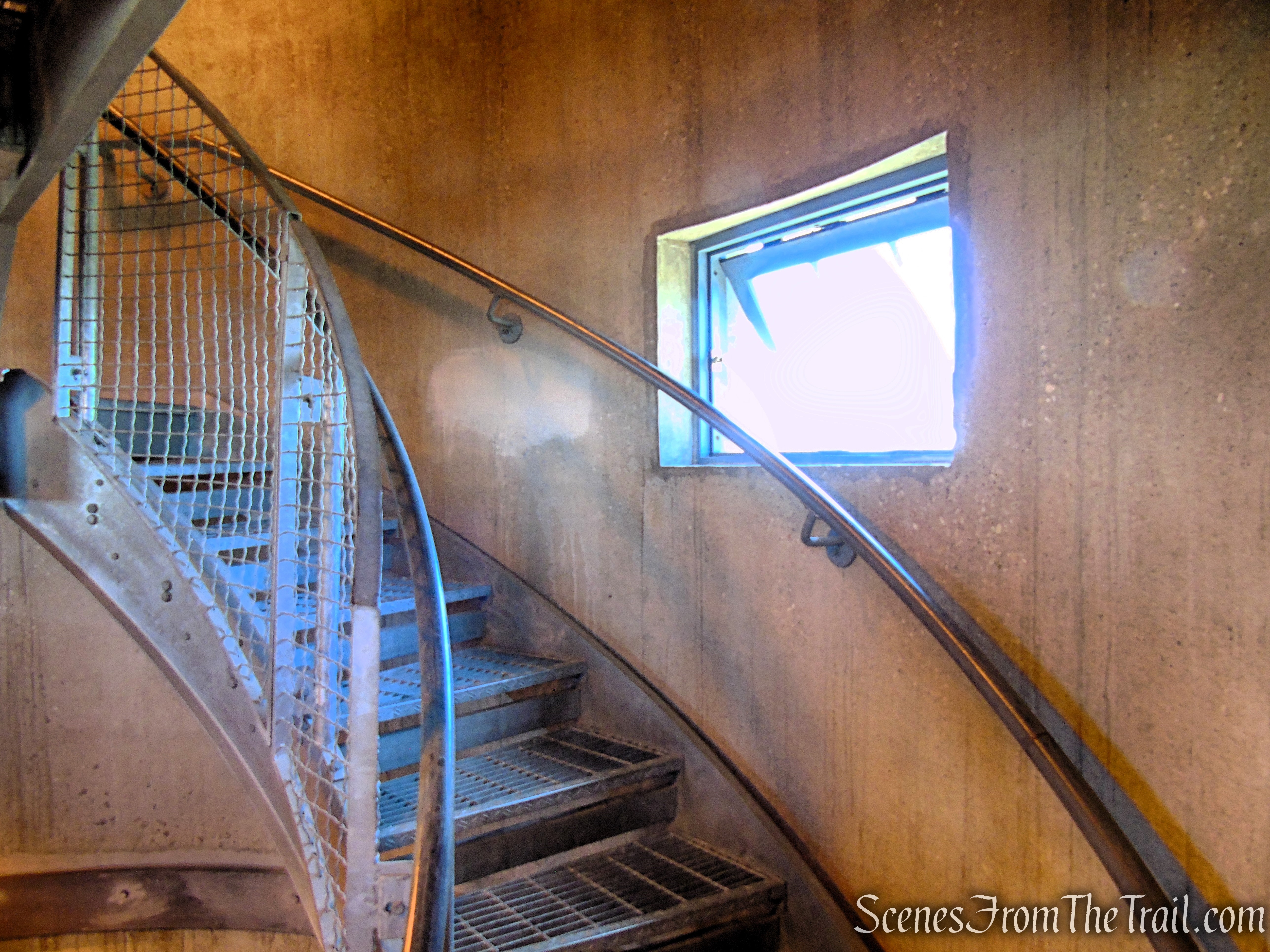
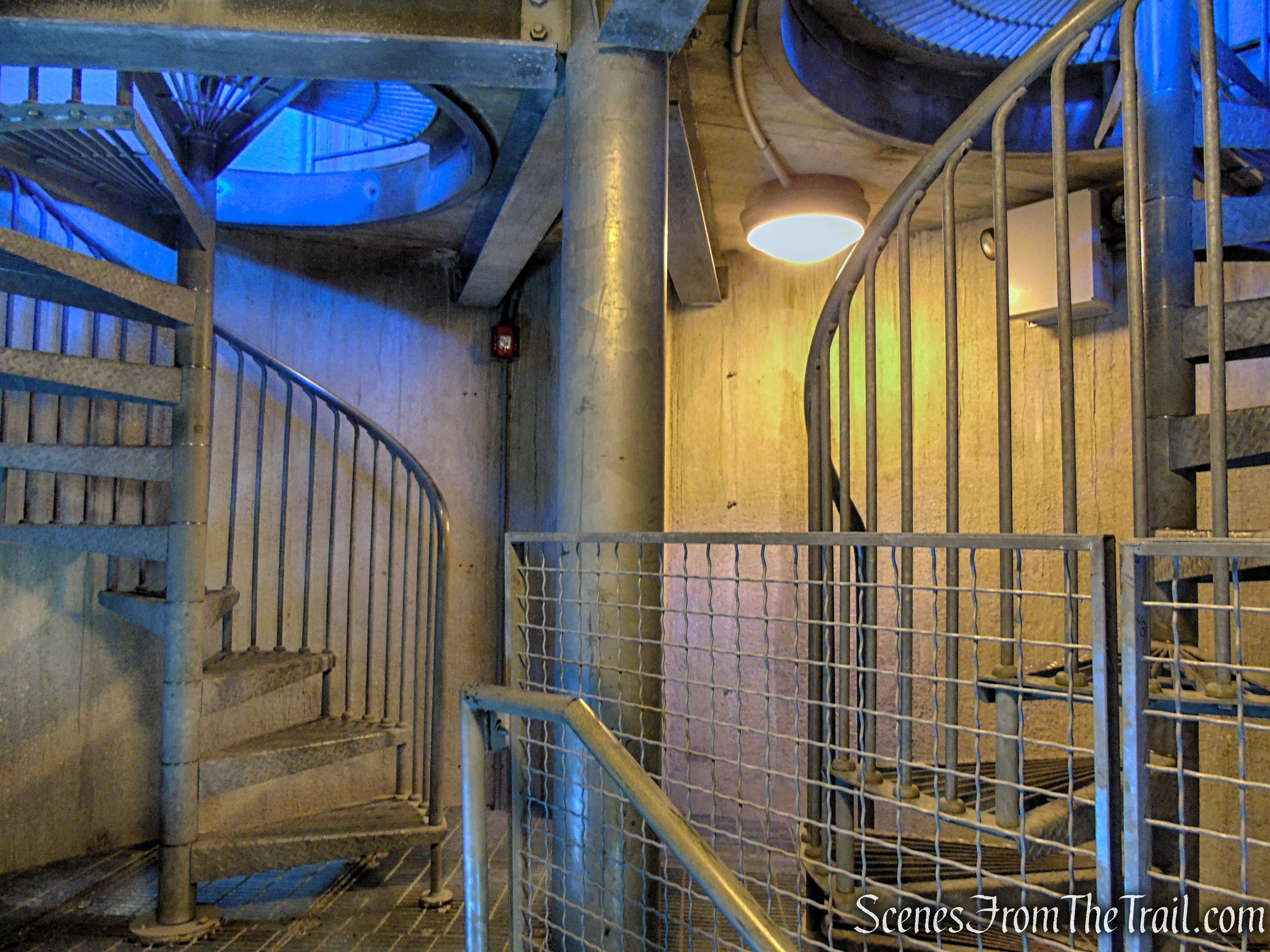
Inside, spiral staircases wind their way to the sixth floor spotting gallery. Climb the 102 steps, where Observers will answer questions and share history about the tower.

World War II Lookout Tower

World War II Lookout Tower

There are changing exhibits along the way to highlight varying topics of history, related to the tower. Interpretive panels and photos explain the tower’s function, while a Wall of Honor pays tribute to local residents who served during World War II.

World War II Lookout Tower

World War II Lookout Tower

Over 160 veterans photos are on display.

World War II Lookout Tower

World War II Lookout Tower

World War II Lookout Tower

World War II Lookout Tower

The World War II Lookout Tower is an easy climb, with exhibits and information on different floors as you climb to the sixth floor spotting gallery.

World War II Lookout Tower

World War II Lookout Tower

World War II Lookout Tower

World War II Lookout Tower

An interpreter at the top will explain the equipment used and the role of those who manned the Tower during the war.

World War II Lookout Tower

World War II Lookout Tower

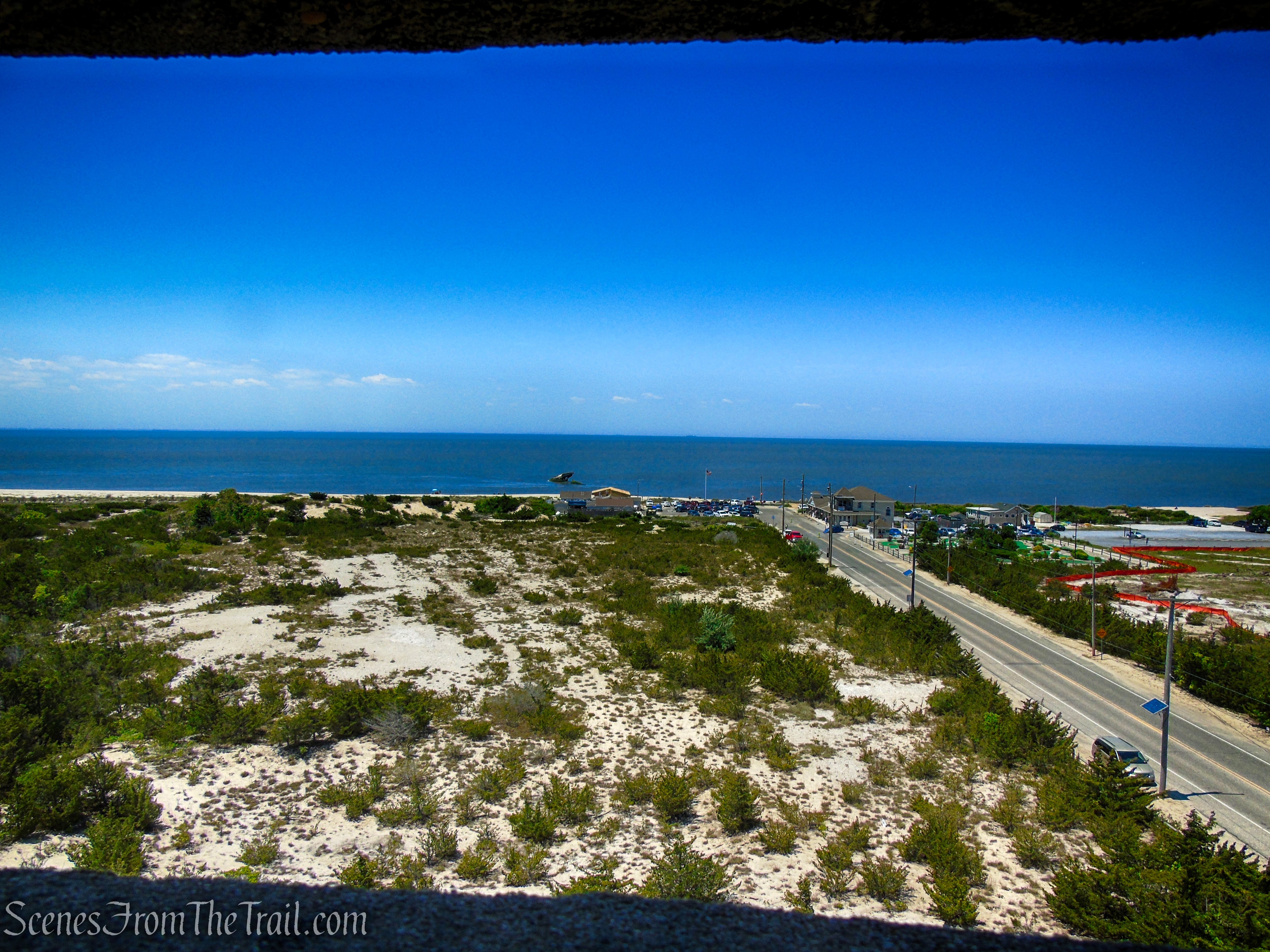
Looking west towards Sunset Beach and the Atlantic Ocean.

World War II Lookout Tower

World War II Lookout Tower

Across the road from the Tower is where the Northwest Magnesite Company once stood. The plant operated 24-7 during WW II making firebricks necessary for the production of steel.

World War II Lookout Tower

World War II Lookout Tower

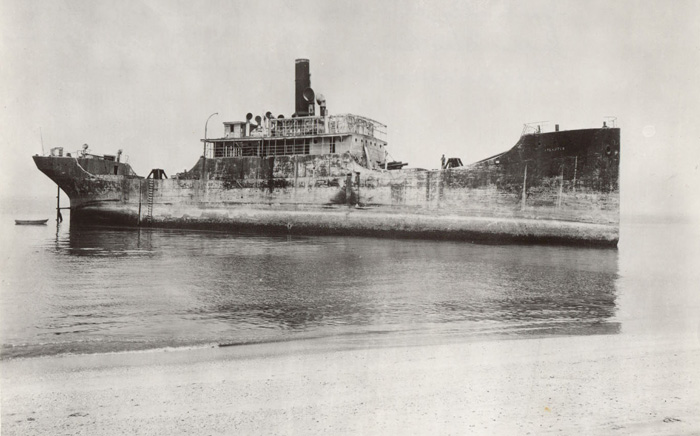
To the west are the remains of an experimental concrete ship, the SS Atlantus. One of twelve built during World War I due to the scarcity of steel during the war. Proven impractical after several Trans-Atlantic trips because of its weight. The Atlantus was used to transport American troops back home from Europe and also to transport coal in New England. On June 8, 1926 a storm hit and the ship broke free of her moorings and ran aground 150 feet off the coast of Sunset Beach. Several attempts were made to free the ship, but none were successful.

SS Atlantus

SS Atlantus

SS Atlantus the day she ran aground, June 8, 1926

SS Atlantus the day she ran aground, June 8, 1926

SS Atlantus the day she ran aground, June 8, 1926

Below is a postcard of the SS Atlantus after it ran aground in in 1926.

SS Atlantus

SS Atlantus

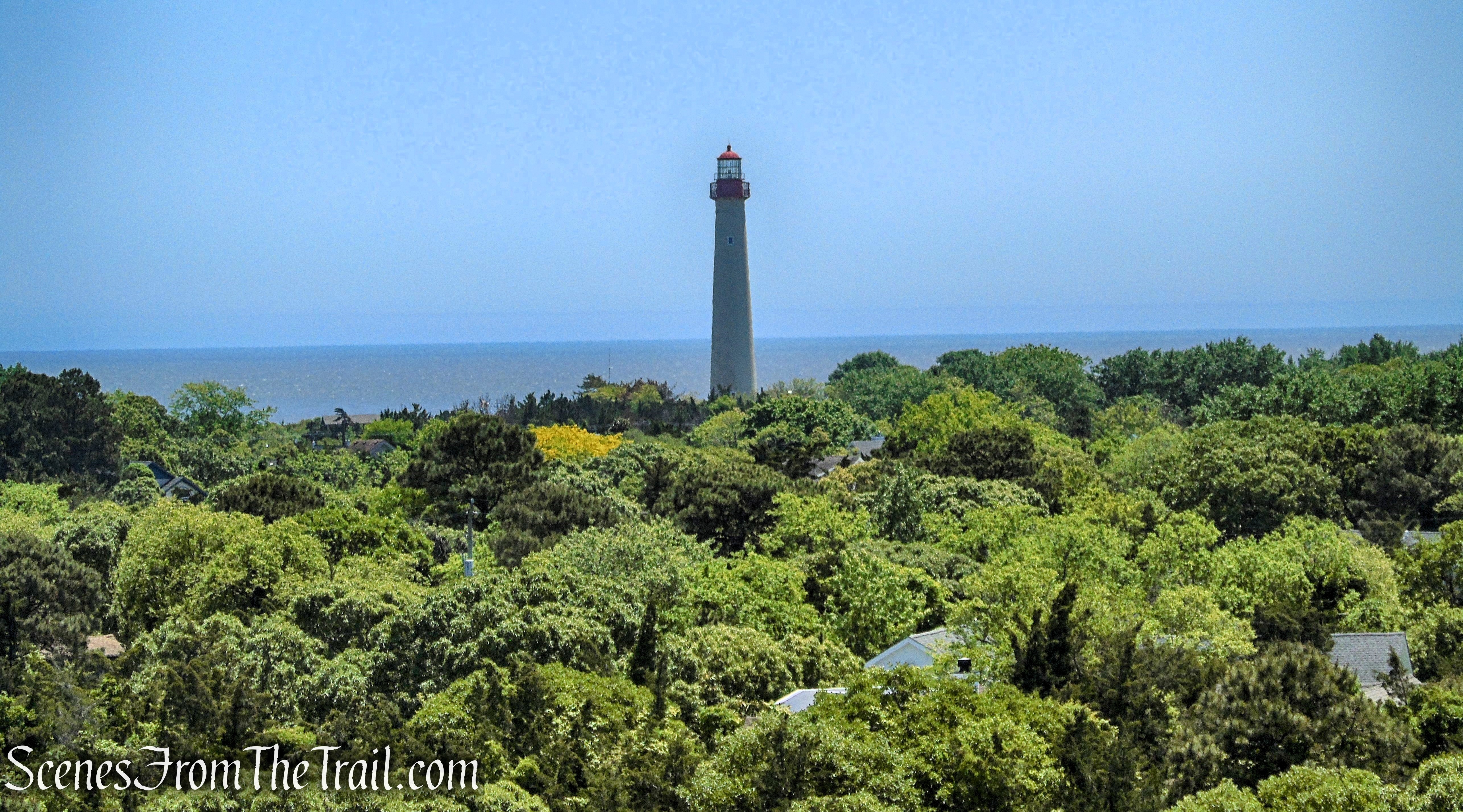
The Cape May Lighthouse as viewed from the spotting gallery, just south of the tower.

Cape May Lighthouse

Cape May Lighthouse

At the rear of the Tower is the All Veterans Memorial, an “eternal flame” monument with benches in a contemplative setting.

Eternal Flame sculpture - Fire Control Tower No. 23

Eternal Flame sculpture – Fire Control Tower No. 23

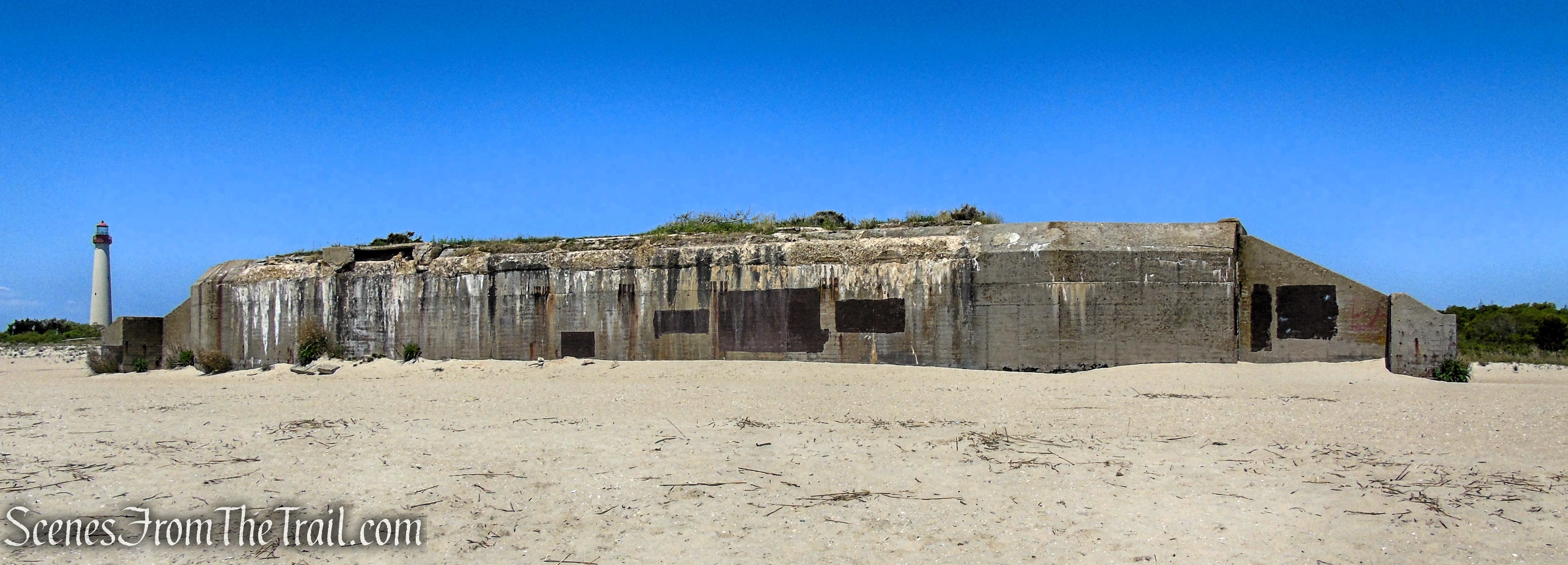
When you are done checking out the tower, you may want to take a short ride to Cape May Point State Park (a 4 minute drive) and take a walk out on the beach to see Battery 223. Fire Control Tower No. 23 and Battery 223 worked in tandem as part of New Jersey’s coastal defense.

From 1940-1945, Cape May was bustling with military activity. The Army, Navy and Coast Guard were all stationed here. The Navy had been here since World War I, when it established its air base. The rest of the military presence was newly established for the upcoming war. Due to the lack of existing infrastructure, as well as the immediate need for services for the troops, several Cape May hotels were called into service as barracks and hospitals. The Admiral, Cape May’s largest beachfront hotel, was used to house naval officers and their families. Even private homes were used by the military, as accommodations were tight, especially in the winter; only a limited number of houses had heat. Some
residents opened up their houses to share. Others provided individual rooms to the military and the civilian staff.


Battery 223:

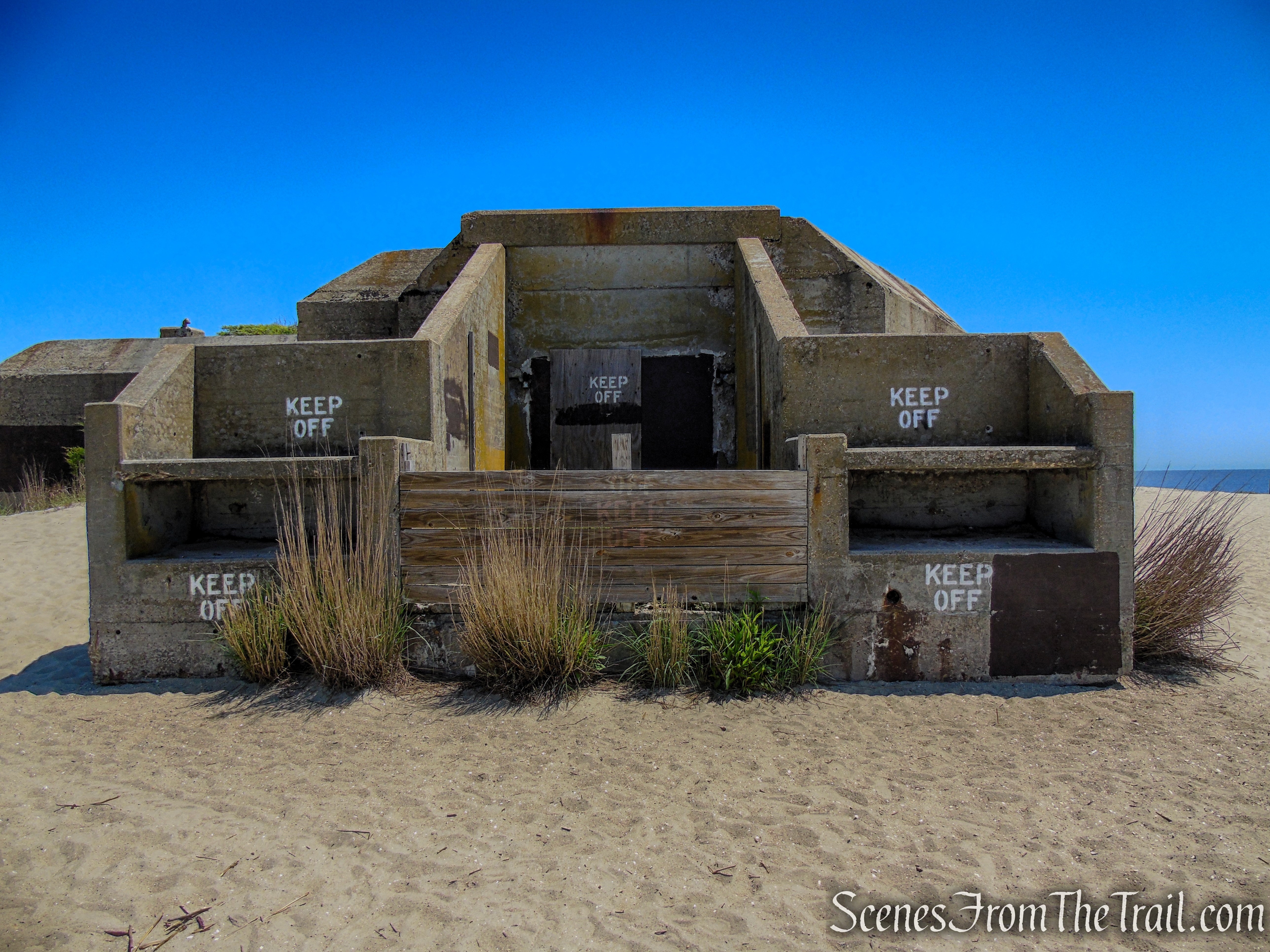
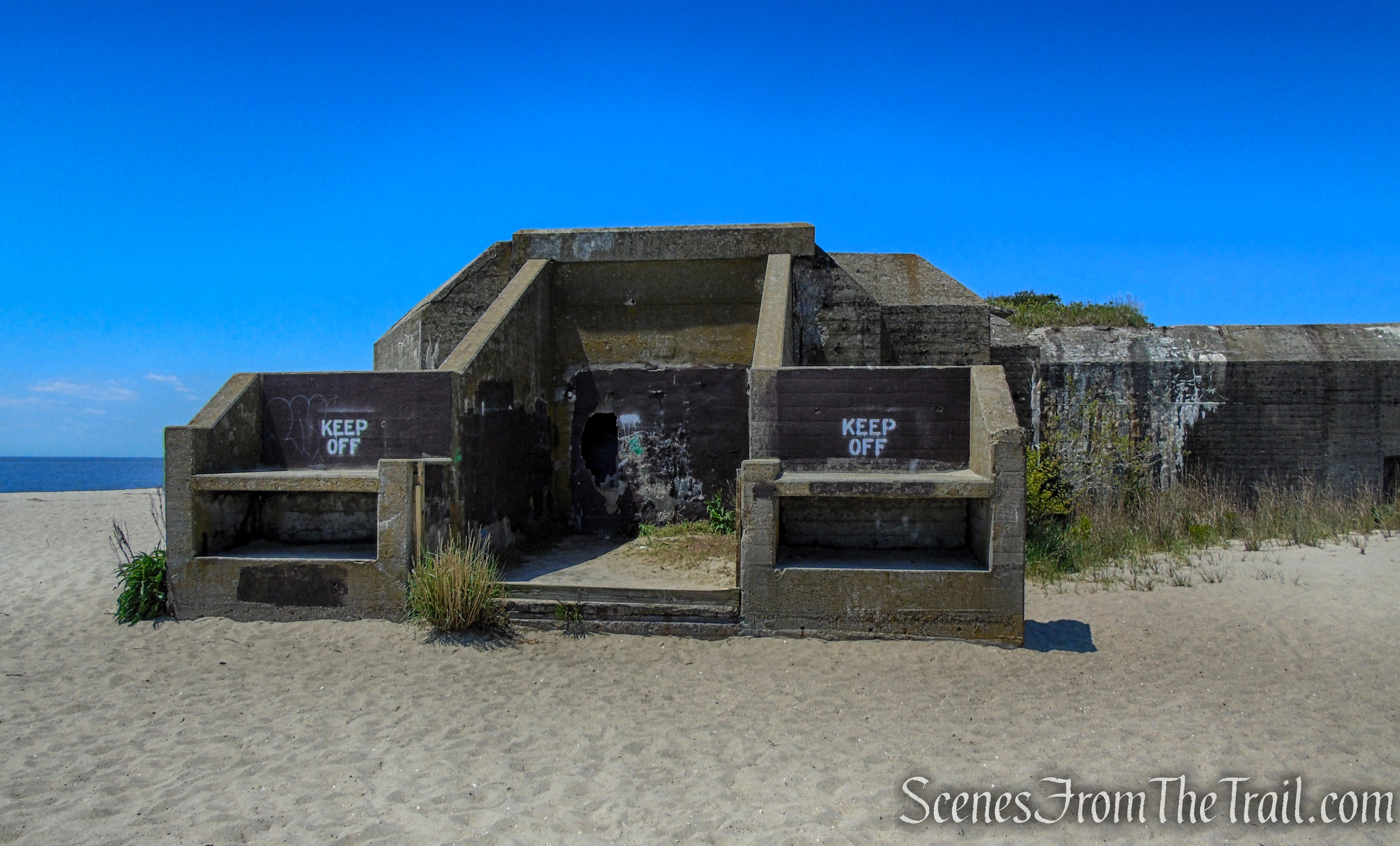
Constructed in the fall of 1942 and completed in June 1943 as part of the Harbor Defenses of the Delaware, Battery 223 is made of thick reinforced concrete with a substantial blast proof roof. Although originally covered with earth, today it is fully exposed and set upon wood pilings, an incongruous man-made object within the natural setting of the beach. Its floor plan has twenty rooms including several shell rooms, a plotting room, a switchboard room, a latrine and a chemical warfare room among other features.

Battery 223 - Cape May Point State Park

Battery 223 – Cape May Point State Park

Today, Battery 223 is located on the beach within Cape May Point State Park. When it was first constructed, it was located 900 feet from the shore; by the 1970s, however, its pilings were underwater due to beach erosion that is severe at this location. In 2005, to stave off the erosion, the Army Corps of Engineers began a beach replenishment project that brought 1.4 million cubic yards of sand to the Cape May beaches. This project set Battery 223 back from the shoreline, re-establishing it in the sand as it was originally constructed.

Battery 223 - Cape May Point State Park

Battery 223 – Cape May Point State Park

The 6-inch guns on Battery 223 could hit targets that were nine miles out. This system depended on mathematical triangulation through coordinates provided by base-end stations, often referred to as fire control towers, which were sent on to aim the guns. From the towers, coastal artillery soldiers scanned the horizon for enemy activity.

Battery 223 - Cape May Point State Park

Battery 223 – Cape May Point State Park

There were four towers in New Jersey which served Battery 223 after it was completed. Fire Control Tower No. 23, the closest to the battery, provided range finding for Battery 223 only. It had two azimuth instruments and exclusively served this battery.

Battery 223 - Cape May Point State Park

Battery 223 – Cape May Point State Park

Battery 223 was decommissioned in 1944. The Navy took over the Army facilities in 1953. Although no paperwork has been uncovered about the Navy’s ownership of the battery specifically, records about Fire Control No. 23 confirm that the Navy took over all the Army resources at Cape May Point.

Battery 223 - Cape May Point State Park

Battery 223 – Cape May Point State Park

Under the Navy tenure, there was a Quonset hut on top of Battery 223; it was used for radio communications. A concrete pad was poured on the roof to accommodate this structure; remnants of the pad remain today.

Battery 223 - Cape May Point State Park

Battery 223 – Cape May Point State Park

Most of the batteries, fire control towers, barracks and auxiliary support buildings that were erected on both coasts between 1940-1945 have been lost. The World War II system that remains is rarely interpreted; it survives because it was forgotten, not because it was valued.

Battery 223 - Cape May Point State Park

Battery 223 – Cape May Point State Park

The military lands, including Battery 223, became Cape May Point State Park in 1962.

Battery 223 - Cape May Point State Park

Battery 223 – Cape May Point State Park


Sources:


Marshall’s Falls Park – Delaware Water Gap

April 28, 2024 – East Stroudsburg, Pennsylvania

Difficulty: Easy

Length: Approximately 0.5 mile

Max elevation: 582 ft.– total elevation gain approximately 87 ft.

Route type: Out and back

Map: None available at this time.

Trailhead parking: 274 Marshalls Creek Rd, East Stroudsburg, PA 18302

Portable bathroom on site – Paved parking lot with 13 spaces plus 1 handicapped spot.

Please note: Waterfall conditions are dynamic, changing with weather and seasons. Stay on the trail when possible and be cautious of your surroundings, like slippery or rocky terrain, fast moving water, or steep drops.


Overview:

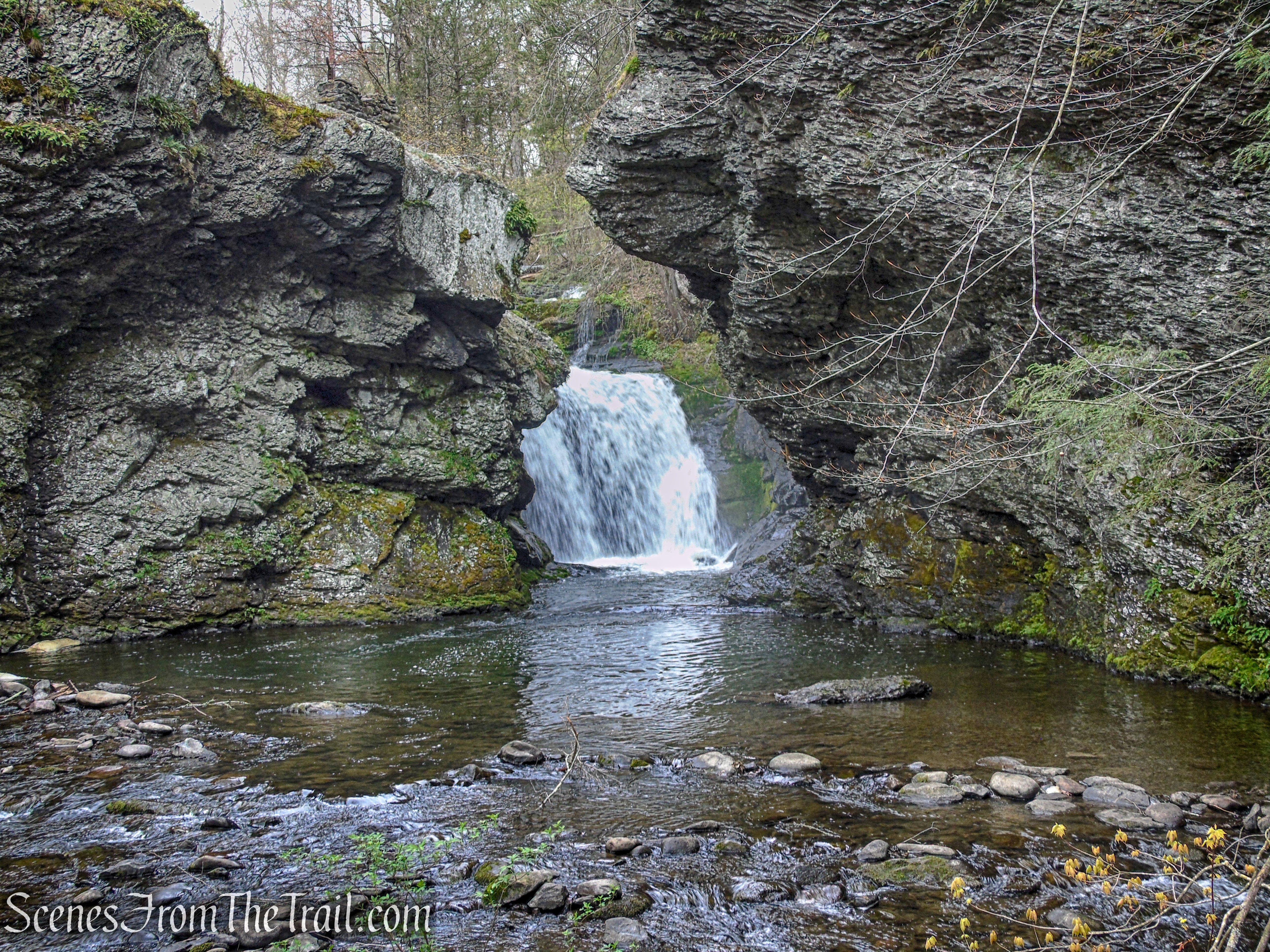
This picturesque 17-acre park showcases Marshall’s Falls, which drops through a narrow rock chasm, into a small and narrow gorge surrounded by 25-foot rock walls.

Marshall's Falls Park

Marshall’s Falls Park

An ADA compliant path accessible to all visitors leads from the parking area to the bridge near the falls.

Marshall's Falls Park

Marshall’s Falls Park

Marshall’s Falls Park officially opened to the public on Friday, April 12, 2024.

Marshall's Falls Park

Marshall’s Falls Park

Marshall's Falls Park

Marshall’s Falls Park


History:

Marshalls Creek is a 13.3-mile-long tributary of Brodhead Creek in the Pocono Mountains. Variant names were “Marshall Creek” and “Marshall’s Creek.” Marshalls Creek is said to be named after Edward Marshall, the successful walker in the “Walking-Purchase” of 1737, by which the Lenape Indians were cheated out of a vast hunting ground.

Beginning in the late 19th century, the property, which was owned by the Congdon Family, functioned as “Hygiene Park,” a hotel and resort (built in 1888) that sought to attract travelers looking to enjoy the beautiful scenery and natural environment surrounding the house.

Marshall's Falls circa 1898

Marshall’s Falls circa 1898

After the turn of the century, Hygiene Park stopped promoting health and became a regular resort named “Titania House” after the queen of the fairies in Shakespeare’s A Midsummer Night’s Dream. Titania House was able to accommodate up to 35 guests. It continued operation until sometime in the early 20th century, after which time it was used as a “finishing school” for girls.

Titania House - 1898

Titania House – 1898

Smithfield Township purchased the land back in 2008, just off of Marshalls Creek Road. Work to install an access trail and boardwalk crossing to the falls started in 2023.

The township removed three buildings from the 17-acre property to make room for a much-needed parking lot. Previously there was only roadside parking for one car. The new paved parking lot has 13 spaces plus 1 handicapped spot. There is also a Porta-Potty in the parking lot.

Marshall's Falls Park

Marshall’s Falls Park

In addition, they installed sidewalks and curbs for safe pedestrian access, paved walking trails, signage with historical information and even created a rain garden. The township plans to expand the trails in the park in future phases.

Marshall's Falls Park

Marshall’s Falls Park

Marshall's Falls Park

Marshall’s Falls Park

Marshall's Falls Park

Marshall’s Falls Park

Marshall’s Falls Park officially opened to the public on Friday, April 12, 2024.


Hike Overview:

I tried visiting Marshall’s Falls in 2021, but couldn’t find a place to park. Then I read about the park opening to the public on April 12, 2024. I decided it was time to go check it out. Although more of a walk than a hike. It was definitely worth visiting. Since the park is small and the ride to the park was 1-1/2 hours, we visited several other waterfalls in the area. Resica Falls is about a 10 minute drive from Marshall’s Falls Park, so we stopped by there as well. We also stopped by Dingman’s Falls.

We arrived at the park at about 8:30am on a Sunday morning and the parking lot was empty. It was nice to have the park to ourselves. When we were leaving, a car pulled in the lot. 


The Hike:  

At the north end of the parking lot, follow the paved path as it gently goes downhill. 

Marshall's Falls Park

Marshall’s Falls Park

Marshall's Falls Park

Marshall’s Falls Park

In a short distance, the path reaches a bench and an elevated boardwalk that descends the now steeper grade on switchbacks.

Marshall's Falls Park

Marshall’s Falls Park

Marshall's Falls Park

Marshall’s Falls Park

Marshall's Falls Park

Marshall’s Falls Park

At the base of the descent, the path reaches a wooden footbridge that spans Marshalls Creek. Proceed ahead to the bridge and you will see the falls on your left between the high rock walls.

Marshall's Falls Park

Marshall’s Falls Park

The best view of Marshall’s Falls is from the center of the footbridge.

Marshall's Falls

Marshall’s Falls

Marshall’s Falls is listed at between 15-20 feet tall, but its unique drop through the narrow rock chasm, creates a dramatic waterfall that is framed by the gorge walls that surround it. 

Marshall's Falls

Marshall’s Falls

Marshall's Falls

Marshall’s Falls

After returning to the parking lot, we drove the 6 miles (9 minutes) to the Resica Falls Scout Reservation to view another easy to get to waterfall.


Resica Falls:

Address: 1200 Resica Falls Rd, East Stroudsburg, PA 18302

Resica Falls is a picturesque roadside waterfall located in East Stroudsburg, Pennsylvania. The falls are located along Bushkill Creek and is part of the Resica Falls Scout Reservation, but is open to the public for viewing. Its easy accessibility makes it a favorite for both locals and tourists seeking to experience the magnificence of a Poconos waterfall.

The parking area is located across from the Scout camp office, just past the entrance from Resica Falls Road.

Resica Falls Scout Reservation

Resica Falls Scout Reservation

Visitors to Resica Falls should be aware that while the waterfall viewing area is open to the public, the rest of the Scout reservation is not.

Resica Falls Scout Reservation

Resica Falls Scout Reservation

It’s important to respect these boundaries and enjoy the falls from the designated viewing area only.

Resica Falls

Resica Falls

Just follow the path past the entrance to the falls and across the catwalk.

Resica Falls

Resica Falls

Resica Falls

Resica Falls

The presence of a protective fence around the viewing area ensures the safety of visitors.

Resica Falls

Resica Falls

Resica Falls at approximately 25-ft. high and 60-ft. across, is quite a sight, depending on the volume of water.

Resica Falls

Resica Falls

Resica Falls

Resica Falls

Resica Falls

Resica Falls


Review:

Marshall’s Falls Park is a beautiful park and it was litter free on the day of our visit. Please, let’s keep it that way. Definitely worth a visit, but I would combine it with other waterfalls in the area, of which there are many.

Resica Falls is a good place to stop if you just want to see a really nice waterfall. It’s a very short walk to the viewing area and the rest of the property is off limits to visitors. 

Below are a few waterfalls that are in close proximity to Marshall’s Falls and Resica Falls.


Breakneck Ridge Short Loop

April 17, 2024 – Cold Spring, NY

Difficulty: Moderate-Strenuous

Length: Approximately 1.9 miles

Max elevation: 596 ft.– total elevation gain approximately 650 ft.

Route type: Circuit

Buy Map: East Hudson Trails Map #102

Free Web Map: Hudson Highlands Trail Map North 2023

Trailhead parking: Breakneck Ridge Trailhead – Cold Spring, NY 10516

Please Note: Despite its short length, this is generally considered to be one of the more strenuous hikes in the East Hudson Highlands. It involves steep climbs over rock ledges that can be very slippery when wet. You’ll need to use both your hands and your feet in many places along the way. Proper footgear is essential for this hike, which is best done on weekdays, to avoid the weekend crowds. Do not attempt this hike in wet weather, or if the trail is covered with snow or ice.

The Breakneck Ridge area has been impacted by the construction of the Hudson Highlands Fjord Trail. The next set of Breakneck Ridge improvements is set to begin in the Fall of 2024, with preparatory work already underway. Expect road and trail closures while construction is ongoing.


Overview:

Breakneck Ridge is a mountain along the Hudson River between Beacon and Cold Spring, straddling the boundary between Dutchess and Putnam counties.

Breakneck Ridge as viewed from Storm King Mountain

Breakneck Ridge as viewed from Storm King Mountain

Breakneck Ridge has several summits, or bumps as they are sometimes called. The highest point (true summit) is some distance inland, reaching approximately 1,260 feet above sea level. The southern face of the peak is remarkable for its striking cliffs, the result of quarrying in past years.

Breakneck Ridge as viewed from Little Stony Point

Breakneck Ridge as viewed from Little Stony Point

Breakneck Ridge is considered one of the best and toughest day hikes in the country. The steep ascent up its western face involves climbing over rock ledges, using both hands and feet.

Breakneck Ridge Trail

Breakneck Ridge Trail

This rock scramble attracts hikers from all over, and is often called “the most popular day hike in America.” Breakneck Ridge is about 90 minutes north of New York City, and rewards hikers with sweeping views of the Hudson River Valley.

View south from Breakneck Ridge

View south from Breakneck Ridge

Breakneck Ridge is located within the confines of Hudson Highlands State Park Preserve and is administered by the New York State Office of Parks, Recreation and Historic Preservation (NYS OPRHP).

Nimham Trail – Breakneck Ridge

Nimham Trail – Breakneck Ridge


History:

Breakneck Ridge lies immediately across the river from Storm King and is well known for its high cliffs, which were formed as a result of heavy quarrying throughout the 19th century. Breakneck was originally known as St. Anthony’s Face or Turk’s Face, due to the presence of a face like rock formation on the southern cliffs, which was eventually destroyed by quarrying in 1846. Today Breakneck Ridge is an immensely popular hiking destination, located within Hudson Highlands State Park Preserve.

According to The History of Putnam County, N.Y., which was published by William J. Blake in 1849, Breakneck Ridge got its name after a group of farmers chased a bull off of a cliff, where the animal broke its neck. A bull had made the mountain just south of Breakneck Ridge (Mt. Taurus aka Bull Hill) its home. At night, it would descend to the low grounds in its vicinity, and plunder corn fields, meadows, and grain fields. The neighbors formed an “alliance” against the bull, determined to pursue him to his strongholds, and effect his capture or destruction. They chased him from this Hill (Bull Hill) to the one immediately north of it (Breakneck), where, being hard pressed by dogs and armed men, was forced off a cliff, thus breaking his neck. His pursuers immediately christened the hill from which they started “Bull Hill,” and the one where they captured the wayward bull, “Breakneck.”

Since 2020, the Breakneck Ridge area has been impacted by the construction of the Hudson Highlands Fjord Trail. Work at Breakneck Ridge Trailhead and Upper Overlook was completed in July 2023. Months of work included the relocation of the trailhead farther up Breakneck Ridge, repair of eroding trail surfaces, improved stormwater management along the trail, installation of stone steps leading up to the Breakneck ascent, and construction of a new Trail Steward Station. This initial work at Upper Overlook marks the launch of Phase 1: Breakneck Connector & Bridge of the Hudson Highlands Fjord Trail.

The next set of Breakneck Ridge improvements is set to begin in the Fall of 2024, with preparatory work already underway. The Hudson Highlands Fjord Trail Project is slated for completion in 2031.


Trails Overview:

The Breakneck Ridge Trail has become the number one hiking destination in the NYC metropolitan area. In good weather, the trail frequently brings more than 3,000 hikers a weekend to hike its steep, rocky ascent and enjoy its breathtaking views.

The white-blazed Breakneck Ridge Trail starts on the west side of Route 9D, just north of the tunnel. The trail climbs steeply up the west face of Breakneck Ridge, often requiring using both hands and feet. This rock scramble is short, but feels much longer. This is a one way trail (up only) and should not be used as the way down.

Breakneck Ridge Trail

Breakneck Ridge Trail

The green-blazed Nimham Trail opened in 2021, making for an easier bailout option for those that just want to hike to the flagpole. This trail follows the natural “bench,” or shelf, along the ridge, connecting the flagpole area to the Wilkinson Memorial Trail.

Nimham Trail - Breakneck Ridge

Nimham Trail – Breakneck Ridge

The yellow-blazed Wilkinson Memorial Trail runs in a westerly direction for about 350 yards from the junction with the Nimham Trail out to Route 9D.

Nimham Trail – Breakneck Ridge

Nimham Trail – Breakneck Ridge

This hike also includes a short road walk (0.3 mile total) along Route 9D, at the beginning and end of the hike.

The trails are well marked and easy to follow.


Hike Overview:

I have hiked Breakneck Ridge numerous times since 2015 using different trails to descend  the ridge. This hike is a good introductory to Breakneck. It allows hikers to enjoy the sweeping views of the Hudson River Valley without having to commit to a much longer and tougher hike.

I did this hike on a Wednesday morning and arrived at the trailhead at about 8am. Surprisingly, there was only one other vehicle when I arrived at the trailhead. Once at the area of the flagpole, a few people started to pass through.

This hike begins and ends on Route 9D and is done counterclockwise.

Breakneck Ridge Short Loop

Breakneck Ridge Short Loop

A majority of the elevation is gained within the first mile.

Elevation profile - Breakneck Ridge Short Loop

Elevation profile – Breakneck Ridge Short Loop


The Hike:

Since I came from south of Cold Spring, I parked facing south so that I could exit more easily after the hike and not have to make a U-Turn.

On the opposite side of the guard rail, alongside the southbound lane, there is a footpath that leads to the trailhead. Follow this path south towards the tunnel.

Route 9D Trail

Route 9D Trail

Route 9D Trail

Route 9D Trail

Breakneck Ridge Trailhead

Breakneck Ridge Trailhead

If you don’t already have a trail map, check the box for a printed map of the trails.

Breakneck Ridge Trailhead

Breakneck Ridge Trailhead

The sign states that this hike is only a mile long. It’s almost twice that long if you do the hike as decribed by this writer.

Breakneck Ridge Trailhead

Breakneck Ridge Trailhead

The white-blazed Breakneck Ridge Trail starts on the west side of Route 9D, just north of the tunnel. The trail climbs stone steps and heads south, almost immediately reaching a viewpoint over the Hudson River from a rock outcrop to the right of the trail. Storm King Mountain is directly across the river with far reaching views to the north and south.

Breakneck Ridge Trail

Breakneck Ridge Trail

Breakneck Ridge Trail

Breakneck Ridge Trail

Breakneck Ridge Trail

Breakneck Ridge Trail

Breakneck Ridge Trail

Breakneck Ridge Trail

Breakneck Ridge Trail

Breakneck Ridge Trail

On weekends, Memorial Day Weekend through Veterans Day, Breakneck Trail Stewards are available at the Breakneck trailhead with maps (highly recommended), water (highly recommended), trail condition updates, and other tips to help you enjoy your day.

Breakneck Ridge Trail

Breakneck Ridge Trail

If you look up towards the ridge, you may be able to see the flags, the destination on this hike, flapping in the wind.

Flagpole Area - Breakneck Ridge

Flagpole Area – Breakneck Ridge

The climb of Breakneck begins on stone steps. Completed in 2023, native stones were utilized from the site to create a rustic, but clear stone staircase that safely guides hikers through the boulder field, to the base of the rock slab scramble just ahead.

Breakneck Ridge Trail

Breakneck Ridge Trail

Breakneck Ridge Trail

Breakneck Ridge Trail

Breakneck Ridge Trail

Breakneck Ridge Trail

Breakneck Ridge Trail

Breakneck Ridge Trail

Breakneck Ridge Trail

Breakneck Ridge Trail

Breakneck Ridge Trail

Breakneck Ridge Trail

At times you may have to use both hands and feet, to scramble up the ridge. The trail is well marked, with arrows painted on rocks directing the way.

Breakneck Ridge Trail

Breakneck Ridge Trail

Breakneck Ridge Trail

Breakneck Ridge Trail

Breakneck Ridge Trail

Breakneck Ridge Trail

Breakneck Ridge Trail

Breakneck Ridge Trail

Follow the white-blazed trail as it steeply climbs the rocky ridge. Pay attention to the white blazes and arrows as you ascend to stay on the right track.

Breakneck Ridge Trail

Breakneck Ridge Trail

Breakneck Ridge Trail

Breakneck Ridge Trail

There are views through the trees of the river as you climb and you may want to take a brief rest here and there to admire them.

Breakneck Ridge Trail

Breakneck Ridge Trail

Breakneck Ridge Trail

Breakneck Ridge Trail

Breakneck Ridge Trail

Breakneck Ridge Trail

Breakneck Ridge Trail

Breakneck Ridge Trail

Breakneck Ridge Trail

Breakneck Ridge Trail

Breakneck Ridge Trail

Breakneck Ridge Trail

Breakneck Ridge Trail

Breakneck Ridge Trail

Breakneck Ridge Trail

Breakneck Ridge Trail

Breakneck Ridge Trail

Breakneck Ridge Trail

In just under a mile, the trail reaches a rock ledge with a flagpole. This is a great spot to rest from the tough climb and enjoy the panoramic views over the Hudson River.

Breakneck Ridge Trail

Breakneck Ridge Trail

Looking north up the Hudson River, with Pollepel Island visible below. Across the river (from left to right), is Cornwall-On-Hudson, New Windsor, and the City of Newburgh. The long ridge that straddles New Windsor and Newburgh is Snake Hill, another great hike.

Breakneck Ridge Trail

Breakneck Ridge Trail

Pollepel Island is a 6.5-acre uninhabited island in the Hudson River. The principal feature on the island is Bannerman’s Castle, an abandoned military surplus warehouse.

Pollepel Island

Pollepel Island

Pollepel Island has been called many different names, including Pollopel Island, Pollopel’s Island, Bannerman’s Island, and Bannermans’ Island. Pollepel is a Dutch word meaning “ladle.”

Bannerman's Castle

Bannerman’s Castle

To the south, Little Stony Point can be seen jutting out on the east side of the river, with Crow’s Nest, North Point and Storm King Mountain across the river.

Breakneck Ridge Trail

Breakneck Ridge Trail

Breakneck Ridge Trail

Breakneck Ridge Trail

Breakneck Ridge Trail

Breakneck Ridge Trail

Breakneck Ridge Trail

Breakneck Ridge Trail

Breakneck Ridge Trail

Breakneck Ridge Trail

Breakneck Ridge Trail

Breakneck Ridge Trail

Breakneck Ridge Trail

Breakneck Ridge Trail

Breakneck Ridge Trail

Breakneck Ridge Trail

Looking up to the top of the ridge from the junction with the Nimham Trail, you’ll notice a steep, near-vertical rock outcrop that the Breakneck Ridge Trail climbs to gain the crest of the ridge. But that section is not part of this hike.

Breakneck Ridge Trail

Breakneck Ridge Trail

When you are done enjoying these majestic views, continue ahead a short distance uphill to a junction with the green-blazed Nimham Trail.

Breakneck Ridge Trail

Breakneck Ridge Trail

Turn left on the Nimham Trail, which is marked by a sign.

Turn left on Nimham Trail

Turn left on Nimham Trail

Turn left on Nimham Trail

Turn left on Nimham Trail

Turn left on Nimham Trail

Turn left on Nimham Trail

Follow the green blazes along the Nimham Trail, which loses over 500 feet of elevation in about a 1/2 mile. There are 500 stone steps throughout this trail that help hikers negotiate the steep sections much more easily. This trail opened in 2021 and makes for an enjoyable and scenic descent of Breakneck Ridge.

Nimham Trail - Breakneck Ridge

Nimham Trail – Breakneck Ridge

Nimham Trail - Breakneck Ridge

Nimham Trail – Breakneck Ridge

Nimham Trail - Breakneck Ridge

Nimham Trail – Breakneck Ridge

Nimham Trail - Breakneck Ridge

Nimham Trail – Breakneck Ridge

Nimham Trail - Breakneck Ridge

Nimham Trail – Breakneck Ridge

Nimham Trail – Breakneck Ridge

Nimham Trail – Breakneck Ridge

Nimham Trail – Breakneck Ridge

Nimham Trail – Breakneck Ridge

Nimham Trail – Breakneck Ridge

Nimham Trail – Breakneck Ridge

Nimham Trail – Breakneck Ridge

Nimham Trail – Breakneck Ridge

DSC01424_HDR_marked

Nimham Trail – Breakneck Ridge

Nimham Trail – Breakneck Ridge

Nimham Trail – Breakneck Ridge

Nimham Trail – Breakneck Ridge

Nimham Trail – Breakneck Ridge

On the way down, there is a rock outcrop with more Hudson River views. You may want to take a moment here for your last viewpoint from Breakneck Ridge.

Nimham Trail – Breakneck Ridge

Nimham Trail – Breakneck Ridge

Nimham Trail – Breakneck Ridge

Nimham Trail – Breakneck Ridge

Nimham Trail – Breakneck Ridge

Nimham Trail – Breakneck Ridge

Nimham Trail – Breakneck Ridge

Nimham Trail – Breakneck Ridge

Nimham Trail – Breakneck Ridge

Nimham Trail – Breakneck Ridge

Nimham Trail – Breakneck Ridge

Nimham Trail – Breakneck Ridge

Nimham Trail – Breakneck Ridge

Nimham Trail – Breakneck Ridge

Nimham Trail – Breakneck Ridge

Nimham Trail – Breakneck Ridge

Nimham Trail – Breakneck Ridge

Nimham Trail – Breakneck Ridge

Nimham Trail – Breakneck Ridge

Nimham Trail – Breakneck Ridge

In about 1/2 mile, the green-blazed Nimham Trail ends at a junction with the yellow-blazed Wilkinson Memorial Trail. Here you want to turn left and follow the yellow blazes downhill for about 350 yards.

Nimham Trail – Breakneck Ridge

Nimham Trail – Breakneck Ridge

Wilkinson Memorial Trail – East Hudson Highlands

Wilkinson Memorial Trail – East Hudson Highlands

Wilkinson Memorial Trail – East Hudson Highlands

Wilkinson Memorial Trail – East Hudson Highlands

When you reach Route 9D, carefully return to your vehicle, where the hike began.

Wilkinson Memorial Trail – East Hudson Highlands

Wilkinson Memorial Trail – East Hudson Highlands


Review:

This is one of those must do hikes in the Hudson Valley. It’s better done early mornings on a weekday to avoid the crowds. With that being said, it’s worth a visit to experience the rock scramble and the fantastic views. If you don’t want to do the rock scramble, you can still enjoy the same views by utilizing the Nimham Trail and doing an out-and-back hike.

Pros:

Rock scramble, panoramic Hudson Valley views, challenging hike, well marked trails.

Cons:

Breakneck gets overcrowded on weekends.


Take a hike!

Breakneck Ridge Short Loop

Breakneck Ridge Short Loop


Sources:


Nuclear Lake Short Loop

April‎ 14‎, ‎2024 – Pawling, NY

Difficulty: Moderate

Length: Approximately 3.3 miles

Max elevation: 832 ft.– total elevation gain approximately 230 ft.

Route type: Lollipop Loop

Map: None available

Trailhead parking: 156 Old Rte 55, Pawling, NY 12564

No restrooms on site – gravel lot for 10-12 vehicles.


Overview:

Nuclear Lake is 1137 acres located on the Boundary of Pawling and Beekman in Dutchess County, NY. The tract of land contains a 55-acre lake that is known for its scenic beauty and diversity of plant life. From 1958 to 1972, the property housed a nuclear fuels processing and research facility and thus received the name “Nuclear Lake.” The Appalachian Trail runs along the western shore of the lake and is widely regarded as one of the most beautiful lakes along the entire Appalachian Trail.

Nuclear Lake

Nuclear Lake


History:

At some point in time, before it was named Nuclear Lake, it was known as Pawling Pond. 

  • Between 1934 and 1942, Herbert Teets acquired approximately ten parcels in the towns of Beekman and Pawling, NY, which comprises the large marjority of the current 1137-acre Nuclear Lake tract.
  • In 1945, the property was sold to Joseph Chazen and Leland Ryder. The dam creating the lake, was constructed shortly thereafter. In 1953, Chazen sold his interests to Ryder.
  • In April 1955, Leland Ryder sold the property to the Southern Dutchess Corporation.
  • In March 1958, the property was transferred to the Nuclear Development Corporation of America (NDA).
  • In May 1961, NDA transferred the property and its assets to United Nuclear Corporation (UNC), which then entered into a contract with the United States Atomic Energy Commission.
  • On December 21, 1972, at approximately 2:55 pm, a chemical explosion occurred at the Plutonium facility, releasing solid and particulate Plutonium Oxide to the lab area. The explosion took place in a plexiglass “glove box” which was used to prepare and examine fuel pellets. After all employees left the building, a second explosion took place. The second explosion is suspected of having blown out two exterior windows on the north side of the building and two exterior doors on the south, spreading radioactive contamination to the outside environment.
  • In June 1979, the 1137-acre parcel was sold to the National Park Service for almost $1 million for relocation of the Appalachian Trail. The purchase was part of a plan to move sections of the Appalachian Trail off of paved roads and back onto a wilderness path.
  • In 1986, after overseeing its cleanup and receiving a clean bill of health, the Appalachian Trail officially opened in the Nuclear Lake area.

Trails Overview:

This hike incorporates an old service road, the Appalachian Trail and the Nuclear Lake Loop Trail.

  • Service Road – This old road is a nice easy and level walk to the southwestern end of the lake. It is just under a mile from the parking lot to the lake.
Nuclear Lake - Service Road

Nuclear Lake – Service Road

  • Appalachian Trail – This white blazed trail runs along the western side of Nuclear Lake. It runs on an old woods road then changes to a footpath. 
Appalachian Trail - Nuclear Lake

Appalachian Trail – Nuclear Lake

  • Nuclear Lake Loop Trail – This yellow blazed footpath begins at the northern end of the lake and ends at the service road, near the southern end. This trail runs along the eastern side of the lake. This section of trail can be wet, has several stream crossings and requires climbing over some rocks.
Nuclear Lake Loop Trail

Nuclear Lake Loop Trail


Hike Overview:

This hike has been on my list for years. On the day of this hike, we only saw a few people on the trails. 

There is another smaller trailhead parking lot about a 1/2 mile northwest on Route 55, where the AT crosses the busy road, but I decided to utilize the larger lot which is easier to access. Either trailhead will get you to the lake.

Nuclear Lake Trailhead – Old Route 55

Nuclear Lake Trailhead – Old Route 55

Nuclear Lake Trailhead – Old Route 55

Nuclear Lake Trailhead – Old Route 55

I rated this hike as moderate strictly for the stream crossings and the rocky hillside on the eastern side of Nuclear Lake. The rest of the hike is relatively easy.

Even though no official trail map is available, I used Gaia GPS with the NatGeo Appalachian Trail map layer. 

Nuclear Lake Short Loop

Nuclear Lake Short Loop

As you can see from the graph below, there are only a couple of short, steep sections on this hike.

Elevation profile - Nuclear Lake Short Loop

Elevation profile – Nuclear Lake Short Loop


The Hike:

From the rear of the parking lot, proceed past the gate on the access road, walk past the dam keeper’s house, and past another gate.

Nuclear Lake Trailhead - Old Route 55

Nuclear Lake Trailhead – Old Route 55

Nuclear Lake - Service Road

Nuclear Lake – Service Road

Nuclear Lake - Service Road

Nuclear Lake – Service Road

Nuclear Lake - Service Road

Nuclear Lake – Service Road

It’s a pleasant walk along the access road. You will soon cross over a culvert, where the Nuclear Lake outlet stream flows beneath the road. Just after crossing the culvert, the yellow blazed Nuclear Lake Loop Trail crosses the road, but continue ahead on the access road.

Nuclear Lake - Service Road

Nuclear Lake – Service Road

Nuclear Lake - Service Road

Nuclear Lake – Service Road

Nuclear Lake outlet stream

Nuclear Lake outlet stream

In just under a mile, you will arrive at the southern end of Nuclear Lake. You may want to take a little time to enjoy the beauty of the lake and the surrounding area.

Nuclear Lake

Nuclear Lake

When you are ready to continue, proceed north on the access road which soon comes to a clearing with a view of the lake.

Appalachian Trail - Nuclear Lake

Appalachian Trail – Nuclear Lake

Nuclear Lake

Nuclear Lake

Nuclear Lake

Nuclear Lake

As you continue north on the old road, you will start seeing the white blazes of the Appalachian Trail, which comes in from the left, with more views of Nuclear Lake.

Appalachian Trail - Nuclear Lake

Appalachian Trail – Nuclear Lake

Nuclear Lake

Nuclear Lake

Appalachian Trail - Nuclear Lake

Appalachian Trail – Nuclear Lake

The AT soon leaves the road and runs on a footpath along the lake. There are more views of the lake along the way. As you near the northern end of the lake, you will pass some interesting rock formations and stone walls. 

Appalachian Trail - Nuclear Lake

Appalachian Trail – Nuclear Lake

Appalachian Trail - Nuclear Lake

Appalachian Trail – Nuclear Lake

Appalachian Trail - Nuclear Lake

Appalachian Trail – Nuclear Lake

Nuclear Lake

Nuclear Lake

Appalachian Trail - Nuclear Lake

Appalachian Trail – Nuclear Lake

The trail can be wet and/or muddy along this section.

Appalachian Trail - Nuclear Lake

Appalachian Trail – Nuclear Lake

Appalachian Trail - Nuclear Lake

Appalachian Trail – Nuclear Lake

Appalachian Trail - Nuclear Lake

Appalachian Trail – Nuclear Lake

Appalachian Trail - Nuclear Lake

Appalachian Trail – Nuclear Lake

View of Nuclear Lake from the northern end.

Nuclear Lake

Nuclear Lake

Appalachian Trail - Nuclear Lake

Appalachian Trail – Nuclear Lake

At the northern end of the lake, the Appalachian Trail turns left, but you should continue straight on the yellow-blazed Nuclear Lake Loop Trail, marked by a wooden sign and a yellow blaze on a tree.

Appalachian Trail - Nuclear Lake

Appalachian Trail – Nuclear Lake

Nuclear Lake Loop Trail

Nuclear Lake Loop Trail

The yellow-blazed trail begins to head in a southerly direction, passing by a stone wall and stone ruins.

Nuclear Lake Loop Trail

Nuclear Lake Loop Trail

Nuclear Lake Loop Trail

Nuclear Lake Loop Trail

Nuclear Lake Loop Trail

Nuclear Lake Loop Trail

The trail starts to veer away from the lake and soon crosses the Nuclear Lake inlet stream on rocks, which are partially submerged. This crossing wasn’t too difficult, but it can be during times of high water. This is where your waterproof boots and hiking poles come in handy.

Nuclear Lake Loop Trail

Nuclear Lake Loop Trail

Nuclear Lake Loop Trail

Nuclear Lake Loop Trail

Looking back after crossing the stream.

Looking back at the Nuclear Lake inlet stream, with the crossing on the far left.

Looking back at the Nuclear Lake inlet stream, with the crossing on the far left.

The trail parallels the stream briefly, then veers away from it. This section can be wet and muddy as well.

Nuclear Lake Loop Trail

Nuclear Lake Loop Trail

Nuclear Lake Loop Trail

Nuclear Lake Loop Trail

The yellow-blazed trail soon climbs the steep hillside, with views of the lake through the trees. Soon the trail levels off and passes through another possible wet section of trail. 

Nuclear Lake Loop Trail

Nuclear Lake Loop Trail

Nuclear Lake Loop Trail

Nuclear Lake Loop Trail

Nuclear Lake Loop Trail

Nuclear Lake Loop Trail

Nuclear Lake Loop Trail

Nuclear Lake Loop Trail

The Nuclear Lake Loop Trail bears right and climbs a small hill, crosses another small stream and soon comes to several small rock outcrops that overlook the lake.

Nuclear Lake Loop Trail

Nuclear Lake Loop Trail

Nuclear Lake Loop Trail

Nuclear Lake Loop Trail

Nuclear Lake Loop Trail

Nuclear Lake Loop Trail

Nuclear Lake Loop Trail

Nuclear Lake Loop Trail

Nuclear Lake Loop Trail

Nuclear Lake Loop Trail

The trail soon traverses an area with large boulders that you may have to climb over. The trail then descends, passes through another wet area, and a short distance later reaches the access road by the culvert from earlier in the hike.

Nuclear Lake Loop Trail

Nuclear Lake Loop Trail

Nuclear Lake Loop Trail

Nuclear Lake Loop Trail

Nuclear Lake Loop Trail

Nuclear Lake Loop Trail

Rock formations on the hillside.

Nuclear Lake Loop Trail

Nuclear Lake Loop Trail

Nuclear Lake Loop Trail

Nuclear Lake Loop Trail

Nuclear Lake Loop Trail

Nuclear Lake Loop Trail

Nuclear Lake Loop Trail

Nuclear Lake Loop Trail

Turn left on the access road, now retracing your steps, and follow the road back to the parking lot, where the hike began.

Nuclear Lake – Service Road

Nuclear Lake – Service Road

Nuclear Lake – Service Road

Nuclear Lake – Service Road

Nuclear Lake Trailhead – Old Route 55

Nuclear Lake Trailhead – Old Route 55


Review:

This was a really nice hike in a very scenic area. Nuclear Lake is gorgeous and worth a visit on its own. Hiking any part of the Appalachian Trail is always fun and the interesting rock formations along the lake, really enhance the scenic landscape. After rainfall or Spring thaw, sections of this route may be wet. The stream crossings may be challenging in times of high water. I recommend wearing some waterproof boots. All in all, a good day on the trails.

Pros:

Nuclear Lake, interesting rock formations, well marked trails, scenic landscape, less foot traffic than some of the more popular trails.

Cons:

No official trail map.


Take a hike!

Nuclear Lake Short Loop

Nuclear Lake Short Loop


Sources:


Charles Island – Silver Sands State Park

March 16, 2024 – Milford, Connecticut

Difficulty: Easy – moderate

Length: Approximately 3 miles

Max elevation: 27 ft. – total elevation gain approximately 20 ft.

Map: Silver Sands State Park Trail MapMap & Brochure

Parking: 1 Silver Sands Pkwy, Milford, CT 06460

Paved parking lot – Restrooms on site

Hours: Open Daily, 8:00am – Sunset

Entrance Fees:
No charge for Connecticut registered vehicles
From April 1 through October 31:
$22 – Out-of-State Vehicles (Weekends/Holidays)
$15 – Out-of-State Vehicles (Weekdays)

Please Note: The sandbar that connects to Charles Island overwashes twice a day when the tides come in, creating dangerous currents and undertow. Walking on any portion when it is covered with water should be avoided.


Park Overview:

Silver Sands State Park in Milford, Connecticut is a 297-acre natural haven that features a combination of beach, salt marshland, fishing area, and wildlife refuge. The park boasts breathtaking views of the Long Island Sound, Charles Island, and the surrounding wildlife.

Silver Sands State Park

Silver Sands State Park

Charles Island - Silver Sands State Park

Charles Island – Silver Sands State Park

Beaches, boardwalks, birds, and a sandbar connecting the park to Charles Island are the big attractions at Silver Sands State Park. Rated the best state park in Connecticut by Travel & Leisure, the park sits along over 1/2-mile of shoreline and features a three-quarter-mile, all-weather boardwalk, sand dunes, marshland, wildlife, and a dazzling array of seashells.

Silver Sands State Park

Silver Sands State Park

Silver Sands State Park

Silver Sands State Park

Silver Sands State Park

Silver Sands State Park

Silver Sands State Park

Silver Sands State Park

Silver Sands State Park

Silver Sands State Park

Over 200 species of birds are seen at Silver Sands. They use this important area for nesting, wintering, and foraging areas during spring and fall migration.

Red-winged Blackbird - Silver Sands State Park

Red-winged Blackbird – Silver Sands State Park

Rough-legged Hawk - Silver Sands State Park

Rough-legged Hawk – Silver Sands State Park

Great Blue Heron - Silver Sands State Park

Great Blue Heron – Silver Sands State Park

Great Egret - Silver Sands State Park

Great Egret – Silver Sands State Park

Many butterflies, several rare plants, and other wildlife can also be seen during walks in this area.

Charles Island is a 14-acre island located roughly a 1/2 mile off the coast of Milford, Connecticut, in Long Island Sound. Though an island during high tide, during low tide it is accessible by foot using a rocky tombolo (locally referred to as a sandbar) that stretches from the beach to the island. Visitors are cautioned about the strong undertow and twice-daily flooding of the sandbar as a result of the tides.

Charles Island tombolo

Charles Island tombolo

Silver Sands State Park and Charles Island are owned and managed by the Connecticut Department of Energy and Environmental Protection (DEEP).

Silver Sands State Park

Silver Sands State Park


History:

Charles Island was originally known as Poquehaug and “was a favorite summer resort” with chief sachem Ansantawae of the Paugussett Tribe having a “big wigwam” upon it. After the area was settled by the English in 1639, the island was referred to as Milford Island. It was renamed Charles Island after Charles Deal bought the 14-acre island in 1657. Deal made a failed attempt to raise tobacco on the island, one of the first such efforts in Connecticut.

In 1835 Major John Harris purchased the island for $800 and built a beautiful summer residence there. The big home, built on the highest ground, had verandas encircling it on the first and second stories. Harris elegantly furnished the house and spent $14,000 grading and landscaping the island making it resemble “a large green inverted saucer.” After his death the island had several different owners.

In 1852 it was purchased by Elizur Pritchard of Waterbury, Connecticut, a wealthy button manufacturer who had recently retired. Pritchard turned the large house into a summer resort known originally as Island House, then later Charles Island House and then Ansantawae House. On Thanksgiving Day 1860, Pritchard died while walking back to shore on the tombolo. His daughter Sarah continued to run the resort and expanded it with new features. The hotel grew to a total of seventy-five rooms and other improvements included a swimming bath with plank bottom, and an aquarium claimed to be the largest in the country.

Island House

Island House

The resort closed by 1868, when the island was leased to the George W. Miles Company to build a plant to produce fertilizer and fish oil. The fish oil plant functioned there until 1884 when it closed amidst lawsuits brought by the town because of the odors that emanated from the operation. The once grand hotel burned down that summer and the island went into foreclosure in 1888.

The next important phase of Charles Island’s history started in 1927 when the Dominican Fathers from St. Mary’s parish on Hillhouse Avenue in New Haven announced they would build a layman’s retreat center on Charles Island. During the next two summers workers cleared the land and built a small complex of wood frame structures. A chapel, dining and
recreation hall, about fourteen cabins (each baptized with a different saint’s name), a grotto, walking paths, and Stations of the Cross were built and eventually accommodated up to fifty retreatants. It was a tranquil and simple sanctuary with few amenities. The facility held its first retreat on the weekend of July 4th, 1929. Two years after opening, several additions were made to the retreat. The wooden chapel that was originally on the grounds was replaced with a stone chapel constructed near the same spot and a statue of St. Christopher was erected on a rock pedestal in memory of six workers who had drowned returning to the mainland in a small boat in 1929. The Dominican fathers also added a dormitory building, a bell tower built of stone gathered from the shore, and a statue of Our Lady mounted on a rock pedestal fronted by a stone altar. For unknown reasons the Aquinas Retreat closed and the little island again went up for sale in 1938.

Bell Tower - Charles Island

Bell Tower – Charles Island

There are a few structural remnants visible on the island including a portion of the bell tower and part of the stone chapel’s foundation, though it is eroding into Long Island Sound. Storms have taken their toll over the years and the evidence of human activity on the island is gradually blending into the sand.

Bell Tower ruins - Charles Island

Bell Tower ruins – Charles Island

Today, Charles Island is owned by The State of Connecticut and is part of Silver Sands State Park. It was designated a Natural Area Preserve in 1999 and is the site of a large Heron and Egret rookery. 

According to legend, infamous pirate Captain Kidd buried his treasure on the island in the late 17th century. While there is no evidence that this is true, it has certainly added to the island’s allure over the years. Some say the island is cursed.


Trails Overview:

Over 3 miles of walking trails, boardwalk, and bridges await to bring you through the park’s range of terrain, from wetlands, beach, coastal forest, to the tombolo linking the park to Charles Island.

Silver Sands State Park

Silver Sands State Park

The Charles Island Trail is roughly a 2-mile lollipop loop across the tombolo and around the island, not including the paths on the interior of the island. This lollipop trail follows the land bridge to Charles Island, loops around its perimeter, then doubles back to the mainland.

Charles Island - Silver Sands State Park

Charles Island – Silver Sands State Park

The interior of the island is an avian sanctuary and off limits to human visitors, but you might be able to catch a glimpse of the ruins from the former resort and religious retreat that were once located there. The area around the island is extremely rocky and a pair of good waterproof hiking boots is recommended.


Hike Overview:

Timing is everything with this hike. Be sure to check the tides before heading out, they rise fast – as much as ten feet in less than two hours. And the way the waves crash and roll over the spit of sand creates a dangerous undertow, perilous for even the strongest swimmer. Several people have drowned walking on the sandbar to the island. They drowned after misjudging the tides.

I visited this park in March of 2020, but the low tide was much too early or later in the day, so I just admired Charles Island from shore. Since this park charges an admission fee beginning April 1st for out of state visitors, I checked the tide charts and got lucky. I checked several different websites for the tides, as the times vary slightly. Pick a day with the lowest amplitude number. A negative number is best, especially if you plan on walking around the island. Below are some helpful tips for staying safe if you choose to visit the island.

Charles Island safety tips

Charles Island safety tips

The tombolo (locally referred to as a sandbar), doesn’t always materialize, even at the lowest tide. On the day of our visit, the amplitude number was just above zero and the walkway didn’t emerge completely. It is not recommended to walk on the tombolo if it is submerged, due to strong currents and undertow. 

Since we had been to this park previously and walked the trails and boardwalks along the beach, this hike was just to Charles Island and back, with a little wandering thrown in. 

This is an easy hike, but the island itself is rocky along its perimeter and I would suggest good waterproof hiking boots and a hiking stick to prevent tripping and/or slipping. There is practically no elevation gain on this hike.

Charles Island – Silver Sands State Park

Charles Island – Silver Sands State Park


The Hike:

From the parking lot, head out towards the boardwalk that spans the tidal marsh and leads to the beach. 

Silver Sands State Park

Silver Sands State Park

Silver Sands State Park boardwalk

Silver Sands State Park boardwalk

tidal marsh - Silver Sands State Park

tidal marsh – Silver Sands State Park

boardwalk - Silver Sands State Park

boardwalk – Silver Sands State Park

It is paramount that you check the online tide charts before you attempt to walk out to Charles Island. Several people have drowned walking on the sandbar to the island. They drowned after misjudging the tides. Don’t let this happen to you or someone you know.

Danger sign - Silver Sands State Park

Danger sign – Silver Sands State Park

Make sure that the tombolo (sandbar) is exposed. Since we arrived at Silver Sands State Park just before 9:30am on a Saturday morning, I was surprised to see a long section of the tombolo already exposed. Low Tide was scheduled for 11:12am, but it is recommended to begin walking the sandbar as it appears, giving you enough time to walk around the island and back before the tide rises and covers the tombolo.

Charles Island tombolo

Charles Island tombolo

We began walking out on the tombolo, but stopped where it was still underwater. We waited patiently as the tide receded and the path materialized. We walked a little farther and stopped each time where the water still covered the sandbar. Since I had waterproof boots, I walked through a couple inches of water to the next exposed section while others waited. 

Charles Island tombolo

Charles Island tombolo

Charles Island tombolo

Charles Island tombolo

Charles Island with submerged tombolo

Charles Island with submerged tombolo

Charles Island with submerged tombolo

Charles Island with submerged tombolo

Charles Island with submerged tombolo

Charles Island with submerged tombolo

A look back at people waiting for the tombolo to appear.

Looking back at the submerged tombolo

Looking back at the submerged tombolo

I continued ahead, carefully navigating across exposed sections of the tombolo.

Charles Island tombolo

Charles Island tombolo

As you get close to the island, there is a low point in the tombolo. This section on some days, never fully emerges. It didn’t on the day I was there, but the water was only a few inches deep so I decided to walk through it. I wouldn’t recommend anyone else to do it. It is not safe. 

Charles Island with submerged tombolo

Charles Island with submerged tombolo

After trudging through the water for about 100 yards or so, the section of the tombolo which is closest to the island was visible and I made my way onto the island.

Charles Island tombolo

Charles Island tombolo

American Oystercatcher - Charles Island

American Oystercatcher – Charles Island

Before becoming a nesting area for Egrets and Herons, Charles Island was home to a resort in the 1850’s and 1860’s. It was in the 1930’s when the island was briefly used as a religious retreat.

Charles Island

Charles Island

I knew that I wouldn’t have too much time to circle the island so I hurriedly did a counterclockwise loop around its rocky shoreline.

Charles Island

Charles Island

Charles Island

Charles Island

I saw a path off to the left and wandered down it to explore. I saw what looked like the remains of a bell tower that was left over from The Aquinas Retreat in the 1930’s. The area was overgrown and hard to navigate through and this was as close as I decided to get. I was hoping to find another route that was easier, but I did not.

Bell Tower ruins - Charles Island

Bell Tower ruins – Charles Island

These stone ruins are right by the path that I took to get to the bell tower. 

ruins - Charles Island

ruins – Charles Island

There were a lot of geese on the island and they were making quite a racket as I walked by. 

Charles Island

Charles Island

ruins - Charles Island

ruins – Charles Island

The views from the island are quite nice, but I didn’t have much time to enjoy them. As I made my way around the front of the island (the beach-facing section), I checked the time and it was 11:12am. That meant that the tide would begin rising and I had to make my way back to the mainland.

view northeast from Charles Island

view northeast from Charles Island

Charles Island

Charles Island

Charles Island

Charles Island

large nest in a tree - Charles Island

large nest in a tree – Charles Island

Near the front, not far from where the tombolo is, there is a wide path that travels to the interior of the island. There I saw more stone ruins. Although I made my way to where the bell tower is, I couldn’t get a good vantage point due to the pricker bushes. I tried another route, but with time running out, I returned to the tombolo and began my return to the mainland.

ruins - Charles Island

ruins – Charles Island

Charles Island tombolo on the way back to the mainland.

Charles Island tombolo on the way back to the mainland.

Since the tombolo never fully appeared, the low point was more submerged than when I walked out. I had to walk through about 6 inches of water for about 100 yards. The water was higher than my boots and my feet got soaked. I could feel the current from both sides, making for rather unstable footing. I hurriedly splashed through until I made it to the still exposed section.  

Charles Island tombolo on the way back to the mainland.

Charles Island tombolo on the way back to the mainland.

A look back at Charles Island after walking through the submerged section.

A look back after walking through the submerged tombolo.

A look back after walking through the submerged tombolo.

I was glad to make it back to the wide exposed section of the tombolo and continued back to the sandy beach.

Charles Island tombolo on the way back to the mainland.

Charles Island tombolo on the way back to the mainland.


Review: 

This was a wonderful adventure that provided a unique experience. After all, how many opportunities does one get to walk out to an island? Fully enjoyable yet a little stressfull not to get stuck on the island. Timing it just right is key. 

Pros:

Charles Island, Long Island Sound, sandy beach, shore birds, scenic area, the tombolo.

Cons:

The tombolo never fully materialized, not enough time to explore the island.


Take a hike!

Charles Island tombolo - Silver Sands State Park

Charles Island tombolo – Silver Sands State Park


Sources:


Saville Dam and Barkhamsted Reservoir

March 14, 2024 – Barkhamsted, Connecticut

Parking: Saville Dam Road, Barkhamsted, CT 06063


Overview:

The Saville Dam and Barkhamsted Reservoir are located in Barkhamsted and Hartland, Connecticut, and together they form one of the most important water supply systems in the state.

Saville Dam and Barkhamsted Reservoir

Saville Dam and Barkhamsted Reservoir

Completed in 1940, the Saville Dam is one of Connecticut’s most iconic landmarks and a stunning example of early 20th-century engineering. Spanning nearly 2,000 feet across the East Branch of the Farmington River, the dam features a striking stone-faced gatehouse that looks like something out of a fairytale.

Saville Dam

Saville Dam

Named after Calvin D. Saville, the Metropolitan District Commission’s chief engineer, the dam created the vast Barkhamsted Reservoir that supplies drinking water to the Hartford region. Visitors can stop at the scenic overlook on Route 318 to walk along the top of the dam and take in panoramic views of the water and surrounding forested hills—especially breathtaking during the fall foliage season.

Stretching for nearly eight miles through the valleys of Barkhamsted and Hartland, the Barkhamsted Reservoir is the largest body of water in the Metropolitan District Commission’s system and a crucial source of clean drinking water for more than 400,000 residents. Completed in 1940 when the Saville Dam was finished, the reservoir holds about 36 billion gallons of water and is surrounded by thousands of acres of protected forest. Though swimming and boating are prohibited to maintain water quality, the area offers exceptional scenic beauty, quiet roadside vistas, and nearby hiking opportunities in Peoples State Forest. Beneath the surface lie the remnants of Barkhamsted Hollow, a once-thriving farming community relocated when the valley was flooded to create the reservoir.

Barkhamsted Reservoir

Barkhamsted Reservoir


The Saville Dam and its upper gatehouse have become one of the most photographed spots in Connecticut, drawing visitors year-round for its storybook architecture and panoramic scenery. Its location along Route 318 makes it an easy and accessible stop, and the combination of the stone tower, calm reservoir waters, and forested hills provides a picture-perfect backdrop—especially at sunrise or during peak fall foliage. The site’s mix of natural beauty and historic charm has made it a favorite destination for photographers, road-trippers, and anyone exploring the Litchfield Hills region.

Saville Dam Upper Gatehouse

Saville Dam Upper Gatehouse

I visited Saville Dam and Barkhamsted Reservoir to photograph the iconic upper gatehouse and the scenic surroundings. By pure luck, a maintenance worker happened to be there that day and kindly let me step inside for a closer look. Timing is everything—thanks to that chance encounter, I got a rare, firsthand glimpse of the gatehouse’s inner workings.

Saville Dam Upper Gatehouse

Saville Dam Upper Gatehouse

Inside the Saville Dam’s upper gatehouse, the design is both practical and impressive. Beneath its storybook exterior lies a system of heavy steel valves, control wheels, and pipes that regulate the flow of water from the Barkhamsted Reservoir into the underground aqueduct leading toward Hartford. These mechanisms allow operators to precisely control water levels, releases, and flow rates depending on demand and weather conditions.

Saville Dam Upper Gatehouse

Saville Dam Upper Gatehouse


Saville Dam Upper Gatehouse

Saville Dam Upper Gatehouse

Inside the upper gatehouse at Saville Dam, the ceiling is just as striking as the rest of the structure. It features arched stonework that reflect the same craftsmanship seen on the exterior. Iron fixtures, pulleys, and support hooks are mounted overhead—part of the original system used to lift and operate the massive gate valves that control the reservoir’s outflow. These mechanical components, along with the exposed stone and metalwork, give the interior an almost cathedral-like feel—equal parts utility and artistry—showcasing how even a functional space was designed with enduring beauty and precision.

Saville Dam Upper Gatehouse

Saville Dam Upper Gatehouse


Saville Dam Upper Gatehouse

Saville Dam Upper Gatehouse

The gatehouse extends well below the surface, with access ladders and platforms descending to additional control chambers. Though it appears decorative from the outside, the interior reveals the dam’s true purpose—a carefully engineered heart of Connecticut’s largest water supply system.

Saville Dam Upper Gatehouse

Saville Dam Upper Gatehouse


Saville Dam Upper Gatehouse

Saville Dam Upper Gatehouse


The landscape around Barkhamsted Reservoir is a picture of serene New England beauty. Forested hills rise on either side of the long, winding reservoir, their slopes blanketed in a mix of evergreens and deciduous trees. The water’s surface reflects the changing seasons, while the protected, largely undeveloped shoreline gives the area a quiet, untouched feel. Rolling ridges, occasional clearings, and the gentle curves of the reservoir create a peaceful, scenic setting that feels both expansive and intimate.

Barkhamsted Reservoir

Barkhamsted Reservoir

From the Saville Dam, you can see Lake McDonough stretching out just below, framed by rolling, forested hills that seem to flow endlessly into the distance. The view captures the calm beauty, where the clear blue water winds through a landscape of dense woods and gentle valleys. It’s a peaceful, postcard-perfect scene—especially striking when the morning mist rises off the lake or when autumn colors light up the hillsides surrounding the reservoir. Lake McDonough functions mainly as a regulatory and compensatory reservoir within the Metropolitan District Commission’s system.

Lake McDonough

Lake McDonough

On the opposite side of Barkhamsted Reservoir, near Lake McDonough, a decorative fountain serves as a scenic focal point on the calm waters. When running, it creates gentle ripples that enhance the beauty of the surrounding forested hills. The fountain is a favorite for photographers and visitors enjoying views from nearby roads or trails, especially when sunlight sparkles on the water, adding a subtle, charming touch to the serene New England landscape.

A service road associated with the reservoir system runs parallel to Lake McDonough and leads directly to the fountain at the far end of Barkhamsted Reservoir. Primarily used by Metropolitan District Commission (MDC) personnel for maintenance and water management, the road is not open to public traffic.

Saville Dam fountain

Saville Dam fountain

The area surrounding the Saville Dam and Barkhamsted Reservoir offers excellent opportunities for hiking and nature walks. A network of forest roads, short trails, and scenic overlooks allows visitors to explore the landscape and enjoy close-up views of the dam, reservoir, and surrounding valley.

Beyond the immediate dam area, nearby state forests offer more established hiking options. In Peoples State Forest, you’ll find both loop and out-and-back trails with moderate climbs, leading to scenic overlooks and peaceful wooded areas perfect for photography and nature exploration.

Visiting Saville Dam and the Barkhamsted Reservoir is a peaceful and visually rewarding experience. The fairytale-like gatehouse, calm blue water, and surrounding forested hills created a picture-perfect New England scene. Walking along the dam which offers sweeping views in every direction, and the quiet, natural setting makes it easy to linger and take in the beauty. It’s a must-visit spot for photographers, nature lovers, and anyone looking for a scenic escape.

Saville Dam Upper Gatehouse

Saville Dam Upper Gatehouse


Sources:


Pomerance Park

January 27, 2024 – Greenwich, Connecticut

Difficulty: Easy

Length: Approximately 2.5 miles

Max elevation: 83 ft. – total elevation gain approximately 135 ft.

Map: Pomerance Park Trail Map

Parking: 101 Orchard St, Greenwich, CT 06830

Paved parking lot – Restrooms on site

Hours: Open year round, sunrise to sunset


Park Overview:

Pomerance Park is located in Cos Cob, a neighborhood in the town of Greenwich, Connecticut. The Town-owned park is comprised of 107 acres that features hiking trails and the stone ruins of the former estate of Ernest Thompson Seton, who helped establish the Boy Scouts of America in the early twentieth century.

Wyndygoul - Pomerance Park

Wyndygoul – Pomerance Park

The park is also home to the 4.6-acre Cos Cob Pond, paved and unpaved trails, an elevated wooden boardwalk and some interesting historical remnants that are scattered about, such as the “Hobbit House” located not far from the entrance.

Cos Cob Pond - Pomerance Park

Cos Cob Pond – Pomerance Park

“Hobbit House” - Pomerance Park

“Hobbit House” – Pomerance Park

Pomerance Park is open to the public and managed by the Greenwich Department of Parks & Recreation.

Pomerance Park

Pomerance Park


History:

The history of Pomerance Park is remarkable, beginning with naturalist-author Ernest Thompson Seton (August 14, 1860 – October 23, 1946) laying out his Wyndygoul estate in 1901. In Scottish Gaelic, Wyndygoul translates to Windy Gulch or Windy Glen.

Wyndygoul

Wyndygoul

There he created the Woodcraft Indians, a precursor to the Boy Scouts of America.

Medicine Rock - Council and War Dance - circa 1910

Medicine Rock – Council and War Dance – circa 1910

Ernest Thompson Seton is the father of distinguished historical fiction writer Anya Seton. Mr. Seton would eventually sell his estate in 1912 to financier Maurice Wertheim (February 16, 1886 – May 27, 1950), who willed the property to his three daughters, one of whom married into the Pomerance family, and another became the distinguished historian and Pulitzer winning author (twice), Barbara W. Tuchman. The property was then divided among the three sisters.

The home was demolished in 2014, but its stone walls have been preserved as a memorial to Seton. There is a plaque commemorating Wyndygoul and Seton in the park.

Wyndygoul ruins - Pomerance Park

Wyndygoul ruins – Pomerance Park

You can also see several features prominent in some of Seton’s writings about his home, including the pond and Medicine Rock.

Medicine Rock - Pomerance Park

Medicine Rock – Pomerance Park

In 2003, the Town acquired 75 acres of the Pomerance Property off Orchard Street. Then, in 2007 the Tuchman Property added 31 more acres.

For more information about Wyndygoul and the history of the park, check the links at the bottom of the page.


Trails Overview:

The red-blazed trail is the main trail in the park. It runs mostly around the perimeter of the property, but passes by or near most of the points of interest. On the map it is listed as 1.3 miles long, but it may be a little longer.

Red Trail - Pomerance Park

Red Trail – Pomerance Park

There are unmarked footpaths, along with paved and dirt roads that criss-cross the property. Pomerance Park is adjacent to the 90-acre Montgomery Pinetum Park, which has more trails to explore.


Hike Overview:

Pomerance Park may be accessed from Orchard Street in the Cos Cob neighborhood of Greenwich, CT. There is a paved lot that holds about 14 cars.

Pomerance Park entrance

Pomerance Park entrance

There are restrooms available, just across from the Hobbit House, not far from the entrance.

Restrooms - Pomerance Park

Restrooms – Pomerance Park

I happened to stumble upon this park while searching the internet for something else. After seeing some images of interesting stone structures, I decided to check it out. It’s only a 1/2 hour drive from the Tappan Zee Bridge and less than 5 miles from Greenwich Point Park, another great spot to check out.

We arrived at the park about 8:30am on a Saturday morning and there were several cars in the lot. Upon our return, at about 10am, there were still several spots available. From what I read and saw during my visit, it’s a popular spot for dog walkers.

Parking lot - Pomerance Park

Parking lot – Pomerance Park

This hike is mostly a counterclockwise loop using the Red Trail. The elevation gain is minimal and the woods, for the most part, are quiet, except for the occasional barking dogs and loud phone talkers.

Pomerance Park - Red Trail Loop

Pomerance Park – Red Trail Loop

elevation profile- Pomerance Park

elevation profile- Pomerance Park

It rained for days prior to our visit, and the ground was quite saturated, making the wet areas muddy, but passable. I recommend wearing waterproof boots.


The Hike:

At the southeastern end of the parking lot, look for a break in the wooden fence with a red blaze on a tree. This is the start of the loop. Continue ahead, following the well marked trail which parallels Orchard Street, but soon turns left, heading north. The Red Trail soon approaches a paved road and turns left, now running along Brothers Brook.

Start of Red Trail - Pomerance Park

Start of Red Trail – Pomerance Park

Red Trail - Pomerance Park

Red Trail – Pomerance Park

Red Trail - Pomerance Park

Red Trail – Pomerance Park

Red Trail - Pomerance Park

Red Trail – Pomerance Park

Red Trail - Pomerance Park

Red Trail – Pomerance Park

In about 1/3 of a mile, the Red Trail reaches the southern end of Cos Cob Pond. Just before reaching the pond, there is a short spur trail on the left that leads to the Stone Arch bridge and a picturesque small waterfall. You may want to take a few minutes to enjoy this scenic spot.

Red Trail - Pomerance Park

Red Trail – Pomerance Park

Stone Arch bridge - Pomerance Park

Stone Arch bridge – Pomerance Park

Below is an old image before the  Stone Arch bridge was built.

Cos Cob Pond Dam - Pomerance Park

Cos Cob Pond Dam – Pomerance Park

Cos Cob Pond Dam

Cos Cob Pond Dam

Mr. Seton created the Cos Cob Pond after damming Brothers Brook. In addition, he populated the pond with trout, bass, duck and geese.

Cos Cob Pond - Pomerance Park

Cos Cob Pond – Pomerance Park

When you are ready to continue, return to the Red Trail, which follows the paved road uphill. In a short distance, the Red Trail veers right and leaves the paved road, now running along a wide dirt path.

Red Trail - Pomerance Park

Red Trail – Pomerance Park

Veer right to remain on Red Trail

Veer right to remain on Red Trail

Red Trail - Pomerance Park

Red Trail – Pomerance Park

Red Trail - Pomerance Park

Red Trail – Pomerance Park

Red Trail - Pomerance Park

Red Trail – Pomerance Park

Red Trail - Pomerance Park

Red Trail – Pomerance Park

The trail soon bears right at a fork. Bear left, leaving the trail momentarily to the site of an old root cellar.

Red Trail - Pomerance Park

Red Trail – Pomerance Park

Root Cellar - Pomerance Park

Root Cellar – Pomerance Park

Root Cellar - Pomerance Park

Root Cellar – Pomerance Park

When you are done checking out the root cellar, return to the Red Trail and turn left, heading northeast. A short distance later, the Red Trail comes to another junction and turns left, now joined by the Green Trail (from Montgomery Pinetum Park), which comes in from the right.

Red Trail - Pomerance Park

Red Trail – Pomerance Park

Turn left to remain on the Red Trail

Turn left to remain on the Red Trail

Follow the Red Trail as it passes under a trestle bridge. Immediately after passing under the bridge, turn left and follow an unmarked footpath uphill to the site of Wyndygoul.

Red Trail - Pomerance Park

Red Trail – Pomerance Park

Red Trail - Pomerance Park

Red Trail – Pomerance Park

Turn left on unmarked trail

Turn left on unmarked trail

In a very short distance, the trail reaches the stone ruins of Wyndygoul. You may want to take a little time here to explore this interesting area.

Wyndygoul ruins - Pomerance Park

Wyndygoul ruins – Pomerance Park

Wyndygoul ruins - Pomerance Park

Wyndygoul ruins – Pomerance Park

Wyndygoul ruins - Pomerance Park

Wyndygoul ruins – Pomerance Park

Wyndygoul ruins - Pomerance Park

Wyndygoul ruins – Pomerance Park

Wyndygoul ruins - Pomerance Park

Wyndygoul ruins – Pomerance Park

Wyndygoul ruins – Pomerance Park

Wyndygoul ruins – Pomerance Park

This viewpoint, once held a grand view of the pond and the garden below. The trees have since grown up, obscuring the view.

Wyndygoul Overlook - Pomerance Park

Wyndygoul Overlook – Pomerance Park

The stone garden just below the Wyndygoul site. We would be headed there soon.

Wyndygoul Overlook - Pomerance Park

Wyndygoul Overlook – Pomerance Park

Opposite the pond overlook is a curved stone wall with benches built in. The view extends over the woods and the Red Trail below.

Wyndygoul site - Pomerance Park

Wyndygoul site – Pomerance Park

Wyndygoul site - Pomerance Park

Wyndygoul site – Pomerance Park

When you are done checking out these historical ruins, retrace your steps back to the trestle bridge and cross it. 

Wyndygoul site - Pomerance Park

Wyndygoul site – Pomerance Park

Trestle bridge - Pomerance Park

Trestle bridge – Pomerance Park

Trestle bridge - Pomerance Park

Trestle bridge – Pomerance Park

At the split in the bridge, turn right to check out more ruins. 

Trestle bridge - Pomerance Park

Trestle bridge – Pomerance Park

Ruins - Pomerance Park

Ruins – Pomerance Park

Ruins - Pomerance Park

Ruins – Pomerance Park

Retrace your steps and follow a path that curves around to the left and meets up with the Red Trail. Turn right on the Red Trail and follow it downhill.

Red Trail - Pomerance Park

Red Trail – Pomerance Park

The Red Trail comes to a T-intersection and turns right. You should leave the Red Trail and follow another unmarked trail that runs along the left of the pond. This short footpath will bring you to the garden ruins along the edge of Cos Cob Pond.

Unmarked trail - Pomerance Park

Unmarked trail – Pomerance Park

Garden ruins - Pomerance Park

Garden ruins – Pomerance Park

Garden ruins - Pomerance Park

Garden ruins – Pomerance Park

Cos Cob Pond - Pomerance Park

Cos Cob Pond – Pomerance Park

Garden ruins - Pomerance Park

Garden ruins – Pomerance Park

Stone Arch bridge - Pomerance Park

Stone Arch bridge – Pomerance Park

Garden ruins - Pomerance Park

Garden ruins – Pomerance Park

Garden ruins - Pomerance Park

Garden ruins – Pomerance Park

When you are ready to continue, retrace your steps along the edge of the pond, rejoin the Red Trail and continue straight, now heading north.

Unmarked trail - Pomerance Park

Unmarked trail – Pomerance Park

Red Trail - Pomerance Park

Red Trail – Pomerance Park

Red Trail - Pomerance Park

Red Trail – Pomerance Park

Red Trail - Pomerance Park

Red Trail – Pomerance Park

Red Trail - Pomerance Park

Red Trail – Pomerance Park

Soon the Red Trail turns left, heading in a westerly direction. The trail now skirts private property as it runs along the northern perimeter of the park.

Turn left to remain on the Red Trail

Turn left to remain on the Red Trail

Red Trail - Pomerance Park

Red Trail – Pomerance Park

Red Trail - Pomerance Park

Red Trail – Pomerance Park

In a short distance, the Red Trail crosses a wooden bridge over Brothers Brook, the inlet stream of Cos Cob Pond, and turns right. After crossing the bridge, turn left at this junction, leaving the Red Trail briefly, and walk a short distance on the unmarked woods road.

Red Trail - Pomerance Park

Red Trail – Pomerance Park

Turn left at the junction

Turn left at the junction

A short distance down that road, on the left, there is an old chimney in the woods that was once the site of a log cabin. This may be hard to see when the foliage is grown in.

Chimney ruins - Pomerance Park

Chimney ruins – Pomerance Park

Below is an image of the cabin that used to be there.

Cabin - Pomerance Park

Cabin – Pomerance Park

Return to the junction with the Red Trail and turn left.

Turn left on Red Trail

Turn left on Red Trail

Turn left on Red Trail

Turn left on Red Trail

The trail heads west then curves south, bordering private homes on the right. The trail soon passes through wetlands, with wooden planks and stepping stones to help keep your feet dry.

Red Trail - Pomerance Park

Red Trail – Pomerance Park

Red Trail - Pomerance Park

Red Trail – Pomerance Park

Red Trail - Pomerance Park

Red Trail – Pomerance Park

Red Trail - Pomerance Park

Red Trail – Pomerance Park

The Red Trail soon emerges on a paved park road and turns right. Follow the paved road a short distance and keep your eyes open for an unmarked footpath on the left, marked with a stone with a plaque on it. Turn left on this footpath to the location of Medicine Rock.

Turn right on Red Trail

Turn right on Red Trail

Medicine Rock Trail - Pomerance Park

Medicine Rock Trail – Pomerance Park

Medicine Rock Trail - Pomerance Park

Medicine Rock Trail – Pomerance Park

Medicine Rock - Pomerance Park

Medicine Rock – Pomerance Park

Cos Cob Pond - Medicine Rock Trail

Cos Cob Pond – Medicine Rock Trail

When you are done, return to the paved road and turn left. Not far from Medicine Rock, is the Hobbit House.

Turn left on Red Trail (paved road)

Turn left on Red Trail (paved road)

I couldn’t find any information on the purpose of this unique looking structure, nor the year that it was built, but it makes for an intriguing stop along the trail.

"Hobbit House" - Pomerance Park

“Hobbit House” – Pomerance Park

You may want to return to the southern end of Cos Cob Pond, which is close by, for another look. 

Cos Cob Pond - Pomerance Park

Cos Cob Pond – Pomerance Park

When you are ready to continue, retrace your steps back to the Hobbit House and turn left. The restrooms are located opposite the Hobbit House, so if you have to go, this is a good time to do so.

Cos Cob Pond Dam - Pomerance Park

Cos Cob Pond Dam – Pomerance Park

"Hobbit House" - Pomerance Park

“Hobbit House” – Pomerance Park

Restrooms - Pomerance Park

Restrooms – Pomerance Park

Continue on the paved road (route of the Red Trail) and follow it a short distance back to the parking lot, where the hike began.

Red Trail - Pomerance Park

Red Trail – Pomerance Park

Parking lot - Pomerance Park

Parking lot – Pomerance Park


Review:

Although short in distance, this hike packs a lot of points of interest. The Red Trail is well marked and easy to follow. The majority of people that we saw, were along the paved sections. We didn’t see anyone along the dirt (muddy on this day) trails. This is a really nice spot to visit for the historical features alone. I would recommend this hike for anyone looking for an easy hike in the woods.

Pros:

Scenic landscape, historical features, stone ruins, Cos Cob Pond, the Red Trail is well marked.

Cons:

Not much information available on some of the structures in the park.


Take a hike!

Pomerance Park

Pomerance Park


Sources:


Rockland Breakwater Lighthouse

September‎ 25‎, ‎2023 – Rockland, Maine

Difficulty: Easy

Length: Approximately 2 miles

Parking: Samoset Rd, Rockland, ME 04841

Parking is available at near the end of Samoset Rd.

Grounds are open sunrise to sunset. Lighthouse tours are volunteer dependent, please visit the Rockland Breakwater Lighthouse Facebook page for any announcements. All tours are weather permitting.


Overview:

The Rockland Breakwater Lighthouse sits at the end of a 7/8-mile granite breakwater that stretches 4,346 feet into Rockland Harbor. It is an active U.S. Coast Guard aid to navigation. The property is owned by the City of Rockland and managed by Friends of Rockland Harbor Lights, a chapter of the American Lighthouse Foundation.

Rockland Breakwater Lighthouse

Rockland Breakwater Lighthouse

A favorite destination for locals, it has also been a popular tourist attraction for years. The Rockland Breakwater and Lighthouse is a good choice for an interesting walk while providing a different kind of outdoor experience. The breakwater is just under a mile long and is a beautiful and scenic walk on sunny days. During bad weather, waves often crash over the granite breakwater which can make the walk a very wet one and possibly hazardous. Along the way, there are stunning views of Rockland, Rockland Harbor and Penobscot Bay.

Looking northwest - Rockland Breakwater Lighthouse

Looking northwest – Rockland Breakwater Lighthouse

Looking northeast - Rockland Breakwater Lighthouse

Looking northeast – Rockland Breakwater Lighthouse


History:

  • Rockland Breakwater~

A breakwater is a barrier that is built out into a body of water to help “break the water,” protecting a coast or harbor from strong waves. The Rockland Breakwater was built between 1881 and 1899 by the United States Army Corps of Engineers. Almost a mile long, it was built to help protect Rockland Harbor. The Bodwell Granite Company used around 700,000 tons of granite for the project, which cost more than three quarters of a million dollars. It was listed on the National Register of Historic Places in 2003.

The Rockland Breakwater is a 4,346 long granite structure that stretches across the mouth of the broad Rockland Harbor south from Jameson Point. At its southern terminus the breakwater supports the Rockland Breakwater Lighthouse.

Since its completion, the Rockland Breakwater has drawn the attention of visitors and local residents alike. Throughout its history it has been a popular spot for walking, boating, fishing, swimming and picnicking. Although designed to ensure the safety of the vessels and businesses that relied on Rockland Harbor it has become a community landmark and resource.

  • Rockland Breakwater Lighthouse~

The Rockland Breakwater Lighthouse was established in 1902, about two years after completion of the breakwater. The complex consists of the lighthouse itself, a fog-signal building, and a Keeper’s house, all constructed on a rectangular platform of dressed granite. All of these elements are attached to each other, and the lighthouse tower rises from the roof of the fog signal building. In 1964 the Rockland Breakwater Lighthouse was automated by the Coast Guard. The Lighthouse was listed on the National Register of Historic Places on March 20, 1981.

Rockland Breakwater Lighthouse

Rockland Breakwater Lighthouse

Today, the Rockland Breakwater and its historic lighthouse that stands sentinel at the south end of the granite structure are well-known and beloved icons of Midcoast Maine. The breakwater continues to serve as a harbor of refuge along Penobscot Bay, with thousands of people walking the nearly mile-long stretch each year. This enjoyable walk allows visitors to admire panoramic seascapes, historic schooners, and marine life before reaching the end of their destination at the lighthouse.

Rockland Breakwater Lighthouse

Rockland Breakwater Lighthouse


Visiting Rockland Breakwater Lighthouse:

There are roughly 35 or so parking spots along Samoset Road. Park in the pull-offs on the left-side of the road in front of the golf course. Once on foot, walk down Samoset Road to where it ends and the Breakwater Path begins. This path along the beach takes you to the beginning of the Rockland Breakwater.

Rockland Breakwater Lighthouse Parking

Rockland Breakwater Lighthouse Parking

When walking the breakwater to the Lighthouse, it is important to keep several things in mind. As you set out on this scenic walk, treat it like you would a hike through the woods.

  • There is no running water at the lighthouse, which means no bathrooms. This also means that you need to bring water for yourself just like any other hike.
  • This walk is about 2 miles round trip.
  • You will need appropriate footwear with good gripping soles.
  • Granite can become very slick when it gets wet, so pay attention.
  • There are also some gaps between the blocks that can trip you up if you are not paying attention.
  • Finally, you should always dress for cooler weather because there is always a cool breeze on the breakwater. There is also a noticeable decrease in temperature as you approach the lighthouse because it is nearly a mile out into the bay.

There is a small park near the beginning of the breakwater, the Marie H. Reed Breakwater Park. The lighthouse is also part of the 5.5-mile Rockland Harbor Trail that also takes hikers through the city and some of its open spaces.

Once you are ready to go, walk down towards the water and turn left on the Breakwater Path. This short dirt path connects Samoset Road to the Rockland Breakwater.

Breakwater Path – Rockland Breakwater Lighthouse

Breakwater Path – Rockland Breakwater Lighthouse

Breakwater Path - Rockland Breakwater Lighthouse

Breakwater Path – Rockland Breakwater Lighthouse

Breakwater Path – Rockland Breakwater Lighthouse

Breakwater Path – Rockland Breakwater Lighthouse

Breakwater Path - Rockland Breakwater Lighthouse

Breakwater Path – Rockland Breakwater Lighthouse

Breakwater Path - Rockland Breakwater Lighthouse

Breakwater Path – Rockland Breakwater Lighthouse

Proceed ahead on the breakwater and head towards the lighthouse. Please watch your step to keep from tripping or slipping (if it is wet).

Rockland Breakwater

Rockland Breakwater

Rockland Breakwater

Rockland Breakwater

You probably won’t be alone while walking the breakwater, especially if it’s a nice day.

Rockland Breakwater Lighthouse

Rockland Breakwater Lighthouse

Rockland Breakwater Lighthouse

Rockland Breakwater Lighthouse

Rockland Breakwater Lighthouse

Rockland Breakwater Lighthouse

Rockland Breakwater Lighthouse

Rockland Breakwater Lighthouse

The best views for photographing the Rockland Breakwater Lighthouse are from the water itself. If you do not want to travel on any of the boats and schooners that frequent the harbor, there are daily ferries from Rockland to Vinalhaven and to North Haven that pass close by. The ferries run hourly during the day from the Maine State ferry terminal located in Rockland Harbor nearby. The image below was taken from the floating dock which was added in 2003.

Rockland Breakwater Lighthouse

Rockland Breakwater Lighthouse

At the base of the flagpole.

Rockland Breakwater Lighthouse

Rockland Breakwater Lighthouse

Carved into the granite at the end of the breakwater: “BRW – 4347 FEET LONG.” Records have the Rockland Breakwater listed at 4,346 feet long.

Rockland Breakwater

Rockland Breakwater

View southeast from the Rockland Breakwater Lighthouse.

Rockland Breakwater

Rockland Breakwater

The steps are on the right side and can be used to walk around the lighthouse.

Rockland Breakwater Lighthouse

Rockland Breakwater Lighthouse

Rockland Breakwater Lighthouse

Rockland Breakwater Lighthouse

Looking south.

Looking south - Rockland Breakwater Lighthouse

Looking south – Rockland Breakwater Lighthouse

Looking north.

Looking north - Rockland Breakwater Lighthouse

Looking north – Rockland Breakwater Lighthouse

Looking north - Rockland Breakwater Lighthouse

Looking north – Rockland Breakwater Lighthouse

You may want to take a break here to relax and enjoy the views.

Looking northwest - Rockland Breakwater Lighthouse

Looking northwest – Rockland Breakwater Lighthouse

A look back the way you came.

Looking north - Rockland Breakwater Lighthouse

Looking north – Rockland Breakwater Lighthouse

Looking northeast - Rockland Breakwater Lighthouse

Looking northeast – Rockland Breakwater Lighthouse

Looking north - Rockland Breakwater Lighthouse

Looking north – Rockland Breakwater Lighthouse

The floating dock and boat ramp which was added in 2003, is the best spot to photograph the lighthouse. Just watch your step if you decide to walk on it, especially if the water is a little rough.

Looking northwest - Rockland Breakwater Lighthouse

Looking northwest – Rockland Breakwater Lighthouse

View over Penobscot Bay and the majestic hills rising beyond.

Looking northeast - Rockland Breakwater Lighthouse

Looking northeast – Rockland Breakwater Lighthouse

Rockland Breakwater

Rockland Breakwater

Rockland Harbor

Rockland Harbor

When you are ready to return to the mainland, retrace your steps along the breakwater, and back to the parking area, where the hike began.

Rockland Breakwater

Rockland Breakwater


Review:

A very cool experience that was quite enjoyable. I would definitely recommend visiting this historic breakwater and lighthouse if you are able.

Pros:

Rockland Breakwater Lighthouse, Rockland Breakwater, panoramic views, scenic seascape.

Cons:

Can get crowded during warm weather.


Sources:


Portland Head Light at Fort Williams Park

September‎ 25‎, ‎2023 – Cape Elizabeth, Maine

Difficulty: Easy

Map: Fort Williams Park

Parking: Fort Williams Park – 1000 Shore Rd, Cape Elizabeth, ME 04107

  • Fort Williams Park follows a carry-in/carry-out policy.
  • Fort Williams Park is a public park that is open year-round from sunrise to sunset.
  • From April 1 to November 15, there is a fee for parking in premium spaces in the park. Free parking is available in the Overflow Lot.

Overview:

Situated along the shores of Fort Williams Park in Cape Elizabeth, Portland Head Light sits at the entrance of the shipping channel into Casco Bay. A popular destination for those touring the area’s historic lighthouses or those simply looking for a quintessential coastal scene on their visit to Maine. The lighthouse, a commission of George Washington, is Maine’s oldest, dating to 1791.

Fort Williams Park is spread across more than 90 acres of recreational area, providing visitors with a plethora of activities to indulge in. You can plan a picnic, fly a kite, walk along the pathways, explore the rocky beach, tour the Arboretum, take a walk on the cliffside loop, or enjoy the playground.

Fort Williams Park

Fort Williams Park

Famous for having Portland Head Light on its grounds, the park also encompasses the decommissioned and largely demolished United States Army post Fort Williams, which was operational during World War I and World War II.

Portland Head Light at Fort Williams Park

Portland Head Light at Fort Williams Park

The park offers many great views of the Portland Head Light. Visitors can easily take photographs of the lighthouse from many areas within the park. However, please note that the lighthouse tower is only open to the public one day per year on Maine Open Lighthouse Day.

Portland Head Light

Portland Head Light


History:

  • Portland Head Light:

In 1787, the General Court of Massachusetts (the Massachusetts legislature) provided $750 to begin construction of a lighthouse. In 1790, when the United States Government took over the responsibility of all lighthouses, Congress appropriated $1,500 for its completion. The original tower measured 72′ from base to lantern deck and was lit with 16 whale oil lamps. It was first lit on January 10, 1791. By 1865, the tower was raised 20′ and a 2nd order Fresnel lens was installed. This lens was in the lighthouse until 1958. The current Keepers’ Quarters building was constructed in 1891 as a two-story duplex. Until 1989, it was home to the head and assistant lighthouse keepers and their families.

Portland Head Light

Portland Head Light

The United States Coast Guard maintains the actual light and the fog signal, but the remainder of the property is managed by the Town of Cape Elizabeth.

  • Fort Williams Park:

The original 14-acre purchase in 1872 served to establish a sub-post to Fort Preble located at Spring Point. Over about 25 years, a total of 90 acres were purchased to develop a fortification at Portland Head. These formative years saw the first three batteries — Sullivan, DeHart, and Hobart — completed on April 16, 1898.

This fortification became known as Fort Williams on April 13, 1899, by order of Army Headquarters. The fort was named in honor of the late Brevet Major-General Seth Williams, Assistant Adjutant-General, United States Army.

During World War I, the fort was fully manned by artillery companies and National Guard troops. Anti-aircraft guns were added to the defenses during this time.

During World War II, Fort Williams served as the headquarters of the Harbor Defenses of Portland. In January, 1950, Fort Williams’ mission was officially changed from a harbor defense post to a logistical and administrative support installation for all military units and personnel in the State of Maine.

On Saturday, June 30, 1962, Fort Williams officially closed and was turned over to the General Services Administration to be sold. At a special town meeting on June 29, 1964, the residents of Cape Elizabeth voted to buy Fort Williams. Their offer of $200,000 was accepted and on December 1, 1964, the Town of Cape Elizabeth acquired Fort Williams.

After many proposals ranging from a Coastal Science Park to low-income housing, the Town Council designated Fort Williams on July 23, 1979, as “Fort Williams Park.” Since that time, Fort Williams Park has been host to many picnics, concerts and other events and has been enjoyed by countless thousands of visitors and Cape Elizabeth residents alike.

Fort Williams Park

Fort Williams Park


Visit Overview:

This lighthouse was on my list of places to visit during my Maine road trip. Having visited the Nubble Light earlier in the morning, we made our way to the Portland Head Light, which is about an hour north. This was a great place to stop and stretch the legs. Aside from the lighthouse, Fort Williams Park has a lot to see and explore. I wandered around the park for a couple of hours and saw most if not all there is to see. It was a beautiful day in September and there were a lot of people visiting, but if one wants, there are some spots where you can find a little seclusion.


Portland Head Light:

Portland Head Light

Portland Head Light

Portland Head Light

Portland Head Light

Portland Head Light

Portland Head Light

Portland Head Light

Portland Head Light

Portland Head Light

Portland Head Light

Portland Head Light

Portland Head Light

Annie C. McGuire Shipwreck Memorial: A large rock near the lighthouse commemorates the wreck of the Annie C. Maguire. Late on Christmas Eve in 1886, the three masted bark struck the ledge at Portland Head.

Annie C. McGuire Shipwreck Memorial

Annie C. McGuire Shipwreck Memorial

Fort Williams Park:

When you are done checking out the lighthouse, you may want to explore other areas of the park. Make sure that you either print or download a copy of the map, which will help you find the historical points of interest. It would be a shame if you visited from far away and missed some of them. The park is a wonderful place to wander around and enjoy the gorgeous landscape while getting a history lesson about our great nation.

  • Battery Blair: As you leave the main parking lot and head towards the lighthouse, you are first greeted by the Battery Blair Memorial. The battery, named for Civil War General Francis P. Blair (1821-1875), is the site of the largest of six gun batteries built at Fort Williams. Battery Blair was manned during World War I and the early years of World War II. It was hidden from view at sea behind a concrete and earth berm, it contained two twelve-inch guns mounted on disappearing carriages. It was designed to protect Portland Harbor from enemy attacks by battleships and cruisers, the twelve-inch guns mounted at Battery Blair were the largest in use at the time. These guns firing a 12-inch diameter, 1,000 pound shell, had a range of 8 miles. The guns fired armor-piercing shells on a flat trajectory to breach the heavily protected hulls of battleships.
Battery Blair Memorial

Battery Blair Memorial

Battery Blair Memorial

Battery Blair Memorial

  • Cliff Walk at Fort Williams Park: This crushed stone path winds along the scenic cliffs and historic remains of Fort Williams. Views of Ram Island Ledge Light and Casco Bay Islands can be seen on a clear day. Portland Head Light located right along the path.
Rocky coastline - Fort Williams Park

Rocky coastline – Fort Williams Park

Ram Island Ledge Light Station is about a mile offshore from Portland Head Light, near the entrance to Portland Harbor, and is surrounded by dangerous ledges. The first stones were laid on Ram Island Ledge in July 1903. By the end of September, the tower reached a height of 32 feet. A crew of 25 men worked from April to July 1904 to complete the tower. A 26,000-pound lantern was placed on the tower and fitted with a third-order Fresnel lens. With the lantern, the lighthouse reached a height of 90 feet, with the light 77 feet above mean high water.

Ram Island Ledge Light Station

Ram Island Ledge Light Station

An iron pier was added to the ledge, and the kerosene lamp was first lighted on January 23, 1905.

Ram Island Ledge Light Station

Ram Island Ledge Light Station

Rocky coastline - Fort Williams Park

Rocky coastline – Fort Williams Park

Looking out at Ship Cove with Battery Keyes visible (center) on the far side of the cove.

Ship Cove - Fort Williams Park

Ship Cove – Fort Williams Park

Rocky coastline - Fort Williams Park

Rocky coastline – Fort Williams Park

Located on the north side of the entrance road is a small rocky beach, Ship Cove, with a great view of Ram Island Ledge Light located in Casco Bay. At low tide, a small sandy beach appears.

Ship Cove - Fort Williams Park

Ship Cove – Fort Williams Park

  • Goddard Mansion: Predating the fort, the mansion was designed and built (1858) for local businessman John Goddard, briefly a volunteer army colonel at the start of the Civil War in 1861. Acquired by the army in 1900, the mansion was used as NCO Quarters (non-commissioned officers/sergeants) and later included an NCO Club. Seriously deteriorated by the time of the town’s acquisition in 1962, the interior debris was burned in a controlled fire in the 1980s, and the walls were fenced off in 2009.
Goddard Mansion - Fort Williams Park

Goddard Mansion – Fort Williams Park

  • Battery Keyes (1906): Named after Major General Erasmus D. Keyes (1810–1895), who served with distinction during the U.S. Civil War, the battery was built above the northern point of Ship Cove behind Goddard Mansion.
Battery Keyes - Fort Williams Park

Battery Keyes – Fort Williams Park

Battery Keyes was one of the last two batteries built at the fort in 1906. This concrete battery mounted two 3-inch Rapid Fire Guns on pedestal mounts with a protective shield, meaning they fired 3-inch diameter shells weighing fifteen pounds with a range of four and a half miles. The small battery was designed to defend against small, fast attack boats in a point-and-shoot manner. Still intact are gun emplacement number two, the magazines, and the range finder station.

Battery Keyes - Fort Williams Park

Battery Keyes – Fort Williams Park

The battery also included a mine observation station built on the top to relay information on ship locations to the mine officers in the Mining Casemate on the other side of Ship Cove for firing the electrically controlled mines. Many of the doors leading to the first-level rooms are open for exploration, offering a glimpse into this historic structure.

Battery Keyes - Fort Williams Park

Battery Keyes – Fort Williams Park

This Mining Casemate was originally constructed in 1891. The function of the casemate was to control the minefield in the main channel, which was laid during the Spanish-American War and World Wars I and II to prevent the entry of hostile vessels.

Mining Casemate - Fort Williams Park

Mining Casemate – Fort Williams Park

During World War II Battery Keyes was the “alert” battery, which was manned and prepared to fire on any vessel which failed to identify itself properly.

Battery Keyes - Fort Williams Park

Battery Keyes – Fort Williams Park

While the original weapons and mounts are no longer present, the concrete core of the battery remains in relatively good condition.

Battery Keyes - Fort Williams Park

Battery Keyes – Fort Williams Park

Battery Keyes - Fort Williams Park

Battery Keyes – Fort Williams Park

A CRF (Coincidence Range Finder) Station was built to the right of Battery Keyes in 1921, a more modern fire control system for the bigger gun batteries at the fort.

Battery Keyes - Fort Williams Park

Battery Keyes – Fort Williams Park

  • Central Powerhouse: This building was completed in 1905 as the central powerhouse for Fort Williams by the Quartermaster Corps. The structure was built of reinforced concrete and sited in this sheltered spot to protect it from the fire of hostile vessels.
Central Powerhouse - Fort Williams Park

Central Powerhouse – Fort Williams Park

Inside, coal-fired boilers produced steam to turn generators to meet the electrical needs of the fort. Later, electricity was purchased from the local public utility and the powerhouse was maintained as an emergency power plant. The equipment was maintained and periodically tested so that this plant would immediately be able to provide electricity for the fort.

Central Powerhouse - Fort Williams Park

Central Powerhouse – Fort Williams Park

The small brick building adjacent to the powerhouse was built to house electrical transformers.

Central Powerhouse - Fort Williams Park

Central Powerhouse – Fort Williams Park

  • Fire Station: This building was completed in 1911 by the U. S. Army Quartermaster Corps as a fire station for Fort Williams at a cost of $3,586. It was constructed of brick on a concrete foundation and the roof and tower, used for drying hoses, are slated. The building housed a fire engine, a hook and ladder truck, and two hand-drawn hose carts.
Fire Station - Fort Williams Park

Fire Station – Fort Williams Park

Initially, enlisted men were assigned to duty at the fire station, but during the interwar period civilian personnel were hired to serve as firemen as an economy measure. The fire company was called out to deal with a number of fires. during the seventy-year history of the fort, and it also aided the Cape Elizabeth Fire Department.

Fire Station - Fort Williams Park

Fire Station – Fort Williams Park


There are additional points of interest that are not included here, but may be worth seeking out if you visit. Consult the park map and/or website so that you don’t miss anything.


Review:

Portland Head Light and Fort Williams Park are tourist attractions and get nearly a million visitors every year. That should not dissuade you from visiting as there is a lot to see and do here. The historical aspects of the park are fascinating and the scenic landscape of the rocky and jagged coastline make for an enjoyable time. I would recommend a visit to this park if you are in the area or taking a road trip.

Pros:

Portland Head Light, rocky coastline, Atlantic Ocean, historical features.

Cons:

Tourist attraction and can get crowded during peak times.


Sources:


Nubble Light at Sohier Park

September‎ 25‎, ‎2023 – York, Maine

Difficulty: Easy

Parking: Sohier Park – 11 Sohier Park Rd, York, ME 03909

There is free parking at Sohier Park with an excellent view of the lighthouse.


Overview:

The Cape Neddick Light stands on Nubble Island about 100 yards off Cape Neddick Point. It is commonly known as “Nubble Light” or simply “The Nubble.”

Nubble Lighthouse

Nubble Lighthouse

It is one of Maine’s most popular lighthouses. It rests on a small island just off the point of land occupied by York’s 3-acre Sohier Park. The Nubble Lighthouse is maintained and overseen by The York Parks and Recreation Department.

Nubble Light at Sohier Park

Nubble Light at Sohier Park

The Nubble Light has always drawn hordes of tourists, and is one of Maine’s most popular tourist attractions. Amazing views from the park, beautiful local scenery, and the rich history of the lighthouse make it one of the most photographed lighthouses in the world. Today an estimated half million people visit Sohier Park every year to gaze across the channel at the lighthouse.

Nubble Lighthouse

Nubble Lighthouse

Nubble Island (the land that the Cape Neddick Lighthouse actually sits on) is inaccessible to the public. However, Sohier Park provides spectacular views of the lighthouse and the surrounding area.


History:

To protect the lives of sailors traveling by Maine’s rocky shores, the citizens of York petitioned the U.S. Government for a lighthouse. President Hayes spent $15,000 in 1874 to build a lighthouse on what he called a “nub” of an island. Several years later, the lighthouse opened on July 1, 1879.

In 1939, the U.S. Coast Guard took over the responsibility of running the state’s lighthouses. The Coast Guard took care of the lighthouse until 1987, when the lighthouse was equipped with automated lights, removing the need for a human operator. Shortly after, the Cape Neddick Lighthouse was quickly added to the National Register of Historic Places. A lease was also signed between the U.S. government and the Town of York in 1987 to guarantee the lighthouse’s regular maintenance. The lighthouse was handed over to York 10 years later.

Sohier Park, as currently configured, was acquired in three separate transactions. Two of the parcels of land were sold by William D. Sohier of Beverly, Massachusetts, to the Village Corporation on May 15, 1929 and June 20, 1929, for one dollar each. The Town of York acquired the third parcel, the island with the lighthouse and associated improvements, on May 15, 1998, from the United States of America. While the Town acquired the island and lighthouse in 1998, the Sohier Park Ordinance was amended only in May 2019 to expand the Sohier Park to include the island itself.

Nubble Light at Sohier Park

Nubble Light at Sohier Park


Visit Overview:

Yes I know, this isn’t a hike. I decided to include it because it’s a cool spot to check out in between hikes. From time to time I like to include places that are fun to photograph and may be of interest to others.

At the time of my visit, I was dealing with medical issues that severely limited my stamina, strength and endurance. With that being said, I continued to get outside and walk as much as I could. That is why some of my recent hikes/walks are somewhat short and easy. 

On a road trip to Maine, I wanted to visit as many interesting locations as possible along the way. I had a list a mile long and wasn’t able to visit every place that I wanted, but still hit some really nice spots. I’m especially interested in historic structures and ruins, which includes stone towers and lighthouses.

The previous day, I visited three historic stone towers: Wright’s Tower, Slayton Memorial Tower and High Rock Tower. All three towers are in Massachusetts. 

When traveling along the coast of Maine, there are so many lighthouses to see, but so little time. We arrived at the Nubble Light about 10am on a cool and windy Monday morning. We walked about the small park taking photographs of the lighthouse from every angle. Definitely worth a stop if you are in the area, or combined with other points of interest, a great road trip.


Nubble Lighthouse:

Nubble Lighthouse is a well-maintained, colorful lighthouse with a two-story keeper’s house, and a 41-ft. tower rising 88 ft. above the high water mark. The distinctive red oil house was built in 1902.

Nubble Lighthouse

Nubble Lighthouse

The “Nubble” is a small, rocky island a short distance off the eastern point of Cape Neddick, about two miles north of the entrance to the York River and York Harbor. In 1602, explorer Bartholomew Gosnold met with local Indians on the island and dubbed it “Savage Rock.”

Nubble Lighthouse

Nubble Lighthouse

A small cable car runs from the mainland out to the island. A cable suspended on telephone poles were installed at both ends, and had platforms in place to load and unload whatever was needed. The “bucket” suspended from a cable from the mainland to the island, installed in the 1950’s, was not intended for the transport of people; it was intended for the transportation of supplies. Movement of the cable car was done by hand over hand, not by means of any electric motors.

Nubble Lighthouse

Nubble Lighthouse

Sohier (pronounced “Soy-er”) Park also features benches (and rock formations) with stunning views of the York area and beyond. A gift shop with Maine-theme merchandise, Fox’s Lobster House and an ice cream stand with picnic tables are located within the park.

Sohier Park

Sohier Park

The Nubble was home to more than 30 lighthouse keepers between 1879 and 1987. In 1987, it became the last lighthouse in North America to be automated. Even from a distance, Nubble Lighthouse stands tall, and majestically alongside the rocky Maine coast.

Nubble Lighthouse

Nubble Lighthouse

The light from the Nubble Light’s Fresnel lens is visible for 13 nautical miles in clear weather. The area saw many shipwrecks before Nubble Light was constructed. The wreck of the Isidore in 1842 is the most famous; her crew all perished. Since then, legend has it that a phantom ship continues to haunt the seas around Cape Neddick.

Nubble Lighthouse

Nubble Lighthouse


Sources:


High Rock Tower

September‎ 24‎, ‎2023 – Lynn, Massachusetts

Difficulty: Easy

Parking: 30 Circuit Ave, Lynn, MA 01902

Parking is available at the circle at the end of Circuit Avenue.


Overview:

High Rock Reservation (aka High Rock Park) is a city park in the Highlands neighborhood of Lynn, Massachusetts. Designed in 1907 by the Olmsted Brothers, the roughly 7-acre park encompasses the summit area of a hill with commanding views of the surrounding area, as well as the Atlantic Ocean which is approximately half a mile away.

High Rock Reservation

High Rock Reservation

The park’s principal attraction is the High Rock Tower, a stone structure measuring 85 feet high and completed in 1905. The park was listed on the National Register of Historic Places in 1979.

High Rock Tower

High Rock Tower


History:

In the 17th century, High Rock served as meeting place for the Pawtucket tribe and as the headquarters of their chief, Nanepashemet.

In the late 1840’s, Jesse Hutchinson (1813-1853) of the Hutchinson Family Singers, a politically-active abolitionist singing group, purchased the 5-acre parcel of land at the summit of High Rock.

High Rock – Image Credit: Library of Congress, Geography and Map Division

High Rock – Image Credit: Library of Congress, Geography and Map Division

In 1847, Jesse Hutchinson made plans to build the original High Rock Tower, which was designed by local surveyor, architect and historian Alonzo Lewis. The tower was completed in 1848 and a piazza and balcony were later added to the structure.

High Rock Tower - 1864

High Rock Tower – 1864

The Hutchinson family felt very strongly about making High Rock open to the public and believed it should be used as an “Institute of Advanced Thought” and a “free rostrum for the decision of all the great questions of the day.”

Toward the end of Jesse Hutchinson’s life in 1853, he decided to give the summit of High Rock to the city for the construction of an observatory.

During the Civil War, the Hutchinson family held nightly concerts and rallies on the property. Eventually the tower fell into disrepair and vandals burned it down in celebration of the Fall of Richmond in April of 1865.

By 1904 the city also purchased additional land around the summit to create High Rock Reservation, which is now one of Lynn’s oldest parks.

In 1905, the city constructed High Rock Tower, which was designed by H.K. Wheeler & Charles Betton and made of granite. High Rock Tower was built on top of an outcrop of porphyry (crystal filled granite). The tower was officially dedicated in December 1905.

High Rock Tower - 1930

High Rock Tower – 1930

High Rock Tower is featured prominently on the Lynn city seal.

Official Seal of Lynn, Massachusetts

Official Seal of Lynn, Massachusetts

High Rock Tower was added to the National Register of Historical Places on October 11, 1979.

The lands surrounding the tower were protected by The Trust for Public Land and conveyed to the City of Lynn in 1988.


The Tower:

In 1905, the City of Lynn commissioned the construction of the 85-foot stone, Romanesque-style High Rock Tower. It was designed by architects H.K. Wheeler and Charles Betton.

High Rock Tower

High Rock Tower

The City of Lynn periodically opens the tower and observatory to the public for free use of the telescope. Registrants are offered night-sky investigations of galaxies, star clusters, planets and the surface of the Earth’s moon.

High Rock Tower

High Rock Tower

In 1998, High Rock Tower was restored with the help of a Massachusetts Historical Commission grant and a new astronomical observatory replacing the original observatory.

High Rock Tower

High Rock Tower

In 1906, from April to December, 50,000 people visited the High Rock Tower. Today the tower is mostly closed to visitors, although the base around the tower is open for those that are seeking views.

High Rock Tower

High Rock Tower

High Rock Tower

High Rock Tower

Rising to a height of 170 feet above sea level, High Rock is less than three-quarters of a mile from the ocean and commands unobstructed views of Boston, Nahant, and Swampscott.

View east from High Rock Tower

View east from High Rock Tower

Egg Rock (sometimes called Elephant Rock) in Nahant Bay, is a 3-acre island southeast of High Rock Tower. It was formerly the site of a lighthouse known as Egg Rock Light but now is owned by the state of Massachusetts as a bird sanctuary. Egg Rock can be seen clearly from the coasts of Nahant, Swampscott, and Lynn. Egg Rock is the setting for Sylvia Plath’s poem “Suicide off Egg Rock,” and also appears in her novel, The Bell Jar.

View of Egg Rock Island from High Rock Tower

View of Egg Rock Island from High Rock Tower

Since this is a short and easy walk, it can be combined with other stone towers in the area. Slayton Memorial Tower is about 7 miles away in Melrose, and Wright’s Tower is about 18 miles away in Medford.


Sources:


Slayton Memorial Tower

September‎ 24‎, ‎2023 – Melrose, Massachusetts

Difficulty: Easy

Length: Approximately 1 mile

Max elevation: 260 ft.– total elevation gain approximately 153 ft.

Route type: Out and back

Map: Mount Hood Memorial Park & Golf Course

Trailhead parking: 100 Slayton Rd, Melrose, MA 02176


Overview:

Slayton Memorial Tower also known simply as Slayton Tower, is a four-story stone tower at the summit of Mount Hood in Melrose, Massachusetts. The tower stands near the southeasterly part of Melrose, near the Saugus line, at an elevation of approximately 262 feet above sea level. It offers 360° views that include the Boston skyline and Massachusetts Bay.

Slayton Memorial Tower

Slayton Memorial Tower

It is located on the grounds of the largest City-owned park, the 251-acre, Mount Hood Memorial Park & Golf Course. A public trail system surrounds the course and connects to adjacent public lands. The course’s symbolic landmark, Slayton Tower, overlooks the golf course and also offers a wonderful view of the Boston skyline.

Slayton Memorial Tower

Slayton Memorial Tower


Boston skyline from Slayton Memorial Tower

Boston skyline from Slayton Memorial Tower


History:

Mount Hood was known as “Bear Hill” by the Wampanoag Indians, who used its elevation to signal native tribes as far west as Mount Wachusett. In 1907, John C. Slayton purchased 25 acres of land from Wendell P. Hood and constructed a tower at the summit and an access road.

Slayton Tower circa 1913

Slayton Tower circa 1913

The original tower was destroyed by fire and rebuilt in 1934 as the Slayton Memorial Tower.

Slayton Memorial Tower

Slayton Memorial Tower


Slayton Memorial Tower

Slayton Memorial Tower

From the top of the tower, Melrose is concealed beneath the tree-line in summer, while Boston and the Atlantic Ocean expand before the eye, and mountainous regions of the west excite the imagination. Appreciating the value of such an experience, Slayton willed his land parcel to the city. Melrose then purchased an additional 210 acres of land and began development of the park and golf course in 1931. The park and golf course were completed by the WPA (Works Progress Administration) in 1937.


The Tower:

Please note: This is an active golf course. Be aware of people playing golf and the golf carts traveling about, out of courtesy, and for your safety.

With the Mount Hood Clubhouse on your left and First Pond directly across the road, continue southeast on the road, past Second Pond (on the left) and park at the southwest end of Third Pond. There is parking just before a closed gate that spans the road. Park your vehicle and proceed on foot past the gate on the paved road, passing Third Pond on the left. The paved road proceeds gradually uphill.

Third Pond – Mount Hood Memorial Park & Golf Course

Third Pond – Mount Hood Memorial Park & Golf Course


Third Pond - Mount Hood Memorial Park & Golf Course

Third Pond – Mount Hood Memorial Park & Golf Course


Paved Road - Mount Hood Memorial Park & Golf Course

Paved Road – Mount Hood Memorial Park & Golf Course

After passing through an open area, you’ll come to a small parking area with concrete steps at the far end. Proceed up the steps and the Slayton Memorial Tower is at the top of the rise. 

Paved Road - Mount Hood Memorial Park & Golf Course

Paved Road – Mount Hood Memorial Park & Golf Course


Stairway to Slayton Memorial Tower

Stairway to Slayton Memorial Tower


Slayton Memorial Tower

Slayton Memorial Tower

Climb the tower which offers panoramic views of Melrose, surrounding communities, the Boston skyline and the Atlantic Ocean.

Slayton Memorial Tower

Slayton Memorial Tower


Slayton Memorial Tower

Slayton Memorial Tower

As far as I know, the tower is always open to visitors while the golf course is open.

Slayton Memorial Tower

Slayton Memorial Tower


Slayton Memorial Tower

Slayton Memorial Tower


Slayton Memorial Tower

Slayton Memorial Tower

The 40-foot stone tower was constructed with an overall height of 322 feet above mean sea level.

Slayton Memorial Tower

Slayton Memorial Tower

The four-story stone tower at the summit of Mount Hood offers far reaching views to the east, including the Boston skyline, and Massachusetts Bay.

Boston skyline from Slayton Memorial Tower

Boston skyline from Slayton Memorial Tower


Atlantic Ocean from Slayton Memorial Tower

Atlantic Ocean from Slayton Memorial Tower


View northwest from Slayton Memorial Tower

View northwest from Slayton Memorial Tower

The area around Slayton Tower is also home to a memorial of one man’s heroic act. Army Air Force Major Doak Weston sacrificed his own life in order to save the lives of his crew members and the lives of residents of the Melrose and Saugus area.

Major Doak Weston with his wife and two sons in an undated photograph.

Major Doak Weston with his wife and two sons in an undated photograph.

A memorial was placed at the site where the B-25 Mitchel Bomber he was piloting crashed. He was piloting the bomber aircraft from New Hampshire to Boston following WWII when he lost all engines, telling his crew members to bail out before crash landing on Mt. Hood.

B-25 Mitchel Bomber (USAF Museum photo)

B-25 Mitchel Bomber (USAF Museum photo)


B-25 Bomber crash on Mt. Hood

B-25 Bomber crash on Mt. Hood

The memorial includes a black, granite marker bearing the name of each crewmember, a rendering of the B-25 aircraft they were flying, the Air Corps seal, and a copy of the U.S. Military’s Distinguished Flying Cross. Weston was posthumously awarded the flying cross for, “heroism or extraordinary achievement while participating in an aerial flight.”

Major Doak A. Weston Memorial

Major Doak A. Weston Memorial

The memorial also includes a granite bench, which is inscribed with the biblical passage, “Greater love than this hath no man: than a man lay down his life for his friends.” The memorial to honor Weston’s sacrifice at Mount Hood was unveiled on Friday, Sept. 24, 2010. The 65th anniversary of Weston’s death.

Major Doak A. Weston Memorial

Major Doak A. Weston Memorial

Since this is a short walk, it can be combined with a short hike to Wright’s Tower at Middlesex Fells Reservation, which is only six miles away in Medford. High Rock Tower is about 7 miles away in Lynn.


Sources:


Wright’s Tower – Middlesex Fells Reservation

September‎ 24‎, ‎2023 – Medford, Massachusetts

Difficulty: Easy

Length: Approximately 1.8 miles

Max elevation: 231 ft.– total elevation gain approximately 203 ft.

Route type: Figure-8 Loop

Map: Middlesex Fells Reservation

Trailhead parking: South Border Road, Medford, MA 02155

The current operating hours are sunrise to sunset.


Overview:

Middlesex Fells Reservation, often referred to simply as “The Fells,” is a public recreation area covering more than 2,575 acres in Malden, Medford, Melrose, Stoneham, and Winchester, Massachusetts. The reservation has over 100 miles of trails for hiking, mountain biking, cross-country skiing, and horseback riding. The park is managed by the Massachusetts Department of Conservation and Recreation (DCR) and is part of the Metropolitan Park System of Greater Boston.

Middlesex Fells Reservation

Middlesex Fells Reservation

The Middlesex Fells Reservation is an extremely popular destination which experiences high levels of recreational use, particularly trail use. As an “urban oasis,” the Middlesex Fells trail system is used at all times of the day and in all seasons, but it sees especially heavy use after work and on weekends during the Spring, Summer and Fall.


History:

The area was first explored by Governor John Winthrop and his men in the winter of 1632. The land was favored for its timber, granite quarrying, ice industry, and water power for many mills. By the 1890’s preserving open space for public use was gaining interest, the Middlesex Fells Reservation became one of the first preserved public parks and a prototype for urban park systems across the country. Today it’s legacy remains as a green respite six miles north of Boston and among the most mature woodlands in eastern Massachusetts.

Wright’s Tower was constructed in 1937 under the direction of the Works Progress Administration (WPA). The stone tower was named in honor of Elizur Wright (1804-1885), one of the first to advocate for the protection of this land back in the 1800’s. Wright, a member of the Forestry Association, was instrumental in obtaining the Massachusetts Forestry Act of 1882. He initiated and promoted plans for making Middlesex Fells into a public park. Although he did not succeed during his lifetime, the plan was carried out in 1894 and the area became the Middlesex Fells Reservation.

The 1930’s brought the Civilian Conservation Corps and the Works Progress Administration to the Fells, and with them, the planting of over one million trees, and the continued maintenance and development of roads and trails within the Reservation.


Trails Overview:

Trail junctions are marked with signs within the park that correspond with those on the Department of Conservation and Recreation (DCR) trail map.

The trails at the Middlesex Fells Reservation include both wide fire roads and narrower single track trails. Many single track trails have steep, rough and rocky sections and may be slippery or muddy at any time of the year. Hikers should use caution and wear appropriate footwear.

This hike incorporates a combination of woods roads and footpaths to the summit of Pine Hill, the site of Wright’s Tower. There are two small parking lots along South Border Road. The first, located by Bellevue Pond, makes for a shorter hike to the tower. That parking lot was full when we visited. There is another small parking lot about 0.3-mile west, at the intersection of South Border Road and Jeremiah Circle. That is the parking area that we used.

Middlesex Fells Reservation

Middlesex Fells Reservation


Hike Overview:

On a road trip to Bar Harbor, Maine, this is one of the stops that I wanted to make to break up the long ride. A short hike in the middle of the day was perfect to help stretch the legs a little. Since the first parking lot was full, we drove about 1/3 of a mile to another lot on the same side of the road.

I didn’t know much about this park, except for the tower. Upon doing research for this writing, I found that Middlesex Fells Reservation has a lot to offer and with sufficient time, should be explored properly.

There is an extensive network of trails that could get confusing for those that are unfamiliar with the area. I used the Gaia GPS app on my phone which helped to keep me on track.

The only slightly challenging portion of the hike is the Skyline Trail which is rocky and a little steep as it nears the tower. This trail can be bypassed by using some of the wider woods roads if one desires.

Wright’s Tower – Middlesex Fells Reservation

Wright’s Tower – Middlesex Fells Reservation

The elevation gain is minimal, and mostly on the Skyline Trail.

elevation profile - Wright's Tower

elevation profile – Wright’s Tower

Since this is a short hike, it can be combined with visits to other stone towers in the area. Slayton Memorial Tower is about 7 miles away in Melrose, and High Rock Tower is about 12 miles away in Lynn.


The Hike:

Since we parked down the road from where I originally intended, we followed the unmarked trail along the parking lot east. This short connector trail runs parallel with South Border Road. In about 210 yards, the trail reaches a woods road, marked “Middle Road” on the map. There is a gate on the right that leads out to South Border Road. Turn left on Middle Road and follow it north for about 350 yards,

Unmarked connector trail - Middlesex Fells Reservation

Unmarked connector trail – Middlesex Fells Reservation

Middle Road - Middlesex Fells Reservation

Middle Road – Middlesex Fells Reservation

At a major junction, you will see a large rock formation straight ahead. This is marked as Panther Cave on the map.

Panther Cave - Middlesex Fells Reservation

Panther Cave – Middlesex Fells Reservation

Panther Cave is not really a cave, but rather large boulders piled on top of each other. The boulders were deposited here by the southward movement of glacial ice during the last glaciation.

Panther Cave - Middlesex Fells Reservation

Panther Cave – Middlesex Fells Reservation

I took a short detour to the top of Panther Cave.

Climbing to the top of Panther Cave

Climbing to the top of Panther Cave

The Skyline Trail crosses over the top of Panther Cave and proceeds east. Turn right at this junction and follow the white blazes over extremely rocky terrain.

Skyline Trail - Middlesex Fells Reservation

Skyline Trail – Middlesex Fells Reservation

Skyline Trail - Middlesex Fells Reservation

Skyline Trail – Middlesex Fells Reservation

Skyline Trail - Middlesex Fells Reservation

Skyline Trail – Middlesex Fells Reservation

Skyline Trail - Middlesex Fells Reservation

Skyline Trail – Middlesex Fells Reservation

Skyline Trail - Middlesex Fells Reservation

Skyline Trail – Middlesex Fells Reservation

Skyline Trail - Middlesex Fells Reservation

Skyline Trail – Middlesex Fells Reservation

Skyline Trail - Middlesex Fells Reservation

Skyline Trail – Middlesex Fells Reservation

Skyline Trail - Middlesex Fells Reservation

Skyline Trail – Middlesex Fells Reservation

Skyline Trail - Middlesex Fells Reservation

Skyline Trail – Middlesex Fells Reservation

Skyline Trail - Middlesex Fells Reservation

Skyline Trail – Middlesex Fells Reservation

The trail descends steeply for a short distance, then levels off. A short distance later, it reaches junction D6-2 (see map), and crosses Quarry Road. Proceed ahead, still following the white-blazed Skyline Trail.

Skyline Trail - Middlesex Fells Reservation

Skyline Trail – Middlesex Fells Reservation

Skyline Trail - Middlesex Fells Reservation

Skyline Trail – Middlesex Fells Reservation

Skyline Trail as it crosses Quarry Road

Skyline Trail as it crosses Quarry Road

Skyline Trail as it crosses Mud Road

Skyline Trail as it crosses Mud Road

The Skyline Trail now begins a steep ascent as it climbs Pine Hill.

Skyline Trail - Middlesex Fells Reservation

Skyline Trail – Middlesex Fells Reservation

Skyline Trail - Middlesex Fells Reservation

Skyline Trail – Middlesex Fells Reservation

Skyline Trail - Middlesex Fells Reservation

Skyline Trail – Middlesex Fells Reservation

Skyline Trail - Middlesex Fells Reservation

Skyline Trail – Middlesex Fells Reservation

Skyline Trail - Middlesex Fells Reservation

Skyline Trail – Middlesex Fells Reservation

Skyline Trail - Middlesex Fells Reservation

Skyline Trail – Middlesex Fells Reservation

Skyline Trail - Middlesex Fells Reservation

Skyline Trail – Middlesex Fells Reservation

After approximately 260 yards, the Skyline Trail reaches the summit of Pine Hill and Wright’s Tower.

Skyline Trail - Middlesex Fells Reservation

Skyline Trail – Middlesex Fells Reservation

The steel door to the tower was locked on our visit, but from what I read, it is open occassionally.

Wright’s Tower - Middlesex Fells Reservation

Wright’s Tower – Middlesex Fells Reservation

Wright’s Tower provides expansive views to the east, south and west towards metropolitan Boston. This stone structure features a pyramidal slate roof, narrow slit window openings and an observation platform with openings on all four sides. The tower was built by the Works Progress Administration (WPA) in 1937.

Wright’s Tower - Middlesex Fells Reservation

Wright’s Tower – Middlesex Fells Reservation

Wright’s Tower - Middlesex Fells Reservation

Wright’s Tower – Middlesex Fells Reservation

Adjacent to the tower is a rock outcrop with views southeast, and on a clear day, one can see the Boston Skyline in the distance.

Southeastern Viewpoint from Pine Hill

Southeastern Viewpoint from Pine Hill

When you are ready to continue, proceed downhill on the gravel road that leads from the tower. This road is unnamed on the map, but for this guide, I will refer to it as “Tower Road.”

"Tower Road"

“Tower Road”

At the base of the descent, turn left onto Quarry Road and follow it in a southerly direction.

Turn left at the fork

Turn left at the fork

Quarry Road - Middlesex Fells Reservation

Quarry Road – Middlesex Fells Reservation

Quarry Road - Middlesex Fells Reservation

Quarry Road – Middlesex Fells Reservation

Quarry Road - Middlesex Fells Reservation

Quarry Road – Middlesex Fells Reservation

After another 260 yards or so, you will come to a stone wall with a stone and concrete picnic table in front of it. Turn right just before the wall (junction D6-3 on map), and follow the woods road as it passes along the western side of Bellevue Pond. Bellevue Pond is a seasonal pond and didn’t seem to have any water in it on the day of our visit.

Turn right by the stone wall

Turn right by the stone wall

Quarry Road - Middlesex Fells Reservation

Quarry Road – Middlesex Fells Reservation

Unnamed woods road - Middlesex Fells Reservation

Unnamed woods road – Middlesex Fells Reservation

Unnamed woods road - Middlesex Fells Reservation

Unnamed woods road – Middlesex Fells Reservation

When you reach a fork, turn right and proceed west (junction C6-9 on map). The left fork will take you to the parking lot in front of Bellevue Pond.

Turn right at the fork

Turn right at the fork

Follow this unmarked footpath, which parallels South Border Road, for about 250 yards, back to the parking area, where the hike began.

Unmarked connector trail - Middlesex Fells Reservation

Unmarked connector trail – Middlesex Fells Reservation

Unmarked connector trail - Middlesex Fells Reservation

Unmarked connector trail – Middlesex Fells Reservation


Review:

A really nice hike through a scenic area. Unfortunately the tower was not open when we visited, but worth checking out nonetheless. Since I was road tripping, this made for a nice break from driving and the short hike was just perfect.

Pros:

Wright’s Tower, picturesque landscape, scenic view from near the base of the tower. Good signage at critcal junctions, Many connecting trails to explore.

Cons:

Parking can be an issue, depending on the time of day.


Take a hike!

Wright’s Tower – Middlesex Fells Reservation

Wright’s Tower – Middlesex Fells Reservation


Sources:


Bullwheel, High Peters Kill and Red Trails Loop – Minnewaska State Park Preserve

September‎ 17‎, ‎2023 – Gardiner, NY

Difficulty: Moderate

Length: Approximately 2.5 miles

Max elevation: 1,279 ft.– total elevation gain approximately 430 ft.

Route type: Circuit

Map: Shawangunk Trails #105

Fee: $10.00 per vehicle – Empire Pass Accepted

Trailhead parking: Peter’s Kill Area – 5080 Route 44-55, Gardiner, NY 12525

The current operating hours are 9:00am to 7:00pm.

Restrooms on site – large paved lot.

This is a carry-in/carry-out New York State Park. Trash receptacles are not provided; you must take your trash out with you.


Park Overview:

Located in Ulster County, NY, Minnewaska State Park Preserve is situated on the dramatic Shawangunk Mountain ridge, which rises more than 2,000 feet above sea level and is surrounded by rugged, rocky terrain. The park features numerous waterfalls, three crystalline sky lakes, dense hardwood forests, incising sheer cliffs and ledges opening to beautiful views, clear streams cut into valleys, world-class rock climbing and 35 miles of carriageways and 35 miles of footpaths on which to bike, walk, hike and simply enjoy. And, all this within an hour and a half drive from New York City.

Minnewaska State Park Preserve

Minnewaska State Park Preserve

Visitors have twelve potential access points onto Preserve property. The entrance to the Peter’s Kill Area and Preserve office is accessed from Highway 44/55 and provides 120 parking spaces.

Peter's Kill Area - Minnewaska State Park Preserve

Peter’s Kill Area – Minnewaska State Park Preserve

The Peter’s Kill parking lot is used by visitors accessing the Peter’s Kill climbing area, by hikers heading for the Peter’s Kill Creek and High Peter’s Kill Trail and by visitors wishing to talk with staff.

Peter's Kill Area - Minnewaska State Park Preserve

Peter’s Kill Area – Minnewaska State Park Preserve

The Shawangunks (or “Gunks,” as they are more popularly called) have long been acclaimed as a rock climber’s paradise. The Peter’s Kill Area is a unique and beautiful part of the 23,000 acre Minnewaska State Park Preserve. Rock climbing is permitted here on the Lower Peter’s Kill and Dickie Barre escarpments. This area is home to mixed hardwood forests, pitch pine barrens, wetlands, vernal pools, rock slabs, the Peter’s Kill stream, several waterfalls and the cliffs of the High Peter’s Kill escarpment. In addition to rock climbing and bouldering, hiking, picnicking and snowshoeing are all permitted activities in this area.


Trails Overview:

  • Bull Wheel Trail (0.6 mile) – This short white blazed trail starts off near the Peter’s Kill parking area and ends at the junction of the High Peters Kill Trail. At a crest of a rise the trail passes a concrete footing, where a tower was anchored that once supported a pulley for a ski lift, part of the Ski Minne downhill ski area, which operated from 1964 to 1978. The pulley is commonly referred to as a “bullwheel.”
  • High Peters Kill Trail (0.55 mile) – This blue-blazed trail (also the route of the SRT) traverses around the Dicke Barre Wilderness Area. The trail gains the ridge line and continues through a beautiful section of cliffs. It then descends steeply in places to reach the Peter’s Kill. This trail features the views from High Peters Kill Cliffs.
  • Yellow Connector Trail (0.25 mile) – This short footpath connects the High Peters Kill Trail with the Red Loop Trail near the parking area.
  • Red Loop Trail (0.35 mile) – This trail climbs steeply from the Yellow Connector Trail to the parking area.

Some sections of the trails have faded blazes or none at all, but we didn’t encounter any issues staying on track. As always, I recommend using the Avenza Maps app and using the official park trail map to stay on course and avoid getting lost. There are numerous rock climber trails and unmarked footpaths that branch off from the main trails.

This hike can be extended by using any of the connecting trails. Please consult an up-to-date trail map if you choose to do a longer hike.


Hike Overview:

Although this hike is relatively short, it offers some very attractive scenery in “The Gunks.” The average hiker should be able to complete this hike in 1-1/2 hours, but you might want to allow extra time to pause and take in the beautiful scenery.

Still not back to my normal self, I have been tackling shorter and less strenuous hikes. This hike has been on my radar for quite some time and now seemed the right time to do it. The trails we followed on this hike had very little foot traffic. We only saw several people at the viewpoint and several more near the end of the hike as we were finishing up.

This hike follows trails that for the most part, are easy to follow. This particular route travels over a lot of rock slabs that would be difficult and possibly dangerous if wet or icy. Please plan accordingly.

We arrived at the Peter’s Kill Area lot approximately 40 minutes before it opened and we were the 3rd vehicle in line. By the time they opened the gate at 9am, there were about 25 cars behind us. The restrooms are located in a building with toilets (not flush toilets) and sinks. On the day that we hiked, a couple of the ladies that I was with, told me that it smelled really bad in there. On the upside, there was toilet paper.

Overall, this was a very pleasant hike. The viewpoint on this hike is really nice and the lack of crowds, as is usually the case at Minnewaska on weekends, makes it a worthwhile hike.

This hike was done counterclockwise.

Bullwheel, High Peters Kill and Red Trails Loop

Bullwheel, High Peters Kill and Red Trails Loop

As shown on the elevation profile below, there is a steep ascent at the tail end of this hike.

elevation profile - Bullwheel, High Peters Kill and Red Trails Loop

elevation profile – Bullwheel, High Peters Kill and Red Trails Loop


The Hike:

From a kiosk at the western end of the lower parking area, head north (right) on a gravel road, following the Red Loop Trail. At the top of a rise, a sign and a triple-white blaze on a tree to the right, marks the start of the white-blazed Bullwheel Trail. Turn right onto this trail, which climbs gradually on an old carriage road. After a short descent, the trail bears right at a fork and continues to climb on a rougher route.

Red Loop Trail - Minnewaska State Park Preserve

Red Loop Trail – Minnewaska State Park Preserve

Red Loop Trail - Minnewaska State Park Preserve

Red Loop Trail – Minnewaska State Park Preserve

Red Loop Trail - Minnewaska State Park Preserve

Red Loop Trail – Minnewaska State Park Preserve

Turn right on Bullwheel Trail

Turn right on Bullwheel Trail

Bullwheel Trail - Minnewaska State Park Preserve

Bullwheel Trail – Minnewaska State Park Preserve

Bullwheel Trail - Minnewaska State Park Preserve

Bullwheel Trail – Minnewaska State Park Preserve

Bullwheel Trail - Minnewaska State Park Preserve

Bullwheel Trail – Minnewaska State Park Preserve

Bullwheel Trail - Minnewaska State Park Preserve

Bullwheel Trail – Minnewaska State Park Preserve

Bullwheel Trail - Minnewaska State Park Preserve

Bullwheel Trail – Minnewaska State Park Preserve

Bullwheel Trail - Minnewaska State Park Preserve

Bullwheel Trail – Minnewaska State Park Preserve

Bullwheel Trail - Minnewaska State Park Preserve

Bullwheel Trail – Minnewaska State Park Preserve

After narrowing to a footpath, the trail reaches the crest of the rise, where it passes a concrete slab, with steel bolts protruding. A tower that was anchored to the slab via the bolts once supported a pulley for a ski lift, part of the Ski Minne downhill ski area, which operated from 1964 to 1978. The pulley is commonly referred to as a “bullwheel” – hence the name for the trail.

Bullwheel Trail - Minnewaska State Park Preserve

Bullwheel Trail – Minnewaska State Park Preserve

The trail now descends gradually, passing through mountain laurel thickets and blueberry bushes. Several side trails for rock climbers leave to the left. After passing the cliffs of Dickie Barre on the left, the Bullwheel Trail ends at a junction with the blue-blazed High Peters Kill Trail.

Terminus of Bullwheel Trail

Terminus of Bullwheel Trail

Turn left onto this trail, which climbs briefly to cut through a notch in Dickie Barre (notice the tilted blocks of conglomerate rock on the left), then begins a long, gradual descent through mountain laurel thickets and blueberry bushes to the Peters Kill.

High Peters Kill Trail - Minnewaska State Park Preserve

High Peters Kill Trail – Minnewaska State Park Preserve

High Peters Kill Trail - Minnewaska State Park Preserve

High Peters Kill Trail – Minnewaska State Park Preserve

High Peters Kill Trail - Minnewaska State Park Preserve

High Peters Kill Trail – Minnewaska State Park Preserve

High Peters Kill Trail - Minnewaska State Park Preserve

High Peters Kill Trail – Minnewaska State Park Preserve

High Peters Kill Trail - Minnewaska State Park Preserve

High Peters Kill Trail – Minnewaska State Park Preserve

High Peters Kill Trail - Minnewaska State Park Preserve

High Peters Kill Trail – Minnewaska State Park Preserve

High Peters Kill Trail - Minnewaska State Park Preserve

High Peters Kill Trail – Minnewaska State Park Preserve

High Peters Kill Trail - Minnewaska State Park Preserve

High Peters Kill Trail – Minnewaska State Park Preserve

About halfway down, the trail emerges on exposed rock ledges, with pitch pines growing from the bedrock, and bears right. Before continuing ahead, you should bear left and cross the ledges to reach a dramatic viewpoint from the edge of the cliffs, with the Catskills visible in the distance to the right.

Viewpoint just off the High Peters Kill Trail

Viewpoint just off the High Peters Kill Trail

View south just off the High Peters Kill Trail

View south just off the High Peters Kill Trail

View of the Catskills just off the High Peters Kill Trail

View of the Catskills just off the High Peters Kill Trail

When you are ready to continue, return to the trail, which descends more steeply for a short distance. The grade soon moderates, and the trail runs close to the edge of the escarpment, with sheer drops on the left.

High Peters Kill Trail - Minnewaska State Park Preserve

High Peters Kill Trail – Minnewaska State Park Preserve

High Peters Kill Trail - Minnewaska State Park Preserve

High Peters Kill Trail – Minnewaska State Park Preserve

High Peters Kill Trail - Minnewaska State Park Preserve

High Peters Kill Trail – Minnewaska State Park Preserve

High Peters Kill Trail - Minnewaska State Park Preserve

High Peters Kill Trail – Minnewaska State Park Preserve

High Peters Kill Trail - Minnewaska State Park Preserve

High Peters Kill Trail – Minnewaska State Park Preserve

High Peters Kill Trail - Minnewaska State Park Preserve

High Peters Kill Trail – Minnewaska State Park Preserve

At the base of the descent, just before reaching the Peters Kill, the Yellow Connector Trail begins on the left. Walk straight a short distance to the Peters Kill which flows over rock slabs. This makes for a good spot to take a break.

Peters Kill - Minnewaska State Park Preserve

Peters Kill – Minnewaska State Park Preserve

Peters Kill - Minnewaska State Park Preserve

Peters Kill – Minnewaska State Park Preserve

When you are ready to continue, retrace your steps a few feet to the junction with the Yellow Connector Trail and turn right at a sign that reads: “PETERSKILL PARKING LOT.” The trail parallels the picturesque stream amid hemlocks, rhododendron and mountain laurel. After passing an interesting cascade, where the stream flows over slanted rock slabs, the Yellow Trail bears left, away from the stream, and it soon ends at a sign for the Red Trail. You’ll notice nearby another concrete slab with protruding bolts and steel cables along the ground – more remnants of the downhill Ski Minne operation.

Yellow Connector Trail - Minnewaska State Park Preserve

Yellow Connector Trail – Minnewaska State Park Preserve

Yellow Connector Trail - Minnewaska State Park Preserve

Yellow Connector Trail – Minnewaska State Park Preserve

Yellow Connector Trail - Minnewaska State Park Preserve

Yellow Connector Trail – Minnewaska State Park Preserve

Yellow Connector Trail - Minnewaska State Park Preserve

Yellow Connector Trail – Minnewaska State Park Preserve

Yellow Connector Trail - Minnewaska State Park Preserve

Yellow Connector Trail – Minnewaska State Park Preserve

Yellow Connector Trail - Minnewaska State Park Preserve

Yellow Connector Trail – Minnewaska State Park Preserve

Yellow Connector Trail - Minnewaska State Park Preserve

Yellow Connector Trail – Minnewaska State Park Preserve

Turn left onto the Red Trail, but in only 20 feet turn right and follow the red blazes parallel to the stream. The Red Trail bears left, leaving the stream, and climbs steeply back towards Route 44/55. At the top of the climb, the trail turns left and follows a gravel path through successional fields, soon returning to the parking area where the hike began.

End of Yellow Connector Trail - start of Red Trail

End of Yellow Connector Trail – start of Red Trail

Red Loop Trail - Minnewaska State Park Preserve

Red Loop Trail – Minnewaska State Park Preserve

Red Loop Trail - Minnewaska State Park Preserve

Red Loop Trail – Minnewaska State Park Preserve


Review:

A really pleasant, short hike through a lesser traveled area of Minnewaska. There are better views in the park, but considering that we had the trails mostly to ourselves, this was just perfect. The Peter’s Kill Area is a good place to begin a hike if you want to avoid the hordes of people that flock to the main sections of the park.

Pros:

‘The Gunks,’ lesser traveled area of the park, nice views, easy to follow trails.

Cons:

Faded trail markings could use some fresh paint in certain locations.


Take a hike!

Bullwheel, High Peters Kill and Red Trails Loop – Minnewaska State Park

Bullwheel, High Peters Kill and Red Trails Loop – Minnewaska State Park


Sources:


West Mountain Loop – Bear Mountain State Park

June 4, 2023 – Tomkins Cove, NY

Difficulty: Moderate

Length: Approximately 4.2 miles

Max elevation: 1,245 ft.– total elevation gain approximately 800 ft.

Route type: Circuit

Buy Map (Paper & Avenza): Harriman-Bear Mountain Trails Map #119

Free Map (Paper & Avenza): Harriman State Park Trail Map

Trailhead parking: Anthony Wayne Recreation Area North Lot, Palisades Interstate Pkwy, Bear Mountain, NY 10911

Large gravel parking lot – bathrooms on site

Please note: From late September to late October, Oktoberfest is held at the Anthony Wayne Recreation Area on Saturdays and Sundays.


Overview:

West Mountain is a peak that is located in both Orange and Rockland County, NY, just east of the Palisades Interstate Parkway. Most of the mountain is within the boundaries of Bear Mountain State Park, but part of it is in Harriman State Park as well. In November 1923, the Palisades Interstate Park Commission decided that “all of the Park lying west of Bear Mountain (later, west of West Mountain) shall be designated Harriman State Park.” The summit is at an elevation of 1,257 ft. and the western ridge (the section that is part of this hike), is about 1.5 miles long. The narrow ridge offers hikers many fine outlooks both to the west and to the east as the trail jogs from one side of the ridge to the other.

Iona Island, with West Mountain in the background as viewed from the Camp Smith Trail - April 17, 2018

Iona Island, with West Mountain in the background as viewed from the Camp Smith Trail – April 17, 2018


West Mountain as viewed from The Timp

West Mountain as viewed from The Timp


Trails Overview:

This hike follows trails that were recently rerouted and reblazed over existing trails. An updated map is essential to avoid confusion and/or getting lost. The NY-NJ Trail Conference has released a new 2023 Appalachian Trail Detour Map that reflects the recent trail additions and changes.

The detour of the Appalachian Trail (AT) was implemented in the spring of 2022 to bypass a dangerous road crossing over the heavily trafficked Palisades Interstate Parkway. New for 2023 is the opening of a seasonal potable water source at Anthony Wayne Recreation Area. The route across the overpass is the official AT route until a new permanent crossing is developed.

The detour is fully blazed, and maps of the detour are posted in the surrounding area.

Appalachian Trail - Anthony Wayne Recreation Area

Appalachian Trail – Anthony Wayne Recreation Area

  • Appalachian Trail (AT) ~ (1.2 miles) is marked with 2×6-inch white blazes. The AT runs from the Anthony Wayne Recreation Area, coaligned with the Anthony Wayne Trail, the Fawn Trail and the Timp-Torne Trail, before leaving to continue towards Bear Mountain. It climbs the northern slope of West Mountain, steeply in places, then runs south along the ridge before departing to the left.

Appalachian Trail - West Mountain

Appalachian Trail – West Mountain

  • Timp-Torne Trail ~ (0.75 mile) is marked with rectangular blue blazes. It runs south along the ridge, passing numerous viewpoints before it meets the West Mountain Trail. 

Timp-Torne Trail – West Mountain

Timp-Torne Trail – West Mountain

  • West Mountain Trail ~ (0.70 mile) is marked with orange blazes. This section of trail was formerly part of the AT and was rehabbed in 2018. The white blazes of the AT were overlapped with an orange square, denoting the newly marked trail. This trail descends West Mountain on switchbacks, making the descent less steep. It meets the Ramapo-Dunderberg Trail at Beechy Bottom Road.

West Mountain Trail - Bear Mountain State Park

West Mountain Trail – Bear Mountain State Park

  • Ramapo-Dunderberg (R-D) Trail ~ (1.5 miles) is marked with red-dot-on-white blazes and runs along Beechy Bottom Road, turns left and descends on a gravel road, turning right on a paved sidewalk past the northern parking lot.

Rampo-Dunderberg Trail – West Mountain

Ramapo-Dunderberg Trail – West Mountain


Hike Overview:

I have hiked West Mountain several times and it never disappoints. It’s a great hike to do at any given time and parking is never an issue if you get a late start. Some really nice views can be had from rock outcrops along the ridge. Many different trails can be accessed from the Anthony Wayne Recreation Area, making longer hikes possible. 

For this hike, you will want to park in the North Lot. That is the first parking lot that you come to when you enter the Anthony Wayne Recreation Area from Exit 17.

This loop hike was done clockwise from the Anthony Wayne Recreation Area North Lot.

West Mountain Loop – Bear Mountain State Park

West Mountain Loop – Bear Mountain State Park

The bulk of the elevation is gained in the first two miles, making the 2nd half of the hike, relatively easy.

elevation profile - West Mountain Loop

elevation profile – West Mountain Loop


The Hike:

From the parking area, walk back along the entrance road until you reach a gravel road on the right blocked off with a gate. Turn right and follow this road, marked with the white blazes of the Anthony Wayne Trail and 2×6 inch white blazes of the Appalachian Trail (AT). Bear right at the next fork and continue uphill, proceeding ahead across a four-way intersection.

Start of hike - Anthony Wayne Recreation Area

Start of hike – Anthony Wayne Recreation Area


Appalachian Trail - Anthony Wayne Recreation Area

Appalachian Trail – Anthony Wayne Recreation Area


Appalachian Trail - Anthony Wayne Recreation Area

Appalachian Trail – Anthony Wayne Recreation Area


Appalachian Trail - West Mountain

Appalachian Trail – West Mountain


Appalachian Trail - West Mountain

Appalachian Trail – West Mountain


Appalachian Trail - West Mountain

Appalachian Trail – West Mountain


Appalachian Trail - West Mountain

Appalachian Trail – West Mountain

When you reach a T-intersection, turn left. Then, in 25 feet, you’ll notice three red-“F”-on-white blazes (faded) on a tree along with a 2×6 inch white blaze for the AT, which marks the start of the Fawn Trail and the continuation of the rerouted AT. The AT runs jointly with the Fawn Trail for about 0.3 miles before departing to the right. Continue ahead on the joint AT/Fawn Trail, which climbs, using switchbacks and rock steps for part of the way, to reach a junction with the blue-blazed Timp-Torne Trail.

Appalachian Trail - West Mountain

Appalachian Trail – West Mountain


Appalachian Trail - West Mountain

Appalachian Trail – West Mountain


Appalachian Trail - West Mountain

Appalachian Trail – West Mountain


Appalachian Trail – West Mountain

Appalachian Trail – West Mountain

Turn right onto the coaligned AT/Timp-Torne Trails which climb steeply over rocks to reach a viewpoint to the left over Bear Mountain (with the Perkins Memorial Tower visible at the summit). After a short level stretch, the trail continues its steady climb, steeply in places.

Coaligned AT/Timp-Torne Trails – West Mountain

Coaligned AT/Timp-Torne Trails – West Mountain


Coaligned AT/Timp-Torne Trails – West Mountain

Coaligned AT/Timp-Torne Trails – West Mountain


Coaligned AT/Timp-Torne Trails – West Mountain

Coaligned AT/Timp-Torne Trails – West Mountain


Perkins Memorial Tower as viewed from West Mountain

Perkins Memorial Tower as viewed from West Mountain


Coaligned AT/Timp-Torne Trails – West Mountain

Coaligned AT/Timp-Torne Trails – West Mountain


Coaligned AT/Timp-Torne Trails – West Mountain

Coaligned AT/Timp-Torne Trails – West Mountain


Coaligned AT/Timp-Torne Trails – West Mountain

Coaligned AT/Timp-Torne Trails – West Mountain


Coaligned AT/Timp-Torne Trails – West Mountain

Coaligned AT/Timp-Torne Trails – West Mountain


Coaligned AT/Timp-Torne Trails – West Mountain

Coaligned AT/Timp-Torne Trails – West Mountain


Coaligned AT/Timp-Torne Trails – West Mountain

Coaligned AT/Timp-Torne Trails – West Mountain


Coaligned AT/Timp-Torne Trails – West Mountain

Coaligned AT/Timp-Torne Trails – West Mountain


Coaligned AT/Timp-Torne Trails – West Mountain

Coaligned AT/Timp-Torne Trails – West Mountain

In about a third of a mile, you’ll emerge onto a panoramic viewpoint from an open rock ledge, with Bear Mountain and the Hudson River visible to the left, the north parking area at the Anthony Wayne Recreation Area (where the hike began) below to the right, and Black Mountain in the background.

Coaligned AT/Timp-Torne Trails – West Mountain

Coaligned AT/Timp-Torne Trails – West Mountain

Anthony Wayne Recreation Area parking lot below, with Black Mountain just beyond.

Coaligned AT/Timp-Torne Trails – West Mountain

Coaligned AT/Timp-Torne Trails – West Mountain

Bear Mountain to the north.

Coaligned AT/Timp-Torne Trails – West Mountain

Coaligned AT/Timp-Torne Trails – West Mountain

Perkins Memorial Tower at the summit of Bear Mountain.

Coaligned AT/Timp-Torne Trails – West Mountain

Coaligned AT/Timp-Torne Trails – West Mountain


Coaligned AT/Timp-Torne Trails – West Mountain

Coaligned AT/Timp-Torne Trails – West Mountain

View west.

Coaligned AT/Timp-Torne Trails – West Mountain

Coaligned AT/Timp-Torne Trails – West Mountain

The trail continues south, with some short climbs and descents, sometimes steeply. You may have to use both your hands and feet at times.

Coaligned AT/Timp-Torne Trails – West Mountain

Coaligned AT/Timp-Torne Trails – West Mountain


Coaligned AT/Timp-Torne Trails – West Mountain

Coaligned AT/Timp-Torne Trails – West Mountain


Coaligned AT/Timp-Torne Trails – West Mountain

Coaligned AT/Timp-Torne Trails – West Mountain


Coaligned AT/Timp-Torne Trails – West Mountain

Coaligned AT/Timp-Torne Trails – West Mountain


Coaligned AT/Timp-Torne Trails – West Mountain

Coaligned AT/Timp-Torne Trails – West Mountain


Coaligned AT/Timp-Torne Trails – West Mountain

Coaligned AT/Timp-Torne Trails – West Mountain


Coaligned AT/Timp-Torne Trails – West Mountain

Coaligned AT/Timp-Torne Trails – West Mountain


Coaligned AT/Timp-Torne Trails – West Mountain

Coaligned AT/Timp-Torne Trails – West Mountain


Coaligned AT/Timp-Torne Trails – West Mountain

Coaligned AT/Timp-Torne Trails – West Mountain


Coaligned AT/Timp-Torne Trails – West Mountain

Coaligned AT/Timp-Torne Trails – West Mountain

After another relatively level stretch, the Timp-Torne Trail climbs to reach a junction where the white-blazed Appalachian Trail (AT) turns left. Continue ahead, now following only the blue-blazed Timp-Torne Trail. You may still see white blazes on rocks and trees, the old route of the AT, but as long as you see blue blazes, you are on the right track. 

Continue ahead on the Timp-Torne Trail

Continue ahead on the Timp-Torne Trail


Timp-Torne Trail – West Mountain

Timp-Torne Trail – West Mountain


Timp-Torne Trail – West Mountain

Timp-Torne Trail – West Mountain

Soon, you’ll reach another viewpoint to the left over Bear Mountain and the Hudson River. The trail now swings to the west side of the ridge and emerges at a west-facing viewpoint over Black Mountain, with the Palisades Interstate Parkway and the two large parking areas for the Anthony Wayne Recreation Area visible in the valley below.

Timp-Torne Trail – West Mountain

Timp-Torne Trail – West Mountain


Timp-Torne Trail – West Mountain

Timp-Torne Trail – West Mountain


Timp-Torne Trail – West Mountain

Timp-Torne Trail – West Mountain


Timp-Torne Trail – West Mountain

Timp-Torne Trail – West Mountain


Timp-Torne Trail – West Mountain

Timp-Torne Trail – West Mountain

Looking west over the Anthony Wayne Recreation Area North Lot, with the Harriman Hills just beyond.

Timp-Torne Trail – West Mountain

Timp-Torne Trail – West Mountain

Looking northwest.

Timp-Torne Trail – West Mountain

Timp-Torne Trail – West Mountain

View southwest.

Timp-Torne Trail – West Mountain

Timp-Torne Trail – West Mountain

The Timp-Torne Trail proceeds south along the ridge for about two-thirds of a mile, descending and climbing steeply over rocks in certain spots, passing more viewpoints to the west. 

Timp-Torne Trail – West Mountain

Timp-Torne Trail – West Mountain


Timp-Torne Trail – West Mountain

Timp-Torne Trail – West Mountain


Timp-Torne Trail – West Mountain

Timp-Torne Trail – West Mountain


Timp-Torne Trail – West Mountain

Timp-Torne Trail – West Mountain

Looking back after a steep descent.

Timp-Torne Trail – West Mountain

Timp-Torne Trail – West Mountain


Timp-Torne Trail – West Mountain

Timp-Torne Trail – West Mountain


Timp-Torne Trail – West Mountain

Timp-Torne Trail – West Mountain

Looking southwest.

Timp-Torne Trail – West Mountain

Timp-Torne Trail – West Mountain

Looking northwest.

Timp-Torne Trail – West Mountain

Timp-Torne Trail – West Mountain

View west.

Timp-Torne Trail – West Mountain

Timp-Torne Trail – West Mountain

View southwest.

Timp-Torne Trail – West Mountain

Timp-Torne Trail – West Mountain


Timp-Torne Trail – West Mountain

Timp-Torne Trail – West Mountain


Timp-Torne Trail – West Mountain

Timp-Torne Trail – West Mountain


Timp-Torne Trail – West Mountain

Timp-Torne Trail – West Mountain


Timp-Torne Trail – West Mountain

Timp-Torne Trail – West Mountain

Looking northwest.

Timp-Torne Trail – West Mountain

Timp-Torne Trail – West Mountain


Timp-Torne Trail – West Mountain

Timp-Torne Trail – West Mountain


Timp-Torne Trail – West Mountain

Timp-Torne Trail – West Mountain


Timp-Torne Trail – West Mountain

Timp-Torne Trail – West Mountain


Timp-Torne Trail – West Mountain

Timp-Torne Trail – West Mountain


Timp-Torne Trail – West Mountain

Timp-Torne Trail – West Mountain


Timp-Torne Trail – West Mountain

Timp-Torne Trail – West Mountain

Looking southwest.

Timp-Torne Trail – West Mountain

Timp-Torne Trail – West Mountain


Timp-Torne Trail – West Mountain

Timp-Torne Trail – West Mountain


Timp-Torne Trail – West Mountain

Timp-Torne Trail – West Mountain


Timp-Torne Trail – West Mountain

Timp-Torne Trail – West Mountain


Timp-Torne Trail – West Mountain

Timp-Torne Trail – West Mountain

After passing more viewpoints, you’ll come to a junction, marked by a wooden post. Here, the Timp-Torne Trail turns left, but you should continue straight and begin following the orange-blazed West Mountain Trail, which heads southwest, descending the ridge. This “new” trail is the former route of the AT, with the white blazes overlapped with orange. Follow this trail as it descends West Mountain on switchbacks.

Timp-Torne Trail – West Mountain

Timp-Torne Trail – West Mountain


Continue straight onto the West Mountain Trail

Continue straight onto the West Mountain Trail


West Mountain Trail - Bear Mountain State Park

West Mountain Trail – Bear Mountain State Park


West Mountain Trail - Bear Mountain State Park

West Mountain Trail – Bear Mountain State Park


West Mountain Trail - Bear Mountain State Park

West Mountain Trail – Bear Mountain State Park


West Mountain Trail - Bear Mountain State Park

West Mountain Trail – Bear Mountain State Park

Looking up to the side of the trail.

West Mountain Trail - Bear Mountain State Park

West Mountain Trail – Bear Mountain State Park


West Mountain Trail - Bear Mountain State Park

West Mountain Trail – Bear Mountain State Park


West Mountain Trail - Bear Mountain State Park

West Mountain Trail – Bear Mountain State Park

After 0.7 mile, at the base of the descent, the West Mountain Trail reaches the wide Beechy Bottom Road, blazed with blue-on-white Bike Trail markers and red-dot-on-white blazes of the Ramapo-Dunderberg Trail (also rerouted). Turn right onto this pleasant woods road (improved by workers of the Civilian Conservation Corps in 1934), which you will follow gently downhill for the next 1.5 miles.

Rampo-Dunderberg Trail – West Mountain

Ramapo-Dunderberg Trail – West Mountain


Rampo-Dunderberg Trail – West Mountain

Ramapo-Dunderberg Trail – West Mountain


Rampo-Dunderberg Trail – West Mountain

Ramapo-Dunderberg Trail – West Mountain

When you reach a T-intersection, turn left to remain on the R-D Trail, entering the Anthony Wayne Recreation Area. 

Turn left to remain on the Rampo-Dunderberg Trail

Turn left to remain on the Ramapo-Dunderberg Trail


Turn left to remain on the Rampo-Dunderberg Trail

Turn left to remain on the Ramapo-Dunderberg Trail


Rampo-Dunderberg Trail – Anthony Wayne Recreation Area

Ramapo-Dunderberg Trail – Anthony Wayne Recreation Area

At the next junction, turn right and follow the R-D Trail down the gravel road, past the restrooms building, to the paved sidewalk and back to the parking lot, where the hike began.

Turn right to remain on the Rampo-Dunderberg Trail

Turn right to remain on the Ramapo-Dunderberg Trail


Turn right to remain on the Rampo-Dunderberg Trail

Turn right to remain on the Ramapo-Dunderberg Trail


Rampo-Dunderberg Trail – Anthony Wayne Recreation Area

Ramapo-Dunderberg Trail – Anthony Wayne Recreation Area


Rampo-Dunderberg Trail – Anthony Wayne Recreation Area

Ramapo-Dunderberg Trail – Anthony Wayne Recreation Area


Rampo-Dunderberg Trail – Anthony Wayne Recreation Area

Ramapo-Dunderberg Trail – Anthony Wayne Recreation Area


Rampo-Dunderberg Trail – Anthony Wayne Recreation Area

Ramapo-Dunderberg Trail – Anthony Wayne Recreation Area


Review:

A splendid hike with multiple viewpoints. The ridge is challenging enough to keep the hike interesting. Someone unfamiliar with the area may get confused with the old AT blazes, especially if hiking with an outdated map. The large lot makes it easy to find a parking spot no matter the time of day. A wonderful hiking experience.

Pros:

Multiple scenic views, Well maintained trails, shaded trails, large parking lot, public restrooms.

Cons:

AT trail blazes where they don’t belong can cause confusion, Some road noise from the parkway.


Take a hike!

West Mountain Loop – Bear Mountain State Park

West Mountain Loop – Bear Mountain State Park


Sources:


AT-Long Path Loop from Tiorati Picnic Area – Harriman State Park

May 27, 2023 – Southfields, NY

Difficulty: Moderate

Length: Approximately 4.6 miles

Max elevation: 1,380 ft.– total elevation gain approximately 672 ft.

Route type: Circuit

Buy Map (Paper & Avenza): Harriman-Bear Mountain Trails Map #119

Free Map (Paper & Avenza): Harriman State Park Trail Map

Trailhead parking: Lake Tiorati Picnic Area, Southfields, NY 10975

Paved parking lot – bathrooms on site

Fees apply from Memorial Day weekend to Labor Day weekend – Empire Pass accepted


Park Overview:

At 47,527 acres, Harriman State Park, located in Rockland and Orange counties, is the second-largest park in the NYS parks system. It has 31 lakes and reservoirs, over 200 miles of hiking trails, two beaches, two public camping areas, a network of group camps, miles of streams and scenic roads, and scores of wildlife species, vistas and vantage points. Harriman State Park’s major facilities include Lakes Welch, Tiorati and Silvermine, the Anthony Wayne Recreation Area, Sebago Cabins and Beaver Pond Campgrounds.

Harriman State Park

Harriman State Park

Fingerboard Mountain is a 1,380-ft. peak located southeast of the hamlet of Central Valley in Orange County, New York. It is just southwest of Tiorati Circle in Harriman State Park. The Appalachian Trail traverses the ridge, passing over the summit.

The Greenwood Mine is located near the junction of the Appalachian Trail and the Surebridge Mine Road. Also known as the Patterson Mine, it was first opened in 1838. The mine was owned by Robert and Peter Parrott and supplied ore to the Clove and Greenwood furnaces at Arden, New York, during the Civil War. The Greenwood Mine was last worked in 1880.

Greenwood Mine Complex - Harriman State Park

Greenwood Mine Complex – Harriman State Park

The Cohasset Shelter is located on the Long Path, just west of the junction with Surebridge Mine Road. The Cohasset Shelter is shown on NYNJTC maps as “Unmaintained Shelter.” It was built in 1937 for the girls’ camps on Upper Lake Cohasset. This shelter is made of corrugated steel with two stone fire pits in the front. There is no water source and no views at this shelter.

Cohasset Shelter - Harriman State Park

Cohasset Shelter – Harriman State Park


Trails Overview:

  • Lake Tiorati Trail ~ (0.6 mile) is a blue blazed trail which begins in the Lake Tiorati Picnic Area and connects to the coaligned Appalachian Trail (AT) and Rampo-Dunderberg Trail.
  • Appalachian Trail ~ (1.8 miles) is marked with 2×6-inch white blazes. It is coaligned with the Rampo-Dunderberg (R-D) Trail for just over a mile as it traverses the ridge of Fingerboard Mountain. It then splits from the R-D Trail and descends towards the western foot of the mountain, where it meets Surebridge Mine Road.
  • Surebridge Mine Road ~ (0.25 mile) is an unmarked woods road that runs along the hollow between Fingerboard Mountain and Surebridge Mountain. It connects the AT to the Long Path.
  • Long Path ~ (1.35 mile) is an aqua-blazed footpath that runs southwest to northeast along the base of Fingerboard Mountain. It is very rocky in places and can be wet in the lower lying areas.
  • Arden Valley Road ~ (0.2 mile) This paved park road connects the Long Path to the AT. Care should be taken while walking along this road during warm weather, when it is open to vehicular traffic. 

The trails are maintained by volunteers of the NY-NJ Trail Conference.


Hike Overview:

This loop hike does not offer any views, but does have some scenic footpaths and woods roads, a picturesque open ridge, and an overnight trail shelter that make it a worthwhile hike.

I wanted to complete the Harriman Trail Shelters Challenge, which involves visiting 10 overnight shelters that are located in different areas of the park.

Harriman Shelters Challenge Patch

Harriman Shelters Challenge Patch

In the last two weeks we hiked to the Bald Rocks Shelter on Black Rock Mountain (#8) and the Stone Memorial Shelter (#9). The Cohasset Shelter, marked as “Unmaintained Shelter” on the NY-NJ Trail Map, would be the final shelter needed to complete the challenge. This hike goes right by the Fingerboard Mountain Shelter as well. Since we had already visited this shelter in 2017, we didn’t stop there. This is a good hike to knock off two shelters in one hike.

We did this hike during the Memorial Day weekend, but surprisingly the Tiorati Picnic Area was not crowded at all. In warm weather, the parking lot usually fills up early. With anchored charcoal grills, beach and trails access, the Tiorati Picnic Area is normally a busy spot.

With the exception of the Lake Tiorati Trail, we did not see anyone else on any of the other trails during our hike. It turned out to be a nice loop through the scenic landscape of Harriman. For the most part, the trails were well shaded, making this a good hike on a hot day.

This moderate loop hike was done clockwise and does include a short road walk on Arden Valley Road. 

AT-Long Path Loop from Tiorati Picnic Area

AT-Long Path Loop from Tiorati Picnic Area

There are numerous ups and downs on this hike, but the bulk of the elevation gain is done in the first 1.5 miles.

elevation profile - AT-Long Path Loop from Tiorati Picnic Area

elevation profile – AT-Long Path Loop from Tiorati Picnic Area


The Hike:

Towards the southern end of the parking area, you’ll notice a triple blue blaze (faded), which marks the start of the Lake Tiorati Trail. Proceed uphill on this trail to the ridge of Fingerboard Mountain, following the old route of Arden Valley Road for part of the way. At the top, turn left on the joint Appalachian Trail (AT) (white blazes)/Ramapo-Dunderberg (R-D) Trail (red-dot-on-white), which follows a woods road past metal and concrete water towers and continues to climb along the ridge of Fingerboard Mountain on a footpath. You’ll reach a few false summits, one of which features an interesting balanced boulder. When the leaves are down, Lake Tiorati may be seen through the trees on the left.

Lake Tiorati Trail - Harriman State Park

Lake Tiorati Trail – Harriman State Park


Lake Tiorati Trail - Harriman State Park

Lake Tiorati Trail – Harriman State Park


Lake Tiorati Trail - Harriman State Park

Lake Tiorati Trail – Harriman State Park


Lake Tiorati Trail - Harriman State Park

Lake Tiorati Trail – Harriman State Park


Turn left on joint AT/R-D trails

Turn left on joint AT/R-D trails


Coaligned AT/R-D trails

Coaligned AT/R-D trails

The trail goes to the left of this water tower. We stayed on the woods road on the right and had to cut across to regain the trail.

Coaligned AT/R-D trails - Fingerboard Mountain

Coaligned AT/R-D trails – Fingerboard Mountain


Coaligned AT/R-D trails - Fingerboard Mountain

Coaligned AT/R-D trails – Fingerboard Mountain


Coaligned AT/R-D trails - Fingerboard Mountain

Coaligned AT/R-D trails – Fingerboard Mountain


Coaligned AT/R-D trails - Fingerboard Mountain

Coaligned AT/R-D trails – Fingerboard Mountain


Coaligned AT/R-D trails - Fingerboard Mountain

Coaligned AT/R-D trails – Fingerboard Mountain


Coaligned AT/R-D trails - Fingerboard Mountain

Coaligned AT/R-D trails – Fingerboard Mountain


Coaligned AT/R-D trails - Fingerboard Mountain

Coaligned AT/R-D trails – Fingerboard Mountain


Coaligned AT/R-D trails - Fingerboard Mountain

Coaligned AT/R-D trails – Fingerboard Mountain


Coaligned AT/R-D trails - Fingerboard Mountain

Coaligned AT/R-D trails – Fingerboard Mountain

About a mile from the start, you’ll reach a junction marked by a wooden sign. Here, the blue-blazed Hurst Trail begins on the left. This trail leads down a few hundred feet to the stone Fingerboard Shelter, built in 1928. You may wish to take a short detour to check out this shelter, at which overnight camping is permitted.

Hurst Trail junction - Harriman State Park

Hurst Trail junction – Harriman State Park

Continue south on the Coaligned AT/R-D, which soon reaches another intersection. Here, the R-D Trail continues straight, but you should follow the white blazes of the AT, which bear right. The AT descends through thickets of Mountain Laurel and Hemlock. As the trail descends, it passes some interesting rock formations, just off trail to the right.

Coaligned AT/R-D trails - Fingerboard Mountain

Coaligned AT/R-D trails – Fingerboard Mountain


Bear right on the Appalachian Trail

Bear right on the Appalachian Trail


Appalachian Trail - Fingerboard Mountain

Appalachian Trail – Fingerboard Mountain


Appalachian Trail - Fingerboard Mountain

Appalachian Trail – Fingerboard Mountain


Appalachian Trail - Fingerboard Mountain

Appalachian Trail – Fingerboard Mountain


Appalachian Trail - Fingerboard Mountain

Appalachian Trail – Fingerboard Mountain

The trail soon descends on switchbacks.

Appalachian Trail - Fingerboard Mountain

Appalachian Trail – Fingerboard Mountain 


Appalachian Trail - Fingerboard Mountain

Appalachian Trail – Fingerboard Mountain

At the base of the descent, about 2 miles from the start of the hike, the trail turns left and joins Surebridge Mine Road. A pile of tailings (waste rock) can be seen just to the right of the trail.

Appalachian Trail - Fingerboard Mountain

Appalachian Trail – Fingerboard Mountain

Several exploratory pits, a vertical shaft and a horizontal shaft, all filled with water, may be seen along the hillside to the east of the road. A platform constructed of rough cut stone and measuring fifteen feet by fifteen feet can be observed in this area.

Greenwood Mine Complex - Harriman State Park

Greenwood Mine Complex – Harriman State Park

Just ahead is a large open pit, 100 feet long by thirty feet wide, which is now filled with water. It is located on the east side (left) of the old road. You may want to take a break here to examine these interesting historical features.

Greenwood Mine Complex - Harriman State Park

Greenwood Mine Complex – Harriman State Park


Greenwood Mine Complex - Harriman State Park

Greenwood Mine Complex – Harriman State Park

Directly across from the large open pit, turn right on Surebridge Mine Road. The old, unmarked mine road crosses Surebridge Brook but you’ll hardly notice it, as the brook goes through the rocks far below the surface of the road. Continue to follow Surebridge Mine Road past a marsh to the right, and look carefully for a huge boulder on the left, with a large tree laying alongside it. This marks the crossing of the aqua-blazed Long Path, which can otherwise be easily missed.

Surebridge Mine Road - Harriman State Park

Surebridge Mine Road – Harriman State Park


Surebridge Mine Road - Harriman State Park

Surebridge Mine Road – Harriman State Park


Surebridge Mine Road - Harriman State Park

Surebridge Mine Road – Harriman State Park


Turn left on the Long Path

Turn left on the Long Path

Turn left on the Long Path and follow the aqua blazes a short distance uphill to the site of the Cohasset Shelter.

Turn left on the Long Path

Turn left on the Long Path


Long Path - Harriman State Park

Long Path – Harriman State Park


Long Path - Harriman State Park

Long Path – Harriman State Park

The Cohasset Shelter is shown on NYNJTC maps as “Unmaintained Shelter.” This shelter was built in 1937 for the girls’ camps on Upper Lake Cohasset.

Cohasset Shelter - Harriman State Park

Cohasset Shelter – Harriman State Park

The Cohasset Shelter is made of corrugated steel with two stone fire pits in the front. There is no water source and no views at this shelter. Lean-tos or shelters located in Harriman State Park, are three sided, open front structures with wood sleeping platforms. They all have resident mouse populations.

Cohasset Shelter - Harriman State Park

Cohasset Shelter – Harriman State Park


Cohasset Shelter - Harriman State Park

Cohasset Shelter – Harriman State Park

Retrace your steps on the Long Path, crossing Surebridge Mine Road, and follow the aqua blazes for just over a mile, crossing several intermittent streams and boulder fields, until you reach the paved Arden Valley Road, which is closed to vehicular traffic in the winter. 

Long Path - Harriman State Park

Long Path – Harriman State Park


Long Path - Harriman State Park

Long Path – Harriman State Park


Long Path - Harriman State Park

Long Path – Harriman State Park

Turn right, leaving the Long Path, and follow the paved road up to the crest of Fingerboard Mountain for about 0.2 mile, where the white-blazed AT and red-dot-on-white-blazed R-D Trail cross. Turn right onto the AT/R-D, and in 200 feet, turn left onto the blue-blazed Lake Tiorati Trail. Follow this trail downhill for 0.3 mile to the parking lot where the hike began.

Turn right on Arden Valley Road

Turn right on Arden Valley Road


Arden Valley Road - Harriman State Park

Arden Valley Road – Harriman State Park


Turn right on the coaligned AT/R-D trails - Fingerboard Mountain

Turn right on the coaligned AT/R-D trails – Fingerboard Mountain


Coaligned AT/R-D trails - Fingerboard Mountain

Coaligned AT/R-D trails – Fingerboard Mountain


Lake Tiorati Trail - Harriman State Park

Lake Tiorati Trail – Harriman State Park


Lake Tiorati Picnic Area

Lake Tiorati Picnic Area


Review:

There are no views, but the lack of other hikers on the trail, made for a lovely hike. There is enough to see along the trails to keep this hike interesting. The shaded trails keeps sweat at a minimum. There is some road noise from motorcycles cruising along Seven Lakes Drive and Arden Valley Road.

Pros:

Appalachian Trail, Long Path, Greenwood Mine, Cohasset Shelter, well marked trails, not much foot traffic, shaded trails.

Cons:

No views, some road noise.


Take a hike!

AT-Long Path Loop from Tiorati Picnic Area – Harriman State Park

AT-Long Path Loop from Tiorati Picnic Area – Harriman State Park


Sources:

  • New York-New Jersey Trail Conference
  • Harriman State Park
  • Myles, William J.; Chazin, Daniel. Harriman Trails: A Guide and History . New York – New Jersey Trail Conference. Kindle Edition.
  • Lenik, Edward J.. Iron Mine Trails . New York – New Jersey Trail Conference. Kindle Edition.

Dover Stone Church Preserve

May 26, 2023 – Dover Plains, NY

Difficulty: Easy

Length: Approximately 1.5 miles

Max elevation: 518 ft.– total elevation gain approximately 153 ft.

Route type: Out and Back

Map: Dover Stone Church Map

Map: Stone Church Trail Map

Brochure: Dover Stone Church Visitor’s Guide


Parking:

Designated parking lots – 

  • Dover Elementary School – (When School is NOT in Session & after 3pm) Weekends and holidays. 9 School St, Dover Plains, NY 12522
  • Tabor-Wing House – 3128 NY-22, Dover Plains, NY 12522
  • Four Brothers Pizza Inn – 3189 NY-22, Dover Plains, NY 12522
  • Freshco 223156 NY-22, Dover Plains, NY 12522

There is no public parking on property on or near the right-of-way (driveway) off Route 22. Parking there may be subject to ticketing & towing. The right-of-way traverses private property. Please be respectful.

I have been going to Stone Church for years and have always parked in the Freshco 22 lot. Please use common sense and park away from the front of the stores there. They generously allow parking in their lot, but don’t abuse the privilege by parking where paying customers to the establishment may park. The lot is sizeable so you can park where you won’t be a hindrance to paying customers. 

Dover Stone Church Preserve

Dover Stone Church Preserve


Overview:

This 174-acre public preserve, features more than four miles of hiking trails leading to a natural rock formation called the Dover Stone Church. The “church” is formed by a fissure in the metamorphic rock through which the Stone Church Brook flows, forming a number of ledges and beautiful cascades that descend into a pool below. The outlet of the stream is through a stately arch, which forms the cathedral-like entrance, giving this special attraction its name.

Dover Stone Church

Dover Stone Church

The Stone Church Brook, a tributary of the Ten Mile River, flows through and out the cavern entrance.

Dover Stone Church

Dover Stone Church


History:

The first reference to the Dover Stone Church comes from legend dating back to the mid 1600’s when Pequot sachem Sassacus who, with his warriors, hid in the cave to escape capture and death by the British Army.

The Historical Marker on Stone Church Lane has a typo. It should read “New London” not “New Loudon.” 

Historical Marker - Dover Stone Church

Historical Marker – Dover Stone Church

The popularity of the Stone Church dates back to the 1830’s, when thousands of visitors would come see this natural phenomenon and stay in the adjacent Stone Church Hotel. The romantic nature of the Stone Church and the proximity to the hotel, made it a popular wedding site. The Stone Church captured the attention of Hudson River School artist Asher B. Durand who depicted the site in his Master Drawing in 1847. It was also the subject of a book by Benson Lossing, a local historian, entitled The Dover Stone Church.

The protection of Dover Stone Church was the result of the combined efforts of the Dutchess Land Conservancy (DLC), the Town of Dover, the Friends of Dover Stone Church, and Dutchess County, who together raised the funds to buy and preserve the initial 58 acres in 2004. Since that time the DLC has worked with the Town to secure several additional parcels to enlarge the Preserve to today’s 174 acres, to establish a tree-lined entrance from the Village. In 2015, three new trails were blazed and opened to the public.

The Dover Stone Church property is listed on the National Register of Historic Sites and Places.

Today, the Dover Stone Church Preserve is a popular local attraction, and a tourist destination spot.


Trails Overview:

  • The original Stone Church Cave Trail (0.2 mile from first footbridge), while generally easy, follows closely alongside the Stone Church Brook, and the rocks are often wet and slippery. High water may cover stepping-stones during rainy periods.

New trails include two providing “lollipop loop” hikes:

  • Red Trail – 1.0 mile, loop from trailhead
  • Yellow Trail – 1.0 mile, loop from trailhead
  • Blue Trail – 1.5 mile, out-and-back from trailhead

Hike Overview:

This is more a pleasant walk rather than a hike, although the trail along the gorge to the cave, is a bit rocky and can be wet at times. A pair of waterproof hiking boots is a good idea when visiting.

I have been to this scenic spot more times than I can count. It is simply a wonderful place to spend a little time at. It can be crowded at times, especially on weekends. On this visit, we arrived around noon on a Friday, leading up to Memorial Day weekend. I was pleasantly surpised that we were the only souls there. On our way back, after spending a little time there, we passed a couple, then a family heading down the treelined path.  Regardless, it’s simply a wonderous place to visit anytime of year.

This short, out and back hike, only covers the route from the Freshco 22 parking lot, to the cave and back. 

Dover Stone Church Preserve

Dover Stone Church Preserve

As you can see by the graph below, there is not much elevation gain on this hike.

elevation profile - Dover Stone Church Preserve

elevation profile – Dover Stone Church Preserve


The Hike:

This hike begins in the parking lot of Freshco 22. Walk out onto Mill Street and head west towards Route 22. When you get to the intersection, carefully cross the street and turn left. In a short distance, you’ll see a blue and yellow Historical Marker at the junction of Route 22 and Stone Church Lane. The arrow on the sign indicates the direction of Dover Stone Church Preserve. Stone Church Lane is a right-of-way that traverses private property. Please stay on the gravel road and respect the privacy of right-of-way property owners.

Historical Marker - Dover Stone Church

Historical Marker – Dover Stone Church


Entrance - Dover Stone Church Preserve

Entrance – Dover Stone Church Preserve


Entrance - Dover Stone Church Preserve

Entrance – Dover Stone Church Preserve

At the end of the gravel right-of-way, there is a Dover Stone Church sign and a granite stairway.

Dover Stone Church Preserve

Dover Stone Church Preserve


Entrance – Dover Stone Church Preserve

Entrance – Dover Stone Church Preserve

From the sign, the path immediately descends on granite steps into a flat, man-made valley. Young Maple trees that give a sense of formality to the start of the hike, line the way here. At the end of this flat walk, another shorter set of steps takes the path into woods and near the brook.

Dover Stone Church Preserve

Dover Stone Church Preserve


Dover Stone Church Preserve

Dover Stone Church Preserve


Dover Stone Church Preserve

Dover Stone Church Preserve


Dover Stone Church Preserve

Dover Stone Church Preserve


Dover Stone Church Preserve

Dover Stone Church Preserve


Dover Stone Church Preserve

Dover Stone Church Preserve

The trail emerges briefly into an open area, where there is a kiosk with some history and information about Dover Stone Church. Turn left and you will see another welcome sign for the preserve. Follow the path across a wooden footbridge and remain on the dirt path after crossing Stone Church Brook.

Dover Stone Church Preserve

Dover Stone Church Preserve


Dover Stone Church Preserve

Dover Stone Church Preserve


Dover Stone Church Preserve

Dover Stone Church Preserve


Dover Stone Church Preserve

Dover Stone Church Preserve


Dover Stone Church Preserve

Dover Stone Church Preserve

When you reach the trail sign, bear right and follow the path upstream on the left side of the brook. The path, for the most part, traverses rocks or flat stones. It rises gently through the deep gorge, and after a good rain, Stone Church Brook is filled with the sound of running water from several lovely cascades.

Dover Stone Church Preserve

Dover Stone Church Preserve


Start of Stone Church Cave Trail

Start of Stone Church Cave Trail


Stone Church Cave Trail

Stone Church Cave Trail


Stone Church Cave Trail

Stone Church Cave Trail


Stone Church Cave Trail

Stone Church Cave Trail


Stone Church Cave Trail

Stone Church Cave Trail


Stone Church Cave Trail

Stone Church Cave Trail


Stone Church Cave Trail

Stone Church Cave Trail


Stone Church Cave Trail

Stone Church Cave Trail


Stone Church Brook

Stone Church Brook


Stone Church Cave Trail

Stone Church Cave Trail

A short distance later, the gothic-like entrance to the Stone Church cavern comes into view.

Dover Stone Church

Dover Stone Church

In my opinion, this footbridge, which must be a recent addition, is an eyesore. They should have left this area in its natural state. 

Ugly footbridge - Dover Stone Church

Ugly footbridge – Dover Stone Church


Dover Stone Church

Dover Stone Church

Large metamorphic rocks converge to form the entrance in the shape of a church’s cathedral window. The gothic appearance of the cave entrance gave rise to the name “Stone Church.”

Dover Stone Church

Dover Stone Church


Ugly footbridge - Dover Stone Church

Ugly footbridge – Dover Stone Church


Dover Stone Church

Dover Stone Church


Dover Stone Church

Dover Stone Church


Dover Stone Church

Dover Stone Church

Inside the cavern, there is a 30-foot waterfall cascading into a pool of water that flows through and out the cavern entrance and continues as the Stone Church Book.

Dover Stone Church

Dover Stone Church


Dover Stone Church

Dover Stone Church


Dover Stone Church

Dover Stone Church

Inside the cavern is a rock ledge, affectionately given the name “The Pulpit” by Richard Maher, a Dover Plains resident and former town clerk who wrote the book, Historic Dover in 1908.

Inside of cave - Dover Stone Church

Inside of cave – Dover Stone Church

Stone Church Brook, which flows through the Stone Church cavern, is a tributary of the Ten Mile River. The Ten Mile River flows southeast and is a branch of the Housatonic River in Connecticut.

Dover Stone Church

Dover Stone Church

When you are done enjoying this marvelous slice of nature, retrace your steps on the Stone Church Cave Trail, cross the stone footbridge, past the Maple trees, climbing the granite steps and back to the parking area, where this hike began.

Stone Church Cave Trail

Stone Church Cave Trail


Stone Church Cave Trail

Stone Church Cave Trail


Dover Stone Church Preserve

Dover Stone Church Preserve


Dover Stone Church Preserve

Dover Stone Church Preserve


Dover Stone Church Preserve

Dover Stone Church Preserve


Review:

An exceptional outdoor experience that is worth visiting in every season. If you so desire, you can check out the other trails in the preserve, but the highlight is obviously the “Stone Church.” 

Pros:

Stone Church, Stone Church Brook, scenic landscape, historical feature, shaded trails.

Cons:

That unsightly wooden footbridge near the cave entrance is an eyesore, place does attract crowds during warm weather.


Take a hike!

Dover Stone Church Preserve

Dover Stone Church Preserve

Sources:


Stone Memorial Loop via Sherwood Path – Harriman State Park

May 21, 2023 – Ramapo, NY

Difficulty: Moderate to strenuous

Length: Approximately 5 miles

Max elevation: 1,201 ft.– total elevation gain approximately 902 ft.

Route type: Circuit

Buy Map (Paper & Avenza): Harriman-Bear Mountain Trails Map #118

Free Map (Paper & Avenza): Harriman State Park Trail Map

Trailhead parking: Town of Ramapo Equestrian Center, 1152 Haverstraw Rd, Suffern, NY 10901

Pull-off parking – no bathrooms on site


Overview:

At 47,527 acres, Harriman State Park, located in Rockland and Orange counties, is the second-largest park in the NYS parks system. It has 31 lakes and reservoirs, over 200 miles of hiking trails, two beaches, two public camping areas, a network of group camps, miles of streams and scenic roads, and scores of wildlife species, vistas and vantage points. Harriman State Park’s major facilities include Lakes Welch, Tiorati and Silvermine, the Anthony Wayne Recreation Area, Sebago Cabins and Beaver Pond Campgrounds.

Harriman State Park

Harriman State Park

The Stone Memorial Shelter was built in memory of Edgar Stone and his wife, Jessie, who together founded the Tramp and Trail Club of New York in 1914. The shelter was dedicated in 1935 (Edgar died in 1932). The shelter is near the eastern boundary of Harriman State Park, just northwest of the summit of Horse Stable Mountain, on the Suffern-Bear Mountain Trail.

Stone Memorial Shelter - Harriman State Park

Stone Memorial Shelter – Harriman State Park

Besides the marked hiking trails, Harriman and Bear Mountain State Parks, feature an extensive network of woods roads. Some are maintained by the Park as fire roads, while others are not formally maintained. Except for several woods roads which are used for part of their length by marked hiking trails, these woods roads are not blazed. They can, however, be readily followed by hikers equipped with a map and compass or GPS device, so that they may be combined with marked trails, to form interesting and varied loop hikes.

Sherwood Path - Harriman State Park

Sherwood Path – Harriman State Park


Parking:

Parking for hikers is available along the length of the driveway leading up to the bridge, as well as at the top of the driveway off of Route 202. Parking beyond the bridge has been restricted to people using the equestrian facilities. If you park beyond the bridge, your vehicle may be ticketed and/or towed. We arrived at the Hiker Parking at the Town of Ramapo Equestrian Center at approximately 8:20 am on a Saturday. These were the only vehicles there when we arrived. At the end of the hike, Cars were lined up the hill, almost to the start of the entrance road at Route 202.

Hiker Parking - Town of Ramapo Equestrian Center

Hiker Parking – Town of Ramapo Equestrian Center

“MEMEBERS ONLY” No one spell checked the sign before manufacturing it. You had one job!!

Town of Ramapo Equestrian Center

Town of Ramapo Equestrian Center


Trails Overview:

Please Note: This hike is done using old unmarked woods roads and/or trails that are no longer discernible in certain spots. Those who are not confident of their route-finding ability might wish to choose another hike.

  • Sherwood Path ~ (1.6 miles) although no longer an official trail, runs along a woods road for its entire length, and can be relatively easily followed. There are numerous woods roads that cross or branch off of it. Using the Avenza Maps app will keep you on the right path. The Sherwood Path is an old and eroded woods road that climbs steeply to a junction with the Suffern-Bear Mountain (S-BM) Trail, gaining about 600 feet of elevation in 1.6 miles. Just to the left is the Stone Memorial Shelter which sits on a ledge along the S-BM Trail.

The Sherwood Path once was a narrow mountain trail. It was first blazed in 1943 by Frank Place of the Tramp and Trail Club. He named it after Judson Sherwood, who owned the land through which the trail ran. In 1963, the Park acquired the land above the Algonquin pipeline from Harold T. Sherwood, son of Judson Sherwood. In 1965, the Park widened the footpath to a 20-foot fire road, which later became very much eroded.

Sherwood Path - Harriman State Park

Sherwood Path – Harriman State Park

  • Suffern-Bear Mountain (S-BM) Trail ~ (0.8 mile) is a yellow blazed trail that runs southwest to northeast, from Horse Stable Mountain to Catamount Mountain. The trail has many short ups and downs on the section between the Stone Memorial Shelter and the “junction” with the Pittsboro Trail, gaining about 150 ft. in elevation during that span.

The Suffern-Bear Mountain Trail is slightly overgrown in spots. I would recommend long pants and sturdy boots. The whole route is pretty rocky.

Suffern-Bear Mountain Trail - Harriman State Park

Suffern-Bear Mountain Trail – Harriman State Park

  • First Pittsboro Trail ~ (0.8 mile) is an old woods road that is extremely difficult to follow. The parts that bear any resemblance to a trail, the leaves were ankle deep. At some point, phone in hand with the Avenza Maps app running and following the black dotted lines on the map, we were walking through chest deep weeds and thorn bushes. I wouldn’t recommend this trail and would suggest to just continue on the S-BM Trail to where it meets the Pine Meadow Trail, and follow that back to the Equestrian Center.

Pittsboro Trail - Harriman State Park

Pittsboro Trail – Harriman State Park


Hike Overview:

I am in the process of completing the Harriman Trail Shelters Challenge, which involves visiting 10 overnight shelters that are located in different areas of the park. Last week we hiked to the Bald Rocks Shelter on Black Rock Mountain. That was the 8th shelter that I have visited in the park. The Stone Memorial Shelter would make number nine.

The first part of the hike is quite enjoyable, but the section along the Pittsboro Trail, was not. I would suggest that if your goal is to reach the shelter, the Sherwood Path is the shortest and most direct route to the The Stone Memorial Shelter, but I would bypass the Pittsboro Trail. I would do this as an out and back or continue north on the marked trails to form a loop.

This clockwise loop gains 2/3 of the total elevation within the first 2 miles, as it arrives at the shelter.

Stone Memorial Loop via Sherwood Path

Stone Memorial Loop via Sherwood Path

elevation profile - Stone Memorial Loop

elevation profile – Stone Memorial Loop


The Hike:

Proceed down the road, crossing the bridge over the Mahwah River and continue past the horse corrals. Walk along the white fence on your left, then turn left between the fence and the barn that is behind it. Follow the mowed path alongside the fence, turning right a short distance later and you’ll see three blazes on a tree. This is the start of the red-square-on-white-blazed Pine Meadow Trail. Follow the blazes uphill for 0.1 mile to the gas pipeline service road.

Hiker Parking - Town of Ramapo Equestrian Center

Hiker Parking – Town of Ramapo Equestrian Center

Town of Ramapo Equestrian Center

Town of Ramapo Equestrian Center

Town of Ramapo Equestrian Center

Town of Ramapo Equestrian Center

Town of Ramapo Equestrian Center

Town of Ramapo Equestrian Center

Town of Ramapo Equestrian Center

Town of Ramapo Equestrian Center

Town of Ramapo Equestrian Center

Town of Ramapo Equestrian Center

Start of the Pine Meadow Trail

Start of the Pine Meadow Trail

Start of the Pine Meadow Trail

Start of the Pine Meadow Trail

Pine Meadow Trail - Harriman State Park

Pine Meadow Trail – Harriman State Park

After following the pipeline service road for about 0.7 mile, you will notice concrete barriers across the road. These barriers delineate a road that goes up to the power line (this is the route of the Sherwood Path). If this section is overgrown, you can walk around the end of the barriers, cross Pittsboro Brook and turn right into the woods on a faint footpath.

Sherwood Path - Harriman State Park

Sherwood Path – Harriman State Park

Sherwood Path - Harriman State Park

Sherwood Path – Harriman State Park

Sherwood Path - Harriman State Park

Sherwood Path – Harriman State Park

Sherwood Path - Harriman State Park

Sherwood Path – Harriman State Park

Sherwood Path - Harriman State Park

Sherwood Path – Harriman State Park

After entering the woods, the path is somewhat vague. There are some rock cairns to help guide you, but I would suggest using the Avenza Maps app to keep you going in the right direction. As you continue, the Sherwood Path becomes more discernible and widens to a woods road.

Sherwood Path - Harriman State Park

Sherwood Path – Harriman State Park

Sherwood Path - Harriman State Park

Sherwood Path – Harriman State Park

Sherwood Path - Harriman State Park

Sherwood Path – Harriman State Park

Sherwood Path - Harriman State Park

Sherwood Path – Harriman State Park

Sherwood Path - Harriman State Park

Sherwood Path – Harriman State Park

Sherwood Path - Harriman State Park

Sherwood Path – Harriman State Park

When you get to an intersection where there is a red, overturned pickup truck diagonally to the right, bear left to continue on the Sherwood Path. Consult your Avenza, just to be sure.

Sherwood Path - Harriman State Park

Sherwood Path – Harriman State Park

wrecked vehicle along the Sherwood Path - Harriman State Park

wrecked vehicle along the Sherwood Path – Harriman State Park

The Sherwood Path now begins a steady ascent, getting steeper as you go. Stay on this eroded woods road until you reach a junction with the yellow blazed Suffern-Bear Mountain Trail.

Sherwood Path - Harriman State Park

Sherwood Path – Harriman State Park

Sherwood Path - Harriman State Park

Sherwood Path – Harriman State Park

Sherwood Path - Harriman State Park

Sherwood Path – Harriman State Park

Sherwood Path - Harriman State Park

Sherwood Path – Harriman State Park

Sherwood Path - Harriman State Park

Sherwood Path – Harriman State Park

Turn left on the Suffern-Bear Mountain Trail and in a few feet, the trail reaches the rocky knob on which the Stone Memorial Shelter is located.

Suffern-Bear Mountain Trail - Harriman State Park

Suffern-Bear Mountain Trail – Harriman State Park

This makes for a good spot to take a break after the steep climb. You have now hiked about 2 miles and gained approximately 600 feet in elevation.

Stone Memorial Shelter - Harriman State Park

Stone Memorial Shelter – Harriman State Park

The Stone Memorial Shelter was dedicated on April 28, 1935 in memory of Edgar D. Stone, who died on June 29, 1932. Stone was a mining engineer who, with his wife Jessie, founded the Tramp and Trail Club of New York in 1914. Jessie Stone died in 1936.

Stone Memorial Shelter - Harriman State Park

Stone Memorial Shelter – Harriman State Park

Stone Memorial Shelter - Harriman State Park

Stone Memorial Shelter – Harriman State Park

Trail shelters are available on a first come, first serve basis. If the shelter is occupied, tent camping is allowed within 300 feet from the shelter only. There are no permits or fees required. Fires are only allowed in fireplaces and already established rings. The Stone Memorial Shelter is equipped with “bear hangs,” a cable system with hooks designed to keep food bags out of an animal’s reach.

Stone Memorial Shelter - Harriman State Park

Stone Memorial Shelter – Harriman State Park

The shelter is a three-sided lean-to, made of boulders, with a sleeping platform and fireplace (has been sealed shut) that is built into a central column that supports the roof on the lean-to’s open side.

Stone Memorial Shelter - Harriman State Park

Stone Memorial Shelter – Harriman State Park

When you are ready to continue, retrace your steps back to the junction with the Sherwood Path and head north on the yellow-blazed Suffern-Bear Mountain (S-BM) Trail. After dipping down into the woods, the trail now climbs steadily and, after a few minor ups-and-downs, emerges on the edge of the ridge at Hawk Cliff, with panoramic views. Along the way, the trail passes through an attractive landscape.

Suffern-Bear Mountain Trail - Harriman State Park

Suffern-Bear Mountain Trail – Harriman State Park

Suffern-Bear Mountain Trail - Harriman State Park

Suffern-Bear Mountain Trail – Harriman State Park

Suffern-Bear Mountain Trail - Harriman State Park

Suffern-Bear Mountain Trail – Harriman State Park

Suffern-Bear Mountain Trail - Harriman State Park

Suffern-Bear Mountain Trail – Harriman State Park

Suffern-Bear Mountain Trail - Harriman State Park

Suffern-Bear Mountain Trail – Harriman State Park

Suffern-Bear Mountain Trail - Harriman State Park

Suffern-Bear Mountain Trail – Harriman State Park

Suffern-Bear Mountain Trail - Harriman State Park

Suffern-Bear Mountain Trail – Harriman State Park

Suffern-Bear Mountain Trail - Harriman State Park

Suffern-Bear Mountain Trail – Harriman State Park

Suffern-Bear Mountain Trail - Harriman State Park

Suffern-Bear Mountain Trail – Harriman State Park

Suffern-Bear Mountain Trail - Harriman State Park

Suffern-Bear Mountain Trail – Harriman State Park

Suffern-Bear Mountain Trail - Harriman State Park

Suffern-Bear Mountain Trail – Harriman State Park

Suffern-Bear Mountain Trail - Harriman State Park

Suffern-Bear Mountain Trail – Harriman State Park

Suffern-Bear Mountain Trail - Harriman State Park

Suffern-Bear Mountain Trail – Harriman State Park

Suffern-Bear Mountain Trail - Harriman State Park

Suffern-Bear Mountain Trail – Harriman State Park

Suffern-Bear Mountain Trail - Harriman State Park

Suffern-Bear Mountain Trail – Harriman State Park

Suffern-Bear Mountain Trail - Harriman State Park

Suffern-Bear Mountain Trail – Harriman State Park

Hawk Cliff provides easterly-facing views of the surrounding area. The land on the hillside below this cliff was once terraced for the gardens of Albert and Grace Pitt, a mountain couple who lived in a shack nearby.

Hawk Cliff - Suffern-Bear Mountain Trail - Harriman State Park

Hawk Cliff – Suffern-Bear Mountain Trail – Harriman State Park

Looking southeast, Horse Stable Mountain is visible to the right.

Hawk Cliff - Suffern-Bear Mountain Trail - Harriman State Park

Hawk Cliff – Suffern-Bear Mountain Trail – Harriman State Park

Looking northeast, the Hudson River is visible to the far left, with Cheesecote Mountain just left of center, with Little Tor and High Tor just beyond.

Hawk Cliff - Suffern-Bear Mountain Trail - Harriman State Park

Hawk Cliff – Suffern-Bear Mountain Trail – Harriman State Park

Hawk Cliff – Suffern-Bear Mountain Trail – Harriman State Park

Hawk Cliff – Suffern-Bear Mountain Trail – Harriman State Park

The trail continues northeast and soon begins a steady descent. In approximately 0.3 mile from Hawk Cliff, The S-BM Trail comes to a “junction” with the two Pittsboro Trails.

Suffern-Bear Mountain Trail - Harriman State Park

Suffern-Bear Mountain Trail – Harriman State Park

Suffern-Bear Mountain Trail - Harriman State Park

Suffern-Bear Mountain Trail – Harriman State Park

Suffern-Bear Mountain Trail - Harriman State Park

Suffern-Bear Mountain Trail – Harriman State Park

Suffern-Bear Mountain Trail - Harriman State Park

Suffern-Bear Mountain Trail – Harriman State Park

Suffern-Bear Mountain Trail - Harriman State Park

Suffern-Bear Mountain Trail – Harriman State Park

Suffern-Bear Mountain Trail - Harriman State Park

Suffern-Bear Mountain Trail – Harriman State Park

Suffern-Bear Mountain Trail - Harriman State Park

Suffern-Bear Mountain Trail – Harriman State Park

I was expecting to see a woods road, but there was nothing distinguishable as a path, trail or road. I used my Avenza to make sure that I was on the right path. At times you could make out a road and there are some cairns that mark the way, but to be honest, without Avenza, this would have been much more difficult to navigate. For the most part, the Pittsboro Trail was a bushwack.

Pittsboro Trail - Harriman State Park

Pittsboro Trail – Harriman State Park

Crossing the stream (it was dry) at the base of Catamount Mountain while on the First Pittsboro Trail. I only captured a few images along this stretch because I was too busy trying to navigate my way through.

Pittsboro Trail - Harriman State Park

Pittsboro Trail – Harriman State Park

When the trail was noticeable, it was filled with ankle deep leaves, so we walked along the edge to keep from sinking in the leaves.

Pittsboro Trail - Harriman State Park

Pittsboro Trail – Harriman State Park

Pittsboro Trail - Harriman State Park

Pittsboro Trail – Harriman State Park

At times (for short stretches) the Pittsboro Trail made for a pleasant walk, but soon it disappears and it’s back to bushwacking.

Pittsboro Trail - Harriman State Park

Pittsboro Trail – Harriman State Park

Pittsboro Trail - Harriman State Park

Pittsboro Trail – Harriman State Park

Pittsboro Trail - Harriman State Park

Pittsboro Trail – Harriman State Park

When we reached a 4-way intersection, we continued straight ahead on the grassy woods road, soon passing a wrecked pickup truck along the trail. Shortly after that, we crossed under the powerlines which was overgrown in every direction. It was at this point, that with my phone in hand and the Avenza Maps app running, we followed the black dotted lines (woods roads) on the map, while walking through chest high weeds and thorn bushes. I was wearing shorts, fun times.

Pittsboro Trail - Harriman State Park

Pittsboro Trail – Harriman State Park

Pittsboro Trail - Harriman State Park

Pittsboro Trail – Harriman State Park

Pittsboro Trail - Harriman State Park

Pittsboro Trail – Harriman State Park

After that short, chest high bushwack, the Pittsboro Trail appeared as a woods road again and a short distance later, reached the gas pipeline service road and turned left.

Pittsboro Trail - Harriman State Park

Pittsboro Trail – Harriman State Park

Now retracing our steps from the beginning of the hike, we followed the gas pipeline service road for about 0.7 mile to the junction with the Pine Meadow Trail and turned right. We followed the Pine Meadow Trail for 0.1 mile downhill, to the Town of Ramapo Equestrian Center, crossing over the bridge and back to the Hiker Parking, where the hike began.

Sherwood Path - Harriman State Park

Sherwood Path – Harriman State Park

Pine Meadow Trail - Harriman State Park

Pine Meadow Trail – Harriman State Park

Pine Meadow Trail - Harriman State Park

Pine Meadow Trail – Harriman State Park

Terminus of Pine Meadow Trail - Harriman State Park

Terminus of Pine Meadow Trail – Harriman State Park

Town of Ramapo Equestrian Center

Town of Ramapo Equestrian Center

Town of Ramapo Equestrian Center

Town of Ramapo Equestrian Center

Hiker Parking - Town of Ramapo Equestrian Center

Hiker Parking – Town of Ramapo Equestrian Center


Review:

A nice hike, but I would not recommend the Pittsboro Trail. Instead, continue north on the marked trails to complete the loop. Gorgeous landscape and lightly trafficked area.

Pros:

Stone Memorial Shelter, Suffern-Bear Mountain Trail, Sherwood Path, scenic views.

Cons:

Pittsboro Trail is a slog, Suffern-Bear Mountain Trail is slightly overgrown in spots, it could use some cutting back.


Take a hike!

Stone Memorial Loop via Sherwood Path – Harriman State Park

Stone Memorial Loop via Sherwood Path – Harriman State Park


Sources:


Black Rock Mountain Loop from White Bar Trailhead – Harriman State Park

May 13, 2023 – Southfields, NY

Difficulty: Moderate (Several steep ascents, some climbing over rocks)

Length: Approximately 4 miles

Max elevation: 1,367 ft.– total elevation gain approximately 550 ft.

Route type: Circuit

Buy Map (Paper & Avenza): Harriman-Bear Mountain Trails Map #119

Free Map (Paper & Avenza): Harriman State Park Trail Map

Trailhead parking: 1369 Kanawauke Rd, Southfields, NY, 10975

Gravel parking lot – no bathrooms on site


Overview:

At 47,527 acres, Harriman State Park, located in Rockland and Orange counties, is the second-largest park in the NYS parks system. It has 31 lakes and reservoirs, over 200 miles of hiking trails, two beaches, two public camping areas, a network of group camps, miles of streams and scenic roads, and scores of wildlife species, vistas and vantage points. Harriman State Park’s major facilities include Lakes Welch, Tiorati and Silvermine, the Anthony Wayne Recreation Area, Sebago Cabins and Beaver Pond Campgrounds.

Harriman State Park

Harriman State Park

Black Rock Mountain, at an elevation of 1,382 feet above sea level, is the highest point in Harriman State Park. The Ramapo-Dunderberg (R-D) Trail traverses the ridge and passes over a spectacular area with bare rock ledges that is dotted with boulders.

R-D Trail – Bald Rocks – Black Rock Mountain

R-D Trail – Bald Rocks – Black Rock Mountain

The Bald Rocks Shelter was built in 1933. In early October 2020, the Long Distance Trails Crew erected a food-hanging system at the Bald Rocks Shelter, based on a design from crew member Erik Garnjost. The steel cables were installed to hopefully discourage bears from searching for food in this popular backpacking spot.

Bald Rocks Shelter – Harriman State Park

Bald Rocks Shelter – Harriman State Park


Trails Overview:

  • White Bar Trail ~ (0.35 mile) is marked with horizontal white bars. You may see “W-B” written on some of the blazes. This trail passes through the parking lot. For this hike, you will need to CROSS the road. The trail is well blazed in this area and easy to follow. It follows a footpath at first then joins a woods road before reaching a junction with the Nurian Trail.

White Bar Trail - Harriman State Park

White Bar Trail – Harriman State Park

  • Nurian Trail ~ (0.45 mile) is also blazed white, but the rectangular blazes of the Nurian Trail are vertical, rather than horizontal. Some of the blazes have an “N” on them. The Nurian Trail heads southeast then turns north after gaining the ridge, ending at a junction with the Ramapo-Dunderberg Trail.

Nurian Trail - Harriman State Park

Nurian Trail – Harriman State Park

  • Ramapo-Dunderberg (R-D) Trail ~ (1 mile) is marked with red-dot-on-white blazes. It runs in a northerly direction across the ridge of Black Rock Mountain. It passes through a large flat area of bare rock ledges, known as Bald Rocks. To the left of the trail is a rock outcrop that marks the highest spot in Harriman State Park (elevation 1,382 feet). After passing the Bald Rocks Shelter, the R-D Trail comes to a 4-way intersection with the Dunning Trail.

Ramapo-Dunderberg Trail - Black Rock Mountain

Ramapo-Dunderberg Trail – Black Rock Mountain

  • Dunning Trail ~ (0.6 mile) the yellow-blazed trail runs in a westerly direction from the junction with the R-D Trail. After 0.3 mile, it turns left, heading southwest as it joins the White Bar Trail, which comes in from the right. After another 0.2 mile, the Dunning Trail leaves to the right as the White Bar Trail (which you’ll be following) continues ahead.

Dunning Trail – Black Rock Mountain

Dunning Trail – Black Rock Mountain

  • White Bar Trail ~ (1 mile) marked with horizontal white bars, is coaligned with the Dunning Trail for 0.2 mile as it heads southwest going gently upward through a wide valley that is dotted with straight, tall trees. In another 0.55 mile, the Nurian Trail (white) comes in from the right and in another 530 yards, the Nurian Trail leaves to the left. For most of its route (on this hike), it runs along a wide woods road. In another 0.2 mile, the White Bar Trail joins Island Pond Road and soon approaches Route 106. It turns left and parallels the road for about 500 feet, then crosses the road to the parking area, where the hike began.

White Bar Trail - Harriman State Park

White Bar Trail – Harriman State Park


Parking:

The gravel lot is a decent size, but I have seen it jam packed in the past as I returned from my hike. I would suggest that you back into a space, otherwise you may have trouble backing out on your return if the lot is full.

White Bar Trailhead - Harriman State Park

White Bar Trailhead – Harriman State Park

This parking lot provides access to several different trails, and the White Bar Trail runs right through the lot. For this hike you will have to cross the road to begin your hike.

White Bar Trailhead - Harriman State Park

White Bar Trailhead – Harriman State Park

I’m not sure if they have issues with theft here, but I have parked here numerous times and haven’t had any problems. Nevertheless, use common sense when parking anywhere that you’ll leave your vehicle unattended.

White Bar Trailhead - Harriman State Park

White Bar Trailhead – Harriman State Park


Hike Overview:

I have done a lot of the trails in this area, but have never hiked Black Rock Mountain. Seeing a Harriman Shelter Challenge on Facebook, made me count the shelters that I have visited in the past and I counted seven shelters that I have been to. That left me with three shelters left to earn a patch. I decided to form a loop to knock one off the list. This turned out to be a really good hike. Although the views are decent, the main point of interest on this hike is the area of Bald Rocks along the ridge of Black Rock Mountain, traversed by the Ramapo-Dunderberg (R-D) Trail. On a beautiful Saturday morning in May, I was surprised that there weren’t more people on the trails. We only ran into a handful of people and had a truly enjoyable hike.

This hike is rated moderate, but the half mile or so on the Nurian Trail, is the most difficult part of the hike. The bulk of the elevation gain for the entire hike is done during this stretch. The rest of the hike involves some minor ups and downs, but is relatively easy. This lollipop loop was done counterclockwise from the White Bar Trailhead on CR 106 (Kanawauke Road).

Black Rock Mountain Loop from White Bar Trailhead – Harriman State Park

Black Rock Mountain Loop from White Bar Trailhead – Harriman State Park

elevation profile - Black Rock Mountain Loop

elevation profile – Black Rock Mountain Loop


The Hike:

From the parking area, cross the road and bear left onto the White Bar Trail, blazed with white horizontal rectangles. The trail parallels the road for about 500 feet, then turns right, crosses a stream on a metal culvert, and continues on a woods road. A short distance beyond, it bears right at a fork, crosses a stream on rocks, and continues along a grassy woods road.

White Bar Trail - Harriman State Park

White Bar Trail – Harriman State Park

White Bar Trail - Harriman State Park

White Bar Trail – Harriman State Park

White Bar Trail - Harriman State Park

White Bar Trail – Harriman State Park

White Bar Trail - Harriman State Park

White Bar Trail – Harriman State Park

Bear right to remain on the White Bar Trail

Bear right to remain on the White Bar Trail

White Bar Trail - Harriman State Park

White Bar Trail – Harriman State Park

White Bar Trail - Harriman State Park

White Bar Trail – Harriman State Park

White Bar Trail - Harriman State Park

White Bar Trail – Harriman State Park

In another quarter of a mile, you’ll reach a junction with the Nurian Trail. Both trails are blazed white, but the rectangular blazes of the Nurian Trail are vertical, rather than horizontal. Turn right and follow the Nurian Trail, which descends to cross a stream on rocks. After briefly paralleling the stream, the trail bears left and ascends rather steeply. Several steep pitches alternate with more moderate sections.

Nurian Trail - Harriman State Park

Nurian Trail – Harriman State Park

Stream crossing on the Nurian Trail

Stream crossing on the Nurian Trail

Nurian Trail - Harriman State Park

Nurian Trail – Harriman State Park

Nurian Trail - Harriman State Park

Nurian Trail – Harriman State Park

Nurian Trail - Harriman State Park

Nurian Trail – Harriman State Park

Nurian Trail - Harriman State Park

Nurian Trail – Harriman State Park

Nurian Trail - Harriman State Park

Nurian Trail – Harriman State Park

Nurian Trail - Harriman State Park

Nurian Trail – Harriman State Park

Nurian Trail - Harriman State Park

Nurian Trail – Harriman State Park

As the trail approaches the ridge of Black Rock Mountain, it bears left below a huge boulder, then climbs through a narrow cleft in the rock to reach an expansive west-facing viewpoint from open rock ledges.

Nurian Trail - Harriman State Park

Nurian Trail – Harriman State Park

Nurian Trail - Harriman State Park

Nurian Trail – Harriman State Park

Nurian Trail - Harriman State Park

Nurian Trail – Harriman State Park

Nurian Trail - Harriman State Park

Nurian Trail – Harriman State Park

Nurian Trail - Harriman State Park

Nurian Trail – Harriman State Park

Nurian Trail - Harriman State Park

Nurian Trail – Harriman State Park

Viewpoint from the Nurian Trail at its terminus with the R-D Trail

Viewpoint from the Nurian Trail at its terminus with the R-D Trail

Viewpoint from the Nurian Trail at its terminus with the R-D Trail

Viewpoint from the Nurian Trail at its terminus with the R-D Trail

Viewpoint from the Nurian Trail at its terminus with the R-D Trail

Viewpoint from the Nurian Trail at its terminus with the R-D Trail

Viewpoint from the Nurian Trail at its terminus with the R-D Trail

Viewpoint from the Nurian Trail at its terminus with the R-D Trail

Just beyond, the Nurian Trail ends at a junction with the red-dot-on-white-blazed Ramapo-Dunderberg (R-D) Trail. Continue ahead (north) and follow the red-and-white-blazes along the ridge of Black Rock Mountain, marked by bare rock ledges. After passing another west-facing viewpoint, the trail descends into a hollow, then climbs to regain the ridge.

Terminus of Nurian Trail

Terminus of Nurian Trail

Terminus of Nurian Trail

Terminus of Nurian Trail

Ramapo-Dunderberg Trail - Black Rock Mountain

Ramapo-Dunderberg Trail – Black Rock Mountain

Ramapo-Dunderberg Trail - Black Rock Mountain

Ramapo-Dunderberg Trail – Black Rock Mountain

Ramapo-Dunderberg Trail - Black Rock Mountain

Ramapo-Dunderberg Trail – Black Rock Mountain

Ramapo-Dunderberg Trail - Black Rock Mountain

Ramapo-Dunderberg Trail – Black Rock Mountain

Ramapo-Dunderberg Trail - Black Rock Mountain

Ramapo-Dunderberg Trail – Black Rock Mountain

Ramapo-Dunderberg Trail - Black Rock Mountain

Ramapo-Dunderberg Trail – Black Rock Mountain

Ramapo-Dunderberg Trail - Black Rock Mountain

Ramapo-Dunderberg Trail – Black Rock Mountain

View from the Ramapo-Dunderberg Trail - Black Rock Mountain

View from the Ramapo-Dunderberg Trail – Black Rock Mountain

View from the Ramapo-Dunderberg Trail - Black Rock Mountain

View from the Ramapo-Dunderberg Trail – Black Rock Mountain

View from the Ramapo-Dunderberg Trail - Black Rock Mountain

View from the Ramapo-Dunderberg Trail – Black Rock Mountain

Ramapo-Dunderberg Trail - Black Rock Mountain

Ramapo-Dunderberg Trail – Black Rock Mountain

Ramapo-Dunderberg Trail - Black Rock Mountain

Ramapo-Dunderberg Trail – Black Rock Mountain

Ramapo-Dunderberg Trail - Black Rock Mountain

Ramapo-Dunderberg Trail – Black Rock Mountain

Ramapo-Dunderberg Trail - Black Rock Mountain

Ramapo-Dunderberg Trail – Black Rock Mountain

Ramapo-Dunderberg Trail - Black Rock Mountain

Ramapo-Dunderberg Trail – Black Rock Mountain

Ramapo-Dunderberg Trail - Black Rock Mountain

Ramapo-Dunderberg Trail – Black Rock Mountain

Ramapo-Dunderberg Trail - Black Rock Mountain

Ramapo-Dunderberg Trail – Black Rock Mountain

Ramapo-Dunderberg Trail - Black Rock Mountain

Ramapo-Dunderberg Trail – Black Rock Mountain

Ramapo-Dunderberg Trail - Black Rock Mountain

Ramapo-Dunderberg Trail – Black Rock Mountain

Ramapo-Dunderberg Trail - Black Rock Mountain

Ramapo-Dunderberg Trail – Black Rock Mountain

Ramapo-Dunderberg Trail - Black Rock Mountain

Ramapo-Dunderberg Trail – Black Rock Mountain

Soon after coming out again along the ridge, you’ll reach a large flat area of bare rock ledges, known as Bald Rocks. To the left of the trail is a rock outcrop that marks the highest spot in Harriman State Park (elevation 1,382 feet). The trail itself (marked by paint blazes on the rocks) bears right and continues northeast along the main ridge, but it is worthwhile to take a short detour to the high point, which offers panoramic views to the west and north.

R-D Trail - Bald Rocks - Black Rock Mountain

R-D Trail – Bald Rocks – Black Rock Mountain

R-D Trail - Bald Rocks - Black Rock Mountain

R-D Trail – Bald Rocks – Black Rock Mountain

R-D Trail – Bald Rocks – Black Rock Mountain

R-D Trail – Bald Rocks – Black Rock Mountain

R-D Trail – Bald Rocks – Black Rock Mountain

R-D Trail – Bald Rocks – Black Rock Mountain

R-D Trail – Bald Rocks – Black Rock Mountain

R-D Trail – Bald Rocks – Black Rock Mountain

R-D Trail – Bald Rocks – Black Rock Mountain

R-D Trail – Bald Rocks – Black Rock Mountain

R-D Trail – Bald Rocks – Black Rock Mountain

R-D Trail – Bald Rocks – Black Rock Mountain

R-D Trail – Bald Rocks – Black Rock Mountain

R-D Trail – Bald Rocks – Black Rock Mountain

R-D Trail – Bald Rocks – Black Rock Mountain

R-D Trail – Bald Rocks – Black Rock Mountain

After reentering the woods, you’ll notice the Bald Rocks Shelter to the right. This shelter – built out of huge granite slabs – was constructed in 1933, and it’s worth a visit even if you don’t intend to stay there overnight.

R-D Trail – Bald Rocks – Black Rock Mountain

R-D Trail – Bald Rocks – Black Rock Mountain

R-D Trail – Bald Rocks – Black Rock Mountain

R-D Trail – Bald Rocks – Black Rock Mountain

Bald Rocks Shelter – Harriman State Park

Bald Rocks Shelter – Harriman State Park

Trailside camping in Harriman State Park is only permitted in or within 300 yards of a designated trail shelter.

Bald Rocks Shelter – Harriman State Park

Bald Rocks Shelter – Harriman State Park

Bald Rocks Shelter – Harriman State Park

Bald Rocks Shelter – Harriman State Park

In early October 2020, the Long Distance Trails Crew erected a food-hanging system at Bald Rocks Shelter, based on a design from crew member Erik Garnjost. The steel cables were installed to hopefully discourage bears from searching for food in this popular backpacking spot.

Bald Rocks Shelter – Harriman State Park

Bald Rocks Shelter – Harriman State Park

Bald Rocks Shelter – Harriman State Park

Bald Rocks Shelter – Harriman State Park

A short distance beyond, at the base of a short descent, the R-D Trail reaches a junction with the yellow-blazed Dunning Trail.

R-D Trail – Bald Rocks – Black Rock Mountain

R-D Trail – Bald Rocks – Black Rock Mountain

R-D Trail – Bald Rocks – Black Rock Mountain

R-D Trail – Bald Rocks – Black Rock Mountain

R-D Trail – Bald Rocks – Black Rock Mountain

R-D Trail – Bald Rocks – Black Rock Mountain

R-D Trail – Bald Rocks – Black Rock Mountain

R-D Trail – Bald Rocks – Black Rock Mountain

This junction, which is on the crest of the ridge, is easily missed. Turn left on the Dunning Trail (laid out in 1933 by Dr. James M. Dunning, a volunteer with the Appalachian Mountain Club), which descends through Mountain Laurel thickets before leveling off as it passes through open woods.

Turn left on Dunning Trail

Turn left on Dunning Trail

Turn left on Dunning Trail

Turn left on Dunning Trail

The yellow-blazed trail runs in a westerly direction from the junction with the R-D Trail.

Dunning Trail – Black Rock Mountain

Dunning Trail – Black Rock Mountain

Dunning Trail – Black Rock Mountain

Dunning Trail – Black Rock Mountain

Dunning Trail – Black Rock Mountain

Dunning Trail – Black Rock Mountain

Dunning Trail – Black Rock Mountain

Dunning Trail – Black Rock Mountain

Dunning Trail – Black Rock Mountain

Dunning Trail – Black Rock Mountain

After 0.3 mile, the Dunning Trail turns left, heading southwest as it joins the White Bar Trail, which comes in from the right. In another 0.2 mile, the Dunning Trail leaves to the right as the White Bar Trail (which you’ll be following) continues ahead.

Coaligned Dunning/White Bar Trails – Black Rock Mountain

Coaligned Dunning/White Bar Trails – Black Rock Mountain

Coaligned Dunning/White Bar Trails – Black Rock Mountain

Coaligned Dunning/White Bar Trails – Black Rock Mountain

Coaligned Dunning/White Bar Trails – Black Rock Mountain

Coaligned Dunning/White Bar Trails – Black Rock Mountain

Coaligned Dunning/White Bar Trails – Black Rock Mountain

Coaligned Dunning/White Bar Trails – Black Rock Mountain

Continue straight on the White Bar Trail

Continue straight on the White Bar Trail

The White Bar Trail soon crosses a stream (dry on this day) and continues on a somewhat overgrown, narrow footpath.

Stream crossing - White Bar Trail - Harriman State Park

Stream crossing – White Bar Trail – Harriman State Park

White Bar Trail - Harriman State Park

White Bar Trail – Harriman State Park

White Bar Trail - Harriman State Park

White Bar Trail – Harriman State Park

White Bar Trail - Harriman State Park

White Bar Trail – Harriman State Park

White Bar Trail - Harriman State Park

White Bar Trail – Harriman State Park

White Bar Trail - Harriman State Park

White Bar Trail – Harriman State Park

After crossing another stream, the White Bar Trail bears left and joins a woods road. The Nurian Trail joins from the right, then departs down to the left after 0.1 mile.

Stream crossing - White Bar Trail - Harriman State Park

Stream crossing – White Bar Trail – Harriman State Park

White Bar Trail - Harriman State Park

White Bar Trail – Harriman State Park

White Bar Trail - Harriman State Park

White Bar Trail – Harriman State Park

White Bar Trail - Harriman State Park

White Bar Trail – Harriman State Park

Continue ahead on the White Bar Trail, now retracing your steps from the beginning of the hike.

Continue straight to remain on White Bar Trail

Continue straight to remain on White Bar Trail

In a short distance, the White Bar Trail crosses a small stream on rocks as it continues southwest, soon joined by Island Pond Road, which comes in from the right. Follow the White Bar Trail back to CR 106, where the trail turns left, parallels the road for a short distance, and then crosses the road into the parking area where the hike began.

White Bar Trail - Harriman State Park

White Bar Trail – Harriman State Park

White Bar Trail - Harriman State Park

White Bar Trail – Harriman State Park

White Bar Trail - Harriman State Park

White Bar Trail – Harriman State Park

White Bar Trailhead - Harriman State Park

White Bar Trailhead – Harriman State Park


Review:

A fabulous hike through an extremely scenic area. This hike far exceeded my expectations. The views are decent, but there are much better views in Harriman. The entire length of the Ramapo-Dunderberg Trail that was traversed on this hike, was the highlight of the day. The bare rock slabs, dotted with boulders, makes for an interesting landscape. This lesser traveled area of Harriman, is a hidden gem. With the exception of the ridge, the trails offer a lot of tree cover for those warm sunny days.

Pros:

Very scenic area, Bald Rocks, Bald Rocks Shelter, well marked trails, shaded trails, not much foot traffic.

Cons:

Dunning and White Bar trails could use a little trimming.


Take a hike!

Black Rock Mountain Loop from White Bar Trailhead – Harriman State Park

Black Rock Mountain Loop from White Bar Trailhead – Harriman State Park


Sources:


Roosa Gap State Forest

May 6, 2023 – Wurtsboro, NY

Difficulty: Easy to moderate

Length: Approximately 3.5 miles

Max elevation: 1,644 ft.– total elevation gain approximately 414 ft.

Route type: Out and back

Free map: Roosa Gap State Forest Trail Map – 2021

Free map: Shawangunk Ridge Trail Map – 2016

Buy Map (Paper & Avenza): Shawangunk Trails Map 106B – 2019

Trailhead parking: 159-143 Firetower Rd, Bloomingburg, NY 12721

Pull-off parking for several cars – No restrooms on site

Roosa Gap State Forest is a Carry-in/Carry-out area


Overview:

The 688-acre Roosa Gap State Forest (RGSF) is part of an interconnected and preserved corridor of land that stretches south from Ulster County, through Sullivan County and into Orange County, NY. It is sandwiched between two larger state forests. The Shawangunk Ridge State Forest (1,411 acres) to the north, and the Wurstboro State Forest (1,139 acres) to the south. Roosa Gap State Forest is part of the southern section of the Shawangunk Mountain range known as the Shawangunk Ridge. The most visible geological feature of the ridge is the white rock that forms its “backbone.”

Coaligned SRT/Long Path - Roosa Gap State Forest

Coaligned SRT/Long Path – Roosa Gap State Forest

Hunting and trapping are allowed during appropriate seasons.

Roosa Gap State Forest

Roosa Gap State Forest


Parking:

There are several access points into this state forest.

  • Cox Road Trailhead, which is the entry point into the Shawangunk Ridge State Forest.
  • Ferguson Road Trailhead, which is about where the SRT/LP crosses the road.
  • Wurtsboro Ridge State Forest Trailhead on Ferguson Road, near the intersection with Pickles Road and Shawanga Lodge Road.
  • Fire Tower Road, at the end of the paved section there is pull-off parking for several cars. This is the parking area that we used.
  • Fire Tower Road Trailhead, is at the top of Fire Tower Road along an unpaved section of road. The gravel road is severely rutted and eroded. I do NOT recommend this parking area unless you have 4-Wheel Drive and an SUV. There is a lot of loose gravel along this steep section of road and if you don’t want to damage your paint job, I would advise that you don’t attempt driving on this segment of the road.

Fire Tower Road Trailhead - Roosa Gap State Forest

Fire Tower Road Trailhead – Roosa Gap State Forest


History:

The forested slopes were used in the 18th and 19th century for a variety of farming uses, including Silviculture. The summit of the ridge is mostly pitch pine and slab rock, and not terribly usable for agriculture.

The Open Space Institute (OSI) and the NY-NJ Trail Conference (NYNJTC) began acquiring parcels for the Roosa Gap State Forest in the 1990’s. The process continues today, with OSI buying additional parcels to further protect and expand the state forest. In all, OSI and its conservation partner, the NYNJTC, created or expanded seven state forests, protecting much of the Shawangunk Ridge between Minnewaska State Park Preserve and the New Jersey border, some 30 miles to the south. Most of these lands, after being acquired by OSI or the Trail Conference, are transferred to the DEC for ownership and management.

The name “Roosa,” can be traced to a family of early Dutch settlers and later to wealthy landowners of the area that dates back to 1660.

The fire tower at Roosa Gap is an Aermotor LS-40 35′ steel tower, erected by the Conservation Department in 1948 and closed in 1972. The stair risers run back and forth up the fire tower between large landings. It is now officially open to the public.

Roosa Gap Fire Tower

Roosa Gap Fire Tower

The observation room, a small, 7-foot by 7-foot square cab, is steel-framed, clad with metal sheeting, and topped with a hipped metal roof.

Roosa Gap Fire Tower

Roosa Gap Fire Tower


Trails Overview:

Roosa Gap State Forest features a three-mile section of the coaligned Shawangunk Ridge Trail (SRT) and the Long Path (LP). The SRT is marked with circular blue NYSDEC blazes. The Long Path is marked with rectangular aqua blazes.

Coaligned SRT/Long Path

Coaligned SRT/Long Path

In addition to this section, there are about 2 miles of unmarked multiple use trails that branch off from the Shawangunk Ridge Trail.

The coaligned SRT/LP is fairly well blazed and relatively easy to follow. The trail is well maintained and free of litter. Let’s keep it that way.

The trail is maintained by volunteers of the NY-NJ Trail Conference.


Hike Overview:

We drove up here several weeks earlier, but the dense fog didn’t allow for any views. In fact, just the drive up was a little scary with so little visibility. So we made a return trip when the weather decided to cooperate.

Roosa Gap State Forest

Roosa Gap State Forest

This is a pretty basic out-and-back hike, following the same marked trail for most of the hike. Once on the ridge, it’s a fairly level hike with little elevation gain.

Roosa Gap State Forest

Roosa Gap State Forest

elevation profile - Roosa Gap State Forest

elevation profile – Roosa Gap State Forest


The Hike:

This hike begins at the end of the paved portion of Fire Tower Road. Proceed uphill on the gravel road, passing the Fire Tower Road Trailhead and past the gate. Continue uphill until you reach a junction with the coaligned SRT/Long Path. Turn left and in a short distance, you will arrive at the Roosa Gap Fire Tower.

Fire Tower Road

Fire Tower Road

Fire Tower Road - Roosa Gap State Forest

Fire Tower Road – Roosa Gap State Forest

Fire Tower Road Trailhead - Roosa Gap State Forest

Fire Tower Road Trailhead – Roosa Gap State Forest

Fire Tower Road - Roosa Gap State Forest

Fire Tower Road – Roosa Gap State Forest

Fire Tower Road - Roosa Gap State Forest

Fire Tower Road – Roosa Gap State Forest

Fire Tower Road - Roosa Gap State Forest

Fire Tower Road – Roosa Gap State Forest

Climb the fire tower for 360° views of the area.

Roosa Gap Fire Tower

Roosa Gap Fire Tower

At one time, there were fire towers at 124 locations in New York State.

Roosa Gap Fire Tower

Roosa Gap Fire Tower

Looking south towards Wurtsboro Ridge State Forest and the Basha Kill.

Looking south towards Wurtsboro Ridge State Forest from the Roosa Gap Fire Tower

Looking south towards Wurtsboro Ridge State Forest from the Roosa Gap Fire Tower

Looking northwest over the route of the SRT/Long Path and towards the Catskills.

Looking northwest towards the Catskills from the Roosa Gap Fire Tower

Looking northwest towards the Catskills from the Roosa Gap Fire Tower

Looking northeast towards Sam’s Point and Minnewaska State Park.

Looking northeast towards Sam's Point and Minnewaska State Park from the Roosa Gap Fire Tower

Looking northeast towards Sam’s Point and Minnewaska State Park from the Roosa Gap Fire Tower

Looking west over Summitville and farmlands.

Looking west from the Roosa Gap Fire Tower

Looking west from the Roosa Gap Fire Tower

When you are done checking out the views, descend the steps of the fire tower carefully. If you came just for the views from the fire tower, then retrace your steps back to your vehicle. If you would like to continue the hike, head north on the coaligned SRT/Long Path.

Roosa Gap Fire Tower

Roosa Gap Fire Tower

You may not see any blazes at first, but once there are larger trees, the blazes will appear.

Coaligned SRT/Long Path

Coaligned SRT/Long Path

Coaligned SRT/Long Path

Coaligned SRT/Long Path

At a junction with an unmarked trail, which starts on the left, there is a memorial for John Hennessey, a dedicated volunteer trail maintainer.

John Hennessey Memorial - Roosa Gap State Forest

John Hennessey Memorial – Roosa Gap State Forest

Continue heading north following the aqua/blue blazes. Soon the trail comes out of the forest and you’ll now be walking over slabs of Shawangunk conglomerate rock, with the vegetation including scrub oak and pitch pine. The trail continues along the ridge, with some ups and downs, with the scrub oak remaining the predominant vegetation, along with some blueberries and mountain laurel.

Coaligned SRT/Long Path - Roosa Gap State Forest

Coaligned SRT/Long Path – Roosa Gap State Forest

Coaligned SRT/Long Path - Roosa Gap State Forest

Coaligned SRT/Long Path – Roosa Gap State Forest

Coaligned SRT/Long Path - Roosa Gap State Forest

Coaligned SRT/Long Path – Roosa Gap State Forest

A short distance later, views begin to appear to the northwest and west.

Coaligned SRT/Long Path - Roosa Gap State Forest

Coaligned SRT/Long Path – Roosa Gap State Forest

Coaligned SRT/Long Path - Roosa Gap State Forest

Coaligned SRT/Long Path – Roosa Gap State Forest

Coaligned SRT/Long Path - Roosa Gap State Forest

Coaligned SRT/Long Path – Roosa Gap State Forest

In just under a mile and a half from the start, you’ll come to two boulders on the trail with views north towards Minnewaska State Park. This is the turn around spot for this hike. After enjoying the north-facing views, retrace your steps along the coaligned SRT/Long Path back to the fire tower.

Coaligned SRT/Long Path - Roosa Gap State Forest

Coaligned SRT/Long Path – Roosa Gap State Forest

Looking northeast towards Sam's Point and Minnewaska State Park

Looking northeast towards Sam’s Point and Minnewaska State Park

Looking northeast towards Sam's Point and Minnewaska State Park

Looking northeast towards Sam’s Point and Minnewaska State Park

Coaligned SRT/Long Path - Roosa Gap State Forest

Coaligned SRT/Long Path – Roosa Gap State Forest

You may want to climb the fire tower again to enjoy the 360° views before you go.

Roosa Gap Fire Tower

Roosa Gap Fire Tower

A zoomed in view of the Bashakill Wildlife Management Area (center).

Looking south towards the Basha Kill from the Roosa Gap Fire Tower

Looking south towards the Basha Kill from the Roosa Gap Fire Tower

Looking south to where the coaligned SRT/Long Path climbs the ridge from Ferguson Road..

Looking south towards Wurtsboro Ridge State Forest from the Roosa Gap Fire Tower

Looking south towards Wurtsboro Ridge State Forest from the Roosa Gap Fire Tower

A nice view over Roosa Gap State Forest, with the Catskills in the distance.

Looking northwest towards the Catskills from the Roosa Gap Fire Tower

Looking northwest towards the Catskills from the Roosa Gap Fire Tower

A zoomed in view of the northern Shawangunk Ridge.

Looking northeast towards Sam's Point and Minnewaska State Park from the Roosa Gap Fire Tower

Looking northeast towards Sam’s Point and Minnewaska State Park from the Roosa Gap Fire Tower

When you are done enjoying the fabulous views, retrace your steps along Fire Tower Road, past the gate, and back downhill to the paved section of the road, where the hike began.

Fire Tower Road - Roosa Gap State Forest

Fire Tower Road – Roosa Gap State Forest

Fire Tower Road - Roosa Gap State Forest

Fire Tower Road – Roosa Gap State Forest

Fire Tower Road - Roosa Gap State Forest

Fire Tower Road – Roosa Gap State Forest


Review:

A really nice hike with some gorgeous views. The ridgetop is spectacular, as is most of the Shawangunk Ridge. We only saw 2 people by the fire tower at the beginning of the hike and 2 ladies near the end of the hike when we stopped at the fire tower a second time. Nice spot for an easy hike with great views.

Pros:

Roosa Gap Fire Tower, Shawangunk Ridge, scenic views, lightly trafficked.

Cons:

Parking situation could be better.


Take a hike!

Roosa Gap State Forest

Roosa Gap State Forest


Sources:


Trail of the Fallen – Popolopen Torne – Bear Mountain State Park

April 18, 2023 – Highland Falls, NY

Difficulty: Moderate – Strenuous (1 steep climb, 1 steep descent and some light rock scrambling)

Length: Approximately 1.5 miles

Max elevation: 942 ft.– total elevation gain approximately 502 ft.

Route type: Circuit

Buy Map (Paper & Avenza): Harriman-Bear Mountain Trails Map #119

Free Map (Paper & Avenza): Bear Mountain State Park Trail Map

Trailhead parking: 288 Mine Rd, Highland Falls, NY 10928

Limited parking – no restrooms on site.

Details on longer hikes to Popolopen Torne via different routes:


Overview:

The Trail of the Fallen is a short but steep section of the Timp-Torne Trail that climbs and descends Popolopen Torne in Bear Mountain State Park. The Trail of the Fallen was formally opened on May 10, 2014. The revitalization of the trail was Grant Nawoichyk’s Eagle Scout Project. The trail originates near the top of Mine Road where there is a wooden kiosk. It is the site where rocks, some as heavy as 200 pounds, have been carried up to the summit of The Torne and placed in memory of soldiers who have died in recent military conflicts. Most of the stones are painted with names of soldiers that have paid the ultimate sacrifice. The stones are stacked as a tribute to these fallen servicemen and women. Two 400 pound memorial benches in honor of two West Point graduates killed in Afghanistan, were carried up the mountain and bolted in place.

Trail of the Fallen Memorial - Popolopen Torne

Trail of the Fallen Memorial – Popolopen Torne

Popolopen Torne, officially called “The Torne,” is a small mountain with a relatively sharp and bald peak, part of the Hudson Highlands, with a summit of 942 feet above sea level. It is located in Bear Mountain State Park and has 360° views, with the Hudson River and the Bear Mountain Bridge to the east, the hills of the West Point Military Reservation to the west and Bear Mountain to the south.

The Torne as viewed from Long Mountain

The Torne as viewed from Long Mountain


Trail Overview:

The Timp-Torne Trail is the only trail used on this hike. There is a short road walk at the end of the hike along Mine Road. It’s only about 3/4 of a mile from the kiosk to the summit, with about 500 feet of elevation gain in that span. The trail is quite rocky and some light scrambling over rocks and boulders is required. There are some ropes that have been placed at certain locations along the trail to help navigate some of the more difficult sections.

Timp-Torne Trail - Popolopen Torne

Timp-Torne Trail – Popolopen Torne

The route down is even steeper. Again, there are ropes in some places to help hikers descend some of the steeper sections.

The trail is relatively well marked, but there are a few spots where it could use additional blazes. I suggest using the free Avenza Maps app which will keep you on the trail. A good pair of hiking boots is strongly suggested as well.


Hike Overview:

I have done longer versions of this hike in 2017 and 2018. This hike is short, but if you feel ambitious, you can use connecting trails to lengthen the hike.

The parking area can accommodate 6-8 cars, depending on how well people park their vehicles. We did this hike on a somewhat chilly Tuesday morning and did not encounter anyone until we were getting ready to leave the parking area and a car pulled in, around 10:45 am.

This is a counterclockwise loop beginning at a small parking area on Mine Road.

Trail of the Fallen – Popolopen Torne

Trail of the Fallen – Popolopen Torne

elevation profile - Trail of the Fallen

elevation profile – Trail of the Fallen


The Hike:

The blue-blazed Timp-Torne Trail passes through the parking lot and turns left on Mine Road. The trail follows Mine Road for 100 feet, then turns right at a kiosk, leaving the road and begins to climb Popolopen Torne on stone steps and switchbacks.

Mine Road Trailhead - Timp-Torne Trail

Mine Road Trailhead – Timp-Torne Trail

Mine Road Trailhead - Timp-Torne Trail

Mine Road Trailhead – Timp-Torne Trail

Mine Road Trailhead - Timp-Torne Trail

Mine Road Trailhead – Timp-Torne Trail

Mine Road Trailhead - Timp-Torne Trail

Mine Road Trailhead – Timp-Torne Trail

Timp-Torne Trail - Popolopen Torne

Timp-Torne Trail – Popolopen Torne

Timp-Torne Trail - Popolopen Torne

Timp-Torne Trail – Popolopen Torne

Timp-Torne Trail - Popolopen Torne

Timp-Torne Trail – Popolopen Torne

Timp-Torne Trail - Popolopen Torne

Timp-Torne Trail – Popolopen Torne

Timp-Torne Trail - Popolopen Torne

Timp-Torne Trail – Popolopen Torne

Timp-Torne Trail - Popolopen Torne

Timp-Torne Trail – Popolopen Torne

Timp-Torne Trail - Popolopen Torne

Timp-Torne Trail – Popolopen Torne

After a relatively level stretch, the trail turns left and climbs more steeply. Soon, it comes out on an east-facing viewpoint over the Hudson River, the Bear Mountain Bridge and the East Hudson Highlands from a rock ledge.

Timp-Torne Trail - Popolopen Torne

Timp-Torne Trail – Popolopen Torne

Timp-Torne Trail - Popolopen Torne

Timp-Torne Trail – Popolopen Torne

Timp-Torne Trail - Popolopen Torne

Timp-Torne Trail – Popolopen Torne

Timp-Torne Trail - Popolopen Torne

Timp-Torne Trail – Popolopen Torne

Timp-Torne Trail - Popolopen Torne

Timp-Torne Trail – Popolopen Torne

Timp-Torne Trail - Popolopen Torne

Timp-Torne Trail – Popolopen Torne

You’ll want to stop here for a short break, but despite what you might think, this is not the summit of The Torne.

Timp-Torne Trail - Popolopen Torne

Timp-Torne Trail – Popolopen Torne

Timp-Torne Trail - Popolopen Torne

Timp-Torne Trail – Popolopen Torne

Continue ahead on the Timp-Torne Trail. When you reach a short stone column marked with blue blazes, there is a short spur trail to the right of the stone column with some lovely views from a small rock outcrop.

Timp-Torne Trail - Popolopen Torne

Timp-Torne Trail – Popolopen Torne

Looking north towards The Crown Ridge and West Point hills.

Timp-Torne Trail - Popolopen Torne

Timp-Torne Trail – Popolopen Torne

Looking southeast.

Timp-Torne Trail - Popolopen Torne

Timp-Torne Trail – Popolopen Torne

Timp-Torne Trail - Popolopen Torne

Timp-Torne Trail – Popolopen Torne

Continue ahead on the trail, which makes a sharp bend to the south and continues to climb over rock ledges.

Timp-Torne Trail - Popolopen Torne

Timp-Torne Trail – Popolopen Torne

Timp-Torne Trail - Popolopen Torne

Timp-Torne Trail – Popolopen Torne

Timp-Torne Trail - Popolopen Torne

Timp-Torne Trail – Popolopen Torne

Timp-Torne Trail - Popolopen Torne

Timp-Torne Trail – Popolopen Torne

Timp-Torne Trail - Popolopen Torne

Timp-Torne Trail – Popolopen Torne

In certain spots along this stretch of the trail, ropes have been placed along the way to assists hikers with the steep ascent over the bare rock slabs.

Timp-Torne Trail - Popolopen Torne

Timp-Torne Trail – Popolopen Torne

Timp-Torne Trail - Popolopen Torne

Timp-Torne Trail – Popolopen Torne

Timp-Torne Trail - Popolopen Torne

Timp-Torne Trail – Popolopen Torne

Timp-Torne Trail - Popolopen Torne

Timp-Torne Trail – Popolopen Torne

Soon, you will reach the true summit of Popolopen Torne, where open rock ledges afford a 360° view. From here, you can see not only the Hudson River and the Bear Mountain Bridge to the east, but also Bear Mountain to the south, and the hills of the West Point Military Reservation to the west.

View west - Popolopen Torne

View west – Popolopen Torne

At the summit of The Torne, is the memorial for fallen soldiers. You may want to take a moment here to honor these brave men and women who sacrificed their lives to protect our freedoms which we enjoy everyday.

Trail of the Fallen Memorial - Popolopen Torne

Trail of the Fallen Memorial – Popolopen Torne

Trail of the Fallen Memorial - Popolopen Torne

Trail of the Fallen Memorial – Popolopen Torne

Trail of the Fallen Memorial - Popolopen Torne

Trail of the Fallen Memorial – Popolopen Torne

Looking west towards the hills of Harriman State Park.

View west - Popolopen Torne

View west – Popolopen Torne

The Hudson River, Bear Mountain Bridge, Anthony’s Nose on the far side of the bridge and the Palisades Interstate Parkway down below.

View south - Popolopen Torne

View south – Popolopen Torne

Palisades Interstate Parkway down below.

View southwest - Popolopen Torne

View southwest – Popolopen Torne

View southeast - Popolopen Torne

View southeast – Popolopen Torne

Bear Mountain Bridge and Anthony’s Nose.

View southeast - Popolopen Torne

View southeast – Popolopen Torne

After spending some time at this beautiful spot, continue ahead as the trail steeply descends the mountain on rock ledges. The descent is much steeper than the climb, and you will have to use both your hands and your feet in places. Again ropes have been placed in certain spots to assist hikers on the descent.

Timp-Torne Trail - Popolopen Torne

Timp-Torne Trail – Popolopen Torne

Timp-Torne Trail - Popolopen Torne

Timp-Torne Trail – Popolopen Torne

Timp-Torne Trail - Popolopen Torne

Timp-Torne Trail – Popolopen Torne

Timp-Torne Trail - Popolopen Torne

Timp-Torne Trail – Popolopen Torne

Looking back after descending with the help of a rope.

Timp-Torne Trail - Popolopen Torne

Timp-Torne Trail – Popolopen Torne

On the way down there is another wide ranging viewpoint from a rock ledge.

View southeast - Popolopen Torne

View southeast – Popolopen Torne

View southeast - Popolopen Torne

View southeast – Popolopen Torne

View east - Popolopen Torne

View east – Popolopen Torne

Another steep section where ropes have been placed.

Timp-Torne Trail - Popolopen Torne

Timp-Torne Trail – Popolopen Torne

Timp-Torne Trail - Popolopen Torne

Timp-Torne Trail – Popolopen Torne

Looking back up after the steep descent.

Timp-Torne Trail - Popolopen Torne

Timp-Torne Trail – Popolopen Torne

About halfway down, the trail reenters the woods and continues to descend more moderately on stone steps and switchbacks.

Timp-Torne Trail - Popolopen Torne

Timp-Torne Trail – Popolopen Torne

A short distance later, the Timp-Torne Trail reaches Mine Road then crosses it, but you should turn left on the paved road and follow it down a short distance, back to the parking area, where the hike began.

Timp-Torne Trail - Popolopen Torne

Timp-Torne Trail – Popolopen Torne

Mine Road Trailhead - Timp-Torne Trail

Mine Road Trailhead – Timp-Torne Trail


Review:

A really good hike with fantastic views of the Hudson River Valley. A bit short, but can be combined with connecting trails for a longer trek. This hike is perfect for those short on time that want a good workout and views. Some more blazes along the trail would make for easier navigation, but using the Avenza Maps app comes in handy for situations like that. Definitely a must do for those that hike the Hudson Valley.

Pros:

Trail of the Fallen Memorial, 360° views, light rock scrambling, not as crowded as the surrounding peaks.

Cons:

Could be better blazed in some spots, limited parking, no restrooms.


Take a hike!

Popolopen Torne – Bear Mountain State Park

Popolopen Torne – Bear Mountain State Park


Sources:


Fire Island Lighthouse Loop

April 11, 2023 – Bay Shore, NY

Difficulty: Easy

Length: Approximately 2 miles

Max elevation: 12.5 ft.– total elevation gain approximately 7 ft.

Route type: Circuit

Free Web Map: Fire Island National Seashore Map

Trailhead parking: Field 5, Robert Moses State Park

Fees: Robert Moses State Park Field 5 charges a $10.00 per vehicle Day Use (in season) – Empire Pass Accepted

Please Note: The Fire Island Lighthouse Tower will be closed until further notice.


Overview:

The Fire Island Lighthouse is located on the Great South Bay, in southern Suffolk County, NY on the western end of Fire Island, a barrier island off the southern coast of Long Island. The lighthouse is located within Fire Island National Seashore and just to the east of Robert Moses State Park. It is part of the Fire Island Light Station which contains the light, keepers quarters, the lens building containing the original first-order Fresnel lens, and a boat house.

Fire Island Lighthouse

Fire Island Lighthouse

Long Island boasts more than 20 lighthouses, all different styles and sizes but standing at 168 ft. The fire island lighthouse is the tallest!

Fire Island Lighthouse

Fire Island Lighthouse


History:

The first lighthouse built on Fire Island was completed in 1826. It was a 74-foot high, cream-colored, octagonal pyramid made of Connecticut River blue split stone. The tower was built at the end of the island, adjacent to the inlet. This tower was not effective due to its lack of height. It was almost entirely removed and the stone reused to build the terrace for the present lighthouse. Today a circular ring of bricks and stone are all that remain of the original lighthouse.

Site of first lighthouse.

Site of first lighthouse.

In 1857 Congress appropriated $40,000 for the construction of a new tower, 168 feet tall. It was lit for the first time on November 1, 1858. This tower was made of red brick, painted a creamy yellow color. The tower was changed to the present day-mark of alternating black and white bands in August 1891.

Fire Island Lighthouse - 1858

Fire Island Lighthouse – 1858

The Fire Island Lighthouse was decommissioned as an aid to navigation on December 31, 1973. Between 1974 and 1980, private citizens grouped together in an effort to “save the Fire Island Lighthouse.”

By 1981, the empty and decaying tower was declared unsafe and not worth repairing, and was scheduled to be torn down when the Fire Island Lighthouse Preservation Society was formed in 1982 to raise funds to save and restore the lighthouse.

Fire Island Lighthouse circa 1982

Fire Island Lighthouse circa 1982

The Lighthouse was restored to its 1939 condition, which is when electricity was first installed. On Memorial Day, May 25, 1986, the Fire Island Lighthouse was relit and reinstated as an official aid to navigation.

In 1984, the Fire Island Lighthouse was put on the National Register of Historic Places.

The lighthouse is operated by the Fire Island Lighthouse Preservation Society under a cooperative agreement with the National Park Service.

In March of 2023, the National Park Service (NPS) issued a press release that the Fire Island Lighthouse Tower is temporarily closed due to recent damages. On the morning of March 4, 2023 an exterior panel on the northeast side of the Fire Island Lighthouse separated from the structure. Out of abundance of caution half of the terrace will be closed on the north side and boardwalks leading to the north side of the lighthouse will be closed until further notice and the lighthouse structure will remain temporarily closed until further notice, NPS said.

Nature Trail - Fire Island National Seashore

Nature Trail – Fire Island National Seashore


Trails Overview:

The lighthouse can be accessed by a short walk from Robert Moses State Park – Field 5. A nature trail, consisting of raised boardwalks, guides visitors from Field 5 in Robert Moses State Park to the Fire Island Lighthouse in Fire Island National Seashore. There is a small area of sand where it crosses Burma Road.

Start of Nature Trail at Field 5, Robert Moses State Park

Start of Nature Trail at Field 5, Robert Moses State Park

Nature Trail - Fire Island National Seashore

Nature Trail – Fire Island National Seashore

The raised boardwalk to the lighthouse, offers a nice walk through the windswept dunes, offering multiple vantage points for photo opportunities of the lighthouse.

Nature Trail - Fire Island National Seashore

Nature Trail – Fire Island National Seashore

From the lighthouse, the return trip is a pleasant walk along the beach.

Fire Island Beach

Fire Island Beach


Walk Overview:

Looking to get out to the beach before actual beach season starts, I decided to pay this spot a visit. Having been here years earlier, I was familiar with the area and wanted to revisit it.

There is no parking within Fire Island National Seashore, so you’ll have to use Robert Moses State Park’s Field 5, where there is a fee in season.

This is a fairly tame walk using boardwalks and a sandy beach to form a clockwise loop, with almost no elevation gain.

Fire Island Lighthouse Loop

Fire Island Lighthouse Loop

The hike can be extended by walking east or west if one chooses, but on this day we kept the walk short and relaxed a bit near the ocean.


The Walk:

This short loop begins at the east end of the Field 5 parking lot. The boardwalk trail meanders its way through the dunes as it heads east towards the lighthouse.

Start of Nature Trail at Field 5, Robert Moses State Park

Start of Nature Trail at Field 5, Robert Moses State Park

Nature Trail - Fire Island National Seashore

Nature Trail – Fire Island National Seashore

As you walk the nature trail, you’ll get numerous views of the lighthouse.

Nature Trail - Fire Island National Seashore

Nature Trail – Fire Island National Seashore

Nature Trail - Fire Island National Seashore

Nature Trail – Fire Island National Seashore

There is a break in the boardwalk as it crosses Burma Road, the boardwalk resumes after crossing the sandy road.

Nature Trail - Fire Island National Seashore

Nature Trail – Fire Island National Seashore

In about 3/4 of a mile from the start, the trail reaches the Fire Island Lighthouse.

Nature Trail - Fire Island National Seashore

Nature Trail – Fire Island National Seashore

Nature Trail - Fire Island National Seashore

Nature Trail – Fire Island National Seashore

As you approach the lighthouse complex, the first building you come to, which looks like a barn, houses the original Fresnel Lens used in the second Fire Island Lighthouse, the one standing today.

Fresnel Lens Building

Fresnel Lens Building

All that remains of the first lighthouse is the circular foundation, which can still be viewed today beside the new Fresnel Lens Building. The current lighthouse is 200 feet northeast of this site.

Site of first lighthouse.

Site of first lighthouse.

The lighthouse tower is currently closed due to storm damage on March 4, 2023. The museum and gift shop are open.

Nature Trail - Fire Island National Seashore

Nature Trail – Fire Island National Seashore

The exterior brickwork of the tower was covered with a reinforced concrete coating in 1912. This coating is as much as three inches thick in some areas.

Fire Island Lighthouse

Fire Island Lighthouse

A view of the Great South Bay from the back of the Lens Building.

View northwest to Great South Bay

View northwest to Great South Bay

Towering over the keeper’s dwelling is the freestanding, 168-ft. black-and-white striped lighthouse. Originally, the lighthouse connected with the keeper’s dwelling, to its south, via a covered passageway. This passageway was demolished circa 1950.

Fire Island Lighthouse

Fire Island Lighthouse

Starting at the bottom, the diameter of the tower is 32 feet and narrows to 15 feet near the lantern. At the base of the tower, an impressive residence was constructed for the head keeper and his two assistants using New York cut granite.

Fire Island Lighthouse

Fire Island Lighthouse

The Fire Island Lighthouse observatory offers amazing views of Long Island, the Atlantic Ocean, the Great South Bay, and Fire Island beaches. On a clear day, the Fire Island Lighthouse provides views of the New York City skyline.

Fire Island Lighthouse

Fire Island Lighthouse

The first lighthouse at Fire Island was 74 feet tall. About as high as the flagpole that’s next to the current lighthouse.

American Flag - Fire Island Lighthouse

American Flag – Fire Island Lighthouse

Continue east on the raised boardwalk, turning around to view the lighthouse from a different angle.

Nature Trail - Fire Island National Seashore

Nature Trail – Fire Island National Seashore

Fire Island Lighthouse

Fire Island Lighthouse

In about 180 yards, the boardwalk ends at the Ranger Station. Walk through the parking lot towards the front of the Ranger Station and head west on Burma Road.

Ranger Station - Fire Island National Seashore

Ranger Station – Fire Island National Seashore

Ranger Station - Fire Island National Seashore

Ranger Station – Fire Island National Seashore

Ranger Station - Fire Island National Seashore

Ranger Station – Fire Island National Seashore

Burma Road - Fire Island National Seashore

Burma Road – Fire Island National Seashore

Along this sandy road, you’ll encounter more views of the Fire Island Lighthouse.

Fire Island Lighthouse

Fire Island Lighthouse

Fire Island Lighthouse as viewed from Lighthouse Driveway

Fire Island Lighthouse as viewed from Lighthouse Driveway

Fire Island Lighthouse

Fire Island Lighthouse

Turn left on the Pedestrian Beach Access and head toward the ocean. When you reach the shore of Lighthouse Beach, turn right and walk the beach for approximately 0.6 mile, back to Field 5, where the hike began.

Pedestrian Beach Access - Fire Island National Seashore

Pedestrian Beach Access – Fire Island National Seashore

Fire Island Beach

Fire Island Beach

Fire Island Beach

Fire Island Beach

Fire Island Beach

Fire Island Beach

Fire Island Lighthouse

Fire Island Lighthouse

Fire Island Beach

Fire Island Beach


Review:

A lovely walk on the raised boardwalks and along the southern shore of Fire Island. This area is best visited in the off season to avoid the massive summertime crowds.

Pros:

Fire Island Lighthouse, Atlantic Ocean, ocean views.

Cons:

Fire Island Lighthouse tower is currently closed, Long Island traffic.


Take a walk!

Fire Island Lighthouse Loop

Fire Island Lighthouse Loop


Sources:


Squantz Pond State Park Loop

April 2‎‎, ‎2023 – New Fairfield, Connecticut

Difficulty: Easy – Moderate

Length: Approximately 2.9 miles

Max elevation: 672 ft.– total elevation gain approximately 352 ft.

Route type: Circuit

Map: Squantz Pond State Park trail map

Avenza Map: Squantz Pond State Park Avenza Trail Map

Trailhead parking: 178 Short Woods Rd, New Fairfield, CT 06812

Admission and Fees: Out-of-State Registered Vehicle Fee from Memorial Day Weekend through Labor Day – $22.00 weekends, $15.00 weekdays. There is no charge for Connecticut Registered Vehicles.

Pets are not permitted in the park during the summer season from April 15 through September 30. Pets on a leash are permitted in picnic areas and on hiking trails from October 1 to April 14.

The park is open from 8am to sunset year round and offers bathrooms and picnic tables. It is an Alcohol-free park.

Squantz Pond State Park

Squantz Pond State Park


Park Overview:

Squantz Pond offers four season enjoyment with steep, wooded slopes, a cool, blue pond and colorful foliage to delight visitors throughout the year.

Squantz Pond immerses the visitor in a “mountain like” setting. Steep, wooded slopes disappear into the cool, blue pond below. In the fall, the park becomes a haven for photographers capturing the colorful reflection of the foliage in the mirrored surface of the water.

Squantz Pond

Squantz Pond

The state park encompasses 172 acres on the southwestern shore of 270-acre Squantz Pond, offering opportunities for boating, swimming, fishing, and hiking. The park is bordered on the west by Pootatuck State Forest and is managed by the Connecticut Department of Energy and Environmental Protection.

Squantz Pond State Park

Squantz Pond State Park

The park also offers scuba diving as well as a launch for motorized boating. The park also has canoe and kayak rentals, picnicking facilities that include anchored charcoal grills, and a nature center. The park’s hiking trails grant access to the adjacent Pootatuck State Forest.


History:

In 1926 Squantz Pond was established as a state park through the purchase of a 138-acre farm. The pond and state park are named for Chief Squantz, a leader of the Schaghticoke tribe.


Trails Overview:

Squantz Pond State Park and Pootatuck State Forest contain approximately 1,155 acres and offer the best hiking in New Fairfield. There are some wonderful walks through magical mountain settings with breathtaking vistas, steep, wooded slopes, rapidly flowing streams and many interesting rock formations (including Council Rock), all straddling the cool blue waters of Squantz Pond. There are many miles of trails to explore and any number of loop hikes can be done.

Squantz Pond State Park trail map

Squantz Pond State Park trail map

“A common geological feature throughout the hike are large boulder falls hugging the steep hillside as far as the eye can see upward and down to the water’s edge. In addition to stepping across and between boulders, the loop’s upper portion winds past large rock formations, some of them modest caves.”
~ Steve Mirsky, Best Easy Day Hikes: Fairfield County (Falcon Guides).

Red Trail - Squantz Pond State Park

Red Trail – Squantz Pond State Park

The trails are not very well marked and the blazes are faded throughout both the White and Red trails, but for the most part can be followed especially if using the free version of the Avenza Maps app.

Trails used on this hike:

  • White Trail~ Although the White Trail follows the western shoreline of the pond, it involves many ups and downs over rocky terrain with some tree roots and blowdowns thrown in for good measure. There are nice views of Squantz Pond from several spots along the trail.

White Trail - Squantz Pond State Park

White Trail – Squantz Pond State Park

  • Red Trail~ The Red Trail roughly parallels the White Trail, but higher up on the ridge. It passes through an area with large rock formations and high cliffs. Its southern terminus is at a Fire Road a little higher up on the ridge.

Red Trail - Squantz Pond State Park

Red Trail – Squantz Pond State Park

  • Fire Road~ An unmarked wide gravel road that descends to the south and ends at Shortwoods Road.

Fire Road - Squantz Pond State Park

Fire Road – Squantz Pond State Park

  • Green/Teal~ I did not notice any blazes on this wide grassy path. This trail connects the Fire Road to the interior of the park. There is a nice view over the pond from the top of the hill.

Green/Teal Trail - Squantz Pond State Park

Green/Teal Trail – Squantz Pond State Park


Hike Overview:

I visited Squantz Pond State Park in June of 2019 and the adjoining Pootatuck State Forest in July of 2021 and really enjoyed the area. Trying to rebound from some medical issues, I was seeking out a spot where I could do a short loop with a bit of elevation thrown in. I decided to pay this spot another visit. Since I was familiar with the lay of the land, this was an easy choice. It had enough ruggedness without being too taxing.

This counterclockwise loop, is a slight variation from the hike that I did in 2019. It begins on the White Trail which follows the shoreline, then climbs on the Red Trail past Council Rock and other interesting rock formations. It finishes on a Fire Road and a grassy path with views over Squantz Pond.

Squantz Pond State Park Loop

Squantz Pond State Park Loop

Below shows the many ups and downs of the hike, but no significant elevation gain.

elevation profile - Squantz Pond State Park Loop

elevation profile – Squantz Pond State Park Loop


The Hike:

This hike begins at the southeastern parking area, but if you happen to park in a different lot, just head north towards the beach area of the lake and turn left (west), and follow the shoreline. Near the western shore of the pond, there is a sign post which may be the start of the White Trail, but I didn’t notice any blazes. Soon you’ll descend some railroad tie steps and follow a footpath along the edge of the pond. Descend another set of railroad tie steps, cross a wooden footbridge and turn right.

Head north towards the beach area.

Head north towards the beach area.

Squantz Pond beach area

Squantz Pond beach area

Squantz Pond

Squantz Pond

Start of the White Trail?

Start of the White Trail?

White Trail - Squantz Pond State Park

White Trail – Squantz Pond State Park

Squantz Pond

Squantz Pond

White Trail - Squantz Pond State Park

White Trail – Squantz Pond State Park

White Trail - Squantz Pond State Park

White Trail – Squantz Pond State Park

You may begin to see faded white blazes now. The White Trail heads north with Squantz Pond on the right. The White Trail is surprisingly rugged as it travels over undulating terrain. It passes by some large boulders that are scattered near the water. The warning signs are due to numerous deaths in this area over the years from people diving from atop the boulders into the pond. According to DEP records, 10 people have drowned at Squantz Pond since 1998. Most of the drownings have been linked to cliff diving and jumping.

White Trail - Squantz Pond State Park

White Trail – Squantz Pond State Park

White Trail - Squantz Pond State Park

White Trail – Squantz Pond State Park

White Trail - Squantz Pond State Park

White Trail – Squantz Pond State Park

White Trail - Squantz Pond State Park

White Trail – Squantz Pond State Park

White Trail - Squantz Pond State Park

White Trail – Squantz Pond State Park

White Trail - Squantz Pond State Park

White Trail – Squantz Pond State Park

White Trail - Squantz Pond State Park

White Trail – Squantz Pond State Park

White Trail - Squantz Pond State Park

White Trail – Squantz Pond State Park

White Trail - Squantz Pond State Park

White Trail – Squantz Pond State Park

White Trail - Squantz Pond State Park

White Trail – Squantz Pond State Park

The trail continues to rise and fall as it travels over rocky terrain. About a mile from the start of the hike, the White Trail reaches a rock outcrop with sweeping views of Squantz Pond. This is a good spot for a break to take in the scenery.

White Trail - Squantz Pond State Park

White Trail – Squantz Pond State Park

White Trail - Squantz Pond State Park

White Trail – Squantz Pond State Park

The White Trail climbs a little as it continues north. A short distance later, the trail descends to pond level and arrives at a junction with the Red Trail. This turn is easy to miss so keep an eye open for it.

White Trail - Squantz Pond State Park

White Trail – Squantz Pond State Park

White Trail - Squantz Pond State Park

White Trail – Squantz Pond State Park

The Red Trail climbs steeply then curves to the left and begins to head south, paralleling the White Trail below. This area is scattered with jumbled boulders that have fallen down the mountain and is quite scenic. At the time of our visit there were numerous fallen trees across the trail that we had to climb over, but nothing too difficult. Like the White Trail, the Red Trail travels over undulating terrain.

Red Trail - Squantz Pond State Park

Red Trail – Squantz Pond State Park

Red Trail - Squantz Pond State Park

Red Trail – Squantz Pond State Park

Red Trail - Squantz Pond State Park

Red Trail – Squantz Pond State Park

Red Trail – Squantz Pond State Park

Red Trail – Squantz Pond State Park

Red Trail - Squantz Pond State Park

Red Trail – Squantz Pond State Park

In just under 400 yards, the Red Trail reaches Council Rock, a massive round slab of rock that rests above other rocks forming a natural canopy. According to local traditions, the rock formation was a gathering place for the Schaghticoke tribe. Chief Squantz, who held sway over the Schaghticoke in the early 1700’s, could stand there, as if at a pulpit, and address a large gathering of his tribesmen.

Council Rock - Red Trail - Squantz Pond State Park

Council Rock – Red Trail – Squantz Pond State Park

To gain a better perspective of the enormity of this rock formation, the image below shows me standing in front of Council Rock.

Council Rock – Red Trail – Squantz Pond State Park

Council Rock – Red Trail – Squantz Pond State Park

Council Rock - Red Trail - Squantz Pond State Park

Council Rock – Red Trail – Squantz Pond State Park

The Red Trail continues south through the many rock formations that line the trail. There are many crevices that form small caves throughout this area and rock slab walls. After about 0.6 mile from the start of the Red Trail, it comes to a junction with the Purple Trail on the left. Bear right at this junction to remain on the Red Trail.

Red Trail - Squantz Pond State Park

Red Trail – Squantz Pond State Park

Red Trail - Squantz Pond State Park

Red Trail – Squantz Pond State Park

Red Trail - Squantz Pond State Park

Red Trail – Squantz Pond State Park

Red Trail - Squantz Pond State Park

Red Trail – Squantz Pond State Park

Red Trail - Squantz Pond State Park

Red Trail – Squantz Pond State Park

Red Trail - Squantz Pond State Park

Red Trail – Squantz Pond State Park

Red Trail - Squantz Pond State Park

Red Trail – Squantz Pond State Park

Red Trail - Squantz Pond State Park

Red Trail – Squantz Pond State Park

Red Trail - Squantz Pond State Park

Red Trail – Squantz Pond State Park

Red Trail - Squantz Pond State Park

Red Trail – Squantz Pond State Park

Red Trail - Squantz Pond State Park

Red Trail – Squantz Pond State Park

Red Trail - Squantz Pond State Park

Red Trail – Squantz Pond State Park

Red Trail - Squantz Pond State Park

Red Trail – Squantz Pond State Park

In another 280 feet or so, the Red Trail ends at a Fire Road. Turn left on this gravel road and continue in a southerly direction as the road descends gradually. In about 0.3 mile, The Fire Road crosses a small bridge over a stream. Immediately after crossing this bridge, turn left on the Green/Teal Trail. I did not notice any blazes, but this is a wide road (possibly very muddy after rainfall) that heads east, back into the interior of the park. If you miss this turn, the Fire Road ends at Short Woods Road just up ahead.

Fire Road - Squantz Pond State Park

Fire Road – Squantz Pond State Park

I thought that this boulder looked like a frog, so I named it accordingly.

"Frog Rock" along the Fire Road

“Frog Rock” along the Fire Road

Fire Road - Squantz Pond State Park

Fire Road – Squantz Pond State Park

Fire Road - Squantz Pond State Park

Fire Road – Squantz Pond State Park

The start of this trail is dirt, but soon turns into a grassy mowed path. From the top of the hill, there are nice views of Squantz Pond.

Green/Teal - Squantz Pond State Park

Green/Teal – Squantz Pond State Park

Green/Teal Trail - Squantz Pond State Park

Green/Teal Trail – Squantz Pond State Park

Squantz Pond from the Green/Teal Trail

Squantz Pond from the Green/Teal Trail

Squantz Pond from the Green/Teal Trail

Squantz Pond from the Green/Teal Trail

The trail continues around towards the front entrance to the park. When you reach the Ticket Booth, if you parked in the main lot, proceed back to your vehicle. If you parked at the Boat Launch parking area, continue across the grass field, back to where the hike began.

Green/Teal Trail - Squantz Pond State Park

Green/Teal Trail – Squantz Pond State Park

Green/Teal Trail - Squantz Pond State Park

Green/Teal Trail – Squantz Pond State Park

Ticket Booth - Squantz Pond State Park

Ticket Booth – Squantz Pond State Park

Boat Launch parking area - Squantz Pond State Park

Boat Launch parking area – Squantz Pond State Park


Review:

The trails are surprisingly rugged and scenic. We didn’t encounter any other hikers during our time on the trails, which was a pleasant surprise. If you prefer a longer hike, the trails connect with those in Pootatuck State Forest, which is definitely worth a visit as well. The trails do need some maintenance to clear the many downed trees that block the trails and some fresh paint on those faded blazes. Also maybe paint some blazes closer to the junctions to make them easier to see. A gorgeous park that is worth a visit.

Pros:

Scenic landscape, well maintained picnic areas with many anchored charcoal grills, historical features, Council Rock, Squantz Pond.

Cons:

Trail blazes could use a fresh coat of paint and a little maintenance to clear the numerous blowdowns along the trails.


Take a hike!

Squantz Pond State Park Loop

Squantz Pond State Park Loop


Sources:


Greenwich Point Park

January 21 & 29, 2023 – Old Greenwich, Connecticut

Difficulty: Easy

Length: Approximately 6 trail miles

Max elevation: 34 ft.

Map: Greenwich Point Park Map

Parking: 11 Tods Driftway, Old Greenwich, CT 06870

Paved parking lots – Restrooms on site

Hours: Open year round, daily from 6am to sunset

Fees: You’ll need a non-resident Greenwich beach pass, or Single Entry beach pass. You can purchase these online. Be sure to purchase a pass for each person in your party and a separate pass for your vehicle. Passes are $10 per day per person and a parking pass is $45.

November 1st through April 30th, no fees will be charged to enter Greenwich Point Park


Park Overview:

Greenwich Point Park is a 147-acre Town beach and recreation facility in Old Greenwich, CT. Also known by locals as “Tod’s Point,” it was the former estate of J. Kennedy Tod and many historic buildings still exist in the park. Among them are the Innis Arden Cottage, Seaside Garden and Cowbarn Building, and the Chimes Building. Concessions, restrooms, picnic areas, and walking trails are also found at Greenwich Point. Home to Old Greenwich Yacht Club, there is also a boatyard and a launch for boats and kayaks. Greenwich Point Park is owned by the Town of Greenwich and operated by Greenwich’s Parks and Recreation Department in coordination with the Conservation Commission.

Greenwich Point Park

Greenwich Point Park

Greenwich Point Park is situated on the southerly side of Greenwich Cove. Greenwich Cove is located between Cos Cob Harbor and Stamford Harbor in the “Old Greenwich” section of town. The park is essentially an island, connected to the mainland by a causeway which supports the park access road known as Tod’s Driftway.

Aerial view of Greenwich Point Park

Aerial view of Greenwich Point Park

There are seven parking lots in the park, five of which are paved. The topography ranges from sea level to a maximum elevation of +40 feet Above Sea Level (ASL). The majority of the park lies within 10-20 foot ASL, with three pronounced knolls rising above the surrounding landscape, in the western, central and eastern portions of the park.

Greenwich Point Park is a Recognized Important Bird Area (IBA) and due to the park’s peninsular geography and the variety of habitats available, it is an important migrant stopover habitat for many species of birds. Good numbers of waterfowl winter offshore and in Eagle Pond, many raptors pass the park in fall migration and the park acts as stopover habitat for some of them.

Bald Eagle

Bald Eagle

In the winter, the Point is a popular place for dog walkers to walk their dogs. Leashed dogs are allowed at the Point from December 1 to March 31.


History:

The Point was known by the Siwanoy Indians as “Monekewaygo” (shining sands). Beginnning in 1640 with the purchase by Elizabeth Feake, the Point was known as “Elizabeth’s Neck.” Following its purchase by the Tods in the 1880’s, the Point was known as “Innis Arden. Tod and his wife, Marie Howard Potter Tod, owned the land and its estate from 1884 to 1939, the year she died. He willed the property to New York’s Presbyterian Hospital.

On January 10, 1945, the Town of Greenwich purchased Tod’s Point and the Innis Arden estate for $550,000. Upon acquisition, the Town changed the name of the peninsula from Innis Arden (or Tod’s Point) to Greenwich Point, a designation it retains, although many continue to call it Tod’s Point. The Town made immediate changes to its new property, including the renovation of the Tods’ formal walled garden, known today as the Seaside Garden, by the Garden Club of Old Greenwich. In addition, the Old Greenwich Boating Association, which later became the Old Greenwich Yacht Club, transferred its headquarters to Greenwich Point.

For a more detailed history, scroll to the bottom of the page for external links.


Trails Overview:

Paved Loop – Greenwich Point has a 2.25 mile paved loop that offers a scenic opportunity for walking and jogging, as well as, roller blading, biking, and in-line skating.

Beach Loop – Greenwich Point also offers a wonderful 2.35 mile beach loop. After cutting off from Tod’s Driftway you will be on a packed sand and small stone path that allows enjoyment of the ever changing marsh.

Beach Loop – Greenwich Point Park

Beach Loop – Greenwich Point Park

Beach Loop – Greenwich Point Park

Beach Loop – Greenwich Point Park

Beach Loop – Greenwich Point Park

Beach Loop – Greenwich Point Park

There are trails that wander off from both the Paved Loop and the Beach Loop towards the interior of the park that are worth exploring as well. You will encounter less people along these trails.

Interior Trails – Greenwich Point Park

Interior Trails – Greenwich Point Park

On Sundays 9:00 AM – 12:30 PM from mid November to mid April the Friends of Greenwich Point in cooperation with the Greenwich Department of Parks and Recreation, sponsors Safe Roads. Visitors can enjoy the open roads as all roads past the main parking lots are closed to vehicular traffic. However, an occasional car is permitted to pass under certain circumstances, so please be aware.

Safe Roads Sundays - Greenwich Point

Safe Roads Sundays – Greenwich Point


Hike Overview:

I had this park on my list for many years, but was hesitant to go there because of the “residents-only policy.” Very little information was available online and the park’s website was unclear about non-residents visiting the park. Fast forward a few years and I found that: “In 1968, a Greenwich residents-only policy was instituted on the Point, but that restriction was lifted when the Supreme Court of Connecticut overturned it in 2001.” They do charge a hefty fee for non-residents in season, but November 1st through April 30th, no fees are charged to enter Greenwich Point Park.

We visited this park on two consecutive weekends. On our first visit, it was quite cold and we stuck to the westernmost section of the park, visiting the stone ruins, Seaside Garden, etc. We only walked about 1.5 miles, although we drove a loop through the park at the beginning and picked out a spot to park. The red line on the map below indicates our walking route on that day. The following week, we began at the first parking lot, just past the original entrance gate and walked clockwise. The purple track indicates the route we walked on that day, which totaled about 3.4 miles. The terrain is mostly flat with about 30-40 feet of elevation gain.

Greenwich Point Park

Greenwich Point Park

Although we covered most of the park on our two visits, there is more to see that is not listed here. This is the type of park that is worth visiting more than once.


Points of Interest:

  • Sue H. Baker Pavilion at the Old Barn ~ Originally built by the Tods in 1887, the old livestock and storage barn is the oldest surviving structure at Greenwich Point. Once the town purchased the estate in 1945, the barn underwent many renovations until, at last, it housed a concession stand, a first aid station, and lifeguard lockers.

Sue H. Baker Pavilion at the Old Barn

Sue H. Baker Pavilion at the Old Barn

In 2012, Superstorm Sandy pummeled the coastline with 80 miles per hour winds and tidal floods. While the barn had already been slated for renovation by the Greenwich Point Conservancy, completion of the $650,000 project became urgent. In 2015, the renovated structure was renamed the Sue H. Baker Pavilion at the Old Barn in honor of the co-founder of the Conservancy.

Sue H. Baker Pavilion at the Old Barn

Sue H. Baker Pavilion at the Old Barn


  • Innis Arden Cottage ~ In 1903, the Tods added a guest cottage just south of the access road to their property. Innis Arden Cottage was built to provide a temporary home for Maria Tod’s widowed sister-in-law, Mrs. Cranston Potter, and her three young daughters. The girls attended the all-girl school, Rosemary Hall, in Rock Ridge for a short time before the family returned to their home in the state of Washington.

Innis Arden Cottage

Innis Arden Cottage

From 1906 through 1913, the Tods made the Cottage available as a summer retreat for Anna C. Maxwell and her nursing students from the New York Presbyterian Hospital. Maxwell, often referred to as the “American Florence Nightingale,” performed pioneering work in the development of the nursing profession. The Tods’ support of the hospital, and Maxwell in particular, most probably derives from J. S. Kennedy’s tenure as president of the hospital’s board of directors. Besides donating one million dollars to establish a nursing school at the hospital (now known as the Columbia University School of Nursing), Kennedy also recommended Maxwell to be its first director. Maxwell was one of the first women to be buried with full military honors at Arlington National Cemetery.

Innis Arden Cottage

Innis Arden Cottage

From the back of  Innis Arden Cottage, looking slightly northeast, about 1.5 miles away, the Stamford Harbor Ledge Lighthouse is visible on a clear day. The sparkplug lighthouse was built in 1882 and was manufactured in Boston. It was added to the National Register of Historic Places in 1991.

Stamford Harbor Ledge Lighthouse

Stamford Harbor Ledge Lighthouse


  • Original Entrance Gate ~ The original entrance gate to Innis Arden, the 147-acre estate of Mr. and Mrs. J.Kennedy Tod. It is located between Innis Arden Cottage and The Old Barn. The Gate Lodge which was built in 1887, was destroyed by fire in 1904.

Original Entrance Gate

Original Entrance Gate

A plaque mounted on one of the stone columns, details some of the history of the structures located within the park.

Original Entrance Gate

Original Entrance Gate


  • 375th Anniversary Plaque ~ On Founders’ Day, July 18, 2016, the town attached a commemorative bronze plaque to a small boulder on the bluff at the southeastern tip of the Point. The plaque features a replica of the original deed to the land they now call Old Greenwich.

375th Anniversary Plaque

375th Anniversary Plaque

The plaque also contains the town’s coat-of-arms designed in 1940. The design features a windmill representing the town’s early Dutch influence, a horse’s head for Horseneck (an early name for the land between the Mianus and Byram Rivers), a plow for the agricultural history of the founders, a ship from the coat-of-arms of Greenwich, England, and a clamshell representing the early maritime trade in the town.

375th Anniversary Plaque

375th Anniversary Plaque


  • Eagle Pond ~ As you head farther out on the Point, you come to the northern land bridge at Eagle Pond; across the Pond is the southern land bridge. Tod created both to connect the two islands. Tod considered himself a naturalist and built the Pond as a bird sanctuary, populated by swans, pelicans, and ducks.

Eagle Pond

Eagle Pond

View over Eagle Pond towards the Long Island Sound from the Innis Arden House Site. The thin strip of land between the Pond and the Long Island Sound, is the southern land bridge.

Eagle Pond

Eagle Pond

View of Eagle Pond from Mansion Road.

Eagle Pond

Eagle Pond

The Pond takes its name from the eagle sculpture that Tod installed in 1905 on the small island on the southern side of the Pond. Local Stamford sculptor and New York hotelier James Knowles created a new bronze eagle for the island in 1979 through the generosity of Helen Binney Kitchel.

Eagle Pond

Eagle Pond

Ospreys build a stick nest on top of the 14-foot wingspan of the eagle each year from which they can easily see their enemies approaching. The sculpture and nest are best viewed from the eastern side of the pond.

Eagle statue

Eagle statue


  • The Holly Grove ~ Mr. and Mrs. Allan Farrand Kitchel donated twenty-one different species of holly to the town in 1959 in celebration of their 50th wedding anniversary. In 2016, the Friends of Greenwich Point, in celebration of their 60th anniversary, began working with the town to restore the Holly Grove. In addition to clearing brush, trimming trees, and planting new hollies, they rebuilt the entrance post with a new sign.

The Holly Grove

The Holly Grove


  • Innis Arden House Site ~ J. Kennedy Tod was among the wealthy elite of New York who made the Connecticut coast their playground. Soon after he married Maria Howard Potter, while residing in NYC, they began acquiring acreage on the Point on which they planned to build their summer cottage. By 1887, they had secured title to most of the peninsula. By 1889, the house was complete.

Innis Arden House - Courtesy of Greenwich Historical Society

Innis Arden House – Courtesy of Greenwich Historical Society

The style of the manor house was eclectic and uniquely suited to the site. It was designed in the High Victorian Gothic and American Romanesque styles. Thirty European stonemasons, having been brought to America specifically for this work, built the 37-room mansion and its surroundings.

Innis Arden House - Courtesy of Greenwich Historical Society

Innis Arden House – Courtesy of Greenwich Historical Society

This magnificent house had to be torn down in 1962 as it needed extensive repairs and required more money, time, and attention than the public coffers could provide.

Courtesy of Greenwich Historical Society

Courtesy of Greenwich Historical Society

The stone mansion and estate built by railroad tycoon J. Kennedy Tod was the height of seaside luxury. Tod, who was born in Glasgow, Scotland, named it Innis Arden, Gaelic for the high meadows.

Innis Arden House Site

Innis Arden House Site

Mr. and Mrs. Tod had no children. They passed away in this house in 1925 and 1939, respectively. After Mrs. Tod passed, the estate was ultimately given to the NY Presbyterian Hospital to site a convalescent hospital.

Innis Arden House Site

Innis Arden House Site

The Town of Greenwich purchased the property in 1945 and, subsequently, converted the mansion into 13 apartments for returning WWII veterans. Rent was nominal. Approximately 30 veterans’ families lived in the former mansion over the next 15 years. Only the “tower” and part of the foundation remain.

Innis Arden House Site

Innis Arden House Site

Innis Arden House Site

Innis Arden House Site

The view over Eagle Pond and beyond.

Innis Arden House Site

Innis Arden House Site

The paved road leading from the Innis Arden House.

Innis Arden House Site

Innis Arden House Site

Innis Arden House Site

Innis Arden House Site

Stone steps on Mansion Road, by the west side of Eagle Pond.

Innis Arden House Site

Innis Arden House Site

Mansion Road.

Innis Arden House Site

Innis Arden House Site

Mansion Road.

Innis Arden House Site

Innis Arden House Site


  • The Seaside Garden ~ As mentioned earlier, J. Kennedy Tod joined two islands together. The island to the west has twin peaks. The Seaside Garden occupies the northern peak and Innis Arden House, the southern peak. The Tods commissioned Marian Cruger Coffin to design and build the walled garden in 1918.

The Seaside Garden

The Seaside Garden

In 1945, the Garden Club of Old Greenwich restored Mrs. Tod’s walled garden. In 1964, the Knollwood Garden Club assumed responsibility for the care and preservation of the garden.

The Seaside Garden

The Seaside Garden

The Seaside Garden

The Seaside Garden


  • Shell Beach ~ is a strip of shoreline that is covered in sea shells along the westernmost section of the park.

Shell Beach

Shell Beach

Shell Beach

Shell Beach


  • Views ~ Surrounded by water on three sides, Greenwich Point Park, on a clear day, affords magnificent views of the Long Island Sound, with the New York City skyline to the southwest. To the north there are views over Greenwich Cove.

New York City skyline

New York City skyline

Long Island Sound

Long Island Sound

Views are pretty much everywhere you walk. Below is a view of Eagle Pond from the southern end of Mansion Road.

Eagle Pond

Eagle Pond


  • Wildlife ~ Officially designated an Important Bird Area, Greenwich Point Park, is a great place to watch birds year round. Migrating songbirds, shorebirds, flycatchers, hawks and more stop by in spring and fall, a variety of waterfowl feed in the waters of Long Island Sound in the winter, and summer brings breeding birds and waders.

On our visit we saw a variety of waterfowl and plenty of seagulls, but the prize was watching a Bald Eagle soar overhead and land in a tree by the parking lot near the original entrance gate, shortly after we arrived.

Bald Eagle

Bald Eagle


Review:

This park is absolutely gorgeous and the amount of people that flock here, even in winter, confirms it. On our first visit, it was in the low to mid 30’s and I was quite surprised at how many people were walking around. Although there were many people out walking, quite a few with their leashed dogs, it never felt crowded. Foot traffic is mostly concentrated along the paved paths/roads. There is a lot to see and photograph here, so bring your camera and check it out for yourself.

Pros:

Scenic landscape, historical features, gorgeous views, serene environment.

Cons: 

Hefty fees in season for non-residents, attracts crowds year-round.


Sources:


Snake Hill from San Giacomo Park

November 12, 2022 – New Windsor, NY

Difficulty: Easy – Moderate

Length: Approximately 2 miles

Max elevation: 705 ft.– total elevation gain approximately 450 ft.

Route type: Lollipop Loop

Free map: Snake Hill Trail Map 2022 – Scenic Hudson

Trailhead parking: San Giacomo Park, 402 Union Ave, New Windsor, NY 12553

Large paved parking lot – Restrooms on site

Park Closes At Dusk

San Giacomo Park and Snake Hill are Carry-in/Carry-out areas

Details on a hike to Snake Hill via a different route:


Overview:

Snake Hill rises 700 feet above the Hudson River and is the highest elevation along Newburgh’s boundary with the Town of New Windsor. Snake Hill is the dominant feature of the landscape surrounding Newburgh and New Windsor.

Snake Hill as viewed from Denning's Point - 2022

Snake Hill as viewed from Denning’s Point – 2022

Snake Hill as viewed from Mount Beacon - 2016

Snake Hill as viewed from Mount Beacon – 2016

Snake Hill is a local landmark that offers sweeping views of the Hudson River and surrounding landscape from its summit. The Hill straddles the City of Newburgh/Town of New Windsor. It drops off precipitously to the east, giving unobstructed views of the Hudson River, the East Hudson Highlands, the cities of Newburgh and New Windsor, Pollepel Island to the southeast, and Storm King Mountain to the south.

View from Snake Hill

View from Snake Hill

San Giacomo Park is a 9-acre Town Park that has the following amenities: Dog Park (Membership Required For Dog Park), Basketball Courts, Tennis Courts, Playground, and Restrooms. Park Closes At Dusk.

San Giacomo Park

San Giacomo Park


History:

Once named Muchattoes Hill (Much-Hattoos, Much-Hattoes), which loosely translated means bad or evil small hill. In local nomenclature the hill has long been known as Snake Hill from the abundance of rattlesnakes that inhabited it, though few have been seen there in recent years.

At the summit of Snake Hill there is a rock outcrop referred to as “Spy Rock.” According to the Historical Society of Newburgh Bay and the Highlands, “Legends say local Indians and then colonial militia used the high point to watch activity on the Hudson.”

Blue Trail benches – Snake Hill

Blue Trail benches – Snake Hill

During the American Revolution, patriots kept a signal fire in readiness atop Snake Hill to warn surrounding communities of a British invasion upriver.

Although the land didn’t face any threat of development, Scenic Hudson felt it was worth permanently protecting and the opportunity to do so arose. Scenic Hudson paid $1.06 million for 95 acres, comprising the bulk of Snake Hill, in 2004.

The trails were built from 2017-2018 (finished in spring of 2018) by Scenic Hudson and volunteers. Scenic Hudson maintains the trails, again with volunteer help.

Thanks to Reed Sparling, Writer and Scenic Hudson Historian for providing the information on its history.


Trails Overview:

There are three marked trails on the map and a paved road that cuts through the center of the property. There are also some unmarked “social” trails as well. The official trails are well marked and relatively easy to follow, although they can use an extra blaze or two at a couple of turns.

Snake Hill Trail Map - 2022

Snake Hill Trail Map – 2022

The trails are marked with Scenic Hudson round plastic discs in various colors.

Snake Hill - Scenic Hudson

Snake Hill – Scenic Hudson

The Yellow Trail, travels through the City of Newburgh property and is marked with painted rectangular blazes. The Scenic Hudson trail map only shows the spur that leads to the view which doesn’t have many blazes.

Yellow Trail – Snake Hill

Yellow Trail – Snake Hill


Hike Overview:

I first hiked Snake Hill in early September, 2022. I enjoyed the view so much that I came back two more times since then. Snake Hill has some of the best views anywhere up and down the Hudson River. Normally I am an early morning hiker to secure a parking spot and avoid the crowds. But this hike is better done after midday. Midday you ask? Yes, because as fabulous as the views are, on a sunny day, the sun is right in your face as you try to photograph and/or enjoy the views. Since it was raining all through the night and into the morning of this hike, I decided it was a good time to return. When the rain ended it became a little hazy, but still these views have to be experienced to truly appreciate them.

This is a short Lollipop Loop with the stick being at the far end. It can be combined with some of the other trails for a slightly longer hike. We utilized the paved road for our return route after stopping at the bench view for a second time.

Snake Hill from San Giacomo Park

Snake Hill from San Giacomo Park

elevation profile - Snake Hill from San Giacomo Park

elevation profile – Snake Hill from San Giacomo Park


The Hike:

This hike begins near the northeast area of the parking lot. Follow an unmarked footpath past the gate and turn left on the paved road. In about 180 feet, turn right on the White Trail, which is marked with three white blazes and a sign. You will be following the White Trail for the next 1/2 mile or so.

San Giacomo Park trailhead

San Giacomo Park trailhead

Turn left after the gate

Turn left after the gate

Asphalt Road - San Giacomo Park

Asphalt Road – San Giacomo Park

White Trail - Snake Hill

White Trail – Snake Hill

White Trail - Snake Hill

White Trail – Snake Hill

The White Trail climbs gradually through the woods passing some interesting looking boulders that are scattered about. In about 0.4 mile, the White Trail reaches a slanted rock outcrop with wide ranging views over the Hudson River.

White Trail - Snake Hill

White Trail – Snake Hill

White Trail - Snake Hill

White Trail – Snake Hill

White Trail - Snake Hill

White Trail – Snake Hill

White Trail - Snake Hill

White Trail – Snake Hill

White Trail - Snake Hill

White Trail – Snake Hill

White Trail - Snake Hill

White Trail – Snake Hill

Storm King Mountain and Butter Hill is visible to the right. Across the Hudson River, a good stretch of the East Hudson Highlands can be seen with Pollepel Island and Bannerman’s Castle near its shore.

White Trail - Snake Hill

White Trail – Snake Hill

White Trail - Snake Hill

White Trail – Snake Hill

DSC04864_HDR_marked

White Trail – Snake Hill

There were plenty of vultures and several hawks circling high above on this day. The communications towers visible to the left are on North Beacon Mountain.

Turkey Vulture - Snake Hill

Turkey Vulture – Snake Hill

North Beacon Mountain just right of center and the Mount Beacon Fire Tower can be seen on the high point on the far right.

White Trail - Snake Hill

White Trail – Snake Hill

The White Trail climbs rather steeply, and soon ends at a junction with the Blue Trail, which comes in from the left. Proceed ahead on the Blue Trail, passing a rock outcrop just off the trail with similar views as those on the White Trail.

White Trail - Snake Hill

White Trail – Snake Hill

White Trail - Snake Hill

White Trail – Snake Hill

Blue Trail - Snake Hill

Blue Trail – Snake Hill

Blue Trail - Snake Hill

Blue Trail – Snake Hill

In a short distance, the Blue Trail ends at a large rock outcrop fitted with two benches. This makes for a great spot to relax and enjoy the glorious views.

Blue Trail - Snake Hill

Blue Trail – Snake Hill

Known as “Spy Rock,” Legend has it that local Indians and then colonial militia used this high point to watch for activity on the Hudson. During the American Revolution, patriots kept a signal fire in readiness at this spot to warn surrounding communities of British troops’ movements.

Blue Trail - Snake Hill

Blue Trail – Snake Hill

A good chunk of the Hudson River Highlands can be viewed from this very spot.

View from Snake Hill

View from Snake Hill

Blue Trail - Snake Hill

Blue Trail – Snake Hill

Blue Trail - Snake Hill

Blue Trail – Snake Hill

Blue Trail - Snake Hill

Blue Trail – Snake Hill

Blue Trail - Snake Hill

Blue Trail – Snake Hill

When you are ready to continue, follow the unmarked footpath directly behind the benches out to the paved access road and turn right. Follow the asphalt road as it heads northeast along the summit ridge, soon passing a communications tower on the left.

Unmarked footpath - Snake Hill summit

Unmarked footpath – Snake Hill summit

Turn right on the paved road

Turn right on the paved road

Paved access road - Snake Hill

Paved access road – Snake Hill

Communication tower - Snake Hill

Communication tower – Snake Hill

Once you pass the tower, the road is no longer paved until you get to the next tower.

Unpaved road – Snake Hill

Unpaved road – Snake Hill

I have no idea what the purpose of this contraption is. It’s a small locker strung up on this pole using insulated electrical wires. By the way it is rigged up, it appears that it could be raised and lowered. If anyone knows what this is used for, please comment below. It was here the last two times that I hiked this area.

Unpaved road – Snake Hill

Unpaved road – Snake Hill

Soon, the road comes to a gate with another communications tower just beyond on the left. You are now leaving Scenic Hudson property and entering property owned by the City of Newburgh. Proceed downhill on the paved road past the gate for about 400 feet. After passing telephone pole #38, turn right on a woods road that heads uphill briefly then turns left. This is the route of the Yellow Trail even though you may not see any blazes. The trail dead ends in about 360 feet at another lovely viewpoint.

Unpaved road – Snake Hill

Unpaved road – Snake Hill

Unpaved road – Snake Hill

Unpaved road – Snake Hill

Communications tower – Snake Hill

Communications tower – Snake Hill

Paved access road – Snake Hill

Paved access road – Snake Hill

Telephone pole 38 - paved access road – Snake Hill

Telephone pole 38 – paved access road – Snake Hill

Yellow Trail - Snake Hill

Yellow Trail – Snake Hill

Yellow Trail - Snake Hill

Yellow Trail – Snake Hill

Yellow Trail - Snake Hill

Yellow Trail – Snake Hill

Here the panorama is more extensive, with views north as well as south. The Beacon waterfront and the East Hudson Highlands can be seen across the river. The historic architecture of Newburgh is visible down below to the north with the Newburgh-Beacon Bridge just beyond.

Yellow Trail - Snake Hill

Yellow Trail – Snake Hill

Yellow Trail - Snake Hill

Yellow Trail – Snake Hill

Yellow Trail - Snake Hill

Yellow Trail – Snake Hill

Yellow Trail - Snake Hill

Yellow Trail – Snake Hill

Yellow Trail - Snake Hill

Yellow Trail – Snake Hill

When you are done enjoying the view, retrace your steps on the Yellow Trail back to the paved road and turn left. Continue retracing your steps past the two communications towers and continue downhill on the paved road. We stopped at the viewpoint with the benches one more time then returned to the paved road, following it downhill all the way to San Giacomo Park, where the hike began.

Yellow Trail - Snake Hill

Yellow Trail – Snake Hill

Turn left on paved access road

Turn left on paved access road

Unmarked footpath – Snake Hill summit

Unmarked footpath – Snake Hill summit

Blue Trail benches - Snake Hill

Blue Trail benches – Snake Hill

Blue Trail benches view - Snake Hill

Blue Trail benches view – Snake Hill

Paved access road – Snake Hill

Paved access road – Snake Hill

Angry boulder – Snake Hill

Angry boulder – Snake Hill


Review:

This is one of my favorite views, so much so that I have hiked it three times in two months. We saw two people at the first viewpoint on the White Trail and no one thereafter. I am surprised that each time that I have hiked Snake Hill, I haven’t seen more than a couple of people. This is a great spot for a relatively easy hike and those benches are great. I highly recommend this hike to those that enjoy Hudson Valley views.

Pros:

Outstanding views, well marked trails, no litter (let’s keep it that way!), not much foot traffic, large paved parking lot that feels safe to leave your vehicle.

Cons:

None.


Take a hike!

Snake Hill from San Giacomo Park

Snake Hill from San Giacomo Park


Sources:


River Trail – Haverstraw Beach State Park

November 5, 2022 – Haverstraw, NY

Rehiked August 17, 2025

Difficulty: Easy

Length: Approximately 4.5 miles

Max elevation: 131 ft.– total elevation gain approximately 373 ft.

Route type: Out and back

Buy Map (Paper & Avenza): Hudson Palisades Trails Map #111 (2023)

Trailhead parking: Hudson River Greenway trailhead & parking
Riverside Ave, Haverstraw, NY 10927

Paved parking area for about 8 cars – No restrooms on site

The park is open year-round, from dawn to dusk.


Overview:

The 73-acre Haverstraw Beach State Park is nestled between the high cliffs of Hook Mountain and the Hudson River. It is a component of the larger Rockland Lake State Park complex. The park complex is located on the Hudson River in central Rockland County in the lower Hudson Valley. Haverstraw Beach State Park is minimally developed, and is NOT a swimming beach, but primarily offers trails for biking, hiking and dog-walking. Scenic vistas overlooking the Hudson River, can be found within the park. The Hook Mountain/Nyack Beach Bikeway/River Trail runs through the park.

Haverstraw Beach, Rockland Lake, Hook Mountain and Nyack Beach state parks are together nearly 2,000 acres of public land. The four adjacent state parks are linked together by hiking and biking trails and function as one park system.

The park complex is located in the Palisades Region that is jointly administered by the Palisades Interstate Park Commission (PIPC) and NYS Office of Parks, Recreation and Historic Preservation (OPRHP).

River Trail – Haverstraw Beach State Park

River Trail – Haverstraw Beach State Park


History:

In Dutch, “Haverstroo” means “oat straw,” possibly suggested by the wild oats that grew at the waterfront beds of natural clay in the area. This clay helped the Haverstraw area play a significant role in the brick industry, due to the clay content in the soil and the large quantity of wood available nearby, including wood from Hook Mountain that was needed to fire the furnaces. Some evidence from this time period remains in the area in the form of ruins and discarded bricks.

On the night of September 21st, 1780, British spy Major John André traveled north on a British sloop, the H.M.S. Vulture. At the same time, American General Benedict Arnold traveled south from West Point to Haverstraw. Arnold met Andre along the Hudson River shoreline near Haverstraw’s Dutchtown in the early morning hours of September 22, 1780.  A stone marker identifies the place where Andre landed (Andre’s Dock).

Treason Rock Map

Treason Rock Map

The H.M.S. Vulture was anchored in Haverstraw Bay just off Teller’s Point (Croton Point Park), while a rowboat brought André ashore for the meeting with Arnold. A historical marker along the River Trail designates the area where American General Benedict Arnold met secretly with British Major John André in the pre-dawn darkness on September 22, 1780 in order to finalize plans for Arnold’s betrayal of West Point to the British.

River Trail – Haverstraw Beach State Park

River Trail – Haverstraw Beach State Park

The park’s location was formerly known as Snedeker’s Landing then later on Waldberg Landing. Early in the 19th Century the Snedeker family’s landing on the Hudson shore below, came into use for local shipping. In 1845 the Snedekers established a shipyard with marine railway for repairing brickyard vessels and a dock for scheduled steamboats. The entire yard was demolished by fire in 1854 and abandoned. Later during the Conger family ownership it became known as Waldberg Landing.

The Palisades Interstate Park Commission purchased what was to become the park in 1911 to protect the land from the effects of quarrying that were impacting the Hudson River Palisades during the late 19th and early 20th centuries.

Many of the historic structures and sites found on Hook Mountain, Nyack Beach and Haverstraw Beach State Parks are remnants of a former park complex developed by PIPC after the purchase of the land in 1911.

River Trail – Haverstraw Beach State Park

River Trail – Haverstraw Beach State Park


Trails Overview:

The Long Path runs along the escarpment above, while a bike path follows the river’s edge from Haverstraw Beach State Park in “Dutchtown,” a quaint section of Haverstraw, to Nyack Beach State Park in Upper Nyack. Visitors can bike, hike, walk, or run for almost 5 uninterrupted miles along the Hudson River. The River Trail is the only trail along the lower Hudson River in New York, that does not share its waterfront with a train line or highway. The Long Path parallels this trail high above atop the cliffs.

River Trail – Haverstraw Beach State Park

River Trail – Haverstraw Beach State Park

Three connecting trails to the Long Path, one each at the north, south, and middle points of the magnificent facade of Hook Mountain, allow for circular hikes of varying lengths. The full loop of the Long Path and bike path is 12 miles.

The section of the River Trail chronicled here, runs near the base of Hook Mountain and is part of Hudson River Valley Greenway. The approximately 10-foot wide path is paved at the northern end, but transitions to crumbling asphalt then gravel as it heads south.

River Trail – Haverstraw Beach State Park

River Trail – Haverstraw Beach State Park


Hike Overview:

Looking to get outside on a warm November day, I was looking for more of an easy stroll than an actual hike. Originally, I was going to walk the River Trail from Nyack Beach State Park, but having walked that section numerous times, decided to start at the northern end in Haverstraw. I also wanted to check out “Treason Rock” also known as “Traitor’s Rock.” An engraved boulder on the shore of the Hudson River, marking the spot where Major John André landed in Haverstraw to plot the surrender of West Point with General Benedict Arnold. The problem is, the engraved boulder can only be viewed during low tide. I will have to go back another time to actually see it. The NY-NJ Trail Conference map shows Treason Rock on land, but it is actually on the shore of the river.

Treason Rock - Photo by Joe Harness - August 14, 2010

Treason Rock – Photo by Joe Harness – August 14, 2010

This section of the River Trail is less popular and thus less traveled than the area around Nyack Beach State Park. There being only 8 parking spaces may be one of the reasons that this section sees less foot traffic. We saw about a 1/2 dozen people walking and about the same amount of bikers. Unlike the section at Nyack Beach State Park which runs mostly at river level, the River Trail in Haverstraw Beach State Park runs higher above the river with a few spur trails that descend to river level.

This is an easy out and back which can be easily turned into a longer and more challenging hike by utilizing the Long Path, or continuing along the River Trail 4.9 miles to Nyack Beach State Park.

Haverstraw Beach State Park

Haverstraw Beach State Park

As you can see below, the River Trail is mostly moderate rolling terrain, with little elevation gain.

elevation profile - Haverstraw Beach State Park

elevation profile – Haverstraw Beach State Park


The Hike:

This hike begins at the Hudson River Greenway trailhead parking area, at the end of Riverside Avenue, where there are lined parking spaces for 8 vehicles.

Hudson River Greenway trailhead & parking

Hudson River Greenway trailhead & parking

Proceed past the gate on the paved River Trail. This is a multi-use path so be vigilant of passing two-wheelers and runners.

River Trail – Haverstraw Beach State Park

River Trail – Haverstraw Beach State Park

River Trail – Haverstraw Beach State Park

River Trail – Haverstraw Beach State Park

As you walk south on the River Trail, the Hudson River is visible through the trees on the left. In about 250 yards, there is a historical marker alongside the pathway detailing American General Benedict Arnold’s meeting with British spy John André.

River Trail – Haverstraw Beach State Park

River Trail – Haverstraw Beach State Park

River Trail – Haverstraw Beach State Park

River Trail – Haverstraw Beach State Park

River Trail – Haverstraw Beach State Park

River Trail – Haverstraw Beach State Park

In about 0.3 mile from the parking area, there is a footpath on the left that leads down to old Redstone Beach, which was abandoned sometime after World War II. We continued past and explored this area on the way back.

Trail to Redstone Beach – Haverstraw Beach State Park

Trail to Redstone Beach – Haverstraw Beach State Park

Just ahead are the remains of the caretaker’s home, barely visible through the vegetation.

Abandoned caretaker's home - Redstone Beach

Abandoned caretaker’s home – Redstone Beach

Abandoned caretaker's home - Redstone Beach

Abandoned caretaker’s home – Redstone Beach

A short distance ahead, there is a deteriorated old park building on the left.

River Trail – Haverstraw Beach State Park

River Trail – Haverstraw Beach State Park

River Trail – Haverstraw Beach State Park

River Trail – Haverstraw Beach State Park

River Trail – Haverstraw Beach State Park

River Trail – Haverstraw Beach State Park

River Trail – Haverstraw Beach State Park

River Trail – Haverstraw Beach State Park

River Trail – Haverstraw Beach State Park

River Trail – Haverstraw Beach State Park

Soon, the River Trail passes stone quarries that were abandoned in the early 1900’s. A few hundred yards south, one can see the foundation and massive concrete footings of the Foss stone crusher (Wilson Perkins Foss), down below on the left.

River Trail – Haverstraw Beach State Park

River Trail – Haverstraw Beach State Park

River Trail – Haverstraw Beach State Park

River Trail – Haverstraw Beach State Park

River Trail – Haverstraw Beach State Park

River Trail – Haverstraw Beach State Park

River Trail – Haverstraw Beach State Park

River Trail – Haverstraw Beach State Park

River Trail – Haverstraw Beach State Park

River Trail – Haverstraw Beach State Park

River Trail – Haverstraw Beach State Park

River Trail – Haverstraw Beach State Park

River Trail – Haverstraw Beach State Park

River Trail – Haverstraw Beach State Park

River Trail – Haverstraw Beach State Park

River Trail – Haverstraw Beach State Park

River Trail – Haverstraw Beach State Park

River Trail – Haverstraw Beach State Park

The River Trail climbs gradually and passes a concrete and brick shelter built into the hillside. Possibly a crude blast shelter to protect workers from blasts, explosions and rock slides during quarry operations.

River Trail – Haverstraw Beach State Park

River Trail – Haverstraw Beach State Park

River Trail – Haverstraw Beach State Park

River Trail – Haverstraw Beach State Park

River Trail – Haverstraw Beach State Park

River Trail – Haverstraw Beach State Park

River Trail – Haverstraw Beach State Park

River Trail – Haverstraw Beach State Park

River Trail – Haverstraw Beach State Park

River Trail – Haverstraw Beach State Park

River Trail – Haverstraw Beach State Park

River Trail – Haverstraw Beach State Park

River Trail – Haverstraw Beach State Park

River Trail – Haverstraw Beach State Park

River Trail – Haverstraw Beach State Park

River Trail – Haverstraw Beach State Park

River Trail – Haverstraw Beach State Park

River Trail – Haverstraw Beach State Park

Fencing has been placed at points of erosion to warn visitors of steep slopes and reduce the risk of accidents.

River Trail – Haverstraw Beach State Park

River Trail – Haverstraw Beach State Park

River Trail – Haverstraw Beach State Park

River Trail – Haverstraw Beach State Park

About 1.5 miles from the start, the River Trail comes to a viewpoint over the Hudson River and Croton Point Park. There are a couple of large stone blocks placed here to sit upon. This makes for a good spot to take a break and enjoy the view.

River Trail – Haverstraw Beach State Park

River Trail – Haverstraw Beach State Park

River Trail – Haverstraw Beach State Park

River Trail – Haverstraw Beach State Park

I spotted something floating in the river, possibly a personal flotation device that fell out of a boat.

Something floating in the river

Something floating in the river

Boat on the Hudson

Boat on the Hudson

The viewpoint makes for a good turnaround spot, but we continued south for a short distance and were glad that we did.

River Trail – Haverstraw Beach State Park

River Trail – Haverstraw Beach State Park

A large hollowed out fallen tree which would make a nice shelter for some critters.

River Trail – Haverstraw Beach State Park

River Trail – Haverstraw Beach State Park

River Trail – Haverstraw Beach State Park

River Trail – Haverstraw Beach State Park

River Trail – Haverstraw Beach State Park

River Trail – Haverstraw Beach State Park

River Trail – Haverstraw Beach State Park

River Trail – Haverstraw Beach State Park

I happened to spot a Bald Eagle perched on a tree overlooking the river. He stayed there posing for us for quite some time, then flew off looking for something to eat I presume.

Bald Eagle – Haverstraw Beach State Park

Bald Eagle – Haverstraw Beach State Park

Bald Eagle – Haverstraw Beach State Park

Bald Eagle – Haverstraw Beach State Park

Bald Eagle – Haverstraw Beach State Park

Bald Eagle – Haverstraw Beach State Park

Bald Eagle – Haverstraw Beach State Park

Bald Eagle – Haverstraw Beach State Park

We then retraced our steps on the River Trail and when we got to the footpath to Redstone Beach, we turned right and descended towards the river’s edge.

River Trail – Haverstraw Beach State Park

River Trail – Haverstraw Beach State Park

River Trail – Haverstraw Beach State Park

River Trail – Haverstraw Beach State Park

River Trail – Haverstraw Beach State Park

River Trail – Haverstraw Beach State Park

River Trail – Haverstraw Beach State Park

River Trail – Haverstraw Beach State Park

River Trail – Haverstraw Beach State Park

River Trail – Haverstraw Beach State Park

Redstone Beach Trail – Haverstraw Beach State Park

Redstone Beach Trail – Haverstraw Beach State Park

The area is now in ruins and a little overgrown, but in its heyday was quite active. There are remnants of park benches and walkways designed to accommodate visitors who used the Hudson River for swimming and other recreational activities.

Redstone Beach – Haverstraw Beach State Park

Redstone Beach – Haverstraw Beach State Park

What remains of an old park building, possibly a changing room for beach-goers, is situated close to the edge of the river.

Redstone Beach – Haverstraw Beach State Park

Redstone Beach – Haverstraw Beach State Park

Shoreline view of the Hudson River east to Croton-on-Hudson in Westchester County.

Redstone Beach – Haverstraw Beach State Park

Redstone Beach – Haverstraw Beach State Park

Looking south, that strip of land jutting out into the river behind the buoy, is Teller’s Point in Croton Point Park

Redstone Beach – Haverstraw Beach State Park

Redstone Beach – Haverstraw Beach State Park

Looking directly across the Hudson River to Croton-On-Hudson.

Redstone Beach – Haverstraw Beach State Park

Redstone Beach – Haverstraw Beach State Park

Redstone Beach – Haverstraw Beach State Park

Redstone Beach – Haverstraw Beach State Park

Redstone Beach – Haverstraw Beach State Park

Redstone Beach – Haverstraw Beach State Park

Looking north towards Haverstraw and beyond.

Redstone Beach – Haverstraw Beach State Park

Redstone Beach – Haverstraw Beach State Park

This location throughout history has had a number of names. originally it was called Snedekers Landing, then Waldberg Landing, and finally Redstone Beach.

Redstone Beach – Haverstraw Beach State Park

Redstone Beach – Haverstraw Beach State Park

Redstone Beach – Haverstraw Beach State Park

Redstone Beach – Haverstraw Beach State Park

The concrete table tops are pretty much intact, but have been separated from the legs.

Redstone Beach – Haverstraw Beach State Park

Redstone Beach – Haverstraw Beach State Park

A small park building, a concession stand perhaps?

Redstone Beach – Haverstraw Beach State Park

Redstone Beach – Haverstraw Beach State Park

After exploring Redstone Beach for a bit, we returned to the River Trail, turned right and walked back to the parking area, where the hike began.

River Trail – Haverstraw Beach State Park

River Trail – Haverstraw Beach State Park


Review:

A really nice walk with little foot traffic. The trail is mostly shaded and with minimal elevation gain, makes it ideal for a hot summer day. In winter, probably a good spot to view Bald Eagles and other birds of prey. In Autumn, the scenery is quite nice.

Pros:

Easy walking trail, historical features, Hudson River views. wildlife.

Cons:

None.


Take a hike!

Haverstraw Beach State Park

Haverstraw Beach State Park


Sources: