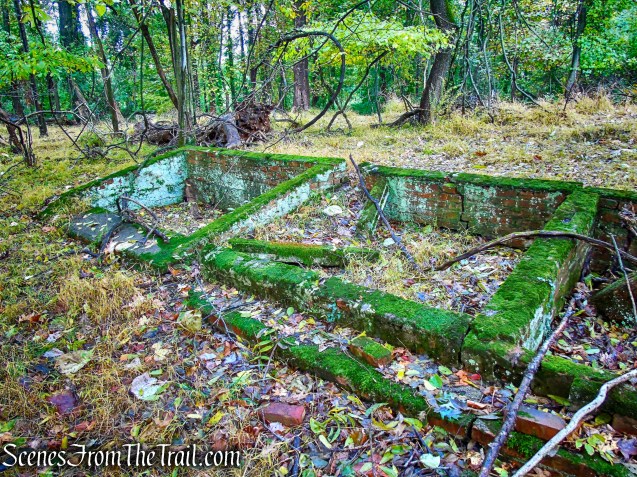
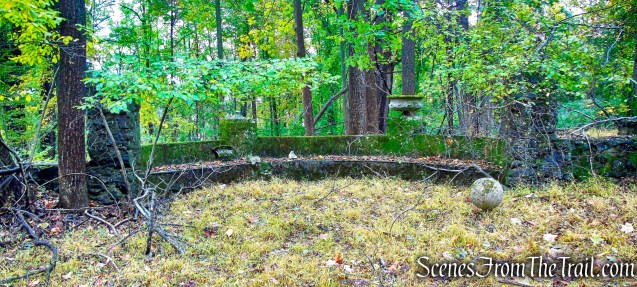
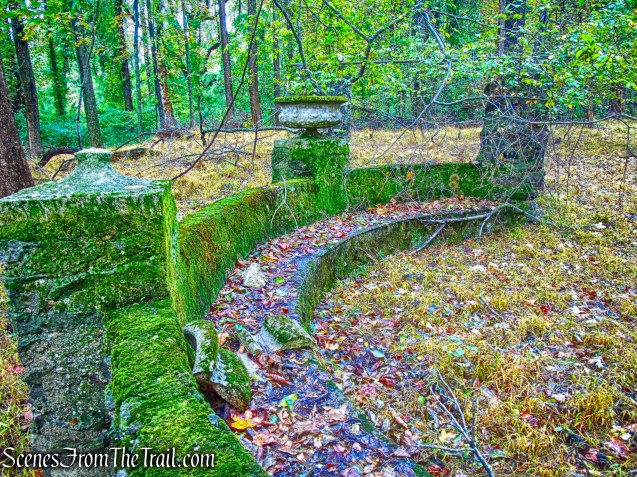
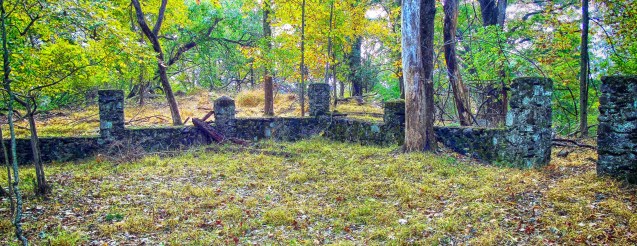
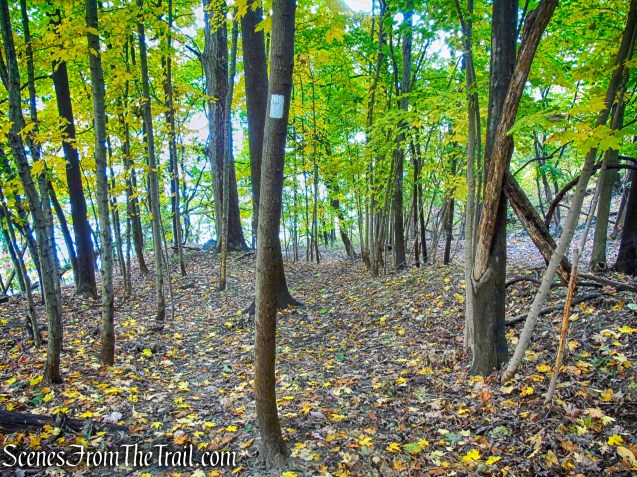
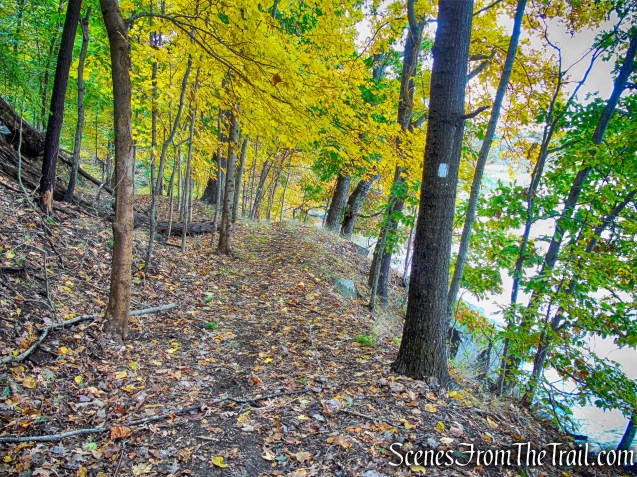
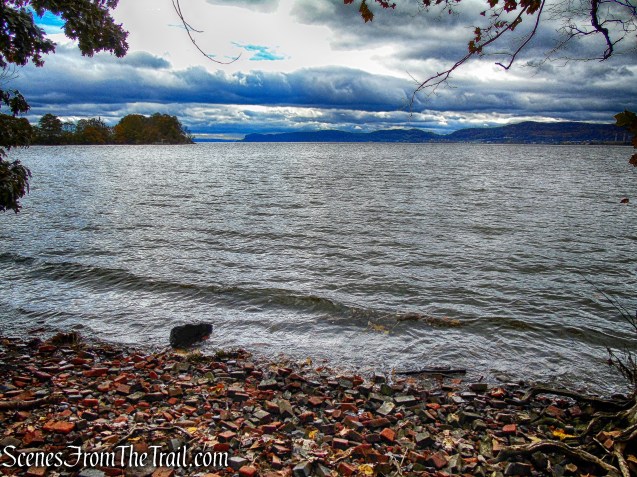
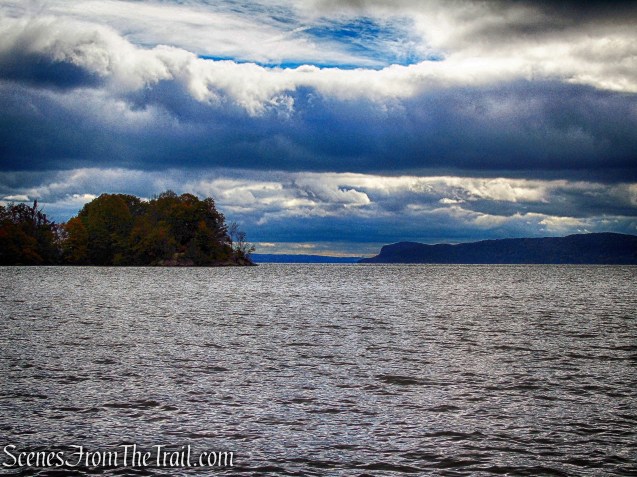
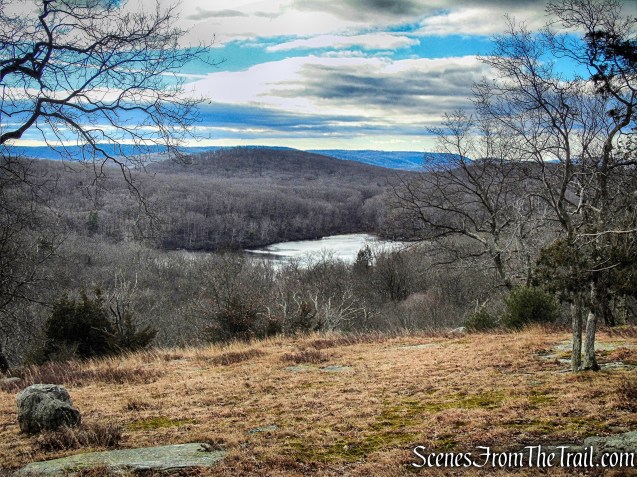
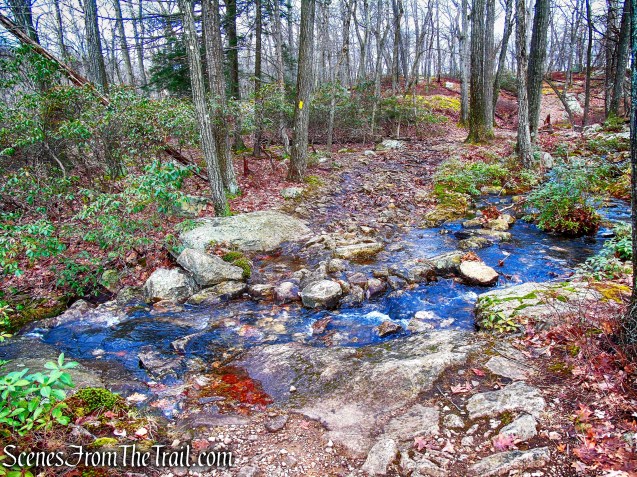
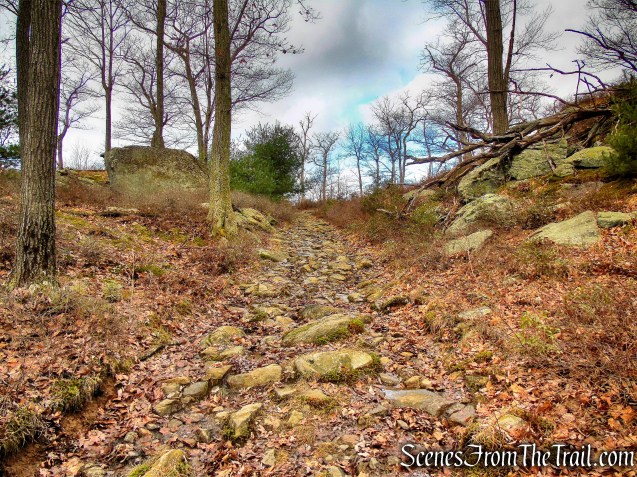
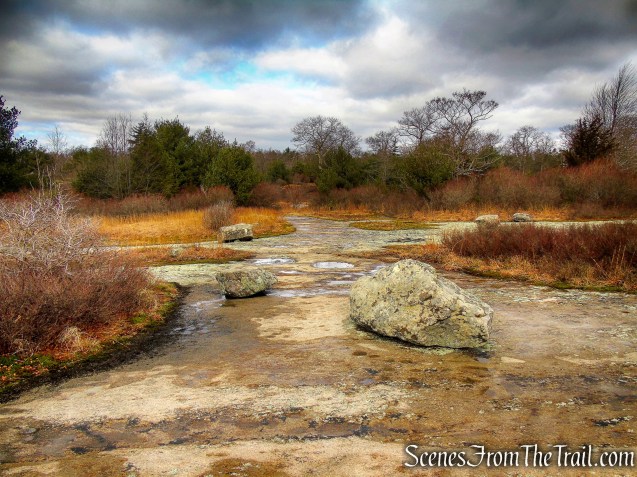
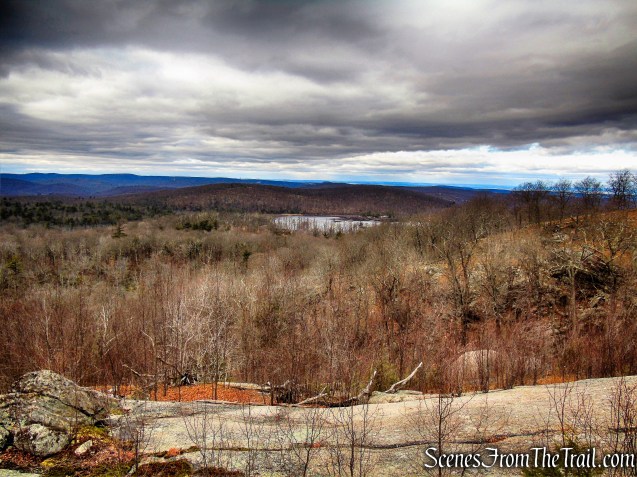
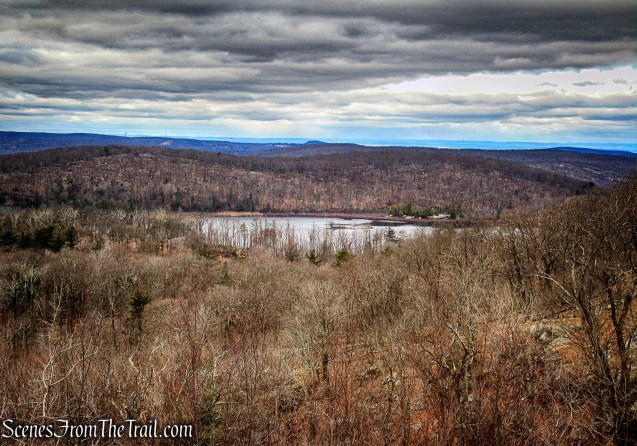
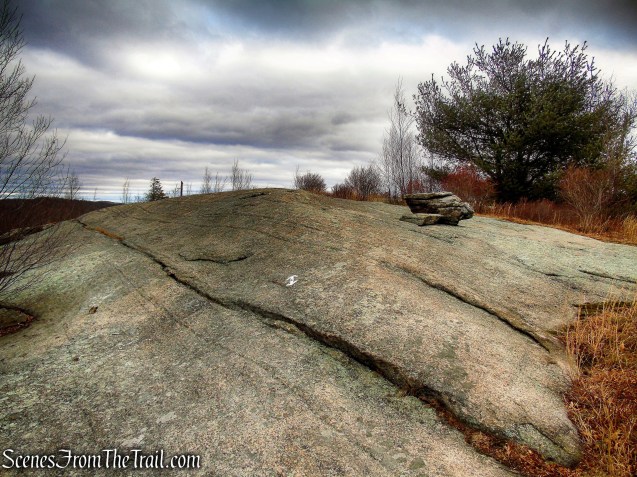
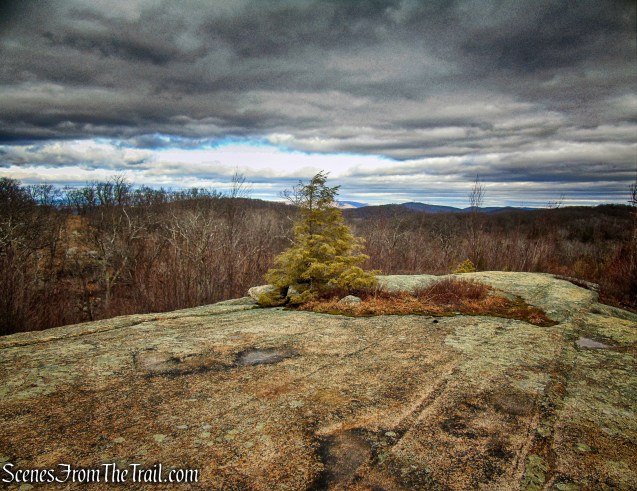
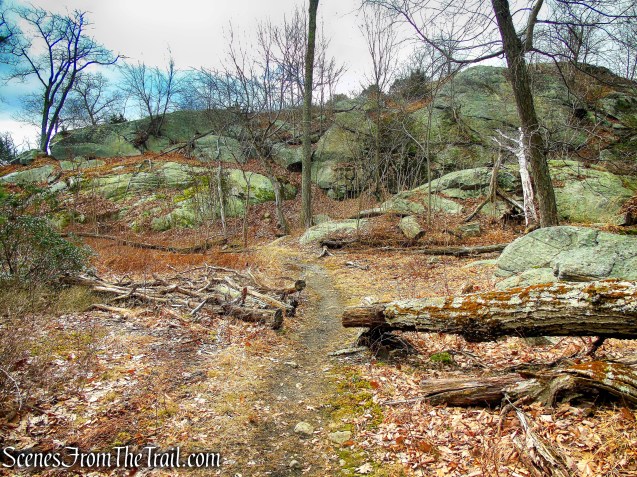
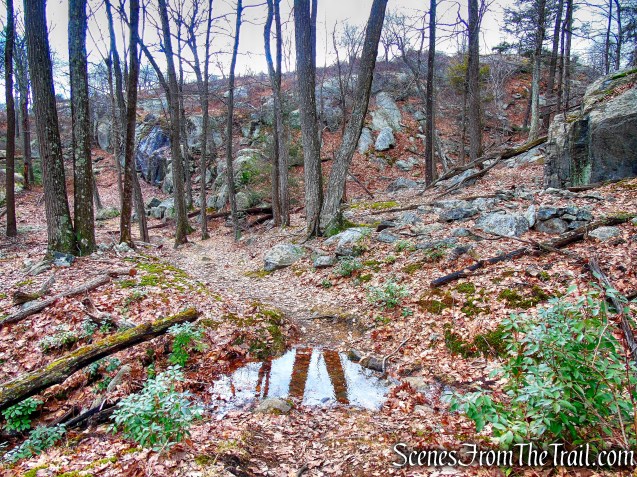
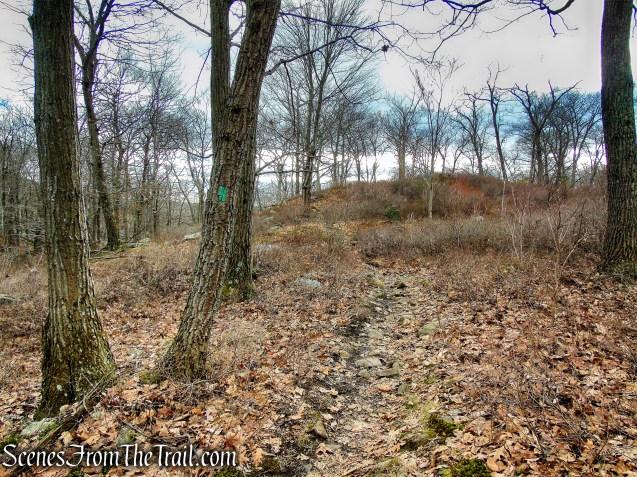
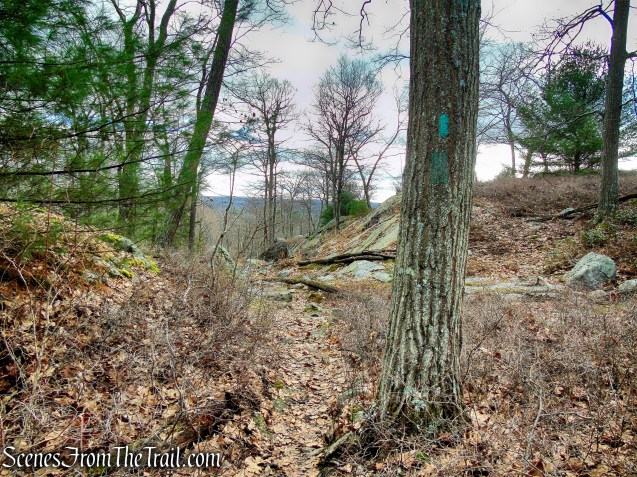
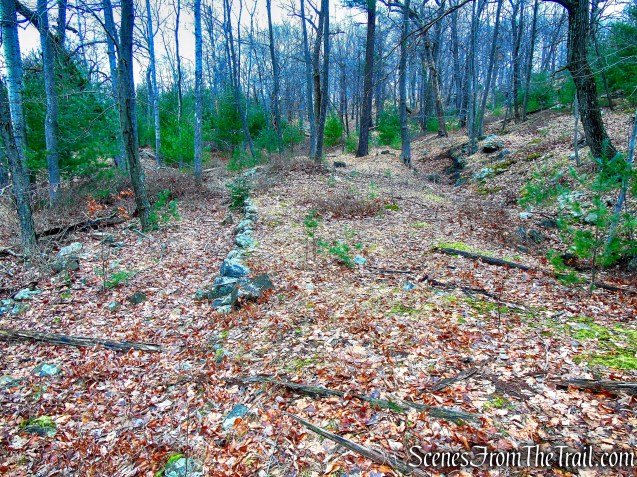
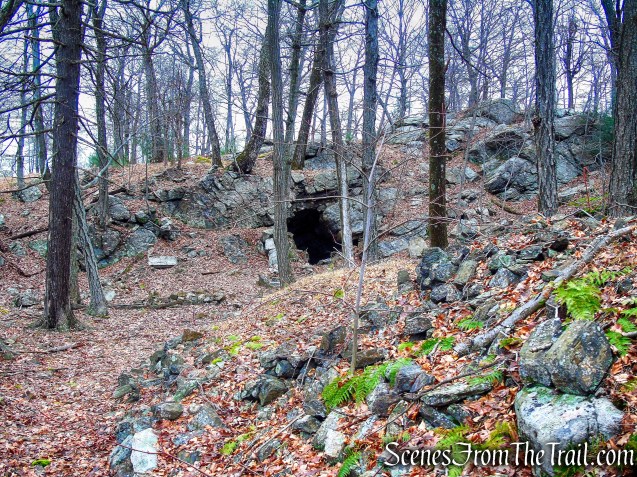
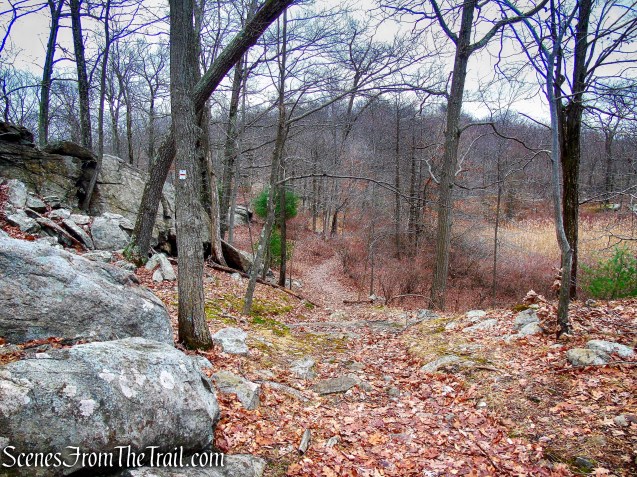
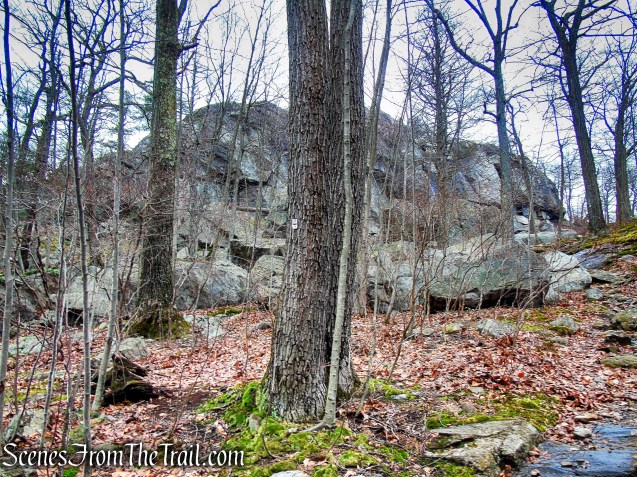
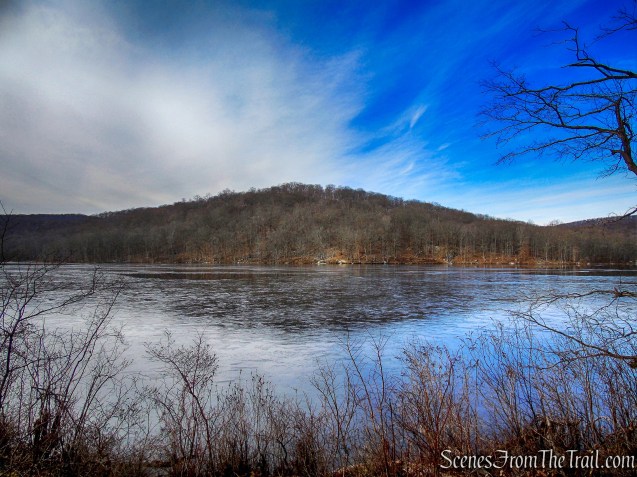
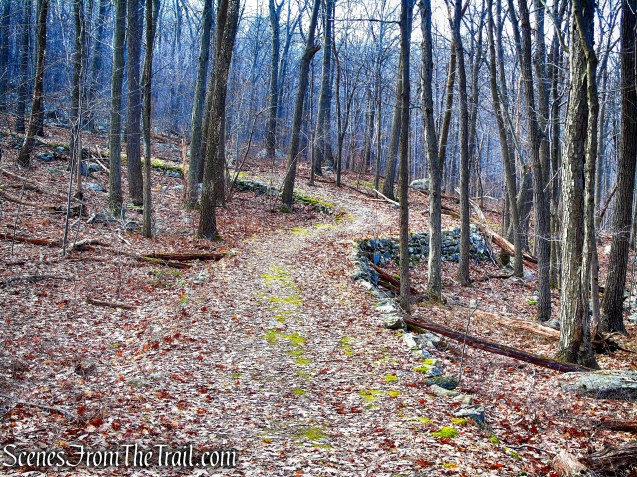
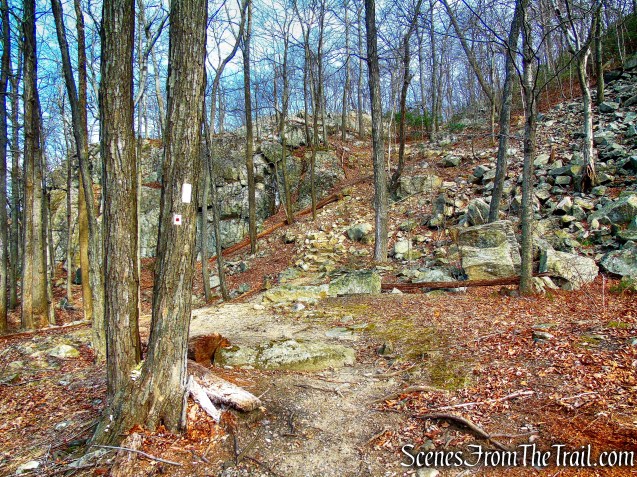
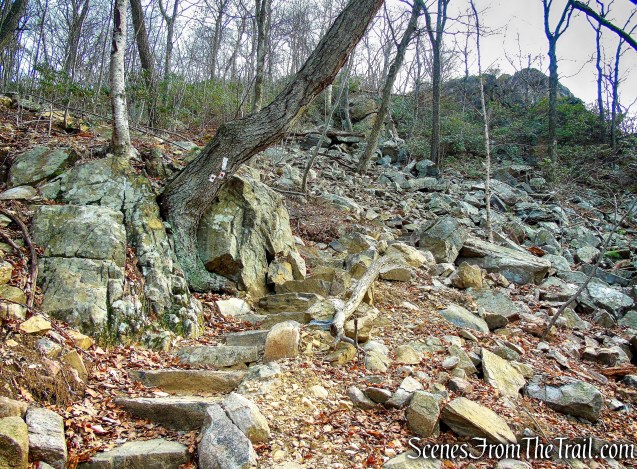
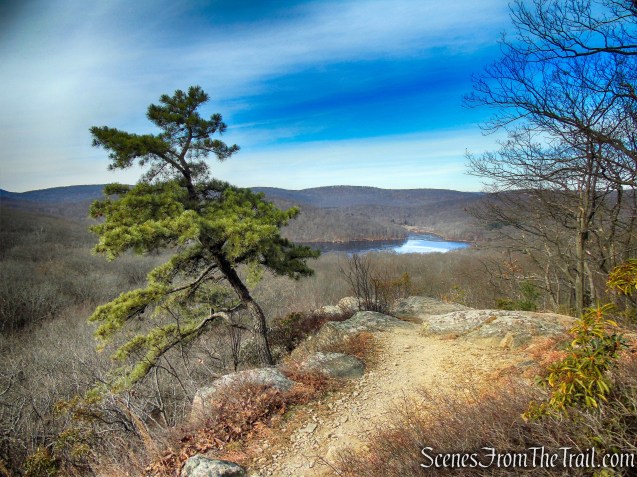
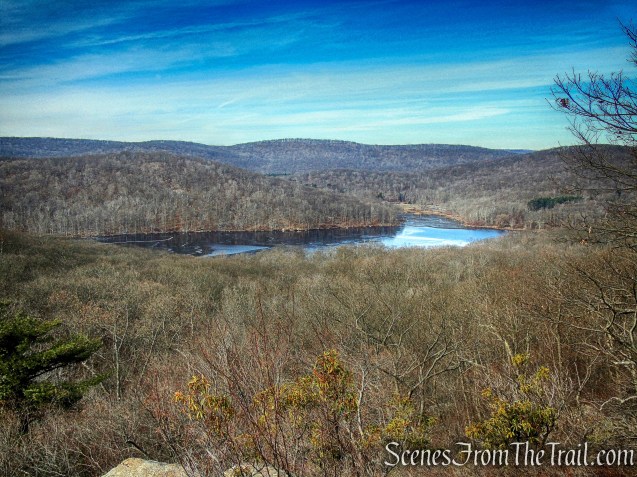
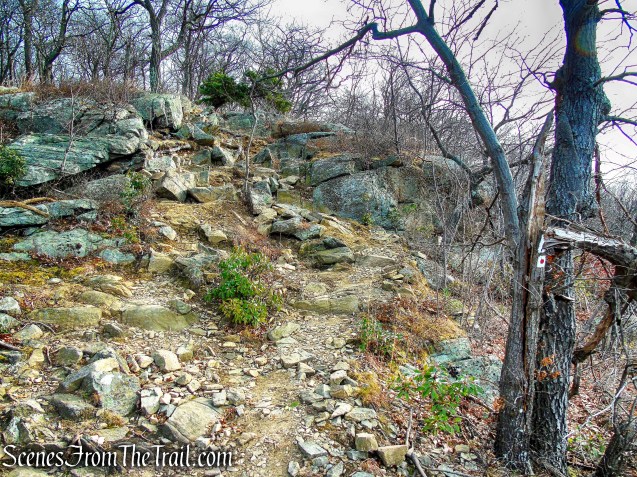
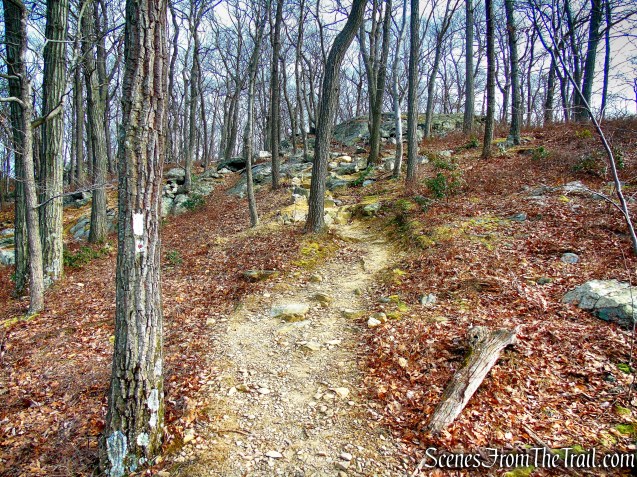
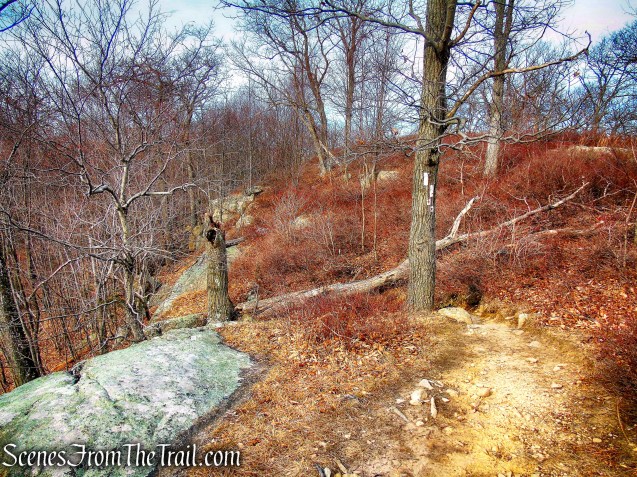
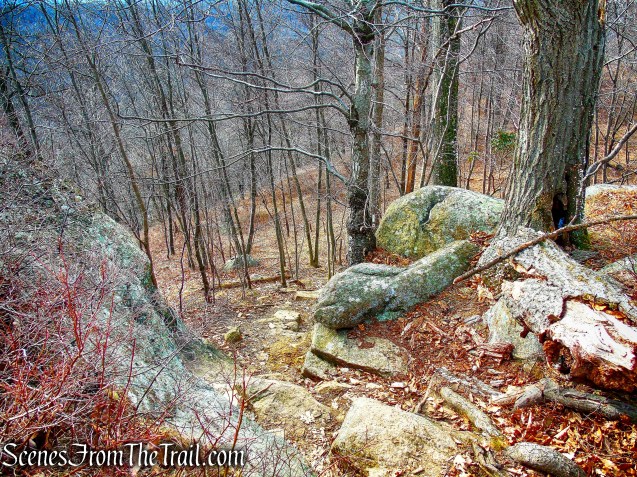
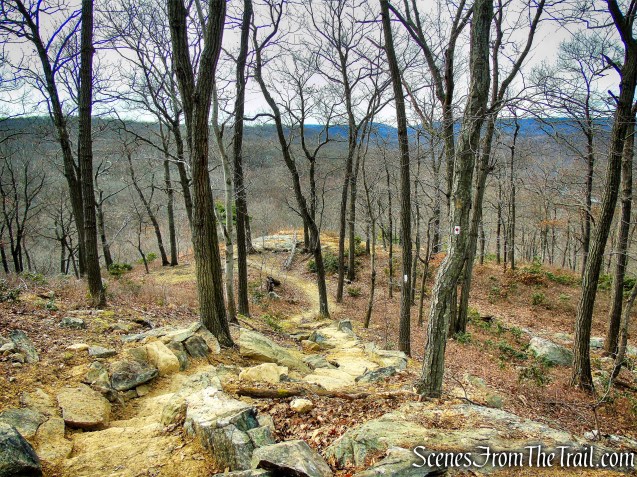
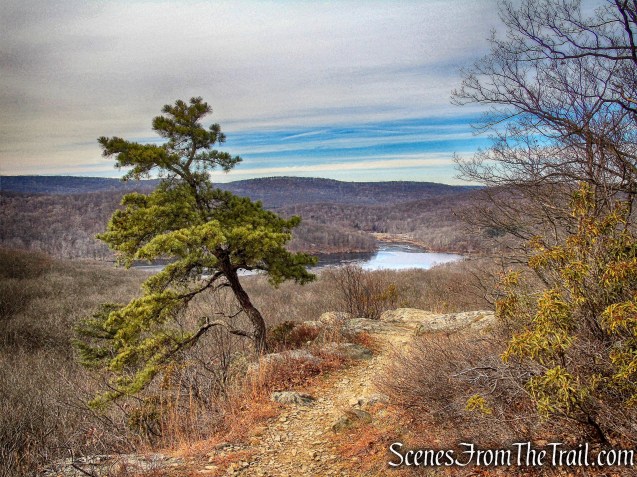
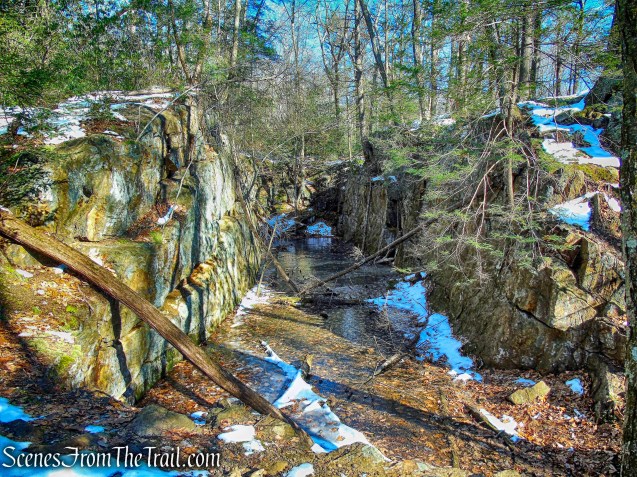
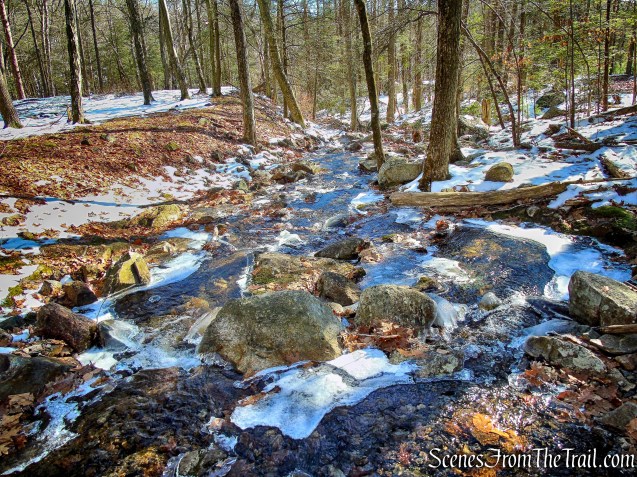
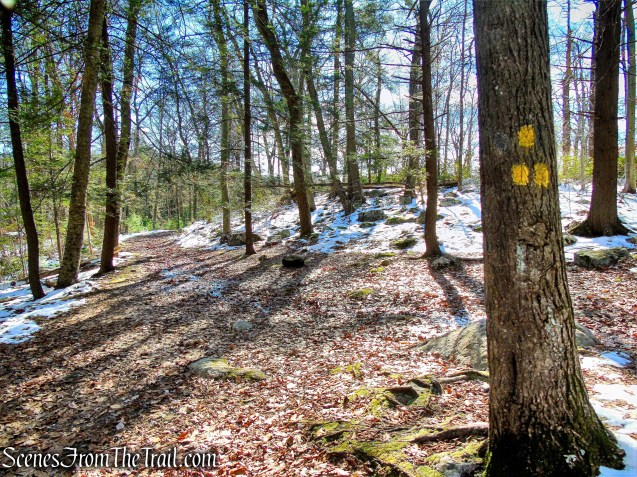
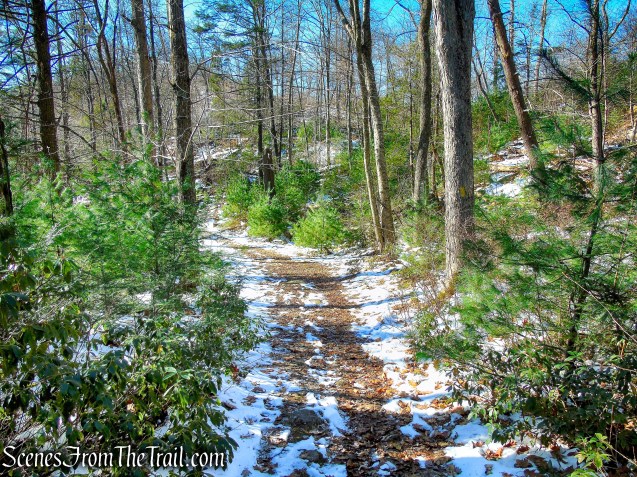
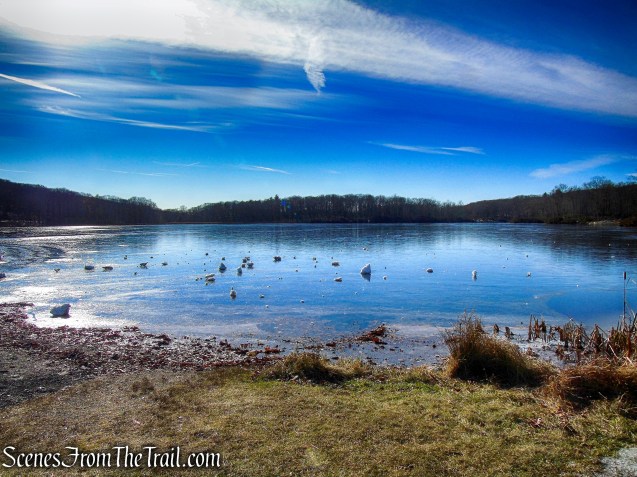
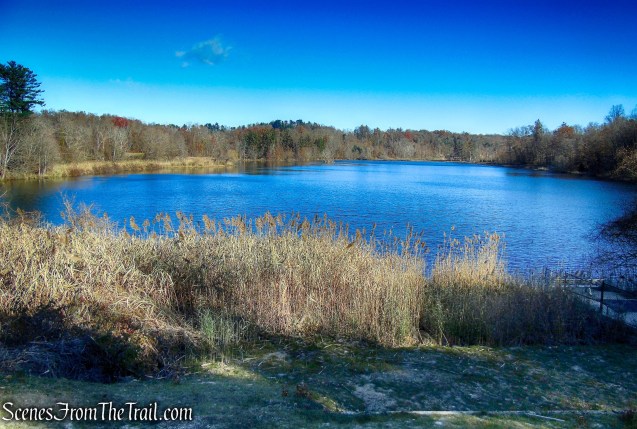
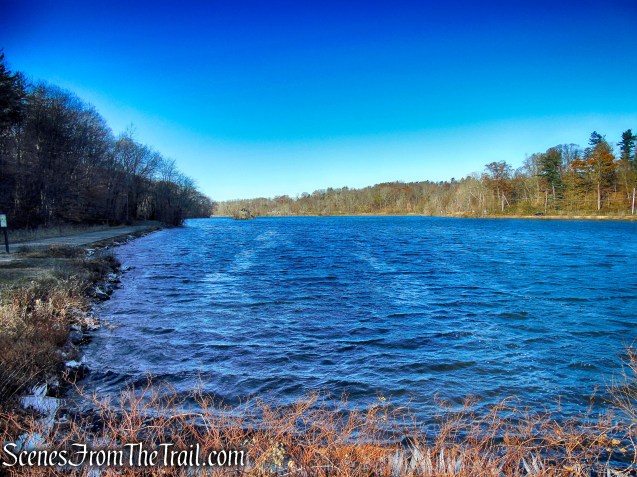
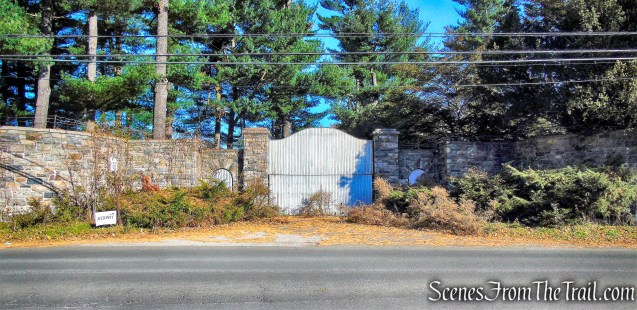
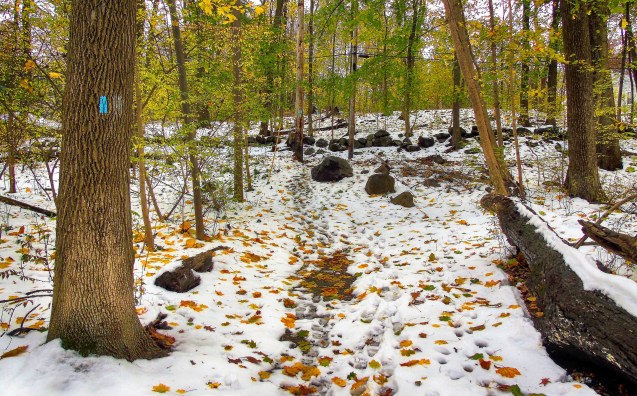
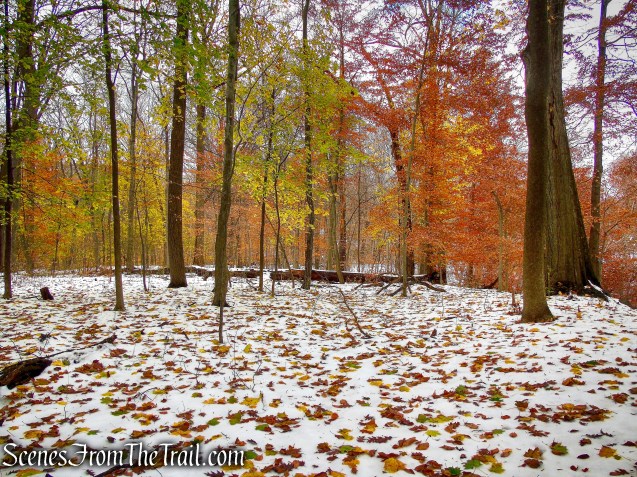
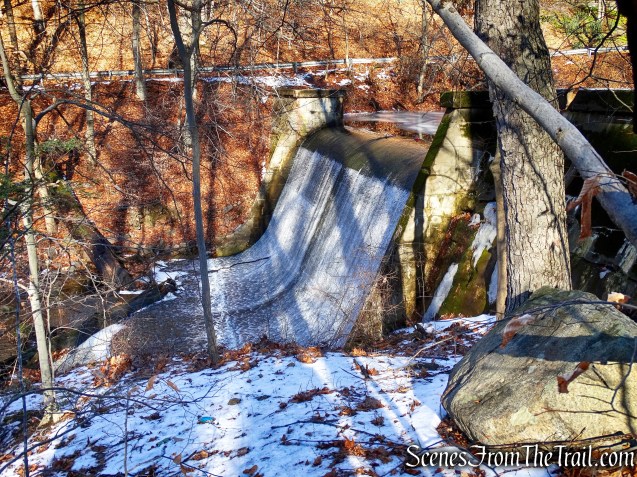
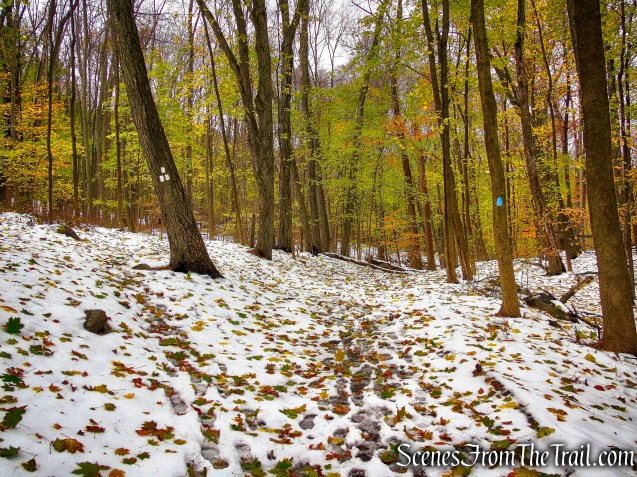
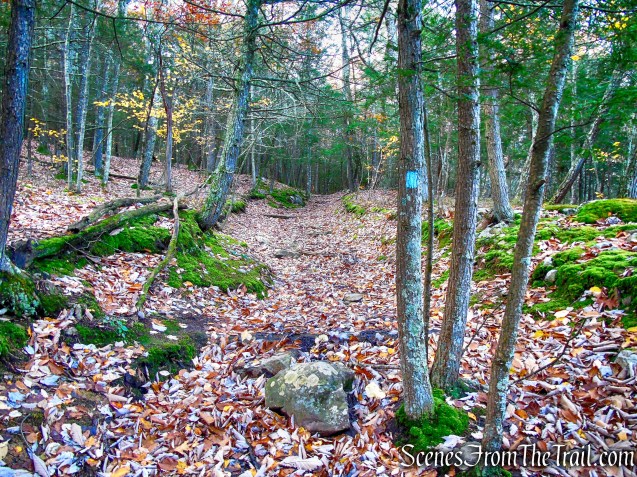
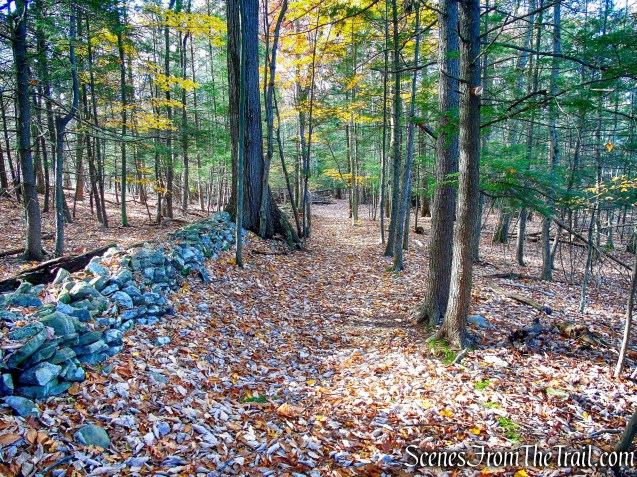
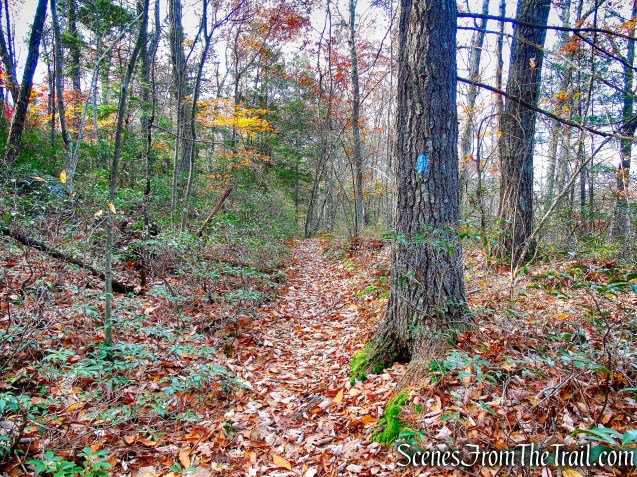
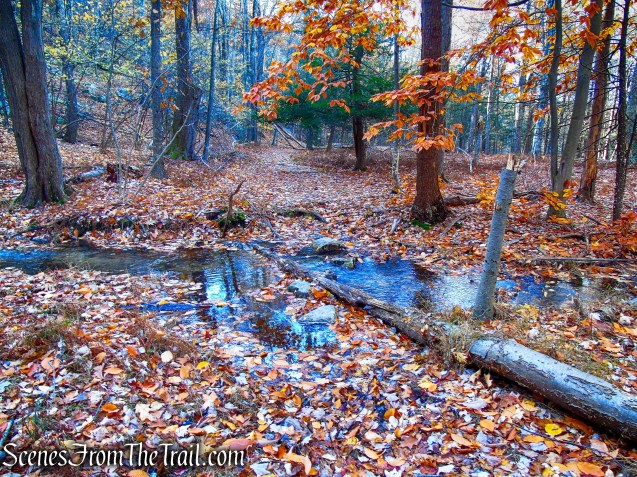
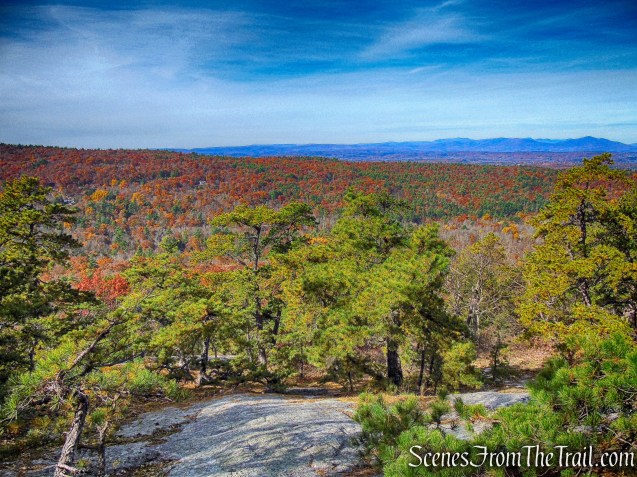
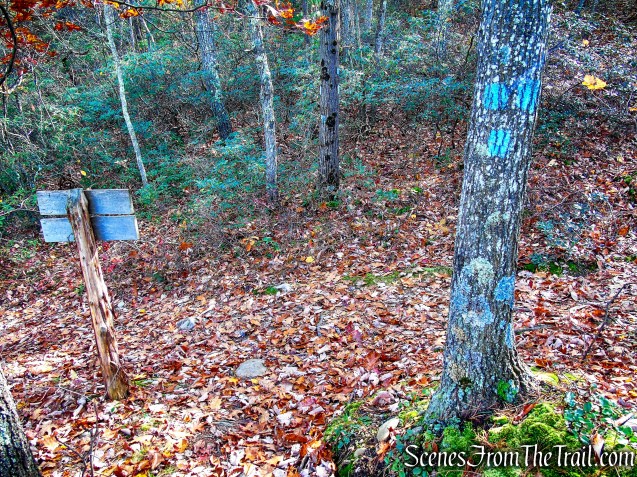
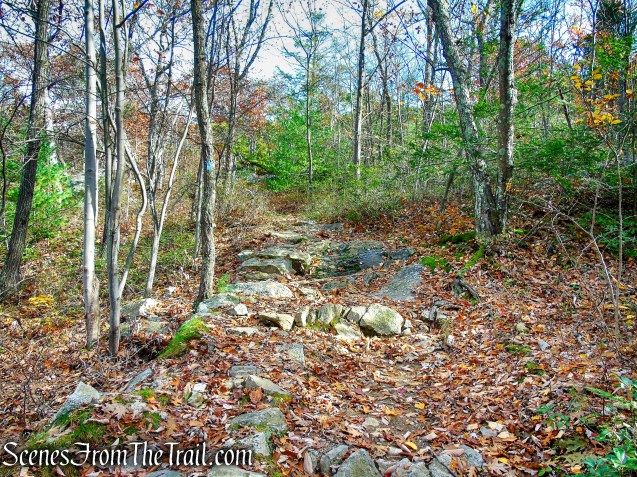
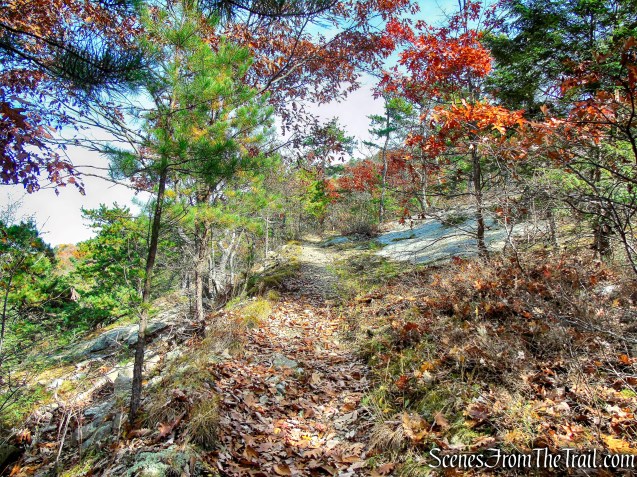
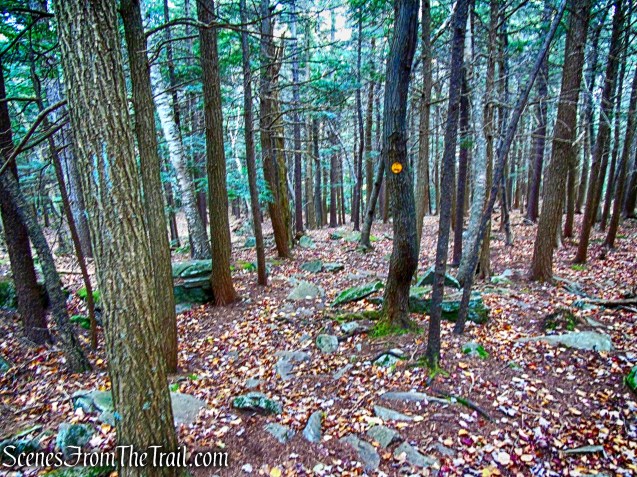
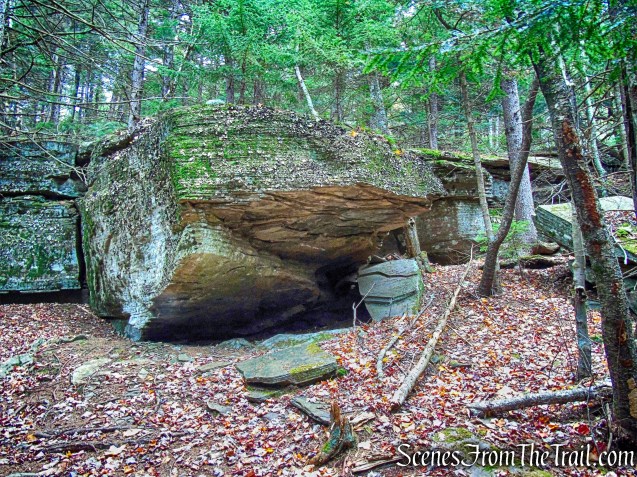
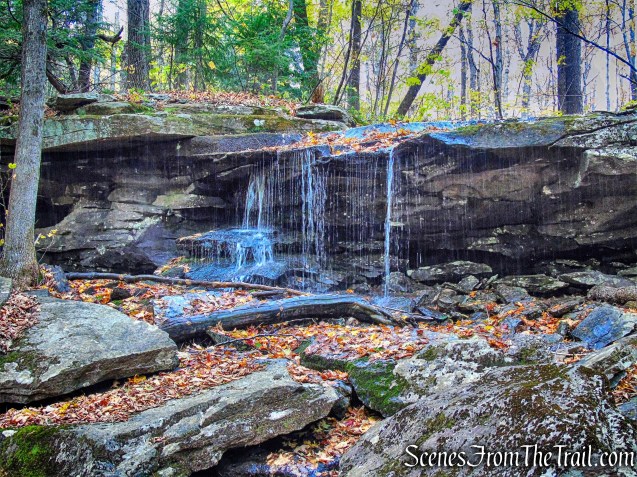
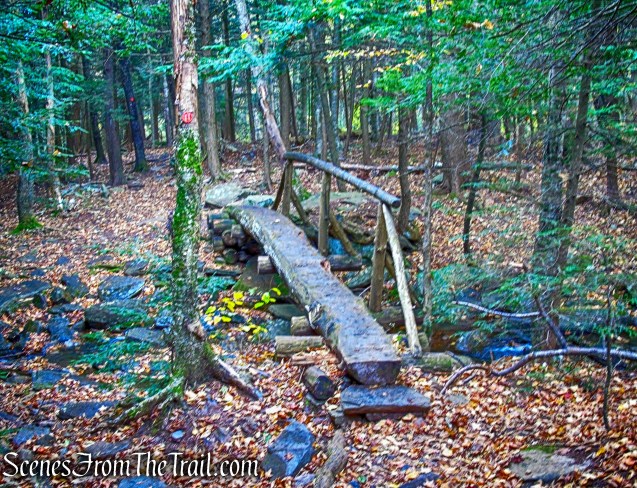
Hart’s Brook Park and Preserve

‎January‎ ‎19‎, ‎2019 – Hartsdale, NY

Difficulty: Easy

Trail Miles: Approximately 3.2 miles

Map: Hart’s Brook Park and Preserve Trail MapBrochure

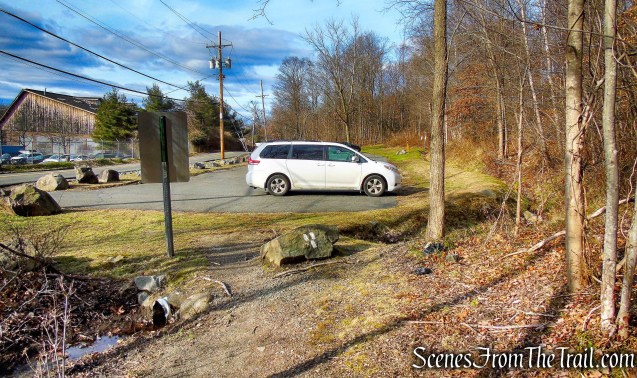
Trailhead parking: 156 Ridge Road, Hartsdale, NY 10530


Overview:

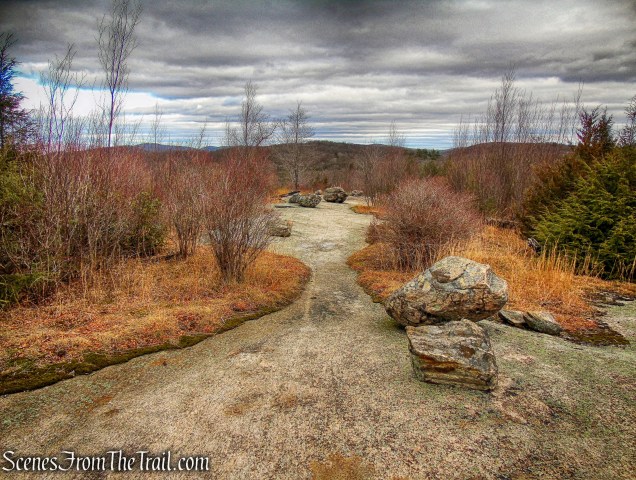
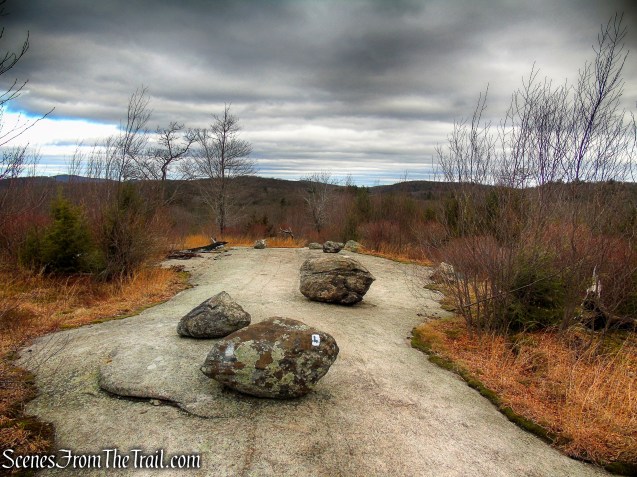
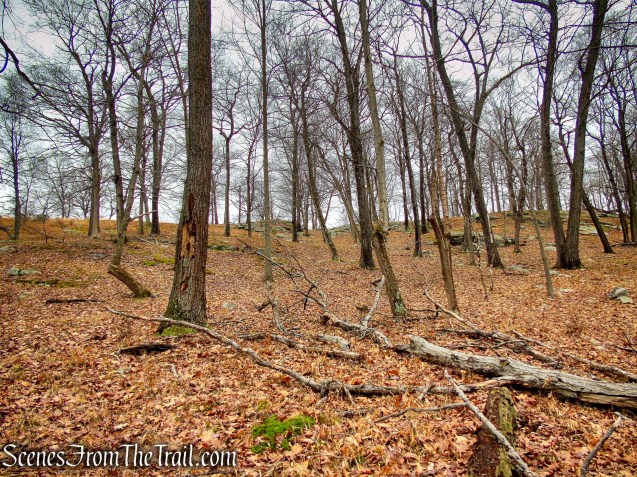
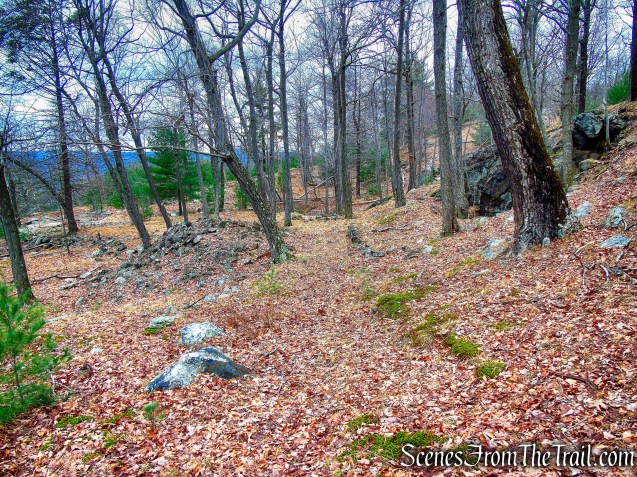
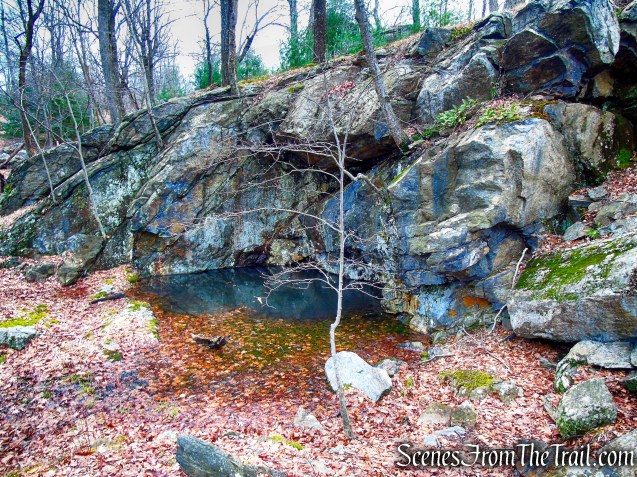
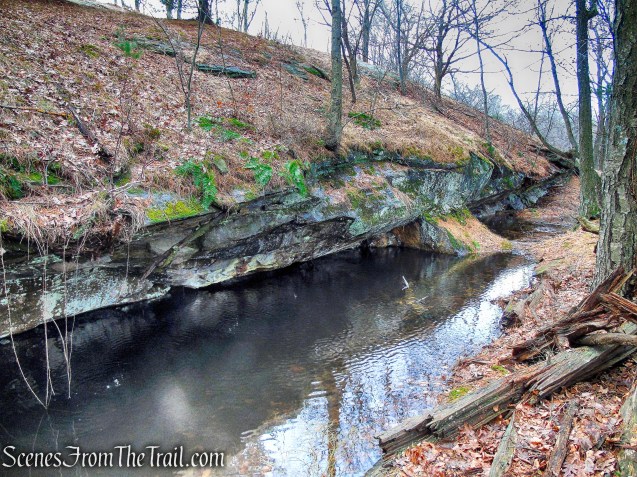
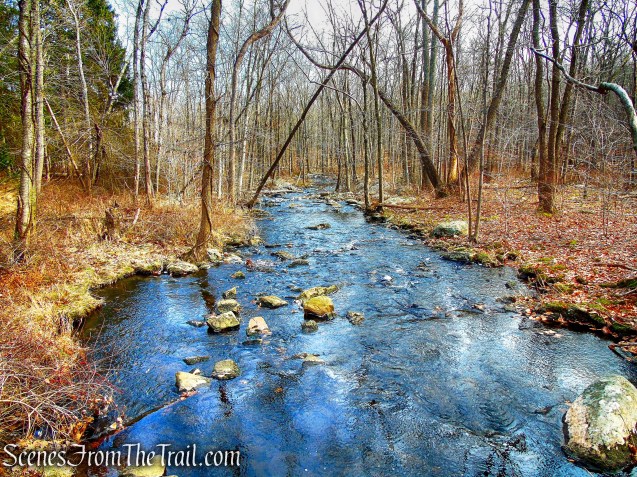
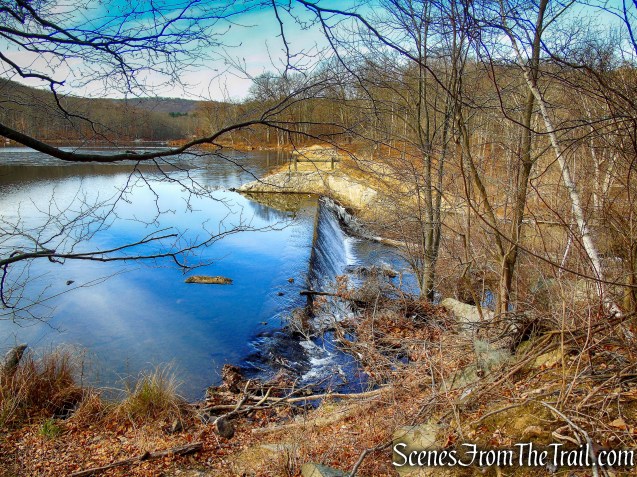
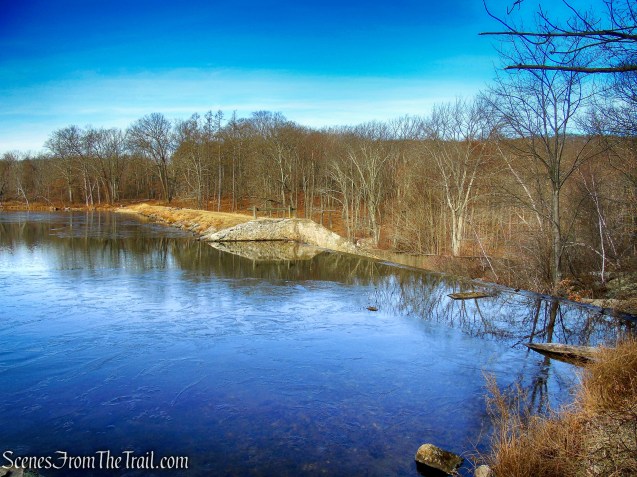
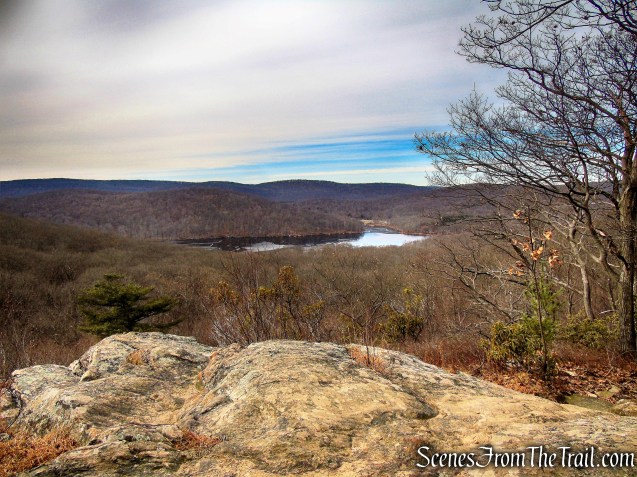
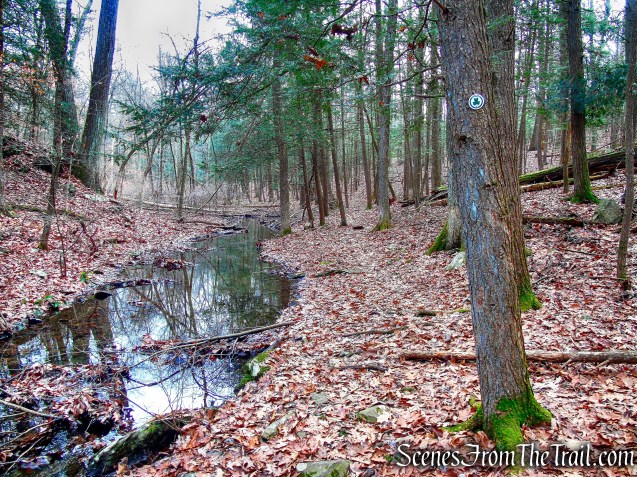
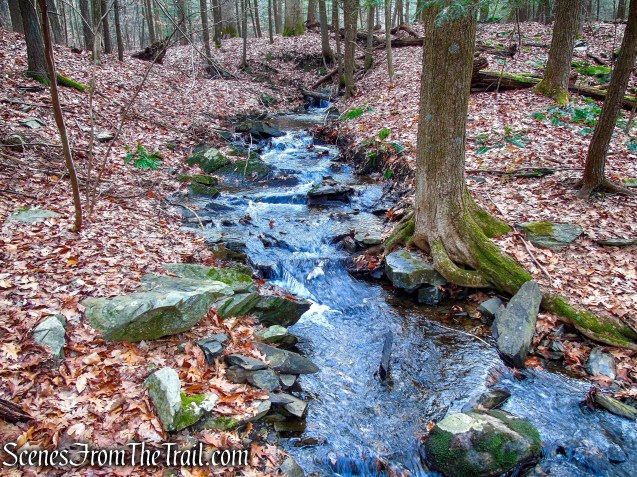
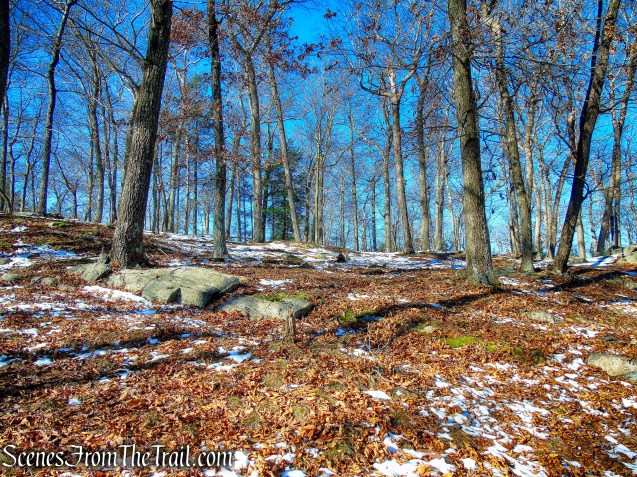
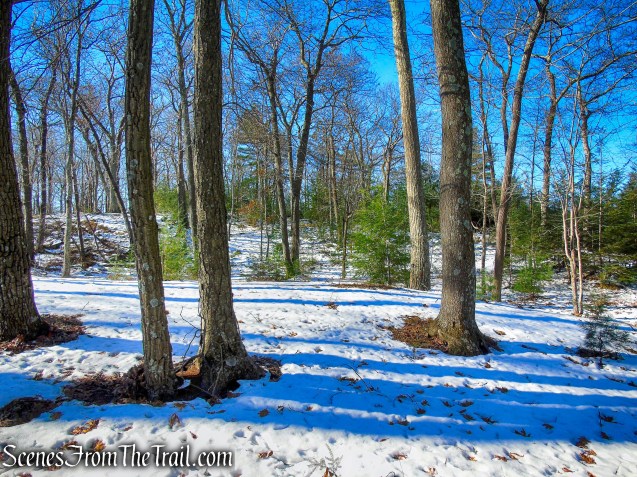
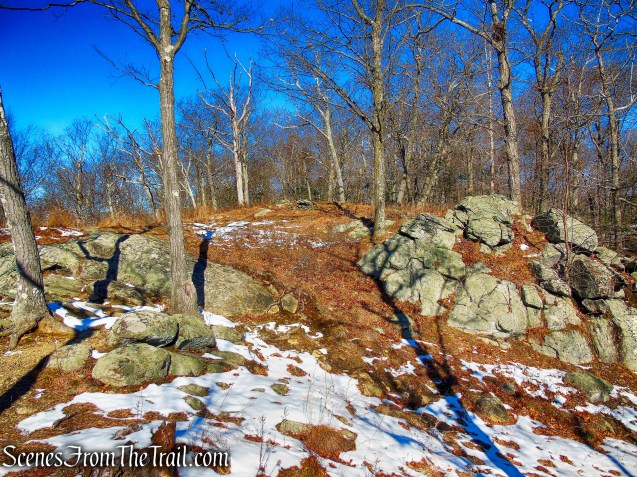
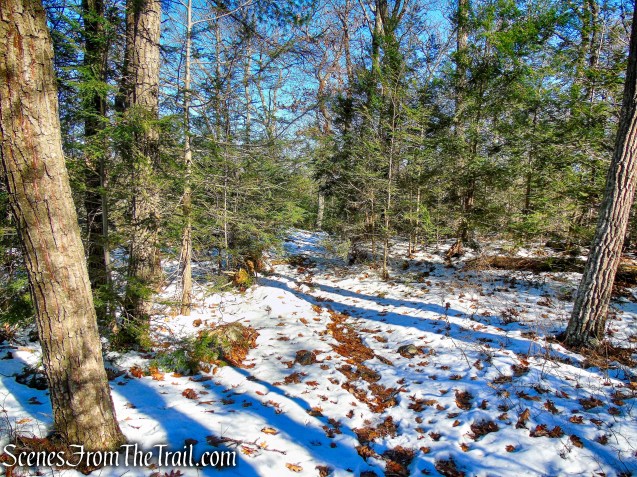
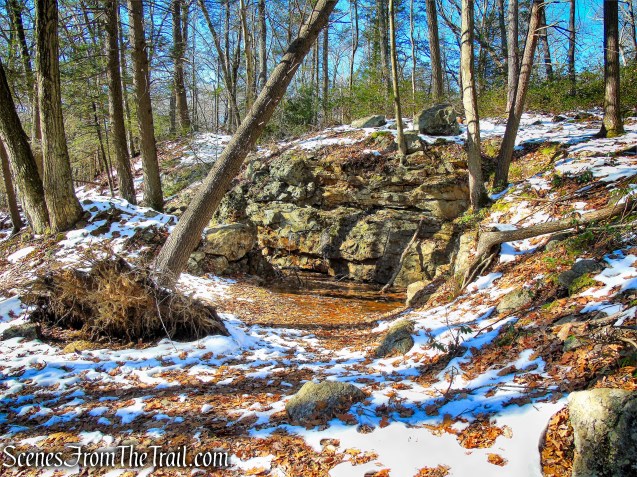
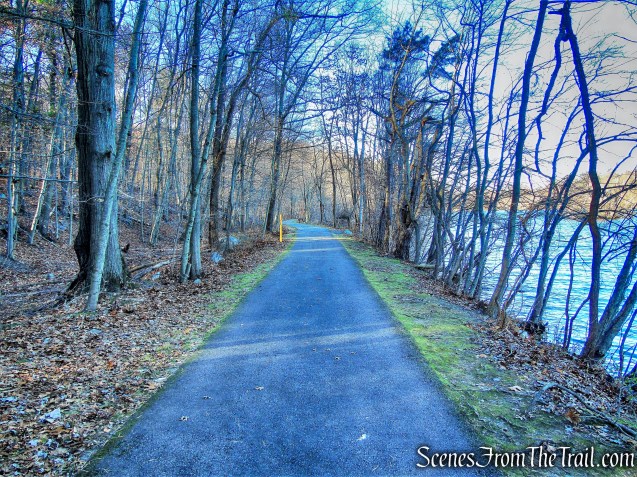
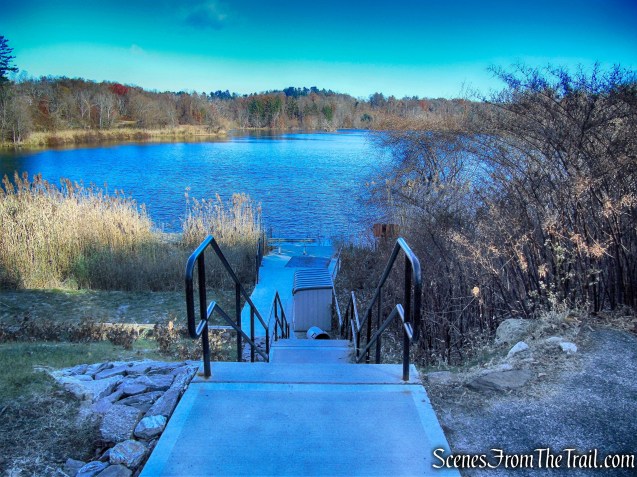
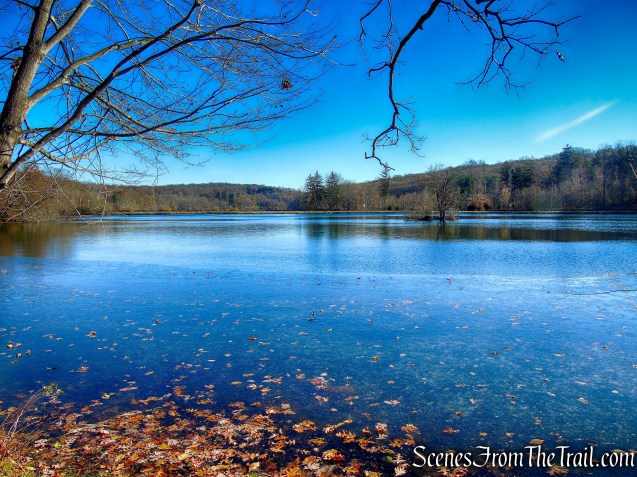
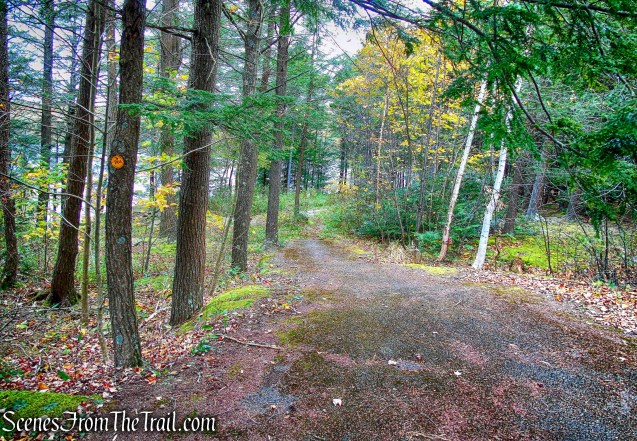
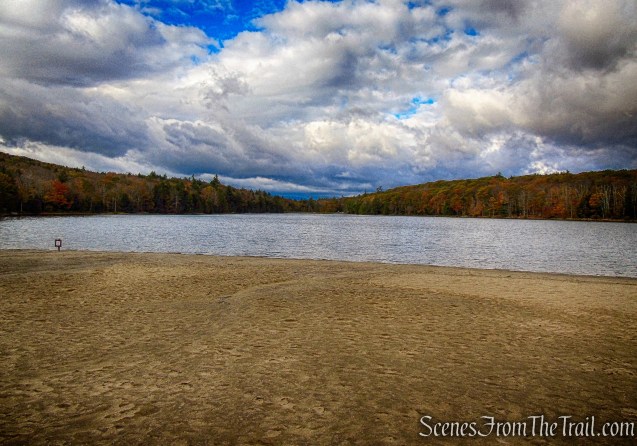
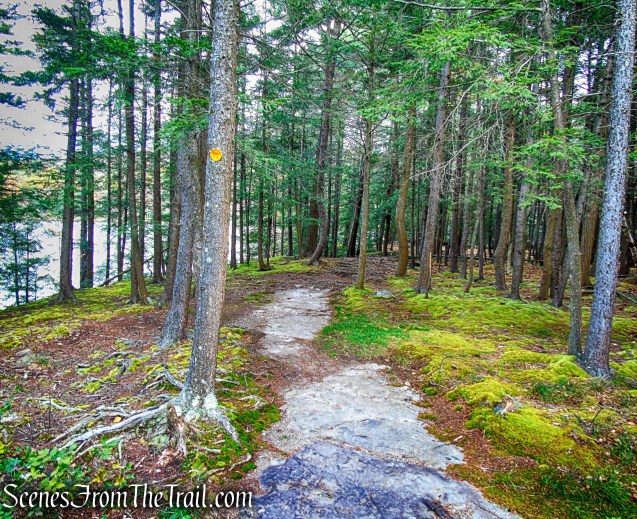
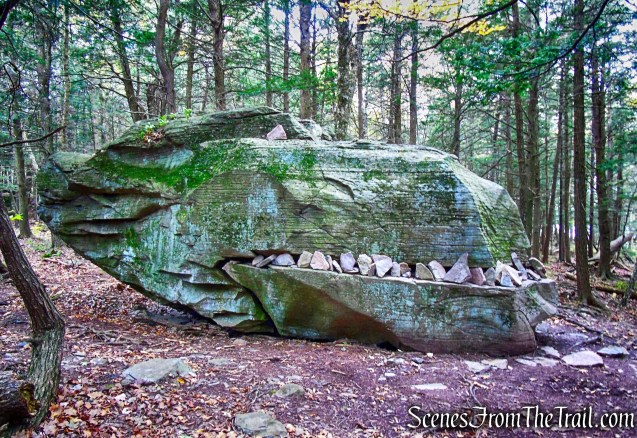
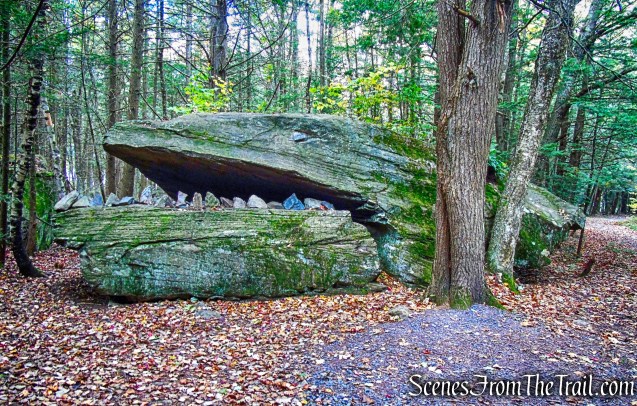
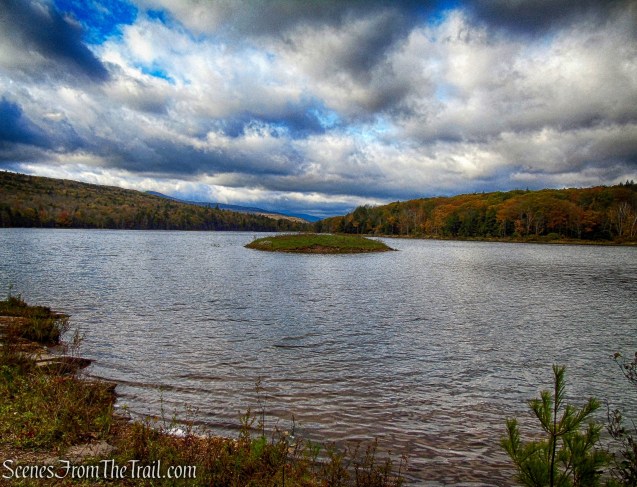
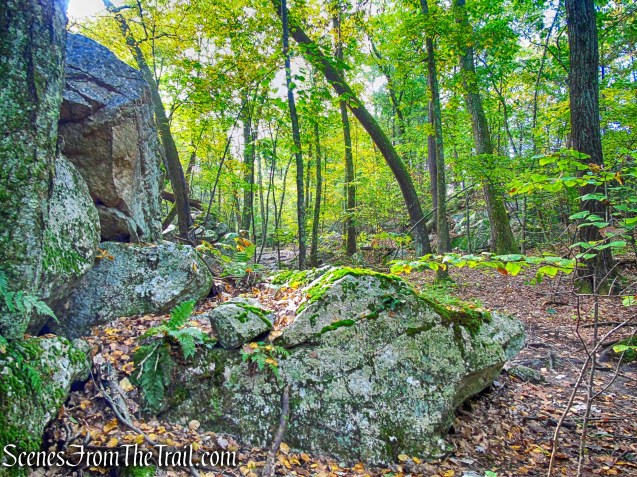
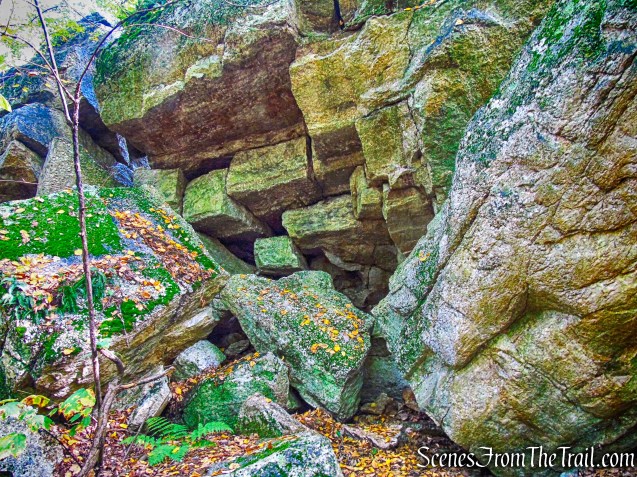
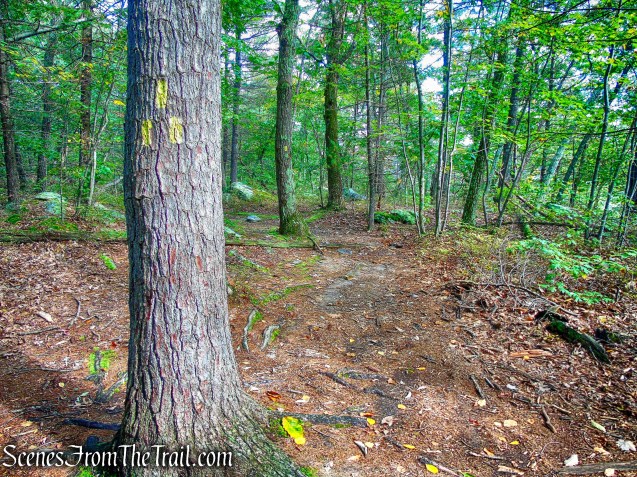
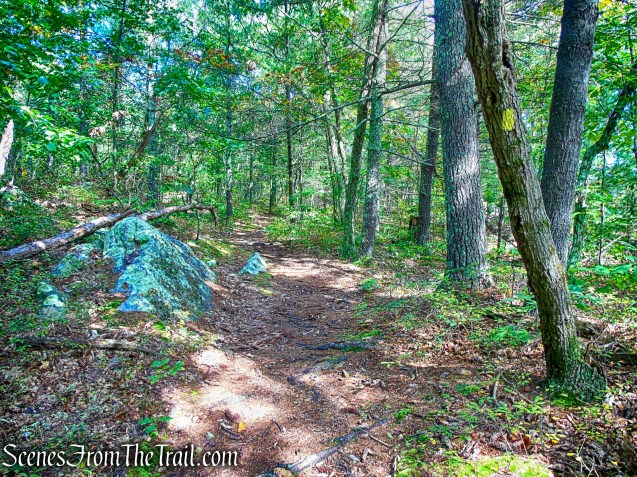
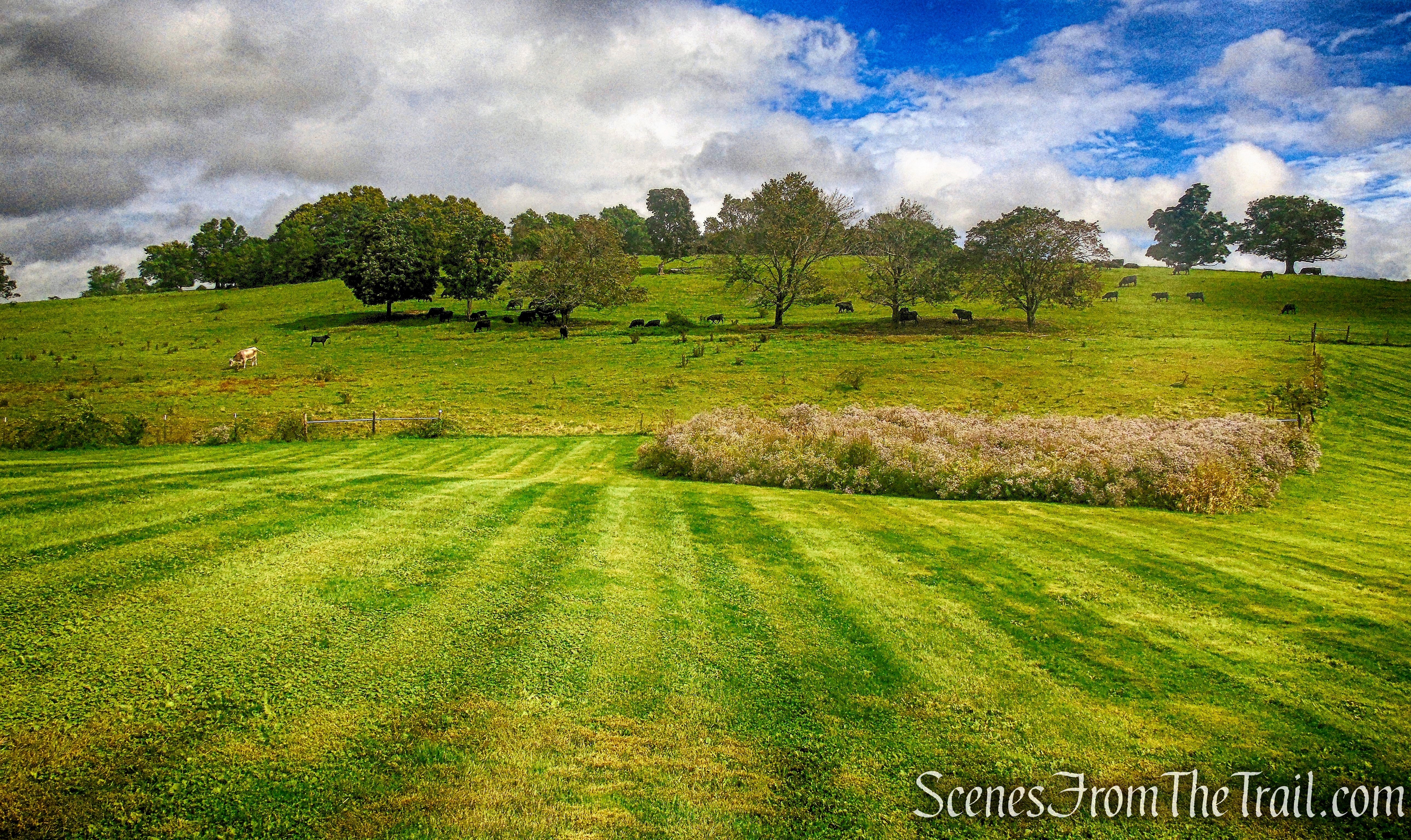
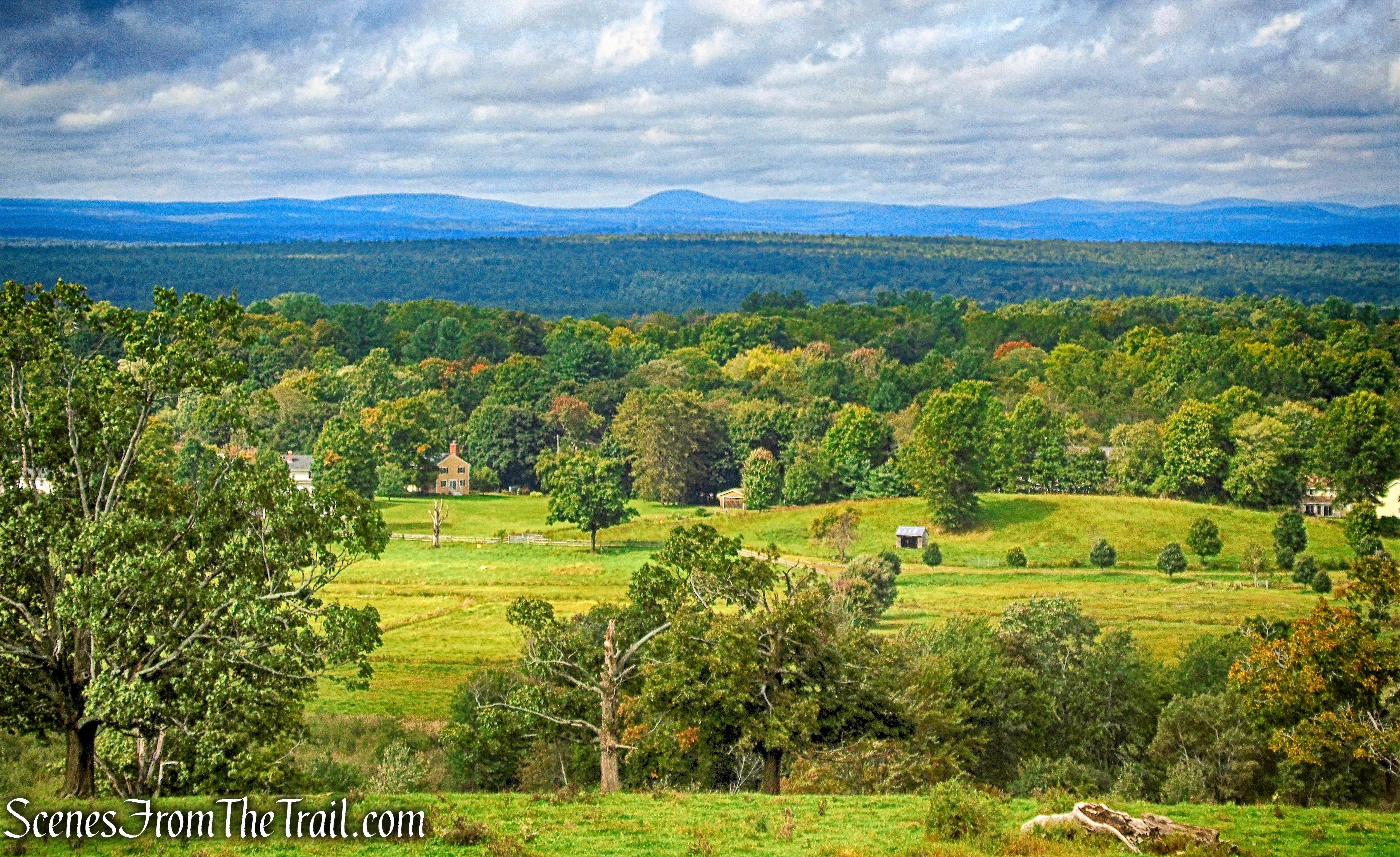
The woodlands that cover most of the tract of Hart’s Brook Park & Preserve contain an abundant variety of native flora and fauna, with streams, ponds, meadows and geologic features of interest. A smaller section of the property was developed as a more formal horticultural environment that includes specimen trees, bushes and rolling lawns.

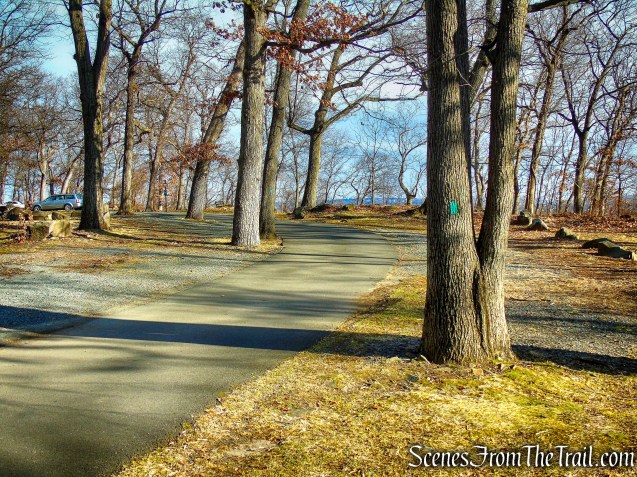
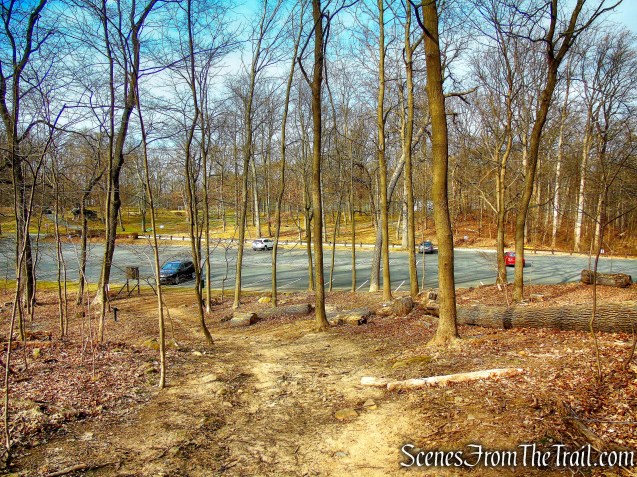
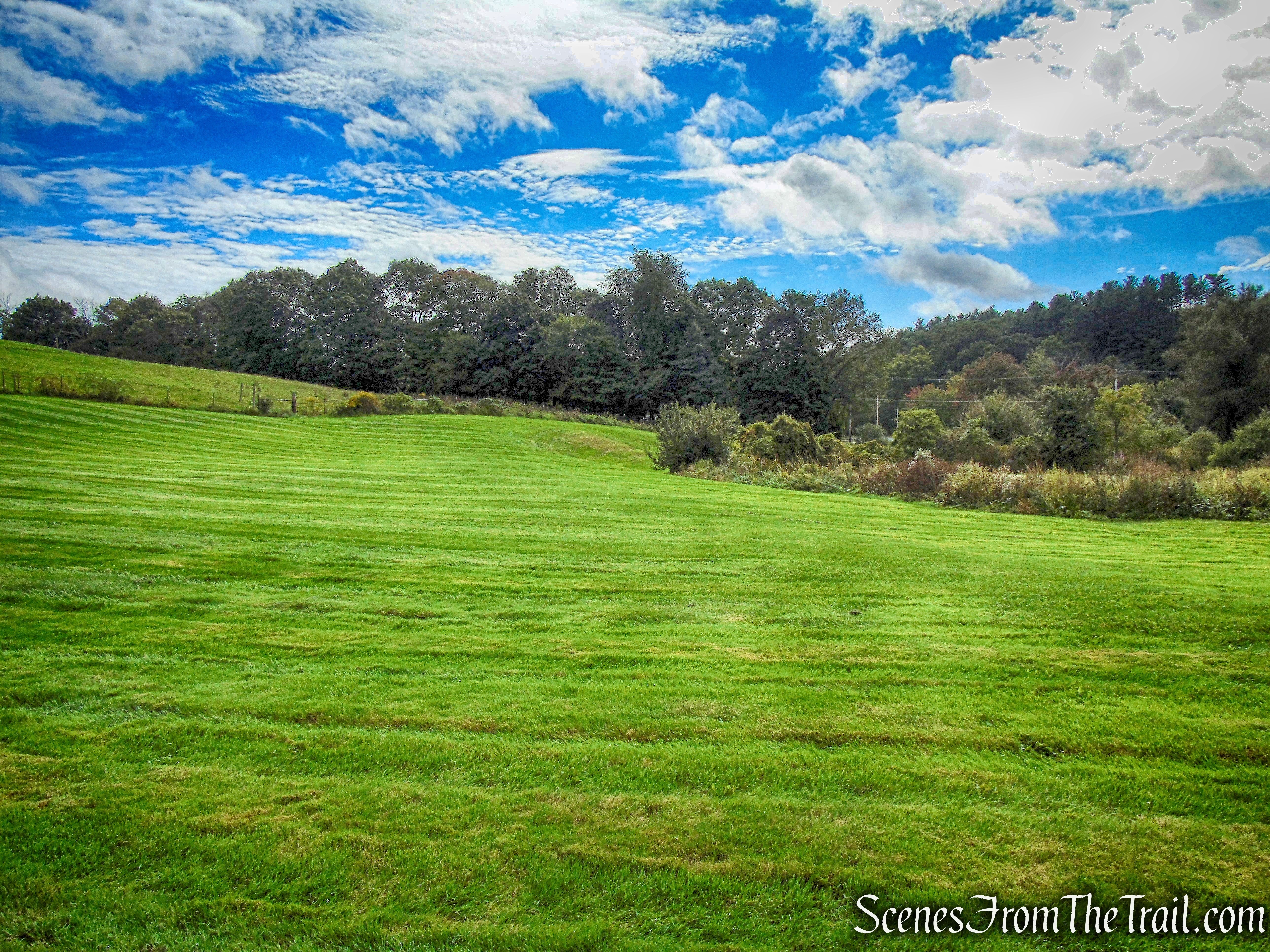
In front of the parking lot is a semi open field, numerous nest boxes scatter this area. Keep an eye out for nesting Eastern Bluebirds. The preserve has its own pair of Great Horned Owls and Screech Owls are present as well.

The 3.2 miles of trails are open to the public and the preserve is open dawn to dusk.
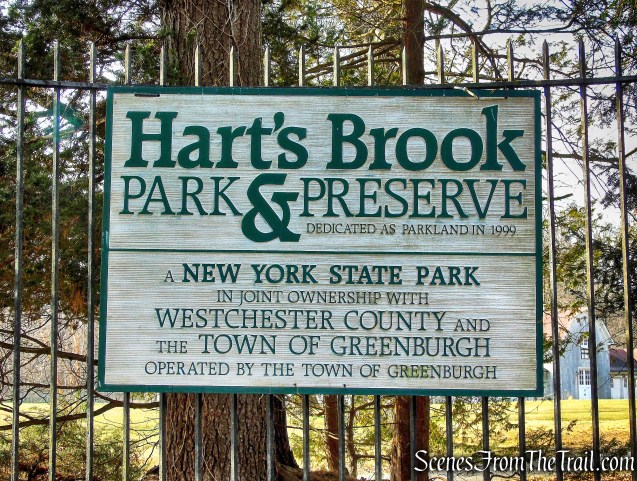
Hart’s Brook Park & Preserve

Hart’s Brook Park & Preserve

History:

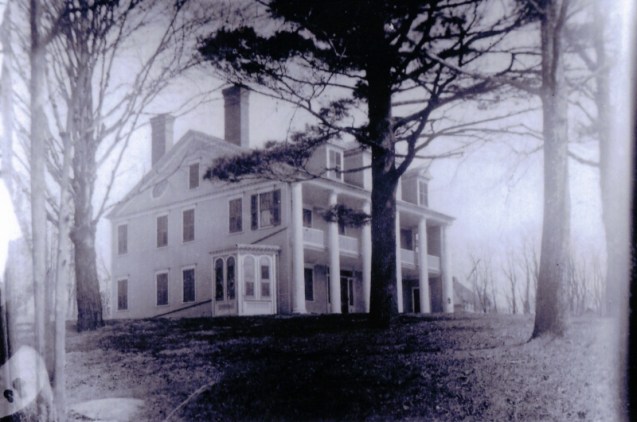
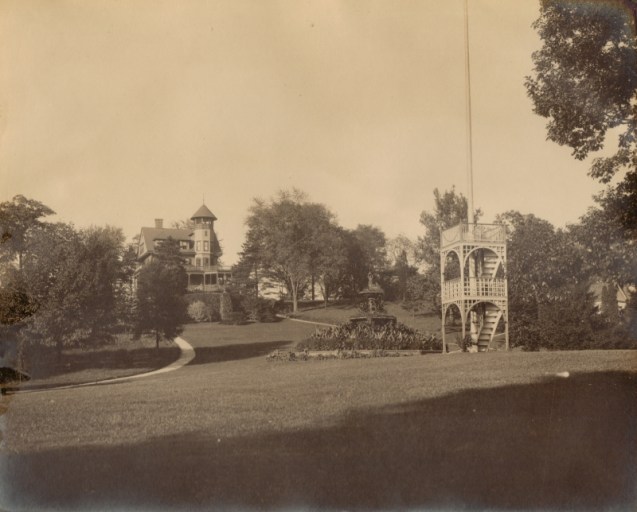
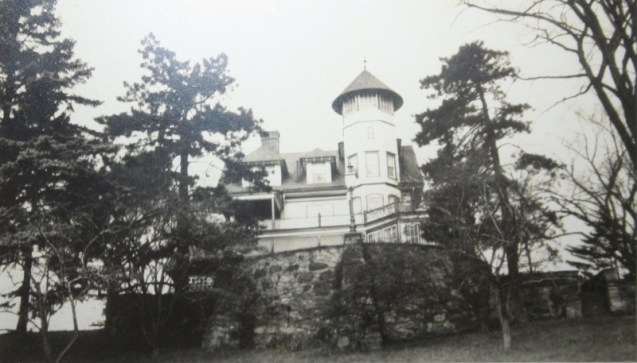
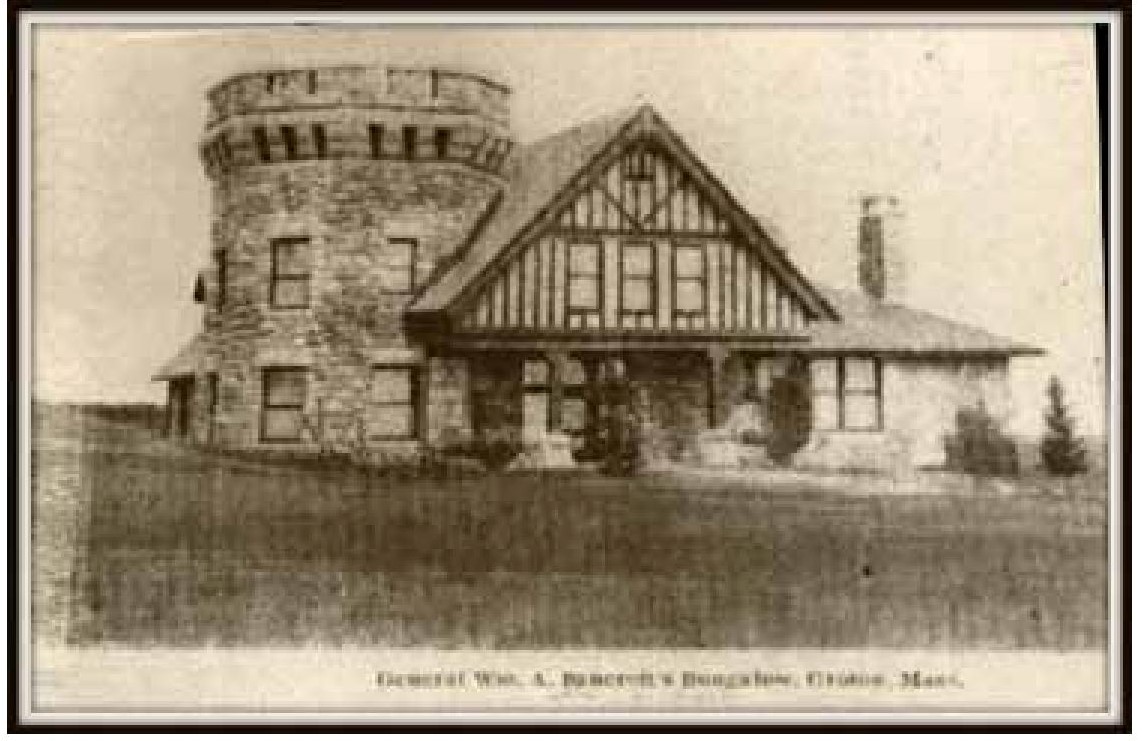
In 1932 Henry Gaisman, who had made his fortune as a founder of Gillette Safety Razor Company, purchased 135 acres of land from George Christiancy, a former United States minister to Peru. The property ran from the south side of Ridge Road and Hillcrest Avenue to Maple Avenue in Hartsdale. The Gaismans lived on the property for many years and in 1957 Gaisman passed the title to the land to the New York Archdiocese with the understanding that he and his wife Catherine, could live on the property as long as they so desired. Mr Gaisman lived here until 1974 until he died at the age of 104. Catherine continued to live here until 1995. The property was subsequently taken over by the Archdiocese, which leased the land to Marian Woods Convent, as a headquarters and future retirement home for aging nuns.

In 1999, through efforts of the Committee to Save the Gaisman Property, 124 acres were purchased jointly by New York State, Westchester County and the Town of Greenburgh. Eleven acres in the middle of the property were retained by Marian Woods Convent.

The park is administered by the Town of Greenburgh. The Master Gardener Demonstration Garden at Hart’s Brook Park was created in 2000 and has continued to grow every year.
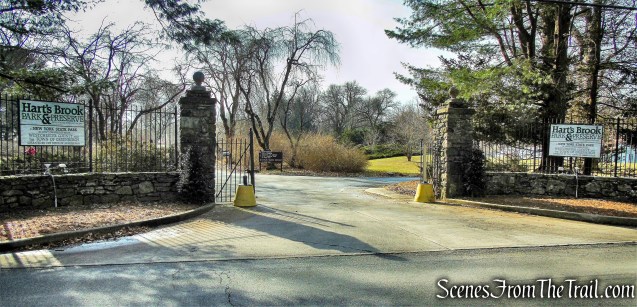
Hart’s Brook Park & Preserve

Hart’s Brook Park & Preserve

Trails Overview:

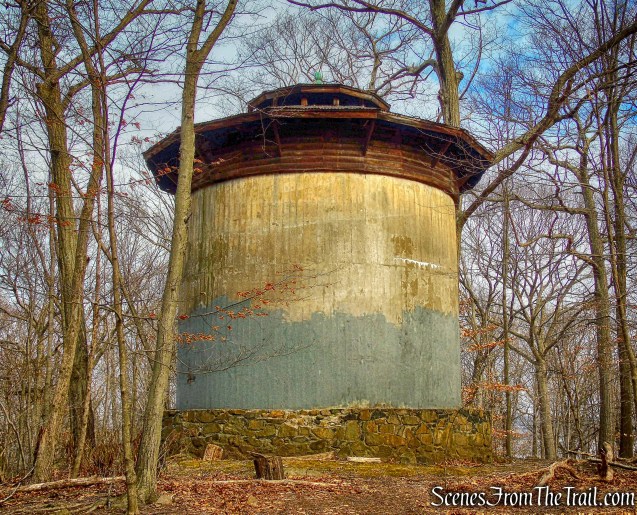
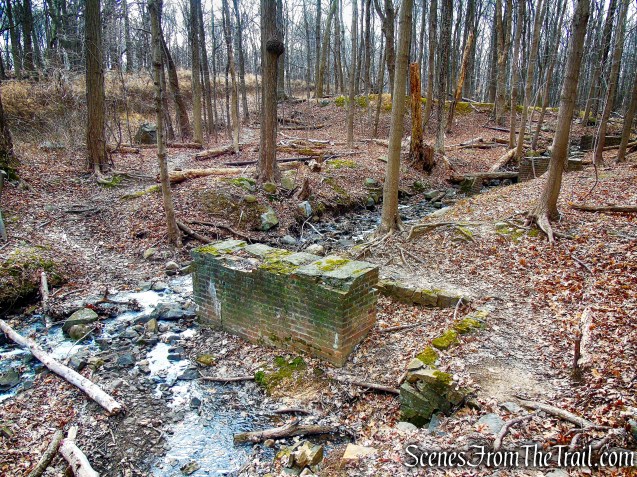
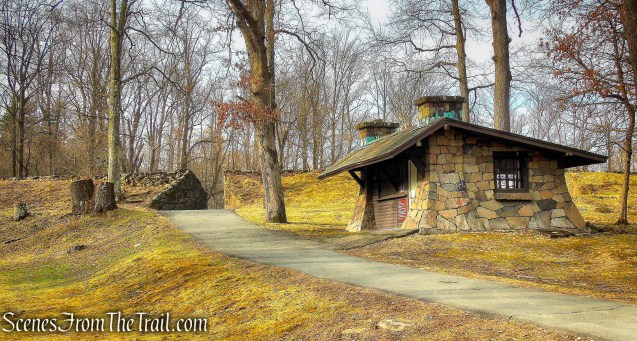
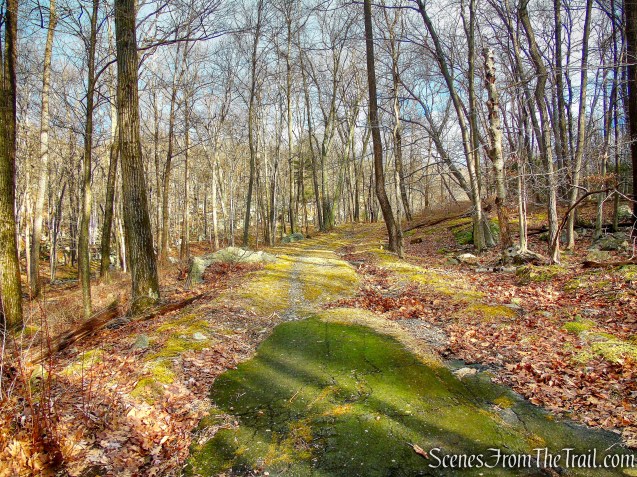
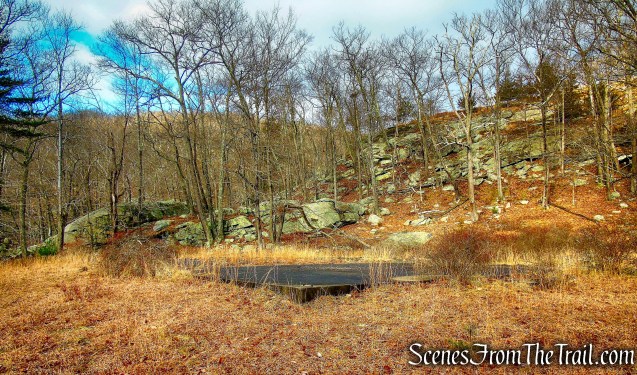
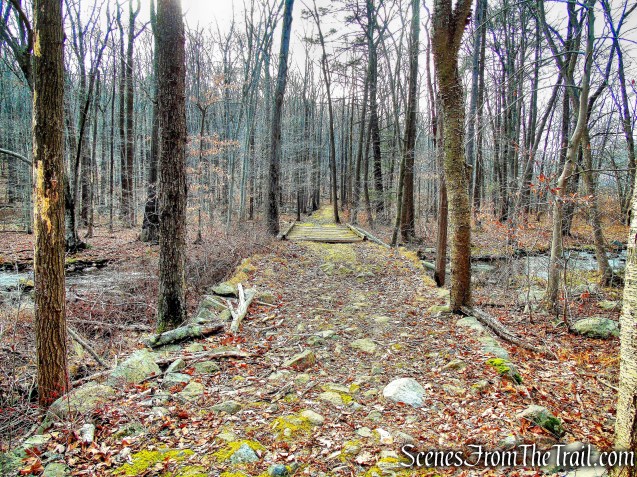
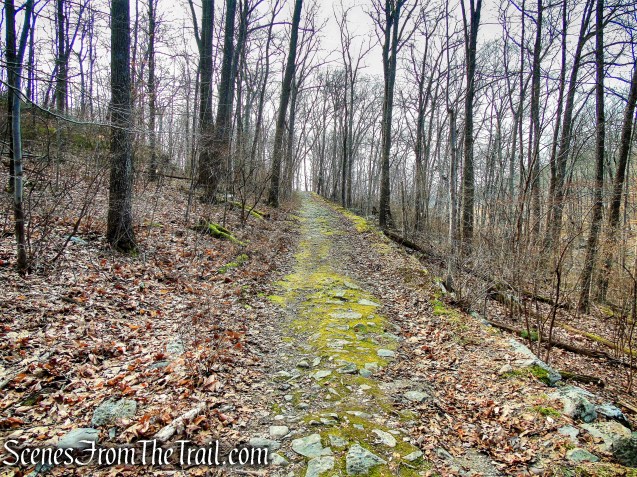
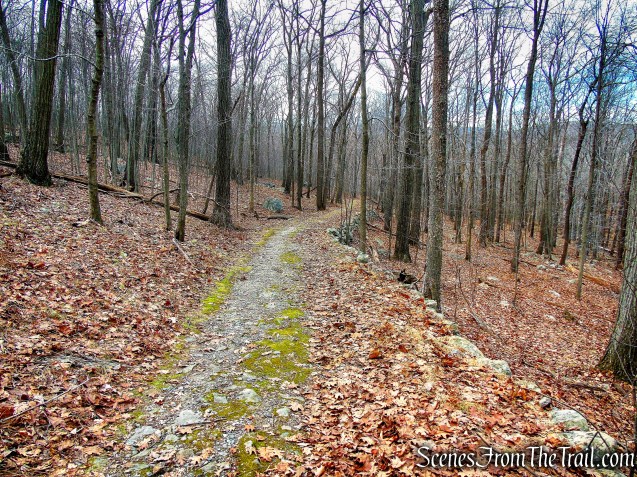
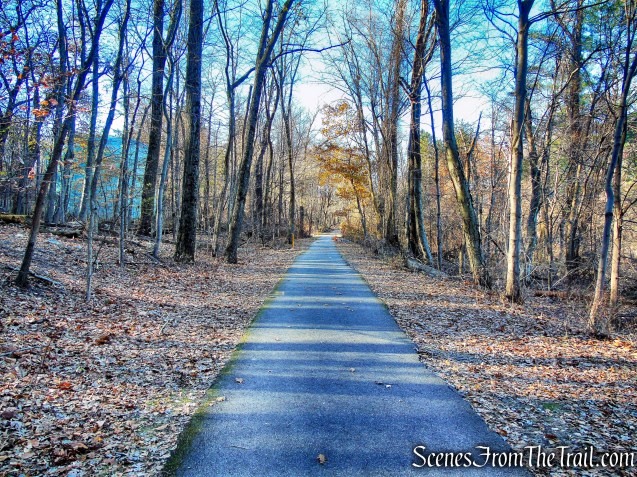
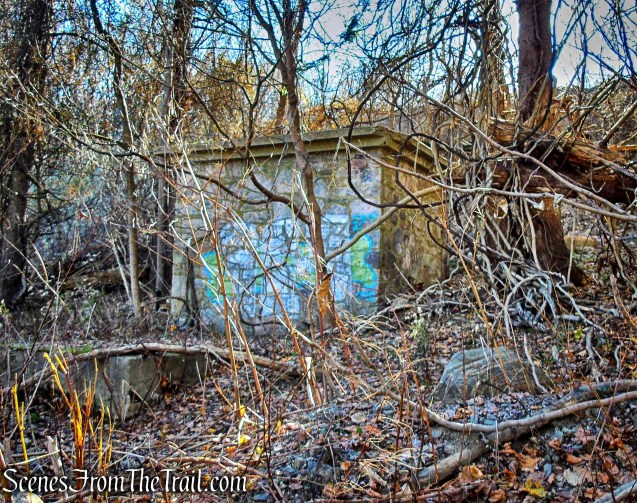
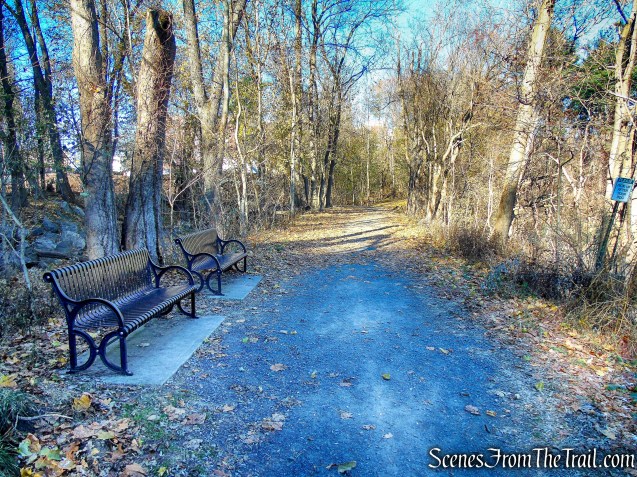
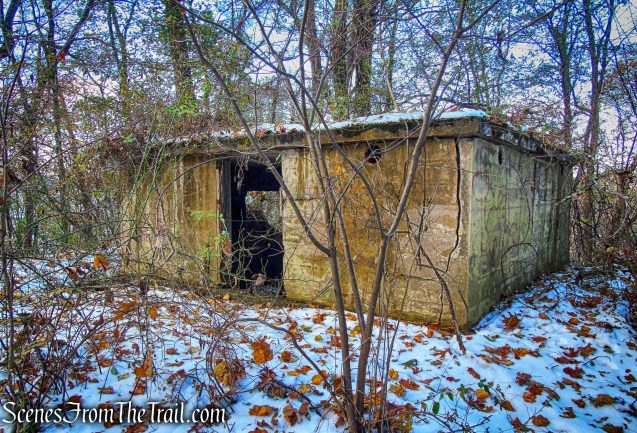
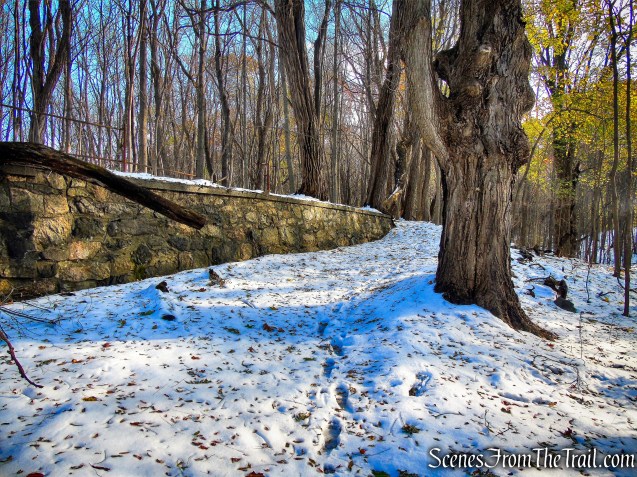
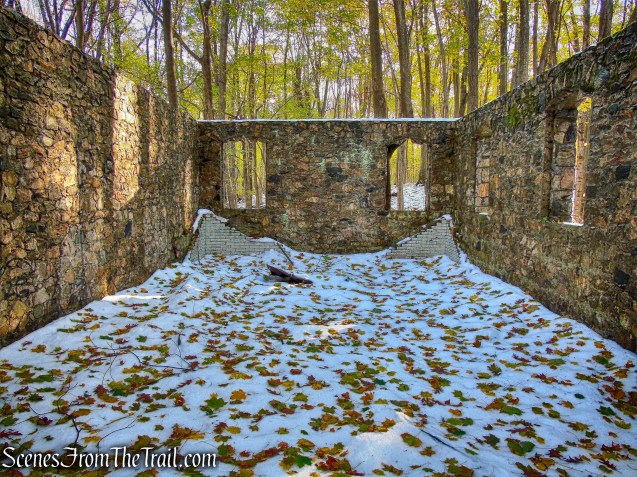
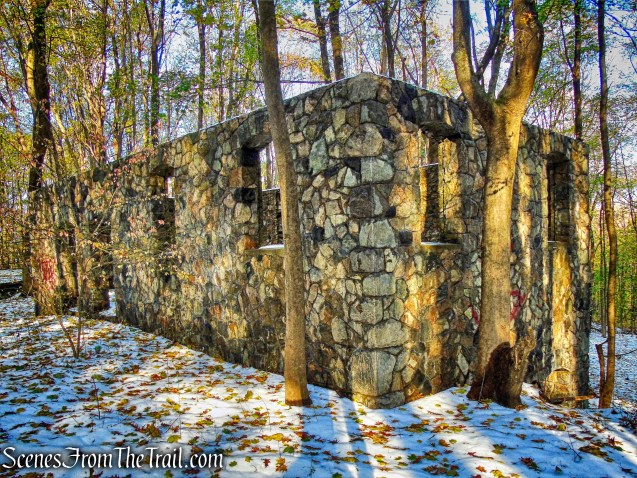
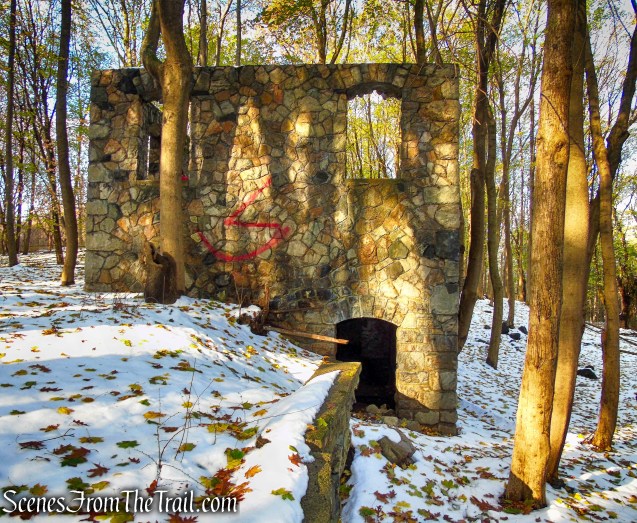
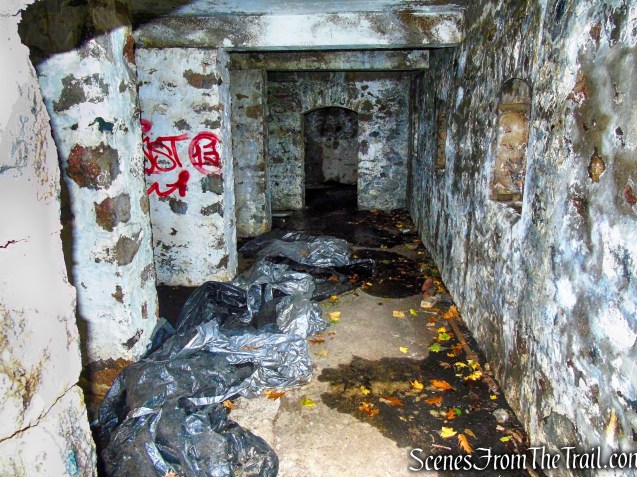
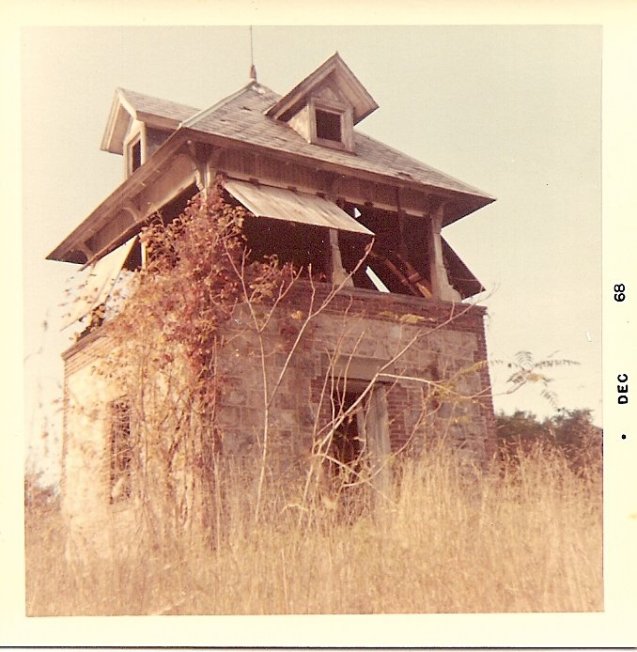
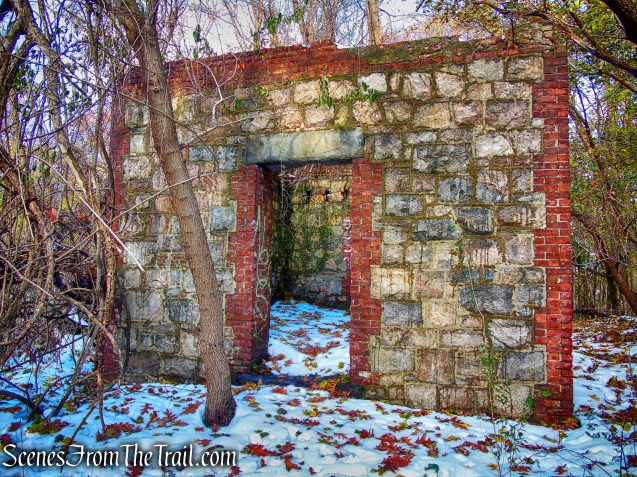
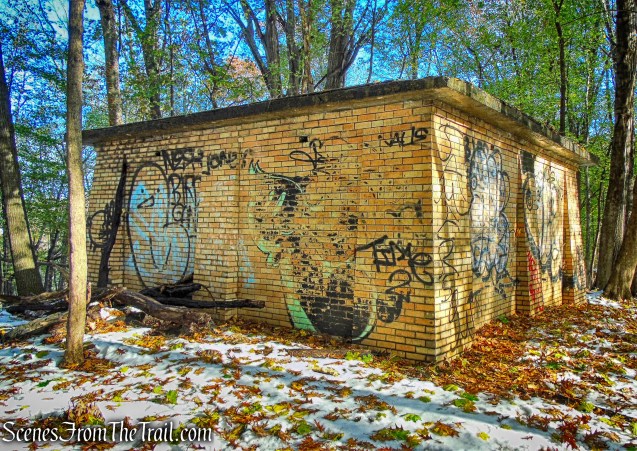
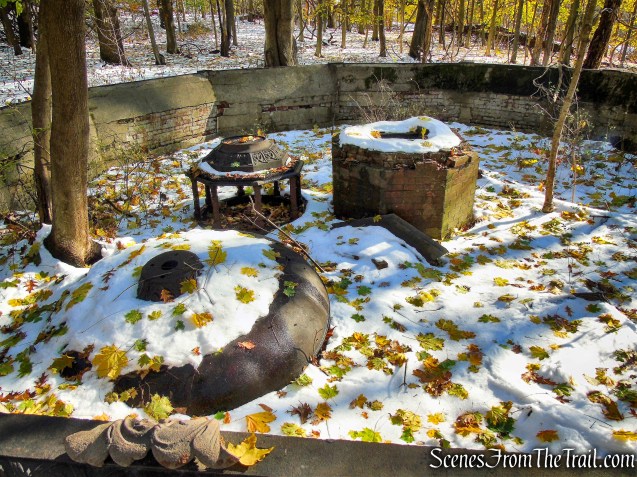
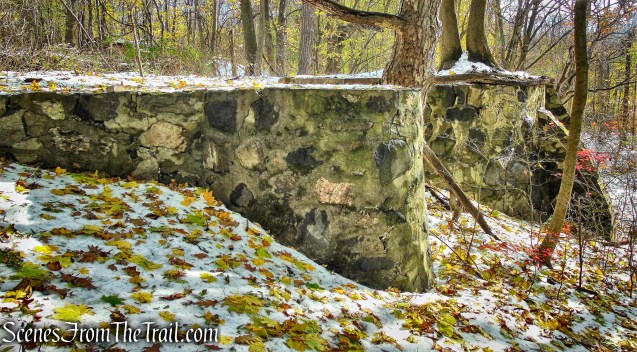
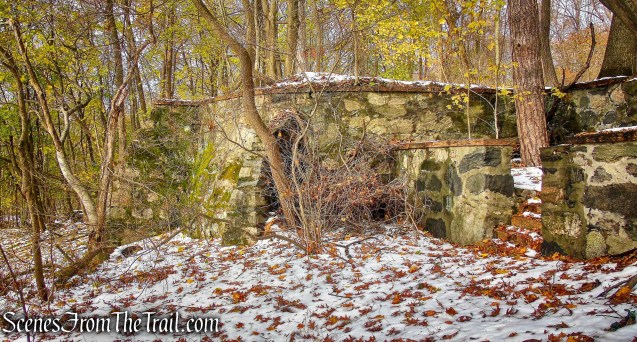
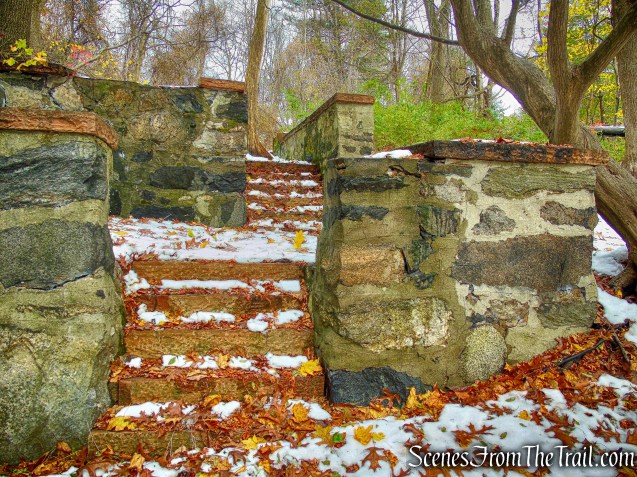
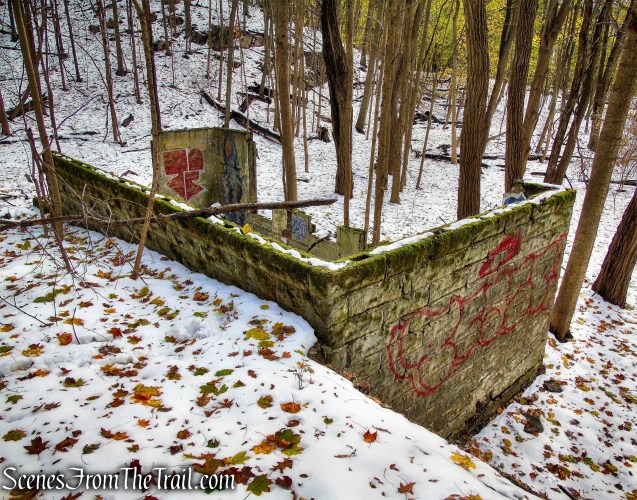
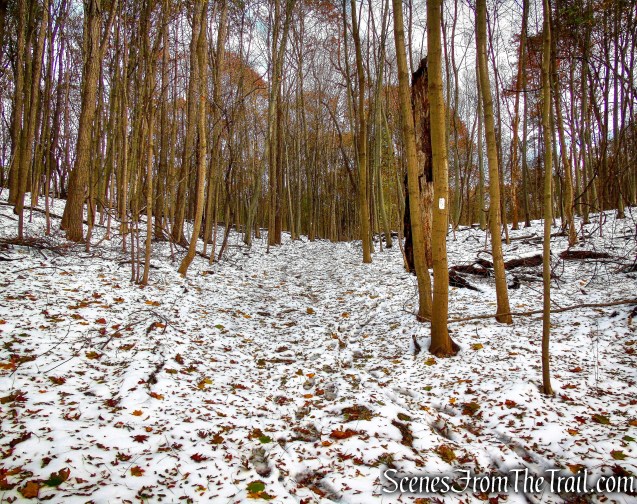
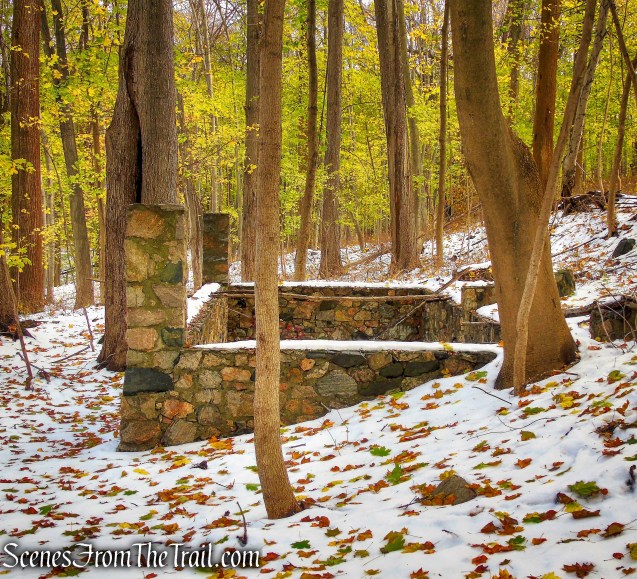
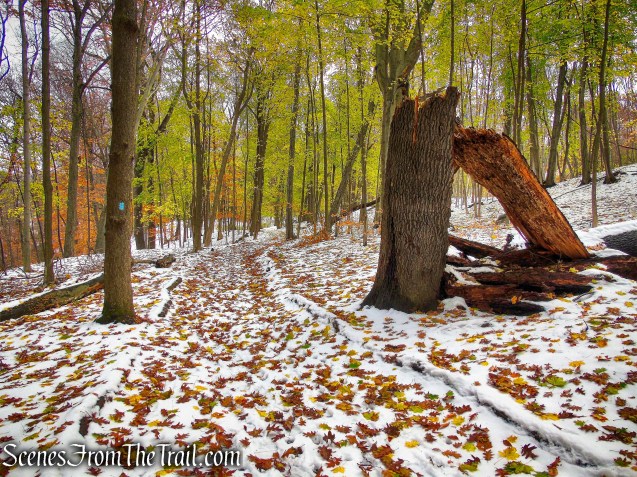
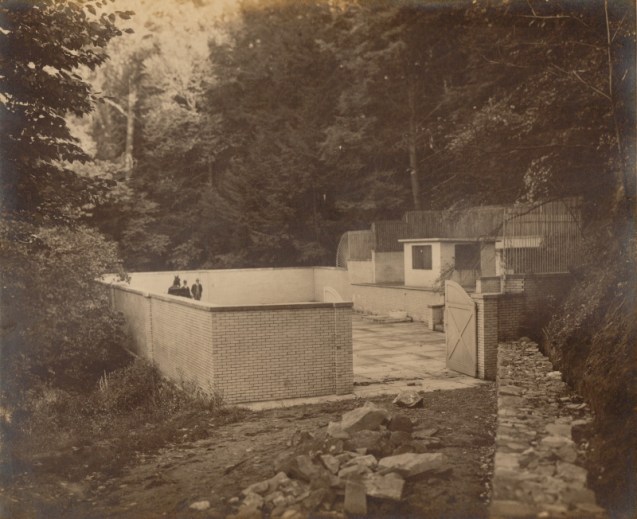
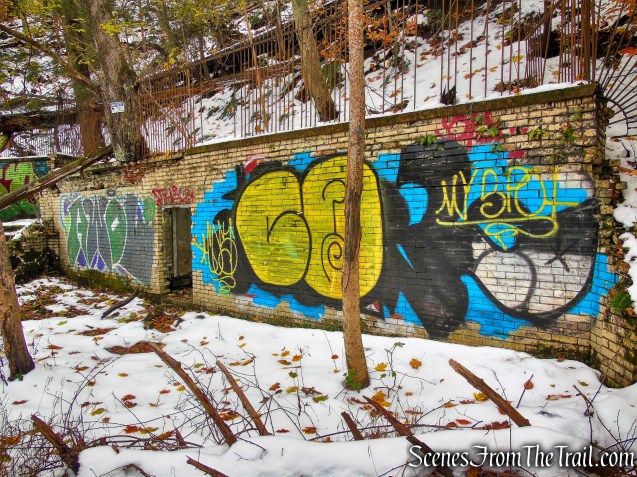
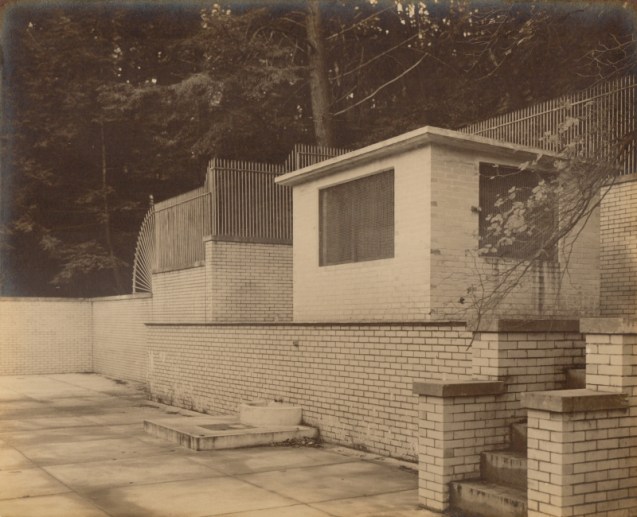
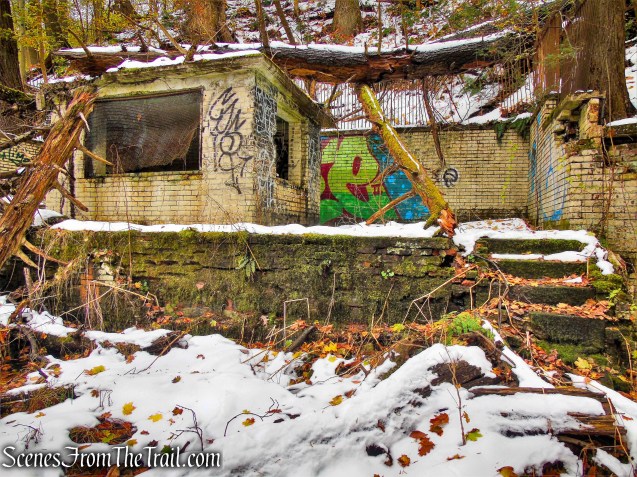
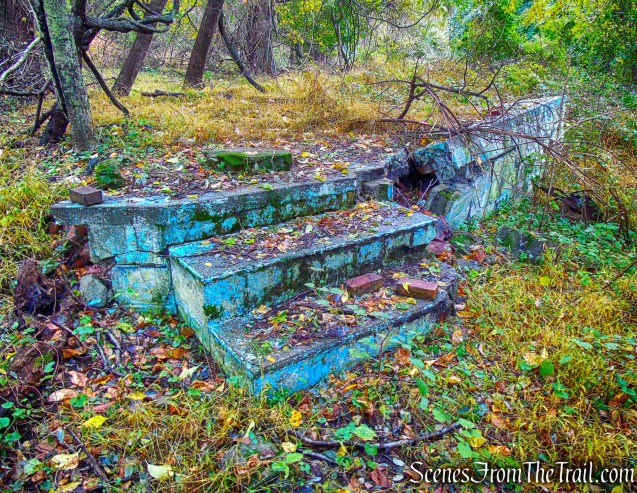
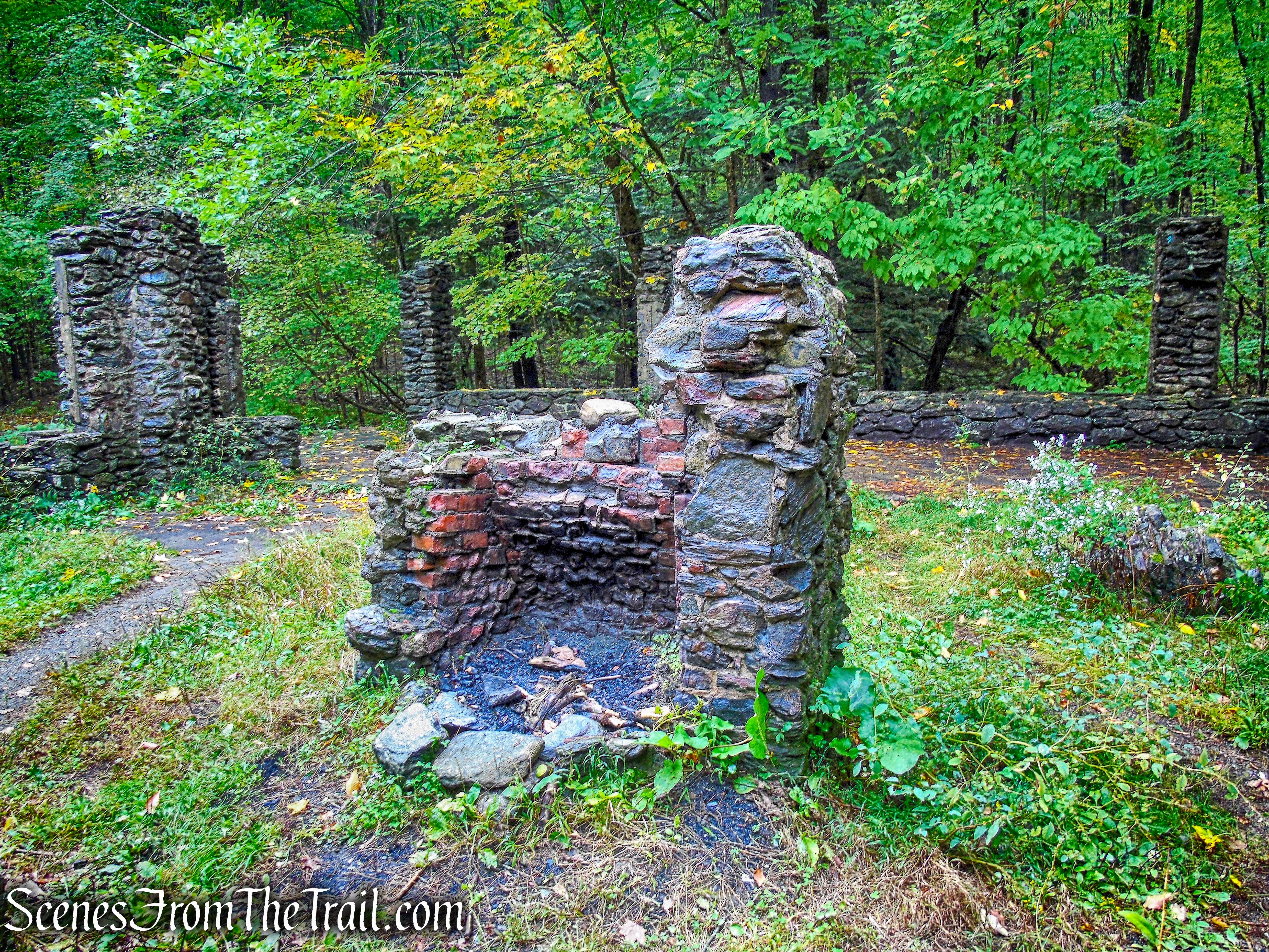
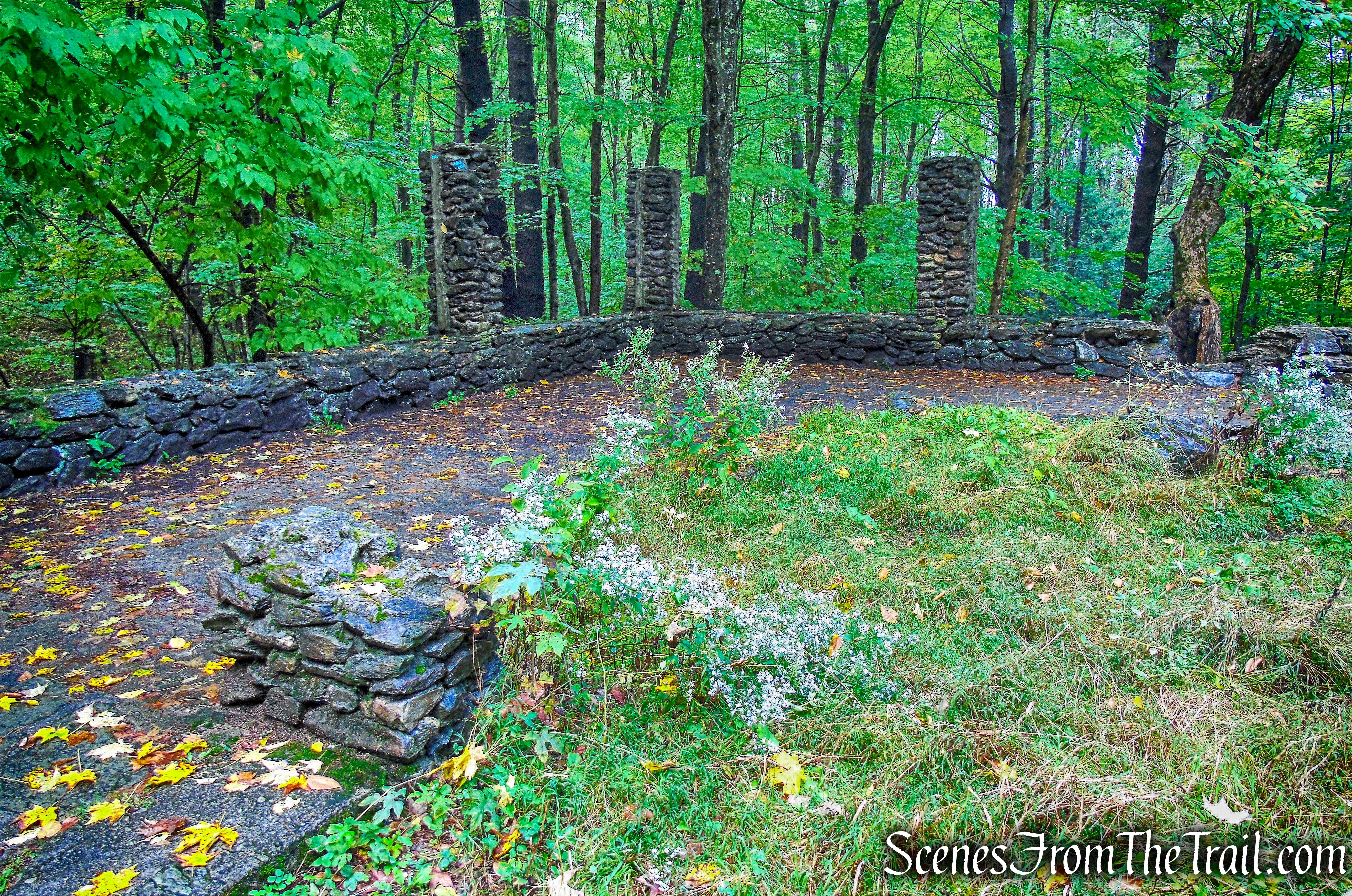
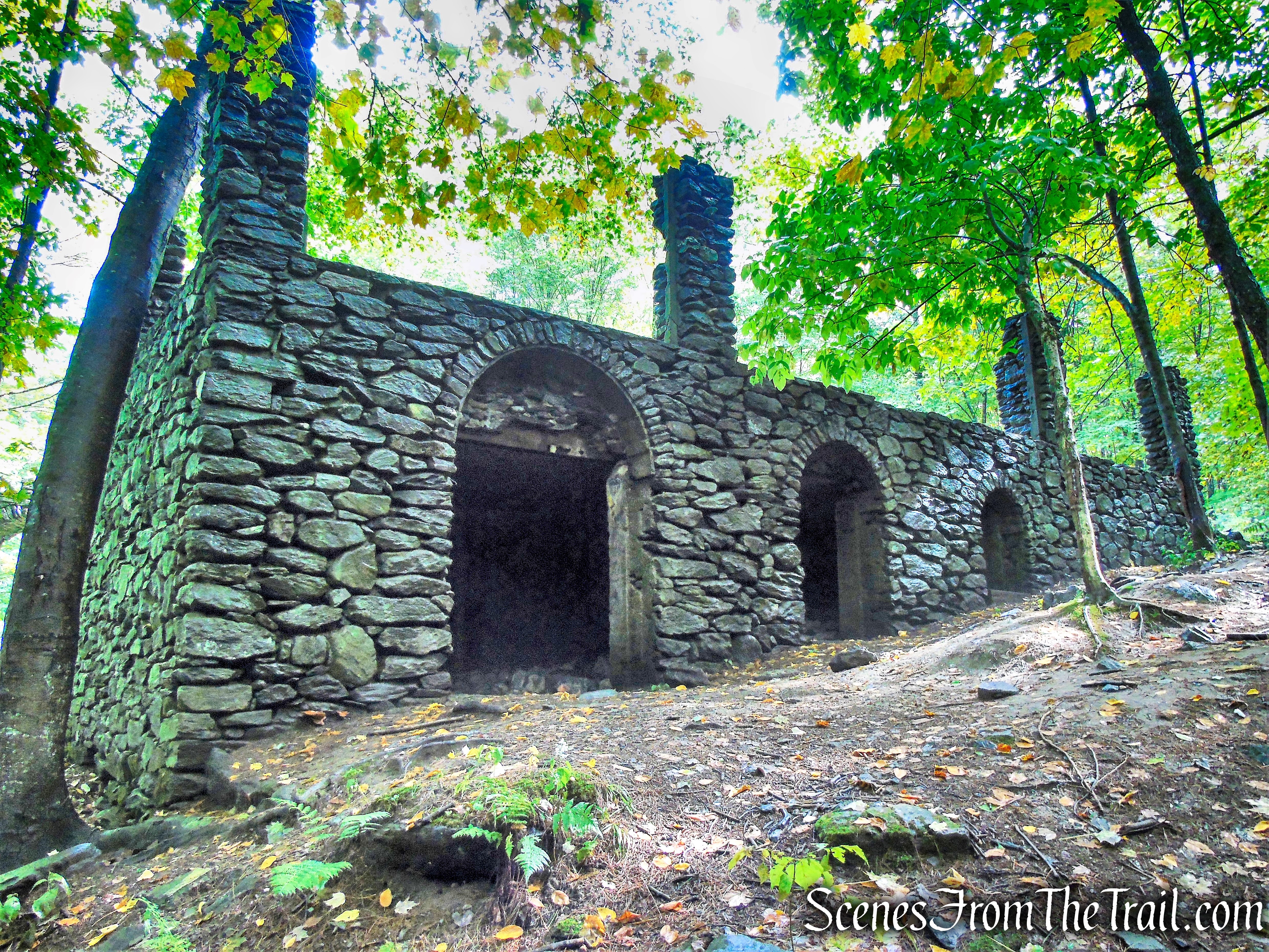
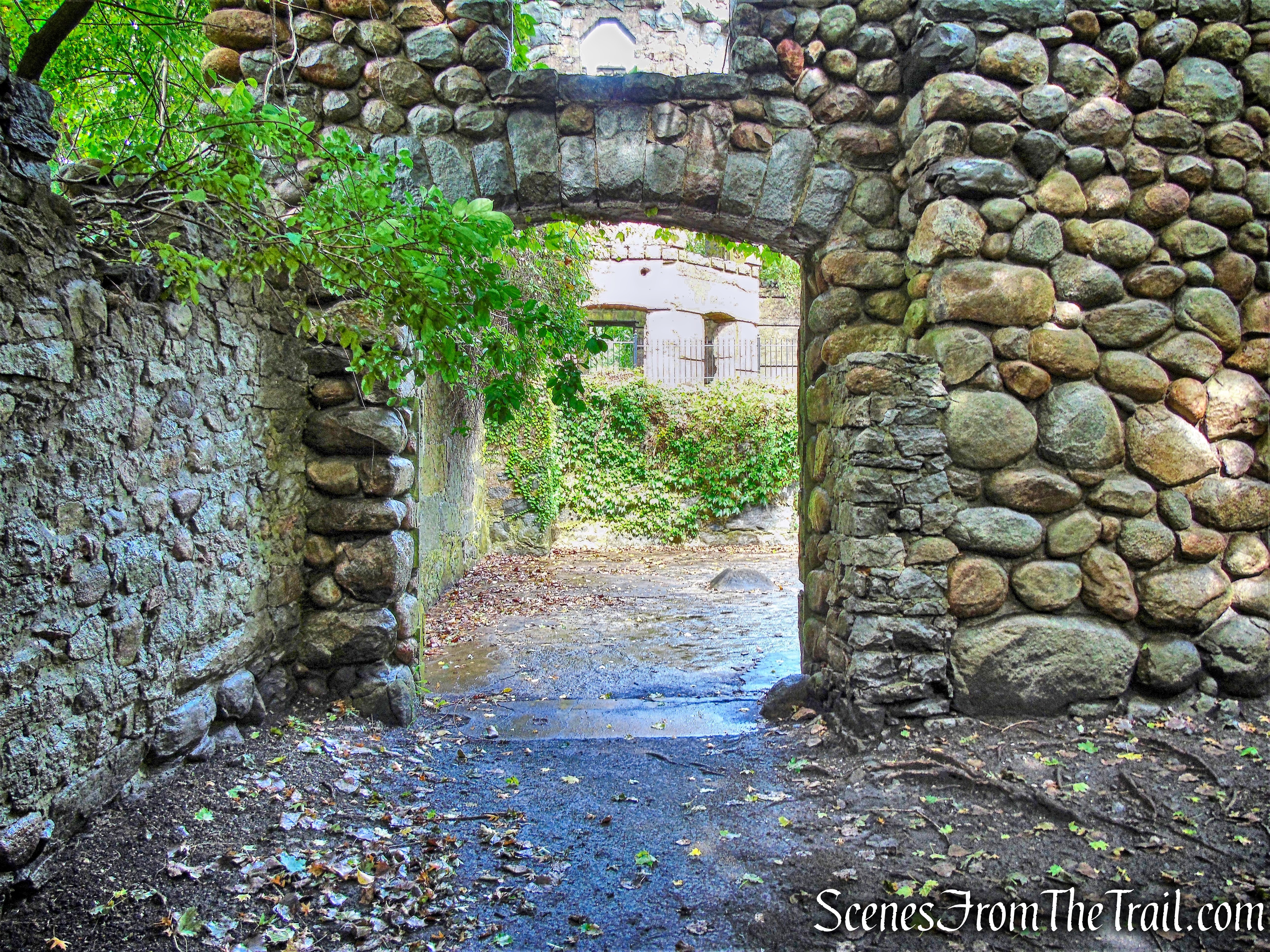
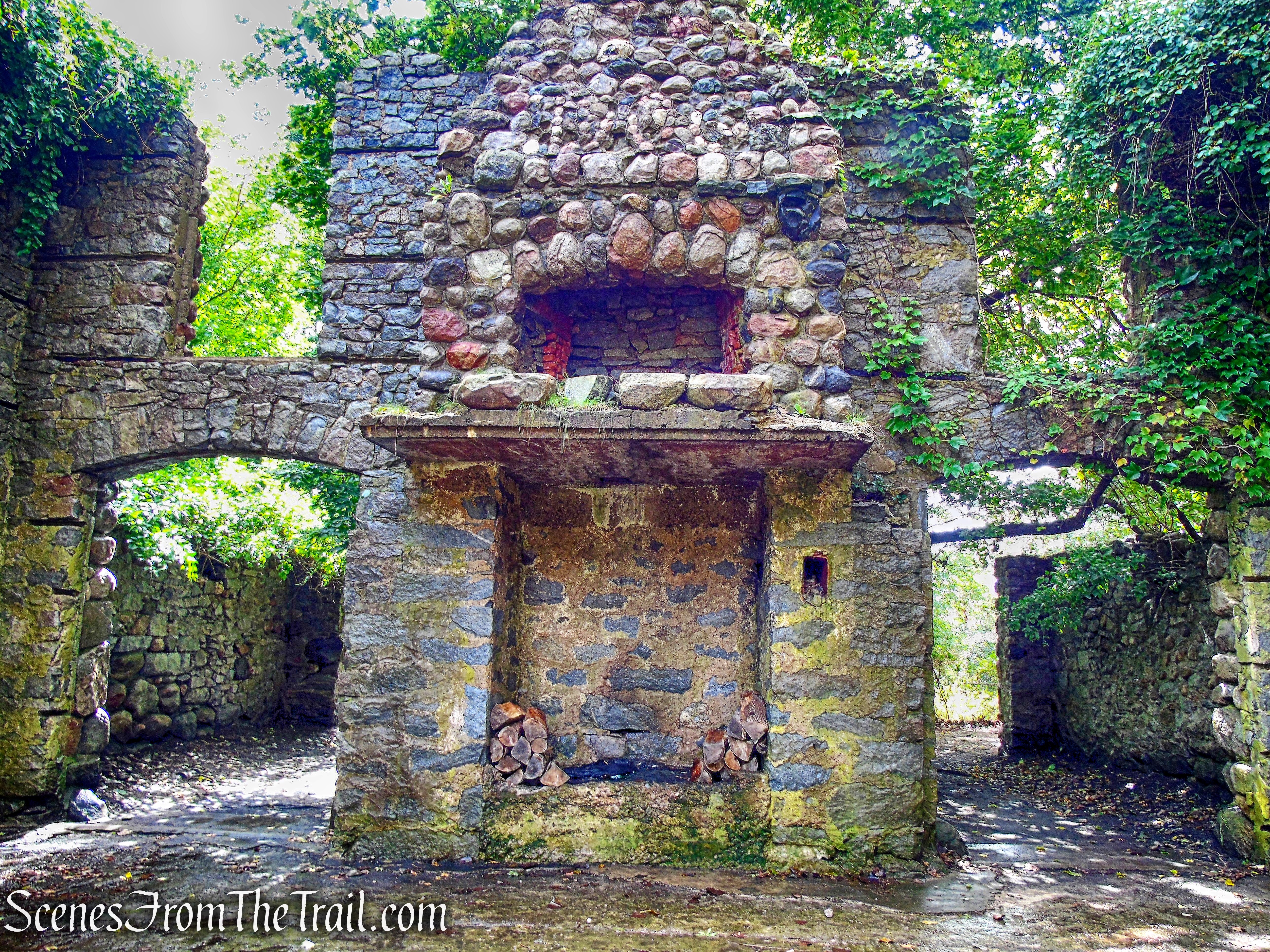
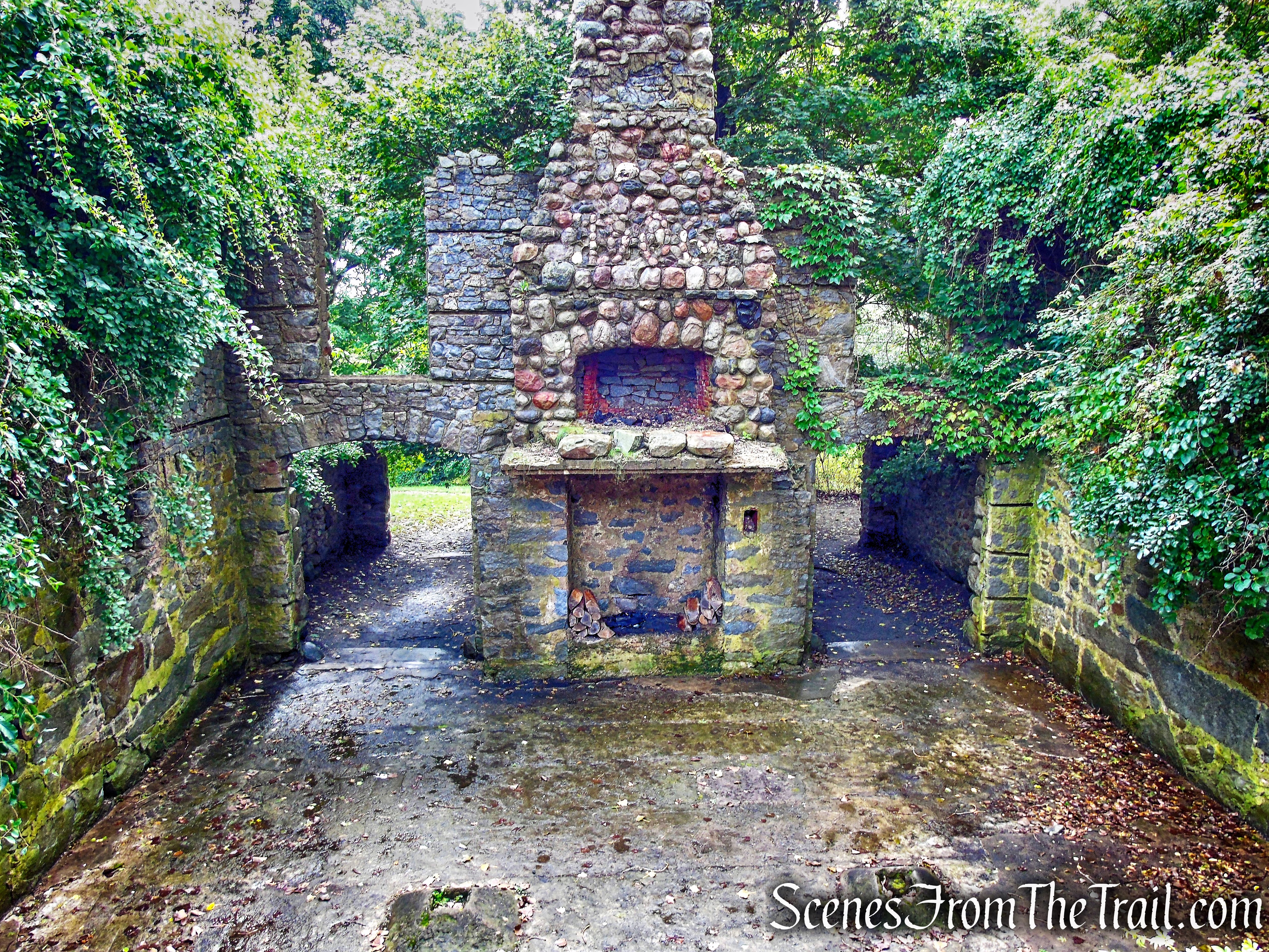
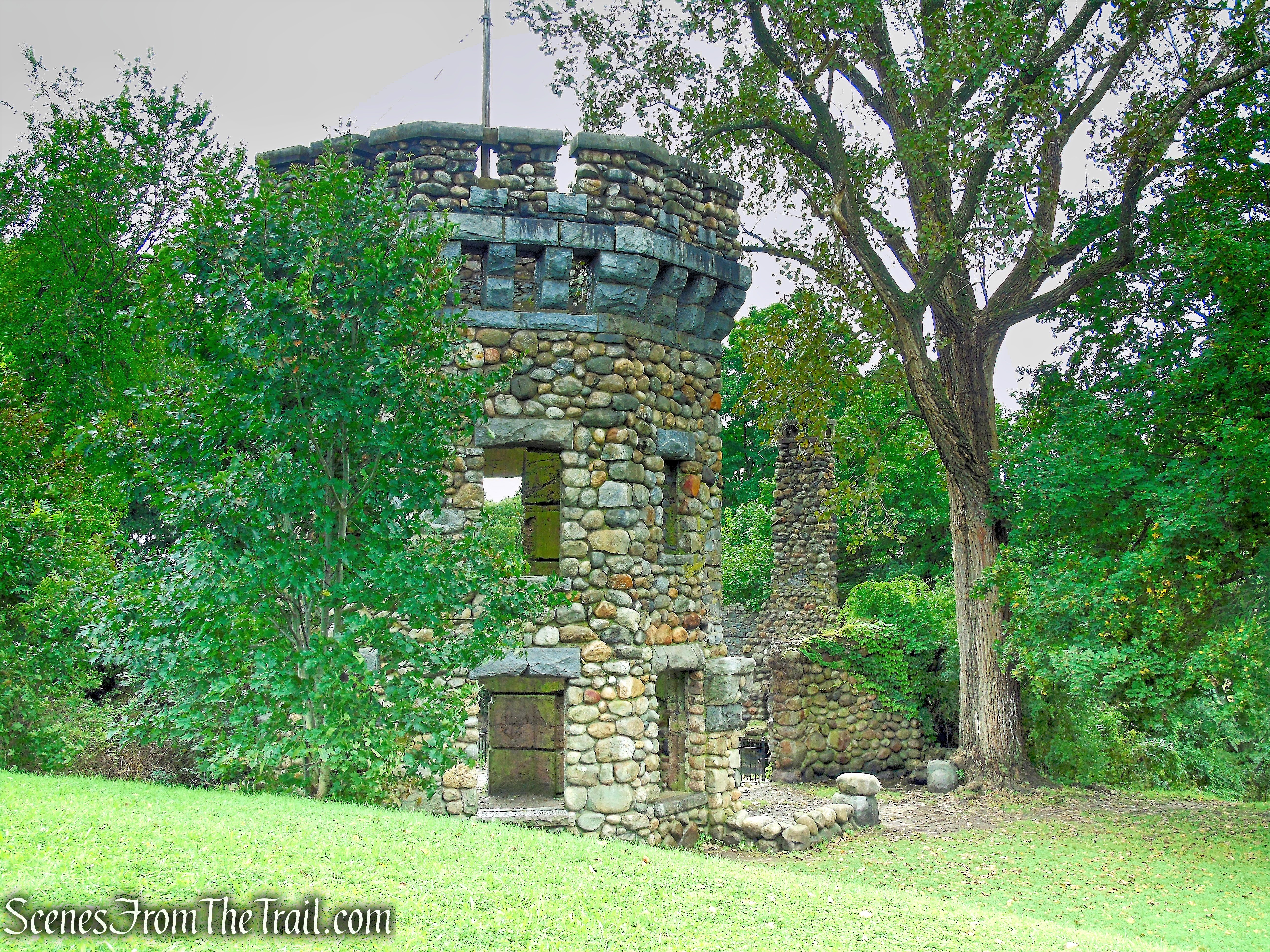
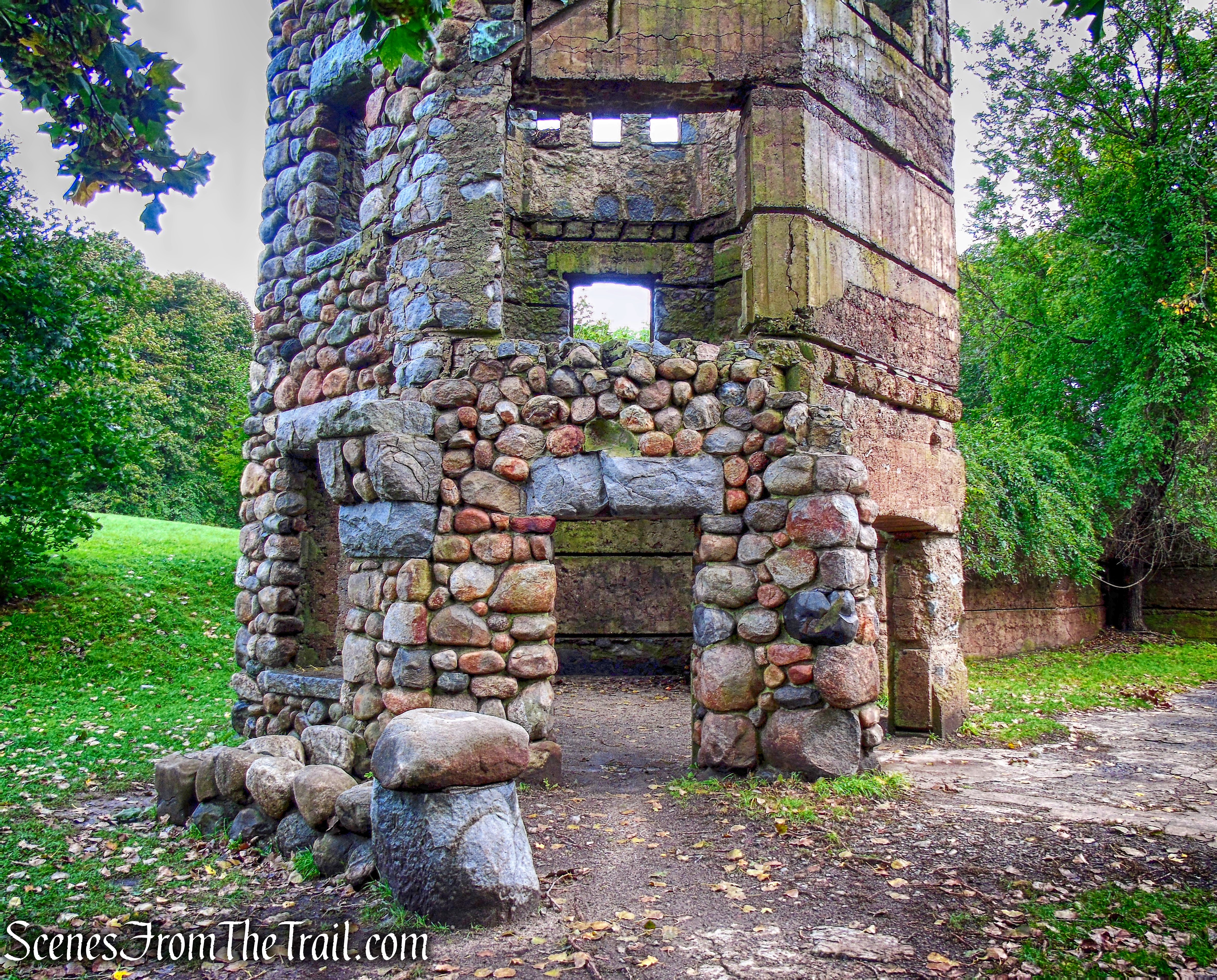
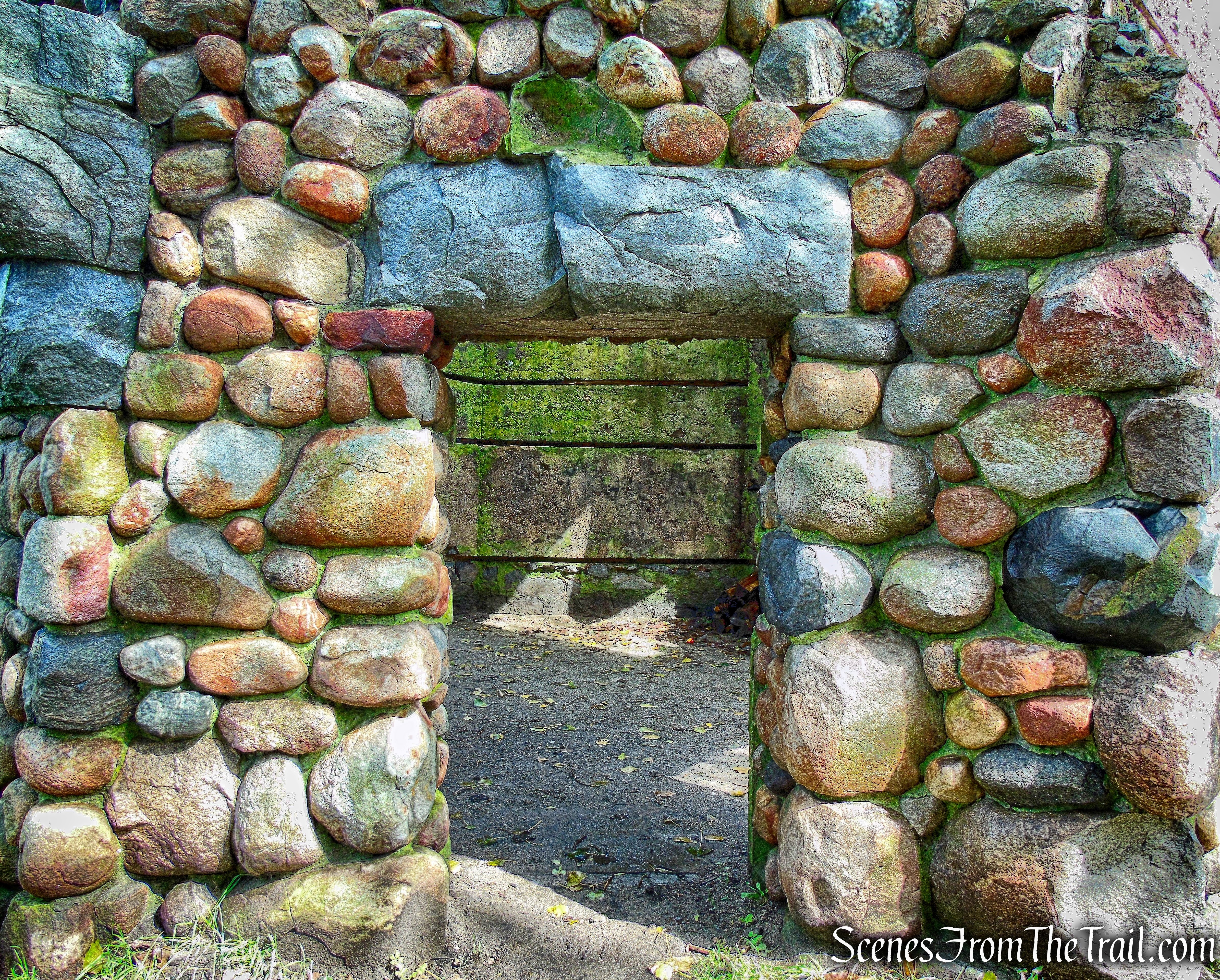
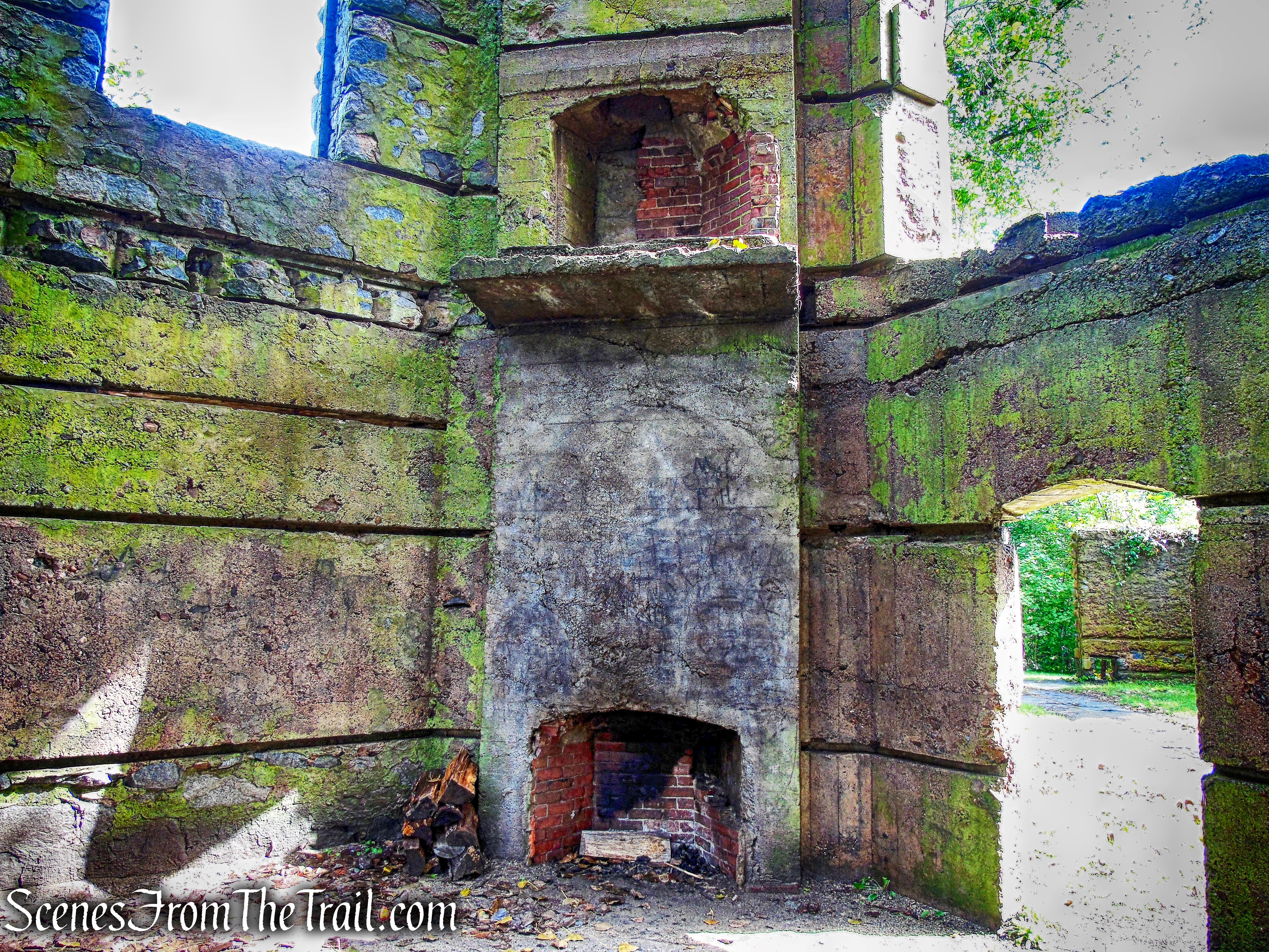
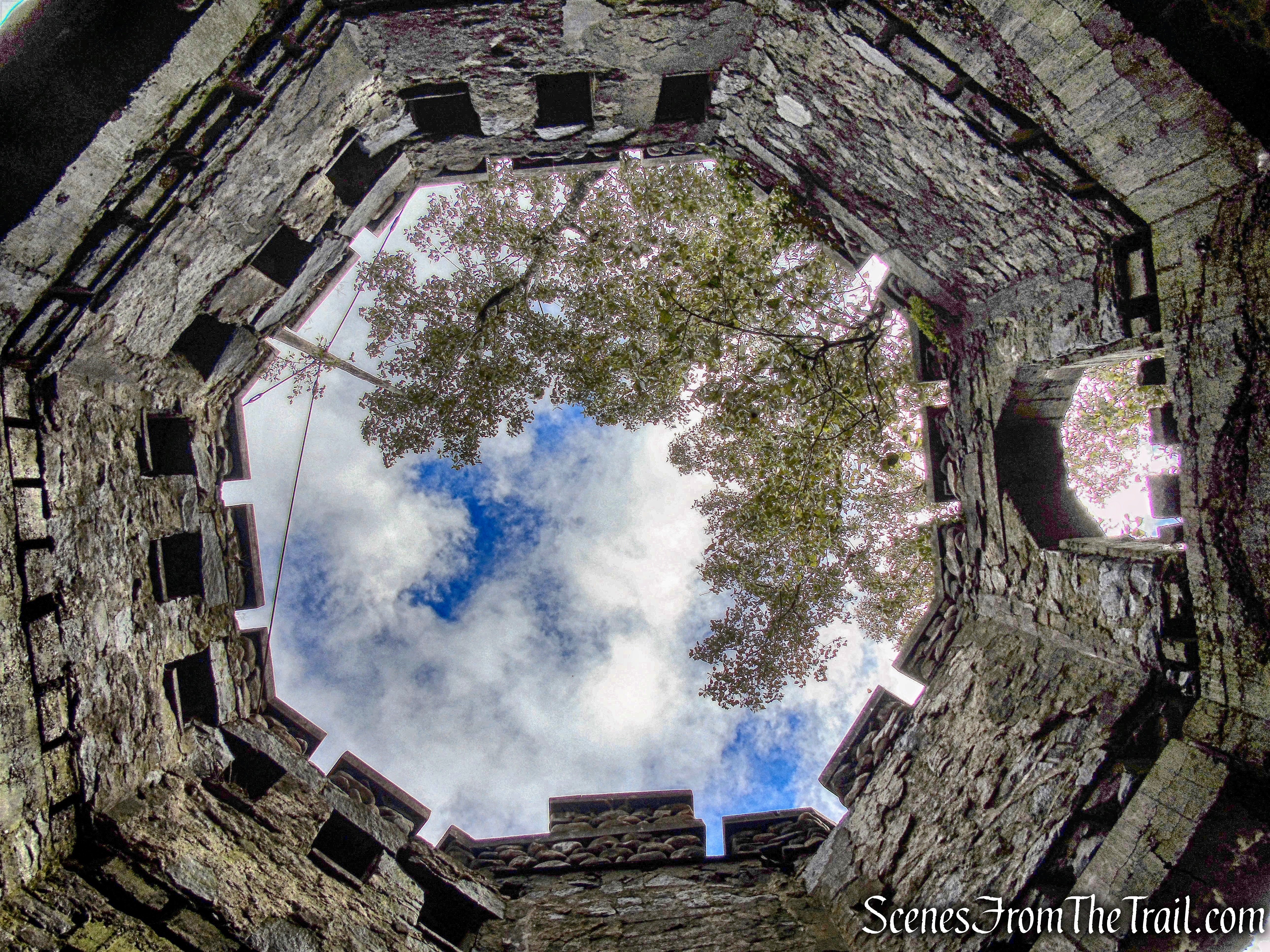
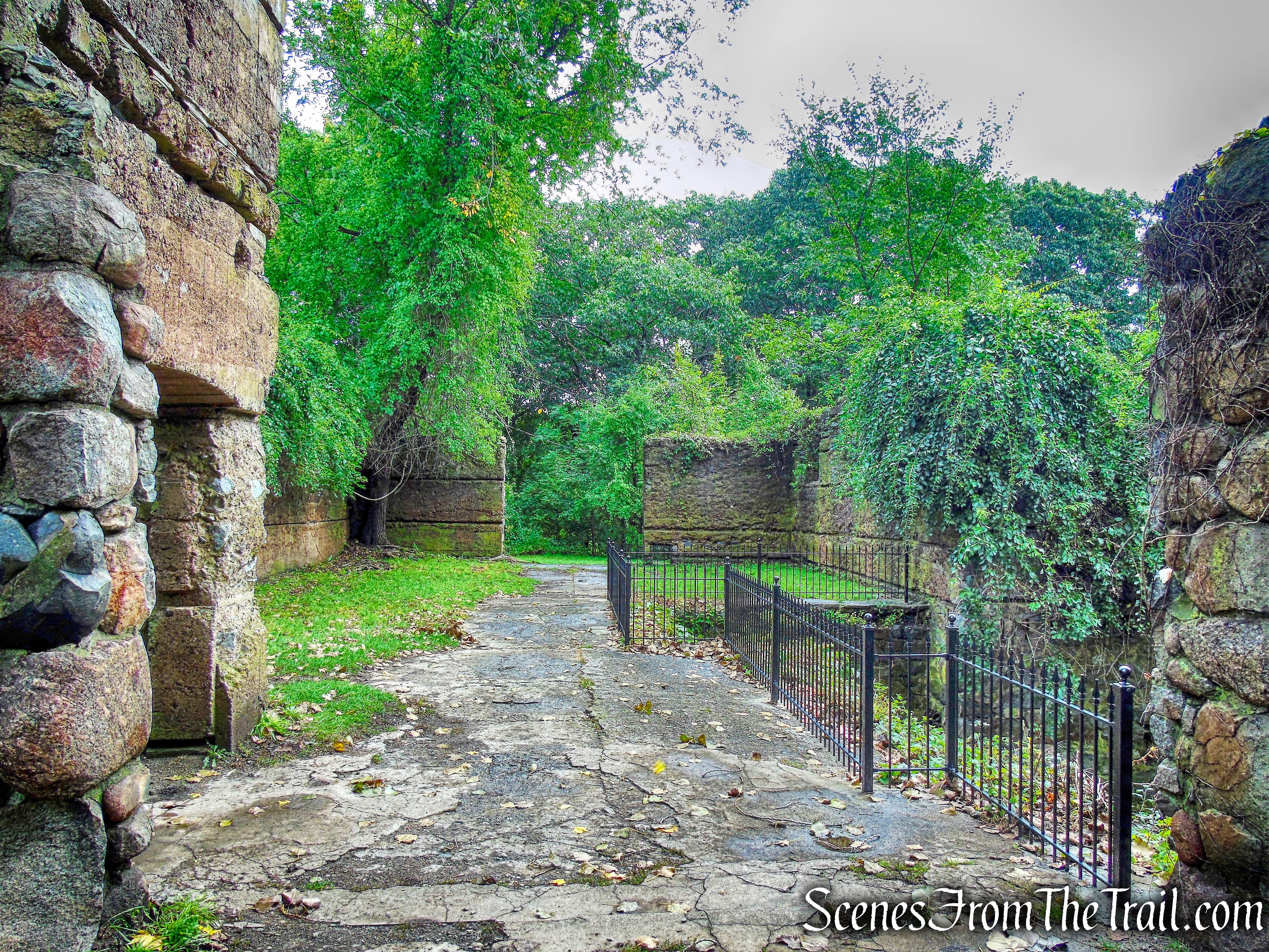
For the most part, the wide woodland trails are gently graded and wide enough for walking two or three abreast. Conditions permitting, the trails are ideal for snowshoeing or crosscountry skiing. There are geological features along the woodland trails and opportunities for studying a variety of wildlife. A stone building near the pond was a warming hut in winter. It silently attests to the opulence of a bygone era.

The trails intersect at various points which make loop hikes of various lengths possible.

The Hike:

Since this is a relatively small preserve, the objective was to hike all of the trails. We had to retrace our steps several times to accomplish that and also skipped a small section of several of the trails.

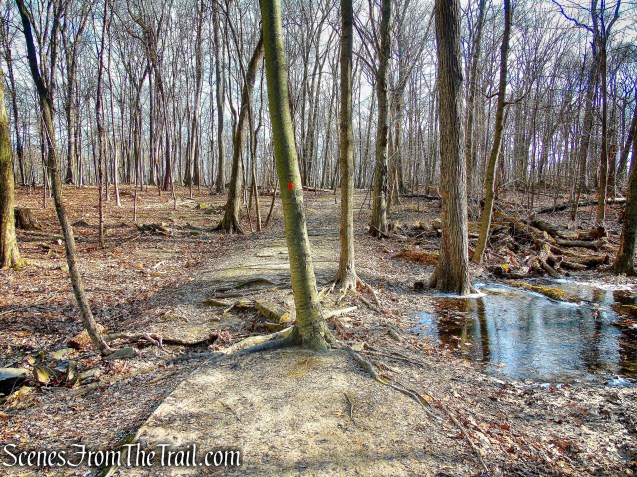
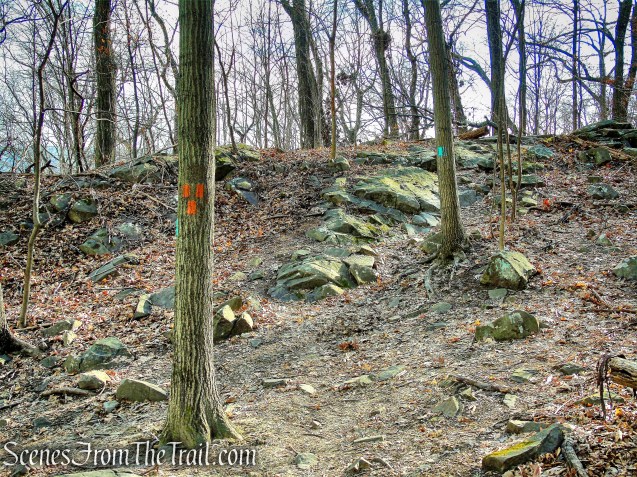
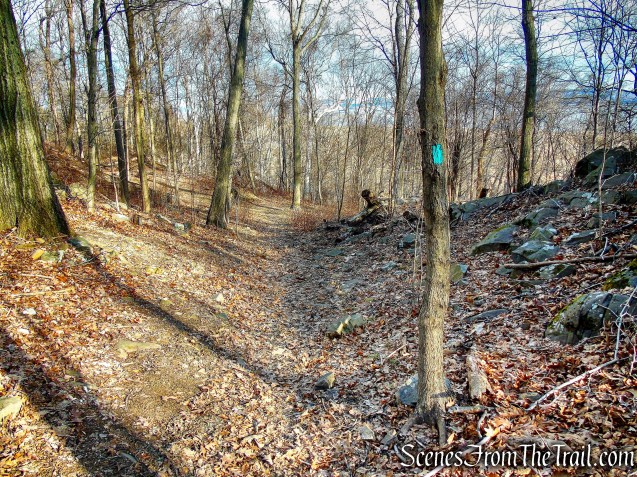
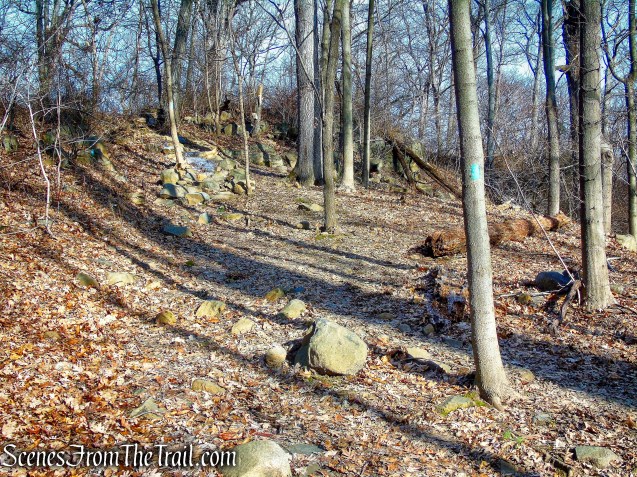
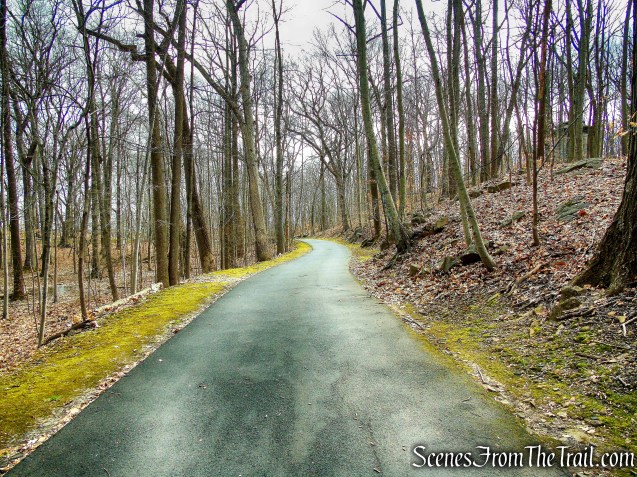
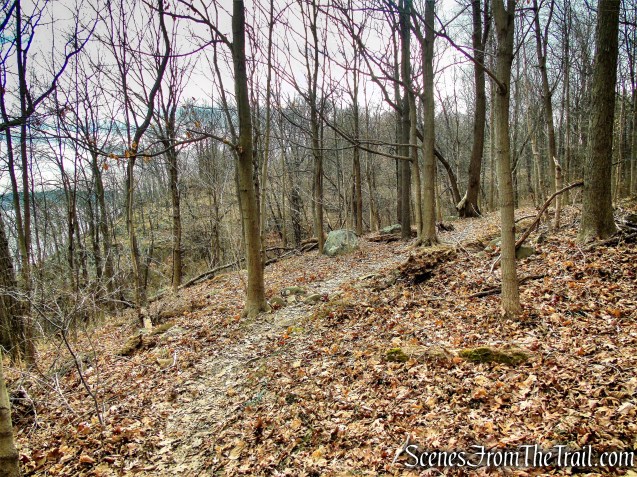
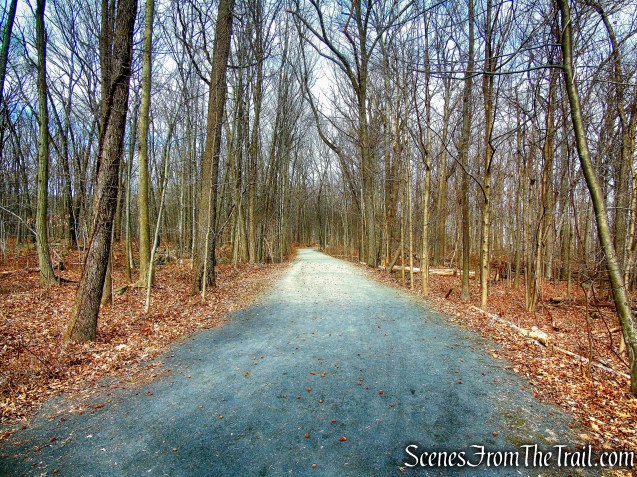
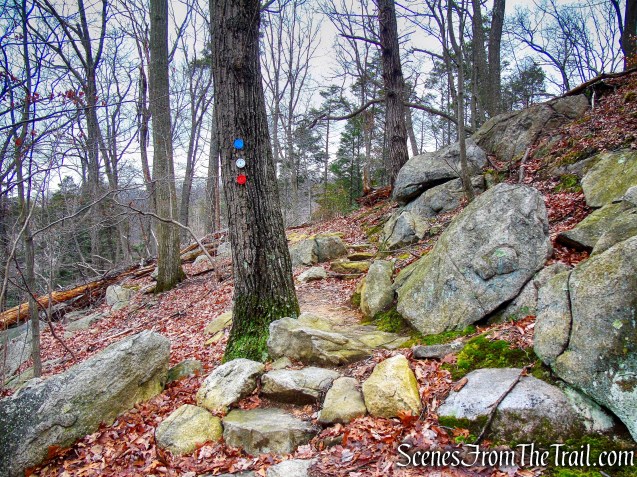
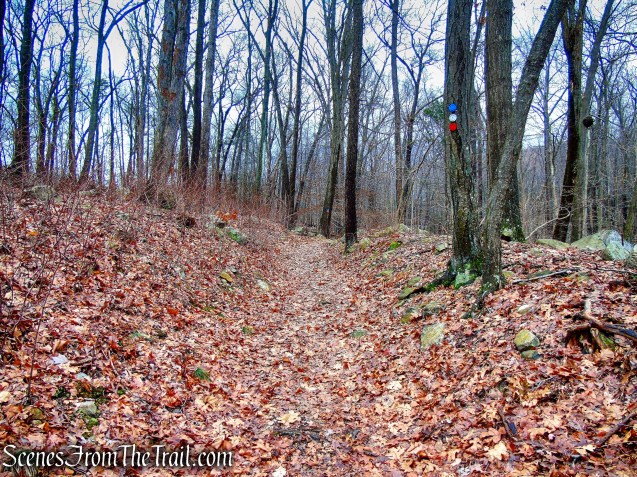
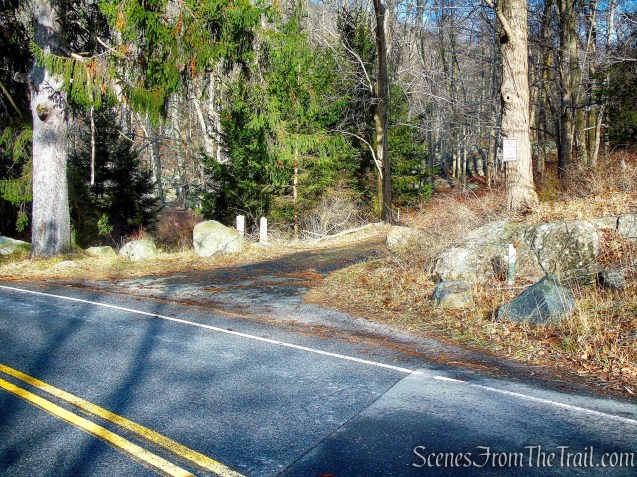
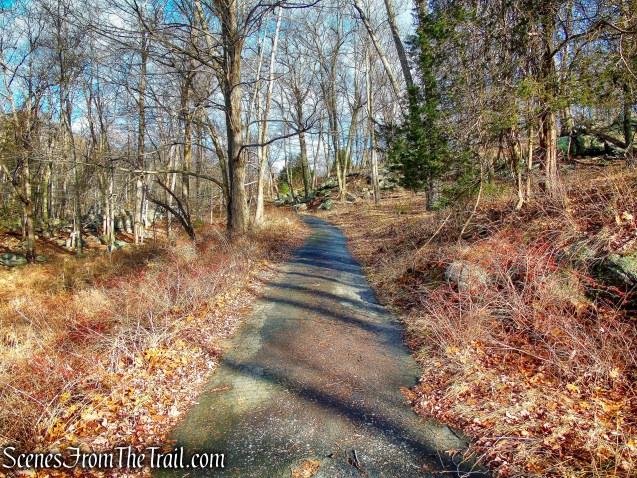
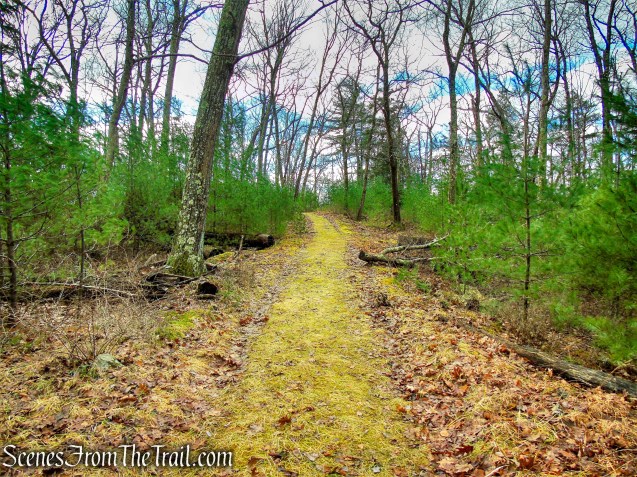
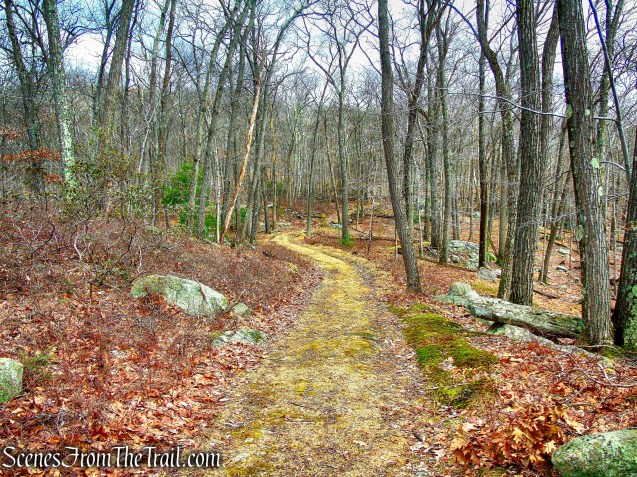
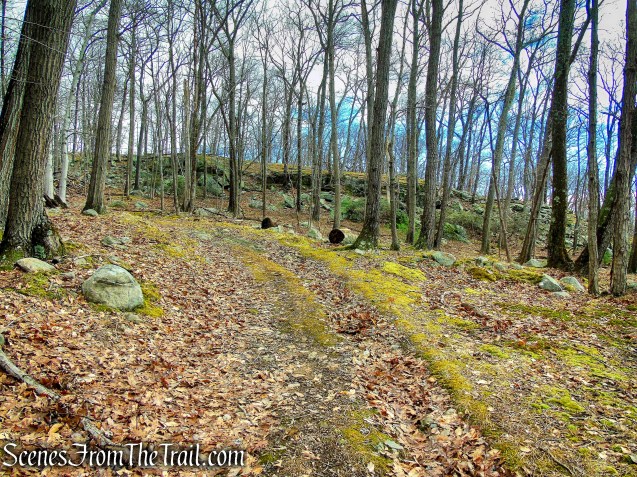
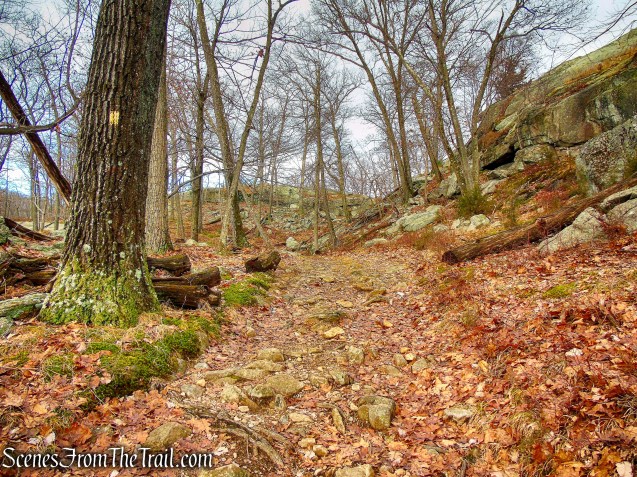
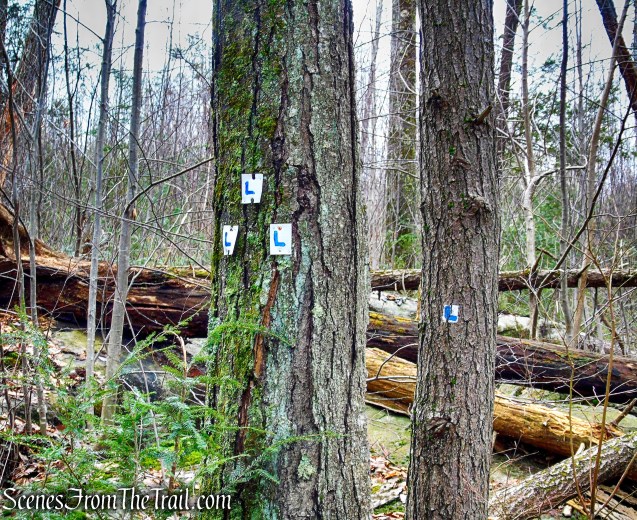
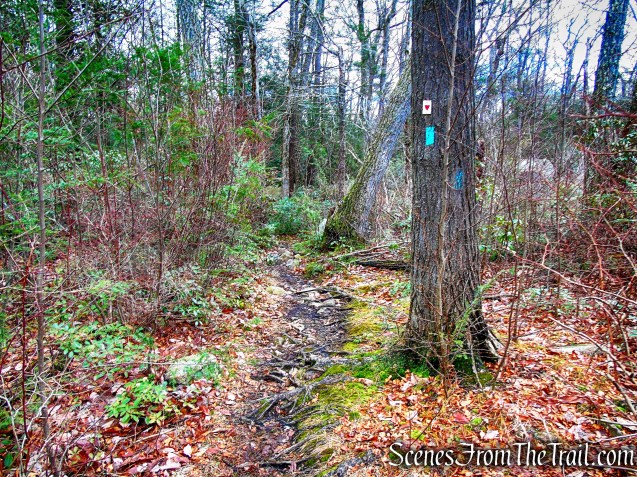
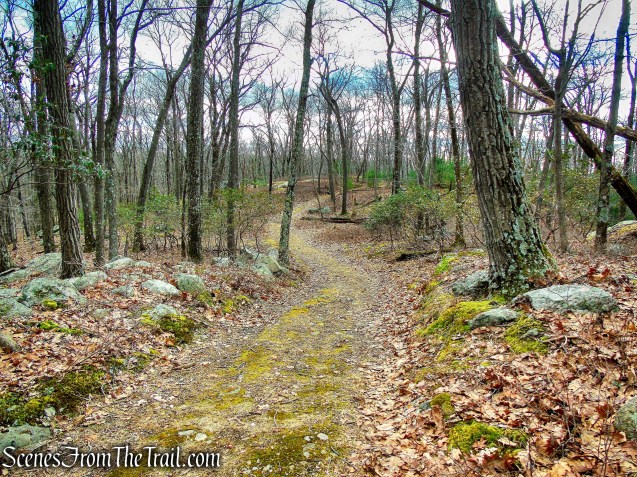
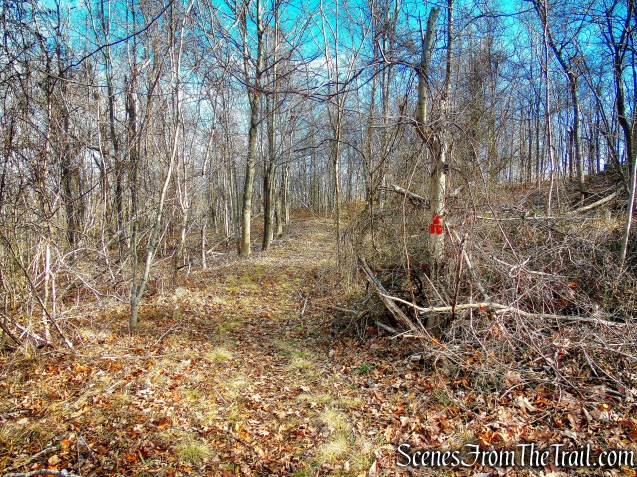
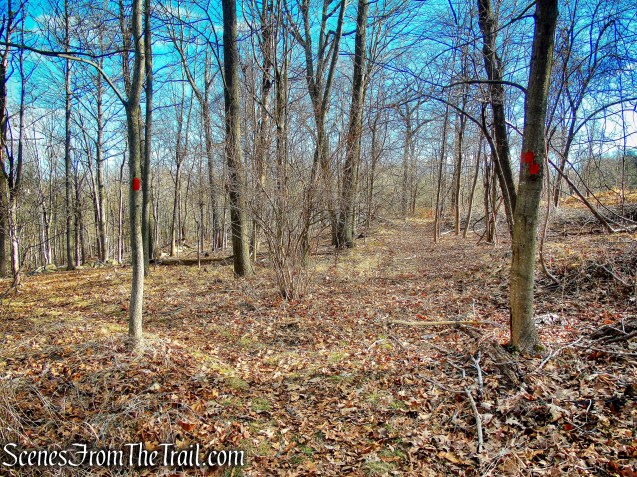
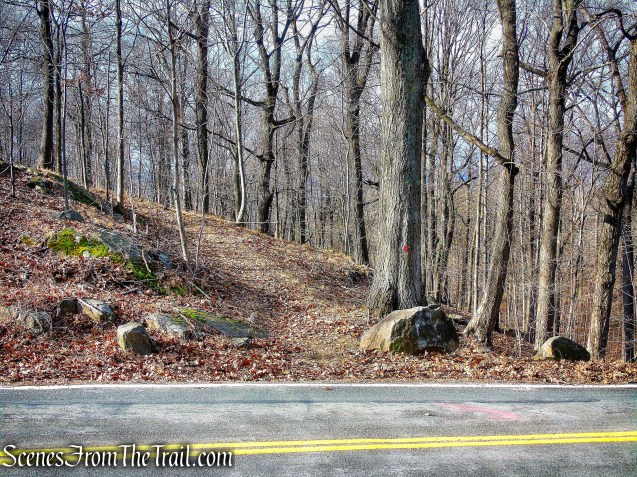
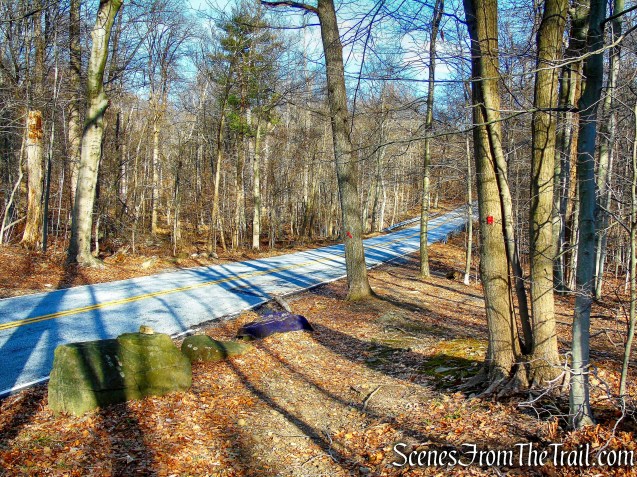
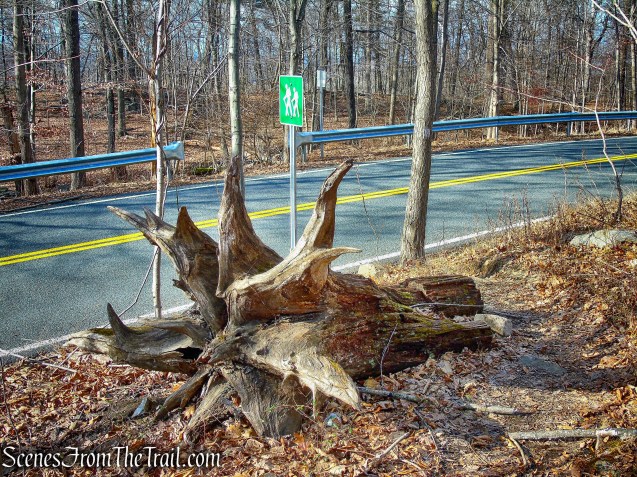
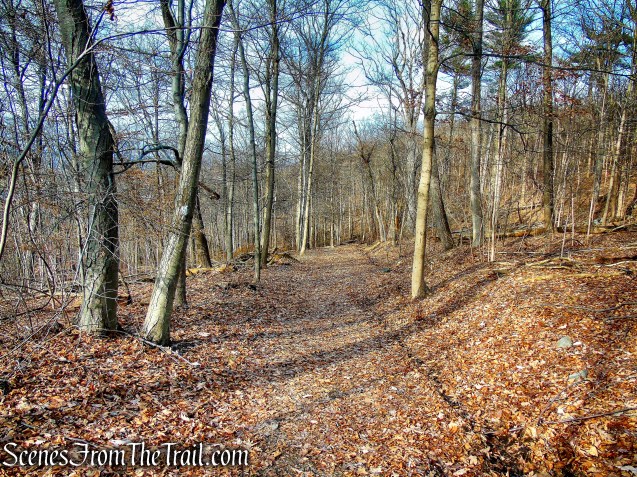
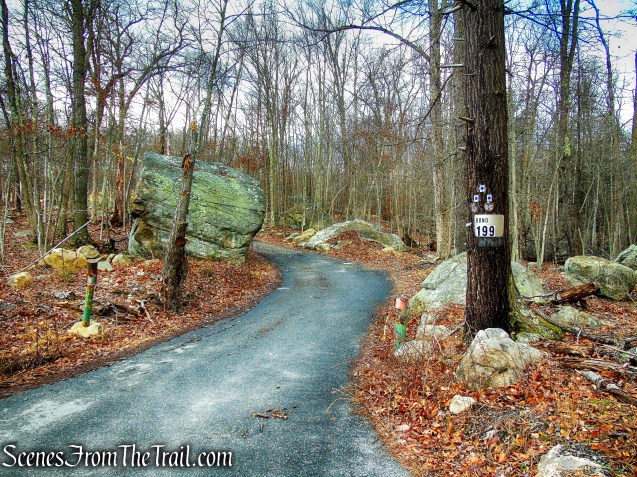
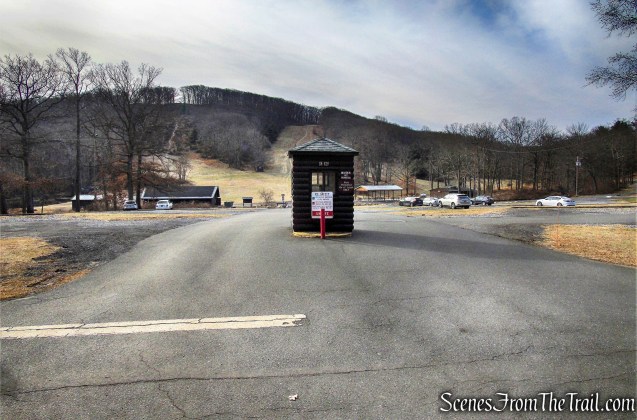
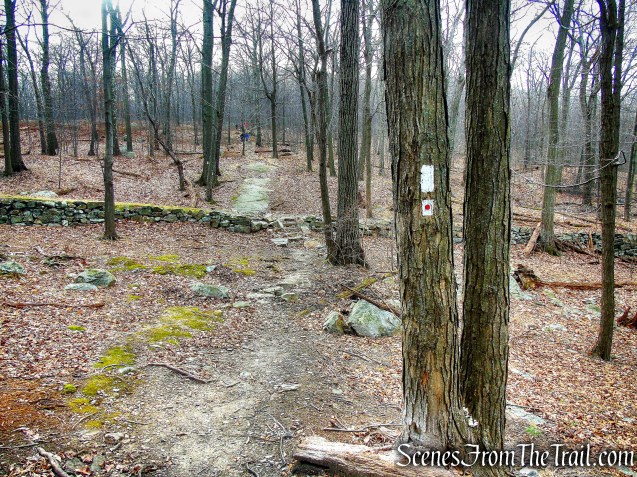
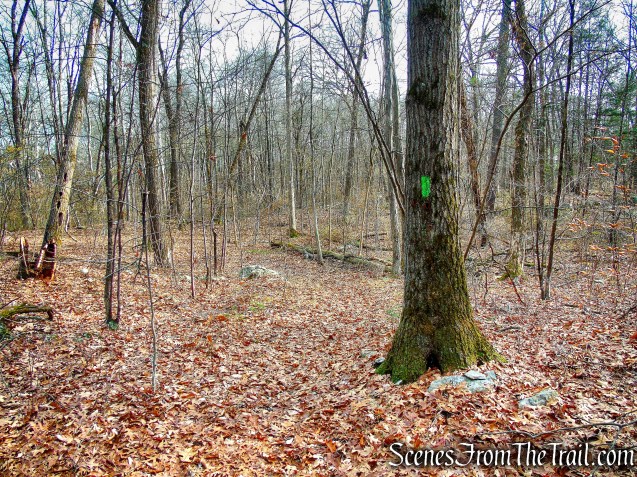
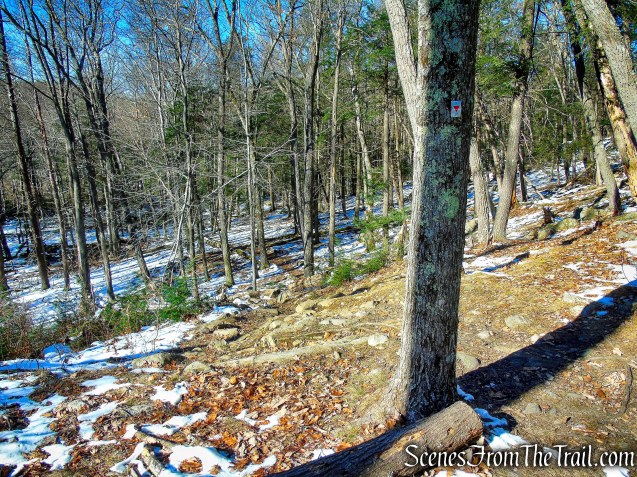
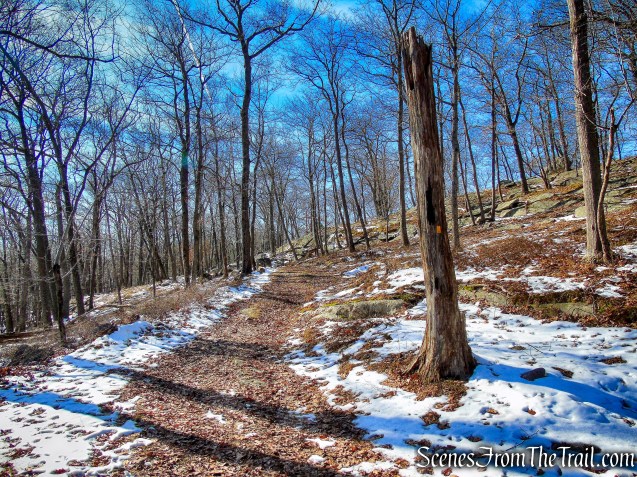
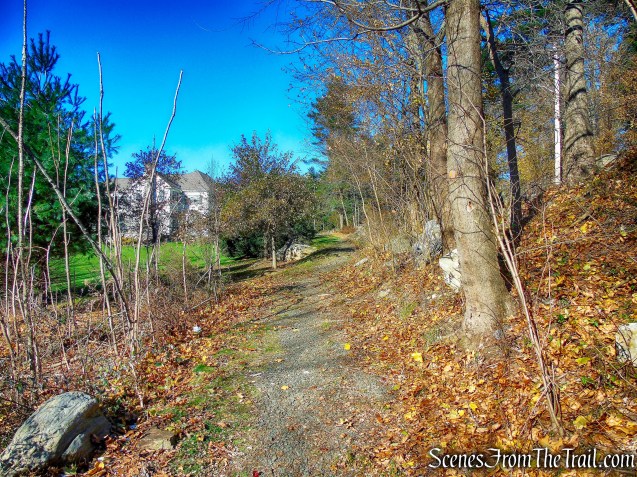
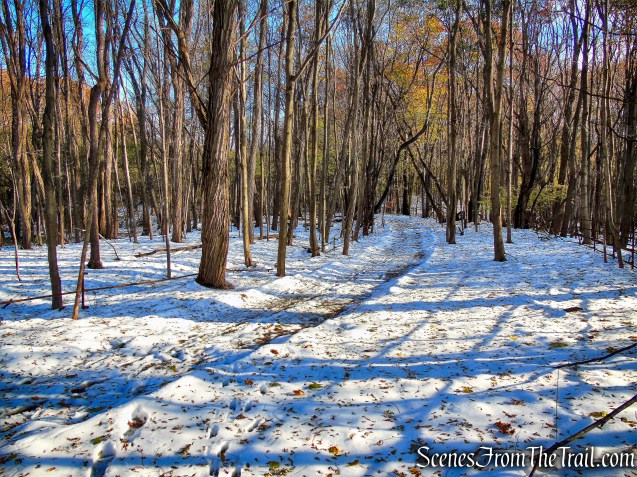
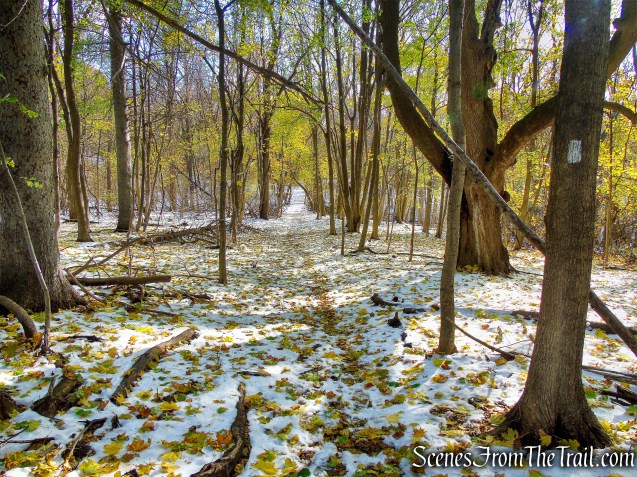
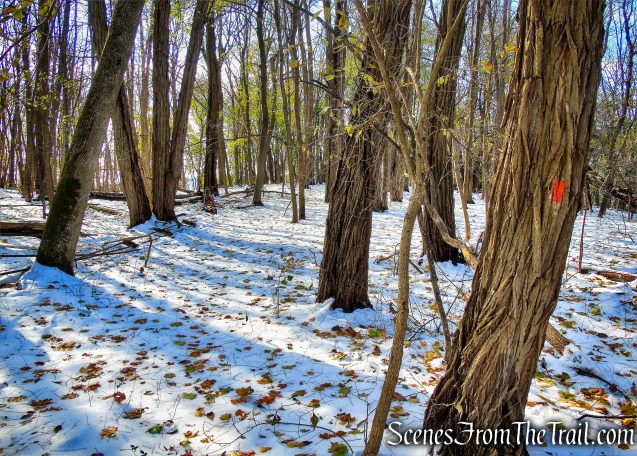
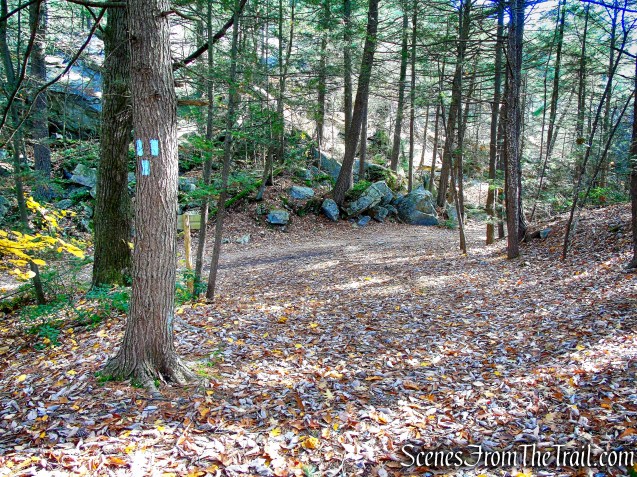
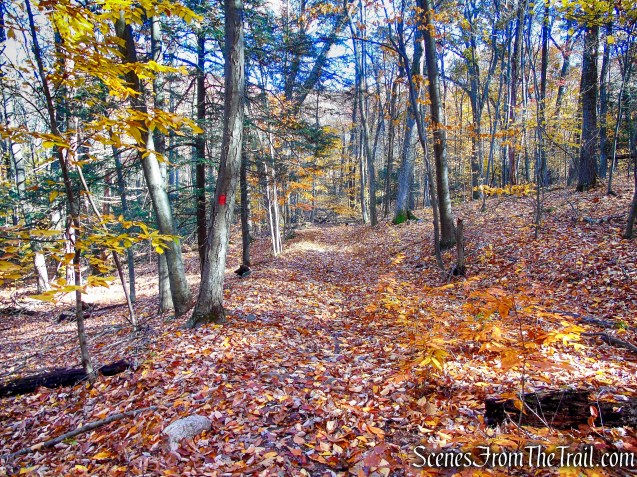
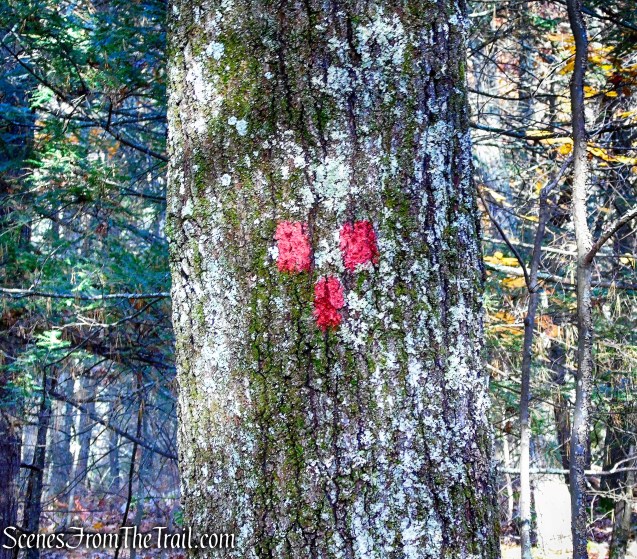
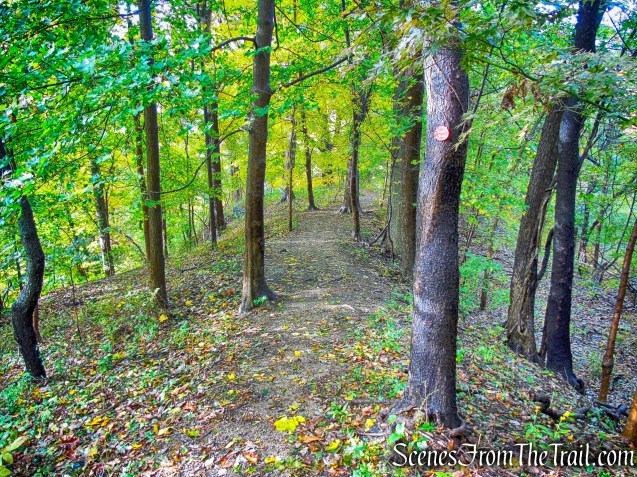
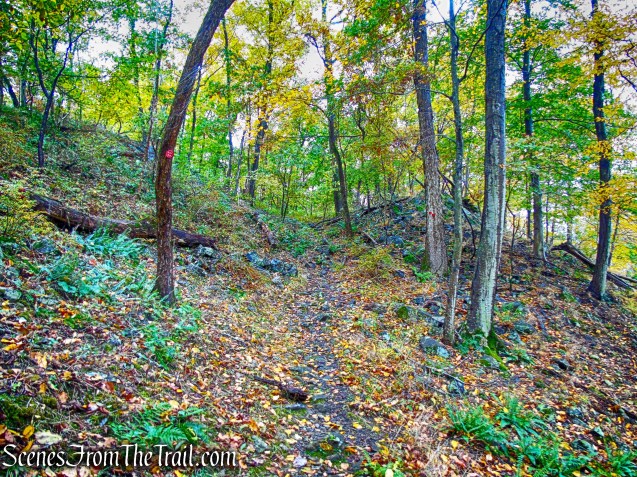
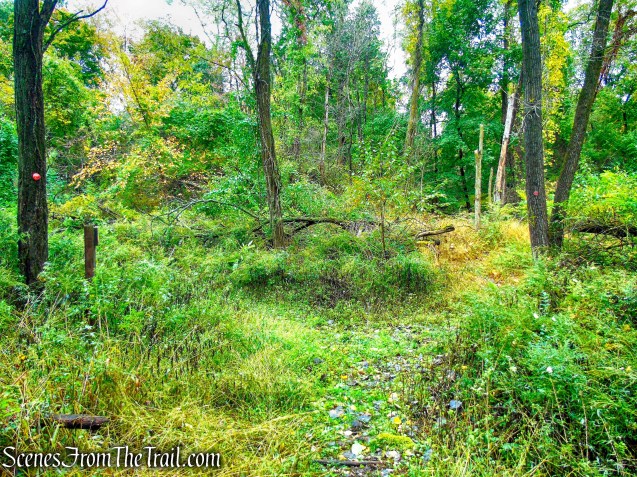
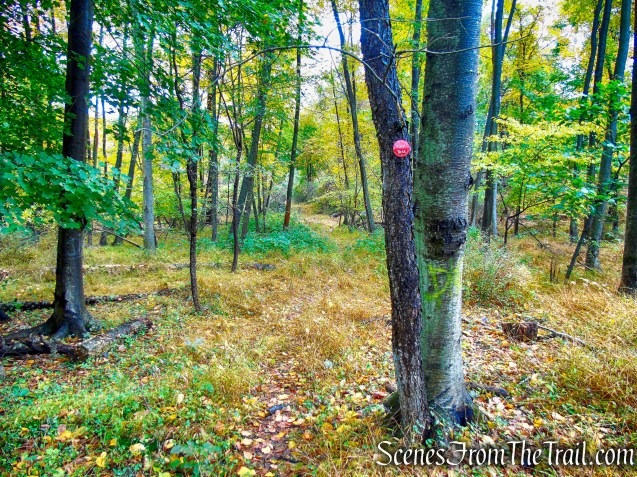
From the parking area, we headed west past the greenhouse onto a woods road that parallels Ridge Road. The red blazes soon appear on a tree as the road continued west, with Ridge Road visible through the trees on the right.

greenhouse - Hart's Brook Park and Preserve

greenhouse – Hart’s Brook Park and Preserve
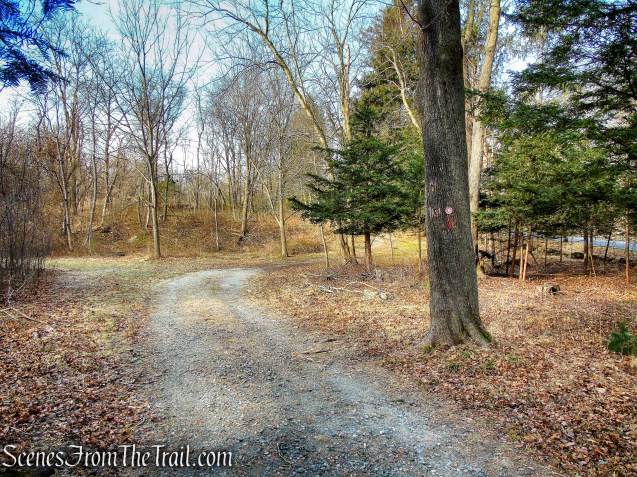
Red Trail - Hart's Brook Park and Preserve

Red Trail – Hart’s Brook Park and Preserve

Red Trail - Hart's Brook Park and Preserve

Red Trail – Hart’s Brook Park and Preserve

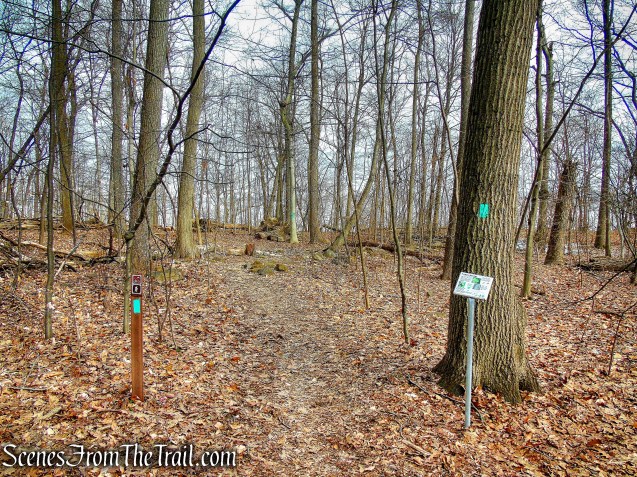
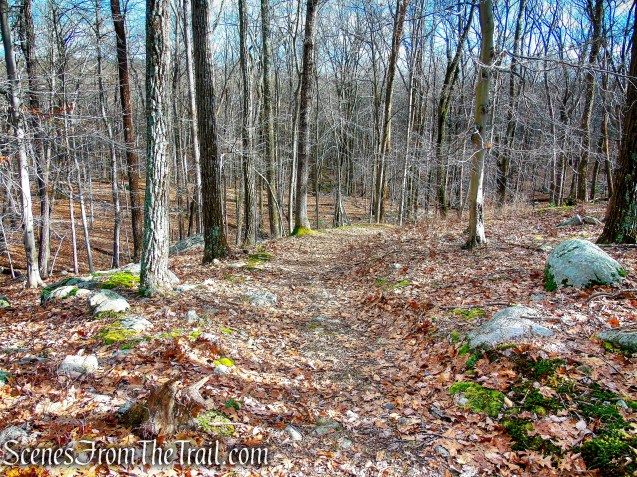
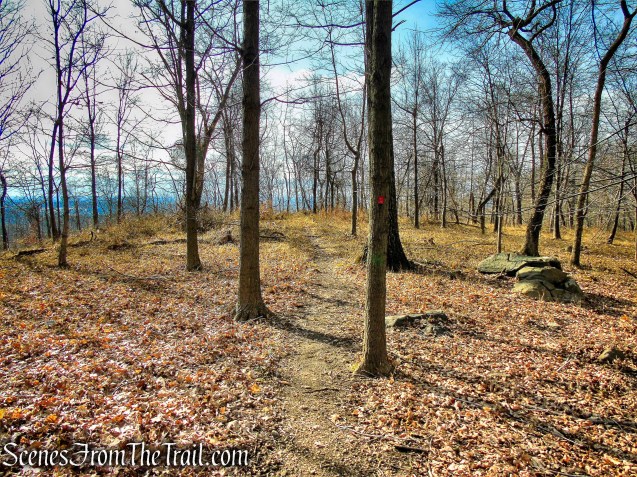
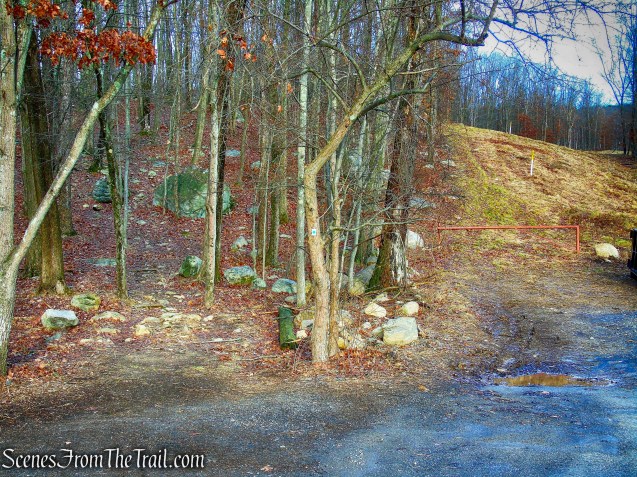
The trail soon turns left and heads south, away from Ridge Road. It then passes through an open area and soon comes to a junction where the red blazes turn left and also continue straight. The left turn leads back to the parking area, we continued straight.

Red Trail - Hart's Brook Park and Preserve

Red Trail – Hart’s Brook Park and Preserve

Red Trail - Hart's Brook Park and Preserve

Red Trail – Hart’s Brook Park and Preserve

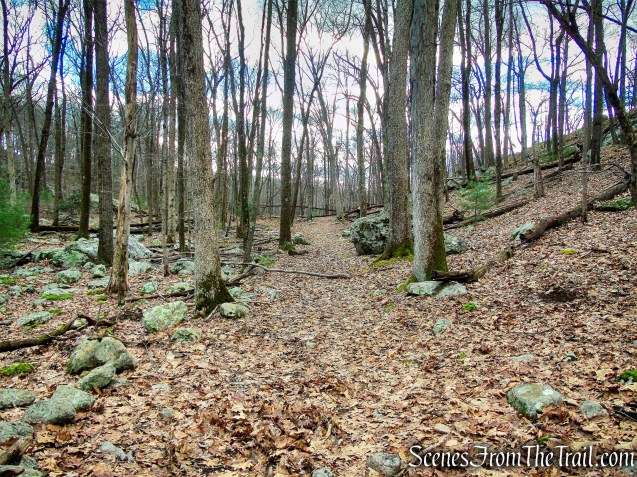
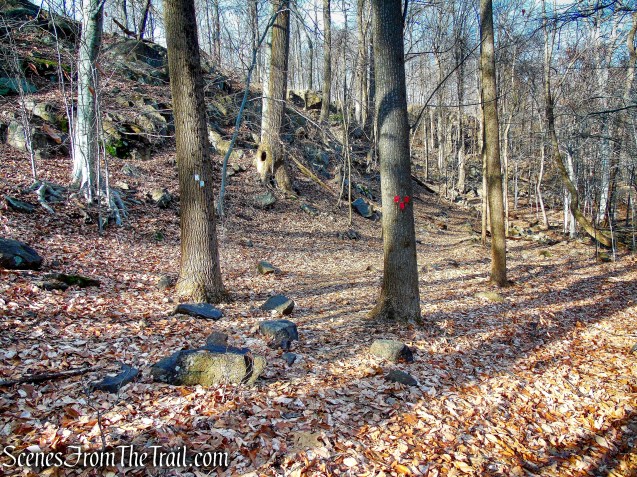
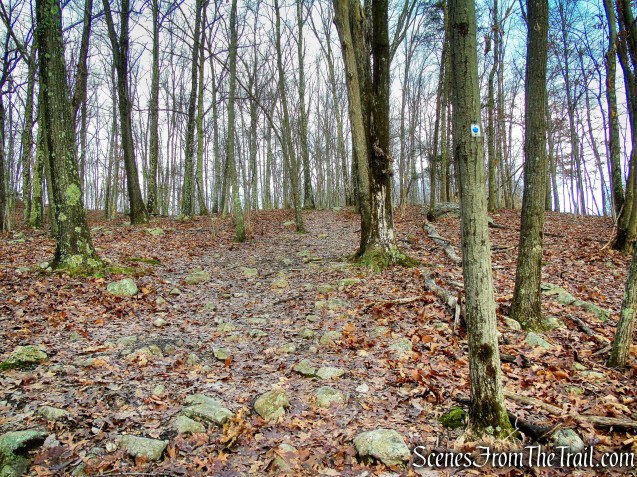
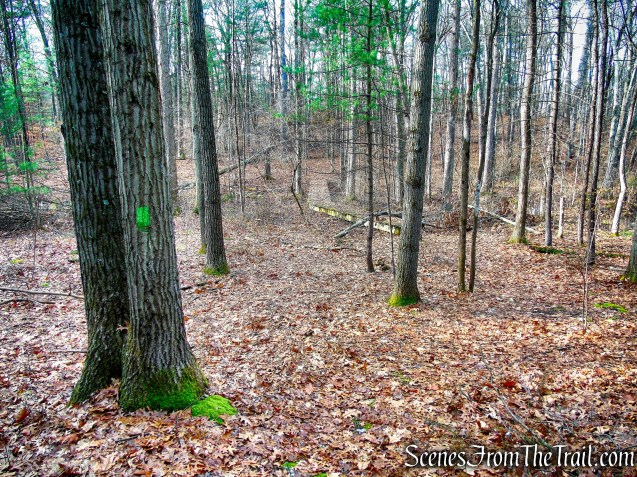
The Red Trail continues south and soon ends at a T-intersection with the Green Trail. We turned left and now headed east on the Green Trail.

Red Trail - Hart's Brook Park and Preserve

Red Trail – Hart’s Brook Park and Preserve

junction of Red & Green Trails - Hart's Brook Park and Preserve

junction of Red & Green Trails – Hart’s Brook Park and Preserve

junction of Red & Green Trails - Hart's Brook Park and Preserve

junction of Red & Green Trails – Hart’s Brook Park and Preserve
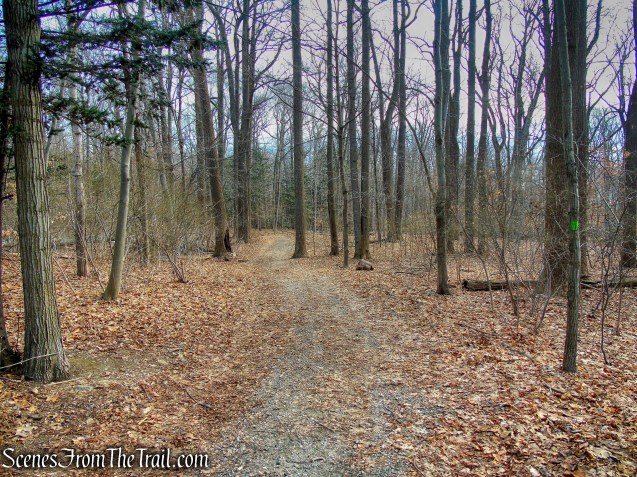
Green Trail - Hart's Brook Park and Preserve

Green Trail – Hart’s Brook Park and Preserve
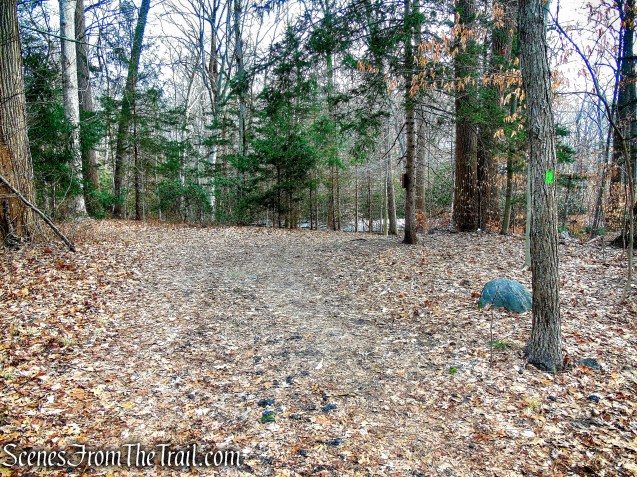
Green Trail - Hart's Brook Park and Preserve

Green Trail – Hart’s Brook Park and Preserve

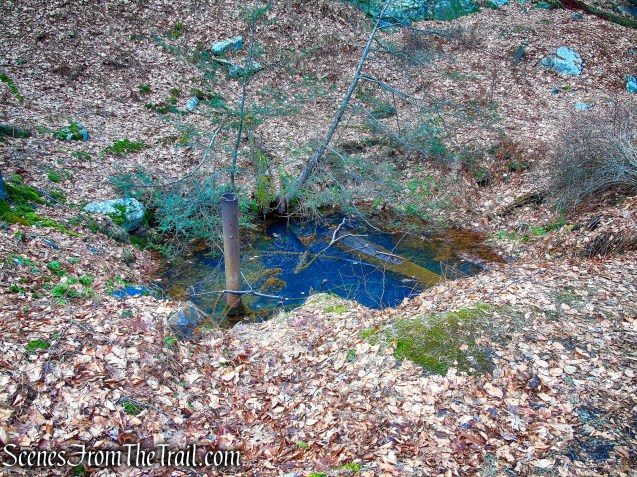
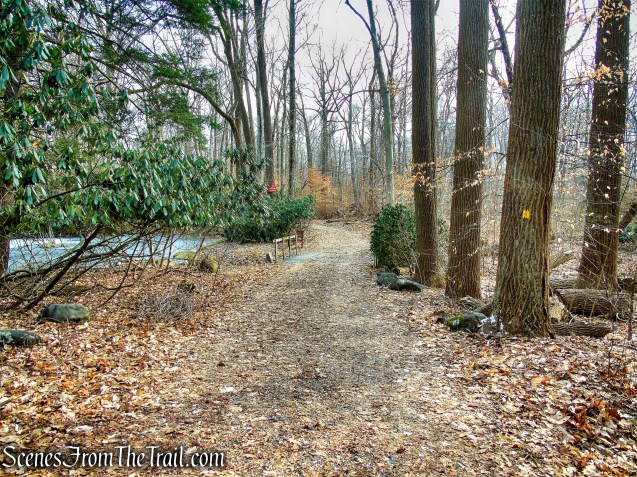
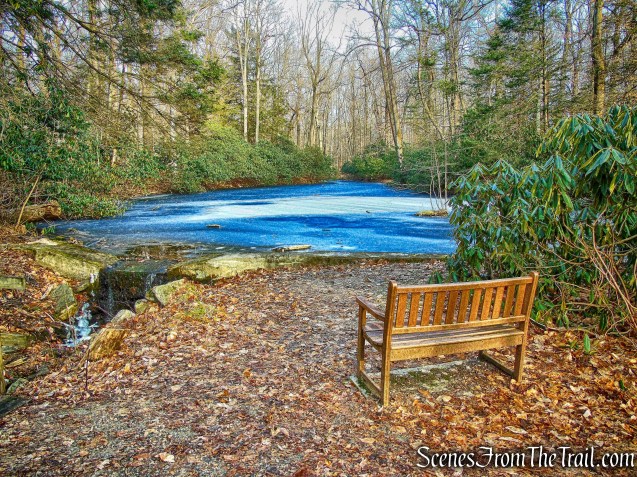
In about 450 feet, the Green Trail ends at a T-intersection with the Yellow Trail. Here we turned right and in a short distance reached a small pond with a bench.
Yellow Trail - Hart's Brook Park and Preserve

Yellow Trail – Hart’s Brook Park and Preserve

Yellow Trail - Hart's Brook Park and Preserve

Yellow Trail – Hart’s Brook Park and Preserve

Yellow Trail - Hart's Brook Park and Preserve

Yellow Trail – Hart’s Brook Park and Preserve
Yellow Trail - Hart's Brook Park and Preserve

Yellow Trail – Hart’s Brook Park and Preserve

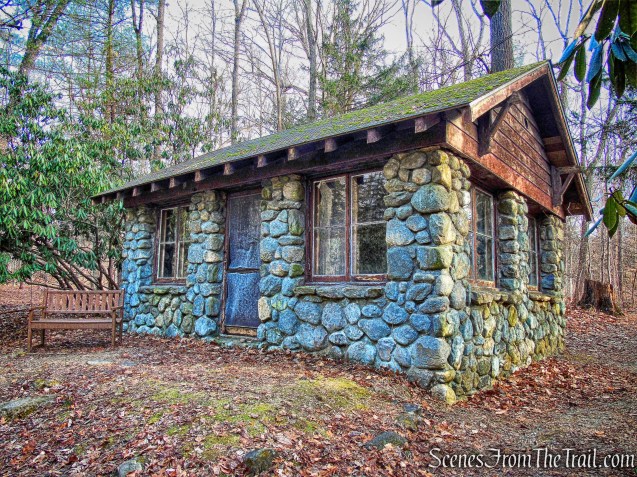
The Yellow Trail wraps around the east side of the pond and soon reaches a stone warming hut. The Yellow Trail continues north, but we turned left onto an unmarked woods road and then turned left again on the other leg of the Yellow Trail, which passes the west side of the pond. A short distance later, the Yellow Trail comes to the junction with the Green Trail and we turned right, retracing our steps here.

warming hut - Yellow Trail - Hart's Brook Park and Preserve

warming hut – Yellow Trail – Hart’s Brook Park and Preserve
warming hut - Yellow Trail - Hart's Brook Park and Preserve

warming hut – Yellow Trail – Hart’s Brook Park and Preserve

Yellow Trail - Hart's Brook Park and Preserve

Yellow Trail – Hart’s Brook Park and Preserve

junction of Green & Yellow Trails - Hart's Brook Park and Preserve

junction of Green & Yellow Trails – Hart’s Brook Park and Preserve

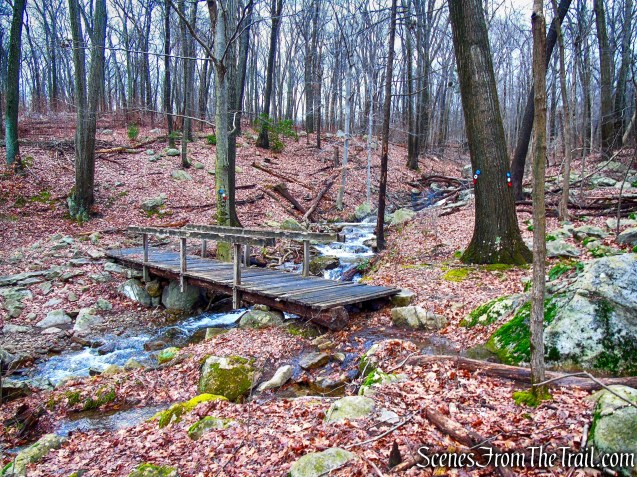
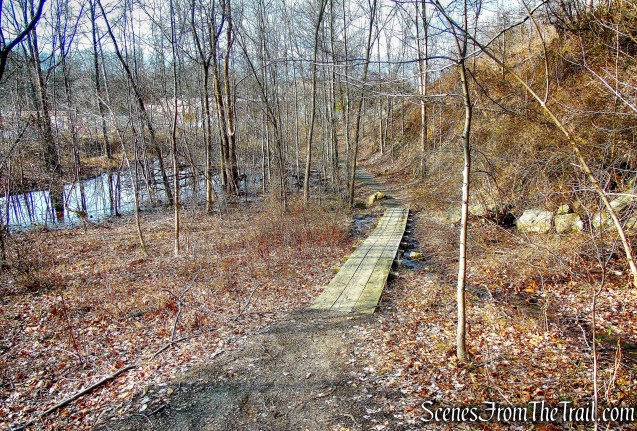
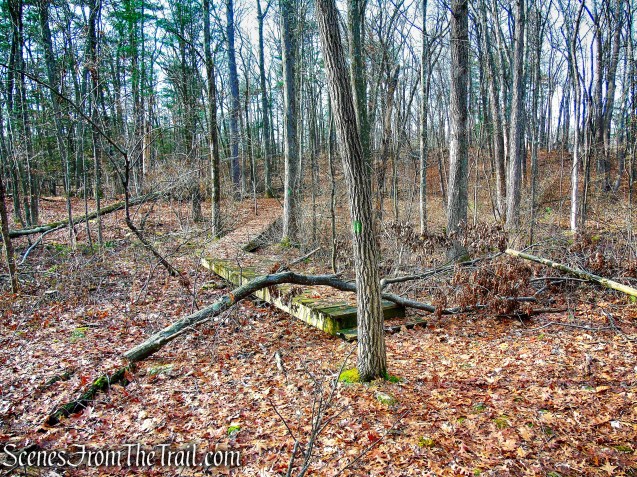
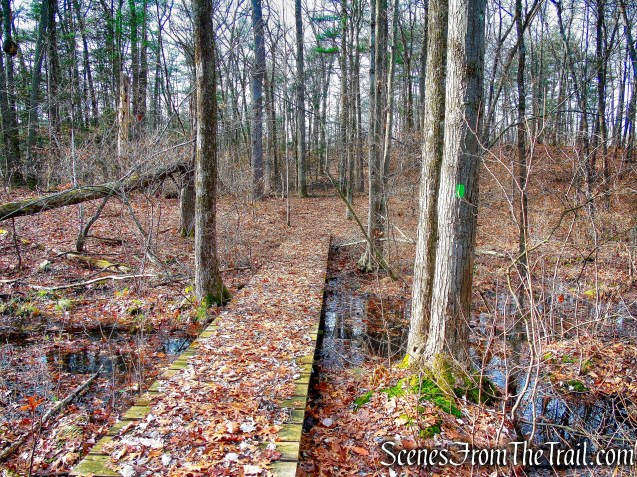
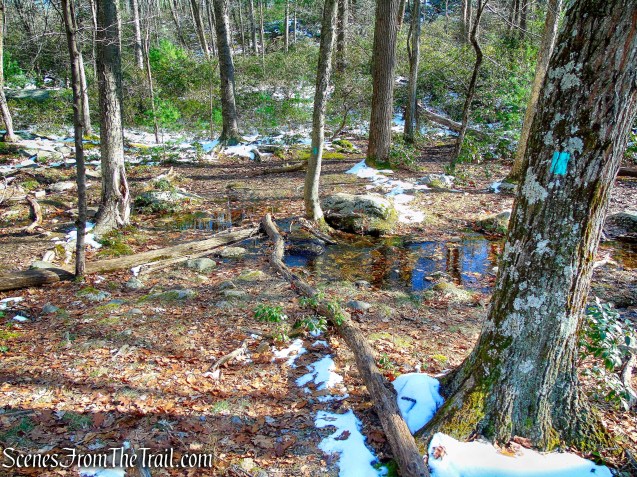
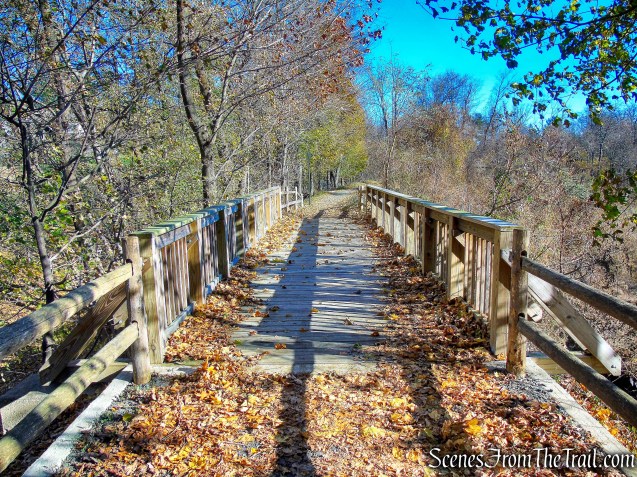
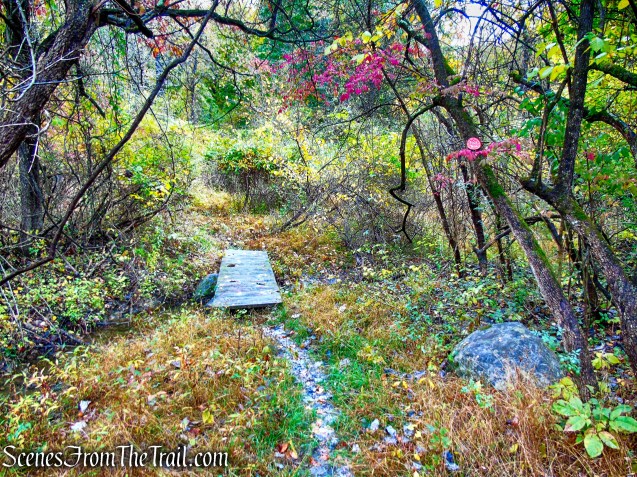
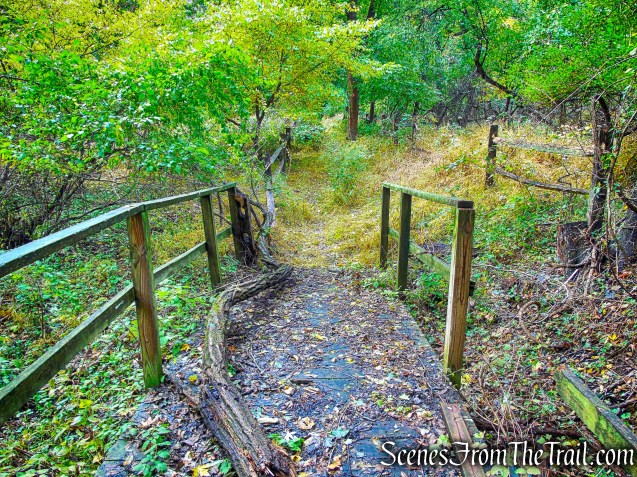
When we arrived at the junction with the Red Trail, we turned left to remain on Green. The trail now heads south, bordering private property and crosses a wooden footbridge.

junction of Red & Green Trails - Hart's Brook Park and Preserve

junction of Red & Green Trails – Hart’s Brook Park and Preserve

Green Trail - Hart's Brook Park and Preserve

Green Trail – Hart’s Brook Park and Preserve

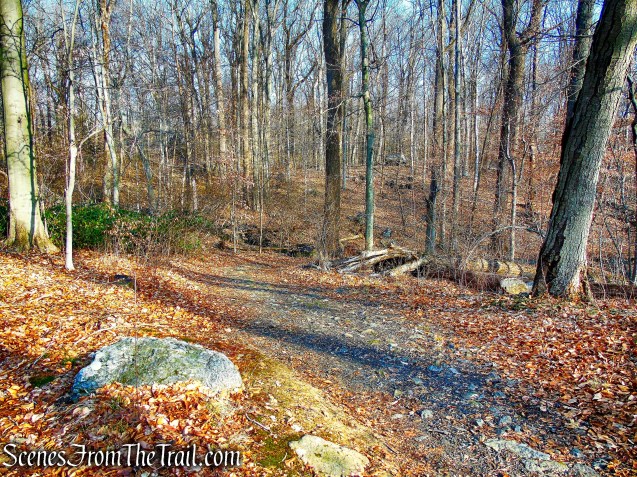
The Green Trail soon curves to the left and heads east along the southern end of the preserve. After crossing another wooden footbridge, the Green Trail soon reaches a junction with the start of the Orange Trail, which begins straight ahead as the Green Trail turns left.
Green Trail - Hart's Brook Park and Preserve

Green Trail – Hart’s Brook Park and Preserve

Green Trail - Hart's Brook Park and Preserve

Green Trail – Hart’s Brook Park and Preserve
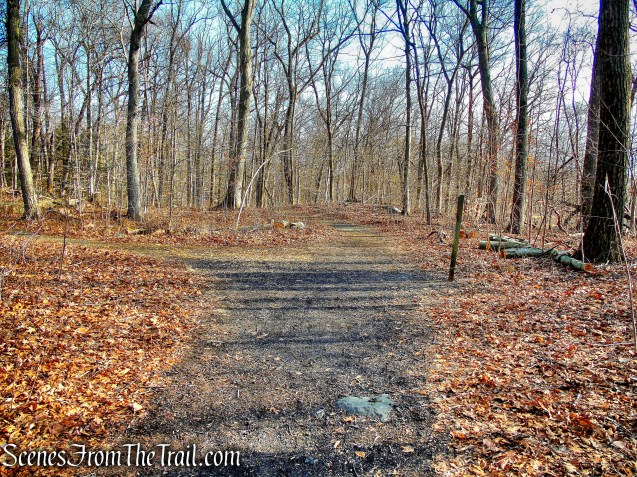
junction of Orange & Green Trails - Hart's Brook Park and Preserve

junction of Orange & Green Trails – Hart’s Brook Park and Preserve

We followed the orange blazes a short distance to a junction with the Blue Trail. We then left the Orange Trail as it turns left and began on the Blue Trail.

Orange Trail - Hart's Brook Park and Preserve

Orange Trail – Hart’s Brook Park and Preserve

junction of Orange & Blue Trails - Hart's Brook Park and Preserve

junction of Orange & Blue Trails – Hart’s Brook Park and Preserve

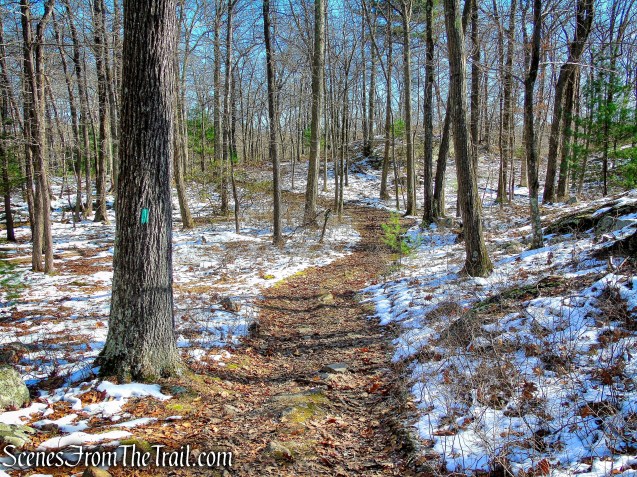
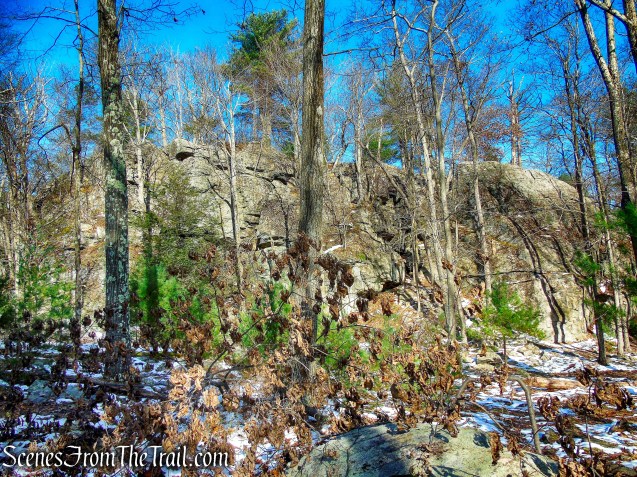
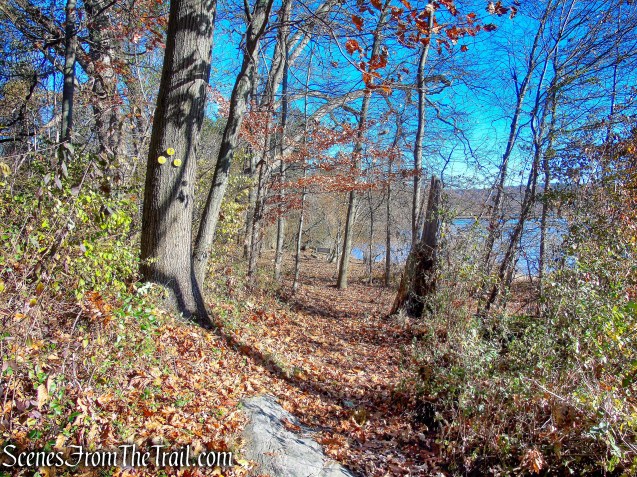
The Blue Trail begins heading south then turns left and heads northeast along the eastern edge of the preserve, with some views through the trees.

Blue Trail - Hart's Brook Park and Preserve

Blue Trail – Hart’s Brook Park and Preserve
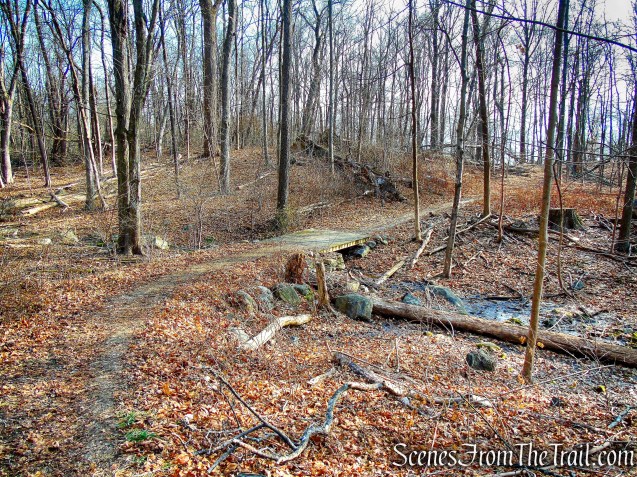
Blue Trail - Hart's Brook Park and Preserve

Blue Trail – Hart’s Brook Park and Preserve

Blue Trail - Hart's Brook Park and Preserve

Blue Trail – Hart’s Brook Park and Preserve

Blue Trail - Hart's Brook Park and Preserve

Blue Trail – Hart’s Brook Park and Preserve

The Blue Trail soon reaches a junction with another leg of the Blue Trail, which goes to the left. We veered right on the outer leg of the Blue Trail, which soon passes between a fence and continues on a paved road.

Blue Trail - Hart's Brook Park and Preserve

Blue Trail – Hart’s Brook Park and Preserve

Blue Trail - Hart's Brook Park and Preserve

Blue Trail – Hart’s Brook Park and Preserve
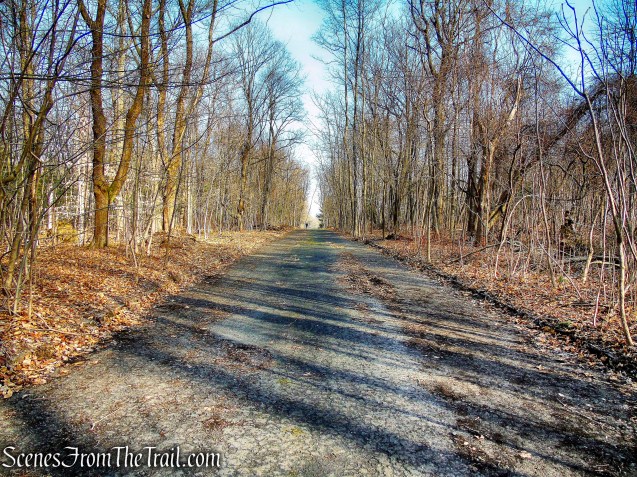
Blue Trail - Hart's Brook Park and Preserve

Blue Trail – Hart’s Brook Park and Preserve

The Blue Trail soon turns left and leaves the paved road, now heading west through the woods. In just under 400 feet, the Blue Trail ends at a T-intersection with the Orange Trail. We turned left on Orange and now began heading southwest. We passed the junction of the start of the Blue Trail (from earlier), which begins on the left and followed the orange blazes until its terminus at the Green Trail.
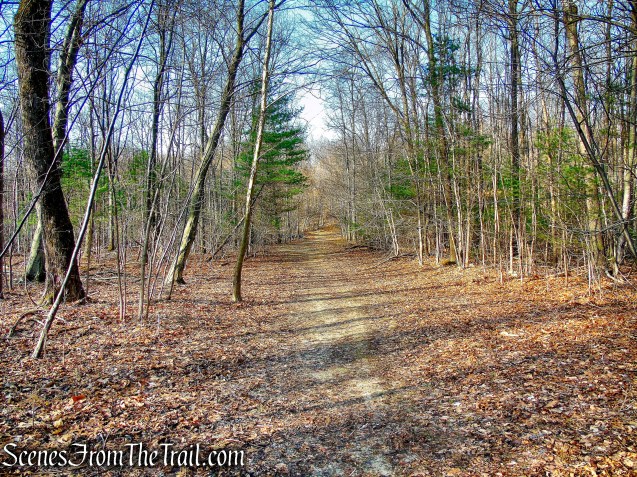
Blue Trail - Hart's Brook Park and Preserve

Blue Trail – Hart’s Brook Park and Preserve

junction of Orange & Blue Trails - Hart's Brook Park and Preserve

junction of Orange & Blue Trails – Hart’s Brook Park and Preserve

Orange Trail - Hart's Brook Park and Preserve

Orange Trail – Hart’s Brook Park and Preserve
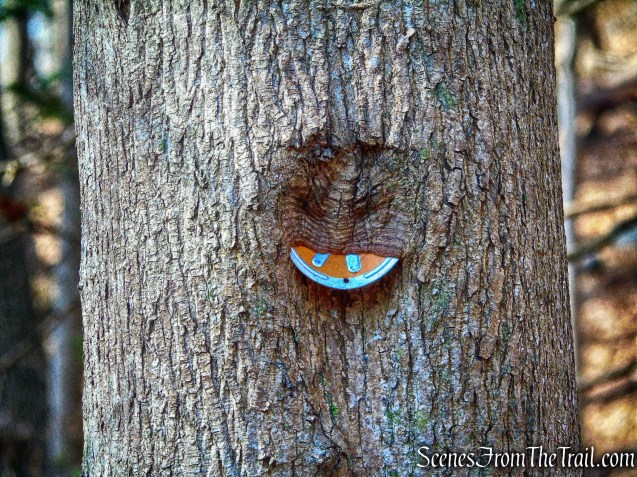
Orange Trail - Hart's Brook Park and Preserve

Orange Trail – Hart’s Brook Park and Preserve

We turned right on Green and followed it north until its terminus, at a junction with the Yellow Trail.

Green Trail - Hart's Brook Park and Preserve

Green Trail – Hart’s Brook Park and Preserve
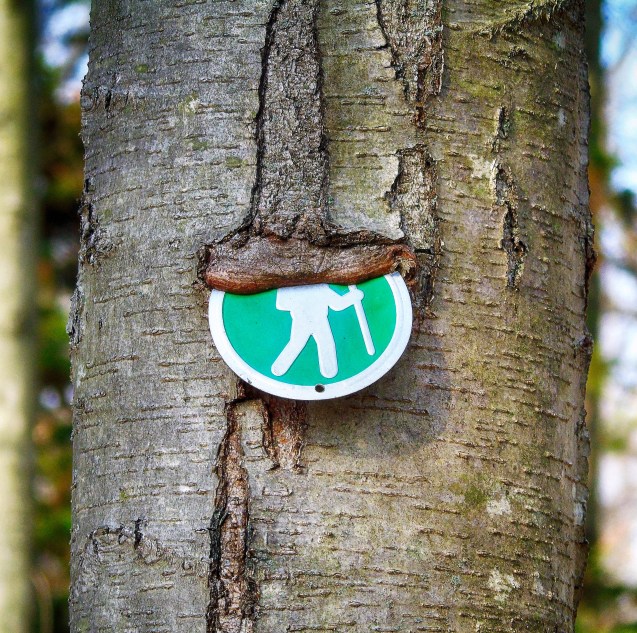
Green Trail - Hart's Brook Park and Preserve

Green Trail – Hart’s Brook Park and Preserve

We continued ahead, now following the yellow blazes in a northerly direction. The Yellow Trail passes two junctions with unmarked woods roads on the left and a paved road (not on the map) which veers right and enters the Marian Woods Convent property.
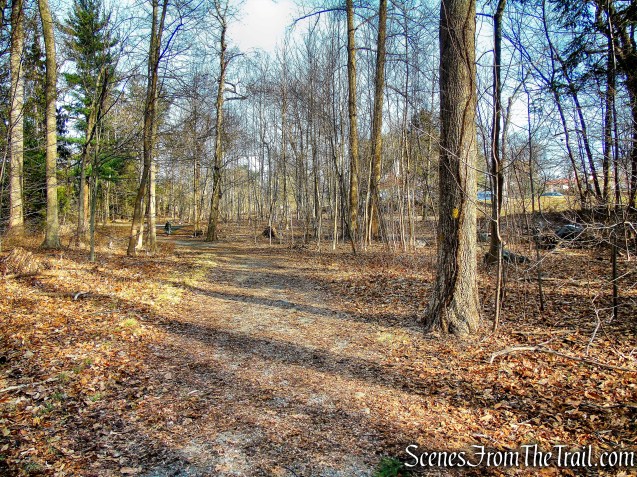
Yellow Trail - Hart's Brook Park and Preserve

Yellow Trail – Hart’s Brook Park and Preserve

The Yellow Trail soon comes out behind the greenhouse and crosses a field and ends at the parking area.

greenhouse - Hart's Brook Park and Preserve

greenhouse – Hart’s Brook Park and Preserve
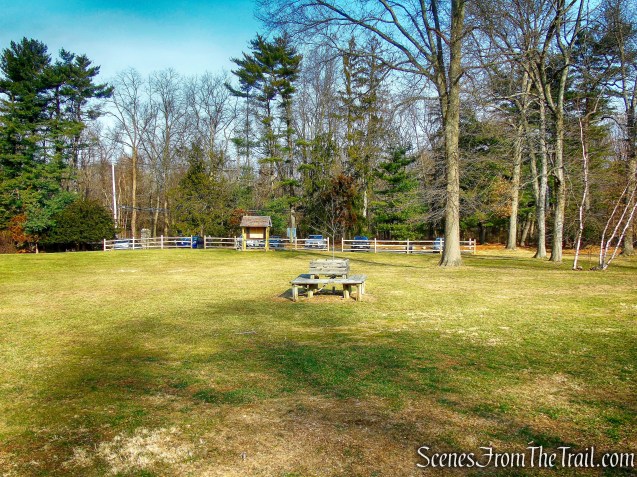
Yellow Trail - Hart's Brook Park and Preserve

Yellow Trail – Hart’s Brook Park and Preserve

A steel sculpture sits along the entrance road.

steel sculpture - Hart's Brook Park and Preserve

steel sculpture – Hart’s Brook Park and Preserve

We then headed east on the Orange Trail which runs across the front lawn. In this area is where we saw what we thought was an owl.

Orange Trail - Hart's Brook Park and Preserve

Orange Trail – Hart’s Brook Park and Preserve

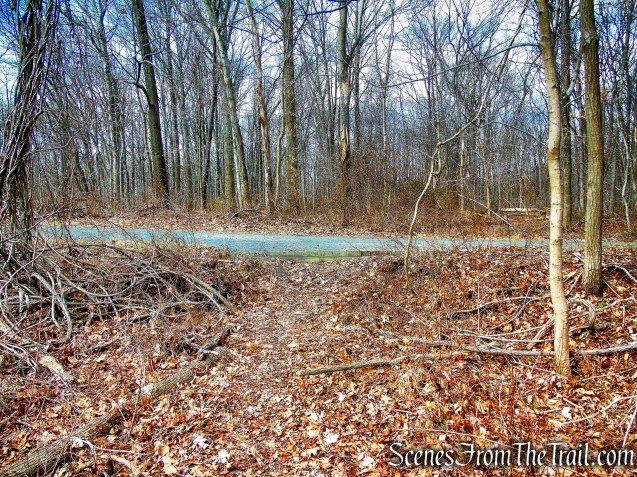
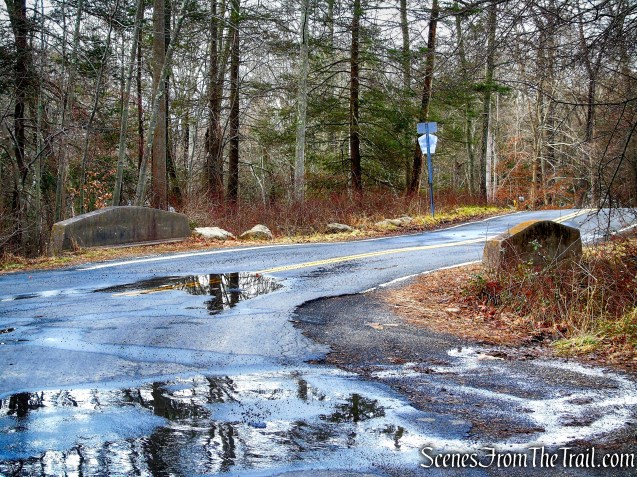
The Orange Trail soon crosses the paved exit road and enters the woods.

Orange Trail - Hart's Brook Park and Preserve

Orange Trail – Hart’s Brook Park and Preserve

Just off the Orange Trail, the buildings of what used to be the Gaisman Estate, now Marian Woods property. The Orange Trail descends the hillside a short distance to where we already hiked. We then retraced our steps back on Orange, across the lawn and back to the parking area, where the hike began.
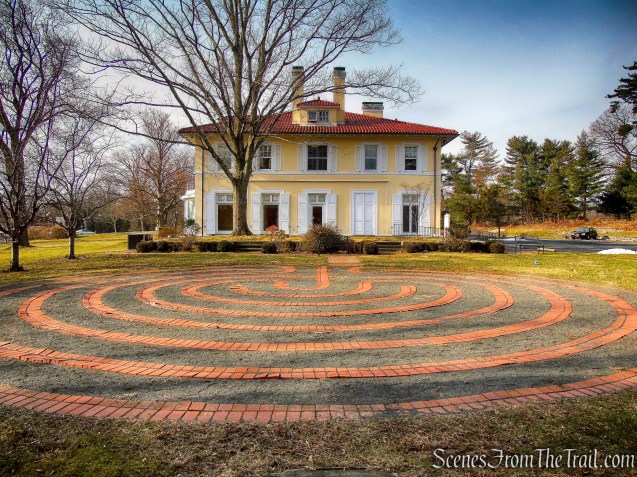
Orange Trail - Hart's Brook Park and Preserve

Orange Trail – Hart’s Brook Park and Preserve

Orange Trail - Hart's Brook Park and Preserve

Orange Trail – Hart’s Brook Park and Preserve

Review:

A very pleasant walk on woods roads through scenic woodlands. The trails are well blazed and the terrain is mostly level, with only several short, steep hills. On the day we visited, there were mostly dog walkers or people out for a walk. A good place to visit in cold weather when there would be less people. We saw what appeared to be a Great Horned Owl flying through the pine trees and a Red-tailed Hawk. Worth the time and effort to explore this lovely preserve.

Pros: Scenic woods, wildlife, lots of bird activity.

Cons: None.

Take a hike!


Tallman Mountain State Park – Hudson River Palisades

January‎ ‎12‎, ‎2019 – Sparkill, NY

Difficulty: Easy

Length: Approximately 4.4 miles

Max elevation: 218 ft. – total elevation gain 409 ft.

Route type: Circuit

Map: Hudson Palisades Trails Map #109Tallman Mountain State Park Map

Trailhead parking: Rockland Road, Sparkill, NY 10976

Overview:

The southernmost component of the Palisades Interstate Park system in New York State, 706-acre Tallman Mountain State Park stretches along the Hudson River from the hamlet of Palisades to the Village of Piermont.

Tallman Mountain State Park comprises wooded country on the easterly slope of the Palisades uplands overlooking the Hudson River and the 1,000-acre Piermont Marsh, which lies between the river and the slope. The marsh is part of the Hudson River National Estuarine Research Reserve. The park operates as a day-use area, offering a running track, tennis courts, ball field, cross country skiing, a walking trail, hiking and picnic areas. Fees may apply.

Tallman Mountain State Park

Tallman Mountain State Park

History:

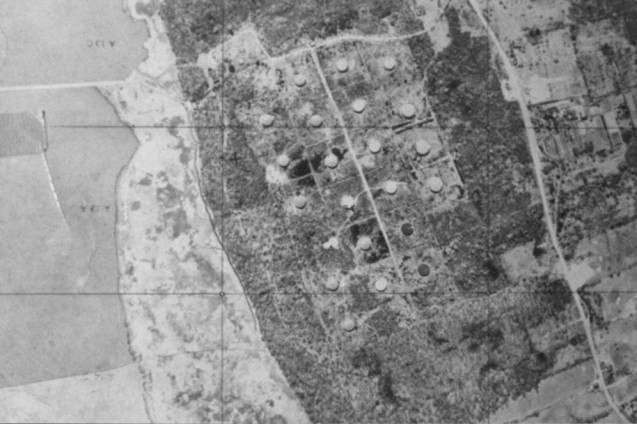
The cliff area was once threatened with quarrying. In 1923 the Standard Oil Company planned to take 540 acres to make an oil tank “farm.” The project was never completed because of strong public opposition. There are still many oil-seepage ditches with earthen berms. When the land was acquired by the park, the ditches became woodland ponds.

Below is an aerial photograph (circa 1920) which show the tanks. Image courtesy of the Nyack Library.

Tallman Mountain State Park - Nyack Library

Tallman Mountain State Park – Nyack Library

Tallman Mountain State Park was formed in 1928 after the Palisades Interstate Park Commission moved to condemn the 164-acre property of the Standard Trap Rock Company in an effort to preserve a portion of the Hudson River Palisades. Park facilities were improved in 1933 by Temporary Emergency Relief Administration workers, who constructed a swimming pool, recreation fields, and picnic areas. Some 550 men commuted daily from Yonkers to work on the construction. The park was so popular that it soon became overcrowded. In 1942 the Commission acquired 542 additional acres, the money donated by three of the Commissioners, Laurance S. Rockefeller, George W. Perkins, and W. Averell Harriman.

Trails:

Two north-south trails extend the length of the park, the Long Path and the Tallman Bike Path. These two trails may be combined to make loop hikes from 2.5 to 5 miles. There are also some paved path roads, walkways and unmarked footpaths that branch off the main trails as well.

Tallman Mountain State Park

Tallman Mountain State Park

The Hike:

I scheduled this hike to coincide with the controlled demolition of the East Anchor of the Tappan Zee Bridge. Some of the best views of the Tappan Zee Bridge can be had from the Piermont Pier and Tallman Mountain. Unfortunately the demolition was postponed, but I decided to proceed with the hike anyway.

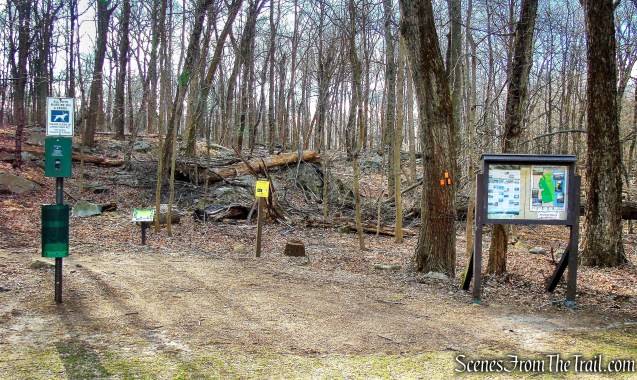
From the South Picnic parking area, we began following the orange blazes of the Interpretive Trail.

Start of Interpretive Trail

Start of Interpretive Trail

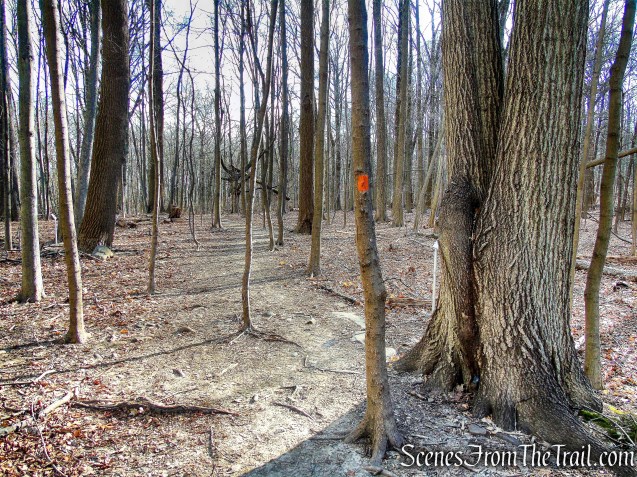
Interpretive Trail

Interpretive Trail

The trail heads east through the tree lined forest.

Interpretive Trail

Interpretive Trail

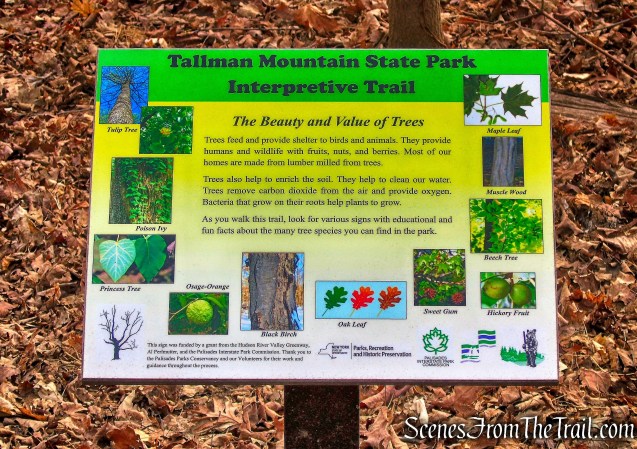
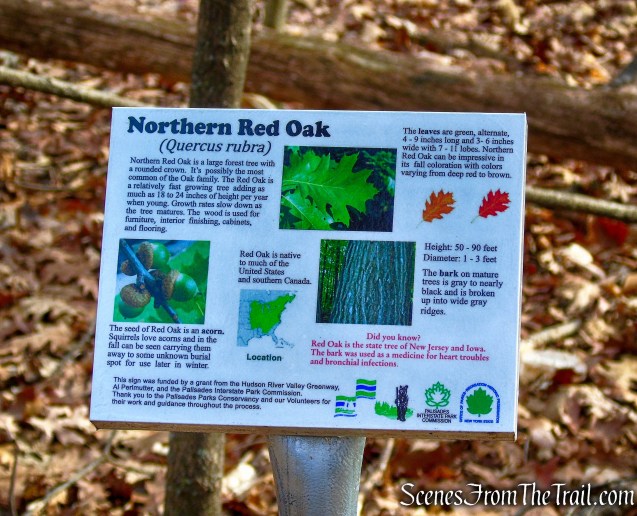
Along the way there are interpretive signs with detailed information on the different species of the native trees.

Interpretive Trail

Interpretive Trail

Interpretive Trail

Interpretive Trail

In about 400 yards, the Interpretive Trail crosses the Tallman Bike Path. In another 250 feet, the orange-blazed trail ends at a T-intersection with the aqua-blazed Long Path.

terminus of Interpretive Trail

terminus of Interpretive Trail

We turned left on the Long Path which heads north. The Long Path bears right at a fork and descends to reach the south end of a picnic area. With a gated road visible on the left, the Long Path bears right again and soon passes a stone comfort station on the left (closed in the winter) and a large group of picnic tables. Just beyond, it bears right at a fork, descends a slope, and briefly continues ahead along a stone-lined road. The trail bears right, leaving the road, and continues to descend more steeply on a footpath and stone steps. At the bottom of the steps, the trail turns sharply right and descends on a switchback.

Long Path

Long Path

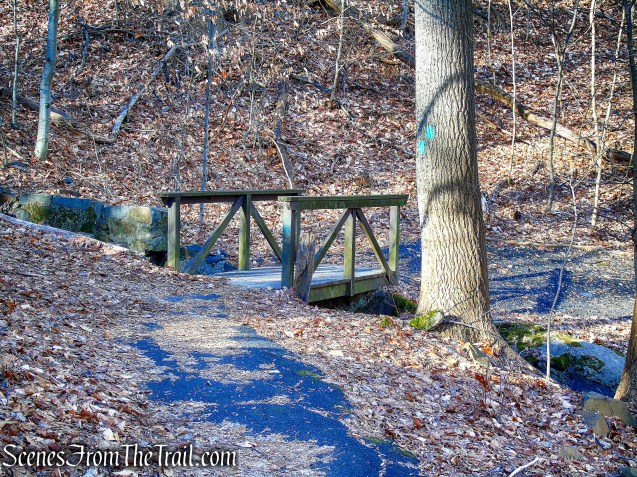
The Long Path turns right at the base of the descent and crosses a stream on a wooden bridge.

Long Path

Long Path

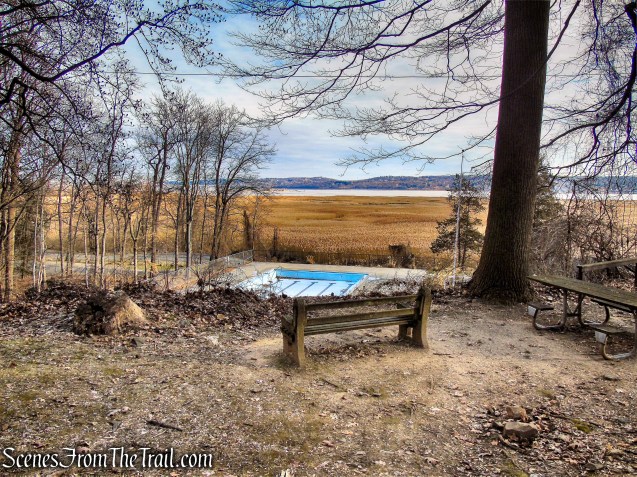
Just ahead, the park swimming pool is visible below on the right, with the Piermont Marsh and the Hudson River beyond. A bench has been placed here for visitors to pause to enjoy the view.

Long Path

Long Path

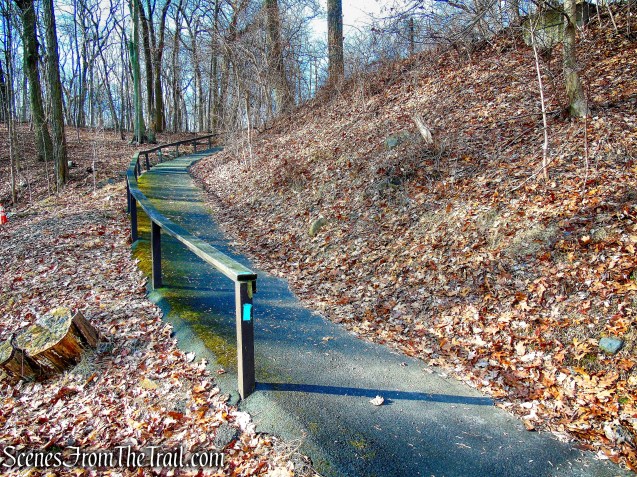
We continued to follow the Long Path as it turns sharply left and climbs a paved path to a traffic circle.

Long Path

Long Path

The marked trail bears right and crosses the park road that leads down to the river.

Long Path

Long Path

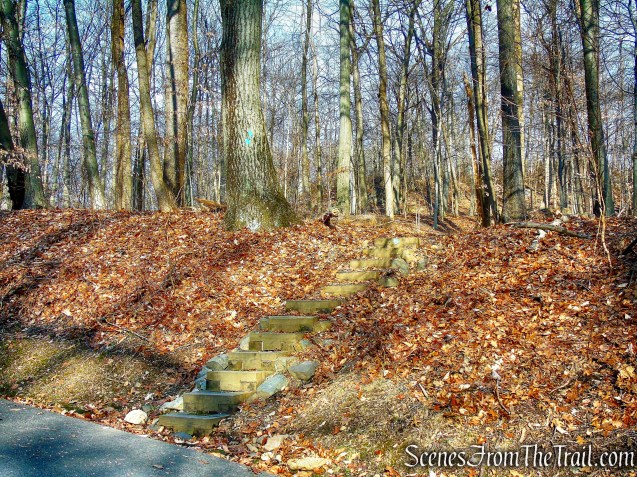
On the other side of the road, it goes up wooden steps and continues to climb rather steeply to the North Picnic Area.

Long Path

Long Path

Long Path

Long Path

At the top, it turns right and follows the paved park road that runs close to the edge of the escarpment.

Long Path

Long Path

There are picnic tables and benches along the way to take a break and enjoy the partial views through the trees.

Long Path

Long Path

After passing a stone picnic shelter on the left, the Long Path reaches a viewpoint over the Hudson River from an open area on the right. The mile-long Piermont Pier (built by the Erie Railroad in 1838 as a terminus for its trains from the west) juts into the river to the north, with the Tappan Zee Bridge beyond. Piermont Marsh is directly below, and the villages of Irvington and Dobbs Ferry may be seen across the river.

Long Path

Long Path

Tappan Zee Bridge

Tappan Zee Bridge

We continued ahead along the paved road. In another 200 feet, as the road bends to the left, we followed the aqua blazes which leave the road and continue ahead to a panoramic viewpoint.

Long Path

Long Path

This one looks north along the Hudson, with the village of Piermont directly below and Hook Mountain jutting into the river in the distance. Benches have been placed here to encourage you to pause and enjoy the view.

Long Path

Long Path

Tappan Zee Bridge

Tappan Zee Bridge

Hook Mountain

Hook Mountain

The Long Path now bears right and steeply descends to the river level on rough, uneven rock steps. Caution should be exercised here if it is wet or covered with leaves.

Long Path

Long Path

Long Path

Long Path

Long Path

Long Path

At the base of the descent, the Long Path reaches a gravel road, the route of the Tallman Bike Path. I turned left here to make a little detour.

Long Path

Long Path

I followed the Long Path to the gate on Ferdon Avenue to get a look at the historic Sparkill Creek Drawbridge.

Long Path

Long Path

The Sparkill Creek Drawbridge is a historic Pratt Pony Truss drawbridge located at Piermont in Rockland County, New York.

Sparkill Creek Drawbridge

Sparkill Creek Drawbridge

It was built in 1880 by the King Iron Bridge Company of Cleveland, Ohio, and is a single-leaf movable metal bridge.

Sparkill Creek Drawbridge

Sparkill Creek Drawbridge

Chains can lift the bridge when an operator turns a crank, helped by counterweights. It spans Sparkill Creek, a tributary of the Hudson River.

Sparkill Creek Drawbridge

Sparkill Creek Drawbridge

The bridge was listed on the National Register of Historic Places in 1985 and documented by the Historic American Engineering Record in 1994. A complete dismantling and restoration for $900,000 was completed in 2009 and the bridge now serves as solely a pedestrian bridge. The Rockland County Highway Department was responsible for this historic restoration.

Sparkill Creek Drawbridge

Sparkill Creek Drawbridge

After checking out the bridge, I retraced my steps and rejoined my hike mates on the gravel road. Passing the spot where the Long Path meets the gravel road, we began heading south. This unmarked gravel road which curves to the right and begins to parallel the reeds of the Piermont Marsh, is the Tallman Bike Path.

Tallman Bike Path

Tallman Bike Path

When the gravel road ends at a barrier of wooden posts, we veered right and continued uphill on the paved park road.

Tallman Bike Path

Tallman Bike Path

paved park road

paved park road

looking east from paved park road

looking east from paved park road

When we reached the traffic circle, we turned left at the end of the guardrail and then immediately veered right onto an unmarked footpath that leads into the woods.

unmarked footpath

unmarked footpath

We followed this unmarked path which heads south, parallel to the park road. After crossing an open area, it joins a moss-covered paved path that comes in from the left and soon ends at a park road that leads to the South Picnic Area.

unmarked footpath

unmarked footpath

moss-covered paved path

moss-covered paved path

We turned left onto this paved road, then veered right at the fork, following the green “Bike Route” sign.

bear right at the fork, following the green “Bike Route” sign

bear right at the fork, following the green “Bike Route” sign

Heading south on the paved bike path, we spotted a water tank just up the hill on the right.

Tallman Bike Path

Tallman Bike Path

I bushwacked up the hill to check it out, a worthwhile detour.

water tower

water tower

I then bushwacked south from the water tower and rejoined my fellow hikers on the bike path.

Tallman Bike Path

Tallman Bike Path

The pavement ends at the top of the hill, but we followed the gravel road as it heads south, parallel to the Hudson River, which is sometimes visible through the trees on the left. From the point at which the paving of the Bike Path ends (near the top of the hill), we continued ahead on the Bike Path for 0.3 mile, watching carefully for the Long Path crossing. When we reached the spot where the Long Path crosses the Bike Path, we turned left onto the aqua-blazed trail.

turn left on Long Path

turn left on Long Path

We continued on the Long Path for about 300 feet until we came close to the cliff edge and noticed an unmarked footpath that comes in from the right.

Long Path

Long Path

We turned right onto this footpath and headed south, with views of the Hudson River to the left through the trees.

unmarked footpath

unmarked footpath

In about half a mile, we reached an open rock ledge on the left that affords spectacular views over the river, the Piermont Marsh below, and the Tappan Zee Bridge to the north.

view from open rock ledge

view from open rock ledge

view from open rock ledge

view from open rock ledge

view from open rock ledge

view from open rock ledge

After taking in the view, we continued south along the unmarked trail. In about 500 feet, just before reaching a deep ravine, the trail turns right and begins to head west.

unmarked footpath

unmarked footpath

Just beyond, we were supposed to bear right at a fork (this turn can easily be missed, as the left fork is more distinct). We overshot this turn and ended up at stream crossing with some brick columns along the edge of the stream. We backtracked a short distance and with the help of the Avenza app, found the trail we were looking for.

unmarked footpath

unmarked footpath

Once on the trail it became more discernible and easier to follow. The unmarked trail soon ends at the gravel road followed by the Bike Path.

turn right on Tallman Bike Path

turn right on Tallman Bike Path

We turned right onto the Tallman Bike Path and began heading north.

Tallman Bike Path

Tallman Bike Path

Tallman Bike Path

Tallman Bike Path

After about 0.8 mile on the bike path, we reached the spot where the orange-blazed Interpretive Trail crosses the road.

turn left on Orange Trail

turn left on Orange Trail

Here we turned left and began following the orange blazes as they lead west, now retracing our steps.

Interpretive Trail

Interpretive Trail

Interpretive Trail

Interpretive Trail

We followed the orange blazes back to the parking area where the hike began.

Interpretive Trail

Interpretive Trail

Upon returning to the vehicle and enjoying some hot chocolate and a Raspberry Turnover, I decided to take a walk and take a look at the stone handiwork of the TERA workers. (This distance is not included in the length of the hike).

Tallman Mountain State Park

Tallman Mountain State Park

I was intrigued by the stonework just beyond.

Tallman Mountain State Park

Tallman Mountain State Park

Tallman Mountain State Park

Tallman Mountain State Park

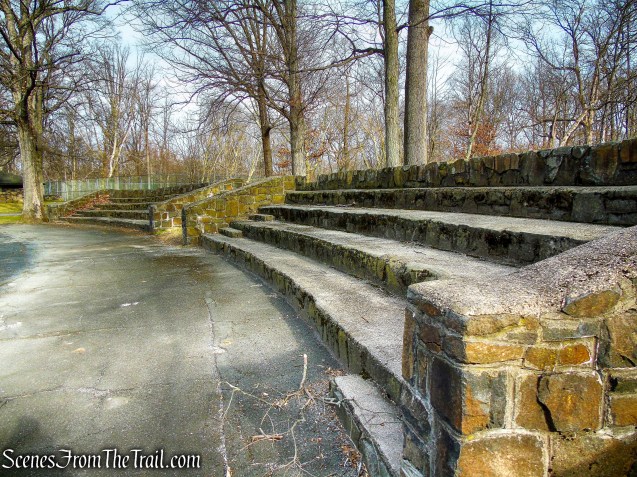
I was surprised and impressed when I discovered that they were stone bleachers.

Tallman Mountain State Park

Tallman Mountain State Park

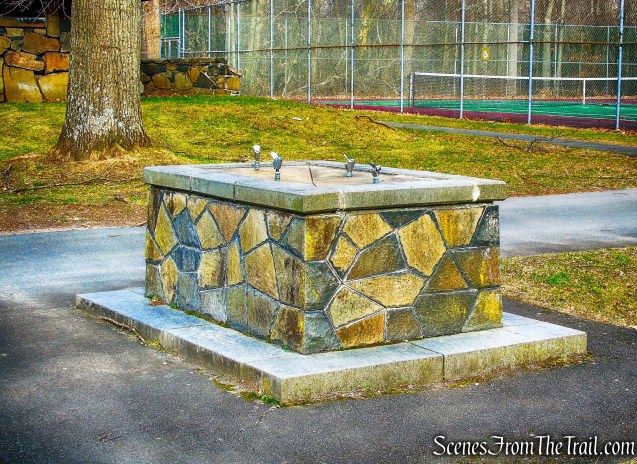
A stone water fountain nearby.

Tallman Mountain State Park

Tallman Mountain State Park

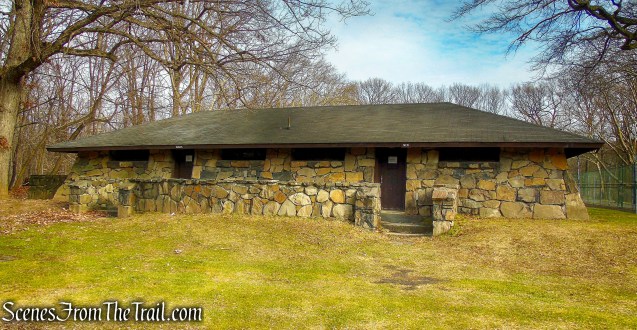
A double-sided stone comfort station with terraces.

Tallman Mountain State Park

Tallman Mountain State Park

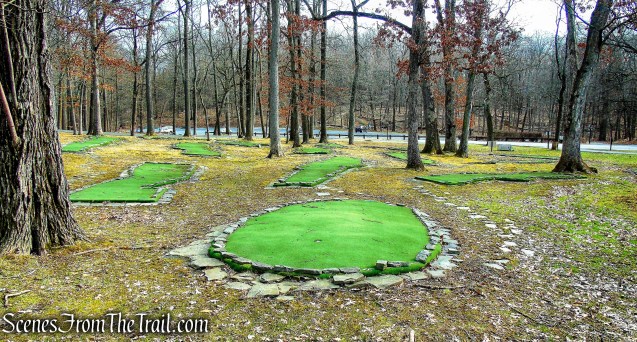
There is a miniature golf course and tennis courts in this area as well.

Tallman Mountain State Park

Tallman Mountain State Park

Review:

This is a really nice hike, but most likely better done in the colder months as this park gets crowded in the summer. We saw several pairs of hikers/walkers on our visit, but were mostly alone for the duration. With the leaves being off the trees, we had almost constant views of the Hudson River throughout the hike. The history of the park and the stonework of the Temporary Emergency Relief Administration workers during the Great Depression, makes this park worth visiting.

Pros: Scenic views, historical features, Long Path.

Cons: Gets crowded during the summer months.

Take a hike!

Tallman Mountain State Park

Tallman Mountain State Park

Sources:

MANITOGA

January‎ ‎6‎, ‎2019 – Garrison, NY

Difficulty: Easy – moderate

Length: Approximately 2.6 miles

Max elevation: 640 ft. – total elevation gain: approximately 617 ft.

Route type: Circuit

Map: East Hudson Trails Map #101Free Web Map

Trailhead parking: 584 NY-9D, Garrison, NY 10524


Overview:

Located in Garrison, New York, approximately one hour north of New York City, Manitoga is the House, Studio and 75-acre woodland garden of American industrial designer Russel Wright (1904-1976). Manitoga is a National Historic Landmark, an Affiliate Site of the National Trust for Historic Preservation, and one of the few 20th century modern homes with original landscape open to the public.

Over 70 years ago, Russel and Mary Wright acquired an abandoned quarry and surrounding hillside in the Lower Hudson Valley, and he slowly restored this land to a place of extraordinary beauty. Inspired by the legacy of the Wappinger people, the ancestral residents of the area, Wright called the emerging vision for these 75 acres “Manitoga” or Place of Great Spirit.

MANITOGA

MANITOGA

The Trails:

The trails offer opportunities for moderate loop hikes of varying distances on the west facing slopes as well as access to extended hiking on the Osborn Loop Trail and Appalachian Trail in the adjacent Hudson Highlands State Park. In the summer there are pocket views of the Hudson River. These are called “osios” at Manitoga, from the language of the Iroquois.

Three trail loops, named for an historic trail segment, story, or event unique to that loop are marked with blue, red, or white markers.

The trails are co-aligned, following a single path from the start, with the Wickopee Trail Loop (Red) first peeling off to a short inner loop; then the White Pine Trail Loop (White): and finally, the Lost Pond Trail Loop (Blue) extending up the hill to an elevation of 650’ (400’ above the start). Loops reunite at Four Corners and are co-aligned for the descent to the meadow origin.

Wickopee Trail Loop – Red Blazes
.74 miles 45 min.
– easy hike on Wickopee Trail includes Log Bridge stream crossing

White Pine Trail Loop – White Blazes
1.1 miles 1 hr.
– easy to moderate hike follows White Pine Path along the top of a great cliff; over a boulder stream crossing; past the fallen, giant white pine to Deer Pool; and through Fern Meadow

Lost Pond Trail Loop – Blue Blazes
1.5 miles 1-1/2 hrs.
– moderate hike crosses streams on boulder stepping stones and ascends to Lost Pond
– access to 3 view spots: Mossy Overlook, Lost Pond Osio, and Chestnut Ridge Osio
– connects to Osborn Loop and Appalachian Trail

Trails to View Spots and at connecting trail – Yellow Blazes
Trail to Sunset Osio .03 miles
Trail to Chestnut Oak Ridge Osio .16 miles
Osborn Loop & AT connecting trail at Lost Pond .12 miles

In keeping with Wright’s original plan, all his trails were designed to be hiked in one direction; trail blazes reinforce that intention by being single colored in one direction, and the same color but with a black dot in the reverse direction.

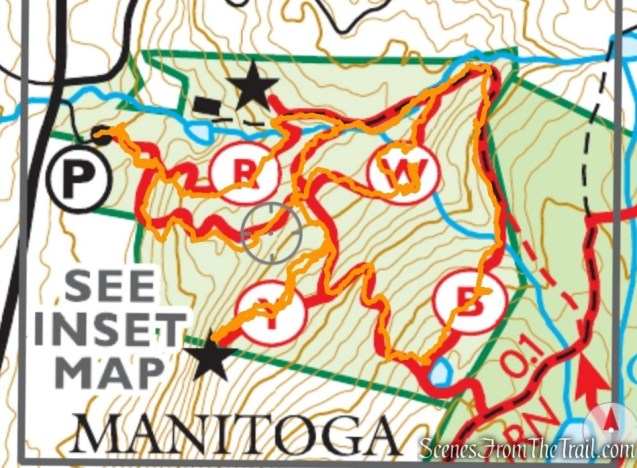
MANITOGA Trail Map

MANITOGA Trail Map

The hike:

The three main trails on the property, which are are laid out ladder-like up the hill toward Lost Pond, are intended to be hiked in a clockwise direction. Although they are also blazed in the other direction, those blazes have a black dot in the middle, indicating that this is not the preferred direction of travel. This hike follows the trails in a clockwise direction, but you will notice blazes with black dots when you retrace your steps on side trails that lead to viewpoints. This hike covers all of the main trails on the property.

MANITOGA

MANITOGA

After stopping at the Guide House to register, head uphill on a wood-chip road. Turn left at a sign for “TRAILS,” then turn left again at a larger sign. You’ll be following the blue-blazed Lost Pond Trail Loop, but at first, this trail is co-aligned with the red-blazed Wickopee Trail Loop and the white-blazed White Pine Trail Loop.

Guide House - MANITOGA

Guide House – MANITOGA

MANITOGA

MANITOGA

Killalemy Trail - MANITOGA

Killalemy Trail – MANITOGA

Follow the trail, marked with white, red and blue blazes, as it climbs on stone steps and switchbacks. After passing through mountain laurel thickets, the trail goes between two large boulders and levels off. It then descends a little to cross a wooden bridge over a stream. The trail now turns sharply left to briefly parallel the stream, then curves to the right.

Killalemy Trail

Killalemy Trail

Killalemy Trail - MANITOGA

Killalemy Trail – MANITOGA

Killalemy Trail - MANITOGA

Killalemy Trail – MANITOGA

railing bridge - MANITOGA

railing bridge – MANITOGA

Just beyond, a triple-yellow blaze marks the start of a short side trail that goes off to the left to a viewpoint known as the Sunset Osio. The view from this location is very limited when there are leaves on the trees, but the short side trip is worthwhile, as there are two interesting boulders at the end of the yellow-blazed side trail.

Please note: The sign pictured below is adjacent to the start of the Yellow Trail described above. We took that to mean that the Yellow Trail was off limits, so we skipped it. The sign refers only to the woods road that is behind the sign and not the marked trail.

MANITOGA

MANITOGA

Return to the main trail and turn left. You now head uphill on an old woods road. Soon, the red-blazed Wickopee Trail Loop leaves to the right, but you should continue ahead, now following white and blue blazes.

Killalemy Trail - MANITOGA

Killalemy Trail – MANITOGA

stay left when Red Trail leaves to the right

stay left when Red Trail leaves to the right

now following white and blue blazes

now following white and blue blazes

A short distance beyond, you’ll cross a stream on rocks opposite a cliff.

cross a stream on rocks

cross a stream on rocks

Next, the white-blazed White Pine Trail Loop goes off to the right. Continue ahead, now following only blue blazes.

white-blazed White Pine Trail Loop goes off to the right

white-blazed White Pine Trail Loop goes off to the right

now following only blue blazes

now following only blue blazes

The trail curves to the right and continues to ascend. Along the way, a yellow blaze on the right of the trail marks the Mossy Overlook Osio, a limited viewpoint from which you can see across the Hudson River.

Mossy Overlook Osio

Mossy Overlook Osio

Mossy Overlook Osio

Mossy Overlook Osio

A short distance beyond, you’ll reach a junction where a sign indicates that the Osborn Loop is to the left. Continue ahead on the blue-blazed trail, following the sign for “Lost Pond.” The trail now crosses a stream and continues to ascend.

Lost Pond Trail Loop

Lost Pond Trail Loop

Lost Pond Trail Loop

Lost Pond Trail Loop

Lost Pond Trail Loop

Lost Pond Trail Loop

After passing through dense mountain laurel thickets, you’ll reach Lost Pond. At the southern end of the pond, a yellow blaze on the right marks the Lost Pond Osio, another limited viewpoint over the Hudson River, and a triple-yellow blaze on the left marks the start of a connecting trail that leads to the Osborn Loop.

Lost Pond Trail Loop

Lost Pond Trail Loop

Lost Pond

Lost Pond

Lost Pond Osio

Lost Pond Osio

connecting trail that leads to the Osborn Loop

connecting trail that leads to the Osborn Loop

Here, you should turn right and follow the blue-blazed Lost Pond Trail Loop downhill.

Lost Pond Trail Loop

Lost Pond Trail Loop

About halfway down, you’ll notice a triple-yellow blaze on the left. Turn left and follow this yellow-blazed side trail to the Chestnut Oak Ridge Osio, a panoramic viewpoint over the Hudson River (the best view is a short distance beyond the triple blaze that marks the official end of this side trail).

Turn left and follow this yellow-blazed side trail

Turn left and follow this yellow-blazed side trail

Chestnut Oak Ridge Osio

Chestnut Oak Ridge Osio

Chestnut Oak Ridge Osio

Chestnut Oak Ridge Osio

After taking in the view, retrace your steps to the blue-blazed trail, turn left and continue heading downhill.

retrace your steps on yellow-blazed trail

retrace your steps on yellow-blazed trail

Lost Pond Trail Loop

Lost Pond Trail Loop

A short distance beyond, you’ll come to the Four Corners, where the blue-blazed Lost Pond Trail Loop turns left and joins the white and red trails.

Four Corners

Four Corners

Proceed ahead on the red-blazed Wickopee Trail, which will be followed with the black dot in the middle.

Wickopee Trail

Wickopee Trail

The red blazes head downhill in a westerly direction.

Wickopee Trail

Wickopee Trail

The Wickopee Trail then crosses a stream on a log bridge.

log bridge - Wickopee Trail

log bridge – Wickopee Trail

After crossing the stream, turn right, leaving the red-blazed trail and now following the blue and white blazes. In a short distance recross the stream on rocks. This short section between the two stream crossings is a repeat from earlier in the hike.

now following white and blue blazes

now following white and blue blazes

A short distance after crossing the stream, the White Pine Trail leaves to the right. Turn right and follow the white blazes as they lead uphill.

White Pine Trail

White Pine Trail

White Pine Trail

White Pine Trail

Follow the white blazes along the top of a cliff, over a boulder stream crossing, to Deer Pool and through Fern Meadow.

White Pine Trail

White Pine Trail

stream crossing - White Pine Trail

stream crossing – White Pine Trail

Deer Pool - White Pine Trail

Deer Pool – White Pine Trail

Deer Pool - White Pine Trail

Deer Pool – White Pine Trail

White Pine Trail

White Pine Trail

The white blazes pass through the Four Corners and join the red and blue blazes. Continue downhill, now following the trail marked with white, red and blue blazes.

Upper Laurel Field Trail

Upper Laurel Field Trail

The trail heads downhill, turns right and comes to a T-intersection. Turn left and follow the wood chip path back to the parking area, where the hike began.

Upper Laurel Field Trail

Upper Laurel Field Trail

Review:

This preserve is surprisingly rugged and the trails are well blazed. The property is quite scenic and the numerous stream crossings make for a fun hike. The three loop trails along varied terrain make any number of loop hikes possible for the seasoned hiker or the novice. A nice way to spend a few hours in the Hudson Valley.

Pros: Well blazed trails, cascading streams, varied terrain, scenic landscape.

Cons: Scenic viewpoints are not impressive, trails get swampy after heavy or prolonged rainfall.

Take a hike!

MANITOGA

MANITOGA

Sources:


George’s Island Park

January‎ ‎1‎, ‎2019 – Montrose, NY

Difficulty: Easy

Map: George’s Island Park Map (outdated)

Trailhead parking: Dutch St, Montrose, NY 10548

Admission and Fees: County Park Pass is not required for admission
Fee: $5 with Park Pass, $10 without Park Pass — weekends only in May and September until Sunday, Oct. 1. Daily 5/27 through Labor Day.


Overview:

George’s Island Park in Montrose is a 208-acre riverside park offering a freshwater pond, nature study, picnic spots, tidal wetlands, fishing, baseball and wooded trails linked to the Hudson River Greenway, and boat access to the Hudson River for sailing and more. In winter, this is a favorite spot for watching eagles on the Hudson. A trail network links the park to the Hudson River Greenway and Montrose Point State Forest, making longer hikes possible. George’s Island, acquired by the County in 1966, has been the site of archeological finds dating back to the time of early Native American settlements. A lesser used section of the park can be entered from Montrose Point Road.

George’s Island Park

George’s Island Park

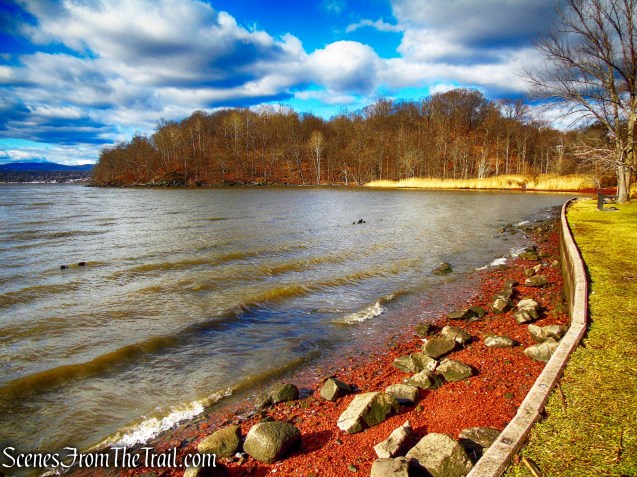
The Gormley Brick Company once occupied this site. Their bricks were used in the construction of the Sing Sing Correctional Facility in Ossining, N.Y., as well as the buildings at Graymoor and the Roman Catholic institution in Garrison, N.Y. The last shipment of Gormley bricks was sent to New York City by boat on April 13, 1938. On George’s Island there were three leased brickyards, employing 130 men. The shoreline of George’s Island is still sprinkled with bricks.

Shasta's Cove - George’s Island Park

Shasta’s Cove – George’s Island Park

The Trails:

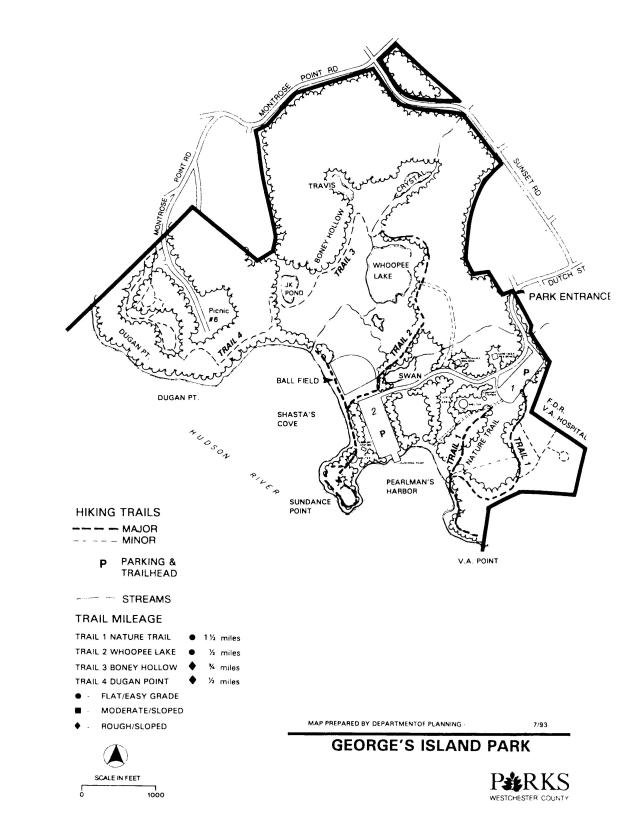
There are approximately 5 miles of blazed and unmarked trails over a variety of terrain. The trail map is from 1993, but it’s helpful to bring one along. I have hiked all of the trails at different times and have wandered throughout most of the property. I will describe the trails below as they appear on the map.

George's Island Park Trail Map

George’s Island Park Trail Map

Trail 1:

The trailhead is located at the southwestern end of Parking Lot 1, which is located on the left almost immediately after entering the park from Dutch Street. There is a large green sign just to the left of the start of the trail.

Trail 1 - George's Island Park

Trail 1 – George’s Island Park

The trail begins at a break in the fence and heads south through the woods.

Trail 1 - George's Island Park

Trail 1 – George’s Island Park

The trail travels through a section of the park that is shown on the map as V.A. Point.

Trail 1 - George's Island Park

Trail 1 – George’s Island Park

The trail comes to a fork with an unmarked woods road, turns right and descends towards the river.

Trail 1 - George's Island Park

Trail 1 – George’s Island Park

A large rock outcrop just ahead leads to obstructed views of the Hudson River.

Trail 1 - George's Island Park

Trail 1 – George’s Island Park

The trail then descends on a switchback and passes alongside the previous rock outcrop as it heads south.

Trail 1 - George's Island Park

Trail 1 – George’s Island Park

Trail 1 - George's Island Park

Trail 1 – George’s Island Park

The trail descends to near river level and crosses a wooden footbridge.

Trail 1 - George's Island Park

Trail 1 – George’s Island Park

At the end of the point, there are south-facing views of the Hudson River.

Trail 1 - George's Island Park

Trail 1 – George’s Island Park

Hook Mountain is visible in the distance, with the Tappan Zee Bridge just beyond, to the left.

Trail 1 - George's Island Park

Trail 1 – George’s Island Park

The trail ends at a gate that enters the V.A. Hospital property. From here you have to retrace your steps.

Trail 1 - George's Island Park

Trail 1 – George’s Island Park

Unmarked Side Trail off of Trail 1:

The unmarked woods road that forks from Trail 1 has several side trails.

Unmarked Side Trail off of Trail 1 - George's Island Park

Unmarked Side Trail off of Trail 1 – George’s Island Park

One such trail leads a short distance to partial views of the river.

Unmarked Side Trail off of Trail 1 - George's Island Park

Unmarked Side Trail off of Trail 1 – George’s Island Park

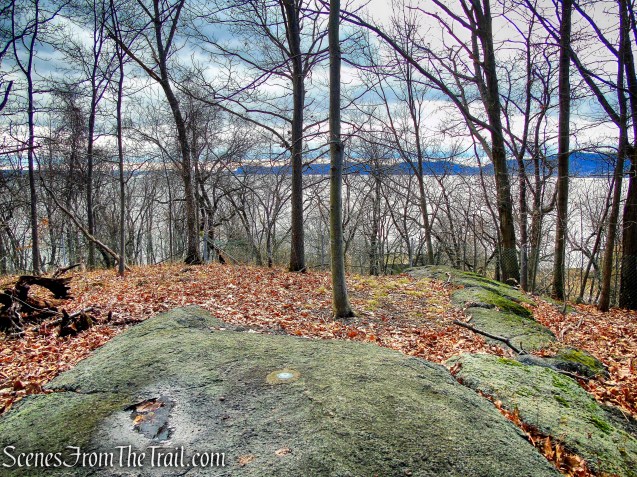
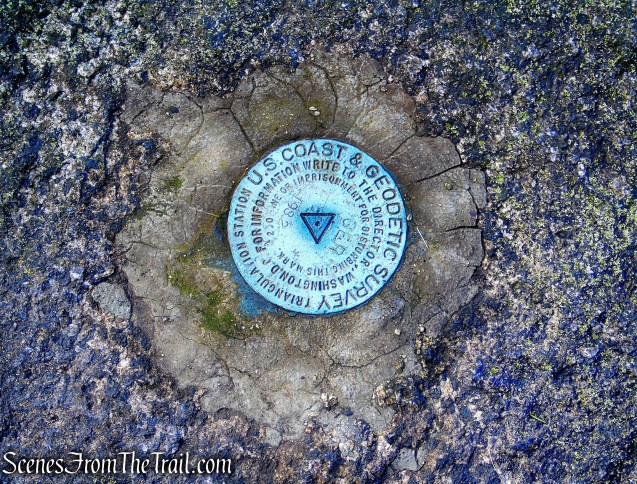
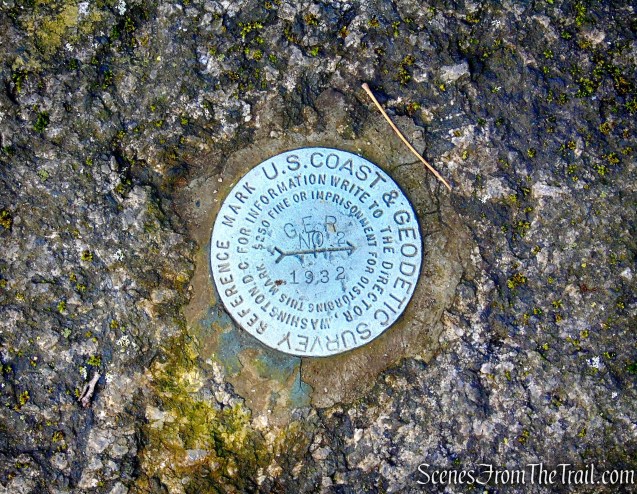
A USCG Survey marker is located on a rock slab.

Unmarked Side Trail off of Trail 1 - George's Island Park

Unmarked Side Trail off of Trail 1 – George’s Island Park

A few feet away there is another survey marker.

Unmarked Side Trail off of Trail 1 - George's Island Park

Unmarked Side Trail off of Trail 1 – George’s Island Park

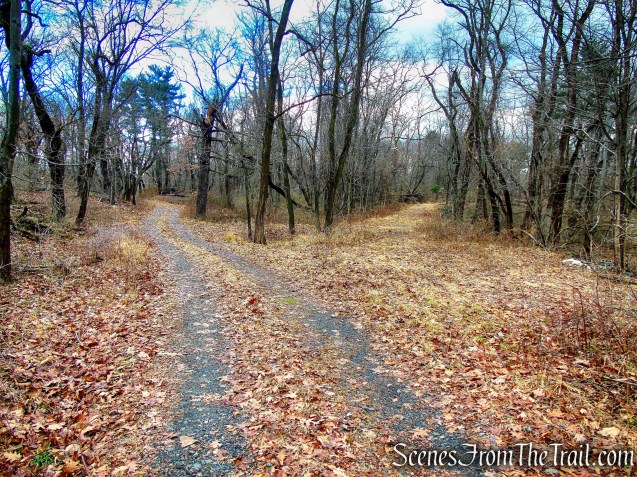
Back on the woods road heading east, the road forks. The left fork leads towards a neighborhood and the right fork heads towards the V.A. Hospital grounds, which is government property. Around this area I spotted a coyote which saw me and ran off. From here you have to retrace your steps back to the trailhead.

Unmarked Side Trail off of Trail 1 - George's Island Park

Unmarked Side Trail off of Trail 1 – George’s Island Park

Trail 2:

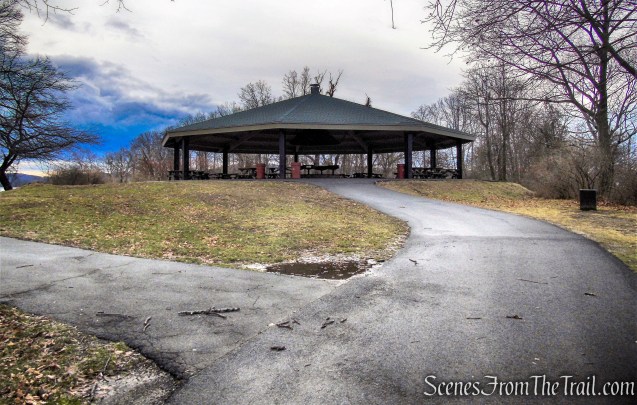
This trail starts near the river at Parking Area 2. Heading south along the river, the trail passes a large picnic pavilion.

Trail 2 - George's Island Park

Trail 2 – George’s Island Park

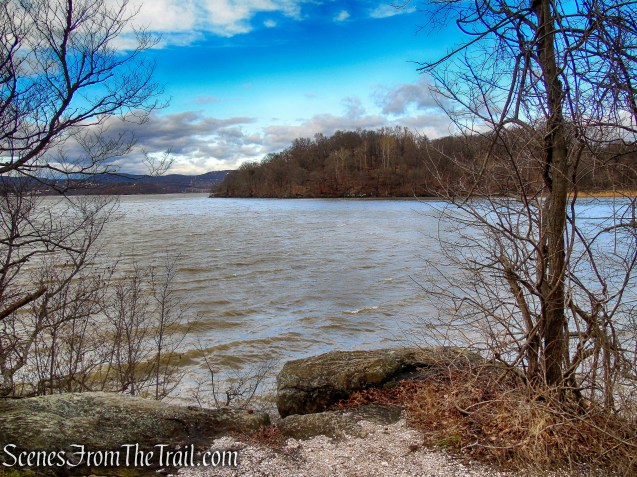
The trail travels close to the river with small rock outcrops offering some views. Looking north one can see across Shasta’s Cove to Dugan Point, a favorite gathering place for wintering Bald Eagles.

Trail 2 - George's Island Park

Trail 2 – George’s Island Park

Looking west, the Stony Point Lighthouse is visible across the river.

Trail 2 - George's Island Park

Trail 2 – George’s Island Park

The trail continues south along the river.

Trail 2 - George's Island Park

Trail 2 – George’s Island Park

This narrow piece of land jutting out into the Hudson River is shown on the map as Sundance Point.

Trail 2 - George's Island Park

Trail 2 – George’s Island Park

Expansive south-facing views at the end of the point.

Trail 2 - George's Island Park

Trail 2 – George’s Island Park

The trail loops around Sundance Point and heads back towards the parking area. Looking east across Pearlman’s Harbor to V.A. Point.

Trail 2 - George's Island Park

Trail 2 – George’s Island Park

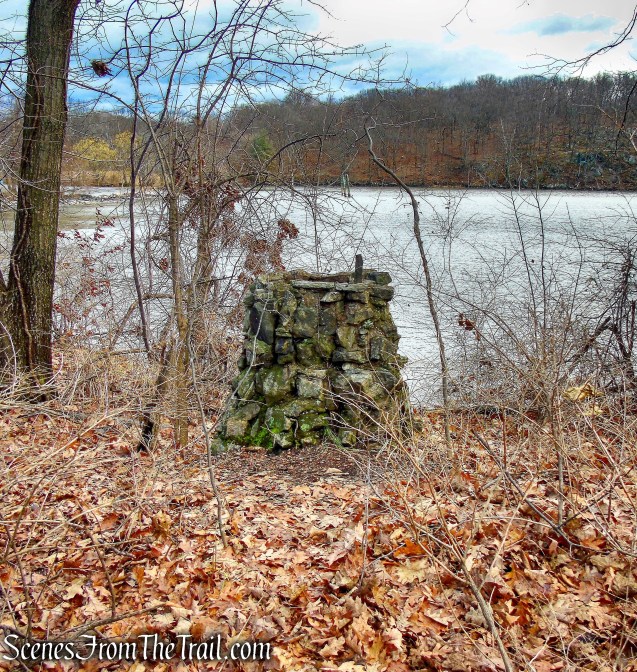
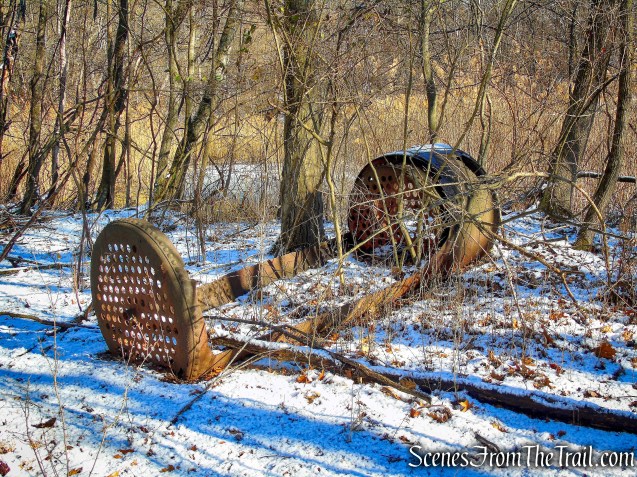
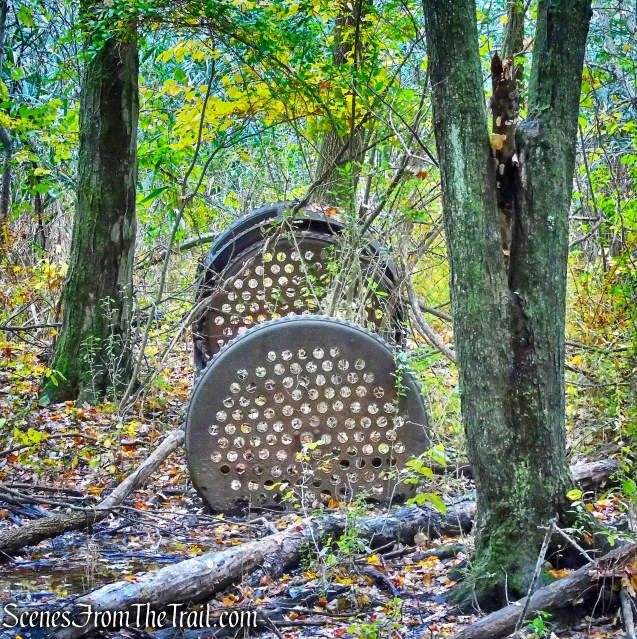
From the parking area, the trail heads past a ballfield and a marshy area. Just off trail in the woods, there is what appears to be the remnants of an old mining steam engine.

Trail 2 - George's Island Park

Trail 2 – George’s Island Park

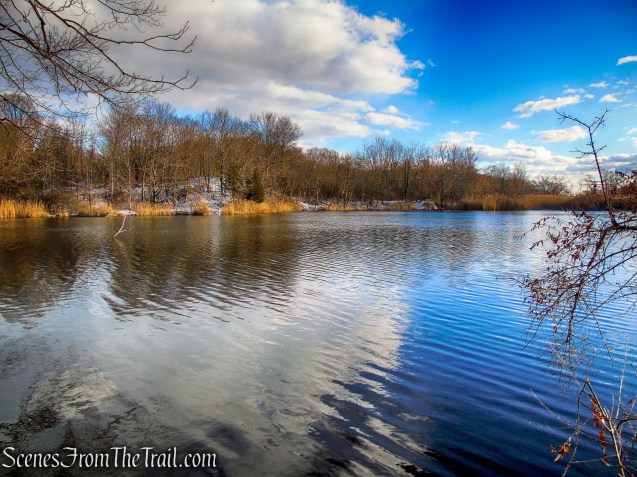
This trail ends at the northern edge of Whoopee Lake, a very scenic spot to take a break. The Blue Trail and Trail 3 begin here as well.

Trail 2 - George's Island Park

Trail 2 – George’s Island Park

Blue Trail:

This trail heads northeast through the woods.

Blue Trail - George's Island Park

Blue Trail – George’s Island Park

This is a scenic and quiet area that doesn’t seem to get much foot traffic.

Blue Trail - George's Island Park

Blue Trail – George’s Island Park

Blue Trail - George's Island Park

Blue Trail – George’s Island Park

There are several large blowdowns in this area, but are easy to get around.

Blue Trail - George's Island Park

Blue Trail – George’s Island Park

The Blue Trail crosses a wooden footbridge and ends at Sunset Road.

Blue Trail - George's Island Park

Blue Trail – George’s Island Park

Trail 4:

Trail 4 can be hiked as a continuation of Trail 3 or entered from Montrose Point Road. Montrose Point Road dead ends at the rear entrance driveway into George’s Island Park. Three white blazes on a tree signify the start of the White Trail. A lesser used section of the park, this area is the most interesting to explore.

White Trail - George's Island Park

White Trail – George’s Island Park

The White Trail ascends gradually on a paved road.

White Trail - George's Island Park

White Trail – George’s Island Park

There are a lot of blowdowns throughout this section of the park.

White Trail - George's Island Park

White Trail – George’s Island Park

Just past the fire hydrant, there is an unmarked footpath.

White Trail - George's Island Park

White Trail – George’s Island Park

There are remnants of brick structures and foundations in this area, but most are overgrown and hard to see.

brick ruins - George's Island Park

brick ruins – George’s Island Park

Back out on the White Trail, a short distance later, extensive stone ruins come into view just to the right of the trail.

ruins - George's Island Park

ruins – George’s Island Park

At first glance, George’s Island Park appears to be a picnic park and boat launch, but off to the side is a network of wooded trails with interesting features.

ruins - George's Island Park

ruins – George’s Island Park

The information on this estate is very scant and somewhat contradictory. Some old maps that I have viewed put the estate just a bit north, on what is now the Kolping-On-Hudson property on the other side of Montrose Point Rd. Based on the design, these ruins could be from the same estate and possibly a large terrace or patio-like structure.

ruins - George's Island Park

ruins – George’s Island Park

The information that I have gathered, if true, give these stone ruins a very historic past.

ruins - George's Island Park

ruins – George’s Island Park

The Seward Estate which was located on Montrose Point, was built and owned by Frederick W. Seward, son of William Seward, Secretary of State under Abraham Lincoln. Frederick was seriously injured, along with several other people, during an assassination attempt on his father’s life on the evening of April 14, 1865 in Washington D.C., at the same time Lincoln was being shot in Ford’s Theater. It was part of a plot to assassinate several government leaders in an attempt to destroy the government. Frederick suffered a fractured skull after being beaten with a pistol that misfired. Both Sewards survived the vicious attack, but it is said that Frederick lived out his life with a silver plate in his skull.

ruins - George's Island Park

ruins – George’s Island Park

The handsome Seward Estate covered about 30 acres. A stately mansion with a beautiful Victorian garden and various outbuildings, it commanded a magnificent view of the Hudson River. The grounds of the estate were dotted by little ponds that had been made by excavating clay for the brickyards which flourished along the Hudson during that period.

ruins - George's Island Park

ruins – George’s Island Park

ruins - George's Island Park

ruins – George’s Island Park

Frederick had talked of living somewhere on the Hudson River and by 1870 he was ensconced in a pretentious Italianate villa that he called “Montrose.”

ruins - George's Island Park

ruins – George’s Island Park

Away from the main ruins, there are several of these short stone columns scattered about.

ruins - George's Island Park

ruins – George’s Island Park

ruins - George's Island Park

ruins – George’s Island Park

The White Trail continues south through Dugan Point.

White Trail - George's Island Park

White Trail – George’s Island Park

Off trail, there are several foundations and a cinder block structure on the hill.

ruins - George's Island Park

ruins – George’s Island Park

ruins - George's Island Park

ruins – George’s Island Park

ruins - George's Island Park

ruins – George’s Island Park

The white blazes continue down the hill, behind the cinder block house.

White Trail - George's Island Park

White Trail – George’s Island Park

The White Trail descends with the Hudson River visible through the trees on the right.

White Trail - George's Island Park

White Trail – George’s Island Park

The trail passes a “brick beach” with great views of the Hudson River.

White Trail - George's Island Park

White Trail – George’s Island Park

Looking northwest from “brick beach.”

White Trail - George's Island Park

White Trail – George’s Island Park

Looking southwest down river, with Sundance Point on the left and Hook Mountain visible further down river on the right.

White Trail - George's Island Park

White Trail – George’s Island Park

Trail 3:

The map shows Trail 3 and Trail 4 as two separate trails, but they are both blazed white and are actually one continuous trail.

White Trail – George’s Island Park

White Trail – George’s Island Park

The White Trail becomes a bit overgrown as it heads inland and passes through wetlands.

White Trail - George's Island Park

White Trail – George’s Island Park

The trail travels through a grassy area that is a bit spongy.

White Trail - George's Island Park

White Trail – George’s Island Park

The trail then curves to the left as do the trees.

White Trail - George's Island Park

White Trail – George’s Island Park

White Trail - George's Island Park

White Trail – George’s Island Park

The trail can be swampy in some sections.

White Trail - George's Island Park

White Trail – George’s Island Park

White Trail - George's Island Park

White Trail – George’s Island Park

A short distance later it passes by the scenic JK Pond.

White Trail - George's Island Park

White Trail – George’s Island Park

An old brick along the trail that dates back to 1905.

White Trail - George's Island Park

White Trail – George’s Island Park

The White Trail now widens to a woods road as it passes through an area listed on the map as “Boney Hollow.”

White Trail - George's Island Park

White Trail – George’s Island Park

Trail 3 passes the northern end of Whoopee Lake and ends at a T-intersection, near the remnants of the old mining steam engine. The white blazes turn right (Trail 2) and head south. The Blue Trail which heads northeast, turns left.

White Trail - George's Island Park

White Trail – George’s Island Park

Review:

This is a really scenic park with great views of the Hudson River. The trails are fairly well blazed and easy to hike. Off trail exploration is a must and the rewards are worthwhile. This is one of my go to spots in the winter, not just to hike, but to view Bald Eagles as well. In the summer, the crowds flock here for a variety of activities and there is an admission fee. Worth a visit for a few hours well spent in the Hudson Valley.

Pros: Hudson River views, historical features, lesser traveled area in winter, lots of bird activity.

Cons: Some overgrown trails and blowdowns, George’s Island Park map is outdated.

Take a hike!

George's Island Park

George’s Island Park

Sources:


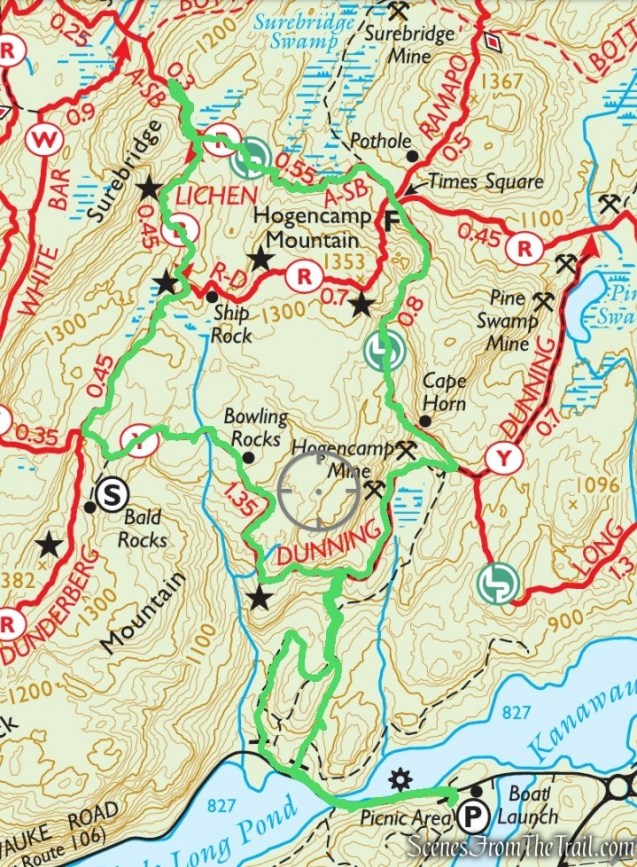
Lichen Trail Loop from Lake Kanawauke – Harriman State Park

December‎ ‎29‎, ‎2018 – Woodbury, NY

Difficulty: Moderate

Length: approximately 6 miles

Max elevation: 1,338 ft.– total elevation gain 872 ft.

Route type: Circuit

Map: Harriman-Bear Mountain Trails Map #118

Trailhead parking: Kanawauke Picnic Area, Woodbury, NY 11797


Overview:

Besides the marked hiking trails, Harriman-Bear Mountain State Parks feature an extensive network of woods roads. There are over 50 miles of woods roads, some are maintained by the Park as fire roads, while others are not formally maintained. Except for the Horn Hill Bike Trail (and several other roads which are used for part of their length by marked hiking trails), these woods roads are not blazed. They can, however, be readily followed by hikers equipped with a map, and they may be combined with the marked trails to form interesting and varied loop hikes.

The Lichen Trail is just under a half mile long, but it is a very scenic and enjoyable stretch of trail. It was built in 1933 by Frank Place of the Tramp and Trail Club as a shortcut from the Arden-Surebridge Trail to the Ramapo-Dunderberg Trail. Frank Place called it the Surebridge Shortcut. R.H. Torrey had found the new trail to be rich in common and unusual lichens and decided to name the new trail the Lichen Trail.

Lichen Trail Loop from Lake Kanawauke

Lichen Trail Loop from Lake Kanawauke

The Hike:

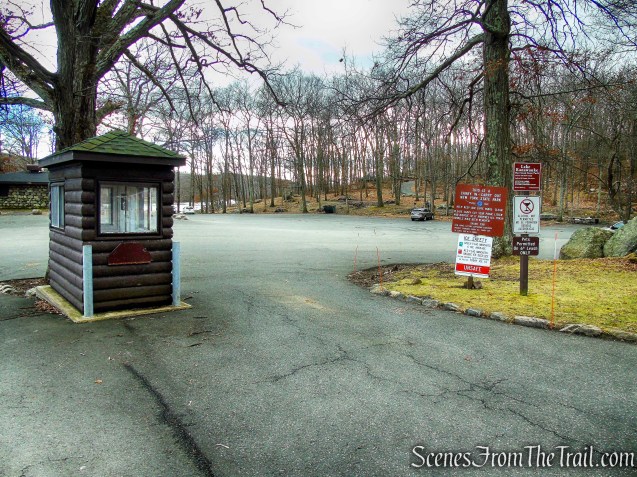
This hike travels on woods roads and footpaths past several points of interest. It begins and ends with a road walk. Kanawauke Road/CR 106 from Kanawauke Circle to Rt 17 is closed in winter. The road barrier at Kanawauke is just west of the Kanawauke Lake parking lot entrance. This provides public access to the lot.

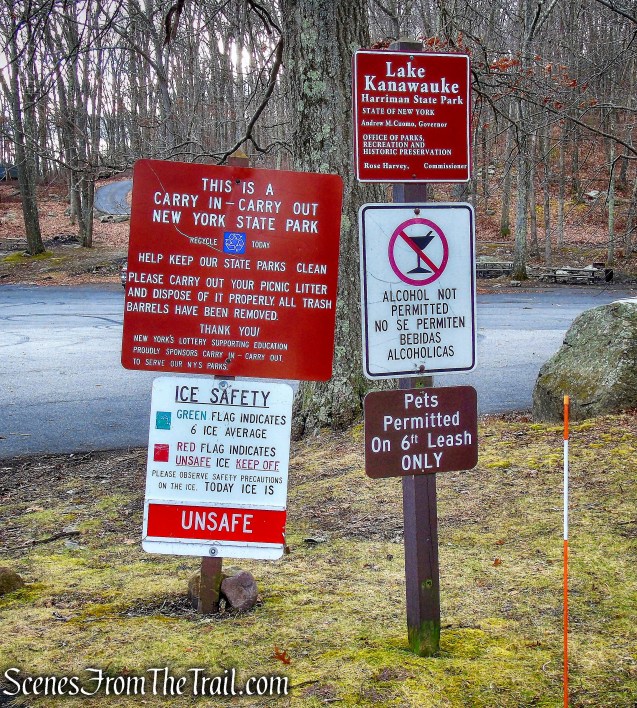
Lake Kanawauke Picnic Area

Lake Kanawauke Picnic Area

Lake Kanawauke Picnic Area

Lake Kanawauke Picnic Area

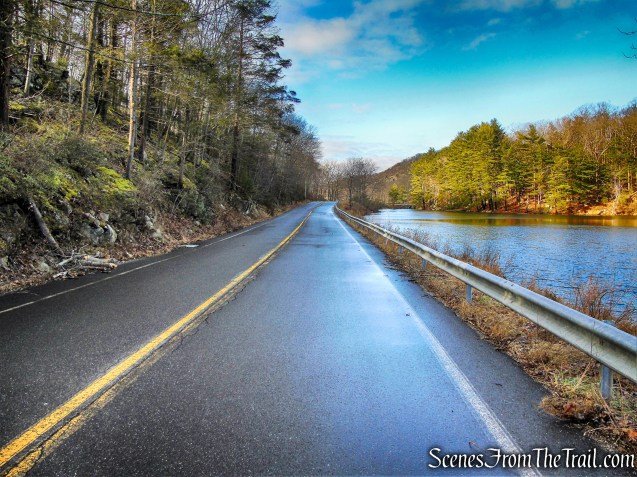
From the Lake Kanawauke Picnic Area, we turned left and began walking west along the road. It is a pleasant walk along the road when it is closed, although care should be taken as a car ignored the road closure and sped by us. The scenic Lake Kanawauke is to the right with Good Spring Mountain on the left. As the road curves to the right, it passes between Lake Kanawauke (on the right) and Little Long Pond (on the left).

Kanawauke Road/CR 106

Kanawauke Road/CR 106

Kanawauke Road/CR 106

Kanawauke Road/CR 106

Lake Kanawauke

Lake Kanawauke

Little Long Pond

Little Long Pond

Once past Lake Kanawauke, there is a woods road with a steel barrier to the right. This is the return route. About 420 feet farther, is another woods road with a cable across it, about 0.5 mile from the parking area. Here we left Kanawauke Road/CR 106 and began walking uphill on what once known as the “Crooked Road,” as it follows many curves around the hills in an attempt to keep the road as level as possible.

return route - woods road

return route – woods road

Crooked Road

Crooked Road

Crooked Road

Crooked Road

Crooked Road

Crooked Road

On the hillside above Little Long Pond, the Park, in 1919, built Camp Matinecock for the Boy Scouts. In the winter of 1920-21, when the new Trail Conference was building the R-D Trail, the volunteers were accommodated with bed and board at Camp Matinecock. In 1930, the Queens Council Girl Scouts took over the camp, calling it Camp Quid Nunc (Latin = What Now?). The Girl Scouts vacated the camp in 1969, and the camp was demolished in 1976.

foundation - Crooked Road

foundation – Crooked Road

Crooked Road continues northeast past the old camp, curves to the south, then curves northeast. It climbs steadily on a moderate grade as it snakes its way up the hillside, and in just over one mile from the start of the hike, reaches the yellow-blazed Dunning Trail, where we turned left.

Crooked Road

Crooked Road

Crooked Road

Crooked Road

Crooked Road

Crooked Road

Crooked Road now follows the route of the Dunning Trail which continues climbing. To the left of the trail there is an unmarked footpath that leads to a view over Little Long Pond. After crossing a stream on rocks, the Dunning Trail goes through a large bare, rocky area, known as “Bowling Rocks” for the boulders that dot the bare rock. The trail continues through a rather open area, with views to the left over the ridge to the south.

Dunning Trail

Dunning Trail

view of Little Long Pond from Dunning Trail

view of Little Long Pond from Dunning Trail

Dunning Trail

Dunning Trail

Dunning Trail

Dunning Trail

Bowling Rocks - Dunning Trail

Bowling Rocks – Dunning Trail

Bowling Rocks - Dunning Trail

Bowling Rocks – Dunning Trail

Dunning Trail

Dunning Trail

About 0.4 mile from Bowling Rocks, after a short climb, the Dunning Trail reaches a junction with the red-dot-on-white-blazed Ramapo-Dunderberg (R-D) Trail. (This junction, which is on the crest of a ridge, is easily missed. If you find yourself beginning a long, steady descent, you’ve gone too far and should return to the highest point, where the junction is located.) Here we turned right and followed the red-dot-on-white blazes northward.

Dunning Trail

Dunning Trail

Dunning Trail

Dunning Trail

Dunning Trail

Dunning Trail

turn right on R-D Trail

turn right on R-D Trail

Ramapo Dunderberg Trail

Ramapo Dunderberg Trail

A short distance ahead, the R-D Trail crosses a huge open rock surface, known as the Whaleback. Just beyond, look for a plaque on a boulder to the right of the trail (I missed it both times that I hiked this area). It was placed in memory of George E. Goldthwaite, a member of the Fresh Air Club of New York, who was reputed to have hiked the entire 21-mile R-D Trail in less than five hours

Ramapo Dunderberg Trail

Ramapo Dunderberg Trail

The trail now steeply descends a rock face to cross a stream on a log bridge.

Ramapo Dunderberg Trail

Ramapo Dunderberg Trail

Ramapo Dunderberg Trail

Ramapo Dunderberg Trail

The R-D Trail then climbs to a junction with the blue-L-on white-blazed Lichen Trail (which begins on the left).

Ramapo Dunderberg Trail

Ramapo Dunderberg Trail

Ramapo Dunderberg Trail

Ramapo Dunderberg Trail

Ramapo Dunderberg Trail

Ramapo Dunderberg Trail

turn left on Lichen Trail

turn left on Lichen Trail

The Lichen Trail travels in a northerly direction over bare rock along the ridge of Surebridge Mountain. This is an extremely scenic section of trail and with its numerous ups and downs, makes it enjoyable as well. There are views of the surrounding hills throughout and at one point views over Island Pond to the northwest. After 0.45 mile, the Lichen Trail ends at a T-intersection with the joint Long Path/Arden-Surebridge Trail.

Lichen Trail

Lichen Trail

Lichen Trail

Lichen Trail

Lichen Trail

Lichen Trail

Lichen Trail

Lichen Trail

Lichen Trail

Lichen Trail

Lichen Trail

Lichen Trail

Lichen Trail

Lichen Trail

Lichen Trail

Lichen Trail

Lichen Trail

Lichen Trail

Lichen Trail

Lichen Trail

Lichen Trail

Lichen Trail

Lichen Trail

Lichen Trail

terminus of Lichen Trail

terminus of Lichen Trail

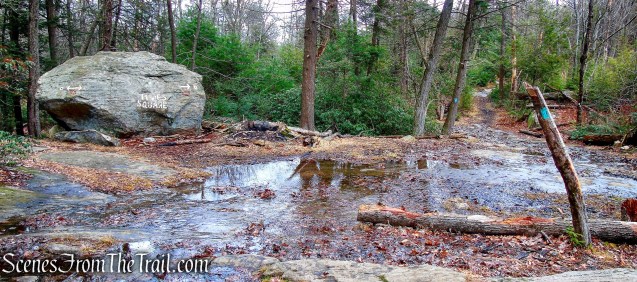
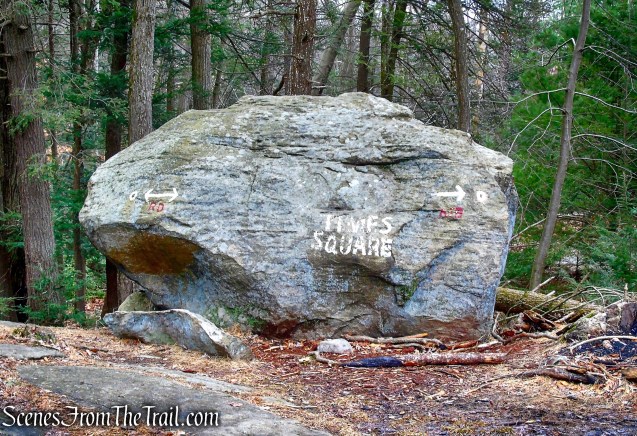
We turned left on the Joint Long Path/A-SB Trail, but after a short distance I remembered that the A-SB Trail is flooded out near Island Pond so we turned around. For the purpose of this hike description, we turned right on the Joint Long Path/A-SB Trail from the Lichen Trail. The trail climbs a little at first, then begins a steady descent. At the base of the descent, the joint trails reach “Times Square,” marked by a fireplace next to a huge boulder. It was so named because it is located at the junction of three trails and serves as a popular meeting place for hikers.

joint A-SB Trail/Long Path

joint A-SB Trail/Long Path

Times Square

Times Square

Times Square

Times Square

The joint A-SB Trail/Long Path continue to the right of Times Square then split, with the A-SB Trail going left and the Long Path to the right. We veered right to remain on the Long Path.

veer right onto Long Path

veer right onto Long Path

veer right onto Long Path

veer right onto Long Path

The Long Path climbs at first, then levels off as it runs along the shoulder of Hogencamp Mountain. It then begins a steady descent as it travels though a valley.

Long Path

Long Path

Long Path

Long Path

Long Path

Long Path

Long Path

Long Path

The Long Path then passes a large boulder to the left with a triangular shaped tunnel I have seen referred to as Cat’s Eye. Just past the boulder, to the left of the trail is a massive rock formation known as Cape Horn. A short distance later, the Long Path comes to a junction with the yellow-blazed Dunning Trail where we turned right.

Long Path

Long Path

Cat's Eye - Long Path

Cat’s Eye – Long Path

Cape Horn - Long Path

Cape Horn – Long Path

The Dunning Trail descends through laurel along a wide woods road. At the base of the descent there are stone foundations on both sides of the trail. These are remnants of the village built in the late 1800’s to house workers at the adjacent Hogencamp Mine, which was active from 1870 to 1885. According to historian James M. Ransom, there were once 20 houses, several barns, a school and a store in this location. After crossing a brook, there is a stone platform to the left. A short distance beyond there is a vertical mine shaft, about 25 feet in diameter, on the right side of the trail. A cast-iron pipe protrudes from the shaft, which is filled with water. There are many other interesting remnants of mining activity in the area. Those who wish to explore the area more extensively should consult Iron Mine Trails by Edward Lenik (now available from the Trail Conference as an e-book).

Dunning Trail

Dunning Trail

Hogencamp Mine - Dunning Trail

Hogencamp Mine – Dunning Trail

The Dunning Trail then reaches Crooked Road where we turned left. We began retracing our steps until we came to another unmarked woods road on the left. We followed this second woods road downhill for about 460 yards until we reached Kanawauke Road/CR 106 and turned left.

Crooked Road

Crooked Road

woods road

woods road

woods road

woods road

woods road

woods road

We then retraced our steps along Kanawauke Road/CR 106 for about 0.5 mile, back to the parking area, where the hike began.

Kanawauke Road/CR 106

Kanawauke Road/CR 106

Review:

This was a great hike through a very scenic section of the park. The Lichen Trail is the highlight of this hike and worth checking out. All the points of interest and nice views, makes this a worthwhile day in Harriman State Park. This hike is better done in the winter months when Kanawauke Road/CR 106 is closed. We encountered very few people on this hike, most at or near Times Square. The R-D and Lichen Trails travel over a lot of bare rock with little or no trees. Therefore, many of the blazes are painted on the rock slabs and may be difficult to see with snow or ice on the ground.

Pros: Lesser traveled area, historical features, well marked trails, scenic views, rock formations.

Cons: Begins and ends with a road walk.

Lichen Trail Loop from Lake Kanawauke

Lichen Trail Loop from Lake Kanawauke

Sources:


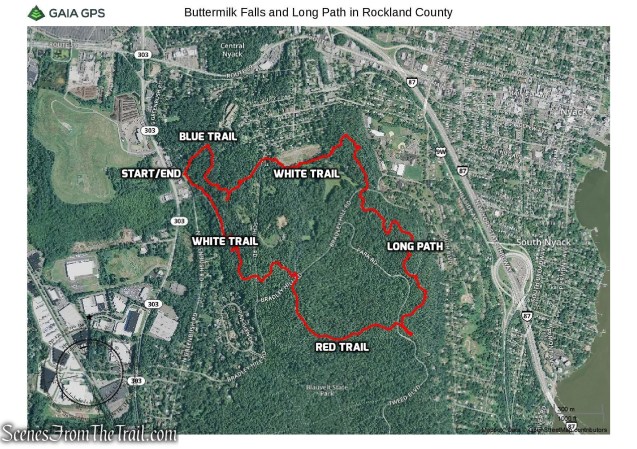
Buttermilk Falls and Long Path in Rockland County

December‎ ‎25‎, ‎2018 – West Nyack, NY

Difficulty: Moderate

Length: Approximately 4 miles

Max elevation: 636 ft.– total elevation gain 735 ft.

Route type: Circuit

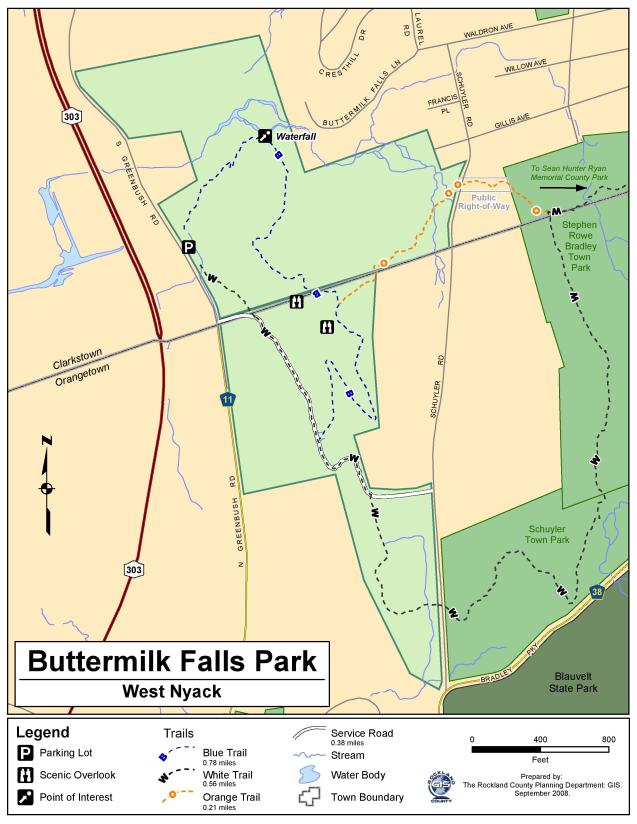
Map: Hudson Palisades Trails Map #109Buttermilk Falls Park Map

Trailhead parking: 199 South Greenbush Road – Nyack, NY

Overview:

This 75-acre park is primarily steep woodland with Buttermilk Falls cascading down the mountain in a westerly direction; part of the Palisades ridge. There are numerous Chestnut Oak, Red Oak, White Oak, Maple, Hemlock, Dogwood, Wild Rose and Sumac. The Park was purchased in 1975 and for decades the falls have been a natural attraction for its deep gorge and ravine effects. From rock outcrops at the scenic overlooks, one can look south towards New Jersey, west towards the Ramapo Mountains, and north to South Mountain. At the turn of the century, President Teddy Roosevelt during his visits to Blauvelt, frequently rode horseback stopping at this point for a view.

Buttermilk Falls County Park

Buttermilk Falls County Park

There are approximately 1.5 miles of trails that lead from the parking lot to the Falls and Stream, and to several scenic overlooks. The trails connect to local undeveloped parks and Blauvelt State Park allowing for longer loop hikes involving the Long Path.

Buttermilk Falls County Park Map

Buttermilk Falls County Park Map

The Hike:

The description below details the hike as done in a clockwise fashion, starting and ending in Buttermilk Falls County Park.

Buttermilk Falls and Long Path in Rockland County

Buttermilk Falls and Long Path in Rockland County

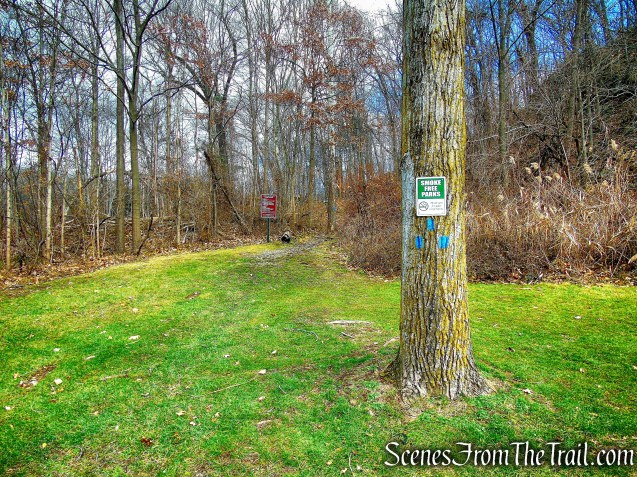
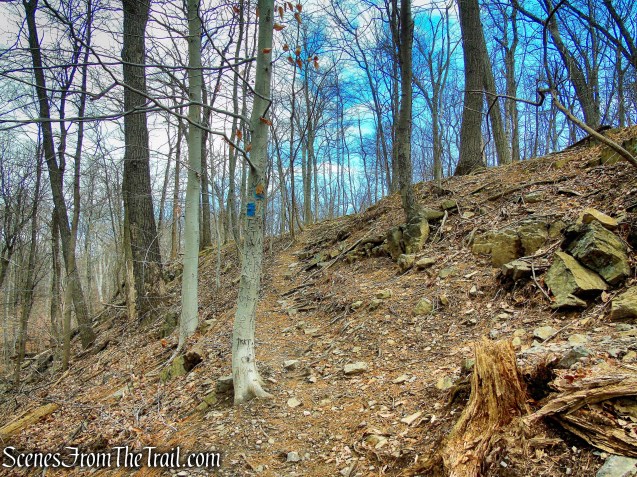
From the northern end of the parking area, head into the woods on a blue-blazed trail, which climbs gradually to the right of a ravine. Pay careful attention to the blazes, as there are a number of side trails in this area.

Start of Blue Trail

Start of Blue Trail

Blue Trail

Blue Trail

After turning sharply and ascending on a switchback, you’ll reach the remnants of two stone pillars to the left of the trail, with scenic Buttermilk Falls cascading down the mountain.

Buttermilk Falls

Buttermilk Falls

The trail now bears right and continues to climb.

Blue Trail

Blue Trail

After a brief descent, you’ll reach a limited west-facing viewpoint, with a field visible below.

Blue Trail

Blue Trail

Continue ahead uphill on the blue trail, and you’ll soon come to a broader viewpoint.

Blue Trail

Blue Trail

You may hear and see a train along the West Shore railroad tracks running parallel to the hills in the background.

view from Blue Trail

view from Blue Trail

After a little more climbing, you’ll reach a T-junction with a woods road. Turn right and continue along the blue-blazed trail for about 150 feet to a third viewpoint, with the broadest view.

Blue Trail

Blue Trail

You can see all the way west to the Ramapo Mountains and, on a clear day, the skyscrapers of Newark are visible on the horizon to the south.

view from Blue Trail

view from Blue Trail

view from Blue Trail

view from Blue Trail

Retrace your steps to the junction and continue ahead on an orange-blazed trail, which begins here.

Orange Trail

Orange Trail

The trail soon bears left at a fork and descends on a footpath to cross a stream on rocks.

Orange Trail

Orange Trail

Orange Trail

Orange Trail

It then climbs slightly to cross paved Schuyler Road.

Orange Trail

Orange Trail

On the other side of the road, the orange-blazed trail crosses a lawn and reenters the woods. Almost immediately, it turns sharply left and descends steeply.

Orange Trail

Orange Trail

It then bears right and joins a wide wood-chip path, paralleling a large storm water retention area behind a fence on the left.

Orange Trail

Orange Trail

In 150 feet, the orange-blazed trail bears right and ends at a junction with a white-blazed trail.

terminus of Orange Trail

terminus of Orange Trail

Turn left onto the white-blazed trail, which parallels the east side of the storm water retention area. It crosses a wet area and a stream on rocks and begins a steady climb. To the right, you’ll pass a line of trees felled by Hurricane Sandy in 2012.

White Trail

White Trail

White Trail

White Trail

After reaching the end of the retention area, the trail reenters the woods and continues to climb. Just beyond a short level stretch, the white-blazed trail ends at a junction with the aqua-blazed Long Path.

terminus of White Trail

terminus of White Trail

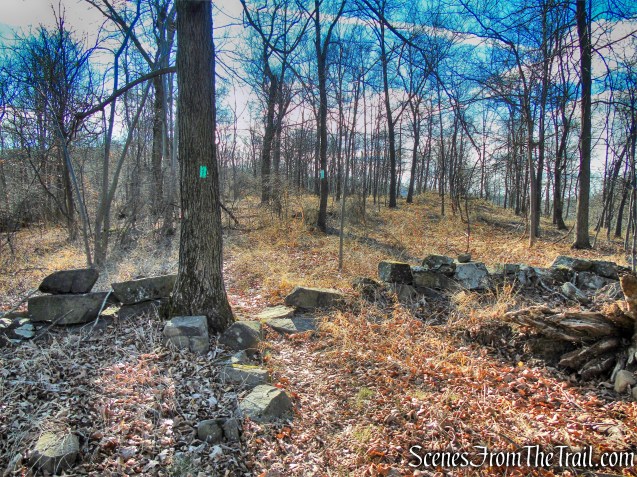
Turn right onto the Long Path and continue to climb, passing through a gap in an old stone wall near the crest of the rise.

Long Path

Long Path

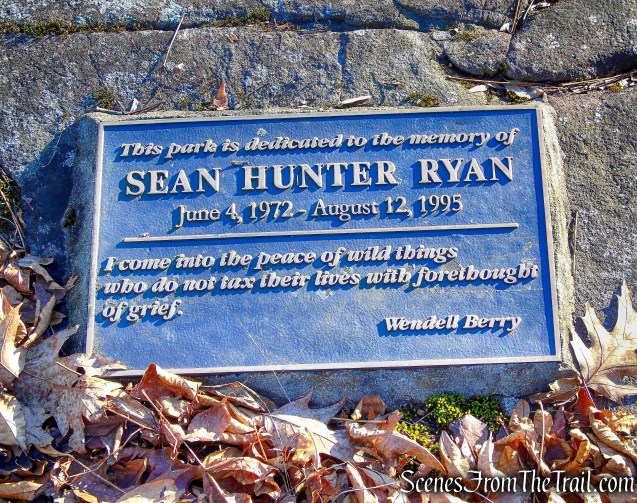
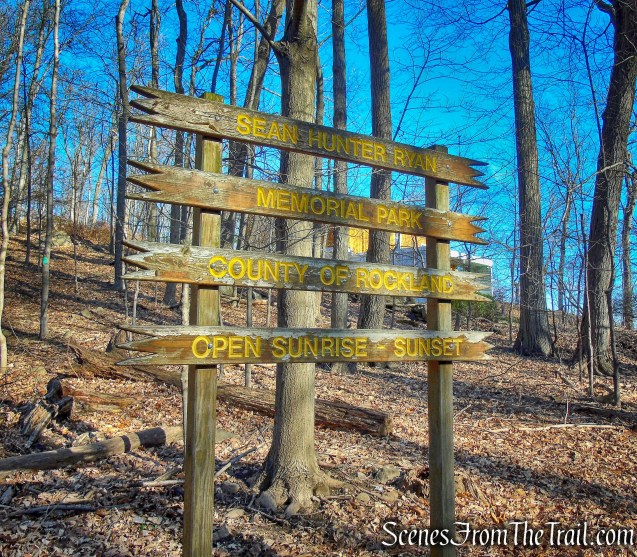
Sean Hunter Ryan Lookout

Sean Hunter Ryan Lookout

Sean Hunter Ryan Lookout

Sean Hunter Ryan Lookout

Long Path

Long Path

Long Path

Long Path

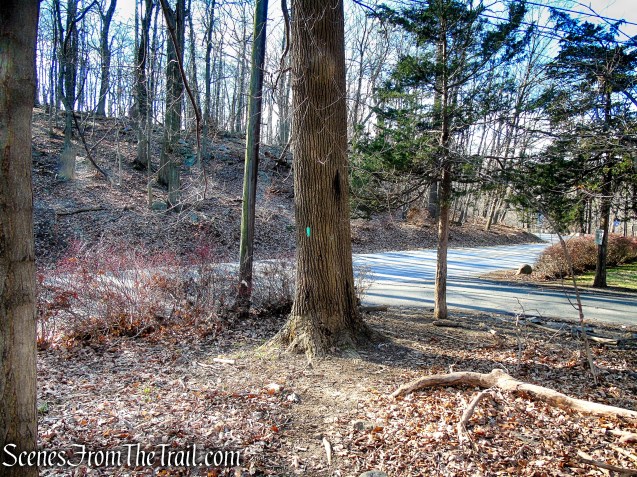
After another level section, the Long Path descends to cross paved Bradley Hill Road diagonally to the right.

Long Path

Long Path

Sean Hunter Ryan Memorial County Park

Sean Hunter Ryan Memorial County Park

It reenters the woods, climbing gradually.

Long Path

Long Path

As the trail approaches the crest of the rise, there are views through the trees to the left over the Hudson River and the Tappan Zee Bridge.

Long Path

Long Path

The Long Path descends to cross a macadam road, climbs again, then descends.

Long Path

Long Path

Long Path

Long Path

After climbing railroad tie steps, you’ll notice a triple-red blaze on the right. You’ll be continuing on this red-blazed trail, but first proceed ahead on the Long Path for another 150 feet to an expansive south-facing viewpoint from a graffiti-scarred rock, with the New York City skyline visible in the distance.

Long Path

Long Path

Long Path

Long Path

Long Path

Long Path

After taking in the view, retrace your steps and bear left onto the red-blazed trail, which crosses Tweed Boulevard, climbs slightly, then begins a steady, gradual descent, with some views through the trees to the left. In half a mile, you’ll notice a white-blazed trail that begins on the left, but you should continue ahead on the red-blazed trail.

start of Red Trail

start of Red Trail

Red Trail

Red Trail

Red Trail

Red Trail

About 100 feet after crossing Bradley Hill Road, the red-blazed trail ends at a junction with another white-blazed trail.

Red Trail

Red Trail

Turn left onto the white-blazed trail, which climbs for a short distance, then begins to descend.

terminus of Red Trail

terminus of Red Trail

Soon, it crosses Schuyler Road, crosses a stream on a wooden footbridge, and continues to descend on a woods road.

White Trail

White Trail

At a T-intersection, the trail bears left onto a wider gravel road and descends more steeply. Along the way, a blue-blazed trail begins on the right, but you should continue ahead on the white-blazed road.

White Trail

White Trail

As the road bears left near the base of the descent, watch carefully for a turn where the white blazes turn right, leaving the road. Continue to follow the white-blazed trail, which descends stone steps, crosses a boardwalk, and soon ends at the parking area where the hike began.

White Trail

White Trail

terminus of White Trail

terminus of White Trail

Review:

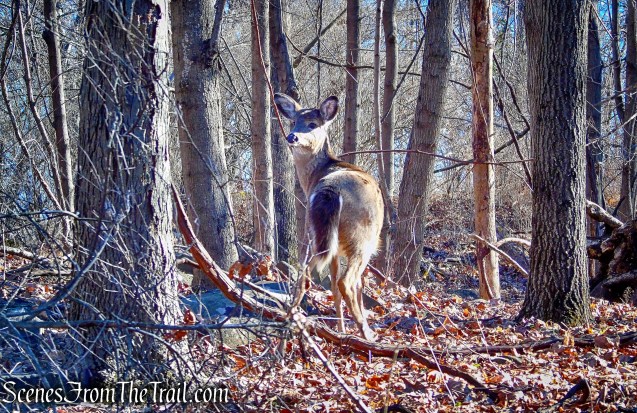
This was a nice hike through the woods and the trails are well blazed throughout. The waterfall is better viewed after heavy rain. The Orange Trail was very swampy and had quite a few blowdowns. There is also some red blazes in the vicinity of the Orange Trail that are not on the trail map. The views are nothing special, but  still a nice hike nonetheless. We only encountered a lone female hiker with a dog on the Long Path. We saw several large groups of deer and several hawks and Turkey Vultures.

Pros: Secluded woods, well blazed trails, lots of wildlife.

Cons: Orange Trail needs work, lackluster views.

Take a hike!

Buttermilk Falls and Long Path in Rockland County

Buttermilk Falls and Long Path in Rockland County

Source:

Dater Mountain Bushwack – Harriman State Park

December‎ ‎22‎, ‎2018 – Sloatsburg, NY

Difficulty: Moderate – strenuous

Length: approximately 5.4 miles

Max elevation: 1,043 ft.– total elevation gain 971 ft.

Route type: Circuit

Map: Harriman-Bear Mountain Trails Map #118

Trailhead parking: 199-31 Johnsontown Rd, Sloatsburg, NY 10974

Click here to see Trail Alerts for Bear Mountain-Harriman State Parks

Please note: Hikers should use caution in the vicinity of the mines, as their deep, water filled pits and unstable overhanging rocks can be dangerous.

Overview:

The Ramapo Mountains in lower New York are rich in iron ore deposits. These deposits were extensively mined in the 1700’s and 1800’s for iron ore, as evidenced by the dozens of old iron mines in the region. The hills and valleys of Harriman State Park contain many abandoned iron mines and exploratory pits. These sites, once scenes of literally earth-shattering activity, are now quiet, with the shafts often filled with water and rock debris. The open holes and piles of iron ore tailings bear mute testimony to this once-active industry, and await rediscovery by curious hikers.

The area above and below the boundary of Orange and western Rockland counties in New York, was a major site of industrial development in the late 1700’s and early 1800’s. There were three natural contributing factors: Rich Iron ore deposits in the area, timber from the heavily wooded hills as fuel for furnaces, and the Ramapo river to provide water power to run mills and other forms of manufacturing. A fourth factor added in the early 1800’s was the Orange Turnpike and the Nyack Turnpike that permitted transporting goods to the Hudson river for shipment to markets in New York City.

Around 1800, Abraham Dater built a system for powering the first of six iron forges in an area first known as “Dater’s Works.” The Iron forges and subsequent grist mill and saw mill of the Dater family and the community of workers they created, became the hamlet of “Pleasant Valley” in the 1800’s and, by the early 1900’s, annexed to become part of the village of Sloatsburg.

High atop Dater Mountain at an elevation of 920 feet above sea level is a large open pit known as the Dater Mine. The mine is located in Harriman State Park, just north of Dater Mountain Nature County Park. I searched for this mine the previous week, but a Black Bear in the area I was searching, cut my exploration short. The following week I hooked up with some seasoned hikers that are familiar with the area and let them show me the way. As a bonus, we bushwacked north from Dater Mine along an old mining road and visited the Augusta Mine as well. We also hit some other better known spots in the area as well.

The hike:

This 5.4 mile loop hike consists of 3 miles of bushwacking and/or unmarked trails. Those who are not confident of their route-finding ability might wish to choose another hike.

Dater Mountain Bushwack

Dater Mountain Bushwack

From the parking circle, we walked back on Johnsontown Road for about 100 feet, crossing a bridge over a stream.

Johnsontown Road

Johnsontown Road

Just west of the bridge, there are three blue-on-white blazes on a tree, which mark the start of the Blue Disc Trail. We turned right and followed this trail up a paved road, passing a huge boulder on the left and crossing the route of a gas pipeline.

Blue Disc Trail

Blue Disc Trail

In a short distance, the trail reaches a pumping station for the pipeline. Here, the Blue Disc Trail bears left onto a footpath and begins to climb parallel to the pipeline.

Blue Disc Trail

Blue Disc Trail

Blue Disc Trail

Blue Disc Trail

Soon, it turns left onto a woods road. Then, in another 0.3 mile, the Blue Disc Trail bears right at a fork and continues along a narrower woods road.

Blue Disc Trail

Blue Disc Trail

The white-blazed Kakiat Trail joins for a short distance, but we continued to follow the blue-on-white blazes.

Blue Disc Trail

Blue Disc Trail

The Blue Disc Trail now begins a steep climb along the woods road.

Blue Disc Trail

Blue Disc Trail

About halfway up, it turns right, crosses a stream, and climbs even more steeply over rocks.

Blue Disc Trail

Blue Disc Trail

Blue Disc Trail

Blue Disc Trail

After 0.9 mile from the start, the trail reaches the top of Almost Perpendicular, a dramatic viewpoint from the top of a cliff. You can see Seven Lakes Drive directly below, with the Ramapo Mountains in the background.

Almost Perpendicular

Almost Perpendicular

Almost Perpendicular is a name given to a cliff on Dater Mountain by the Fresh Air Club in in 1936.

Almost Perpendicular

Almost Perpendicular

After taking in the view, we left the Blue Disc Trail just behind the highest point of the cliff and started down a faint footpath, which soon ends.

Bushwack on Dater Mountain

Bushwack on Dater Mountain

We then began bushwacking in a westerly direction.

Bushwack on Dater Mountain

Bushwack on Dater Mountain

We had to veer slightly north to avoid a wet area, but then continued west.

Bushwack on Dater Mountain

Bushwack on Dater Mountain

We bushwacked for about 0.4 mile through the relatively open woods until we reached the mine.

Bushwack on Dater Mountain

Bushwack on Dater Mountain

The Dater Mine is a large open cut, fifty feet in length by thirty-five feet in width. At the northern end of this cut, the mine extends into the mountainside for an additional fifteen feet and appears to slant downward. This section is filled with water and is dangerous.

Dater Mine

Dater Mine

A pillar of rock in the middle of the mine entrance supports the roof of the mine. Unfortunately, little is known about the history of the Dater Mine. It was probably associated with Abraham Dater, who operated two iron forges on the Ramapo River and one on Stony Brook in the first half of the nineteenth century. Dater also owned 2,600 acres of land in the area between the Ramapo River and Stony Brook.

Dater Mine

Dater Mine

At the south end of the open cut is a flat terrace constructed of mine tailings that have been dumped along the edge of the mountain. This terrace affords a scenic vista of the surrounding area (in the summer, the view may be obscured by the foliage).

terrace - Dater Mine

terrace – Dater Mine

We then took an abandoned mine road which descends from the mine and summit along the westerly side of the mountain and heads in a northerly direction.

Bushwack on Dater Mountain

Bushwack on Dater Mountain

There are some massive rock formations to the right that just beg to be explored.

Bushwack on Dater Mountain

Bushwack on Dater Mountain

Bushwack on Dater Mountain

Bushwack on Dater Mountain

Bushwack on Dater Mountain

Bushwack on Dater Mountain

Some sections of the old mine road are easy to follow and other times it just disappears.

Bushwack on Dater Mountain

Bushwack on Dater Mountain

Looking back at the large rock formation we just explored.

Bushwack on Dater Mountain

Bushwack on Dater Mountain

At times the sides of the road are lined with stones, large cobbles, which delineate its route. The road then reaches a small plateau and becomes more obscure and difficult to follow.

Bushwack on Dater Mountain

Bushwack on Dater Mountain

I ended up a little further down the hill at a cascading stream with a steep ascent of Pine Hill on the other side of the steam crossing. I looked back to see my hike mates much farther up the hillside so I bushwacked up alongside the stream to rejoin them.

cascade

cascade

This was a slightly challenging crossing, but I took out my hiking poles and was able to manage the rock hop without getting wet.

cascade

cascade

After crossing the stream, the road reappears and becomes easier to follow.

Pine Hill bushwack

Pine Hill bushwack

The road runs near the base of Pine Hill. The old mine road continues north, but we turned left at the small cairn and bushwacked up towards the Pine Hill summit.

Pine Hill bushwack

Pine Hill bushwack

I didn’t notice the cairn, but an alert hiker pointed it out.

Pine Hill bushwack

Pine Hill bushwack

We bushwacked west to the ridge of Pine Hill.

Pine Hill bushwack

Pine Hill bushwack

Once at the ridge, we turned right and headed north.

Pine Hill bushwack

Pine Hill bushwack

Soon, another old mining road appears as we neared the Augusta Mine Complex.

Pine Hill bushwack

Pine Hill bushwack

A recently “discovered” iron mine (within the last 20 years or so) not to be confused with the Augusta Mine in nearby Sterling Forest. It is surmised that ore from this mine was used at the Augusta Furnace, a short distance north of the Tuxedo train station.

Augusta Mine

Augusta Mine

The mines themselves were of three general types: open pit, with the ore near the surface and easily accessible; the slope, a slanting tunnel which would follow a vein of ore as far as practical; and the pit type which was a perpendicular shaft to various depths with tunnels following the vein away from the shaft.

Augusta Mine

Augusta Mine

Unlike New Jersey where nearly every mine has been documented big and small, there are a handful of mines in southern New York that have never been formally documented, some of which are only mentioned in modern trail books.

Augusta Mine

Augusta Mine

The workings include open cuts and a short adit.

Augusta Mine

Augusta Mine

The road continues north past the first set of mine openings.

Pine Hill bushwack

Pine Hill bushwack

In a short distance the road comes to the most impressive mine shaft at the northern end of the complex.

Augusta Mine

Augusta Mine

The shaft is not very deep, but the road leads all the way to the adit so it must have been of some importance.

Augusta Mine

Augusta Mine

We then climbed above the mine and continued bushwacking, now in a northeasterly direction, just skirting the summit of Pine Hill.

Pine Hill bushwack

Pine Hill bushwack

The bushwack in this area was relatively easy, but probably more difficult when the area is lush with green foliage.

Pine Hill bushwack

Pine Hill bushwack

Pine Hill bushwack

Pine Hill bushwack

We made our way to the Tuxedo-Mt. Ivy Trail and turned right, now heading east.

Tuxedo-Mt. Ivy Trail

Tuxedo-Mt. Ivy Trail

In a short distance, the trail reaches Claudius Smith Rock. Claudius Smith Rock is a large rock formation that provides spectacular views from the top.

Tuxedo-Mt. Ivy Trail

Tuxedo-Mt. Ivy Trail

The base of the rock formation has caves that were the former hideout of the gang of marauders, known as the Cowboys of the Ramapos, led by Claudius Smith. They operated during the Revolutionary War era.

Claudius Smith’s Den

Claudius Smith’s Den

On January 22, 1779, Claudius Smith was hanged in Goshen, NY.

Claudius Smith’s Den

Claudius Smith’s Den

The Tuxedo-Mt. Ivy Trail climbs along the right side of Claudius Smith Rock.

Tuxedo-Mt. Ivy Trail

Tuxedo-Mt. Ivy Trail

On the way we could see one of the upper chambers where they slept, it’s about 8-10 feet high, 30 feet long, and 10 feet deep.

Tuxedo-Mt. Ivy Trail

Tuxedo-Mt. Ivy Trail

We climbed to the top of Claudius Smith Rock to take in the view.

Claudius Smith Rock

Claudius Smith Rock

The view from the top of Claudius Smith Rock extends west to the village of Tuxedo and beyond.

view west from Claudius Smith Rock

view west from Claudius Smith Rock

Looking northwest.

view northwest from Claudius Smith Rock

view northwest from Claudius Smith Rock

We then jumped back on the Tuxedo-Mt. Ivy Trail and came to a junction with the start of the White Cross Trail. Directly to the right (southeast) is an unmarked footpath.

Junction of Tuxedo-Mt. Ivy and White Cross Trails

Junction of Tuxedo-Mt. Ivy and White Cross Trails

This is the start of the Spring Brook Trail.

Spring Brook Trail

Spring Brook Trail

In a short distance, the trail widens to a woods road.

Spring Brook Trail

Spring Brook Trail

The Spring Brook Trail heads southeast and descends gradually. At a fork with another woods road (which leads to Almost Perpendicular), we veered left and continued to descend.

Spring Brook Trail

Spring Brook Trail

At the base of the descent, the road crosses Spring Brook. This was a very challenging stream crossing, which we were able to negotiate carefully.

Spring Brook Trail

Spring Brook Trail

The Spring Brook Trail climbs slightly as it passes alongside some old stone walls.

Spring Brook Trail

Spring Brook Trail

A short distance later, the Spring Brook Trail ends at a T-intersection with the white-blazed White Bar Trail. Here we turned right.

White Bar Trail

White Bar Trail

The White Bar Trail turns right onto the abandoned section of Johnsontown Road and crosses the also white-blazed Kakiat Trail.

White Bar Trail

White Bar Trail

The blazes in this area have a “WB” on them to alleviate any confusion.

White Bar Trail

White Bar Trail

Here a stone wall begins to run along the side of the road. This is where the Matthew Waldron family once had their home and blacksmith shop.

White Bar Trail

White Bar Trail

We followed the White Bar Trail to its terminus at the parking circle on Johnsontown Road, where the hike began.

terminus of White Bar Trail

terminus of White Bar Trail

Review:

A truly enjoyable hike with many points of interest. The bushwack was not difficult, but I am sure it would be during the warmer months when the area is overgrown. We saw scattered groups of hikers along the marked trails and at Almost Perpendicular and Claudius Smith Rock. Other than that it felt like we had the woods to ourselves. A couple of the stream crossings were a bit challenging, but that made the hike interesting. Since this hike covers areas that don’t see much foot traffic, it is advisable to hike with a partner.

Pros: Abandoned mines, scenic views, historical features, secluded area during bushwack and on unmarked trail.

Cons: Almost Perpendicular and Claudius Smith Rock can get crowded in warmer weather.

Take a hike!

Almost Perpendicular

Almost Perpendicular

Sources:


Spanish Silver Mine – Harriman State Park

December‎ ‎9‎, ‎2018 – Woodbury, NY

Difficulty: Moderate

Length: Approximately 4.2 miles

Max elevation: 1200 ft.– total elevation gain 730 ft.

Route type: Out and back

Map: Harriman-Bear Mountain Trails Map #119

Trailhead parking: Silver Mine Picnic Area, Woodbury, NY 10980

Click here to see Trail Alerts for Bear Mountain-Harriman State Parks

Please note: Hikers should use caution in the vicinity of the mines, as their deep, water filled pits, treacherous terrain and unstable overhanging rocks can be dangerous.

Overview:

Facts regarding the ownership and operation of this mine, also known as the Spanish Mine or the Silver Mine, are lacking, but mystery and legend abound. The Spanish Silver Mine was the reported burial place of Captain Kidd’s treasure. Another legend, attributed to R.H. Torrey, a founder of the New York-New Jersey Trail Conference, states that the mine was dug by Spanish miners in the 18th century. According to the Torrey tale, in 1735, a ship with a Spanish crew sailed up the Hudson River and landed at what is now Jones Point. They made several trips to a mine on Black Mountain and carried out heavy sacks, once boasting to riverside tavern patrons that they were carrying silver. On their final journey to the mine, one of the Spanish crew members disappeared, while the others returned to their ship, never to be seen in the area again. Later, the body of the lost Spanish miner was found by local people in a cabin on the mountain.

Spanish Silver Mine

Spanish Silver Mine

A very cool article from October 1, 1926.  PDF links at the bottom of page.

Spanish Silver Mine

Spanish Silver Mine

Black Mountain, towering more than 1,200 feet above sea level, was the scene of mining activity at some time in the remote past. Two vertical pits, evidence of attempts to extract ore, are present on the summit of this mountain which is situated to the southeast of present-day Silver Mine Lake in Harriman State Park.

Black Mountain across Silver Mine Lake

Black Mountain across Silver Mine Lake

We tried searching for this mine last February to no avail. This time we were determined to find it. It wasn’t easy, but after a long bushwack along the steep slope of Black Mountain, we were able to reach it. Granted, the mine itself isn’t that impressive, but the folklore that surrounds it, made it worth the trek. There is an easier approach to the mine than the one we took, but not knowing its exact location, we traversed the hillside until we found it.

Spanish Silver Mine

Spanish Silver Mine

The hike:

The hike begins from the Silver Mine Picnic Area on Seven Lakes Drive. There are plenty of parking spots in the large lot. Since the temperature was in the low 20’s on this Sunday morning, we got a later start than usual and arrived at about 10:30 am.

Silver Mine Picnic Area

Silver Mine Picnic Area

Originally known as the Silver Mine Ski Center, it was once a popular skiing destination. It was shut down in the 1980’s due to inconsistent weather. The Silver Mine area now offers picnic grounds, fishing and hiking.

Silver Mine Picnic Area

Silver Mine Picnic Area

It was named the Old Silver Mine Ski Area because of its proximity to the legendary Spanish Silver Mine on Black Mountain.

Silver Mine Picnic Area

Silver Mine Picnic Area

From the parking area, we turned right and began heading in an easterly direction along Seven Lakes Drive.

east along Seven Lakes Drive

east along Seven Lakes Drive

We walked along the road for about 0.4 mile until a concrete-and-stone bridge over a stream is visible 300 feet to the right of the road. (This point is about 500 feet west of the stone comfort station farther down the road). We turned right onto a faint unmarked footpath which leads towards the bridge. This footpath is hard to follow and on the way back we couldn’t see it. It’s a short and easy bushwack through the woods.

faint footpath

faint footpath

In about 300 feet, we reached the bridge that spans Queensboro Brook.

Silvermine Road

Silvermine Road

Queensboro Brook

Queensboro Brook

We crossed the bridge, and continued southward along a well-constructed woods road, known as Silvermine Road. This woods road was built in 1934 by workers of the Temporary Emergency Relief Administration.

Silvermine Road

Silvermine Road

The road passes along the east side of Silvermine Lake. In the spring of 1934, Civilian Conservation Corps Camp SP-27 was set up and by September, a 600-foot dam had been built and the new reservoir began to fill.

Silver Mine Lake

Silver Mine Lake

In 1989, the Park removed the wooden walkway across the dam.

Silver Mine Lake

Silver Mine Lake

The lake was originally named Menomine, meaning “wild rice.” In 1951, the lake was renamed Silver Mine Lake.

Silver Mine Lake

Silver Mine Lake

Silvermine Road heads south along the east shore of the lake, curves to the southeast, climbs steadily, then levels off as it goes up through the notch between Black and Letterrock Mountains

Silvermine Road

Silvermine Road

Silvermine Road arrives at the junction of the joint Appalachian/Ramapo-Dunderberg Trail (AT/R-D) at 0.65 mile (from the east side of the dam).

joint AT/R-D Trail - Black Mountain

joint AT/R-D Trail – Black Mountain

We turned left onto the joint AT/R-D Trail and began the steep ascent of Black Mountain.

joint AT/R-D Trail - Black Mountain

joint AT/R-D Trail – Black Mountain

After a short climb, the trail comes out to a rock ledge with a great western facing view of Silver Mine Lake and the surrounding Harriman Hills.

Black Mountain

Black Mountain

We took a break here to enjoy the view.

Silver Mine Lake from Black Mountain

Silver Mine Lake from Black Mountain

We then continued up towards the summit.

joint AT/R-D Trail

joint AT/R-D Trail

We then left the trail around this spot and began our bushwack along the southern slope of Black Mountain. We actually began our bushwack too early and should have continued on the trail a little further.

joint AT/R-D Trail

joint AT/R-D Trail

Traversing the talus slope was the toughest part of the hike. The footing in this area is treacherous.

bushwack - Black Mountain

bushwack – Black Mountain

We slipped and slid numerous times as we made our way in an easterly direction around the face of the cliff. Since we left the trail too soon, we had to climb up to the mine.

bushwack - Black Mountain

bushwack – Black Mountain

After about a 0.4 mile traverse of the talus slope, the Spanish Silver Mine was just above us. The opening is blasted into the rock of the mountain above the talus slope.

Spanish Silver Mine

Spanish Silver Mine

The last few feet were not easy as it becomes very steep right in front of the adit.

Spanish Silver Mine

Spanish Silver Mine

We climbed up to the mine to get a better look.

Spanish Silver Mine

Spanish Silver Mine

This shaft is ten feet wide, nine feet high and penetrates some fifteen feet into the mountain.

Spanish Silver Mine

Spanish Silver Mine

There is no real good spot to stand in front of it to capture a good image. A wide angle lens would come in handy here.

Spanish Silver Mine

Spanish Silver Mine

From the location of the mine, I can’t imagine that it was ever intended to be worked. There is no easy access to it, which would have made transporting any minerals extremely difficult. I tend to believe that the opening was created to serve as a hiding spot rather than to mine silver.

Spanish Silver Mine

Spanish Silver Mine

Mission now complete, we had to make our way back to the trail. We headed in a northerly direction alongside the cliff face.

bushwack - Black Mountain

bushwack – Black Mountain

We made our way around the the cliff, still slipping and sliding along the way, and made our way up towards the summit.

bushwack - Black Mountain

bushwack – Black Mountain

The mine is only about 215 feet from the trail, and about 100 vertical feet below the summit. This is where we rejoined the joint AT/R-D Trail and would have been a better approach as well.

joint AT/R-D Trail

joint AT/R-D Trail

We were within feet of the summit, so we scrambled up towards it,

joint AT/R-D Trail

joint AT/R-D Trail

and continued southeast along the ridge.

joint AT/R-D Trail

joint AT/R-D Trail

joint AT/R-D Trail

joint AT/R-D Trail

No foot traffic in this area, which was nice.

joint AT/R-D Trail

joint AT/R-D Trail

In a short distance we came to a viewpoint over the Hudson River, with the Palisades Interstate Parkway almost directly below.

joint AT/R-D Trail

joint AT/R-D Trail

We walked on the joint AT/R-D Trail until just before it begins to descend steeply towards the parkway. West Mountain is visible to the northeast.

joint AT/R-D Trail

joint AT/R-D Trail

We then turned around and began heading northwest on the joint AT/R-D Trail.

joint AT/R-D Trail

joint AT/R-D Trail

Once again returning to the area just above the Spanish Silver Mine.

joint AT/R-D Trail

joint AT/R-D Trail

To get to the mine, as the trail descends steeply for about 20 vertical feet, turn left, leaving the trail, and continue in an easterly direction around the face of the cliff.

joint AT/R-D Trail

joint AT/R-D Trail

We stayed on the trail and headed towards the first viewpoint.

joint AT/R-D Trail

joint AT/R-D Trail

Once again we stopped here to take in the gorgeous view.

joint AT/R-D Trail

joint AT/R-D Trail

joint AT/R-D Trail

joint AT/R-D Trail

We continued on the joint AT/R-D Trail and after the short steep descent, we arrived at the junction with Silvermine Road.

joint AT/R-D Trail

joint AT/R-D Trail

We turned right on Silvermine Road and made our way back down towards Silver Mine Lake.

Silvermine Road

Silvermine Road

A nice pleasant walk along Silver Mine Lake.

Silvermine Road

Silvermine Road

We stopped at a rock outcrop near the dam for a moment.

Silver Mine Lake

Silver Mine Lake

We recrossed the concrete-and-stone bridge over Queensboro Brook and bushwacked (we couldn’t see the faint footpath) about 300 feet to Seven Lakes Drive and turned left.

Silvermine Road

Silvermine Road

We then walked west for about 0.4 mile on Seven Lakes Drive, back to the parking area, where the hike began.

Seven Lakes Drive

Seven Lakes Drive

Review:

A hike to Black Mountain is always exhilarating and the views aren’t too shabby either. Finding the Spanish Silver Mine was the highlight of the hike on this trip though. I only wish I had brought my wide angle lens to better photograph it. The mine sits on such a steep slope that it is hard to get a good shot of it. All things considered, It was well worth the effort. The AT/R-D is well blazed and Silvermine Road is easy to follow. The terrain near the mine is precarious. The steepness and loose rocks caused us to lose our footing several times as we slid down the slope a few feet, but using hiking poles in this area was a big help.

Pros: Spanish Silver Mine, historical features, Hudson Valley views, Appalachian Trail.

Cons: Road walk.

Take a hike!

Black Mountain

Black Mountain

Sources:


Hackett Hill Park – Hyde Park Trails

December‎ ‎1‎, ‎2018 – Hyde Park, NY

Difficulty: Easy

Length: Approximately 1 mile

Max elevation: 251 ft.– total elevation gain 44 ft.

Route type: Circuit

Map: Hackett Hill Park Trail MapHyde Park Walkabout Trail Map

Trailhead parking: 79 E Market St, Hyde Park, NY 12538


Overview:

The Hyde Park Trails system currently includes about 34 miles of trails, including trails within 3 National Park units, a State Park complex, 3 Town Parks, and a land trust nature preserve, connected in large part by trail easements across private lands, as well as on-road linkages. All trails in the Hyde Park Trail system were designated National Recreation Trails by the U. S. Department of the Interior in 2006, and their formal designation as Hudson River Valley Greenway Trails was underway in 2018.

Hyde Park Trails

Hyde Park Trails

The Hyde Park Healthy Trails Walkabout is an annual program to encourage walking for health. The Walkabout is open to local residents and visitors alike. Participants who complete at least five Hyde Park trails in a given year may earn a free, themed trail patch. The Hyde Park Trail Committee creates a new patch each year, featuring a natural or historical feature that relates to Hyde Park Trails.

Hyde Park Healthy Trails Walkabout 2018 Patch

Hyde Park Healthy Trails Walkabout 2018 Patch

Hackett Hill Park is a town park that is situated on 45-acres of open and forested land on E Market Street between Routes 9 and 9G. This is the main park for the town residents. The Recreation Administration, Registration and Program offices are here in the Hackett House.

Hackett Hill Park

Hackett Hill Park

Access the trails by parking in the parking area and follow the Trail sign to the trailhead kiosk for a map of the parkland. The trails are well-marked and are easy hiking. They meander through the woodlands, past large rock outcroppings formed during the glacial age, past historic stone walls and along the scenic Crum Elbow Creek.

That’s what I read, but to be honest, out of all the hikes we did on this day, it was the most confusing. The blaze colors on the actual trails do not match up with the ones on the trail map. The trail map, issued by the Town of Hyde Park Recreation Department, is from March 2018. I would think that since the Recreation Department is located in this park, they could have paid closer attention to this important detail. This caused us to miss hiking the Red Trail entirely, which we never saw. I was able to figure things out, but it did lead to some confusion. The map below represents the blaze colors of the trails a little better than the actual trail map, but is incorrect at the start of the hike. The map below shows that the co-aligned trails from the kiosk are orange and green, when they are actually orange and light blue. The green-blazed trail does not actually begin until the Y-intersection, when orange veers left.

Pinewoods & Hackett Hill Park map

Pinewoods & Hackett Hill Park map

At the northeast end of the parking area, we proceeded on a gravel road.

Hackett Hill Park

Hackett Hill Park

To the right of the road is the Paul A. Tegtmeier Memorial. Paul Tegtmeier, 41, was a New York City firefighter at the World Trade Center who was a lifelong native of Hyde Park and volunteer for the Roosevelt Fire District, responded to the call for help and died on Sept. 11, 2001.

Paul Tegtmeier Memorial - Hackett Hill Park

Paul Tegtmeier Memorial – Hackett Hill Park

We continued walking north on the gravel road, with stone walls and rock formations visible to the right, on the hillside.

Hackett Hill Park

Hackett Hill Park

The trails begin at the kiosk, which is adjacent to the pool.

Hackett Hill Park trailhead

Hackett Hill Park trailhead

In the field just beyond the kiosk, there was a large rafter of  Wild Turkeys. There must have been over 20 of them, but most took off into the woods before I could get my camera out.

turkeys - Hackett Hill Park

turkeys – Hackett Hill Park

The co-aligned orange-blazed Gorilla Rock Trail and light-blue-blazed Crum Elbow Trail begin here.

Hackett Hill Park trailhead

Hackett Hill Park trailhead

Hackett Hill Park trailhead

Hackett Hill Park trailhead

The co-aligned trails head east through the forest on a woods road.

Gorilla Rock Trail

Gorilla Rock Trail

In about 400 feet from the kiosk, the light-blue-blazed Crum Elbow Trail turns right as the Gorilla Rock Trail proceeds ahead.

junction with Crum Elbow Trail

junction with Crum Elbow Trail

junction with Crum Elbow Trail

junction with Crum Elbow Trail

I walked a short distance to the edge of Crum Elbow Creek to take a look and then retraced my steps back to the Gorilla Rock Trail and turned right.

Crum Elbow Creek

Crum Elbow Creek

In another 140 feet, the orange-blazed trail comes to a Y-intersection with the green-blazed Woodland Trail.

junction with Woodland Trail

junction with Woodland Trail

We veered right and began following the green blazes.

Woodland Trail

Woodland Trail

The Woodland Trail heads in a northeasterly direction through the tranquil forest.

Woodland Trail

Woodland Trail

The trail soon descends and crosses a wet area on a wooden boardwalk.

Woodland Trail

Woodland Trail

Woodland Trail

Woodland Trail

Woodland Trail

Woodland Trail

Woodland Trail

Woodland Trail

The trail then borders a stone wall.

Woodland Trail

Woodland Trail

Soon the trail turns left and begins heading northwest.

Woodland Trail

Woodland Trail

We came to a junction with the yellow-blazed Connector Trail and turned left.

left on Yellow Connector Trail

left on Yellow Connector Trail

This junction is easy to miss and I only noticed the yellow blaze when I turned to look at the rock formations that line the trail.

Yellow Connector Trail

Yellow Connector Trail

The yellow blazed trail heads southeast, bordered by interesting rock formations.

Yellow Connector Trail

Yellow Connector Trail

The trail begins to descend and ends at a junction with the orange-blazed Gorilla Rock Trail.

Yellow Connector Trail

Yellow Connector Trail

terminus of Yellow Connector Trail

terminus of Yellow Connector Trail

Gorilla Rock is a large glacial erratic that at the proper angle, appears like a Gorilla head.

Gorilla Rock

Gorilla Rock

There are informational kiosks and seating area nearby.

Gorilla Rock

Gorilla Rock

We turned right on the orange-blazed trail which descends gradually, now heading southwest.

Gorilla Rock Trail

Gorilla Rock Trail

In a short distance, we came to the playing field where we saw the turkeys earlier. The pool is straight ahead and the kiosk where we began the hike is on the left.

sports field - Hackett Hill Park

sports field – Hackett Hill Park

Not seeing any more blazes, we walked through the field and made our way back to the parking area, where our hike began.

Hackett Hill Park

Hackett Hill Park

A nice hike through very scenic woods and we did not encounter any other hikers during our visit. In warmer weather, the trails are probably more traveled. This hike took about 20 minutes to complete, stopping briefly along the way to shoot some photographs. We now checked our fourth hike off the list and headed down the road to Pinewoods Park.

The hikes completed for the 2018 Hyde Park Healthy Trails Walkabout patch are:

  1. Eleanor’s Walk
  2. Top Cottage Trail
  3. Winnakee Nature Preserve
  4. Hackett Hill Park
  5. Pinewoods Nature Trail Loop

The five hikes totaled about 6.5 miles with approximately 570 ft. of elevation gain. They were done in one day and we picked up our patches at the Vanderbilt Mansion Visitor Center. I called the day before to make sure they had the patches. I called The River Connection, listed on the brochure/map, and was told they no longer stock the patches. No one at the Hyde Park Recreation Dept. at Hackett Hill Park ever answered the phone and returned my call 3 days after I completed the hike. They were closed on the Saturday of the hike.

Pros: Quiet and scenic woods, rock formations, earn a patch.

Cons: No views, some of the blazed trails do not match map.

Take a hike!


Winnakee Nature Preserve – Hyde Park Trails

December‎ ‎1‎, ‎2018 – Hyde Park, NY

Difficulty: Easy

Length: Approximately 1.5 miles

Max elevation: 247 ft.– total elevation gain 53 ft.

Route type: Circuit

Map: Winnakee Nature Preserve Trail MapHyde Park Walkabout Trail Map

Trailhead parking: Terwilliger Road Extension, Hyde Park, NY 12538

PLEASE BE ADVISED: The Entrance to the Nature Preserve at Route 9 and Van Dam Road is not accessible until further notice. Please use the entrance at Terwilliger Road Extension.

Overview:

The Hyde Park Trails system currently includes about 34 miles of trails, including trails within 3 National Park units, a State Park complex, 3 Town Parks, and a land trust nature preserve, connected in large part by trail easements across private lands, as well as on-road linkages. All trails in the Hyde Park Trail system were designated National Recreation Trails by the U. S. Department of the Interior in 2006, and their formal designation as Hudson River Valley Greenway Trails was underway in 2018.

Hyde Park Trails

Hyde Park Trails

The Hyde Park Healthy Trails Walkabout is an annual program to encourage walking for health. The Walkabout is open to local residents and visitors alike. Participants who complete at least five Hyde Park trails in a given year may earn a free, themed trail patch. The Hyde Park Trail Committee creates a new patch each year, featuring a natural or historical feature that relates to Hyde Park Trails.

Hyde Park Healthy Trails Walkabout 2018 Patch

Hyde Park Healthy Trails Walkabout 2018 Patch

The Winnakee Nature Preserve conserves part of the estate of Colonel Archibald Rogers, a neighbor and close friend of the Roosevelt family. It was on Rogers’ land where FDR learned about forestry and was imbued with a deep love of the land and natural habitats. The historic culverts, canals, and trails within the preserve are artifacts of Rogers’ 19th-century innovations in forest management. The nature preserve consists of 105 acres with extensive public hiking trails, protected forever by Winnakee Land Trust.

Winnakee Nature Preserve

Winnakee Nature Preserve

Come hike the yellow and red trail at Winnakee Nature Preserve to work towards your annual walkabout patch! This easy to moderate hike takes you on dirt-surfaced woods roads with rolling hills for a 1.3 mile hike round trip. You’ll enjoy babbling brooks and a chorus of forest birds as you meander through upland hardwood forests and hemlock groves.

Winnakee Nature Preserve

Winnakee Nature Preserve

The trails required to earn a patch are the yellow-blazed Creek Trail and the red-blazed Colonel Rogers Loop Trail. The parking area on Van Dam Road, where the yellow trail begins was not accessible upon our visit. Since this is a small preserve, we decided to hike sections of all the trails and the blue-blazed Beech Trail in its entirety, creating a slightly larger loop.

The hike:

The hike begins just to the left of the kiosk in the back of the parking area.

Winnakee Nature Preserve trailhead

Winnakee Nature Preserve trailhead

We proceeded on a woods road, past the two metal posts with a chain across it.

Winnakee Nature Preserve trailhead

Winnakee Nature Preserve trailhead

Just beyond is the start of the red-blazed Colonel Rogers Loop Trail.

bear right at the fork

bear right at the fork

We veered right and began following the red blazes.

Colonel Rogers Loop Trail

Colonel Rogers Loop Trail

The Colonel Rogers Loop Trail travels northeast along a woods road.

Colonel Rogers Loop Trail

Colonel Rogers Loop Trail

In about 465 yards, the red blazed trail come to a junction with the green-blazed Old carriage Trail where we turned right.

Old Carriage Trail

Old Carriage Trail

The Old Carriage Trail heads north on another woods road.

Old Carriage Trail

Old Carriage Trail

The trail passes some interesting looking rock formations.

Old Carriage Trail

Old Carriage Trail

This preserve is criss-crossed with unmarked woods roads, going in different directions. Keeping a close eye on the blazes is imperative.

Old Carriage Trail

Old Carriage Trail

The Old Carriage Trail comes to a junction with the orange-blazed Spicebush Path, which begins on the left. The Old Carriage Trail continues ahead for about 300 yards to its terminus on Spruce Road.

Old Carriage Trail

Old Carriage Trail

We turned left onto the Spicebush Path, now following the orange blazes.

Left on Spicebush Path

Left on Spicebush Path

The Spicebush Path also follows a woods road as it heads in a westerly direction.

Spicebush Path

Spicebush Path

In about 550 feet, we turned right on the blue-blazed Beech Trail.

Beech Trail

Beech Trail

The Beech Trail is a footpath that runs along the edge of a ravine. It begins heading northwest at first, then meanders through the woods. After about 430 yards, the trail turns left and begins heading southwest.

Beech Trail

Beech Trail

The Beech Trail descends and passes some more rock formations.

Beech Trail

Beech Trail

Beech Trail

Beech Trail

At the base of the descent, the Beech Trail ends at a T-intersection with the yellow-blazed Creek Trail, where we turned left. To the right, the Creek Trail leads to the closed parking area on Van Dam Road.

terminus of Beech Trail

terminus of Beech Trail

turn left on Creek Trail

turn left on Creek Trail

The trail, as its name implies, follows along the edge of a creek and heads east.

Creek Trail

Creek Trail

In about 600 feet, the Creek Trail ends at a T-intersection with the red-blazed Colonel Rogers Loop Trail, where we turned right.

terminus of Creek Trail

terminus of Creek Trail

turn right on Colonel Rogers Loop Trail

turn right on Colonel Rogers Loop Trail

The Colonel Rogers Loop Trail heads south on a woods road.

Colonel Rogers Loop Trail

Colonel Rogers Loop Trail

In about 460 feet, the trail comes to the fork we encountered at the start of the hike and turned right.

Colonel Rogers Loop Trail

Colonel Rogers Loop Trail

We then retraced our steps a short distance back to the parking area, where the hike began.

Winnakee Nature Preserve trailhead

Winnakee Nature Preserve trailhead

A nice hike through very tranquil woods and we did not encounter any other hikers. In warmer weather, the trails are probably more traveled. This hike took under 40 minutes to complete, stopping briefly along the way to shoot some photographs. We now checked our third hike off the list and headed to Hackett Hill Park.

The hikes completed for the 2018 Hyde Park Healthy Trails Walkabout patch are:

  1. Eleanor’s Walk
  2. Top Cottage Trail
  3. Winnakee Nature Preserve
  4. Hackett Hill Park
  5. Pinewoods Nature Trail Loop

The five hikes totaled about 6.5 miles with approximately 570 ft. of elevation gain. They were done in one day and we picked up our patches at the Vanderbilt Mansion Visitor Center. I called the day before to make sure they had the patches. I called The River Connection, listed on the brochure/map, and was told they no longer stock the patches. No one at the Hyde Park Recreation Dept. at Hackett Hill Park ever answered the phone and returned my call 3 days after I completed the hike. They were closed on the Saturday of the hike.

Pros: Quiet and scenic woods, well marked trails, earn a patch.

Cons: No views.

Take a hike!

Sources:


Eleanor’s Walk & Top Cottage Trail – Hyde Park Trails

December‎ ‎1‎, ‎2018 – Eleanor Roosevelt National Historic Site – Hyde Park, NY

Difficulty: Easy – moderate (1 sustained ascent)

Length: Approximately 3.3 miles

Max elevation: 449 ft.– total elevation gain 408 ft.

Route type: Circuit & out and back

Map: Eleanor’s Walk & Top Cottage Trail Map – Hyde Park Walkabout Trail Map

Trailhead parking: 54 Val-Kill Park Rd, Hyde Park, NY 12538


Overview:

The Hyde Park Trails system currently includes about 34 miles of trails, including trails within 3 National Park units, a State Park complex, 3 Town Parks, and a land trust nature preserve, connected in large part by trail easements across private lands, as well as on-road linkages. All trails in the Hyde Park Trail system were designated National Recreation Trails by the U. S. Department of the Interior in 2006, and their formal designation as Hudson River Valley Greenway Trails was underway in 2018.

Hyde Park Trails

Hyde Park Trails

The Hyde Park Healthy Trails Walkabout is an annual program to encourage walking for health. The Walkabout is open to local residents and visitors alike. Participants who complete at least five Hyde Park trails in a given year may earn a free, themed trail patch. The Hyde Park Trail Committee creates a new patch each year, featuring a natural or historical feature that relates to Hyde Park Trails.

Hyde Park Healthy Trails Walkabout 2018 Patch

Hyde Park Healthy Trails Walkabout 2018 Patch

The logo of the Hyde Park Trails is the distinctive leaf of the tulip-tree, Liriodendron tulipifera, which was FDR’s favorite tree species. While the logo is used to brand the entire Hyde Park Trail system, its use on trail markers is limited to the trunkline through-route of the Hyde Park Trail, which extends for about 9 miles. It links the NPS sites, extending from Top Cottage, through Eleanor Roosevelt’s Val-Kill, the Roosevelt Farm Lane, the Home of FDR, the Town’s Riverfront Park, and the Vanderbilt Mansion. Other trails are marked with color coded blazes painted on trees.

Hyde Park Trails

Hyde Park Trails

The Eleanor’s Walk & Top Cottage Trail are located in Eleanor Roosevelt National Historic Site (Val-Kill) and count as two of the trails on the checklist. Parking is available on site and there is a Visitor Center information desk and restrooms are available seasonally (call ahead for more info).

Eleanor Roosevelt National Historic Site

Eleanor Roosevelt National Historic Site

The grounds are free and open daily until sunset. The entrance gate will be subject to closure 30 minutes prior to sunset. The grounds will continue to remain open to pedestrians until sunset. Moderate walking on woodland paths with some steep hills on both Eleanor’s Walk (red blazes) and Top Cottage Trail (tulip-tree leaf marker).

Eleanor’s Walk & Top Cottage Trail

Eleanor’s Walk & Top Cottage Trail

The Trails:

  • Eleanor’s Walk – (red blazes) – 1 Mile Loop

From the parking area head out towards the main road, also the route of the tulip-tree-on-white-blazed Hyde Park Trail.

Eleanor Roosevelt National Historic Site parking

Eleanor Roosevelt National Historic Site parking

Turn right onto the main road and proceed east along the road.

Hyde Park Trail

Hyde Park Trail

There is plenty of signage along the way, so even the most inexperienced hikers can easily find their way.

Hyde Park Trail

Hyde Park Trail

From the long driveway, Stone Cottage comes into view first, on a knoll overlooking Val-Kill Pond.

Hyde Park Trail

Hyde Park Trail

Cross the wooden bridge that spans the Fall Kill.

Fall Kill - Hyde Park Trail

Fall Kill – Hyde Park Trail

wooden bridge on Hyde Park Trail

wooden bridge on Hyde Park Trail

Looking downstream.

Fall Kill - Hyde Park Trail

Fall Kill – Hyde Park Trail

Along the shore of the pond are what appear to be a pair of millstones.

millstones - Hyde Park Trail

millstones – Hyde Park Trail

Roosevelt supervised the building of Stone Cottage for his wife in 1925. A stone replica of a vernacular Dutch colonial cottage, completed in 1926, the building cost $12,000.

Stone Cottage - Hyde Park Trail

Stone Cottage – Hyde Park Trail

Further down the road, the Hyde Park Trail turns right.

Hyde Park Trail

Hyde Park Trail

A short distance away there is a chain across a woods road with wooden signs on a post. This serves as the trailhead for Eleanor’s Walk and the Top Cottage Trail.

Hyde Park Trail

Hyde Park Trail

Eleanor’s Walk & Top Cottage Trail

Eleanor’s Walk & Top Cottage Trail

In just under 300 feet, the woods road comes to a fork, with the Top Cottage Trail veering left and Eleanor’s Walk veering to the right. This is the official start of both trails. We turned right and began following the red blazes.

Eleanor’s Walk & Top Cottage Trail

Eleanor’s Walk & Top Cottage Trail

The official start of Eleanor’s Walk (red blazes) begins here. The total length of this loop is just under 1 mile. The trail is easy at the start, but then climbs briefly before descending on the return. Eleanor’s Walk follows a road built by President Franklin D. Roosevelt in 1940.

Eleanor’s Walk & Top Cottage Trail

Eleanor’s Walk & Top Cottage Trail

In another 200 feet, Eleanor’s Walk comes to a fork in the road. Either direction brings you back to this same spot, but we turned right.

Eleanor’s Walk

Eleanor’s Walk

The trail heads south through the woods on a mostly level grade.

Eleanor’s Walk

Eleanor’s Walk

The trail then curves left and begins to climb.

Eleanor’s Walk

Eleanor’s Walk

The trail travels through an area with stone walls and interesting rock formations along the hillside.

Eleanor’s Walk

Eleanor’s Walk

A short distance later the trail descends and skirts a wooded swamp.

Eleanor’s Walk

Eleanor’s Walk

The trail then begins a gradual descent,

Eleanor’s Walk

Eleanor’s Walk

and passes another wooded swamp.

Eleanor’s Walk

Eleanor’s Walk

The trail continues its descent as it curves northwest.

Eleanor’s Walk

Eleanor’s Walk

The trail levels off as it nears the fork in the road.

Eleanor’s Walk

Eleanor’s Walk

We turned right at the fork and retraced our steps back to where Eleanor’s Walk began. That was a short 1 mile loop through the woods and one trail now checked off the list. We then turned right to begin on the Top Cottage Trail.

turn right on Top Cottage Trail

turn right on Top Cottage Trail

Top Cottage Trail – (Tulip-Tree trail markers) – 2 Miles Out and Back

This trail takes you to the highest point on the Hyde Park Trails. When you reach the summit, you will have made the same climb that kings and queens and a host of foreign leaders made during some of the most critical days of the 20th century.

Top Cottage Trail

Top Cottage Trail

The Top Cottage Trail, sometimes called Hill Top Cottage, this hike is a climb. An out and back trail, the round trip length is 2 miles. The trail has very steep sections and is rough in spots. There are seasonal obstructed views from the Top Cottage porch.

Top Cottage Trail

Top Cottage Trail

This trail heads east and climbs gradually at first. It then turns right passing a stone wall that runs up the hillside.

Top Cottage Trail

Top Cottage Trail

The trail then crosses a stream on a wooden footbridge and turns left.

Top Cottage Trail

Top Cottage Trail

This trail quickly turns from carriage road to a meandering foot path that rambles by a slow-moving stream, as it again heads east.

Top Cottage Trail

Top Cottage Trail

The trail recrosses the same stream and begins to head in a northerly direction.

Top Cottage Trail

Top Cottage Trail

Top Cottage Trail

Top Cottage Trail

The trail continues to climb through the tranquil woods.

Top Cottage Trail

Top Cottage Trail

There are plenty of signs along the way, some with distance shown.

Top Cottage Trail

Top Cottage Trail

The trail then passes through an area with several stone walls, turns left then turns right.

Top Cottage Trail

Top Cottage Trail

Top Cottage Trail

Top Cottage Trail

After about a 1/2 mile, the trail climbs more steeply.

Top Cottage Trail

Top Cottage Trail

The trail reaches a woods road, turns left and levels off.

Top Cottage Trail

Top Cottage Trail

As the Top Cottage Trail approaches private homes on Roosevelt Road, it turns right.

Top Cottage Trail

Top Cottage Trail

The trail now climbs more steeply as it heads south on the woods road.

Top Cottage Trail

Top Cottage Trail

The trail ends at Top Cottage, FDR’s humble hilltop retreat.

terminus of Top Cottage Trail

terminus of Top Cottage Trail

In 1938, Roosevelt commissioned professional architect Henry Toombs to design his private retreat. All aspects of this two bedroom house accommodated his disability, from its single floor layout to the height of the light switches. When he won an unprecedented third term in 1940, Roosevelt’s retirement plans were shelved, but he continued to enjoy Top Cottage often bringing dignitaries there.

Top Cottage

Top Cottage

Among those who enjoyed the commanding Hudson Valley views from its front porch were England’s King George VI and Queen Elizabeth to whom the president served hot dogs. Top Cottage is one of only two buildings designed by a sitting U.S. President (Thomas Jefferson’s Popular Forest is the other). Today Top Cottage contains a mix of period pieces and reproductions matching the furnishings that were in the house at the time of Roosevelt’s death in 1945.

Top Cottage

Top Cottage

The once exceptional views from the porch are no more.

view from Top Cottage

view from Top Cottage

Nearby in the woods, almost hidden from view, is an old horse barn.

barn ruins near Top Cottage

barn ruins near Top Cottage

Top Cottage was declared a National Historic Landmark in 1997.

Top Cottage

Top Cottage

After enjoying a well earned break, we retraced our steps on the Top Cottage Trail.

Top Cottage Trail

Top Cottage Trail

It was all downhill for most of the way.

Top Cottage Trail

Top Cottage Trail

Back on the main road (also the route of the Hyde Park Trail), we recrossed the wooden bridge over the Fall Kill.

Hyde Park Trail

Hyde Park Trail

In a short distance, we turned left into the parking area, where the hike began.

Hyde Park Trail

Hyde Park Trail

A nice hike through scenic woods with some history thrown in. Since I was trying to complete the five required trails to earn the patch, I stuck to the trails and did not explore the rest of the grounds. There were no other hikers on the trails and only encountered a few tourists on our way out, on the main road (driveway). In warmer weather, the trails are probably more traveled. This is a good starting point for the Hyde Park Healthy Trails Walkabout since there are two trails here that can be checked off the list. We now headed to the Winnakee Nature Preserve for our 3rd hike on the list.

The hikes completed for the 2018 Hyde Park Healthy Trails Walkabout patch are:

  1. Eleanor’s Walk
  2. Top Cottage Trail
  3. Winnakee Nature Preserve
  4. Hackett Hill Park
  5. Pinewoods Nature Trail Loop

The five hikes totaled about 6.5 miles with approximately 570 ft. of elevation gain. They were done in one day and we picked up our patches at the Vanderbilt Mansion Visitor Center. I called the day before to make sure they had the patches. I called The River Connection, listed on the brochure/map, and was told they no longer stock the patches.  No one at the Hyde Park Recreation Dept. at Hackett Hill Park ever answered the phone and returned my call 3 days after I completed the hike. They were closed on the Saturday of the hike.

Pros: Quiet and scenic woods, well marked trails, historical features, earn a patch.

Cons: No views.

Take a hike!

Eleanor’s Walk & Top Cottage Trail

Eleanor’s Walk & Top Cottage Trail

Sources:


Pine Swamp Short Loop – Harriman State Park

November‎ ‎23‎, ‎2018 – Southfields, NY

Difficulty: Easy

Length: approximately 3.7 miles

Max elevation: 1,180 ft.– total elevation gain 522 ft.

Route type: Circuit

Map: Harriman-Bear Mountain Trails Map #119

Trailhead parking: Lake Skanatati Parking – Southfields, NY 10975

Click here to see Trail Alerts for Bear Mountain-Harriman State Parks

Please note: Hikers should use caution in the vicinity of the mines, as their deep, water filled pits and unstable overhanging rocks can be dangerous.


This hike was done on Black Friday and while the masses were in the malls, we were on the trails. It was a bitter cold morning, in the low 20’s, so we got a late start hoping for the temperature to rise a few degrees. Upon arriving at the trailhead parking at Lake Skannatati just before 11:00 am, there were only a few cars in the lot. In the warmer months, this parking lot fills up by early morning.

This hike was done in a counterclockwise fashion from the Lake Skannatati parking lot. If not for the missed turn on the easy bushwack, the hike would be closer to 3 miles. Even though I had done the same bushwack several times, I didn’t recognize the spot to leave the trail due to snow on the ground.

A longer similar version of this hike can be viewed HERE.

Pine Swamp Short Loop

Pine Swamp Short Loop

The hike:

At the northwest end of the parking area, to the right of the kiosk, is the start of the inverted-red-triangle-on-white blazed Arden-Surebridge (A-SB) Trail. To the left of the kiosk is the aqua-blazed Long Path which would be our return route.

Arden-Surebridge (A-SB) Trailhead

Arden-Surebridge (A-SB) Trailhead

The kiosk has a large map of the area, but it is a good idea to have an updated paper map along on the hike, as well as a compass. The NY/NJ Trail Conference has an updated 2018 Harriman-Bear Mountain Trails Map for sale. It’s totally worth the price. I was using an outdated map from 2015 and ran into a little confusion on several hikes where trails were rerouted. It’s also a good idea to check for trail conditions as well, in case there are issues where you plan to hike.

Arden-Surebridge (A-SB) Trailhead

Arden-Surebridge (A-SB) Trailhead

The A-SB Trail begins a rather steep climb along the shoulder of Pine Swamp Mountain.

Arden-Surebridge (A-SB) Trail

Arden-Surebridge (A-SB) Trail

This area has a lot of interesting looking boulders and rock formations that are easily visible with the leaves off the trees.

Arden-Surebridge (A-SB) Trail

Arden-Surebridge (A-SB) Trail

In about 300 yards, after passing some large rock formations on the left, there are some stone steps on the trail. That was supposed to be our turn off point, but we continued on. I didn’t bother reading my own blog about a previous hike to the same spot. I figured that I would recognize the turn easily, but I was wrong.

Arden-Surebridge (A-SB) Trail

Arden-Surebridge (A-SB) Trail

We continued on the ASB Trail a little further looking for a less steep section to leave the trail.

Arden-Surebridge (A-SB) Trail

Arden-Surebridge (A-SB) Trail

We then turned left, leaving the ASB Trail and bushwacked west, towards the summit of Pine Swamp Mountain.

bushwack

bushwack

We continued west through the quiet picturesque woods, until we ran into the old route of the ASB Trail and turned left. The footprints in the snow helped identify the old trail. I followed the footprints because I knew the general vicinity of the old trail. I am a little leery of following footprints in the snow because for all I know the hiker that left them may have been lost or just went to a different destination than I was headed.

bushwack

bushwack

We followed the old route of the ASB Trail south, until we came to a rock outcrop with one of the finest views in Harriman. The Arden-Surebridge Trail was first blazed during the summer of 1921 by J. Ashton Allis. In December of 2014 the trail was rerouted from the summit, to the shoulder of Pine Swamp Mountain to alleviate erosion and ongoing impacts to sensitive habitats. The trail no longer passes this rock outcrop at the summit with a great view.

view from Pine Swamp Mountain

view from Pine Swamp Mountain

At the southwest facing viewpoint, Lake Skanatati (foreground) and Lake Kanawauke (background) can be seen from the summit of Pine Swamp Mountain.

view from Pine Swamp Mountain

view from Pine Swamp Mountain

After taking in the view, we bushwacked north, following the old route of the ASB Trail.

bushwack on old ASB Trail

bushwack on old ASB Trail

The footprints in the snow, made it relatively easy to follow, although we lost the trail a couple of times. The current route of the ASB Trail is a couple hundred yards east, so I wasn’t worried.

bushwack on old ASB Trail

bushwack on old ASB Trail

The old route eventually connects with the current route, and we continued heading north on the blazed trail.

Arden-Surebridge (A-SB) Trail

Arden-Surebridge (A-SB) Trail

The trail then begins its descent of Pine Swamp Mountain.

Arden-Surebridge (A-SB) Trail

Arden-Surebridge (A-SB) Trail

After about 0.5 mile after rejoining the ASB Trail, there is an unmarked fire road on the right. Almost immediately after passing that road, the mine workings of the Pine Swamp Mine complex come into view alongside the ASB Trail. Passing a small water filled shaft, there is a large open trench, fifty-five feet long and eleven feet wide, which contains several drilling holes.

Pine Swamp Mine complex

Pine Swamp Mine complex

In another 200 feet there is a large rectangular cut on a low hilltop that is 118 feet long and twenty-nine feet wide, with vertical rock walls that are about twenty-two feet deep. This open cut is presently filled with water and should be approached with caution.

Pine Swamp Mine complex

Pine Swamp Mine complex

In about 100 feet, the ASB Trail crosses a stream on rocks below an attractive cascade and turns right.

stream crossing - Arden-Surebridge (A-SB) Trail

stream crossing – Arden-Surebridge (A-SB) Trail

Looking downstream.

cascading stream

cascading stream

Immediately after crossing the stream, there are three yellow blazes on a tree, indicating the start of the Dunning Trail which goes to the left. The blazes may not be immediately apparent, as they are more to the right and meant to be seen if one is coming down the ASB Trail in the opposite direction.

Dunning Trail

Dunning Trail

We turned left, leaving the ASB Trail and now following the yellow blazes.

Dunning Trail

Dunning Trail

After about 900 feet from the intersection with the A-SB Trail, there is an unmarked footpath to the right of the trail, by a broken tree.

unmarked footpath to Pine Swamp Mine

unmarked footpath to Pine Swamp Mine

A large mine dump of rock or tailings rises steeply about fifty feet up the trail, and the mine is up the hillside nearby. The largest and most spectacular opening in this mine complex is located on the hillside above the Dunning Trail.

unmarked footpath to Pine Swamp Mine

unmarked footpath to Pine Swamp Mine

Pine Swamp Mine is a large open cut about 100 feet long and forty feet wide, with vertical walls seventy-five feet high. Drill holes are visible on the rock walls, along with square and horizontal notches. The notches were probably seats for timber bracing. A rectangular water-filled shaft containing the remains of timbers is located along the bottom of the west wall of the open cut.

Pine Swamp Mine

Pine Swamp Mine

At the southern end of the cut is an adit or opening to a horizontal passage that extends some 125 feet into the hillside. This passage slopes upward, and above its far end is an air shaft opening to the surface. On a sunny day, light pours through this rock-bound skylight, illuminating the long passage.

Pine Swamp Mine

Pine Swamp Mine

The Pine Swamp Mine, part of the Greenwood group of mines, was opened around 1830 and worked intermittently until 1880.

Pine Swamp Mine

Pine Swamp Mine

The mine was owned by Robert and Peter Parrott, and the ore was brought to Clove Furnace in Arden, New York for smelting.

Pine Swamp Mine

Pine Swamp Mine

After checking out Pine Swamp Mine, we retraced our steps down the unmarked footpath, back to the Dunning Trail and turned right.

unmarked footpath to Pine Swamp Mine

unmarked footpath to Pine Swamp Mine

The mine takes its name from the nearby wetland, Pine Swamp.

Pine Swamp

Pine Swamp

The blazes along this section of the trail are somewhat sparse, but it is easy to follow. The Dunning Trail was created by James Dunning, chairman of the AMC Trail Committee in 1934. This section was created in 1943 by Joseph Bartha who extended the Dunning Trail to reach the Arden-Surebridge Trail.

Dunning Trail

Dunning Trail

The Dunning Trail climbs gradually on an old woods road.

Dunning Trail

Dunning Trail

Dunning Trail

Dunning Trail

In just under 1/2 a mile, The Dunning Trail comes to a junction with the aqua-blazed Long Path and we turned left.

turn left onto the Long Path

turn left onto the Long Path

The Long path descends gradually as it heads south through the woods.

Long Path

Long Path

There are several stream crossings in this section, but all were manageable on this day.

stream crossing - Long Path

stream crossing – Long Path

The Long Path then curves to the left and begins heading in an easterly direction.

Long Path

Long Path

The Long Path passes by a massive rock ledge to the left.

large rock formation - Long Path

large rock formation – Long Path

I spotted several caves high up along its face.

cave in rock formation - Long Path

cave in rock formation – Long Path

cave in rock formation - Long Path

cave in rock formation – Long Path

Long Path

Long Path

The trail then crosses Pine Swamp Brook on large rocks,

stream crossing - Long Path

stream crossing – Long Path

and soon starts to approach Lake Skannatati.

Long Path

Long Path

Some large trees with some beaver damage along Lake Skannatati.

Long Path

Long Path

The Long Path then comes to a small open area alongside Lake Skannatati, where we stopped briefly to enjoy the view.

Lake Skannatati

Lake Skannatati

A short distance later, the Long Path emerges from the woods into the Lake Skanatati parking lot, where the hike began.

Lake Skannatati Parking Area

Lake Skannatati Parking Area

Lake Skannatati from the parking lot.

Lake Skannatati

Lake Skannatati

Another great hike in Harriman State Park with lots to see. This is a short hike to do with minimal elevation, but numerous points of interests. I have hiked the area several times on longer loops and it never disappoints. The view on Pine Swamp Mountain is outstanding, with minimal effort to get there. The history of the mine operations throughout the park, make for an interesting day on the trails as well. We only passed a pair of hikers twice along the trails early on, but passed several groups on the Long Path as we neared the trailhead mid afternoon.

Pros: Well marked trails, Pine Swamp Mine, scenic view, Lake Skannatati, large parking lot, somewhat lesser traveled away from the trailhead.

Cons: Parking area fills up early during warmer months.

Take a hike!

Pine Swamp Short Loop – Harriman State Park

Pine Swamp Short Loop – Harriman State Park

Sources:

  • Myles, William J.. Harriman Trails: A Guide and History (Kindle Location 824). New York – New Jersey Trail Conference. Kindle Edition.


Tarrytown Lakes Trails

November‎ ‎22‎, ‎2018 – Tarrytown, NY

Difficulty: Easy

Trails: Approximately 4 miles

Route type: Point to point (shuttle) Can be done as an out and back (doubling the mileage).

Maps: None available

Trailhead parking:


At the northeast edge of the village of Tarrytown, New York, is the Tarrytown Lakes Park, a 72-acre scenic escape to walking and biking trails, kayaking in season, birding and, for local residents, fishing.

Upper Lake - Tarrytown Lakes

Upper Lake – Tarrytown Lakes

The park encompasses two man-made reservoirs, the large Lower Lake and smaller Upper Lake. They once provided water to the village, but the lakes are “retired” now, and serve as habitat for flora and fauna, and a place for accessible recreation.

Lower Lake - Tarrytown Lakes

Lower Lake – Tarrytown Lakes

History of the Tarrytown Lakes area:

The village created the Tarrytown Lakes in 1897 as drinking water reservoirs for Tarrytown. As Tarrytown villagers required more water than the lakes provided, they were decommissioned as a drinking water source in 1993. Now this area, together with the 60 acres surrounding it, comprise the Tarrytown Lakes Park, almost 5% of the acreage of Tarrytown.

Tarrytown Lakes

Tarrytown Lakes

The Eastview Pumping Station, which was built around 1897, stands on the eastern-most point of Tarrytown. It was used until 1993 to clean and move the vil­lage’s drinking water. Today Tarrytown relies solely on the New York City Catskill and Croton Aque­ducts for its drinking water.

Eastview Pumping Station

Eastview Pumping Station

The New York & Putnam Railroad had been established in 1880, with a single rail line that connected Brewster to the Bronx. During its lifetime the railroad had stops in White Plains, Elmsford, Pocantico Hills, Carmel and Brewster. Also along the route were stops at Tarrytown Heights, at the southernmost tip of the reservoir near the present-day intersection of Neperan Road and Sunnyside Avenue, and at East View.

New York & Putnam Railroad - East View

New York & Putnam Railroad – East View

The railroad’s initial path in the area, then known as Swampy Brook Valley, went over a wobbly 80-foot-high trestle bridge at East View, which so frightened passengers that a portion of the rail line was relocated closer to Rockefeller’s estate in Pocantico Hills. Because of the dangers of crossing the trestle, which often required that trains slow down to a crawl, the line was rerouted west around that valley in 1881. The trestle was torn down in 1883 and the valley became the Tarrytown Reservoir.

East View Trestle

East View Trestle

John D. Rockefeller was annoyed by the railroad that ran through his family’s estate in Pocantico Hills. Rockefeller approached the railroad with a plan to move the line off his property. On April 15, 1930, a construction crew of 500 men began work on the railroad relocation. Three stations were closed: Tarrytown Heights, Tower Hill, and Pocantico Hills. The new route opened in 1931. It served fewer people and generated no freight traffic. The last trains ran on May 29, 1958 and the tracks between East View and Lake Mahopac were removed in 1962.

Rockefeller estate - County House Road

Rockefeller estate – County House Road

Today, the 72-acre preserve, just 35 miles north of New York City, serves as a recreation area for local residents and visitors. The park’s two lakes, two bike paths, walking trails, opportunities for kayaking, bird study, ice skating and cross-country skiing in winter, and connections to the county’s extensive network of hiking and bike paths are easily accessible.

Tarrytown Lakes Trails

Tarrytown Lakes Trails

The Trails: Total trail miles are about 4 miles including the Andre Brook Trail.

Opposite the Eastview Park-n-Ride is the entrance to a paved trail, owned by the County of Westchester, a “spur” trail of the North and South County Trailways. This trail is known as the Tarrytown Lakes Extension Trail and can also be accessed from the Neperan Road Tarrytown Lakes parking lot. Both the Tarrytown Lakes Extension Trail and the Tarrytown Lakes Trail are ideal for cycling and long walks, especially since they connect to other long distance multi-use trails.

Eastview Pumping Station

Eastview Pumping Station

The trail begins at the gate beside the old Eastview Pumping Station.

Tarrytown Lakes Extension Trail

Tarrytown Lakes Extension Trail

A view of the Tarrytown Reservoir from the Tarrytown Waterworks Dam.

Tarrytown Lakes Extension Trail

Tarrytown Lakes Extension Trail

The 18×16-ft. stone masonry gatehouse that sits atop the dam.

Tarrytown Lakes Extension Trail

Tarrytown Lakes Extension Trail

Tarrytown Waterworks Dam Spillway.

Tarrytown Lakes Extension Trail

Tarrytown Lakes Extension Trail

The Tarrytown Lakes Extension Trail is on what was once the railroad bed of the Putnam Division of the New York Central Railroad. This pathway is level and wide, easy to navigate and perfect for a leisurely walk.

Tarrytown Lakes Extension Trail

Tarrytown Lakes Extension Trail

Looking back at the Tarrytown Waterworks Dam and gatehouse. The Tarrytown Lakes Dam is of earthen construction and approximately 18 feet in height and 315 feet in length.

Tarrytown Lakes Extension Trail

Tarrytown Lakes Extension Trail

This trail connects Eastview with Sunnyside Lane and Neperan Road.

Tarrytown Lakes Extension Trail

Tarrytown Lakes Extension Trail

The Tarrytown Lakes Extension Trail extends for over a mile alongside the lake’s shore.

Tarrytown Lakes Extension Trail

Tarrytown Lakes Extension Trail

The ruins of a well house.

Tarrytown Lakes Extension Trail

Tarrytown Lakes Extension Trail

Tarrytown Lakes Extension Trail

Tarrytown Lakes Extension Trail

A ruined structure along the trail.

Tarrytown Lakes Extension Trail

Tarrytown Lakes Extension Trail

Approaching Neperan Road.

Tarrytown Lakes Extension Trail

Tarrytown Lakes Extension Trail

The Tarrytown Lakes Extension Trail crosses Neperan Road and ends at the southern end of the smaller Upper Lake, which is also the location of the main parking area.

Tarrytown Lakes Park

Tarrytown Lakes Park

The gravel covered trail known as the Tarrytown Lakes Trail is also on what was once the railroad bed of the Putnam Division of the New York Central Railroad. It is an approximately 0.6 mile long, wide multi-use trail and begins just west of the smaller Upper Lake.

Tarrytown Lakes Trail

Tarrytown Lakes Trail

The old railbed heads north, bordered by the lake on the right and private property on the left.

Tarrytown Lakes Trail

Tarrytown Lakes Trail

The trail crosses a railroad bridge that has been refurbished.

railroad bridge - Tarrytown Lakes Trail

railroad bridge – Tarrytown Lakes Trail

railroad bridge - Tarrytown Lakes Trail

railroad bridge – Tarrytown Lakes Trail

The Tarrytown Lakes Trail ends at County House Road, just across from Rockefeller property.

terminus of Tarrytown Lakes Trail at County House Road

terminus of Tarrytown Lakes Trail at County House Road

Along its route, the Tarrytown Lakes Trail leads to several short footpaths, marked with metal blazes or paint, that meander through the woods, with frequent views of the lakes. These trails offer great bird-watching opportunities.

Blue Trail - Tarrytown Lakes

Blue Trail – Tarrytown Lakes

View northeast from the Blue Trail on the Upper Lake.

Blue Trail - Tarrytown Lakes

Blue Trail – Tarrytown Lakes

Yellow Trail - Tarrytown Lakes

Yellow Trail – Tarrytown Lakes

Yellow Trail - Tarrytown Lakes

Yellow Trail – Tarrytown Lakes

Just before its terminus at County House Road, on the left, is the start of the orange-blazed Andre Brook Trail. The 0.7 mile long Andre Brook Trail turns west, crosses Wilson Park Drive (near Tower Hill/County House Road) and leads down a ravine to the Sleepy Hollow High School parking lot, connecting with the Old Croton Aqueduct Trail, which traverses the parking lot.

Andre Brook Trail

Andre Brook Trail

Andre Brook Trail

Andre Brook Trail

The Hudson River comes into view as the trail begins to descend.

Andre Brook Trail

Andre Brook Trail

The trail enters the woods and turns left as it reaches Andre Brook, behind the high school.

Andre Brook Trail

Andre Brook Trail

The trail then reaches the area behind and above the Sleepy Hollow High School football field.

Sleepy Hollow High School - Andre Brook Trail

Sleepy Hollow High School – Andre Brook Trail

Sleepy Hollow High School - Andre Brook Trail

Sleepy Hollow High School – Andre Brook Trail

Home of the Headless Horsemen, the coolest school mascot ever.

Sleepy Hollow High School - Andre Brook Trail

Sleepy Hollow High School – Andre Brook Trail

Headless Horsemen

Headless Horsemen

At the end of the trail, the orange-blazed Andre Brook Trail connects with the Old Croton Aqueduct Trail and the village of Sleepy Hollow.

Old Croton Aqueduct Trail - Andre Brook Trail

Old Croton Aqueduct Trail – Andre Brook Trail

This hike was done as a shuttle, meaning we used two cars. We parked one vehicle in the north lot of Sleepy Hollow H.S. (closest to Bedford Road/ NY-448) and one vehicle at the Eastview Park-n-Ride. This eliminated an uphill walk from the high school and made the hike even easier. There are numerous variations that can be done depending on where you park, including an out and back, which would double the mileage. For longer hikes, one can jump on the Old Croton Aqueduct Trail which runs through the high school parking lot or take the North/South County Trailways by Eastview. A truly lovely place that is so full of history and I am lucky to have grown up here.

Pros: Tarrytown Lakes, numerous access points, plenty of parking, scenic area, easy walking trails.

Cons: No trail map

Take a hike!

Tarrytown Lakes Trails

Tarrytown Lakes Trails

Sources:


Oscawana Island Nature Preserve

November‎ ‎17‎, ‎2018 – Oscawana Island Nature Preserve – Crugers, NY

Difficulty: Easy

Length: Approximately 1 mile

Max elevation: 69 ft.– total elevation gain approximately 101 ft.

Route type: Out and back

Maps: None available

Trailhead parking: Oscawana Island Nature Preserve – Cortlandt Street, Croton-On-Hudson, NY 10520


Oscawana Island Nature Preserve is a natural Hudson River waterfront park that is bisected by the Metro North Railroad Line. Oscawana Island lies along the Hudson River. This is an excellent spot for birding and possibly sighting a Bald Eagle in winter. The park also has tidal marshlands frequented by Least Bittern and a newly grown forest that contains a river flowing through the mid-northern section.

Oscawana Island Nature Preserve

Oscawana Island Nature Preserve

Westchester County purchased the land in 1958 and currently has an inter-municipal agreement with the Town of Cortlandt who uses and operates the property for municipal recreational purposes.

Oscawana Island Nature Preserve

Oscawana Island Nature Preserve

This preserve is very small and the various trails only add up to about a mile. nevertheless it is a nice place for a leisurely walk with nice views of the Hudson River. Oscawana Island Nature Preserve can be combined with McAndrews Estate which utilizes the same parking area and is right across the street, for a longer hike.

Oscawana Island Nature Preserve

Oscawana Island Nature Preserve

From the parking area, I proceeded past the gate onto the main trail.

Oscawana Island Nature Preserve

Oscawana Island Nature Preserve

The main trail runs along a wide woods road and heads in a westerly direction.

Oscawana Island Nature Preserve

Oscawana Island Nature Preserve

This trails here are not marked, but really easy to follow.

Oscawana Island Nature Preserve

Oscawana Island Nature Preserve

In a short distance, the trail crosses over the tidal marsh. Below, looking north.

Oscawana Island Nature Preserve

Oscawana Island Nature Preserve

Looking south.

Oscawana Island Nature Preserve

Oscawana Island Nature Preserve

The main trail passes a short spur trail on the right and begins to climb as it curves to the left.

Oscawana Island Nature Preserve

Oscawana Island Nature Preserve

The trail continues to climb as it then curves to the right.

Oscawana Island Nature Preserve

Oscawana Island Nature Preserve

The trail then crosses above the Metro North Railroad tracks.

Oscawana Island Nature Preserve

Oscawana Island Nature Preserve

A short distance later, just to the left of the trail is a brick fireplace.

Oscawana Island Nature Preserve

Oscawana Island Nature Preserve

A house once stood on this spot and some of the foundation is still visible. The short brick column in the foreground was the end of the house.

Oscawana Island Nature Preserve

Oscawana Island Nature Preserve

Back on the main trail, it descends towards the edge of the Hudson River where there is a bench and a picnic table.

Oscawana Island Nature Preserve

Oscawana Island Nature Preserve

To the left, the trail continues a short distance to another bench, with south facing views of the Hudson River.

Oscawana Island Nature Preserve

Oscawana Island Nature Preserve

Looking south, the large land mass on the right, sticking out into the river is Hook Mountain.

Oscawana Island Nature Preserve

Oscawana Island Nature Preserve

In the far distance, the new Tappan Zee Bridge can also be seen on a clear day.

Oscawana Island Nature Preserve

Oscawana Island Nature Preserve

A closeup view of Hook Mountain.

Oscawana Island Nature Preserve

Oscawana Island Nature Preserve

To the left of the bench, the trail, now a narrow footpath, continues past a small brick structure. The trail fizzles out a short distance in.

Oscawana Island Nature Preserve

Oscawana Island Nature Preserve

Looking north, the land mass on the right is George’s Island Park.

Oscawana Island Nature Preserve

Oscawana Island Nature Preserve

Looking south towards Hook Mountain.

Oscawana Island Nature Preserve

Oscawana Island Nature Preserve

Looking west from a rock outcrop towards Stony Point.

Oscawana Island Nature Preserve

Oscawana Island Nature Preserve

Retracing my steps, I headed back up the main trail.

Oscawana Island Nature Preserve

Oscawana Island Nature Preserve

Another brick structure, just down the hill to the right.

Oscawana Island Nature Preserve

Oscawana Island Nature Preserve

Now descending, an interesting split tree and split rock combo.

Oscawana Island Nature Preserve

Oscawana Island Nature Preserve

When I reached the junction with the short spur trail, I turned left.

Oscawana Island Nature Preserve

Oscawana Island Nature Preserve

This short trail leads to a boat launch and a bench along the tidal marsh. This is a good place to relax and view all types of birds.

Oscawana Island Nature Preserve

Oscawana Island Nature Preserve

Looking west across the tidal marsh. While sitting here, an Egret hovered over me and landed on the tree branches directly above me. By the time I got the camera out, it flew off.

Oscawana Island Nature Preserve

Oscawana Island Nature Preserve

Looking east across the tidal marsh towards Cortlandt Street.

Oscawana Island Nature Preserve

Oscawana Island Nature Preserve

An interesting tree.

Oscawana Island Nature Preserve

Oscawana Island Nature Preserve

I then retraced my steps back to the main trail and turned left.

Oscawana Island Nature Preserve

Oscawana Island Nature Preserve

A short distance later, I came to the gate by the parking area.

Oscawana Island Nature Preserve

Oscawana Island Nature Preserve

The parking area can accommodate quite a few cars.

Oscawana Island Nature Preserve

Oscawana Island Nature Preserve

A nice little preserve by the Hudson River and in the past I have seen some Bald Eagles here. I normally hike McAndrews Estate (Oscawana County Park) as well when I come here. It makes for an enjoyable hike.

Pros: Hudson River views, ruins, bird activity, quiet in the colder months.

Cons: None.

Take a hike!
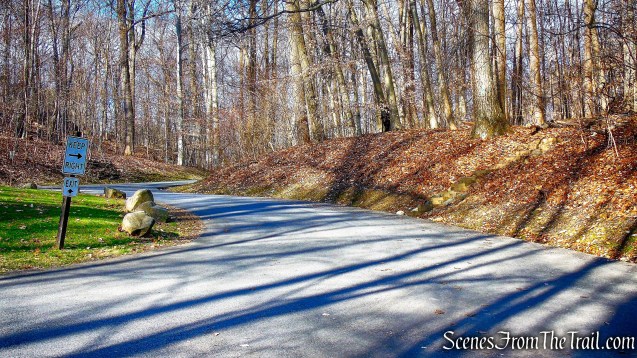
Oscawana Island Nature Preserve

Oscawana Island Nature Preserve

Source:


McAndrews Estate – Oscawana County Park

November‎ ‎17‎, ‎2018 – Oscawana County Park – Crugers, NY

Difficulty: Easy

Length: Approximately 3.5 miles

Max elevation: 209 ft.– total elevation gain approximately 172 ft.

Route type: Circuit

Maps: McAndrews Estate Trail Map

Trailhead parking: Oscawana Island Nature Preserve – Cortlandt Street, Croton-On-Hudson, NY 10520


The McAndrews Estate (also known as Reusens Farm or Long View) is part of Oscawana County Park, located in the Crugers area of the Town of Cortlandt in northern Westchester County, New York. Once a large working farm and estate, it is now unincorporated park land and contains a number of ruins.

McAndrews Estate – Oscawana County Park

McAndrews Estate – Oscawana County Park

The land was originally owned by Nicholas Cruger, and later by a group of individuals including R.A. Wilkinson, Catherine and Gilbert R. Fox, Henry DeGraaf, Warren Leslie, and several others. By the 1880’s it had been acquired piece by piece by Guillaume A. Reusens, a businessman of Belgian ancestry who bred racehorses. Reusens Farm was maintained and sustained by Guillaume Reusens and his descendants for 70 years.

On January 5, 1915 at age 70, Guillaume Albert Reusens passed away. The property was inherited by his nephews, brothers Stanislaus P.M.C. De Ridder and Eugene De Ridder. Eugene De Ridder died under suspicious circumstances only a year after his uncle on April 2, 1916. A lengthy legal dispute over the estate ensued and it’s not clear when (estimated 1922), but eventually Stanislaus De Ridder won his estate claim and became the sole owner of Long View.

On March 7, 1934 Stanislaus De Ridder passed away in NYC. He left no will and the estate reverted to his wife Anne. At some point afterward, Anne married Martin McAndrews. Very little is currently known about the early McAndrews years. Anne McAndrews died on September 20, 1948. In 1962 Martin McAndrews moved away permanently, and the property fell into serious disrepair. At some point after that, the property was vandalized and burned.

By 1965 Westchester County moved to condemn the property, which it did four years later in 1969. Not long after, under the County’s Orders, the deteriorating structures on the property were demolished. Over the next 40 plus years, nature reclaimed what had once been open fields, obscuring what must have been stunning views of the Hudson River. The stone ruins of a few buildings have slowly started to crumble and have become overgrown with vegetation.

Oscawana County Park is owned by Westchester County and managed jointly via an inter-municipal agreement with the Town of Cortlandt. The 100-acre park is open to the public, and contains a number of ruins and hiking trails. Some of the trails are blazed and relatively easy to follow.

McAndrews Estate – Oscawana County Park

McAndrews Estate – Oscawana County Park

The trailhead is located on Cortlandt Street across from Oscawana Island Nature Preserve, where parking is admissible. There are additional access points along the southern edge of the park on Furnace Dock Road as well.

Oscawana Island Nature Preserve

Oscawana Island Nature Preserve

Oscawana Island Nature Preserve’s parking area can accommodate quite a few cars, with the trailhead and kiosk just across the street where Furnace Brook flows beneath the road.

Oscawana Island Nature Preserve

Oscawana Island Nature Preserve

The first time I visited McAndrews Estate, I had no map and kind of just wandered around. There were several areas that I had missed on my previous visit, so I wanted to make sure I covered them on this trip. A lot of the exploration is off trail, but with the leaves down and a mostly open forest, points of interest are easy to find. Having a map this time made it much easier to find my way around and figure out the purpose of the many structures that are scattered throughout the property.

McAndrews Estate – Oscawana County Park

McAndrews Estate – Oscawana County Park

Instead of entering at the trailhead with the kiosk, which would be the way I exited, I instead walked south, up Cortlandt Street, about 300 yards, past a stone wall.

Cortlandt Street

Cortlandt Street

A short distance later, there is an old road that leads into the estate, with large stones at the entrance.

McAndrews Estate – Oscawana County Park

McAndrews Estate – Oscawana County Park

This road is the old Cruger House Driveway. Below is an image of what it looked like circa 1900.

Cruger House Driveway 1900

Cruger House Driveway 1900

I walked up the old road and almost immediately came to an old concrete structure. I am not sure of its origin or purpose, but it could have been a storage building or an ice house. It is not listed on the map.

ice house - McAndrews Estate

ice house – McAndrews Estate

As the road passes the concrete structure, the White Trail comes in from the left as white blazes begin to appear on trees.

White Trail - McAndrews Estate

White Trail – McAndrews Estate

A short distance on the White Trail, there is an unmarked footpath to the left, that leads through the woods. The trail passes by a foundation with stone steps. This is what’s left of the “Johnson House.” It was one of four houses on the estate. It is named for the Johnson family who lived in it during the time of Guillaume Reusens. Originally a two-family house, it was converted to a single family dwelling and renovated by the McAndrews family in the 1940’s.

Johnson house steps

Johnson house steps

Just up ahead is the stone retaining wall for the racetrack.

approaching race track - McAndrews Estate

approaching race track – McAndrews Estate

The Racetrack was once used to exercise the prize horses that were housed on the Estate.

race track - McAndrews Estate

race track – McAndrews Estate

Walking north along the south leg of the racetrack.

race track - McAndrews Estate

race track – McAndrews Estate

The south leg of the racetrack with the arched stone wall and cow barn visible in the distance. This photo was taken in 1911 by E.E. Ballard and compiled into an album by Lynn Stevens in 1964.

race track - McAndrews Estate

race track – McAndrews Estate

At the eastern end of the racetrack, just to the right, is the cow barn. One of the most well-preserved ruins on the estate, this impressive stone stable was used to house cattle.

cow barn - McAndrews Estate

cow barn – McAndrews Estate

The Cow Barn housed cows on the upper level, and occasionally sheep down below. To the left you can see the race track and in the distance the De Graaf/Powers House.

cow barn - McAndrews Estate

cow barn – McAndrews Estate

It is the only structure known to have been built (in 1907) by Guillaume Reusens.

cow barn - McAndrews Estate

cow barn – McAndrews Estate

The circular hole is where the silo used to be.

cow barn - McAndrews Estate

cow barn – McAndrews Estate

cow barn - McAndrews Estate

cow barn – McAndrews Estate

The sheep were housed on the lower level.

cow barn - McAndrews Estate

cow barn – McAndrews Estate

cow barn - McAndrews Estate

cow barn – McAndrews Estate

cow barn - McAndrews Estate

cow barn – McAndrews Estate

This is the northern leg of the racetrack. The racetrack is bordered by metal pipe fencing. There are miles of metal pipe fencing throughout the property.

race track - McAndrews Estate

race track – McAndrews Estate

In the middle of the race track close to the northern loop, was a two-story Judges’ Stand. Presumably it was used to judge horse races or assess training activities.

judge's stand - McAndrews Estate

judge’s stand – McAndrews Estate

Below is an image of what it looked like in 1968.

judge's stand - McAndrews Estate

judge’s stand – McAndrews Estate

judge's stand - McAndrews Estate

judge’s stand – McAndrews Estate

judge's stand - McAndrews Estate

judge’s stand – McAndrews Estate

judge's stand - McAndrews Estate

judge’s stand – McAndrews Estate

Continuing on the northern leg of the racetrack, to the right is a brick reservoir. The Racetrack Reservoir stored water, and was connected to the De Graaf/Powers House located downhill to the east.

race track reservoir - McAndrews Estate

race track reservoir – McAndrews Estate

A large Northern Red Oak near the race track reservoir.

Northern Red Oak - McAndrews Estate

Northern Red Oak – McAndrews Estate

Exiting the racetrack, the same way I came in, I headed west through the woods.

McAndrews Estate

McAndrews Estate

The stone foundation of the Cruger house is just ahead.

Cruger Mansion Foundation - McAndrews Estate

Cruger Mansion Foundation – McAndrews Estate

The Cruger family gave us two Mayors of New York City (one of whom was the host for the Stamp Act Congress), early New York’s most successful merchant trader (who built the largest wharf there), a man who gave Alexander Hamilton his first job, a brave Loyalist who fought in South Carolina, and a man who was actually an elected member of the House of Commons when war broke out and later returned to the newly created United States, to serve as a New York Senator.

The Cruger/Fox House - Photo courtesy of the estate of Edwin Ripley

The Cruger/Fox House – Photo courtesy of the estate of Edwin Ripley

Its large footprint gives an idea of how big a house once stood here.

Cruger Mansion Foundation - McAndrews Estate

Cruger Mansion Foundation – McAndrews Estate

This house was uninhabited as far back as the early 1900’s. It was still standing in the time of the McAndrews, but burnt by vandals in the 1960’s after the property was abandoned.

Cruger House - McAndrews Estate

Cruger House – McAndrews Estate

The Cruger house foundation is just off the White Trail, opposite the concrete storage building.

Cruger Mansion Foundation - McAndrews Estate

Cruger Mansion Foundation – McAndrews Estate

Cruger Mansion Foundation - McAndrews Estate

Cruger Mansion Foundation – McAndrews Estate

Back out on the White Trail, turning left and heading southeast.

White Trail - McAndrews Estate

White Trail – McAndrews Estate

I turned right on the Orange Trail as it heads south through the woods.

Orange Trail - McAndrews Estate

Orange Trail – McAndrews Estate

In about 500 feet, the Orange Trail ends at lower Furnace Dock Road/upper Cortlandt Street.

Orange Trail - McAndrews Estate

Orange Trail – McAndrews Estate

This was once the main entrance to the Cruger estate.

Main Gate - McAndrews Estate

Main Gate – McAndrews Estate

Main pedestrian gate at foot of Furnace Dock Road on the southwest corner of the estate.

Main Gate - McAndrews Estate

Main Gate – McAndrews Estate

I turned around and walked the stone steps back up the Orange Trail.

Orange Trail - McAndrews Estate

Orange Trail – McAndrews Estate

Orange Trail - McAndrews Estate

Orange Trail – McAndrews Estate

Orange Trail - McAndrews Estate

Orange Trail – McAndrews Estate

I retraced my steps along the Orange Trail and turned right as it reaches the junction with the White Trail.

Orange Trail - McAndrews Estate

Orange Trail – McAndrews Estate

A short distance ahead, to the right of the Orange Trail, is a large wrought iron fountain.

fountain - McAndrews Estate

fountain – McAndrews Estate

Looking north and from the vicinity of Furnace Dock Road. In the distance is the Main House. To the right, the large fountain and flag pole.

Fountain and Flag Pole - McAndrews Estate

Fountain and Flag Pole – McAndrews Estate

fountain - McAndrews Estate

fountain – McAndrews Estate

Almost directly across from the fountain is the start of the Yellow Trail.

Yellow Trail - McAndrews Estate

Yellow Trail – McAndrews Estate

The Yellow Trail heads north through the woods towards the main house site.

Main House Site - McAndrews Estate

Main House Site – McAndrews Estate

The Yellow Trail climbs stone steps, just to the left of where the main house once stood.

Yellow Trail - McAndrews Estate

Yellow Trail – McAndrews Estate

The large stone walls are visible just to the right of the trail.

Main House Site - McAndrews Estate

Main House Site – McAndrews Estate

The main house in a vintage photograph.

Main House - McAndrews Estate

Main House – McAndrews Estate

Main House Site - McAndrews Estate

Main House Site – McAndrews Estate

The ruins of the retaining wall and steps that once sat in front of the large main house overlooking the Hudson River.

Main House Site - McAndrews Estate

Main House Site – McAndrews Estate

Main House Site - McAndrews Estate

Main House Site – McAndrews Estate

Close by are the ruins of a brick reservoir.

Main House reservoir - McAndrews Estate

Main House reservoir – McAndrews Estate

Located just east of the main house. The base of the structure, a reservoir that stored water for the main house. The upper level was used as a gazebo.

Main House reservoir - McAndrews Estate

Main House reservoir – McAndrews Estate

Main House reservoir - McAndrews Estate

Main House reservoir – McAndrews Estate

I made my way back to the Yellow Trail and passed cellar holes of a dog kennel and an ice house. I then left the Yellow Trail and walked a short distance west, crossing over the White Trail.

Yellow Trail - McAndrews Estate

Yellow Trail – McAndrews Estate

The remains of what was once a chicken coop, just below where the Johnson house was.

chicken coop ruins - McAndrews Estate

chicken coop ruins – McAndrews Estate

chicken coop ruins - McAndrews Estate

chicken coop ruins – McAndrews Estate

chicken coop ruins - McAndrews Estate

chicken coop ruins – McAndrews Estate

chicken coop ruins - McAndrews Estate

chicken coop ruins – McAndrews Estate

McAndrews Estate

McAndrews Estate

Now back on the White Trail as it heads northeast.

White Trail - McAndrews Estate

White Trail – McAndrews Estate

The White Trail then closely parallels the racetrack and approaches the stone cow barn and curves to the right.

White Trail - McAndrews Estate

White Trail – McAndrews Estate

A short distance ahead, after passing the cow barn, is another stone structure on the right. Known as the “Soil Pit,” this rectangular structure was used to collect manure (via underground pipes) from the Cow Barn.

Soil Pit - McAndrews Estate

Soil Pit – McAndrews Estate

The White Trail ends at a T-intersection with the Blue Trail, where we turned right, now heading east.

junction of White Trail and Blue Trail

junction of White Trail and Blue Trail

Blue Trail - McAndrews Estate

Blue Trail – McAndrews Estate

Through the trees, a pond is visible that was created by damming Furnace Brook.

Blue Trail - McAndrews Estate

Blue Trail – McAndrews Estate

The eastern leg of the Blue Trail ends at the upper section of Furnace Dock Road.

Blue Trail - McAndrews Estate

Blue Trail – McAndrews Estate

Retracing my steps on the Blue Trail, I turned right after passing the pond and began bushwacking north.

bushwacking north

bushwacking north

Just ahead is a dam waterfall, with Maiden Lane on the other side of the brook.

dam and waterfall on Furnace Brook

dam and waterfall on Furnace Brook

I Retraced my steps back to the Blue Trail, turned right and passed the junction with the White Trail and veered right to stay on Blue.

junction of White Trail and Blue Trail

junction of White Trail and Blue Trail

The Blue Trail descends steadily as it heads northwest.

Blue Trail - McAndrews Estate

Blue Trail – McAndrews Estate

At the base of the descent, the Blue Trail turns left, but I continued ahead towards the edge of Furnace Brook and turned right along the shore. Just ahead, past a downed tree is the Fish House Spring.

path to Fish House Spring

path to Fish House Spring

The Fish House Spring was a structure and complex located on the north side of the estate that at one time featured a large concrete patio, brick walls topped with iron security fencing, and a small square building that is believed to have been involved in regulating the fresh natural spring water which was collected at the site.

Fish House Spring

Fish House Spring

Fish House Spring

Fish House Spring

Below is what’s left of the brick wall along Furnace Brook.

Fish House Spring

Fish House Spring

Fish House Spring

Fish House Spring

In addition to being a source of pure water for the various owners of the property, there is strong speculation that a Carp Farming business was managed at this location by Garret De Graaf, who owned the property during the late 1800’s.

Fish House Spring

Fish House Spring

Fish House Spring

Fish House Spring

Fish House Spring

Fish House Spring

Fish House Spring

Fish House Spring

Furnace Brook - McAndrews Estate

Furnace Brook – McAndrews Estate

On the way back to the Blue Trail, the ruins of an old pump that used to send water up the hillside.

steam engine - McAndrews Estate

steam engine – McAndrews Estate

Now heading west on the Blue Trail.

Blue Trail - McAndrews Estate

Blue Trail – McAndrews Estate

Looking west from atop the ruined dam.

Furnace Brook - McAndrews Estate

Furnace Brook – McAndrews Estate

The ruins of an old stone dam alongside the trail.

ruined dam on Furnace Brook - McAndrews Estate

ruined dam on Furnace Brook – McAndrews Estate

The kiosk near the end of the Blue Trail near Cortlandt Street.

Blue Trail - McAndrews Estate

Blue Trail – McAndrews Estate

The Blue Trail ends at a gate on Cortlandt Street. This is also the main trailhead.

terminus of Blue Trail - McAndrews Estate

terminus of Blue Trail – McAndrews Estate

This is a really easy hike that has so much to see. It was fun discovering new points of interest that I missed on my last visit. I saw a pair of elderly men at the parking area, but no one else the entire time I was there. Truly worth a visit if you enjoy historical ruins and a quiet woods walk. This hike can be done in conjunction with Oscawana Island Nature Preserve, which has trails totaling about 1 mile with views of the Hudson River.

Pros: Historical features, ruins galore, lesser traveled area.

Cons: None.

McAndrews Estate – Oscawana County Park

McAndrews Estate – Oscawana County Park

Sources:


Lambs Hill – Fishkill Ridge Conservation Area

November 11, 2018 – Beacon, NY

Difficulty: Strenuous

Length: Approximately 5 miles

Max elevation: 1,488 ft.– total elevation gain approximately 1,737 ft.

Route type: Out and back

Map: East Hudson Trails Map #102Fishkill Ridge Web Map

Trailhead parking: Fishkill Ridge 32 Sunnyside Rd, Beacon, NY 12508

The Fishkill Ridge Conservation Area, owned by Scenic Hudson Land Trust, Inc., is located in the northeast section of Hudson Highlands State Park Preserve, and is managed as an extension of the park. Scenic Hudson has protected more than 1,300 acres along Fishkill Ridge, facilitating creation of 11.5 miles of challenging wilderness trails that allow visitors to walk beside a stream to a waterfall, scramble up rocks and step onto outcroppings affording some of the most breathtaking long-range vistas in the Hudson Highlands.

Fishkill Ridge

Fishkill Ridge

Lambs Hill is in the center of the Fishkill Ridge Conservation Area. It is situated between Mount Beacon and Bald Hill and can be directly accessed via 3 different routes. There are connections to additional trails in Scenic Hudson’s Mount Beacon Park and Hudson Highlands State Park. At an elevation of 1490 feet, it offers some of the most scenic, long-range vistas in the Lower Hudson River Valley.

Synopsis:

The rugged, hilly-to-mountainous terrain includes steep climbs and some scrambling over bare rock. While the views itself are reason enough to undertake the strenuous nature of this hike, the solitude is the real payoff. The crowds that flock to North and South Beacon Mountains rarely make their way to the northeast section of the ridge.

  • Overlook Trail: From the parking area, this trail climbs the ridge via switchbacks and long traverses, with overlooks offering sweeping Hudson River views. It crosses Clove Creek, shaded by towering hemlocks, sugar maples and oaks. On the ridge top, dwarf pitch pines, scrub oaks and mountain laurel predominate. The trail traverses bare rock, affording an unobstructed view to the northeast. After approximately 1.75 miles, the Overlook Trail ends at a junction with the white-blazed Fishkill Ridge Trail.
  • Fishkill Ridge Trail: Passing the junction with the Overlook Trail, it heads east, up to the summit of Lambs Hill, offering broad views of the Hudson River and beyond.

From this point, one can choose to continue on the white-blazed Fishkill Ridge Trail and explore more of the East Hudson Highlands. The Fishkill Ridge Trail continues northeast to Bald Hill and loops back around. Along the way, the yellow-blazed Wilkinson Memorial Trail, the Blue Connector Trail and numerous unmarked footpaths and woods roads make any number of loop hikes possible.

Lambs Hill - Fishkill Ridge Conservation Area

Lambs Hill – Fishkill Ridge Conservation Area

It was in the low 30’s on a Sunday morning so we got a late start, waiting for the temperature to rise a few degrees. There was only one car in the sizable parking lot when we arrived shortly before 10:00 am.

The trailhead is at the rear of the parking lot on Sunnyside Road. An information kiosk and three red markers on a tree, designate the start of the Overlook Trail.

start of Overlook Trail

start of Overlook Trail

The trail climbs gradually at first, crosses a small wooden footbridge and passes some large boulders.

Overlook Trail

Overlook Trail

In about 260 yards, the Overlook Trail reaches a junction with a white-blazed trail, which starts on the left. There is a sign posted high on a tree with an arrow to Malouf’s Mountain Camping, where the white-blazed trail diverts from the main path. The campground, which is hike-in/hike-out, offers both platform and primitive sites.

Overlook Trail

Overlook Trail

The trail descends a little, curves and then cuts into the shoulder of the hill, continuing on a narrow footpath.

Overlook Trail

Overlook Trail

The Overlook Trail then descends to Clove Creek and crosses it on rocks.

Clove Creek - Overlook Trail

Clove Creek – Overlook Trail

The trail then begins its steep ascent of Lambs Hill on switchbacks.

Overlook Trail

Overlook Trail

Around this point, there are faded orange or yellow markers that overlap the red blazes. I found this confusing and thought that we had missed a turn somewhere. As it turns out, this is the red-blazed Overlook Trail and we continued ahead.

Overlook Trail

Overlook Trail

The trail continues to zigzag steeply up the ridge, along craggy ledges and rock. At times, the use of hands as well as feet is necessary.

Overlook Trail

Overlook Trail

After about 1.1 miles from the start, and a brief rock scramble, the Overlook Trail comes to an open rock ledge with views to the northwest. The City of Beacon can be seen directly below, with the Hudson River Valley beyond.

Overlook Trail

Overlook Trail

The Mid-Hudson Bridge, Walkway Over The Hudson and the Catskills, are visible in the distance.

Overlook Trail

Overlook Trail

The trail continues to ascend steeply offering more viewpoints, with the Newburgh-Beacon Bridge and Hudson River visible below.

Overlook Trail

Overlook Trail

After climbing some more, the trail levels off somewhat at 1.4 miles and passes along old stone walls through abandoned orchards.

Overlook Trail

Overlook Trail

After about 1.75 miles and 1,000 feet of elevation gain, the trail comes to an expansive view from an open rock ledge, right near its terminus.

Overlook Trail

Overlook Trail

A short distance later, the Overlook Trail ends at a T-intersection with the white-blazed Fishkill Ridge Trail. We turned left and began following the white blazes.

terminus of Overlook Trail

terminus of Overlook Trail

The Fishkill Ridge Trail heads east along the ridge towards Lambs Hill.

Fishkill Ridge Trail

Fishkill Ridge Trail

The trail is relatively level at first, then dips down and parallels a stone wall.

Fishkill Ridge Trail

Fishkill Ridge Trail

The Fishkill Ridge Trail turns left, crosses over the stone wall and continues to parallel it until it reaches a large rock formation.

Fishkill Ridge Trail

Fishkill Ridge Trail

The trail turns left, climbs alongside the rock formation, then turns right and continues atop the same rock formation.

Fishkill Ridge Trail

Fishkill Ridge Trail

A slight scramble leads onto open rock near the summit.

Fishkill Ridge Trail

Fishkill Ridge Trail

Just before the summit of Lambs Hill, there is a flat area with great views of the Hudson River Valley.

view from Lambs Hill - Fishkill Ridge Trail

view from Lambs Hill – Fishkill Ridge Trail

A small rock scramble Leads to the summit of Lambs Hill with a nice flat area for taking a break high up above the Hudson Valley. The true summit doesn’t have a good view, but we stopped to rest for a few minutes.

Fishkill Ridge Trail

Fishkill Ridge Trail

We walked back down to the flat area just below the summit of Lambs Hill, and enjoyed the sweeping views. Just to the south, from left to right is, South Beacon Mountain, with its fire tower at the summit, the Beacon Reservoir in the center, and North Beacon Mountain, marked by the radio towers at its summit.

view from Lambs Hill - Fishkill Ridge Trail

view from Lambs Hill – Fishkill Ridge Trail

The Mount Beacon Fire Tower at the 1,610-foot southern summit. The highest point in the Hudson Highlands.

view from Lambs Hill - Fishkill Ridge Trail

view from Lambs Hill – Fishkill Ridge Trail

Looking northwest over the City of Beacon and the Hudson Valley.

view from Lambs Hill - Fishkill Ridge Trail

view from Lambs Hill – Fishkill Ridge Trail

The Hudson River, The Gunks and the Catskills.

view from Lambs Hill - Fishkill Ridge Trail

view from Lambs Hill – Fishkill Ridge Trail

Skytop Tower and the Shawangunk Ridge can be seen to the northwest, with the Catskill Mountains just beyond.

view from Lambs Hill - Fishkill Ridge Trail

view from Lambs Hill – Fishkill Ridge Trail

Raptors can be seen hovering high above.

hawk - Lambs Hill - Fishkill Ridge Trail

hawk – Lambs Hill – Fishkill Ridge Trail

It was windy up on Lambs Hill and the combination of sweat, near freezing temperature and cold river breeze, brought a chill to my bones. We decided to retrace our steps back the way we came, rather than continue on to Bald Hill, which was our lofty aspiration. When we reached the junction with the red-blazed Overlook Trail, we turned right and began the steep descent that awaited us.

turn right on Overlook Trail

turn right on Overlook Trail

start of Overlook Trail

start of Overlook Trail

We stopped at all the overlooks on the way back down to take in the views once more. Below is the Fishkill Correctional Facility, with Dutchess Stadium on the far left.

Fishkill Correctional Facility - Overlook Trail

Fishkill Correctional Facility – Overlook Trail

The trail was filled with leaves, which made the trek downhill a little more treacherous. At times the leaves were so deep that we had to be careful not to step on the side of a hidden rock and twist an ankle or worse. Other times the leaves and the ground or rocks underneath were wet and/or frozen. I must have slipped a dozen times, but somehow didn’t fall. The overlooks along the way gave us an excuse to take a breather. On the way down, we passed quite a few afternoon hikers going in the opposite direction. I was surprised, on my previous visit, I didn’t see a soul.

view from Overlook Trail

view from Overlook Trail

At the base of the steep descent, the trail turns left and crosses Clove Creek.

Overlook Trail

Overlook Trail

Clove Creek - Overlook Trail

Clove Creek – Overlook Trail

When we reached the junction with the White Trail, we turned right. Continuing on the red-blazed Overlook Trail is shorter and a more direct route back to the parking area.

turn right on White Trail

turn right on White Trail

We followed the white blazes for about 275 yards until we came to a woods road. Turning left on the woods road, leads back down the hill towards the parking area. We decided to turn right and follow the eroded road steeply uphill to search for something. It was getting late in the day and we were exhausted by this time, so we only followed the eroded woods road for about 400 yards. That ended up tacking on another 260 feet of elevation gain to our hike. We walked downhill on the woods road until it connects with the Overlook Trail and followed the red blazes back to the parking area, where the hike began.

White Trail

White Trail

This hike was a real workout and I was worn out at the end, but felt a sense of accomplishment. There are no easy trails here, but the views and lack of crowds make this a worthwhile hike. I look forward to hiking this area again soon.

Pros: Lesser traveled area, sweeping Hudson River Valley views, rugged terrain.

Cons: Overlook Trail a bit confusing with two different color blazes.

Take a hike!
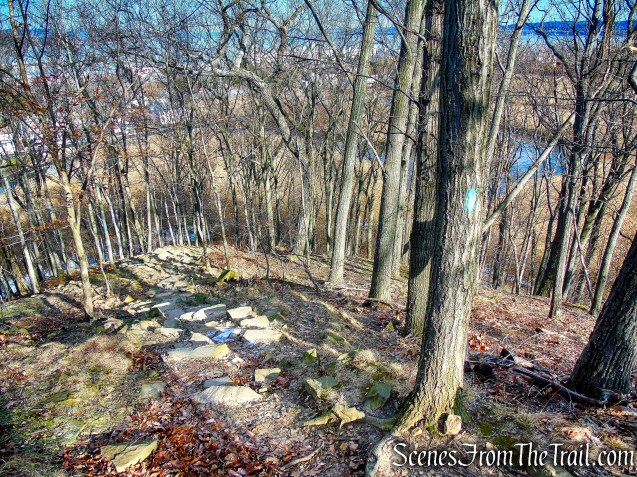
Lambs Hill - Fishkill Ridge Conservation Area

Lambs Hill – Fishkill Ridge Conservation Area

Sources:

Undivided Lot Loop – Mohonk Preserve

November‎ ‎4‎, ‎2018 – High Falls, NY

Difficulty: Moderate – Strenuous

Length: Approximately 6.5 miles

Max elevation: 1,122 ft. – total elevation gain: 1,094 ft.

Route type: Circuit

Map: Shawangunk Trails Map #105 & #106

Trailhead parking: Undivided Lot Trailhead (Clove Chapel) – High Falls, NY 12440

Fees: $15.00 per hiker day use fee (Non-Member) – Purchase Membership


‎With over 8,000 acres on the Shawangunk Ridge, Mohonk Preserve is the largest member and visitor-supported nature preserve in New York State. The Mohonk Preserve is a private land conservation organization established to protect the Shawangunk Ridge. It is not public land funded by the government. Therefore, there is a day use fee to use the preserve which funds its maintenance and programs.

Mohonk Preserve

Mohonk Preserve

The Mohonk Mountain House property consists of 1,325 acres, and much of it is landscaped with meadows and gardens. It adjoins the Mohonk Preserve, which is crisscrossed by 85 miles of hiking trails and carriage roads. The Mohonk Mountain House charges $22.00 Monday-Friday and $27.00 weekends/holidays for a day hiking pass. A hiking pass does not include access to the interior of the house or lake swimming. The Mohonk Preserve (non-profit nature preserve) and the Mohonk Mountain House (resort hotel) are two separate places. The Mohonk Preserve charges $15.00 for a day pass (annual memberships available) which also allows access to the Mohonk Mountain House property. The only drawback is that you have to hike a couple of miles in order to get to the Mountain House grounds. That normally adds about five miles to any hike unless you pay to park on their property.

Starting from Clove Chapel on County Road 6, the light-blue-blazed Undivided Lot Trail travels approximately 2.7 miles southwest along the ridge, co-aligned with the Shawangunk Ridge Trail (SRT), until its terminus at a junction with the Old Minnewaska Trail. The trail features scenic views of the Catskills and is also accessible from either the Coxing or Spring Farm Trailheads.

Prior to the Revolutionary War, the 100-acre piece of land known as Undivided Lot was not usable for agriculture, so a town policy designated it a woodlot for community use and was owned jointly by several nearby valley residents. The ownerships were not designated by land boundaries, giving it the name “undivided,” and the owners were given shares of wood. There is also evidence that at one point, George Washington owned a share when he was stationed at the New Windsor Cantonment in Vails Gate from 1781–1783.

Undivided Lot Trail

Undivided Lot Trail

This hike covers the entire Undivided Lot Trail southwest, from Clove Chapel to the Old Minnewaska Trail. It then returns northeast on Laurel Ledge Road, Maple Path, Stokes Trail and back to the Undivided Lot Trail.

Undivided Lot Loop - Mohonk Preserve

Undivided Lot Loop – Mohonk Preserve

The trailhead parking has room for about 8-10 cars in front of Clove Chapel. When we arrived at approximately 9:15 am on a Sunday morning, the parking area was almost full. Before we began the hike, we walked over to take a look at the historic church.

Situated on the grounds of the Mohonk Preserve, this charming 1876 building was once used not only as a church but also as a library and community center. Today, it is owned by the Community of the Clove (a designated area of deeded land) and the Clove Chapel Board is charged with its the upkeep. Features include a vertical board-and-batten exterior painted yellow with white trim and dormer roof windows that emit natural sunlight (there is also electricity for nighttime events).

Clove Chapel

Clove Chapel

With 28-foot ceilings, the space has great acoustics, and if you whisper up front you can hear it in the back, making it perfect for simple country weddings or christenings. The chapel, which can accommodate 102 people, charges a reasonable fee (the money goes right back into maintenance). Lovely though it is, if you are visiting or attending an event in winter, dress warmly, there’s no heat!

Clove Chapel

Clove Chapel

The light-blue blazed Undivided Lot Trail begins to the right of Clove Chapel (if you are facing it) and is marked by a wooden sign. This is also the route of the Shawangunk Ridge Trail (SRT), marked by blue discs.

Undivided Lot Trail

Undivided Lot Trail

The trail heads southwest through the woods and climbs gradually. The trail was very swampy at the start, but that could be due to the previous day’s rain.

Undivided Lot Trail

Undivided Lot Trail

The Undivided Lot Trail is one of the more remote areas of the Mohonk Preserve and we didn’t encounter any other hikers along the entire trail.

Undivided Lot Trail

Undivided Lot Trail

In about 0.6 mile, the Undivided Lot Trail comes to a Y-intersection with the red-blazed Stokes Trail which starts on the left. That would be our return route, so we stayed to the right and continued following the light blue blazes of the Undivided Lot Trail.

Undivided Lot Trail

Undivided Lot Trail

The trail continues to rise and skirts some cliffs on the right referred to as Outback Slab on some maps. According to my post hike research, there are views to be had from here. I didn’t bother to check it out because I thought that there would be views a little farther up, I was wrong. In hindsight, I wish I had bothered to stop.

Undivided Lot Trail

Undivided Lot Trail

We continued on the Undivided Lot Trail, which has numerous stream crossings. Some wider than others, but all were manageable.

Undivided Lot Trail

Undivided Lot Trail

Originally when I planned this hike, we were going to turn left here on the Clove Path, which connects with Laurel Ledge Road. Once we got to this junction, I suggested that instead of the steep climb up this trail (about 450 ft. elevation gain in about half a mile), we should continue on the Undivided Lot Trail and hike it from end to end. That added some mileage to the original hike and didn’t necessarily eliminate any elevation gain, but made for an interesting hike.

Undivided Lot Trail

Undivided Lot Trail

The trail then turns right, crosses another stream and approaches the edge of the cliffs.

Undivided Lot Trail

Undivided Lot Trail

A short distance later, we came to our first real view.

view from Undivided Lot Trail

view from Undivided Lot Trail

Along the trail there is a stone fireplace.

fireplace -  Undivided Lot Trail

fireplace – Undivided Lot Trail

The trail travels by and over some deep crevices in the rock.

Undivided Lot Trail

Undivided Lot Trail

The trail then makes a right turn and descends steeply alongside the cliffs.

Undivided Lot Trail

Undivided Lot Trail

Undivided Lot Trail

Undivided Lot Trail

The Undivided Lot Trail then levels off somewhat and proceeds through the woods.

Undivided Lot Trail

Undivided Lot Trail

The trail then crosses another stream, climbs again and comes to a rock outcrop with a western-facing viewpoint. It was about this time that after capturing several images of the view, I turned around and saw a large Black Bear about 30 yards away in the woods. It was like we both saw each other at the same time. The bear began to run parallel to the trail, in the same direction we were headed, then abruptly turned and ran up the hill. It all happened so quickly that even with camera in hand, I never even bothered to raise it. I didn’t want to take my eyes off him and was rather relieved that he ran away.

view from Undivided Lot Trail

view from Undivided Lot Trail

We then continued on the Undivided Lot Trail, keeping our eyes and ears open in case the bear came back. Luckily, we didn’t see any more signs of the bear for the rest of the hike.

Undivided Lot Trail

Undivided Lot Trail

The trail climbs over open rock slabs with more views to the west.

view from Undivided Lot Trail

view from Undivided Lot Trail

After 2.7 miles, the Undivided Lot Trail ends at a junction with the Old Minnewaska Trail.

terminus of Undivided Lot Trail

terminus of Undivided Lot Trail

We turned left on the Old Minnewaska Trail, now heading east, away from the ridge.

terminus of Undivided Lot Trail

terminus of Undivided Lot Trail

The Old Minnewaska Trail heads uphill on a moderate grade towards Laurel Ledge Road.

Old Minnewaska Trail

Old Minnewaska Trail

Old Minnewaska Trail

Old Minnewaska Trail

After about 400 yards, the Old Minnewaska Trail ends at Laurel Ledge Road, where we turned left.

terminus of Old Minnewaska Trail

terminus of Old Minnewaska Trail

terminus of Old Minnewaska Trail

terminus of Old Minnewaska Trail

We began heading northeast on this carriage road, encountering several bikers and hikers along the way.

Laurel Ledge Road

Laurel Ledge Road

Laurel Ledge Road is a hiking, biking, and horse trail that runs along the boundary of the Mohonk Mountain House property and Mohonk Preserve. It is 1.9 miles long and begins near Rhododendron Bridge and ends near the Copes Lookout viewpoint.

Laurel Ledge Road

Laurel Ledge Road

This trail connects with the following: Old Minnewaska Trail, Overcliff Carriage Road, Clove Path, Cope’s Lookout Trail, Plateau Path, Zaidee’s Path, Sunset Path, Maple Path and Giant’s Workshop.

Laurel Ledge Road

Laurel Ledge Road

It was a nice change from the rocky footpath we had just left.

Laurel Ledge Road

Laurel Ledge Road

A bench along the trail made a perfect place to have lunch and…..

Laurel Ledge Road

Laurel Ledge Road

enjoy a nice view of the Catskill Mountains.

view from Laurel Ledge Road

view from Laurel Ledge Road

After almost a mile, Laurel Ledge Road comes to a complex junction. At this point map #106 comes into play. It has an expanded view and is much easier to decipher which way to go. Maple Path, our next trail, is just to the right of the sign and large rock formation.

Laurel Ledge Road

Laurel Ledge Road

Laurel Ledge Road

Laurel Ledge Road

We turned left onto Maple Path, which is marked with light blue blazes..

Laurel Ledge Road

Laurel Ledge Road

The Maple Path is 0.3 mile long and connects Laurel Ledge Road with the Stokes Trail

Maple Path

Maple Path

The Maple Path ends at a T-intersection with the red-blazed Stokes Trail. The Stokes Trail is 1.1 miles long and connects the Maple Path with the Undivided Lot Trail.

Stokes Trail

Stokes Trail

The Stokes Trail descends steadily through the forest and comes out on open rock slabs with views to the west.

view from Stokes Trail

view from Stokes Trail

The trail then continues its descent on a woods road.

Stokes Trail

Stokes Trail

tree graffiti - Stokes Trail

tree graffiti – Stokes Trail

At the base of the descent, the Stokes Trail ends at a junction with the Undivided Lot Trail.

terminus of Stokes Trail

terminus of Stokes Trail

We turned right onto the Undivided Lot Trail and began retracing our steps from the beginning of the hike.

turn right on Undivided Lot Trail

turn right on Undivided Lot Trail

In about 0.6 mile, the Undivided Lot Trail ends at Clove Chapel on County Road 6, where the hike began.

Undivided Lot Trail

Undivided Lot Trail

This was a very pleasant hike in a more remote section of Mohonk Preserve. The varied terrain along with the views, make this hike enjoyable. I plan on going back and checking out some of the side trails off of Laurel Ledge Road.

Pros: The Gunks, lesser traveled area, scenic views, stream crossings, good signage at junctions, I saw a bear.

Cons: Trail is swampy in some sections.

Take a hike!
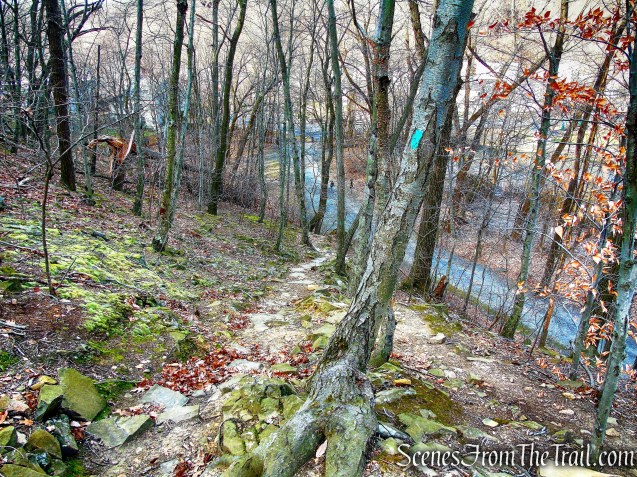
Undivided Lot Loop - Mohonk Preserve

Undivided Lot Loop – Mohonk Preserve

Sources:


Montrose Point State Forest & George’s Island Park

‎October‎ ‎28‎, ‎2018 – Montrose, NY

Difficulty: Easy

Length: Approximately 4.3 miles

Max elevation: 144 ft.– total elevation gain approximately 314 ft.

Route type: Circuit

Map: Montrose Point State Forest Map – George’s Island Park Map (outdated)

Trailhead parking: Directly across from 215 Kings Ferry Rd. Montrose, NY 10548

The 50-acre Montrose Point State Forest is managed cooperatively with Westchester County Parks, which oversees the maintenance on the property. A brick factory was once on the site and the area was heavily mined for the raw materials for this industry, leading to the rolling nature of the topography.

Montrose Point State Forest

Montrose Point State Forest

George’s Island Park is a 208-acre waterfront park offering magnificent views of the historic Hudson River. It contains tidal wetlands, a fresh water pond and wooded trails. It is also an ideal spot for viewing wintering Bald Eagles on the Hudson. It is managed and maintained by Westchester County Parks.

The Westchester RiverWalk, a planned 51.5-mile multi-faceted pathway paralleling the Hudson River in Westchester, runs through Montrose Point State Forest and George’s Island Park.

Greenway Trail - Montrose Point State Forest

Greenway Trail – Montrose Point State Forest

There are 1.25 miles of trails that loop around Montrose Point State Forest. A trail splits off the loop, passes a brick arch bridge and leads down to a “brick beach” and a scenic viewing area. Along the way there are scenic views of the Hudson River. The trails to the south, link to George’s Island Park, making a longer hike possible.

Montrose Point State Forest & George's Island Park

Montrose Point State Forest & George’s Island Park

Due to the steady rain the previous day and early morning, we started a little later than usual and arrived at the trailhead on Kings Ferry Road at approximately 9:30 am. While driving towards Montrose Point State Forest, several emergency vehicles passed us in the opposite direction with sirens blaring. While getting ready to hit the trail, a man that lives nearby offered up some info about what happened. He said that the woman that lives across the street had been feeding a deer by hand and was attacked and gored by that same deer. I only mentioned it because we may have run into that same deer during our hike.

We proceeded past the kiosk and into Montrose Point State Forest.

trailhead - Montrose Point State Forest

trailhead – Montrose Point State Forest

In a short distance, the footpath reaches a T-intersection with the Blue and Red Trails. The Blue Trail would be our return route, so we turned right onto the Red Trail.

turn right on Red Trail - Montrose Point State Forest

turn right on Red Trail – Montrose Point State Forest

The Red Trail travels south through the woods on a relatively level grade.

Red Trail - Montrose Point State Forest

Red Trail – Montrose Point State Forest

The trail then veers right and approaches a pond before it turns left and crosses a wooden footbridge. There are numerous water crossings on this hike and most of the footbridges are in poor shape. The railings are wobbly and we made sure to walk with our weight on the stringers. An easy way to tell is look for nail holes on the decking and follow them across the bridge.

Red Trail - Montrose Point State Forest

Red Trail – Montrose Point State Forest

After crossing the footbridge, the Red Trail climbs a small hill.

Red Trail - Montrose Point State Forest

Red Trail – Montrose Point State Forest

At the top of the rise, just off trail to the right, is a small foundation with stone steps.

Red Trail - Montrose Point State Forest

Red Trail – Montrose Point State Forest

The Red Trail reaches a junction with the Yellow Trail marked by a sign. We turned right onto the Yellow Trail as it heads southwest towards the Hudson River. The image below was taken standing in front of the sign as it is not easily visible from the direction in which we were traveling.

turn right on Yellow Trail - Montrose Point State Forest

turn right on Yellow Trail – Montrose Point State Forest

The Yellow Trail travels through an old growth forest as it heads toward the Hudson River.

Yellow Trail - Montrose Point State Forest

Yellow Trail – Montrose Point State Forest

It also passes alongside an interesting looking brick arch bridge.

brick arch bridge - Montrose Point State Forest

brick arch bridge – Montrose Point State Forest

brick arch bridge - Montrose Point State Forest

brick arch bridge – Montrose Point State Forest

The trail crosses another wooden footbridge and passes a swamp on the right with cliff walls on the left.

Yellow Trail - Montrose Point State Forest

Yellow Trail – Montrose Point State Forest

Yellow Trail - Montrose Point State Forest

Yellow Trail – Montrose Point State Forest

The Yellow Trail comes to a Y-intersection with yellow blazes leading both uphill and towards the river. We stayed to the right and continued towards the river.

bear right on Yellow Trail - Montrose Point State Forest

bear right on Yellow Trail – Montrose Point State Forest

Yellow Trail - Montrose Point State Forest

Yellow Trail – Montrose Point State Forest

This branch of the Yellow Trail ends at the shore of the Hudson River.

Yellow Trail - Montrose Point State Forest

Yellow Trail – Montrose Point State Forest

This area is referred to as “Brick Beach,” where bricks have been discarded along the shore.

Brick Beach - Montrose Point State Forest

Brick Beach – Montrose Point State Forest

We stopped here for a few minutes to take in the view. Directly across the Hudson River is Stony Point and Tomkins Cove.

Brick Beach - Montrose Point State Forest

Brick Beach – Montrose Point State Forest

Looking southwest along the shoreline.

Brick Beach - Montrose Point State Forest

Brick Beach – Montrose Point State Forest

According to the N.Y. State Census of 1855, 37 brickyards were operating in the town of Cortlandt, employing more than a thousand workers.

Brick Beach - Montrose Point State Forest

Brick Beach – Montrose Point State Forest

Brick making along the Hudson started in the 1840’s and by the beginning of the 20th century the clay deposits were becoming exhausted and the brick-making era was coming to a close.

Brick Beach - Montrose Point State Forest

Brick Beach – Montrose Point State Forest

We then retraced our steps……

Yellow Trail - Montrose Point State Forest

Yellow Trail – Montrose Point State Forest

and turned right onto the other branch of the Yellow Trail.

turn right on Yellow Trail - Montrose Point State Forest

turn right on Yellow Trail – Montrose Point State Forest

The trail leads a short distance uphill….

Yellow Trail - Montrose Point State Forest

Yellow Trail – Montrose Point State Forest

with crumbling stone walls to the left of the trail.

Yellow Trail - Montrose Point State Forest

Yellow Trail – Montrose Point State Forest

This branch of the Yellow Trail ends at an overlook with a bench.

Yellow Trail - Montrose Point State Forest

Yellow Trail – Montrose Point State Forest

Looking southwest from the overlook.

Yellow Trail - Montrose Point State Forest

Yellow Trail – Montrose Point State Forest

This is the view from the bench. The Cortlandt Yacht Club is visible below to the right and the hills of Bear Mountain and Harriman State Parks visible across the river..

Yellow Trail - Montrose Point State Forest

Yellow Trail – Montrose Point State Forest

We then retraced our steps back to the junction and turned right on the Yellow Trail.

turn right on Yellow Trail - Montrose Point State Forest

turn right on Yellow Trail – Montrose Point State Forest

Yellow Trail - Montrose Point State Forest

Yellow Trail – Montrose Point State Forest

The largest Osage Orange Tree in NY can be found here in the forest.

Osage Orange - Montrose Point State Forest Map

Osage Orange – Montrose Point State Forest Map

We recrossed the wooden footbridge and passed by the brick arch bridge again.

Yellow Trail - Montrose Point State Forest

Yellow Trail – Montrose Point State Forest

Yellow Trail - Montrose Point State Forest

Yellow Trail – Montrose Point State Forest

Brick Arch Bridge - Montrose Point State Forest

Brick Arch Bridge – Montrose Point State Forest

We returned to the junction with the Red Trail and turned right.

turn right on Red Trail - Montrose Point State Forest

turn right on Red Trail – Montrose Point State Forest

The Red Trail heads southeast through the woods on a level grade.

Red Trail - Montrose Point State Forest

Red Trail – Montrose Point State Forest

Red Trail - Montrose Point State Forest

Red Trail – Montrose Point State Forest

The Red Trail reaches a junction with the Blue Trail which begins on the left (our return route). We turned right and continued following the red blazes.

turn right on Red Trail - Montrose Point State Forest

turn right on Red Trail – Montrose Point State Forest

The trail is a little overgrown in this area.

Red Trail - Montrose Point State Forest

Red Trail – Montrose Point State Forest

The Red Trail turns right and crosses a long wooden footbridge which is not in the best of shape. The railings are really loose and we took great care while crossing it.

Red Trail - Montrose Point State Forest

Red Trail – Montrose Point State Forest

Red Trail - Montrose Point State Forest

Red Trail – Montrose Point State Forest

The Red Trail continues ahead, skirting private property.

Red Trail - Montrose Point State Forest

Red Trail – Montrose Point State Forest

A treehouse on property that adjoins the trail can be seen.

treehouse along the Red Trail - Montrose Point State Forest

treehouse along the Red Trail – Montrose Point State Forest

The trail then passes through an easement, with private homes on the left and the Catholic Kolping Society on the right.

Red Trail - Montrose Point State Forest

Red Trail – Montrose Point State Forest

The Red Trail ends at Montrose Point Road and we turned right onto the paved road, leaving Montrose Point State Forest.

terminus of Red Trail - Montrose Point State Forest

terminus of Red Trail – Montrose Point State Forest

Montrose Point Road, a quiet back road, leads towards the back of George’s Island County Park. Green blazes for the Greenway Trail are visible on telephone poles.

Montrose Point Road

Montrose Point Road

Montrose Point Road dead ends at the rear entrance driveway into George’s Island County Park. Three white blazes on a tree signify the start of the White Trail.

White Trail - George's Island Park

White Trail – George’s Island Park

Halloween decoration on a property that borders the trail.

skeleton

skeleton

The White Trail ascends gradually on a paved road.

White Trail - George's Island Park

White Trail – George’s Island Park

There are a lot of blowdowns throughout the park.

White Trail - George's Island Park

White Trail – George’s Island Park

Just past the fire hydrant, we turned right onto an unmarked footpath.

White Trail - George's Island Park

White Trail – George’s Island Park

We followed the footpath into the woods and up a small hill.

George's Island Park

George’s Island Park

There are remnants of brick structures and foundations in this area, but most are overgrown and hard to see.

ruins - George's Island Park

ruins – George’s Island Park

We walked back out onto the White Trail, turned right and a short distance later, extensive stone ruins came into view just to the right of the trail.

ruins - George's Island Park

ruins – George’s Island Park

At first glance, George’s Island Park appears to be a picnic park and boat launch, but off to the side is a network of wooded trails with interesting features.

ruins - George's Island Park

ruins – George’s Island Park

The information on this estate is very scant and somewhat contradictory. Some old maps that I have viewed put the estate just a bit north, on what is now the Kolping-On-Hudson property on the other side of Montrose Point Rd. Based on the design, these ruins could be from the same estate and possibly a large terrace or patio like structure.

ruins - George's Island Park

ruins – George’s Island Park

The information that I have gathered, if true, give these stone ruins a very historic past.

ruins - George's Island Park

ruins – George’s Island Park

The Seward Estate which was located on Montrose Point, was built and owned by Frederick W. Seward, son of William Seward, Secretary of State under Abraham Lincoln. Frederick was seriously injured, along with several other people, during an assassination attempt on his father’s life on the evening of April 14, 1865 in Washington D.C. at the same time Lincoln was being shot in Ford’s Theater. It was part of a plot to assassinate several government leaders in an attempt to destroy the government. Frederick suffered a fractured skull after being beaten with a pistol that misfired. Both Sewards survived the vicious attack, but it is said that Frederick lived out his life with a silver plate in his skull.

ruins - George's Island Park

ruins – George’s Island Park

The handsome Seward Estate covered about 30 acres. A stately mansion with a beautiful Victorian garden and various outbuildings, it commanded a magnificent view of the Hudson River. The grounds of the estate were dotted by little ponds that had been made by excavating clay for the brickyards which flourished along the Hudson during that period.

ruins - George's Island Park

ruins – George’s Island Park

Frederick had talked of living somewhere on the Hudson River and by 1870 he was ensconced in a pretentious Italianate villa that he called “Montrose.”

ruins - George's Island Park

ruins – George’s Island Park

ruins - George's Island Park

ruins – George’s Island Park

ruins - George's Island Park

ruins – George’s Island Park

Away from the main ruins, there are several of these short stone columns scattered about.

ruins - George's Island Park

ruins – George’s Island Park

Everything AND the kitchen sink.

ruins - George's Island Park

ruins – George’s Island Park

We continued on the White Trail as it leads south.

White Trail - George's Island Park

White Trail – George’s Island Park

Wandering off trail, due to another blowdown, we spotted several foundations and a cinder block structure on the hill.

ruins - George's Island Park

ruins – George’s Island Park

ruins - George's Island Park

ruins – George’s Island Park

ruins - George's Island Park

ruins – George’s Island Park

I spotted some white blazes down the hill, behind the cinder block house so we descended the hill until we caught up with the White Trail.

White Trail - George's Island Park

White Trail – George’s Island Park

The White Trail descends with the Hudson River visible through the trees on the right.

White Trail - George's Island Park

White Trail – George’s Island Park

Another small blowdown to get around.

White Trail - George's Island Park

White Trail – George’s Island Park

The trail passes another “brick beach” with great views of the Hudson River.

White Trail - George's Island Park

White Trail – George’s Island Park

Looking northwest to where we just came from.

White Trail - George's Island Park

White Trail – George’s Island Park

Looking southwest down river, with Sundance Point (George’s Island Park) on the left and Hook Mountain visible further down river on the right.

White Trail - George's Island Park

White Trail – George’s Island Park

The Tappan Zee Bridge can be seen peeking out from behind Hook Mountain.

White Trail - George's Island Park

White Trail – George’s Island Park

An interesting piece of steel laying on a picnic table by the river.

White Trail - George's Island Park

White Trail – George’s Island Park

We continued on the White Trail which becomes a bit overgrown as it heads inland and passes through wetlands.

White Trail - George's Island Park

White Trail – George’s Island Park

The trail travels through a grassy area that was a bit spongy.

White Trail - George's Island Park

White Trail – George’s Island Park

The trail then curves to the left as do the trees.

White Trail - George's Island Park

White Trail – George’s Island Park

White Trail - George's Island Park

White Trail – George’s Island Park

With all the recent rain, the trail was swampy in some sections.

White Trail - George's Island Park

White Trail – George’s Island Park

White Trail - George's Island Park

White Trail – George’s Island Park

A short distance later it passes by the scenic JK Pond.

White Trail - George's Island Park

White Trail – George’s Island Park

An old brick along the trail that dates back to 1905.

White Trail - George's Island Park

White Trail – George’s Island Park

The White Trail now widens to a woods road as it passes through an area listed on the map as “Boney Hollow.”

White Trail - George's Island Park

White Trail – George’s Island Park

Just off trail in the woods, there is what appears to be the remnants of an old mining steam engine.

White Trail - George's Island Park

White Trail – George’s Island Park

The image below, from a previous visit in December 2017, shows a better perspective of the steam engine ruins.

steam engine ruins

steam engine ruins

The White Trail comes to a T-intersection and turns right. We turned left on the Blue Trail which heads northeast.

Blue Trail - George's Island Park

Blue Trail – George’s Island Park

Blue Trail - George's Island Park

Blue Trail – George’s Island Park

A small blowdown on the Blue Trail.

Blue Trail - George's Island Park

Blue Trail – George’s Island Park

The Blue Trail crosses a wooden footbridge and ends at Sunset Road.

Blue Trail - George's Island Park

Blue Trail – George’s Island Park

We turned left onto Sunset Road and followed it uphill to the stop sign and then turned left on Montrose Point Road.

Sunset Road

Sunset Road

We walked on Montrose Point Road, a quiet street that gets little traffic.

Montrose Point Road

Montrose Point Road

I spotted this buck in a yard and thought that this could be the culprit that injured that woman earlier in the morning. The woman sustained some serious injuries, including a ruptured lung and a broken pelvis. Read about it HERE.

Montrose Point Road

Montrose Point Road

We arrived at the start of the Red Trail on Montrose Point Road and entered Montrose Point State Forest.

Red Trail - Montrose Point State Forest

Red Trail – Montrose Point State Forest

We again crossed the rickety bridge.

Red Trail - Montrose Point State Forest

Red Trail – Montrose Point State Forest

A short distance later, we left the Red Trail and turned right on the Blue Trail.

Blue Trail - Montrose Point State Forest

Blue Trail – Montrose Point State Forest

The Blue Trail heads north through the woods.

Blue Trail - Montrose Point State Forest

Blue Trail – Montrose Point State Forest

It then crosses a wooden footbridge over a stream.

Blue Trail - Montrose Point State Forest

Blue Trail – Montrose Point State Forest

The Blue Trail ends at the junction with the Red Trail, where we turned right.

Blue Trail - Montrose Point State Forest

Blue Trail – Montrose Point State Forest

We then walked a short distance back to the parking area, where the hike began.

trailhead - Montrose Point State Forest

trailhead – Montrose Point State Forest

This was a really nice hike to do in an area of historical significance. We didn’t encounter anyone else on the trails during our visit. Updated maps and clearer trails would be nice, but it’s not that big an area to get lost in. Definitely worth the visit.

Pros: Hudson River, historical features, lesser traveled area, lots of bird activity.

Cons: Overgrown trails and numerous blowdowns, George’s Island Park map is outdated.

Take a hike!
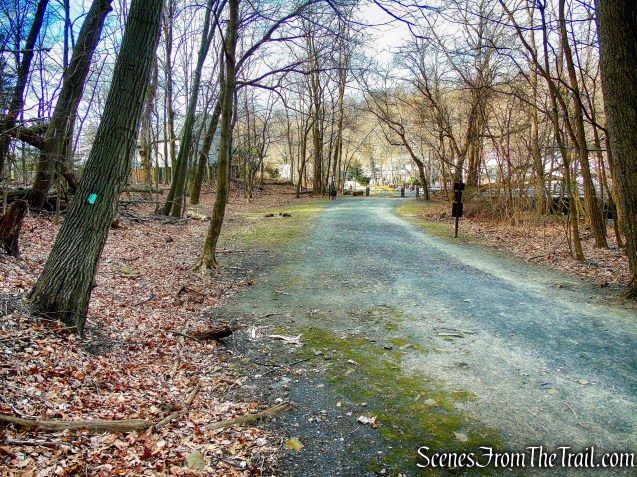
Montrose Point State Forest & George's Island Park

Montrose Point State Forest & George’s Island Park

Sources:


Bad Man’s Cave Loop – Catskill Park

October‎ ‎20‎, ‎2018 – Palenville, NY

Difficulty: Moderate – Strenuous

Length: Approximately 6 miles

Max elevation: 2,656 ft.– total elevation gain approximately 1,274 ft.

Route type: Circuit

Map: Catskills Trail Map #141Free Web Map

Fee: $10.00 per vehicle Day Use (in season) – Empire Pass Accepted

Trailhead parking: 874 N Lake Rd, Haines Falls, NY 12436

Catskill Park is not actually a single park but consists of public and private lands in the Catskills region open to hikers. It consists of 700,000 acres in Southeastern New York’s Ulster, Greene, Delaware and Sullivan Counties. The Catskill Forest Preserve is the state land within the Catskill Park.

North-South Lake is the biggest and most popular state campground in the Catskill Forest Preserve, offering extraordinary scenic beauty, and historical sites, such as: Alligator Rock, Kaaterskill Falls, and the former site of the Catskill Mountain House. The provinces around the lake have long provided visitors with exceptional views of the surrounding countryside. It is said that on a clear day, you can see five states from the escarpment. The campground offers access to numerous hiking trails. The short hike to the Catskill Mountain House site provides the reward of incredible vistas. Longer and more strenuous hikes can bring you to such spots as Artist’s Rock, Sunset Rock, Newman’s Ledge, Boulder Rock, and the Kaaterskill Hotel and Laurel House sites. Kaaterskill Falls lies outside the campground and can be reached by several connecting trails.

view from Catskill Mountain House site

view from Catskill Mountain House site

At the end of our hike, Kaaterskill Falls & Inspiration Point Loop, the previous week, we stopped off at the Catskill Mountain House site to take in the view and have a snack. I was so enamored with the view that I just had to come back and explore the area a little further. This loop hike covers the northeastern section of the North-South Lake area which includes the most dramatic section of the Escarpment Trail.

Bad Man's Cave Loop - Catskill Park

Bad Man’s Cave Loop – Catskill Park

After entering the campground, we followed North Lake Road all the way to North Lake Beach and through the day-use area public lot, towards the large picnic pavilion, turned left and parked in a dirt lot. This is the closest one can park to the Catskill Mountain House site and the Escarpment Trail also passes through the upper portion of the parking area. As luck would have it, the morning started out with heavy fog so we adjusted the hike slightly until it cleared up. From the parking area, we headed east to the blue-blazed Escarpment Trail and began walking uphill on the gravel road. From the parking area it is a 0.2 mile uphill walk.

Escarpment Trail

Escarpment Trail

In a short distance, the Escarpment Trail reaches a T-Intersection and turns left. The blazes indicating the left turn are well above eye level on a tree, a good distance away from the junction.

Escarpment Trail

Escarpment Trail

Escarpment Trail

Escarpment Trail

Almost immediately after turning left, the trail passes between what remains of the two stone gateposts of what was once America’s most fashionable resort.

Escarpment Trail

Escarpment Trail

The trail continues out to an open field, the site of the Catskill Mountain House.

Catskill Mountain House Site

Catskill Mountain House Site

On this morning the fog was so thick that there were no views to be had.

Catskill Mountain House Site

Catskill Mountain House Site

The same location and view the previous week. On a clear day you can see five states.

Catskill Mountain House Site

Catskill Mountain House Site

The Mountain House location had been famous for its panoramic views of the Hudson Valley before the building of the hotel. Artists and writers had discovered the Catskills earlier, and frequented the Mountain House once it was built. Washington Irving and artists of the new Hudson River School, most notably Thomas Cole, enjoyed and depicted the hotel.

Interpretive signage is located at the summit.

Catskill Mountain House Site

Catskill Mountain House Site

The Catskill Mountain House was built in the fall and winter of 1823, and opened in the summer of 1824. Located on a cliff 1,630 feet above the hamlet of Palenville, it offered sweeping views of the Hudson River Valley. In its heyday, “America’s Grandest Hotel” catered to 400 guests a night, including three United States presidents, Ulysses S. Grant, Chester A. Arthur, and Theodore Roosevelt, as well as other prominent figures of the day.

Catskill Mountain House

Catskill Mountain House

The view that made the Mountain House famous came at a cost, getting up the 1,600 ft. climb from the valley required a five-hour stagecoach ride. As more competing hotels that were easier to reach began to be developed, the Mountain House built the cable-operated Otis Elevating Railway to bring its guests directly from the Hudson to the hotel. But the railway proved to be expensive to operate, and was finally sold for scrap in 1918 during World War I.

Otis Elevating Railway

Otis Elevating Railway

The Mountain House hung on until the start of World War II, but the season of 1941 would be it’s last. In 1962 the State of New York acquired the property, and the hotel, severely damaged by weather, years of neglect and an unfinished attempt to renovate the hotel in 1952-1953, was burned by the New York State DEC on Jan. 25, 1963.

Catskill Mountain House circa 1953

Catskill Mountain House circa 1953

All that remains of what was once America’s first mountaintop resort are the gateposts, the sweeping views from the cleared site and the carvings in the red sandstone rocks from visitors long ago.

Catskill Mountain House Site

Catskill Mountain House Site

Since this hike was centered around views, we stayed at the Catskill Mountain House Site for a while, hoping for the fog to dissipate. The wind began to blow the fog past the cliff and we were hopeful, but that only lasted briefly. I was able to capture an image of the precipitous cliff in the few moments it was clear.

Catskill Mountain House Site

Catskill Mountain House Site

Since most of the views on this hike are to the east, we decided to head west towards North-South Lake and check out Alligator Rock. This was an optional end of hike detour, but instead, because of the fog, we decided to go there first. I figured by the time we were done at the lake and made our way back to the Escarpment Trail, the fog would be gone.

We retraced our steps on the Escarpment Trail, through the stone gateposts and past the intersection where the Escarpment Trail turns right. We followed the gravel road down towards the boat rentals on South Lake. As we neared the lake, we jumped on the yellow-blazed North-South Lake Loop Trail.

North-South Lake Loop Trail

North-South Lake Loop Trail

When we reached the shore of the lake, the trail comes to a T-intersection with the yellow blazes going both left and right along the shoreline. I wasn’t quite sure of which way to go, so we turned left. In a short distance we reached the South Lake Beach and boat rentals. Originally the two lakes were separated by an earthen dam, but the two lakes that people enjoyed in the 1800’s were merged into one.

South Lake

South Lake

It is a very scenic spot and most importantly, no fog. We wandered about a bit and asked the boat rental attendant where Alligator Rock is. She pointed us in the right direction and we retraced our steps on the North-South Lake Loop Trail, passing the junction where we first came from and continued along the lake. This stretch of the trail can be hard to follow.

North-South Lake Loop Trail

North-South Lake Loop Trail

The trail leads away from the lake and passes alongside Dinosaur Rock, a massive glacial erratic.

Dinosaur Rock

Dinosaur Rock

In about 500 feet, the trail reaches a gravel road and turns left. To the right, about 140 feet, on the side of the gravel road, is Alligator Rock, a pair of glacial erratics that formed an open mouth and had “teeth” added over the years so it looks like an alligator’s open mouth.

Alligator Rock

Alligator Rock

We retraced our steps and continued following the yellow blazes. There are many small rock outcrops along the shore with nice views of the lake.

North-South Lake

North-South Lake

The wide gravel road heads southeast along the shore of North Lake and back towards the parking area.

North-South Lake Loop Trail

North-South Lake Loop Trail

Once back in the parking area, we found where the Escarpment Trail ducks into the woods and began heading northeast. The blue-blazed trail continues straight ahead, with the lake on the left, picnic areas and a chain-link fence on the right. The trail then passes an overlook deck on the right, but it was still foggy, so we kept it moving.

Escarpment Trail

Escarpment Trail

The Escarpment Trail soon climbs steeply over rock ledges.

Escarpment Trail

Escarpment Trail

There are interesting rock overhangs to the right of the trail and we took a little time to explore them.

rock overhang - Escarpment Trail

rock overhang – Escarpment Trail

We walked down a good distance then turned around and headed back to the trail. After climbing up, the trail passes right above.

rock overhang - Escarpment Trail

rock overhang – Escarpment Trail

The Escarpment Trail passes a small rock outcrop with limited views, then closely parallels the cliff edge.

Escarpment Trail

Escarpment Trail

A short distance later, we reached Artists Rock and our first fantastic view of the day. Artists Rock, where on a clear day it is possible to see four other states. Massachusetts and Connecticut are straight ahead at the South Taconic mountain range (behind the Hudson River, which snakes through the valley).

Artist's Rock

Artist’s Rock

Vermont and New Hampshire are to the left. Albany may be seen to the far left, with the Adirondack Mountains in the distance. This rock ledge was a favorite spot from which artists of the Hudson River School of Painting would paint scenes of the Hudson River Valley.

Artist's Rock

Artist’s Rock

From Artists Rock, the trail ascends steeply…..

Escarpment Trail

Escarpment Trail

Escarpment Trail

Escarpment Trail

The Escarpment Trail then passes by a massive outcrop of conglomerate rock to the right of the trail,

Escarpment Trail

Escarpment Trail

with cliff walls to the left.

Escarpment Trail

Escarpment Trail

The trail parallels this rock outcrop until it reaches a junction where a yellow-blazed trail begins on the right.

Sunset Rock Trail

Sunset Rock Trail

This short trail leads to one of the best views in the Catskill Mountains.

Sunset Rock Trail

Sunset Rock Trail

A short distance in, Lookout Rock is to the left. It offers similar views as Artists Rock, but a worthwhile stop.

Lookout Rock

Lookout Rock

We then followed the yellow blazes to the end and arrived at Sunset Rock, my favorite view of the day.

Sunset Rock

Sunset Rock

At least three major Hudson River School painters, Thomas Cole, founder of the School and his followers, Jasper Cropsey and Sanford Gifford, painted the spectacular view south along the eastern Catskill escarpment from the massive platform of conglomerate called Sunset Rock.

North-South Lake as viewed from Sunset Rock

North-South Lake as viewed from Sunset Rock

We then retraced our steps back to the Escarpment Trail and turned right.

Escarpment Trail

Escarpment Trail

The trail climbs rather steeply,

Escarpment Trail

Escarpment Trail

then a short distance later, arrives at Newman’s Ledge.

Newman's Ledge

Newman’s Ledge

Newman's Ledge

Newman’s Ledge

The vertical drop below Newman’s Ledge is estimated to be around 500 feet.

Newman's Ledge

Newman’s Ledge

We encountered several groups of hikers at this spot and most of them posed for photographs on that ledge that juts out.

Newman's Ledge

Newman’s Ledge

After we were done admiring the glorious view, we proceeded on our way.

Escarpment Trail

Escarpment Trail

The trail climbs steeply again and at times we had to scramble over the rock ledges.

Escarpment Trail

Escarpment Trail

The Escarpment Trail makes a U-turn and starts heading southwest and reaches the junction with the Rock Shelter Trail.

turn left on yellow-blazed Rock Shelter Trail

turn left on yellow-blazed Rock Shelter Trail

Off to the right, just up the hill, is Bad Man’s Cave. We had now hiked close to 4 miles.

Badman's Cave

Badman’s Cave

Legend has it that this is where outlaws hid during the eighteenth century after plundering the valley.

Badman's Cave

Badman’s Cave

It is more of a rock shelter than a cave, but it is large enough for a band of outlaws to hide out in.

Badman's Cave

Badman’s Cave

We stopped here to catch our breath from the climb.

Badman's Cave

Badman’s Cave

We then began heading down North Mountain on the yellow-blazed Rock Shelter Trail.

Rock Shelter Trail

Rock Shelter Trail

As we began walking on the Rock Shelter Trail, to the right is another large rock shelter.

Rock Shelter Trail

Rock Shelter Trail

On our way down, it started raining steadily so I put the camera away. It also made the rocky trail a little slick and slower going. We then came to a junction with the red-blazed Mary’s Glen Trail and turned left. At the junction is Ledge Falls, a very long ledge that at times has water cascading over large sections.

Ledge Falls

Ledge Falls

The Mary’s Glen Trail descends steadily and crosses a log footbridge that spans Ashley Creek. Looking to the left, just a short distance down stream, the very top of Ashley Falls is visible.

Mary's Glen Trail

Mary’s Glen Trail

I heard the sound of the water and ventured off trail on a faint footpath. That brought me up alongside the falls.

Ashley Falls

Ashley Falls

After climbing down some wet rocks, the Mary’s Glen Trail comes to a junction with a short spur trail that leads to the base of Ashley Falls. I walked down there to check it out, but since the falls were not at full force, the view from earlier was much better.

Ashley Falls Trail

Ashley Falls Trail

The Mary’s Glen Trail then reaches North Lake Road, the road we drove in on. The plan was to walk to the lake and pick up the North-South Lake Loop Trail, turn left, following the shoreline until we were close to the parking area, then cut across and back to the vehicle. Since by this time there was a steady downpour, my hiking buddies took shelter under a tree. I bit the bullet and walked the paved North Lake Road alone, almost a mile, to where we parked, then came back to pick them up.

Mary's Glen Trail

Mary’s Glen Trail

Despite the early morning fog and afternoon rain, this hike was outstanding. The Escarpment Trail is fun and challenging along with the seemingly endless views it provides. This area is so rich in history and folklore that it made the hike that much more interesting. The trails at times could use a few more blazes, but the junctions are marked with signs, which are very helpful. I fully expect to explore some more of this area in the near future.

Guests of the Mountain House gave romantic names to many of the amazing view points and rock formations on the escarpment, and still today we can enjoy the likes of Artists Rock, Sunset Rock, Lookout Rock, Alligator Rock and Badman’s Cave. These scenic lookouts and rock formations of the eastern Catskills escarpment are truly unique and spectacular. It is definitely an area of the Catskills that is a must-see and must-explore for any hiker.

Pros: Escarpment Trail, Catskill Mountain House Site, sweeping Hudson Valley views, historical features, glacial erratics, Badman’s Cave.

Cons: Very popular area and can get crowded during warmer months when campground is in full swing.

Take a hike!
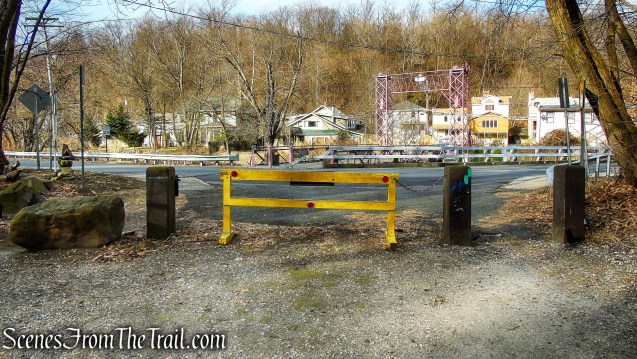
Bad Man's Cave Loop - Catskill Park

Bad Man’s Cave Loop – Catskill Park

Sources:


Kaaterskill Falls & Inspiration Point Loop – Catskill Park

‎October‎ ‎14‎, ‎2018 – Palenville, NY

Difficulty: Moderate

Length: Approximately 4 miles

Max elevation: 2,235 ft.– total elevation gain approximately 1,010 ft.

Route type: Loop

Map: Catskills Trail Map #141 – Free Web Map

Trailhead parking: 103 Laurel House Rd, Palenville, NY 12463

Please note: Although Kaaterskill Falls is one of the most popular destinations in the Catskills, it’s also one of the most dangerous, due to visitors ignoring posted warnings to hike only on marked trails. Hikers are strongly encouraged to stick to the marked path due to the treacherously slippery rocks located at the top of the falls. Take precautions along the path as erosion and water can create slick conditions. As a general rule, use common sense and be aware of the loose rocks, dirt and water-slick stones. There have been eight fatal accidents at the waterfall since 1992 and numerous serious injuries. The ranger covering Kaaterskill Falls says since 2014, at least four hikers who fell to their deaths there, were taking pictures.

Overview:

The Great Northern Catskills of Greene County are home to many treasures, from the stunning natural beauty of the landscape to the rich literary and artistic heritage immortalized by Thomas Cole and Washington Irving. Perhaps the crowning jewel is the highest cascading waterfall in New York State, Kaaterskill Falls. Dropping in two tiers over 260 feet, Kaaterskill Falls has been one of the region’s most popular destinations for centuries.

Kaaterskill Falls - image courtesy of Corey Herzlich Photography

Kaaterskill Falls – image courtesy of Corey Herzlich Photography

Considered by Native Americans to be the resting place of the creator, a sacred place for the Mohican people who called the Catskills home, Kaaterskill Falls has captivated the hearts, pens and paintbrushes of poets, painters, filmmakers and photographers.

Kaaterskill Falls

Kaaterskill Falls

Kaaterskill Falls

Kaaterskill Falls

The 8,550-acre Kaaterskill Wild Forest includes all the state land on Kaaterskill High Peak, as well as the Kaaterskill Clove and South Mountain areas including Kaaterskill Falls. The terrain within Kaaterskill Wild Forest varies significantly in topography with sprawling mountains, dramatic cliffs, scenic waterfalls, and deep valleys.

The Escarpment Trail is a 23.9-mile section of trail (9.8 miles in the Kaaterskill Wild Forest) that runs from the Scutt Road Parking Area in the Kaaterskill Wild Forest north along the northeast corner of the Catskill Mountains, ending at the Route 23 Parking Area in the Elm Ridge Wild Forest. Along the way, the Escarpment Trail connects to the yellow-blazed Kaaterskill Falls Trail and many others.

In 2017, the NYS Department of Environmental Conservation (DEC) completed significant safety improvements at Kaaterskill Falls, that began in 2014. My last visit here was in April of 2015 and the place was really crowded. At that time, the lower trail ended at the base of the falls. Beyond that point, the trail was closed off due to numerous injuries and fatalities suffered by hikers and tourists. Even though there were signs warning of the danger, I observed many people beyond the safety zones.

Kaaterskill Falls - April 12, 2015

Kaaterskill Falls – April 12, 2015

The upper trail, which leads to the top of the falls, had no real good view of the falls. That caused many to go beyond the fence and closer to the cliff edge, in order to get a better look. I was guilty of that ill advised move.

Kaaterskill Falls - April 12, 2015

Kaaterskill Falls – April 12, 2015

Kaaterskill Falls - April 12, 2015

Kaaterskill Falls – April 12, 2015

Now that the two trails connect, along with a new viewing platform, it was time to pay Kaaterskill Falls a return visit. I also wanted to check out some views from the Escarpment Trail, while extending the hike a little. As always, I like to have options when I map out a hike and with so many intersecting trails in the area, I had no definitive route in mind. We ended up doing a very scenic and manageable hike, while avoiding most of the large crowds around the falls. We executed this hike in a counterclockwise direction.

Kaaterskill Falls & Inspiration Point Loop

Kaaterskill Falls & Inspiration Point Loop

The Hike:

We got an early start, but with a two hour drive and a pit stop, we didn’t arrive at the Laurel House Trailhead until about 8:30 am. There were several cars in the lot when we arrived, but when we returned at the end of the hike, the lot was full and there were cars lined up on both sides of Laurel House Road. The lot was expanded to accommodate approximately 35 cars, almost tripling the previous amount of available parking spaces. We geared up and headed for the kiosk at the southern end of the parking lot.

kiosk - Laurel House Trailhead

kiosk – Laurel House Trailhead

We proceeded straight along the trail, our first stop being the viewing platform.

Kaaterskill Falls Trail

Kaaterskill Falls Trail

The upper falls viewing platform is just a short walk.

straight on Kaaterskill Falls Trail

straight on Kaaterskill Falls Trail

Kaaterskill Falls Trail

Kaaterskill Falls Trail

At the next junction we turned right. We would return to this junction after viewing the falls.

turn right on Kaaterskill Falls Trail

turn right on Kaaterskill Falls Trail

turn right on Kaaterskill Falls Trail

turn right on Kaaterskill Falls Trail

In 2015, DEC constructed a new, wide, smooth surface trail with level resting areas to an observation platform overlooking the top of the falls.

Kaaterskill Falls Trail

Kaaterskill Falls Trail

These new features improve the public’s view of the falls from the top and enhance safety by directing people to a safe viewing area away from the top of the falls, where people have fallen.

viewing platfrom - Kaaterskill Falls

viewing platfrom – Kaaterskill Falls

The view of the upper falls is much better now since they installed the platform .

Kaaterskill Falls

Kaaterskill Falls

The view extends to the surrounding mountains as well, with Kaaterskill High Peak visible in the distance, on the left.

view from platform

view from platform

We retraced our steps back to the junction and turned right, crossing the bridge over Spruce Creek.

Among the 2016 improvements, was the installation of a 115-foot hiking bridge that spans Spruce Creek and connects the hamlet of Haines Falls to the Escarpment Trail and North/South Lake Campground. The bridge is part of a new 1.8-mile trail connection between Haines Falls and the existing trail system in the Kaaterskill Wild Forest and North/South Lake Campground, which DEC completed with the assistance of the Kaaterskill Rail Trail Committee.

Kaaterskill Falls Trail

Kaaterskill Falls Trail

After crossing the bridge, we turned right, leaving the road and onto the blue-blazed Escarpment Trail. The road to the left would be our return route.

turn right onto the Escarpment Trail

turn right onto the Escarpment Trail

Escarpment Trail

Escarpment Trail

The Escarpment Trail begins to climb then levels off somewhat.

Escarpment Trail

Escarpment Trail

In a short distance, we came to another junction where we turned right.

turn right towards lower falls

turn right towards lower falls

We then began following the yellow blazes towards the lower falls.

turn right towards lower falls

turn right towards lower falls

The Kaaterskill Falls Trail was also extended from the middle pool to the Escarpment trail creating a key linkage between the top and the bottom of the falls, allowing hikers to avoid a potentially dangerous bushwhack between the two locations.

Kaaterskill Falls Trail

Kaaterskill Falls Trail

Even though it’s a short distance down (0.4 mile), the path is narrow and rocky in places. If it’s wet, it’s most likely slippery.

Kaaterskill Falls Trail

Kaaterskill Falls Trail

The steps help with the steep descent, but if they are covered with leaves, care should be taken while descending.

Kaaterskill Falls Trail

Kaaterskill Falls Trail

On the way down towards the lower falls, we left the staircase and turned right onto the middle falls trail.

turn right onto middle falls trail

turn right onto middle falls trail

With all the safety improvements there are still significant dangers and care should be exercised around this area. People have slipped and fallen to their deaths here.

middle falls trail

middle falls trail

One of the more recent improvements includes a new, 200-foot cable hand rail on the trail leading to the middle pool of Kaaterskill Falls. I used the handrail because due to the hard and slippery terrain, the ground was slick, almost like a wet floor.

middle falls trail

middle falls trail

The trail leads to “the amphitheater,” a grand rounded cavity, roofed over by a massive ledge of thickly stratified sandstone. It’s one of the most popular destinations for hikers at Kaaterskill. In the summer, you can be assured that there will be lots of people wading in the water here.

Kaaterskill Falls

Kaaterskill Falls

A view of the top of the lower falls.

Kaaterskill Falls

Kaaterskill Falls

We wanted to sit here for a while and relax, but everything was wet, muddy and slick, so we retraced our steps along the middle falls trail.

middle falls trail

middle falls trail

When we reached the staircase, we turned right and continued descending to the lower falls.

middle falls trail

middle falls trail

On our way down we could see a lot of people around the base of the falls, including photographers with their tripods.

Kaaterskill Falls Trail

Kaaterskill Falls Trail

We opted instead to make a sharp right by the split rail fence and followed it to a rock outcrop with a great view of the lower falls.

Kaaterskill Falls

Kaaterskill Falls

When done enjoying the falls, we made our way back to the stone staircase and retraced our steps back up the mountain.

A new foot trail now leads from the end of the yellow-blazed Kaaterskill Falls Trail at the base of the falls, up to the middle pool of the falls, which included installation of a new 200-step stone staircase. The staircase was designed to blend in with the natural stone of the trail.

Kaaterskill Falls Trail

Kaaterskill Falls Trail

The staircase contractor, a professional trail crew from the Adirondack Mountain Club, built the staircase by hand, using an elaborate cable system and ramps to move each of the 700-pound stone steps from a staging area on the opposite side of the falls.

Kaaterskill Falls Trail

Kaaterskill Falls Trail

We then came to the junction with the blue-blazed Escarpment Trail and turned right.

Escarpment Trail

Escarpment Trail

The Escarpment Trail is a rocky footpath and was very swampy on this day.

Escarpment Trail

Escarpment Trail

After a short descent, the Escarpment Trail reaches Layman’s Monument.

Frank D. Layman Memorial

Frank D. Layman Memorial

The Frank D. Layman Memorial was erected in 1901 to commemorate Frank D. Layman, who died on the site of the memorial on August 10, 1900, while fighting a forest fire.

Frank D. Layman Memorial

Frank D. Layman Memorial

It is pyramidal in shape, four sided, and rises upward from a base approximately seven feet in diameter to approximately 11 feet.

Frank D. Layman Memorial

Frank D. Layman Memorial

The trail now reaches the edge of the escarpment and turns left here. In a short distance, it turns left again and begins to climb. In 500 feet, after a steep climb up a large rock, it reaches a panoramic viewpoint. Kaaterskill Clove is directly below. Roundtop Mountain and Kaaterskill High Peak tower above the clove to the south, and the small community of Twilight Park may be seen to the right.

view from Escarpment Trail

view from Escarpment Trail

This first viewpoint was very crowded. Since I knew there were numerous other viewpoints on this hike, we did not stay long and continued on.

Escarpment Trail

Escarpment Trail

A little further along, we reached another expansive viewpoint on the right. This was a much smaller rock ledge, but it was perfect to take a short break here.

view from Escarpment Trail

view from Escarpment Trail

The trail begins to climb away from the escarpment…..

Escarpment Trail

Escarpment Trail

and passes through a very picturesque and rocky area.

Escarpment Trail

Escarpment Trail

Escarpment Trail

Escarpment Trail

Escarpment Trail

Escarpment Trail

The Escarpment Trail can be dangerous since it is never far from the edge of the Kaaterskill Clove. It is strongly recommended that you wear proper hiking boots and use trekking poles to steady yourself in case you lose your balance.

Escarpment Trail

Escarpment Trail

After a short climb, we came to a third viewpoint with a more limited view.

Escarpment Trail

Escarpment Trail

Just beyond, the trail climbs steeply,

Escarpment Trail

Escarpment Trail

then more gradually,

Escarpment Trail

Escarpment Trail

as it reaches a junction with a yellow-blazed connector trail that begins on the left.

junction with Yellow Connector Trail

junction with Yellow Connector Trail

We continued straight, but would return to this junction shortly.

junction with Yellow Connector Trail

junction with Yellow Connector Trail

We continued a short distance to Inspiration Point.

Inspiration Point

Inspiration Point

We continued ahead on the blue-blazed trail,

Escarpment Trail

Escarpment Trail

which shortly emerges onto Sunset Rock, with a somewhat limited south-facing view.

view from Escarpment Trail

view from Escarpment Trail

After a short level stretch, the trail descends steeply over rock ledges to reach Inspiration Point.

view from Escarpment Trail

view from Escarpment Trail

From here there are panoramic views to the west and south.

Inspiration Point

Inspiration Point

The two large rock ledges are covered with carved inscriptions, some of which date back over 100 years.

Inspiration Point

Inspiration Point

Inspiration Point

Inspiration Point

When we arrived at Inspiration Point, there were three hikers taking photographs, but they left almost immediately upon our arrival.

Inspiration Point

Inspiration Point

This is a gorgeous spot and we decided to stop here for a while and enjoy it.

Inspiration Point

Inspiration Point

Inspiration Point

Inspiration Point

We then retraced our steps on the Escarpment Trail and climbed over the rock ledges as other hikers approached. Timing is everything.

Escarpment Trail

Escarpment Trail

When we reached the junction with the Yellow Connector Trail, we turned right.

turn right on Yellow Connector Trail

turn right on Yellow Connector Trail

We followed the yellow blazes uphill a short distance.

Yellow Connector Trail

Yellow Connector Trail

The trail turns left (as did we) and is joined by the yellow-blazed Horse Trail which joins from the right.

yellow-blazed Horse Trail

yellow-blazed Horse Trail

We followed the yellow-blazed Horse Trail as it leads downhill. When we arrived at the next junction, we turned left again.

turn left on co-aligned yellow-blazed Horse/red-blazed Scutt Road Trails

turn left on co-aligned yellow-blazed Horse/red-blazed Scutt Road Trails

Now the yellow-blazed Horse Trail is joined by the red-blazed Scutt Road Trail.

co-aligned yellow-blazed Horse/red-blazed Scutt Road Trails

co-aligned yellow-blazed Horse/red-blazed Scutt Road Trails

At the next junction, we turned left on the blue-blazed Escarpment Trail, as the Yellow Horse Trail continues ahead and crosses a wooden footbridge..

turn left on Escarpment Trail

turn left on Escarpment Trail

The Yellow Horse Trail and the Escarpment Trail continue straight and cross a wooden footbridge. Going that way leads to the parking area on Scutt Road. We turned left on the wide woods road and continued downhill, with the creek to our right.

turn left on Escarpment Trail

turn left on Escarpment Trail

A short distance later, we arrived at the junction with yellow-blazed Kaaterskill Falls Trail and turned right.

turn right on Kaaterskill Falls Trail

turn right on Kaaterskill Falls Trail

turn right on Kaaterskill Falls Trail

turn right on Kaaterskill Falls Trail

We crossed the bridge over Spruce Creek,

Kaaterskill Falls Trail

Kaaterskill Falls Trail

and continued straight towards the Laurel House Parking Lot, where the hike began.

Laurel House Trailhead

Laurel House Trailhead

Review:

This was a fantastic hike that is doable by most beginners. By arriving early enough, we avoided the large crowds at Kaaterskill Falls. The improved trails, bridge, viewing platform and stone staircase make visiting Kaaterskill Falls much more enjoyable, not to mention safer. After the first viewpoint on the Escarpment Trail, we ran into only a few hikers. The Escarpment Trail is quite beautiful to hike and there are frequent views. Totally worth the two hour drive.

Pros: Escarpment Trail, Kaaterskill Falls, scenic views, Catskill Mountains, historical features.

Cons: Kaaterskill Falls gets crowded.

Take a hike!
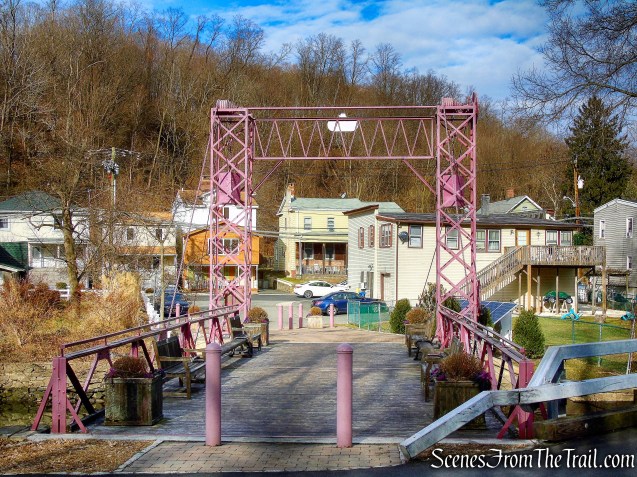
Kaaterskill Falls & Inspiration Point Loop - Catskill Park

Kaaterskill Falls & Inspiration Point Loop – Catskill Park

Sources:

Giant’s Ledges Pocket Park – Mohonk Preserve

October‎ ‎7‎, ‎2018 – Rosendale, NY

Difficulty: Easy – Moderate

Length: approximately 3.3 miles

Max elevation: 400 ft. – total elevation gain: 543 ft.

Route type: Out and back

Map: Wallkill Valley Rail Trail

Trailhead parking: Binnewater Kiln Parking Lot – Kingston, NY 12401

In 2011, Mohonk Preserve acquired Giant’s Ledges, an iconic 142.5 acre parcel in Rosendale, which extends permanent protection to the northernmost section of the Shawangunks. The massive ledge of Shawangunk Conglomerate stretches from Bonticou Crag north, all the way to the hamlet of Rosendale. Known locally as the “Giant’s Ledges” for its dramatic views, impressive boulders, and talus fields, made up of rock fragments, it links the Northern Preserve to the Wallkill Valley Rail Trail.

Giant’s Ledges Pocket Park

Giant’s Ledges Pocket Park

Having recently only just learned of this park, I was intrigued and decided to pay it a visit. Having planned a short hike on Joppenbergh Mountain, I was looking for elsewhere to hike in the immediate area to justify a 1-1/2 hour drive from Westchester County. Giant’s Ledge was a perfect fit and made the drive well worth it.

Giant’s Ledges Pocket Park

Giant’s Ledges Pocket Park

After completing the Joppenbergh Mountain Loop, we drove over to the Binnewater Kiln Parking Lot, which provides access to the Wallkill Valley Rail Trail. It is a large gravel parking area across from the entrance to the Wallkill Valley Rail Trail on Binnewater Road. It’s marked by a pedestrian crossing and “Rail Trail” signs.

Binnewater Kiln Parking Lot

Binnewater Kiln Parking Lot

At the rear of the parking area there is a wall of kilns that were used in the production of Rosendale Cement.  The area quickly developed into the largest single production source of natural cements. By 1830, nearly 10 million pounds per year of natural cement were being produced, marking the beginning of its commercialization.

Binnewater Kiln Parking Lot

Binnewater Kiln Parking Lot

Binnewater Kiln Parking Lot

Binnewater Kiln Parking Lot

We crossed Binnewater Road and made our way to the Wallkill Valley Rail Trail.

Wallkill Valley Rail Trail

Wallkill Valley Rail Trail

We turned right on the Rail Trail and began heading south, with the base of Joppenbergh Mountain to our left.

heading south on the Wallkill Valley Rail Trail

heading south on the Wallkill Valley Rail Trail

In a short distance we came to mile marker 15.5 of the Wallkill Valley Rail Trail. A large mine sits close by that gives off some cool air.

Wallkill Valley Rail Trail

Wallkill Valley Rail Trail

We stopped here for a few minutes to examine the mine and suck up some free air conditioning.

Joppenbergh Mountain mine

Joppenbergh Mountain mine

The entrance to this mine is quite large.

Joppenbergh Mountain mine

Joppenbergh Mountain mine

The mine appears to undercut the Rail Trail.

Joppenbergh Mountain mine

Joppenbergh Mountain mine

As we continued south, we passed some old railroad ties that were removed from the trestle.

Wallkill Valley Rail Trail

Wallkill Valley Rail Trail

We then reached the Rosendale Trestle.

Rosendale Trestle

Rosendale Trestle

The Rosendale Trestle is a 940-foot continuous truss bridge and former railroad trestle. Originally constructed by the Wallkill Valley Railroad to continue its rail line from New Paltz to Kingston, the bridge rises 150 ft. above Rondout Creek, spanning both Route 213 and the former Delaware and Hudson Canal. Construction on the trestle began in late 1870, and continued until early 1872. When it opened to rail traffic on April 6, 1872, the Rosendale Trestle was the highest span bridge in the United States.

Rosendale Trestle

Rosendale Trestle

The Wallkill Valley rail line was closed in 1977 and the trestle renovated as a pedestrian walkway for the Wallkill Valley Rail Trail. It opened to the public with a celebration on June 29, 2013.

Rosendale Trestle

Rosendale Trestle

Looking southwest at Rondout Creek.

Rosendale Trestle

Rosendale Trestle

Turning around, the scarred face of Joppenbergh Mountain, where we had just been a little earlier.

Joppenbergh Mountain

Joppenbergh Mountain

Looking east from the trestle.

DSC02275_HDR_marked

Surprisingly, there were hardly any people on the trestle as we crossed. Normally there is quite a lot of foot traffic here.

Joppenbergh Mountain as viewed from the Rosendale Trestle

Joppenbergh Mountain as viewed from the Rosendale Trestle

We continued south on Wallkill Valley Rail Trail to the southern end of the trestle.

Rosendale Trestle

Rosendale Trestle

After crossing the trestle, we continued straight on the Rail Trail.

Wallkill Valley Rail Trail

Wallkill Valley Rail Trail

In a short distance, we crossed Mountain Road and continued ahead on the Wallkill Valley Rail Trail.

Wallkill Valley Rail Trail

Wallkill Valley Rail Trail

We then passed mile marker 15.

Wallkill Valley Rail Trail

Wallkill Valley Rail Trail

Continuing south on the Rail Trail, we only saw several cyclists on such a beautiful day.

Wallkill Valley Rail Trail

Wallkill Valley Rail Trail

About a 1/2 mile later, shortly before the 14.5 mile marker, the trailhead for the green-blazed Lime Kiln Trail in Giant’s Ledges Pocket Park, begins to the right.

Giant’s Ledges Pocket Park

Giant’s Ledges Pocket Park

Giant’s Ledges Pocket Park

Giant’s Ledges Pocket Park

I could not find a map online, but the map on the sign is helpful. It isn’t quite accurate, as the Yellow Trail on the map ends at the view, but in reality continues heading north. I think that it connects with a woods road that leads back to the Lime Kiln Trail.

Giant’s Ledges Pocket Park

Giant’s Ledges Pocket Park

The green-blazed Lime Kiln Trail is 0.75 mile long (one way) and visits the northernmost section of the Shawangunk Mountains. To the southwest, they reach a height of 2,200 feet above sea level. Here, the highest elevations are about 400 feet.

Lime Kiln Trail - Giant’s Ledges Pocket Park

Lime Kiln Trail – Giant’s Ledges Pocket Park

The name of the trail refers to the area’s historic limestone mines and kilns used over a century ago to produce natural cement. The dark green blazes are at times difficult to see, but the trail itself is discernible.

Lime Kiln Trail - Giant’s Ledges Pocket Park

Lime Kiln Trail – Giant’s Ledges Pocket Park

The trail passes a woods road with a private property sign. I think that this is the road that links up with the Yellow Trail.

Lime Kiln Trail - Giant’s Ledges Pocket Park

Lime Kiln Trail – Giant’s Ledges Pocket Park

I believe that “DO NOT ENTER” refers to cyclists and not hikers. The sign reads at the bottom: “Mohonk Preserve” and as long as you are a member or pay the hiking fee, there shouldn’t be an issue.

Lime Kiln Trail - Giant’s Ledges Pocket Park

Lime Kiln Trail – Giant’s Ledges Pocket Park

The Lime Kiln Trail crosses a small wooden footbridge over a stream, then bears left.

Lime Kiln Trail - Giant’s Ledges Pocket Park

Lime Kiln Trail – Giant’s Ledges Pocket Park

The trail then enters an area called “The Boulders.”

Lime Kiln Trail - Giant’s Ledges Pocket Park

Lime Kiln Trail – Giant’s Ledges Pocket Park

As we passed by, a group of climbers were setting up. It must have been too wet for them because on our return, they were gone.

The Boulders - Giant’s Ledges Pocket Park

The Boulders – Giant’s Ledges Pocket Park

At The Boulders, the Lime Kiln Trail ascends past the base of a dramatic cliff amid fallen, often huge blocks of conglomerate rock.

Lime Kiln Trail - Giant’s Ledges Pocket Park

Lime Kiln Trail – Giant’s Ledges Pocket Park

At the top of the rise, the Lime Kiln Trail ends at a junction with the start of the Yellow Trail. The Yellow Trail turns a sharp left, heads north and passes above the area of The Boulders. This turn can be easily missed because although the green blazes end here, the trail itself continues heading south, entering other areas of the Mohonk Preserve.

Yellow Trail - Giant’s Ledges Pocket Park

Yellow Trail – Giant’s Ledges Pocket Park

Now following the yellow blazes, the trail is carpeted with pine needles.

Yellow Trail - Giant’s Ledges Pocket Park

Yellow Trail – Giant’s Ledges Pocket Park

In a short distance we reached what I have seen referred to on several maps as the “White Dot” viewpoint.

Yellow Trail - Giant’s Ledges Pocket Park

Yellow Trail – Giant’s Ledges Pocket Park

The east-facing viewpoint from Giant’s Ledges.

Giant’s Ledges Pocket Park

Giant’s Ledges Pocket Park

The Marlboro Mountains are visible in the distance.

Giant’s Ledges Pocket Park

Giant’s Ledges Pocket Park

Giant’s Ledges Pocket Park

Giant’s Ledges Pocket Park

Past the viewpoint, the Yellow Trail descends and continues north. Being unsure at the time of where it leads, we did not go any farther than the viewpoint. We retraced our steps back to the Lime Kiln Trail where we turned right.

Lime Kiln Trail - Giant’s Ledges Pocket Park

Lime Kiln Trail – Giant’s Ledges Pocket Park

Passing through The Boulders area again.

The Boulders - Giant’s Ledges Pocket Park

The Boulders – Giant’s Ledges Pocket Park

There are many crevices and cave like areas where one can explore.

The Boulders - Giant’s Ledges Pocket Park

The Boulders – Giant’s Ledges Pocket Park

The Boulders - Giant’s Ledges Pocket Park

The Boulders – Giant’s Ledges Pocket Park

We then recrossed the small wooden footbridge and retraced our steps on the green-blazed Lime Kiln Trail all the way back to the Wallkill Valley Rail Trail, where we turned left and began heading north, back the way we came.

turn left onto the Wallkill Valley Rail Trail

turn left onto the Wallkill Valley Rail Trail

We recrossed the Rosendale Trestle,

Rosendale Trestle

Rosendale Trestle

passing Joppenbergh Mountain along the way.

Joppenbergh Mountain as viewed from the Rosendale Trestle

Joppenbergh Mountain as viewed from the Rosendale Trestle

We continued north on the Wallkill Valley Rail Trail and stopped at the mine for some free air conditioning again.

heading north on the Wallkill Valley Rail Trail

heading north on the Wallkill Valley Rail Trail

As the Wallkill Valley Rail Trail proceeds north to Kingston, we turned left to return back to the parking lot, where the hike began.

heading north on the Wallkill Valley Rail Trail

heading north on the Wallkill Valley Rail Trail

turn left to Binnewater Kiln Parking Lot

turn left to Binnewater Kiln Parking Lot

Cross Binnewater Road.

Binnewater Kiln Parking Lot

Binnewater Kiln Parking Lot

This was an excellent hike through a beautiful area that is not very well known. The Rosendale Trestle does attract crowds, but mixed in with Giant’s Ledges Pocket Park, it made for a really nice day on the trails.

Pros: Gorgeous scenery, historical features, Rosendale Trestle, Wallkill Valley Rail Trail, Giant’s Ledges Pocket Park.

Cons: A trail map of Giant’s Ledges Pocket Park would be very helpful.

Take a hike!
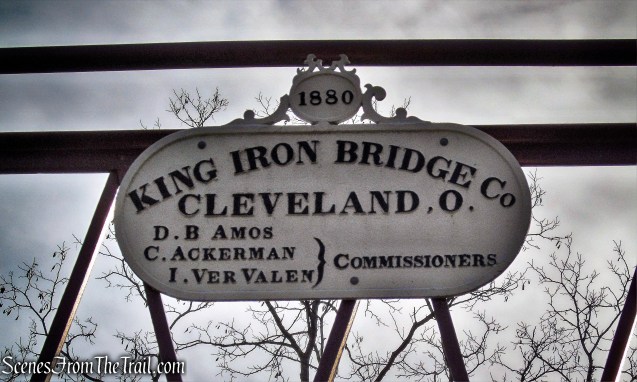
Giant’s Ledges Pocket Park - Mohonk Preserve

Giant’s Ledges Pocket Park – Mohonk Preserve

Sources:


Joppenbergh Mountain Loop

An updated version of this hike can be found here:

Joppenbergh Mountain Loop 2024


October‎ ‎7‎, ‎2018 – Rosendale, NY

Difficulty: Easy – Moderate

Length: approximately 1.8 miles

Max elevation: 461 ft. – total elevation gain: 450 ft.

Route type: Circuit

Map: Joppenbergh Mountain Map 2019

Trailhead parking: Willow Kiln Park – 5 Hardenburgh Lane, Rosendale, NY 12472

Joppenbergh Mountain, located in the heart of the Town of Rosendale, has a rich history. It has also been called Jacob’s Nose, Jacob’s Mount, and in an early 18th-century deed, Jobsenbright. Mined in the late 19th century of limestone as a part of then-booming Rosendale cement industry, it also was the site of several long-distance ski-jumping competitions in the mid-20th century. At over 500 feet, and supporting the northern end of the Rosendale Trestle, it dominates the natural landscape of the Town of Rosendale.

Joppenbergh Mountain

Joppenbergh Mountain

A section of the base of the 118-acre parcel contains a very important parking area for the Town of Rosendale, which is leased to the Town. This area includes a small park, known as Willow Kiln Park, which is maintained by the Town.

Willow Kiln Park

Willow Kiln Park

Joppenbergh Mountain’s underlying bedrock is composed of limestone and dolostone, quite different from the white conglomerate of the Shawangunk Ridge, just to the south. It was named after Rosendale’s founder, Jacob Rutsen, and mined throughout the late 19th century for use in the manufacture of natural cement. Extensive mining caused a large cave-in on December 19, 1899, that destroyed equipment and collapsed shafts within Joppenbergh. The mine shafts visible on the mountain in the image below were destroyed in the 1899 cave-in.

Image circa 1888 - Jane Brodhead Lefevre - Hudson River Valley Heritage

Image circa 1888 – Jane Brodhead Lefevre – Hudson River Valley Heritage

The Wallkill Valley Land Trust (WVLT) purchased the property from the Open Space Institute (OSI) in late December 2011. This opened up the opportunity for the land to become public space for the recreation of the Town’s 6,000+ residents and visitors from near and far. Today, trails lead to the top of the mountain from Willow Kiln park behind Rosendale’s Main Street, and the views from the summit are splendid.

Joppenbergh Mountain

Joppenbergh Mountain

It was a misty and overcast Sunday morning in October, but blue skies were coming, or so we hoped. We arrived at the Rosendale Municipal Parking Lot, which is adjacent to Willow Kiln Park at approximately 9:30am. The Rosendale Farmer’s Market was setting up at that time and we made our way towards the park to have a look at the kilns.

Willow Kiln Park

Willow Kiln Park

Over one hundred years ago, Willow Kiln Park was a very busy spot. The kilns that form the parks backdrop burned all the rock mined under Joppenberg Mountain. It is this cement company’s claim that its product built the Brooklyn Bridge, in fact calling its cement “Brooklyn Bridge Brand.” America’s first railroad steam engine, the Sturbridge Lion, passed through today’s park on a canal boat on the Delaware & Hudson canal located on the south side of the park.

Willow Kiln Park

Willow Kiln Park

The kiln wall which runs 100 feet along the park, is 35-foot-high wall (at its tallest section) and is constructed of stone rubble and grout core, with a stone and mortar face.

Willow Kiln Park

Willow Kiln Park

The trails are not blazed on Joppenberg Mountain, but they are relatively easy to follow and there are directional signs at the start of the hike. The easiest way to do this hike is in a clockwise direction.

Joppenberg Mountain Loop

Joppenberg Mountain Loop

A small sign staked into the ground, directs hikers to the trail entrance, which is located to the far right of the kilns.

Willow Kiln Park

Willow Kiln Park

We followed the arrows up a short hill as the trail bends to the left and crosses the hillside above the kilns.

Joppenbergh Mountain Loop Trail

Joppenbergh Mountain Loop Trail

In a short distance, the trail passes a kiosk that displays a map of the mountain.

Joppenbergh Mountain Loop Trail

Joppenbergh Mountain Loop Trail

The trail then curves to the right and comes to a fork. Initially, we continued on ahead, but there is a confusing junction up ahead and we ended up on the trail that turns left at the “Overlook Trail” sign. It is the easiest way to go and a much shorter distance to the viewpoint.

turn left on Overlook Trail

turn left on Overlook Trail

Just ahead, to the right of the trail is an old brick building.

ruins - Joppenbergh Mountain Loop Trail

ruins – Joppenbergh Mountain Loop Trail

The trail now climbs steadily along the southern slope of Joppenbergh Mountain.

Joppenbergh Mountain Loop Trail

Joppenbergh Mountain Loop Trail

As the trail nears the edge of the mountain, the Town of Rosendale is visible through the trees below.

Joppenbergh Mountain Loop Trail

Joppenbergh Mountain Loop Trail

The trail then curves to the right as it passes through the woods.

Joppenbergh Mountain Loop Trail

Joppenbergh Mountain Loop Trail

The trail once again approaches the edge of the mountain as it nears the summit.

Joppenbergh Mountain Loop Trail

Joppenbergh Mountain Loop Trail

After about 0.7 mile from the start, the trail reaches a rock outcrop with views to the southwest.

Overlook - Joppenbergh Mountain Loop Trail

Overlook – Joppenbergh Mountain Loop Trail

Directly below is the 940 ft. long Rosendale Trestle. Construction on the trestle began in late 1870, and continued until early 1872. When it opened to rail traffic on April 6, 1872, the Rosendale Trestle was the highest span bridge in the United States. The bridge rises 150 ft. above Rondout Creek, spanning both Route 213 and the former Delaware and Hudson Canal.

Rosendale Trestle as viewed from Joppenbergh Mountain

Rosendale Trestle as viewed from Joppenbergh Mountain

After taking in the spectacular view, we continued on our way. The trail continues to climb, steeply in spots.

Joppenbergh Mountain Loop Trail

Joppenbergh Mountain Loop Trail

The trail then levels off and passes by debris, which includes a locker.

Joppenbergh Mountain Loop Trail

Joppenbergh Mountain Loop Trail

The trail then curves north as it begins to descend on a woods road, gradually at first, then the descent steepens.

Joppenbergh Mountain Loop Trail

Joppenbergh Mountain Loop Trail

The trail passes underneath some power lines twice then narrows to a footpath. A short distance later, the trail reaches the “Overlook Trail” sign from earlier in the hike. From there, we retraced our steps back to Willow Kiln Park, where the hike began.

Joppenbergh Mountain Loop Trail

Joppenbergh Mountain Loop Trail

This was a really good short hike with an outstanding view. We didn’t encounter any other hikers on our visit and it turned out to be a beautiful day. Since we drove almost 1-1/2 hours to do this hike, we also did another hike close by, Giant’s Ledges Pocket Park.

Pros: Outstanding views, historical features, lesser traveled area.

Cons: Unmarked trails.

Take a hike!
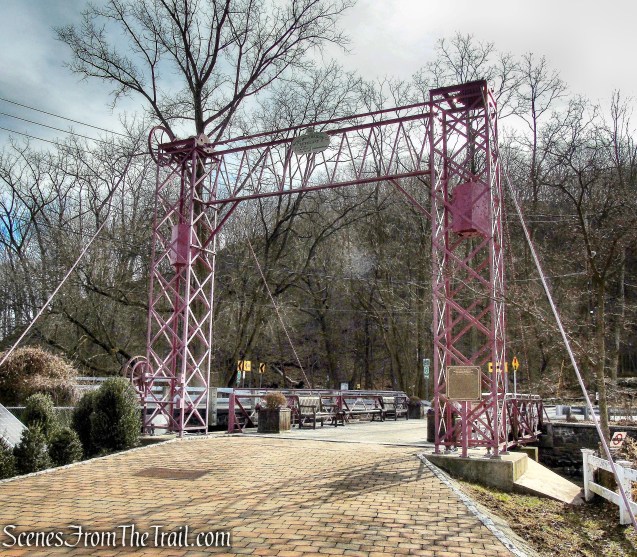
Joppenbergh Mountain Loop

Joppenbergh Mountain Loop

Source

Long Path from Gurnee County Park to Little Tor

September‎ ‎30, 2018 – New City, NY

Difficulty: Strenuous

Length: Approximately 7.6 miles

Max elevation: 774 ft.– total elevation gain approximately 1,289 ft.

Route type: Out and back

Map: Hudson Palisades Trails Map #112

Trailhead parking: Gurnee County Park – Andreanna Park Rd, New City, NY 10956

Little Tor is a peak on South Mountain, part of The Palisades escarpment in High Tor State Park. It rises about 693 feet above the Hudson River and offers superb views of the Hudson Valley and the Manhattan skyline.

Extending 358 miles from the 175th Street Subway Station in New York City to John Boyd Thacher State Park near Albany in New York, the aqua-blazed Long Path Trail is a thread connecting many of New York’s parks, preserves, and state forest land. The Long Path follows the Palisades Escarpment from Fort Lee, NJ to its end in Mt. Ivy. There are many spectacular views of the Hudson River and New York City along the way. Much of the route is through State Parks but the trail also serves as a link to smaller county and town parks.

The Long Path

The Long Path

The 23-acre Gurnee County Park is an old quarry arena, having a 40 to 80 foot escarpment as a backdrop. The grounds are hard packed with traprock, and partly covered with brush and small trees. It first began business in 1896 and continued for 34 years. Rock was removed by hand drilling and blasting. The crushed stone was shipped by rail from the former Mount Ivy railroad station. The high quality of the stone was used for driveway and roadbeds throughout eastern and southern New York. In 1981 the land was acquired through tax delinquency.

Gurnee County Park

Gurnee County Park

This mountainous ridge within the 239-acre South Mountain County Park is part of the Palisades escarpment. It borders High Tor State Park to the east and Gurnee County Park to the west. From Gurnee County Park, South Mountain County Park runs along the ridge eastward for almost two miles to Central Highway. It has a number of scenic views overlooking Haverstraw and the Hudson River, Mt. Ivy and Thiells, Clarkstown and Orangetown. It is covered with a mature stand of hardwood trees and in season there are blueberries, wild grapes and raspberries.

South Mountain County Park

South Mountain County Park

Named for their vertical columns of volcanic rock resembling a stockade fence (or palisade) from a distance, The Palisades are directly across the Hudson River from where I grew up. Since childhood I have admired and visited The Palisades. I remember jumping in my dad’s old Chevy and driving across the Tappan Zee Bridge and stopping along the scenic overlooks and at times trying to spot familiar landmarks from the top of the cliffs. That youthful exuberance continues to this day. Having never hiked the northernmost section of The Palisades, it was the right day for this hike.

We traveled through three different parks on this out and back hike. With the exception of the white-blazed spur trail that leads to Little Tor, The Long Path is the only official marked trail that spans this section of The Palisades. That means that loop hikes are difficult unless it involves a road walk or some bushwacking. My intent was to reach Little Tor and then retrace my steps back to Gurnee County Park. Three side trips are included in this hike which can be eliminated to shorten the mileage and elevation gain.

Long Path from Gurnee County Park to Little Tor

Long Path from Gurnee County Park to Little Tor

We arrived at the parking area at about 8:45 am and there was only one car in the lot. Upon returning mid-afternoon, there were no other cars in the lot. Before beginning the hike, we made a side trip to the Amphitheater. This is a short and worthwhile side trip. The light is not very good in the morning, and at the end of the hike, I returned to capture some much better images.

We walked past the gate at the rear of the parking lot and walked a short distance on a gravel road.

Gurnee County Park

Gurnee County Park

The old quarry arena is quite impressive with its 80 foot escarpment as a backdrop. With the sunlight just peeking over the top of the cliffs, the amphitheater was somewhat shaded. The image below was captured at the end of the hike when the sun was behind me.

Gurnee County Park Amphitheater

Gurnee County Park Amphitheater

We then retraced our steps back to the parking area. The aqua-blazed Long Path is at the left side of the entrance while facing the road. The hike begins exactly where the entire Palisades escarpment ends, dipping right into the ground.

The Long Path

The Long Path

The Long Path climbs gradually along the side of the cliffs.

The Long Path

The Long Path

It briefly skirts a chain link fence alongside private property.

The Long Path

The Long Path

At the top of the rise, as the trail turns right, there is a north-facing viewpoint from the top of the cliffs, with the amphitheater just below. This image was captured on the way back.

north-facing viewpoint

north-facing viewpoint

A short distance ahead, there is another rock outcrop that looks down into the amphitheater and across to the Harriman and Ramapo hills.

west-facing view Gurnee County Park

west-facing view Gurnee County Park

Looking west across the Palisades Interstate Parkway towards Cheesecote Mountain and Harriman State Park.

west-facing view Gurnee County Park

west-facing view Gurnee County Park

The Long Path continues to ascend South Mountain as it leaves Gurnee County Park and enters South Mountain County Park.

Long Path - South Mountain County Park

Long Path – South Mountain County Park

After just over one mile from where we started on The Long Path, we came to a south-facing viewpoint, just to the right of the trail. In the distance, the Manhattan skyline can be seen.

south-facing viewpoint - South Mountain County Park

south-facing viewpoint – South Mountain County Park

South Mountain ridge has plenty of ups and downs, with some short steep sections thrown in.

Long Path - South Mountain County Park

Long Path – South Mountain County Park

Long Path - South Mountain County Park

Long Path – South Mountain County Park

The Long Path briefly joins a woods road, then almost immediately leaves to the left.

Long Path - South Mountain County Park

Long Path – South Mountain County Park

After a rather steep ascent and descent, the Long Path exits South Mountain County Park and crosses Central Highway (CR-33).

Long Path - South Mountain County Park

Long Path – South Mountain County Park

The Long Path now enters High Tor State Park and travels along a fire road as it ascends gradually. After approximately 430 yards from entering High Tor State Park, we came to the power lines. The rocky trail alongside the power lines is a worthwhile detour. The trail leads up to some views and then connects with a woods road, a little farther down in the same direction we were traveling. We did not venture up this trail, but I wish I had.

power lines - High Tor State Park

power lines – High Tor State Park

Instead, we continued on the Long Path and turned left on the woods road that connects with the power line trail.

woods road to power lines - High Tor State Park

woods road to power lines – High Tor State Park

Looking north, Bear Mountain State Park is visible, with the Hudson River to the northeast.

power lines view - High Tor State Park

power lines view – High Tor State Park

We then retraced our steps back down to the Long Path and turned left, continuing south along the Long Path. In about 0.7 mile from the power lines woods road, we turned left onto the white-blazed Little Tor Trail, another woods road.

left on the white-blazed Little Tor Trail

left on the white-blazed Little Tor Trail

The road heads briefly uphill and swings to the front of the open summit of Little Tor. Haverstraw is directly below with the Hudson River in the distance.

view northeast - Little Tor

view northeast – Little Tor

The white trail continues a little farther up to the true summit, with views south of the Manhattan skyline.

Manhattan skyline - Little Tor

Manhattan skyline – Little Tor

We found a nice spot at the summit and had a snack while enjoying the view.

view west - Little Tor

view west – Little Tor

view southeast - Little Tor

view southeast – Little Tor

view east - Little Tor

view east – Little Tor

After spending some time at the summit and chatting with other hikers, we retraced our steps on the white-blazed Trail back to the Long Path. Just to the left of the tree with the three white blazes is an unmarked woods road that leads steeply downhill.

Long Path junction

Long Path junction

At the base of the descent is the man made Tweed Pond. It was the water source for the Kaatz mansion, a building demolished in the early 1970’s during the construction of High Tor State Park.

Tweed Pond

Tweed Pond

Tweed Pond outlet

Tweed Pond outlet

This side trip wasn’t really worth the effort, but it was only an extra 500 yards and another 100 feet of elevation gain.

unmarked woods road

unmarked woods road

Back on the Long Path, we turned left and began to retrace our steps. The trail passes two painted posts, to the left an unmarked trail leads down to the swimming pool in High Tor State Park. To the right, the trail heads steeply down the eastern face of the mountain.

Long Path - High Tor State Park

Long Path – High Tor State Park

Along the way, we passed a split rock, most likely dropped by a glacier and fractured by frost action.

glacial erratic - High Tor State Park

glacial erratic – High Tor State Park

The Long Path then exits High Tor State Park, crosses Central Highway (CR-33) and re-enters South Mountain County Park.

approaching Central Highway (CR-33)

approaching Central Highway (CR-33)

After entering South Mountain County Park, we opted for the fire road which parallels the Long Path, but with a more moderate grade. The fire road reconnects with the Long Path in several places. It can be taken past the communication tower where it meets up with the Long Path again. We continued heading west along the ridge, leaving South Mountain County Park and re-entering Gurnee County Park. A short distance later we returned to the parking area where the hike began. I then took a walk back to the amphitheater, where the light was better.

Gurnee County Park Amphitheater

Gurnee County Park Amphitheater

This was another great hike in the Hudson Valley that was definitely worth doing. From Gurnee Park to High Tor State Park, we didn’t encounter any other hikers. Since Little Tor is reached via the fire road and just over a mile from Central Highway (CR-33), there was some foot traffic. It was such a gorgeous day that I was surprised there wasn’t more people in that area.

Pros: Hudson Valley views, well marked trails, secluded woods.

Cons: More foot traffic near Little Tor.

Take a hike!
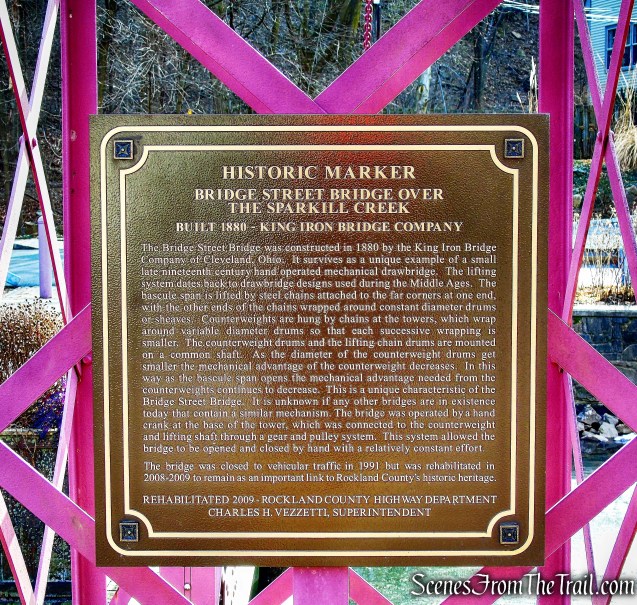
Long Path from Gurnee County Park to Little Tor

Long Path from Gurnee County Park to Little Tor


Fort Wetherill State Park

September 27, 2018 – Jamestown, Rhode Island

Difficulty: Easy

Park map: None available

Address: Fort Wetherill Road – Jamestown, Rhode Island 02835

Facilities include restrooms and fireplaces


Park Overview:

Fort Wetherill State Park, situated upon 100 foot high granite cliffs, is a former coastal defense battery and training camp. Known for its spectacular view of Newport Harbor and the East Passage of Narragansett Bay, Fort Wetherill has been a popular sight for viewing the numerous Tall Ship Events and America’s Cup Races. The area is also a major attraction for scuba diving, with Diving Clubs from New York State, Connecticut, Massachusetts and Rhode Island using the facilities at the boat ramp year round. Additionally, the park offers family and group picnicking, boating, fishing, hiking and exploring on the park’s 61.5 acres of property. Fort Wetherill State Park is managed by the Rhode Island Department of Environmental Management (DEM).

Fort Wetherill State Park

Fort Wetherill State Park


History:

Fort Wetherill State Park, on the Island of Conanicut, in Jamestown, Rhode Island, was formally acquired by the State of Rhode Island from the Federal Government in 1972. Its history as a military site dates back to the American Revolution. As a prominent overlook to the East or Middle passage of Narragansett Bay.

The military story of the site began with an effort by the American colonists to fortify it to prevent British attacks on Newport at the outbreak of the Revolution. The battery here to be known as the Dumpling Rocks Battery was captured before it could go into effect. In December of 1776, the British captured Jamestown along with Newport. The British retained control of the lower Bay, except for a brief interlude in August of 1778, until 1779. During the Battle of Rhode Island, the troops of the French fleet occupied Jamestown.

The location of the first permanent fortification at the southeastern end of Jamestown went atop odd-shaped outcroppings, called the Dumplings. Fort Dumpling, a defensive installation, built here in 1799-1800, was a round, Martell-style, fortified tower. Its purpose was to support Fort Adams blocking enemy ships from entering Newport Harbor. It was never really used and in the 19th century and became a stabilized ruin after gunners at Fort Adams used it for target practice. What remained of Fort Dumpling was blown up in 1898 to make way for more modern defenses. In 1885, Congress had directed the Secretary of War, William C. Endicott to draw up plans for new coastal defenses all along the Atlantic seaboard.

Fort Dumpling - circa 1890

Fort Dumpling – circa 1890

Fort Dumpling - circa 1896

Fort Dumpling – circa 1896

With the outbreak of the Spanish American War in 1898, and with the growing importance of Newport to the U.S. Navy, the property was enlarged for new gun emplacements as part of the Endicott Defense system. This tied Jamestown to other defensive locations around the lower bay. In 1900 Fort Dumpling became Fort Wetherill in honor of Captain Alexander M. Wetherill who died at San Juan Hill in Cuba. His family were area residents. The new 12 inch, 10 inch, disappearing rifles and their mounts were installed in 1905 and 1906.

12 inch Gun In Action - circa 1917

12 inch Gun In Action – circa 1917

Endicott batteries, as described by military historians “were designed for two or three weapons, each gun having a separate platform protected on three sides by concrete walls 15 to 20 feet thick. These massive structures were further protected on the exterior by parapets of sand and dirt 40 or more feet thick. Vegetation was planted so that the mounds would blend with the natural terrain. Located below and adjacent to the gun platforms were offices, plotting rooms, communication equipment, and ammunition vaults with mechanical hoists for moving powder and shells.” Seven separate batteries like these were located at Fort Wetherill.

In 1940, just prior to the United States’ entry into World War II, new construction began at Fort Wetherill. Managing the site were units of the 243rd Coast Artillery, based at Newport’s Fort Adams. The barracks installed here at that time could accommodate 1,200 men. The training which occurred at Wetherill during this period included artillery spotting, signaling, and observation. While the Endicott defenses were the most modern for the period of the Spanish American War and World War I, they were not suitable by the Second World War and the age of air power. Fortunately, the revamped facilities were never put to the test. Part of Wetherill’s responsibilities included caring for the mine fields and submarine nets between Jamestown and Newport. After the war, as was the case of the interwar years, Wetherill was placed under a caretaker status. Guns were removed and by 1970 the land was put on the Federal government’s list of surplus facilities.

In 1972, the same year Fort Dumpling was listed in the National Register of Historic Places, the State of Rhode Island acquired the 61.5-acre site for use as a state park. New roads were laid out to follow the historic routes developed by the military and several meandering trails branch from these, passing through undergrowth and brambles to access rocky cliffs and remnant architecture. Crumbling gun embankments, bunkers, and tunnels attract visitors who also make use of the park for picnicking, hiking, boating, fishing, and scuba diving.


Trails Overview:

Fort Wetherill State Park has a vast network of narrow paths and old roads that meander throughout the park. These trails lead to panoramic views of the ocean from the 100-ft. cliffs and along extended stretches of rocky shoreline.

Fort Wetherill State Park

Fort Wetherill State Park

Fort Wetherill State Park

Fort Wetherill State Park

Fort Wetherill State Park

Fort Wetherill State Park

Fort Wetherill State Park

Fort Wetherill State Park

West Cove.

West Cove - Fort Wetherill State Park

West Cove – Fort Wetherill State Park

Looking east towards Newport Harbor.

Fort Wetherill State Park

Fort Wetherill State Park

Fort Wetherill State Park

Fort Wetherill State Park

Looking south.

Fort Wetherill State Park

Fort Wetherill State Park

Castle Hill Lighthouse in Newport, is visible in the distance on a clear day.

view south of Castle Hill Light

view south of Castle Hill Light

West Cove - Fort Wetherill State Park

West Cove – Fort Wetherill State Park


Fort Wetherill Ruins:

Please exercise caution when exploring the crumbling gun emplacements, bunkers, and tunnels.

Fort Wetherill Ruins

Fort Wetherill Ruins

What’s left of Fort Wetherill is now covered in multicolored graffiti.

Fort Wetherill Ruins

Fort Wetherill Ruins

Fort Wetherill Ruins

Fort Wetherill Ruins

Battery Varnum, overlooking Narragansett Bay.

Fort Wetherill Ruins

Fort Wetherill Ruins

Fort Wetherill Ruins

Fort Wetherill Ruins

Fort Wetherill Ruins

Fort Wetherill Ruins

Fort Wetherill Ruins

Fort Wetherill Ruins

Fort Wetherill Ruins

Fort Wetherill Ruins

Fort Wetherill Ruins

Fort Wetherill Ruins

Fort Wetherill Ruins

Fort Wetherill Ruins

Fort Wetherill Ruins

Fort Wetherill Ruins

Fort Wetherill Ruins

Fort Wetherill Ruins


Review:

A great place to visit that offers outstanding ocean views, but the highlight of the park are the ruins and its history. A flashlight is recommended if venturing more than a few feet inside any of the rooms, as it is extremely dark. It’s not the type of place that one should go alone and there are a lot of deep tunnels with the ladders removed. If someone should fall in and survive, it is highly unlikely that they could get out without help. Worth a visit nonetheless.

Pros:

Ocean views, historical features, ruins, scenic landscape.

Cons:

No signage with information about the history of the numerous areas of the fort.


Sources:


Newport Cliff Walk

September‎ ‎27‎, ‎2018 – Newport, Rhode Island

Difficulty: Easy

Length: Approximately 3.5 miles

Max elevation: 57 ft.– total elevation gain approximately 47 ft.

Route type: Point to point

Map: Newport Cliff Walk Map

Trailhead parking: Easton’s Beach 175 Memorial Blvd, Newport, RI 02840

The Cliff Walk along the eastern shore of Newport, RI is world famous as a public access walk that combines the natural beauty of the Newport shoreline with the architectural history of Newport’s gilded age. Wildflowers, birds, geology, all add to this delightful walk.

Newport Cliff Walk Map

Newport Cliff Walk Map

In 1975 the walk was designated as a National Recreation Trail, the 65th in the nation and first in New England. The walk runs 3.5 miles and about two-thirds of the walk is in easy walking condition. Parts of the southern half of the walk are a rough trail over the natural and rugged New England rocky shoreline.

Newport Cliff Walk

Newport Cliff Walk

Newport’s Cliff Walk is a public right of way over private property owned by the waterfront property owners. The walk historically was really a path or trail with many rustic components, and in some spots has never changed.

The walk starts at the western end of Easton’s or First Beach at Memorial Blvd. and runs south with major exits at Narragansett Ave., Webster St., Sheppard Ave., Ruggles Ave., Marine Ave., Ledge Rd., and ends at Bellevue Ave. at the east end of Bailey’s Beach locally referred to as Reject’s Beach.

Limited metered parking is available along the sidewalk on Memorial Blvd. between Easton’s Beach (also known as First Beach) and the entrance to the Cliff Walk. The meters accept credit cards and there is a 3-hour limit. There is also public parking in the Easton’s Beach parking lot. They charge a fee in season, but when we visited (September 27, 2018) there was no one in the booth collecting the parking fees.

Easton's Beach Public Parking

Easton’s Beach Public Parking

It’s a short distance from the parking area to the official start of the Cliff Walk.

Memorial Boulevard

Memorial Boulevard

I happen to notice this bronze plaque embedded in the sidewalk on Memorial Boulevard. In Newport, Rhode Island, the WPA (Works Progress Administration) built sidewalks and most of the stone walls, grandstands, concession buildings and other facilities in Newport’s public parks during The Great Depression.

W.P.A. plaque

W.P.A. plaque

Cliff Walk entrance on Memorial Boulevard

Cliff Walk entrance on Memorial Boulevard

near the Cliff Walk entrance on Memorial Boulevard

near the Cliff Walk entrance on Memorial Boulevard

I will divide this hike into sections, as there are five unique segments to the Cliff Walk.

1. Memorial Blvd. to Forty Steps

Cliff Walk entrance on Memorial Boulevard

Cliff Walk entrance on Memorial Boulevard

The beginning is the easiest section because it is paved and is the most recently renovated area.

1. Memorial Blvd. to Forty Steps

1. Memorial Blvd. to Forty Steps

The paved walk is ideal for a casual stroll.

1. Memorial Blvd. to Forty Steps

1. Memorial Blvd. to Forty Steps

1. Memorial Blvd. to Forty Steps

1. Memorial Blvd. to Forty Steps

1. Memorial Blvd. to Forty Steps

1. Memorial Blvd. to Forty Steps

The 40 Steps plunge 40 feet down the side of a cliff and onto a balcony that rests just above the ocean. Unfortunately they were cordoned off during our visit for maintenance.

1. Memorial Blvd. to Forty Steps

1. Memorial Blvd. to Forty Steps

2. Forty Steps to Ruggles Ave.

2. Forty Steps to Ruggles Ave.

2. Forty Steps to Ruggles Ave.

This section covers a close up of Mansions at Salve University campus. There are several sets of steps in this area.

2. Forty Steps to Ruggles Ave.

2. Forty Steps to Ruggles Ave.

2. Forty Steps to Ruggles Ave.

2. Forty Steps to Ruggles Ave.

This section will allow you to see some beautiful coastal views, along with Ochre Court (part of Salve Regina University), The Breakers mansion and the Vinland Estate (below), a Romanesque Revival “summer cottage.” This Gilded Age house was completed in 1884 by the architecture firm Peabody & Stearns for wealthy tobacco heiress Catharine Lorillard Wolfe.

2. Forty Steps to Ruggles Ave.

2. Forty Steps to Ruggles Ave.

The 80-acre grounds of Salve Regina University is arguably the most scenically situated campus in New England.

2. Forty Steps to Ruggles Ave.

2. Forty Steps to Ruggles Ave.

The Breakers mansion. This 70-room palazzo was designed by Richard Morris Hunt for Commodore Cornelius Vanderbilt.

2. Forty Steps to Ruggles Ave.

2. Forty Steps to Ruggles Ave.

2. Forty Steps to Ruggles Ave.

2. Forty Steps to Ruggles Ave.

3. Ruggles Ave. to Belmont Beach

3. Ruggles Ave. to Belmont Beach

3. Ruggles Ave. to Belmont Beach

This section covers a touch of rough terrain and waves breaking near or on the walk at times.

3. Ruggles Ave. to Belmont Beach

3. Ruggles Ave. to Belmont Beach

3. Ruggles Ave. to Belmont Beach

3. Ruggles Ave. to Belmont Beach

3. Ruggles Ave. to Belmont Beach

3. Ruggles Ave. to Belmont Beach

Not as rugged as the sign implies, but if wet, the rocks can be slick.

3. Ruggles Ave. to Belmont Beach

3. Ruggles Ave. to Belmont Beach

At Marine Ave. there is a small natural beach (Belmont) that is often used by surfers to launch their boards when surfing off the “Breakers” on those rare occasions when hurricanes are passing offshore.

3. Ruggles Ave. to Belmont Beach

3. Ruggles Ave. to Belmont Beach

3. Ruggles Ave. to Belmont Beach

3. Ruggles Ave. to Belmont Beach

4. Belmont Beach to Ledge Rd. There are no public exits on this part of Cliff Walk from Marine Ave. to Ledge Rd.

4. Belmont Beach to Ledge Rd.

4. Belmont Beach to Ledge Rd.

4. Belmont Beach to Ledge Rd.

4. Belmont Beach to Ledge Rd.

Beechwood (Astor mansion)

4. Belmont Beach to Ledge Rd.

4. Belmont Beach to Ledge Rd.

4. Belmont Beach to Ledge Rd.

4. Belmont Beach to Ledge Rd.

4. Belmont Beach to Ledge Rd.

4. Belmont Beach to Ledge Rd.

4. Belmont Beach to Ledge Rd.

4. Belmont Beach to Ledge Rd.

4. Belmont Beach to Ledge Rd.

4. Belmont Beach to Ledge Rd.

4. Belmont Beach to Ledge Rd.

4. Belmont Beach to Ledge Rd.

4. Belmont Beach to Ledge Rd.

4. Belmont Beach to Ledge Rd.

4. Belmont Beach to Ledge Rd.

4. Belmont Beach to Ledge Rd.

4. Belmont Beach to Ledge Rd.

4. Belmont Beach to Ledge Rd.

This was my favorite section.

4. Belmont Beach to Ledge Rd.

4. Belmont Beach to Ledge Rd.

4. Belmont Beach to Ledge Rd.

4. Belmont Beach to Ledge Rd.

The Walk becomes a rocky trail meandering along the shoreline.

4. Belmont Beach to Ledge Rd.

4. Belmont Beach to Ledge Rd.

4. Belmont Beach to Ledge Rd.

4. Belmont Beach to Ledge Rd.

Doris Duke, the reclusive tobacco heiress and philanthropist, loved Newport and summered here for many years. Rough Point, the 39,000 square foot mansion with 105 rooms, was one of her many beautiful homes.

4. Belmont Beach to Ledge Rd.

4. Belmont Beach to Ledge Rd.

4. Belmont Beach to Ledge Rd.

4. Belmont Beach to Ledge Rd.

4. Belmont Beach to Ledge Rd.

4. Belmont Beach to Ledge Rd.

4. Belmont Beach to Ledge Rd.

4. Belmont Beach to Ledge Rd.

4. Belmont Beach to Ledge Rd.

4. Belmont Beach to Ledge Rd.

4. Belmont Beach to Ledge Rd.

4. Belmont Beach to Ledge Rd.

4. Belmont Beach to Ledge Rd.

4. Belmont Beach to Ledge Rd.

The Waves mansion served as romantic backdrop for Grace Kelly and Frank Sinatra in the 1956 movie, “High Society.”

4. Belmont Beach to Ledge Rd.

4. Belmont Beach to Ledge Rd.

4. Belmont Beach to Ledge Rd.

4. Belmont Beach to Ledge Rd.

5. Ledge Road to Bellevue Ave.

5. Ledge Road to Bellevue Ave.

5. Ledge Road to Bellevue Ave.

5. Ledge Road to Bellevue Ave.

5. Ledge Road to Bellevue Ave.

5. Ledge Road to Bellevue Ave.

5. Ledge Road to Bellevue Ave.

5. Ledge Road to Bellevue Ave.

5. Ledge Road to Bellevue Ave.

5. Ledge Road to Bellevue Ave.

5. Ledge Road to Bellevue Ave.

5. Ledge Road to Bellevue Ave.

5. Ledge Road to Bellevue Ave.

The path leads out to Bellevue Avenue where we walked 1-1/2 blocks to the bus stop.

Bellevue Ave.

Bellevue Ave.

The bus stop is located on Bellevue Avenue, just past the intersection with Ledge Road. The 67 Bus stops here and will drop you off on Memorial Boulevard.

Route 67 Bus Stop - Bellevue Ave. & Ledge Rd.

Route 67 Bus Stop – Bellevue Ave. & Ledge Rd.

This is one of those “must do it once” type of hikes. It’s extremely easy and quite enjoyable. The rough terrain sections are not rough at all unless the rocks are wet, then they can become a little trickier. The only drawback is waiting for the bus at the end of the hike and the walk back to the car. In season there is a bus every 20 minutes and every 30 minutes off season. In retrospect, I would have taken the bus to Bailey’s Beach and started from there. On the return trip, the bus dropped us off at the corner of Bellevue Ave and Memorial Blvd. We then walked about 1.3 miles along Memorial Blvd back to Easton’s Beach (First Beach), where we parked the vehicle. Other than that it was a beautiful stroll along the Newport shoreline.

Pros: Too many to list.

Cons: Waiting for the bus and the walk back to the parking lot, During summer months expect crowds.

Take a hike!
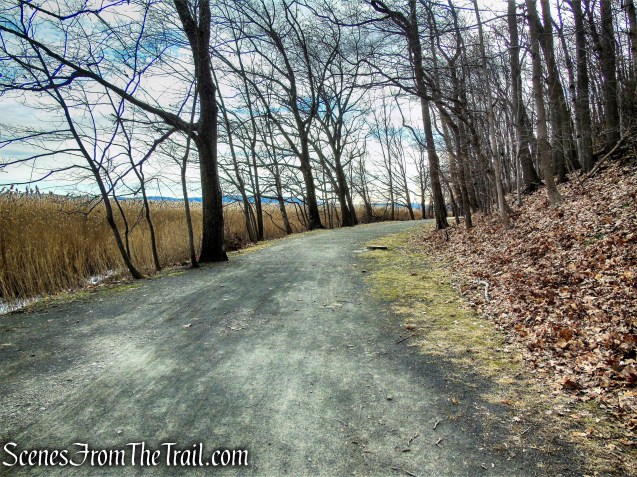
Newport Cliff Walk

Newport Cliff Walk

Sources:

Madame Sherri Forest

September‎ ‎26‎, ‎2018 – Chesterfield, New Hampshire

Map: Madame Sherri Forest Map and Surrounding Conservation Lands and Trails

Trailhead parking: Gulf Rd, West Chesterfield, NH 03466


The 513-acre Madame Sherri Forest is situated on the eastern slope of Wantastiquet Mountain, also known as Rattlesnake Mountain in Chesterfield, New Hampshire. The property abuts the larger, 847-acre Wantastiquet State Forest. Trails in the Madame Sherri forest are linked to the larger Wantastiquet – Monadnock Greenway Trail, which stretches from the Connecticut River east to Mount Monadnock. The Anne Stokes Loop Trail leads to scenic Indian Pond, and other trails ascend Wantastiquet Mountain, with excellent views.

Madame Sherri Forest

Madame Sherri Forest

The Madame Sherri Forest is named after a former owner, Madame Antoinette Sherri, a Paris-born theatrical costume designer who worked in New York City during the early 1900’s. She and her husband built a French-inspired chateau summer house in Chesterfield that featured extensive stonework including a roman arch stairway, ornate interior, and designed landscape gardens. It was her “castle” in the woods.

The black and white images below are from 1949.

image courtesy of the Chesterfield Conservation Commission

image courtesy of the Chesterfield Conservation Commission

Madame Sherri Castle Ruins 2018.

Madame Sherri Castle Ruins

Madame Sherri Castle Ruins

Madame Sherri Castle Ruins

Madame Sherri Castle Ruins

There they lavishly entertained their New York City friends at parties during the Roaring 1920’s. Madame Sherri became famous (or infamous) for her wild parties. Her chauffeur-driven Packard, her fur coat (and nothing else), and her fast crowd of friends made the townsfolk talk whenever she appeared.

image courtesy of the Chesterfield Conservation Commission

image courtesy of the Chesterfield Conservation Commission

Madame Sherri Castle Ruins

Madame Sherri Castle Ruins

However, in time, Madame Sherri’s fortunes declined and her castle fell to ruin and vandalism. After a long separation, she returned to the house in 1959 to find the interior badly vandalized. She left, heartbroken, never to return again. The house burned down completely in 1963. Today, ancient sugar maples surround a stone foundation and stairway.

image courtesy of the Chesterfield Conservation Commission

image courtesy of the Chesterfield Conservation Commission

Madame Sherri Castle Ruins

Madame Sherri Castle Ruins

Madame Sherri died in Brattleboro, Vermont on October 21, 1965, at the age of 84.

Madame Sherri Castle Ruins

Madame Sherri Castle Ruins

Ann Stokes, who loved this property and its theatrical legacy, purchased it shortly after Madame Sherri passed away in 1965. Over the next several years, she hosted several concerts and parties, using the foundation and stairway as a stage for elaborate sound and lighting displays. She decided to permanently protect the land in 1976, when she donated the property to the Forest Society.

Madame Sherri Castle Ruins

Madame Sherri Castle Ruins

Madame Sherri Castle Ruins

Madame Sherri Castle Ruins

There is a small parking lot at the Madame Sherri Forest trailhead on Gulf Road. An informational kiosk displays a trail map and property information.

Madame Sherri Forest

Madame Sherri Forest

There is a separate interpretive display nearby that explains the rich cultural history of the property and its former owners.

Madame Sherri Forest

Madame Sherri Forest

A small wooden footbridge just beyond the kiosk, leads to trails that take you into the forest.

Madame Sherri Forest

Madame Sherri Forest

A two-mile loop trail passes by scenic Indian Pond, and other side trails lead to several longer hikes on adjoining conservation lands.

Madame Sherri Forest

Madame Sherri Forest

From the parking lot, the foundation and grand stone staircase of the former Madame Sherri “castle” are just a short distance up a side trail.

Madame Sherri Forest

Madame Sherri Forest

Trail Information:

ANNE STOKES LOOP TRAIL
Difficulty: Moderate
Round-trip Distance: 2 miles
Trail Markings: None

TRAIL DIRECTIONS:
From the Madame Sherri Forest parking area, follow the hiking trail across a small bridge. In approximately 0.25 mile, the trail forks. Bear right at the fork and continue for another 0.4 mile on the Anne Stokes Loop Trail to the junction with the Wantastiquet Mountain Trail (heading off to the right). Continue straight on the Anne Stokes Loop Trail, passing scenic Indian Pond is on the right. The pond is framed to the west by the open ledges and talus slopes of Mine Ledge on Wantastiquet Mountain. To complete the loop, continue southeast from Indian Pond up a small hill with fine views, then downhill through a hemlock forest through Chesterfield’s Cook Town Forest. At the junction with the Daniels Mountain Loop Trail, the Anne Stokes Loop Trail curves left to the northwest, leading back to the parking area.

WANTASTIQUET MOUNTAIN
Difficulty: Moderate
Round-trip Distance: 3 miles
Trail Markings: None

TRAIL DIRECTIONS:
From the Madame Sherri Forest parking area, follow the hiking trail across a small bridge. In approximately 0.25 mile, the trail forks. Bear right at the fork and continue for another 0.4 mile on the Anne Stokes Loop Trail to the junction with the Wantastiquet Mountain Trail. Turn right at the trail junction, heading west toward Wantastiquet Mountain. The summit is approximately 0.8 mile from the junction with the Anne Stokes Loop Trail and affords excellent views of the Connecticut River valley, Mount Monadnock, and the distant Berkshire Mountains. Retrace your steps to return to the Madame Sherri Forest parking area.

Take a hike!
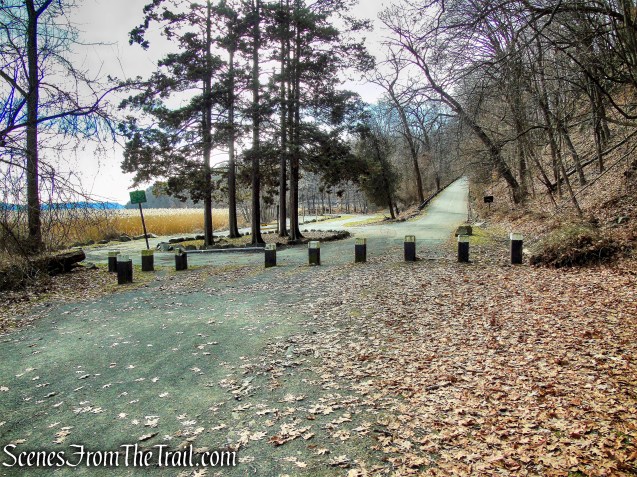
Madame Sherri Forest

Madame Sherri Forest

PLEASE NOTE:
The castle is near the entrance to the Madame Sherri Forest on Gulf Road. You’ll have to drive deep into the woods on winding dirt and stone roads, which are narrow. There may be limited phone and/or GPS reception throughout that area. While the structures seem stable, be careful, as there are no handrails on the steps and may be slick when covered with leaves.


Sources:


Bancroft’s Castle on Gibbet Hill

September‎ ‎26‎, ‎2018 – Groton, Massachusetts

Difficulty: Easy

Length: Approximately 1 mile

Map: Gibbet Hill Trails

Gibbet Hill Property Map

Trailhead parking: Gibbet Hill Grill – 61 Lowell Rd, Groton, MA 01450


Gibbet Hill in Groton, Massachusetts offers an interesting story, as well as nice views. In 1645 the hill was named for the English “gibbet” (pronounced JIB-bet), a gallows generally situated on a hill for public executions. Although there are some local legends and rumors, there are no substantiated claims of executions on the hill.

Gibbet Hill

Gibbet Hill

Gibbet Hill was more likely named after a hill in England by Groton’s English settlers when they first came to the area in the 17th century.

Gibbet Hill

Gibbet Hill

In 1906 General William Bancroft, a Groton native who became head of the Boston Elevated Railroad and Mayor of Cambridge, began building a retirement home called “Shawfieldmont” at the crest of Gibbet Hill. Beginning with a modest bungalow, he planned to add a castle-like mansion and a stable, but ran out of money before the project was complete.

Shawfieldmont

Shawfieldmont

In 1918 the property was sold to Harold Ayres, a prominent physician who turned the bungalow into a private sanitarium, which accepted “all but insane or contagious” patients for $20 per week. In the 1930’s, the Groton Hunt Club uses the bungalow for fox-hunting parties, dinners, dances and nature outings. In 1932 “careless fireworks” are blamed for a fire that destroyed most of the bungalow, leaving only the remains of a stone observation tower intact.

Bancroft's Castle

Bancroft’s Castle

In 1947 After World War II, Marion Campbell, a Vassar graduate who had written for the Washington Post and whose father owned Atlantic Monthly, purchases the rundown farm. Campbell hires local farm manager Bill Conley to help her breed Black Angus cattle. By the 1980’s, the herd producing “superior meat” had grown to 600 head and bloodlines have been tracked as far as Australia and Zimbabwe.

Black Angus - Gibbet Hill

Black Angus – Gibbet Hill

Bull - Gibbet Hill

Bull – Gibbet Hill

In the late 1990’s the Marion Campbell Trust put the property up for sale. In the summer of 2000, they reached the final stages of an agreement with the construction company Modern Continental, which approved plans to develop 78 houses on the property. In 2000 Geotel Communications founder Steven Webber, a Groton native, purchased the 338-acre farm, plus an adjacent 188-acre orchard, to prevent the imminent development of the property. He vowed to prevent any future residential development. The farm had long been home to a renowned Black Angus cattle breeding operation but was changing hands upon the death of its owner. Over the ensuing years the Webber family worked to transform the barns on the property into the Gibbet Hill Grill and the Barn at Gibbet Hill event facility.


Know before you go:

Please park at the designated end of the restaurant parking lot (until 4:00 PM) or at the other indicated parking locations; parking along Lowell Road is not recommended.

Trails are open until dusk and are marked with green-on-white “Groton Trails Network” markers.

The “Castle” and hilltop park area inside the fencing are open to the public; please enjoy them!
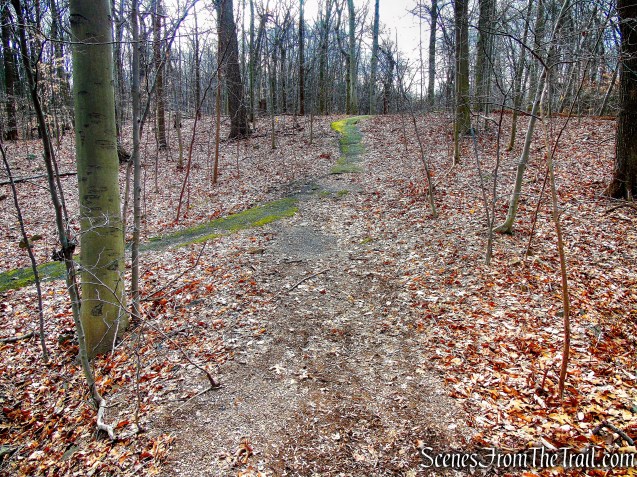

The hike:

Walk down the hill from the restaurant and bear right, heading towards Lowell Road. Follow the mowed path between the fence on the left and a pond on the right.

Bancroft's Castle on Gibbet Hill

Bancroft’s Castle on Gibbet Hill

The trail reaches Lowell Road and turns left, closely paralleling the road.

Bancroft's Castle on Gibbet Hill

Bancroft’s Castle on Gibbet Hill

The trail comes out to the shoulder of the road and continues through two stone pillars.

Bancroft's Castle on Gibbet Hill

Bancroft’s Castle on Gibbet Hill

The trail skirts the fence that keeps the cattle enclosed in the pasture, passing a sign warning visitors to stay on the other side of the fence. The trail now gradually ascends Gibbet Hill

Gibbet Hill Cattle

Gibbet Hill Cattle

In about 0.5 mile from the start, the trail reaches the ruins of Bancroft’s Castle.

Bancroft's Castle

Bancroft’s Castle

General William Bancroft led an accomplished life. He rose to the rank of brigadier general during the Spanish-American War, before going on to become the first president of the Boston Elevated Railroad.

Bancroft's Castle

Bancroft’s Castle

He also served a term as mayor of the city of Cambridge in the 1890’s. During all that time away from Groton, his hometown, Bancroft dreamt of retiring to Gibbet Hill.

Bancroft's Castle

Bancroft’s Castle

He built his retirement home on Gibbet Hill in 1906 and called it Shawfieldmont.

Bancroft's Castle

Bancroft’s Castle

Bancroft's Castle

Bancroft’s Castle

He built the tower, and a house, but ran out of money before he got to the mansion and horse stable he had planned.

Bancroft's Castle

Bancroft’s Castle

He kept at it, for twelve years, when, discouraged, he sold the property to Harold Ayers, a well-known physician who converted it into a sanatorium.

Bancroft's Castle

Bancroft’s Castle

Experts of the day touted the Groton Private Hospital as “unique” and raved how its absolute quiet, pure air, and atmosphere of home embraced the open air treatments so popular during that era.

Bancroft's Castle

Bancroft’s Castle

Ayers called his sanatorium the Groton Private Hospital, where, for $20 a week, sick, rich people could take in the spectacular views while they languished through ailments such as TB, or what the 1920’s called insanity.

Bancroft's Castle

Bancroft’s Castle

The sanatorium too, met an early end. By the dawn of the 1930’s, it too was gone.

Bancroft's Castle

Bancroft’s Castle

The property was then used by the Groton Hunt Club for dances, social events, and to host fox hunts until 1932 when it was destroyed by a fire.

Bancroft's Castle

Bancroft’s Castle

The trail continues past Bancroft’s Castle and opens up to scenic views over the Groton countryside and beyond. It is a one mile round trip to the castle, but if a longer hike is desired, one can continue on. Otherwise just retrace your steps back the way you came to the parking area.

view from Gibbet Hill

view from Gibbet Hill


Sources: