March 29, 2026 – Yorktown Heights, NY
Difficulty: Moderate (1 short, steep climb)
Length: Approximately 3 miles
Max elevation: 831 ft. – total elevation gain approximately 581 ft.
Route type: Circuit
Map: Turkey Mountain Nature Preserve Trail Map
Trailhead parking: Locke Lane/Croton Heights Road, Yorktown Heights, NY 10598
Dirt parking lot for about 15 vehicles – No restrooms on site
Hours: Open Daily, Sunrise – Sunset
Overview:
Tucked into the wooded hills of Yorktown Heights, Turkey Mountain Nature Preserve offers a surprisingly rugged escape in the heart of Westchester County. Rising to 831 feet, this modest, forested high point delivers a true hiking experience, with rocky footpaths, steady climbs, and a sense of seclusion that feels far removed from the surrounding suburbs.
The mountain is defined by exposed rock outcrops and ledges, where weathered slabs, scattered boulders, and lichen-covered stone—shaped by ancient glaciers—break through the forest floor to form natural viewpoints. As the trail climbs, dense stands of oak, maple, and mountain laurel give way to open rock near the summit, revealing sweeping views over the Croton Reservoir, the Hudson Highlands, and beyond.
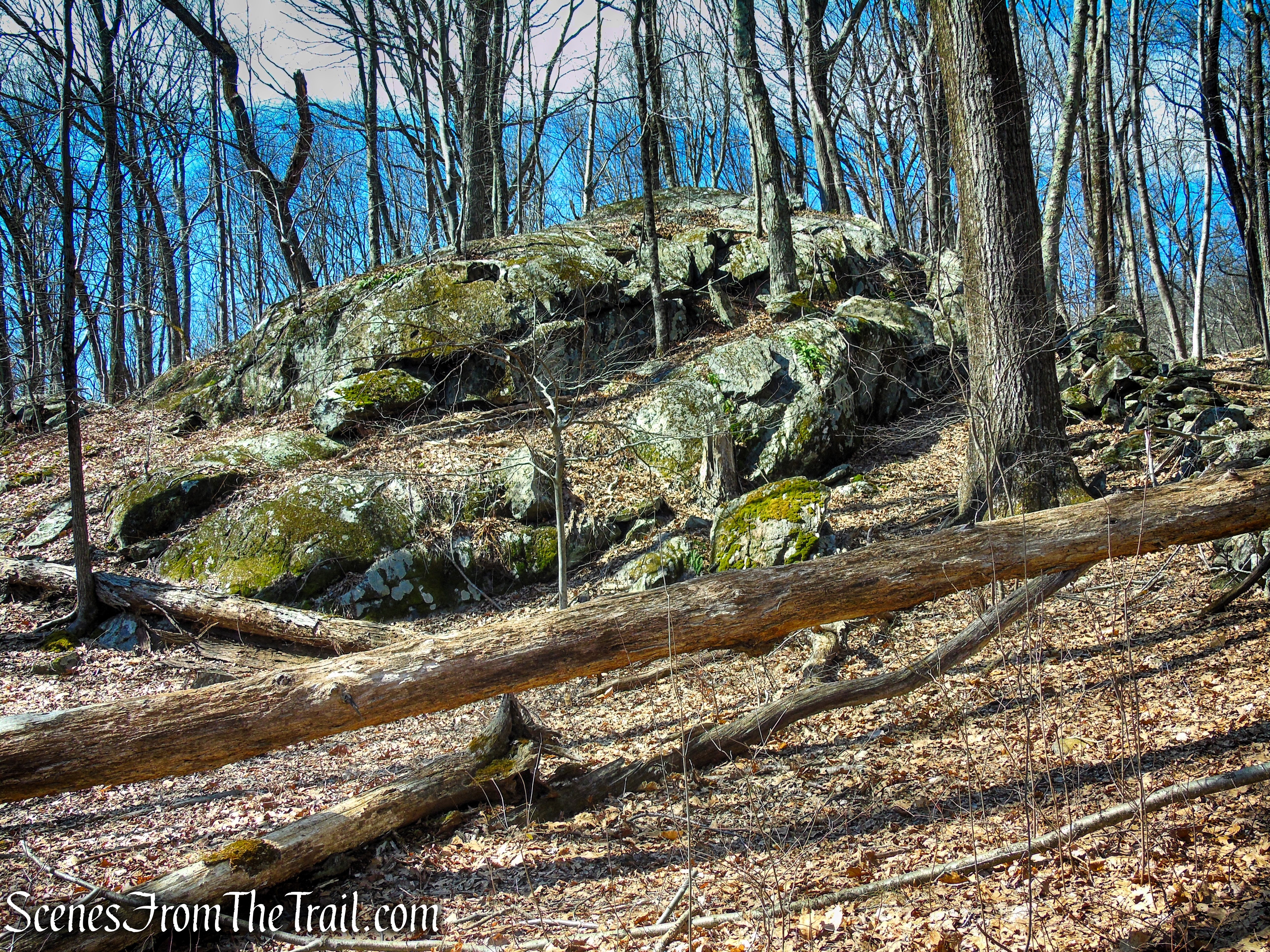
Blue Trail – Turkey Mountain Nature Preserve
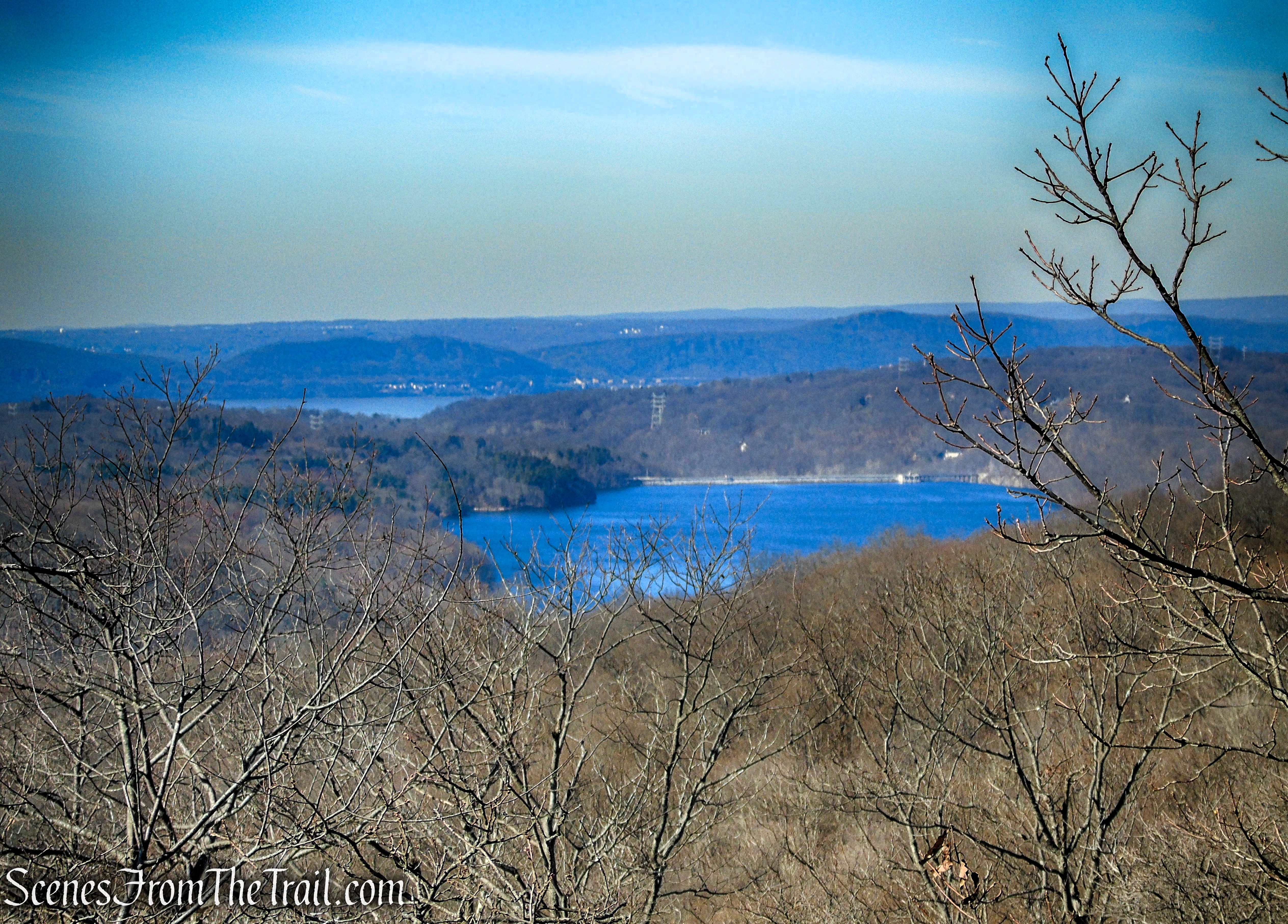
Turkey Mountain summit
What sets Turkey Mountain apart isn’t its height, but its contrast—a compact preserve that feels unexpectedly wild, where rugged terrain and expansive vistas far exceed its modest scale.
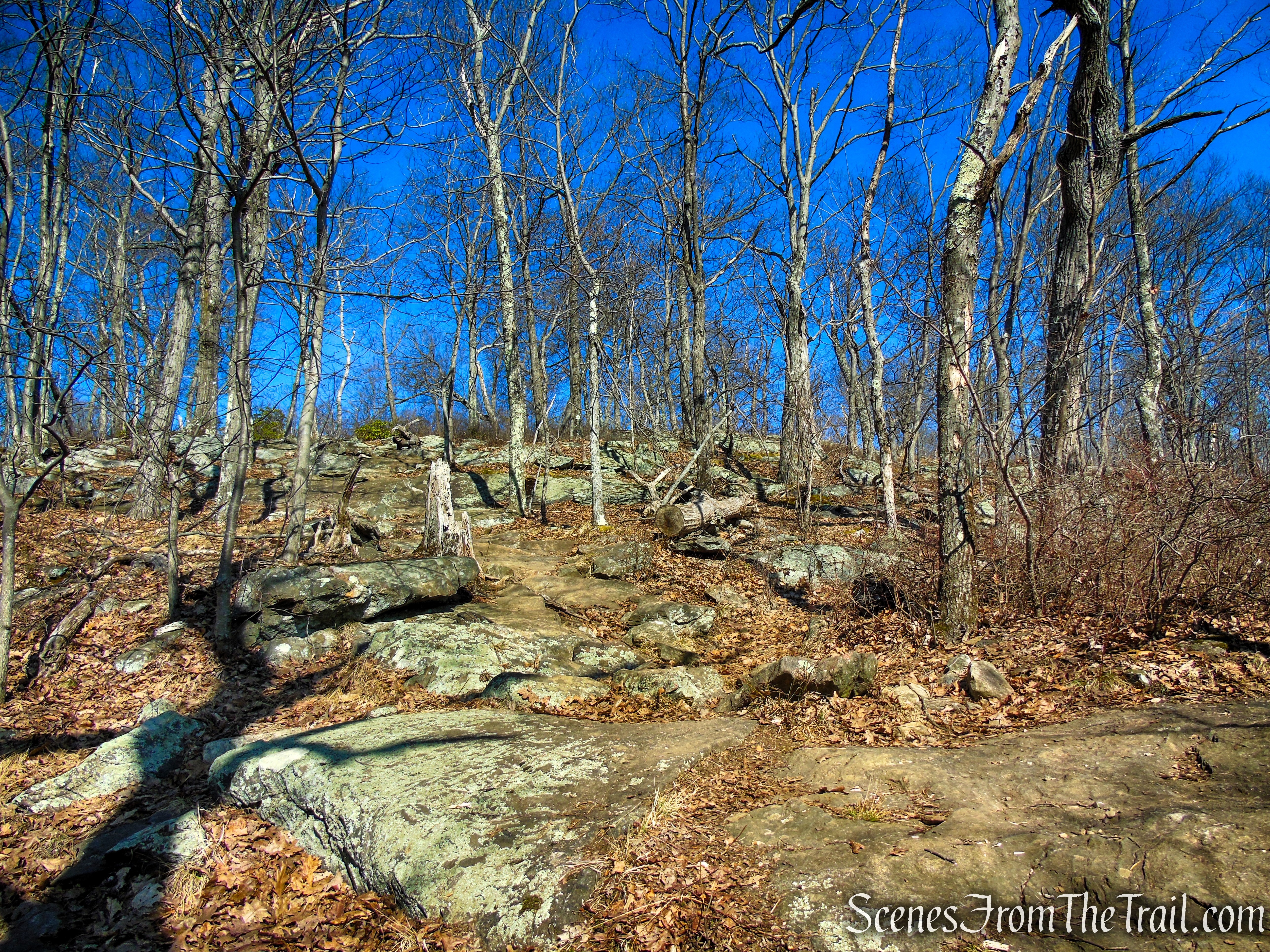
White Trail – Turkey Mountain Nature Preserve
Turkey Mountain Nature Preserve covers roughly 125 acres of forested trails and rocky ledges and has been protected as a public park since 1969. The preserve is owned by the Town of Yorktown and maintained in partnership with the Yorktown Land Trust.
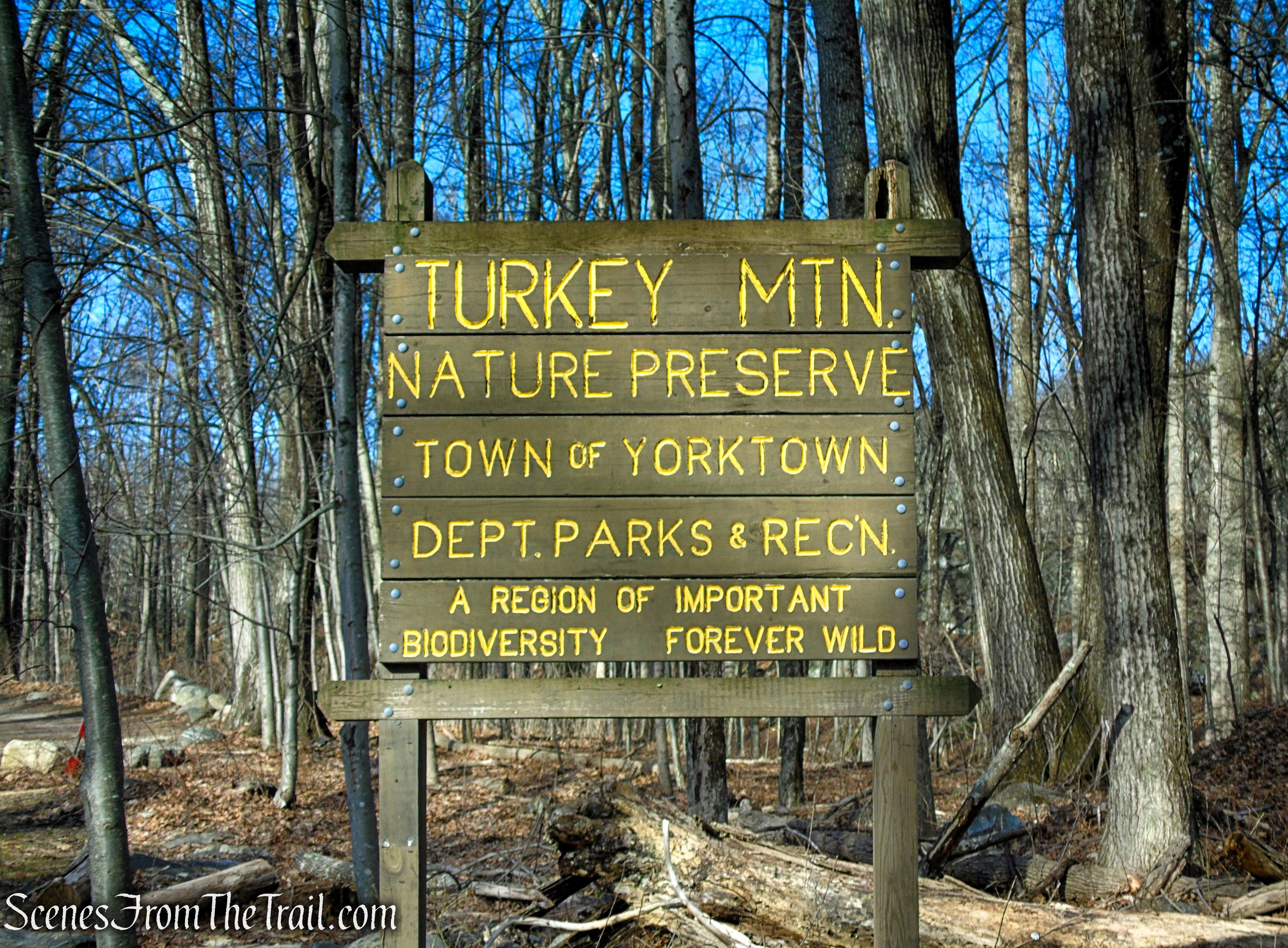
Turkey Mountain Nature Preserve
History:
From the Colonial era through 1917, the land that is now Turkey Mountain Nature Preserve remained in the hands of the Griffen family. The Griffen Farm, marked as “Pleasant View” on old maps, consisted of a large farm house surrounded by springs, streams, wooded meadows, barns, and a 10-acre apple orchard. It was later purchased by Lydia Locke, (1884–1966) an opera singer whose eventful personal life—including seven marriages and a high-profile murder trial—captured national attention for decades. She assembled roughly 400 acres and established a preserve known as Loch Ledge.

Lydia Locke
In 1951, after the Town of Yorktown declined her proposal to purchase the land for a school, she sold 125 acres to the Child Service League of Queens for use as a boys’ summer camp. The camp operated from 1957 until 1964, when it closed due to financial challenges.

Child Service League – Turkey Mountain
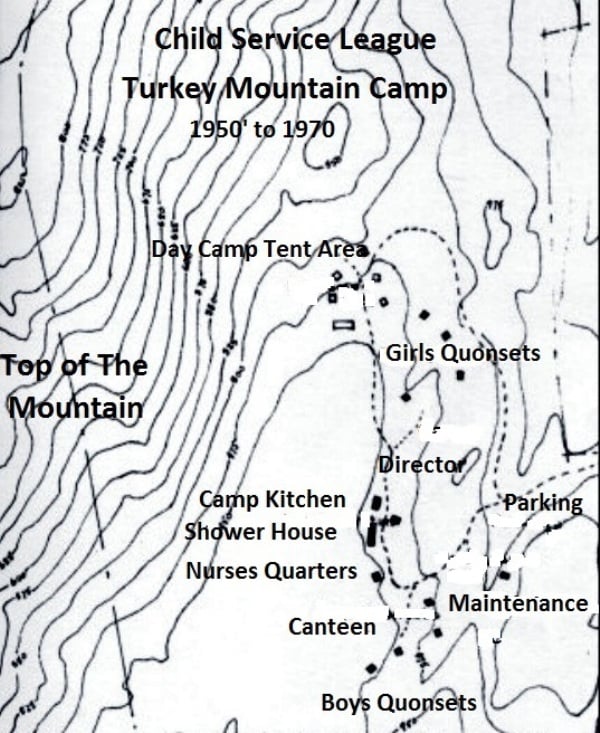
Child Service League – Turkey Mountain
Efforts to protect the property began soon after, with the formation of the Save Turkey Mountain Committee in 1965. Working with local supporters, the Town of Yorktown committed $30,000 to match private contributions, and in 1969 the land was acquired with the condition that it be preserved for outdoor education and hiking.
Trails Overview:
The trails are marked with Town of Yorktown Parks & Recreation round discs.
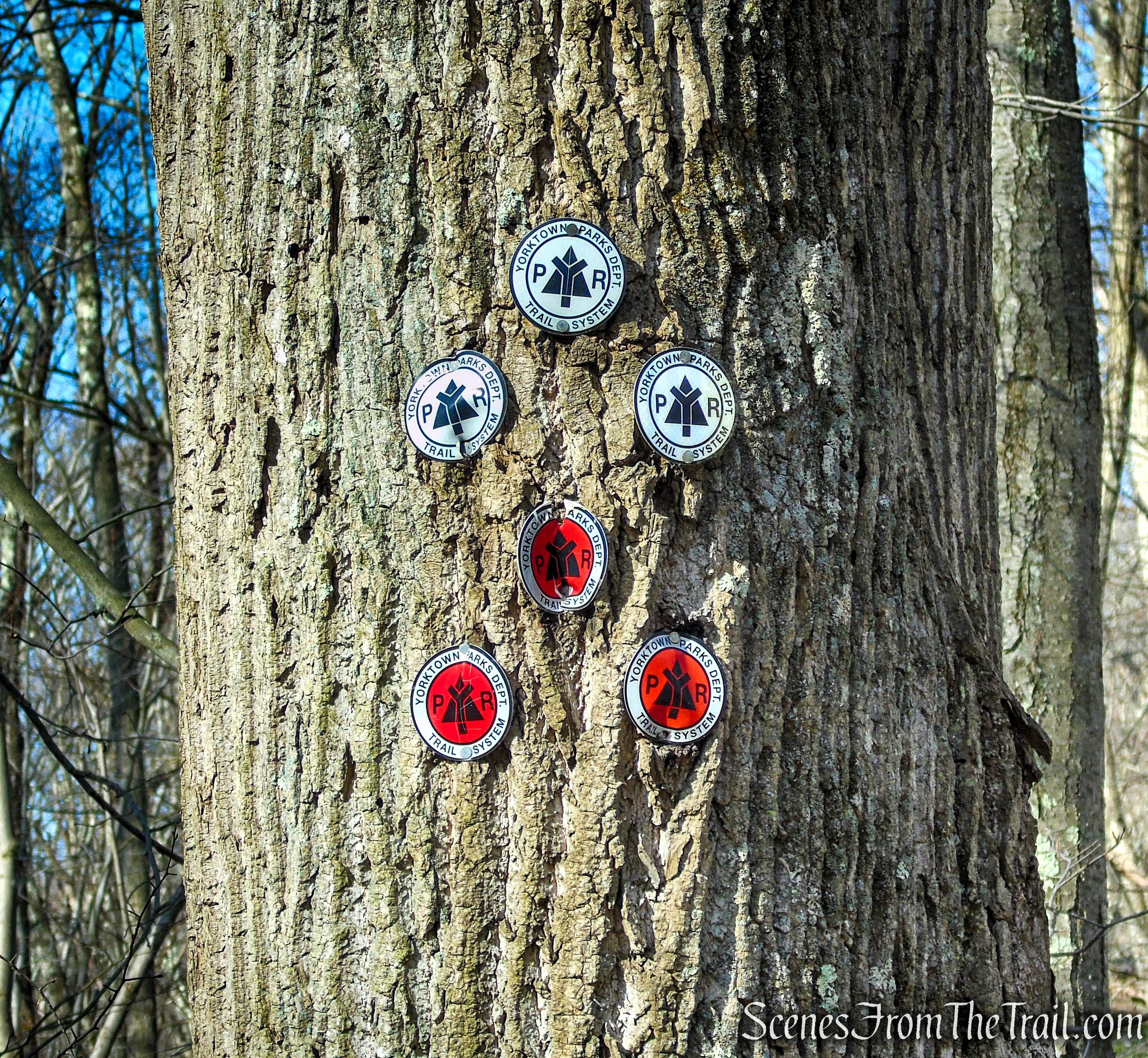
White Trail – Turkey Mountain Nature Preserve
White Trail ~ Starting from the small parking lot off Route 118, the White Trail at Turkey Mountain Nature Preserve begins through gentle forest before quickly climbing over rocky, uneven terrain scattered with roots and boulders. The trail ascends steadily, winding through dense hardwoods and moss-covered rocks, offering a wild, textured landscape.
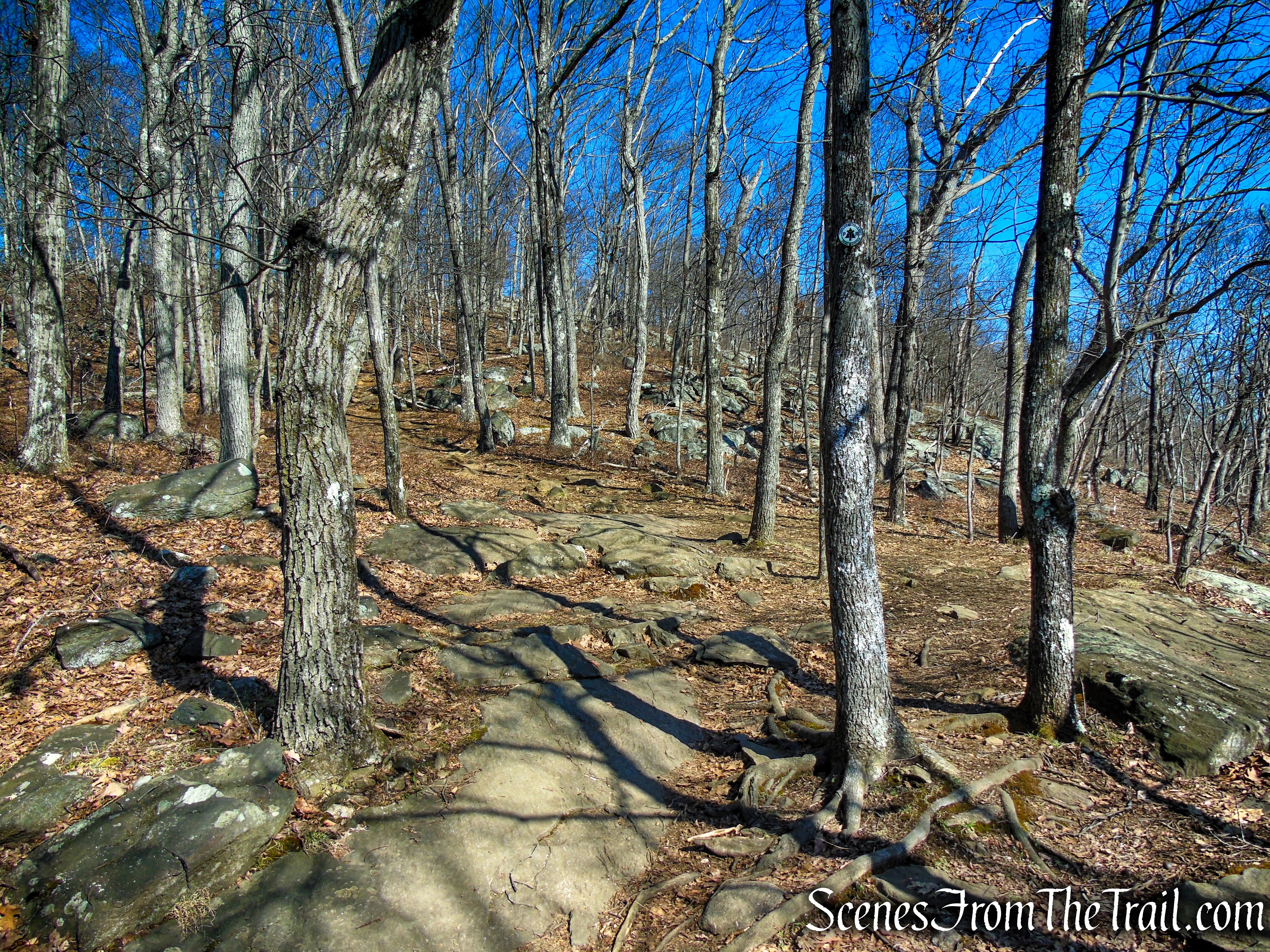
White Trail – Turkey Mountain Nature Preserve
Halfway up, the slope eases briefly with glimpses of surrounding hills, then resumes its climb along exposed rock outcrops. The final stretch opens onto summit ledges with sweeping views of the Croton Reservoir, the Hudson Highlands, and distant ridges. Short but steep, the White Trail is a direct, challenging, and rewarding ascent that highlights the preserve’s rugged, boulder-strewn character.
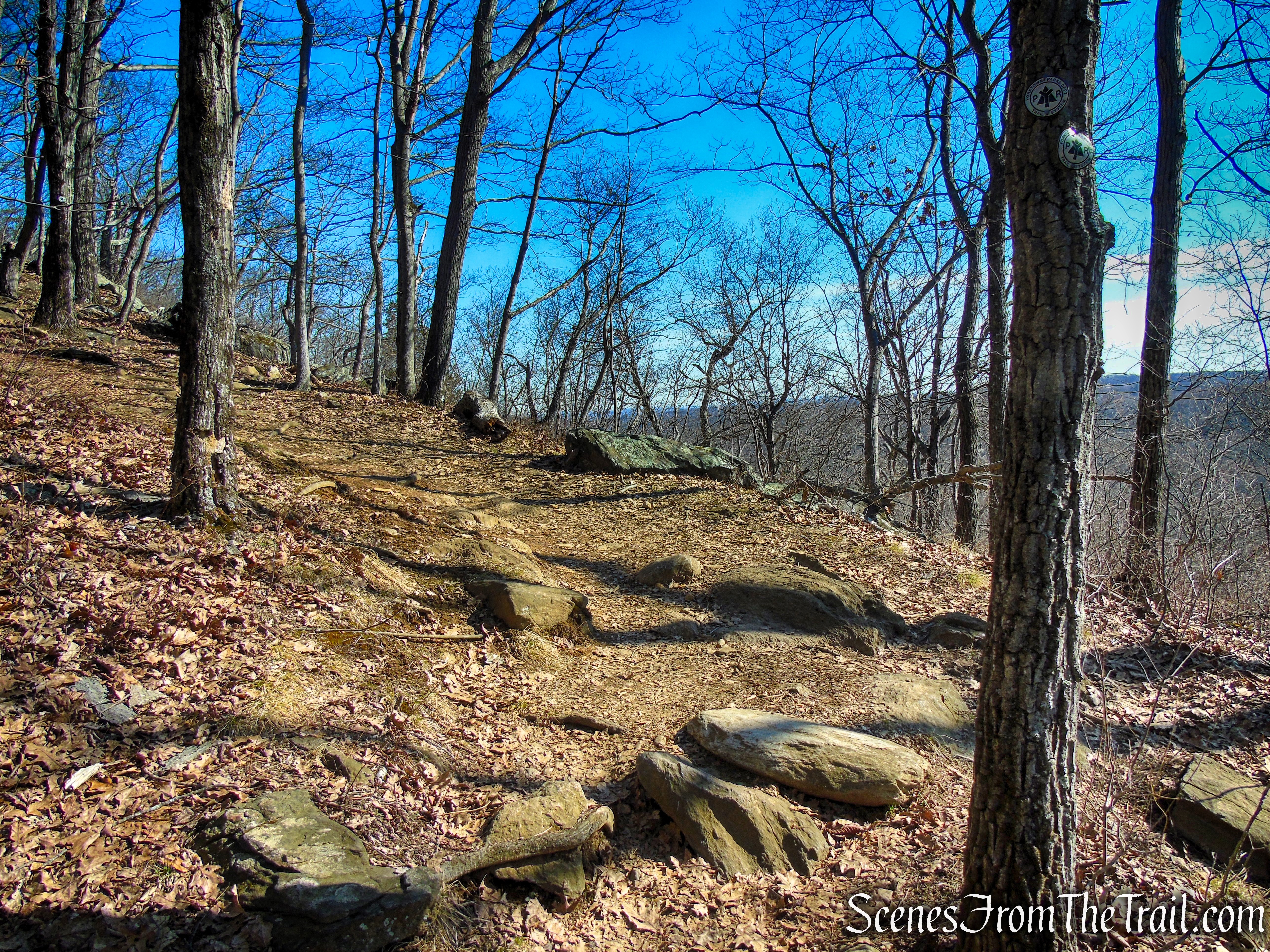
White Trail – Turkey Mountain Nature Preserve
Blue Trail ~ Descending from the summit of Turkey Mountain, the Blue Trail offers a more gradual and forgiving route back to the parking area. Leaving the open rock ledges behind, the trail eases into the woods, trading expansive views for a quieter walk beneath a canopy of oak and maple.
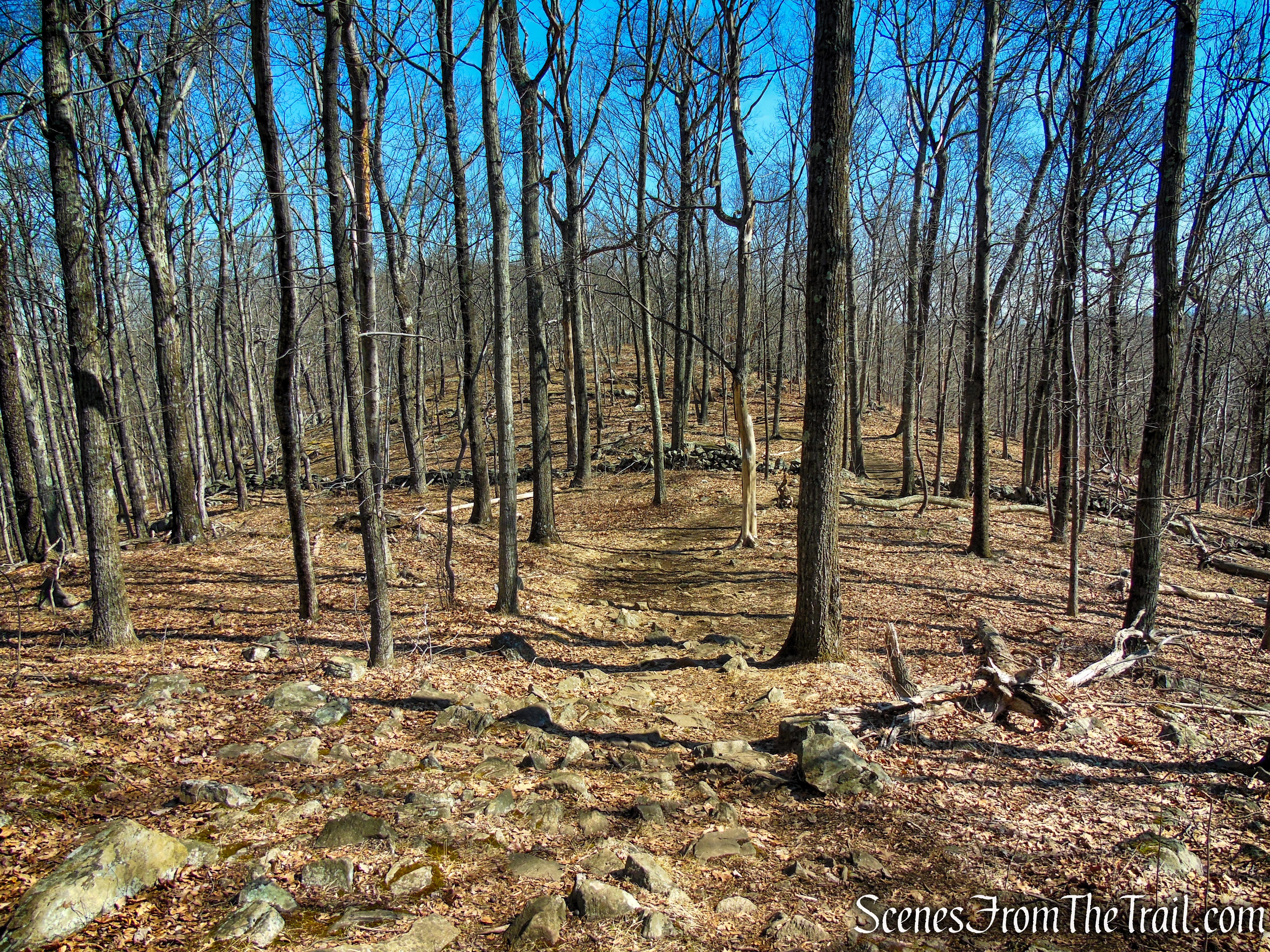
Blue Trail – Turkey Mountain Nature Preserve
The grade softens compared to the White Trail, but the footing remains rocky and uneven, with roots and small stones keeping you attentive on the descent. As you continue downward, the terrain becomes less exposed and more enclosed, with occasional glimpses of old stone walls and subtle remnants of the mountain’s past appearing off to the sides of the trail.
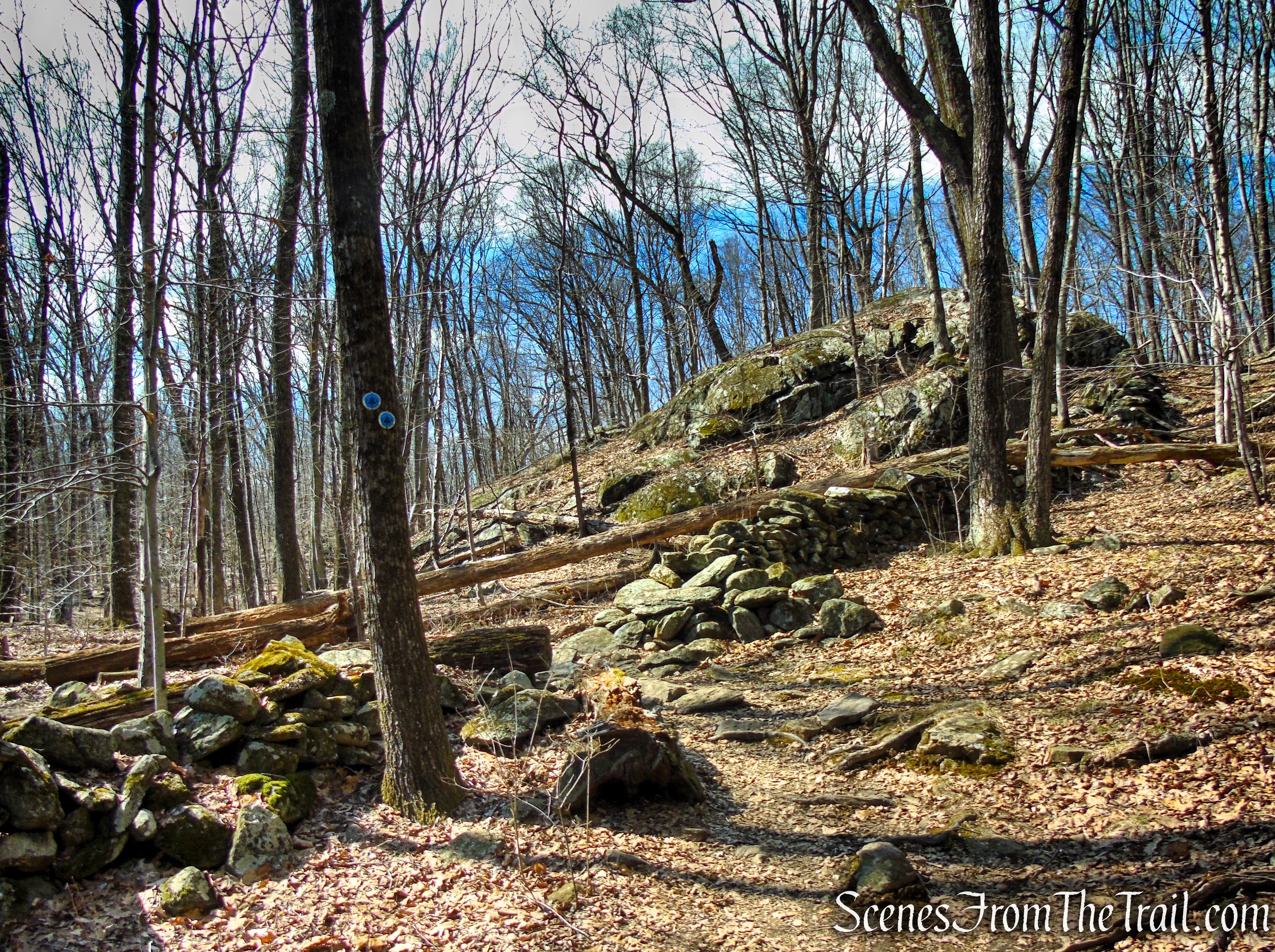
Blue Trail – Turkey Mountain Nature Preserve
Lower down, the path levels out and smooths slightly as it approaches the trailhead, making for a relaxed finish after the climb. It’s an ideal way to come down—steady, scenic, and just rugged enough to remind you that even the “easier” route on Turkey Mountain still feels like a true hike.
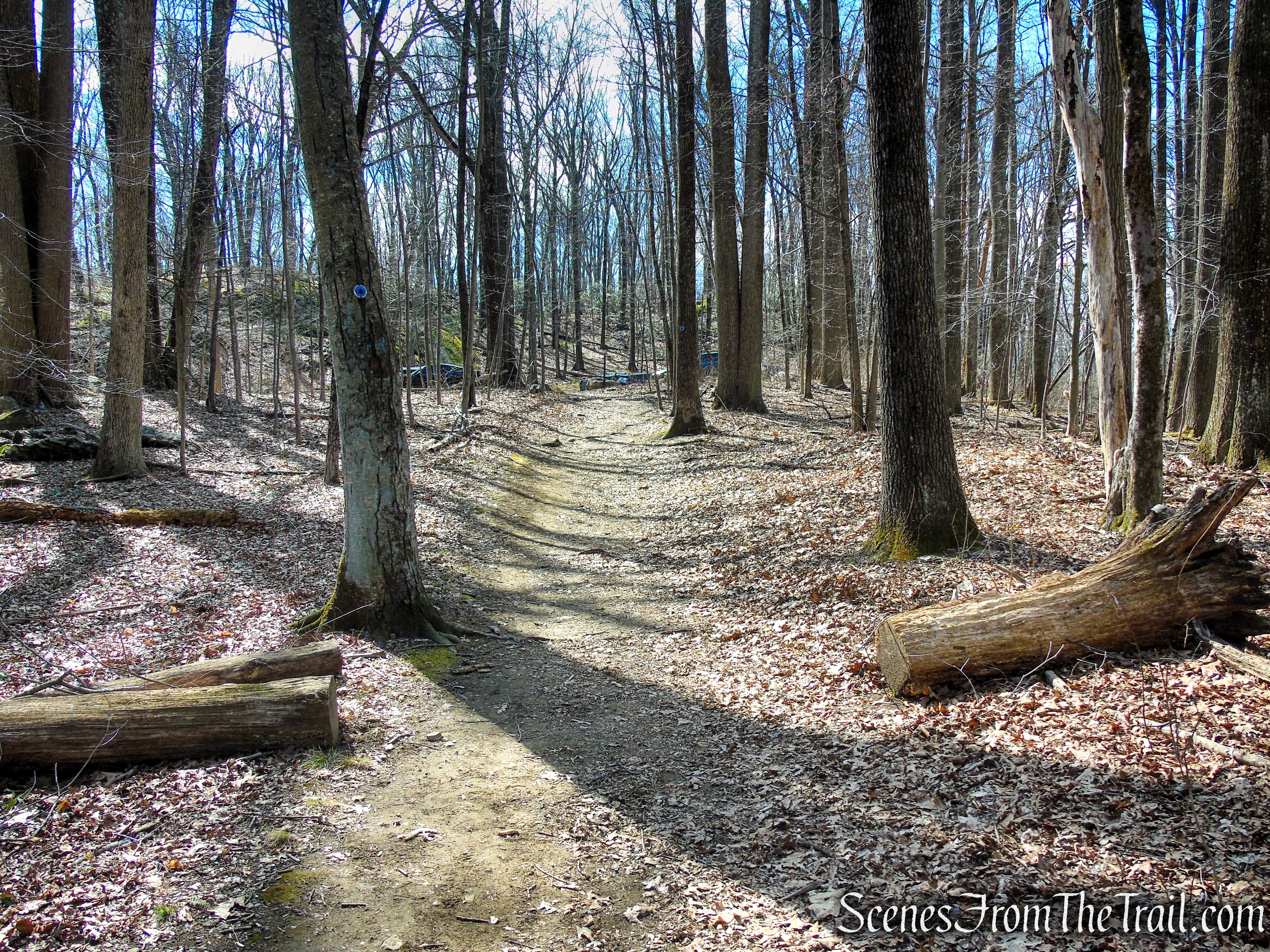
Blue Trail – Turkey Mountain Nature Preserve
Parking:
The preserve is served by a single, small, unpaved parking lot just off Route 118. It’s fairly limited in size, generally accommodating roughly 10–15 cars at most, depending on how efficiently people park.
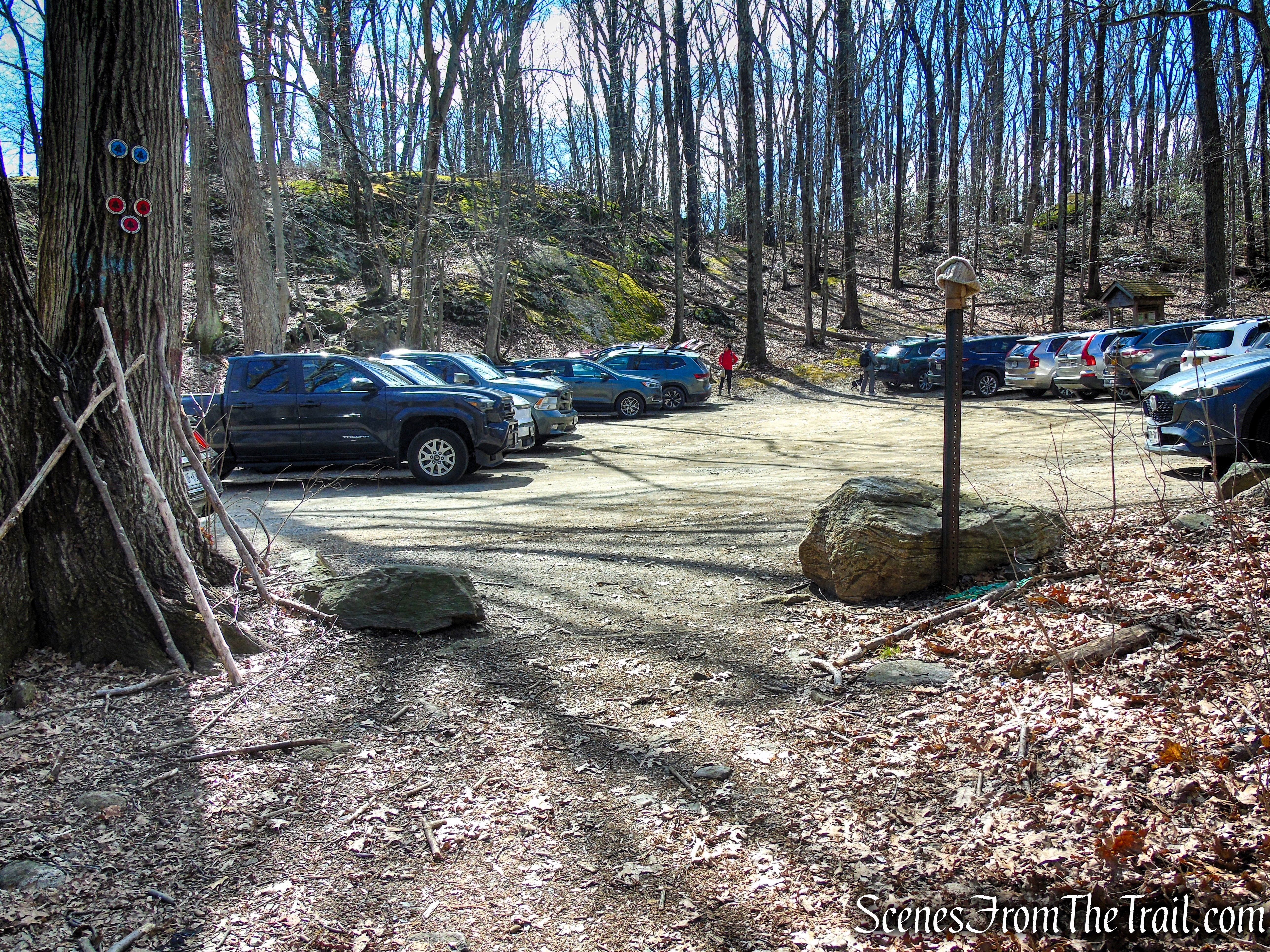
Turkey Mountain Nature Preserve Trailhead
Because of that, it tends to fill up quickly—especially on weekends, holidays, or nice weather days. When the lot is full, visitors often line the narrow entrance road, which can create a bit of congestion and makes the approach feel tighter than expected.
For a smoother experience:
- Arrive early (especially weekends)
- Weekdays are significantly easier for parking
- Be mindful of roadside parking—it’s informal and can get crowded
In short, the lot is small and easy to miss, but that limited access is part of what keeps the preserve feeling a bit more tucked away and less developed than many other local hikes.
Hike Overview:
I did this hike in 2017 and felt that it was time for a return visit. While the views aren’t really that spectacular, the trails and landscape make the hike worthwile. Visiting during “leaf off” season, revealed the forest’s bare skeleton, usually hidden during the warmer months. We arrived around 9:30 a.m. on a Sunday to find only a few cars in the trailhead lot, but by the time we returned a couple of hours later, it was full.
We completed the loop clockwise, ascending the steeper White Trail and descending the gentler Blue Trail—a route I prefer to protect my knees. Most hikers we encountered were going the opposite direction.
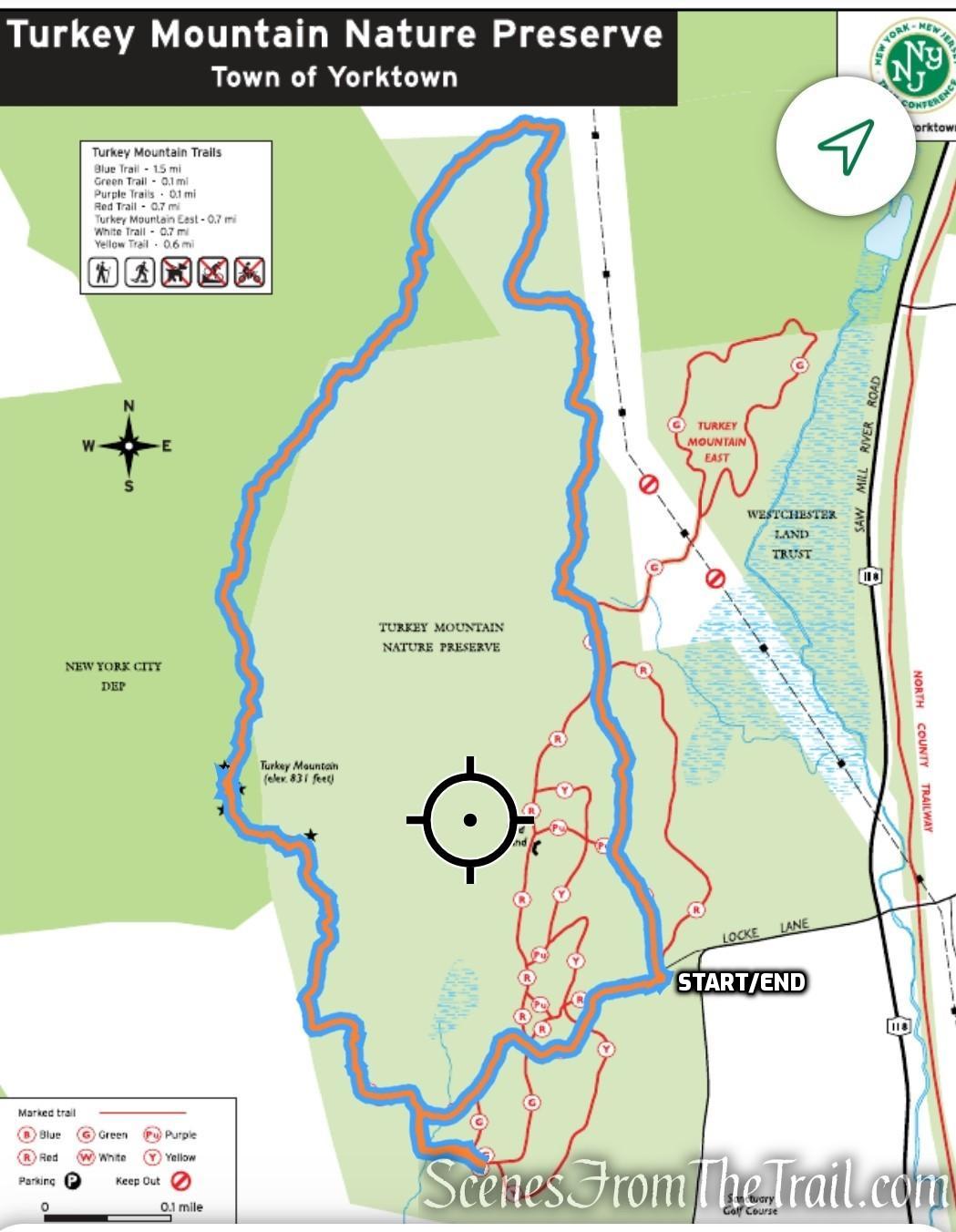
Turkey Mountain Nature Preserve Loop
I rated this hike as moderate because of the initial steep ascent; once at the summit, the remainder of the hike is relatively easy.
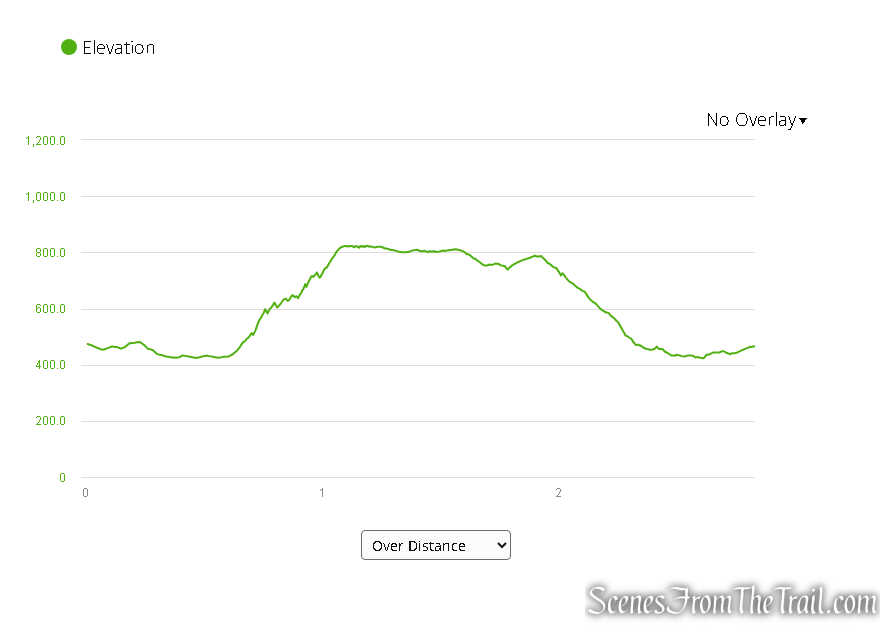
Elevation profile – Turkey Mountain Loop
The trails are generally well marked, with some spray-painted blazes on exposed rock on the higher sections of the mountain. That may be an issue when snow covers the ground.
The Hike:
From the west end of the parking lot, look for three white blazes on a tree—these mark the start of the White Trail, which you’ll follow for the first three-quarters of a mile to the summit of Turkey Mountain. The trail begins co-aligned with the Red Trail but soon reaches a junction where the Red Trail splits right and the White Trail bears left. Shortly after, it passes a woods road on the left. Continue following the white blazes as the trail crosses a wooden boardwalk over a wet area, passes a junction with the Orange Trail on the left, and then crosses a second boardwalk.
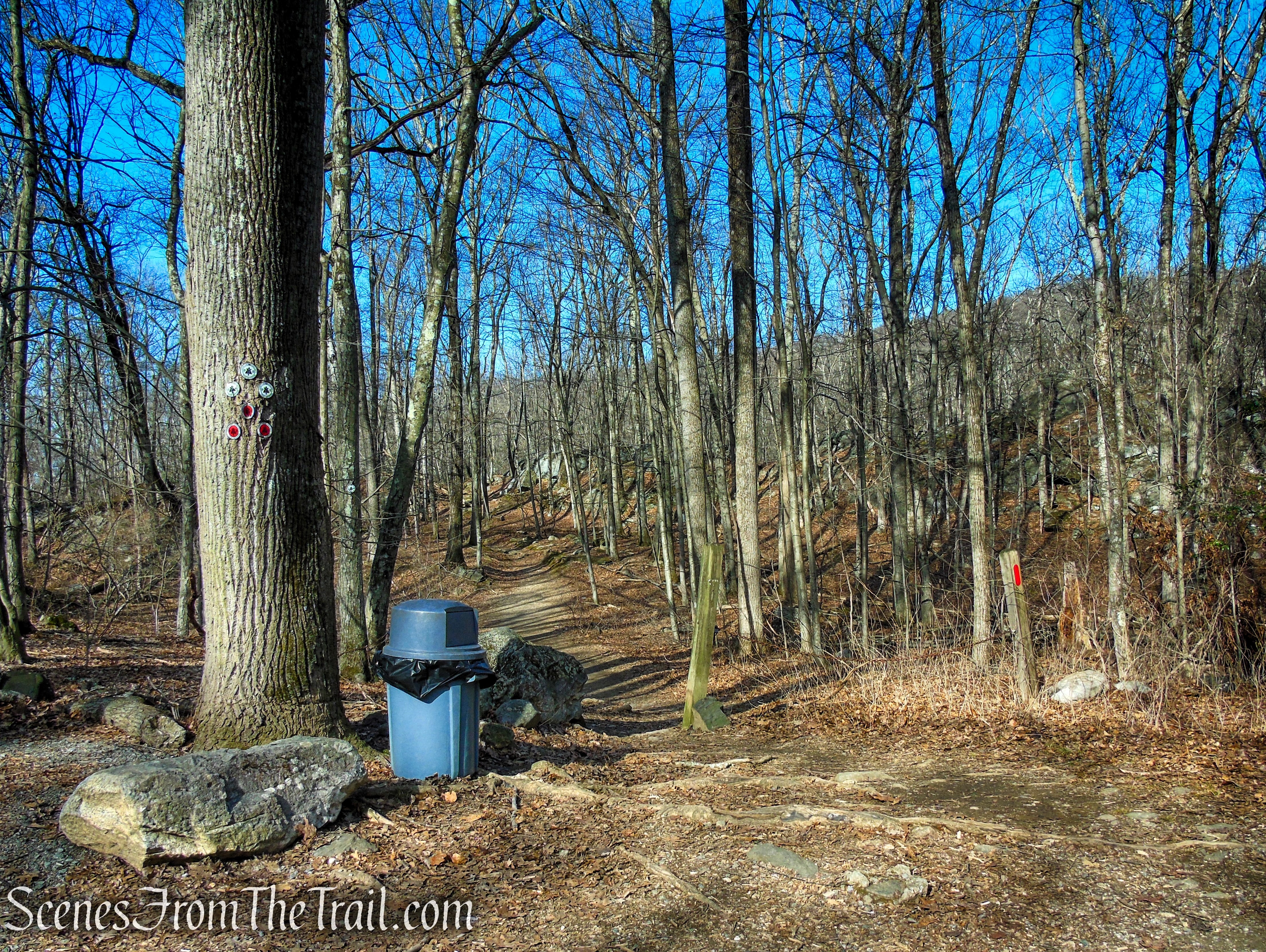
White Trail – Turkey Mountain Nature Preserve
White Trail – Turkey Mountain Nature Preserve
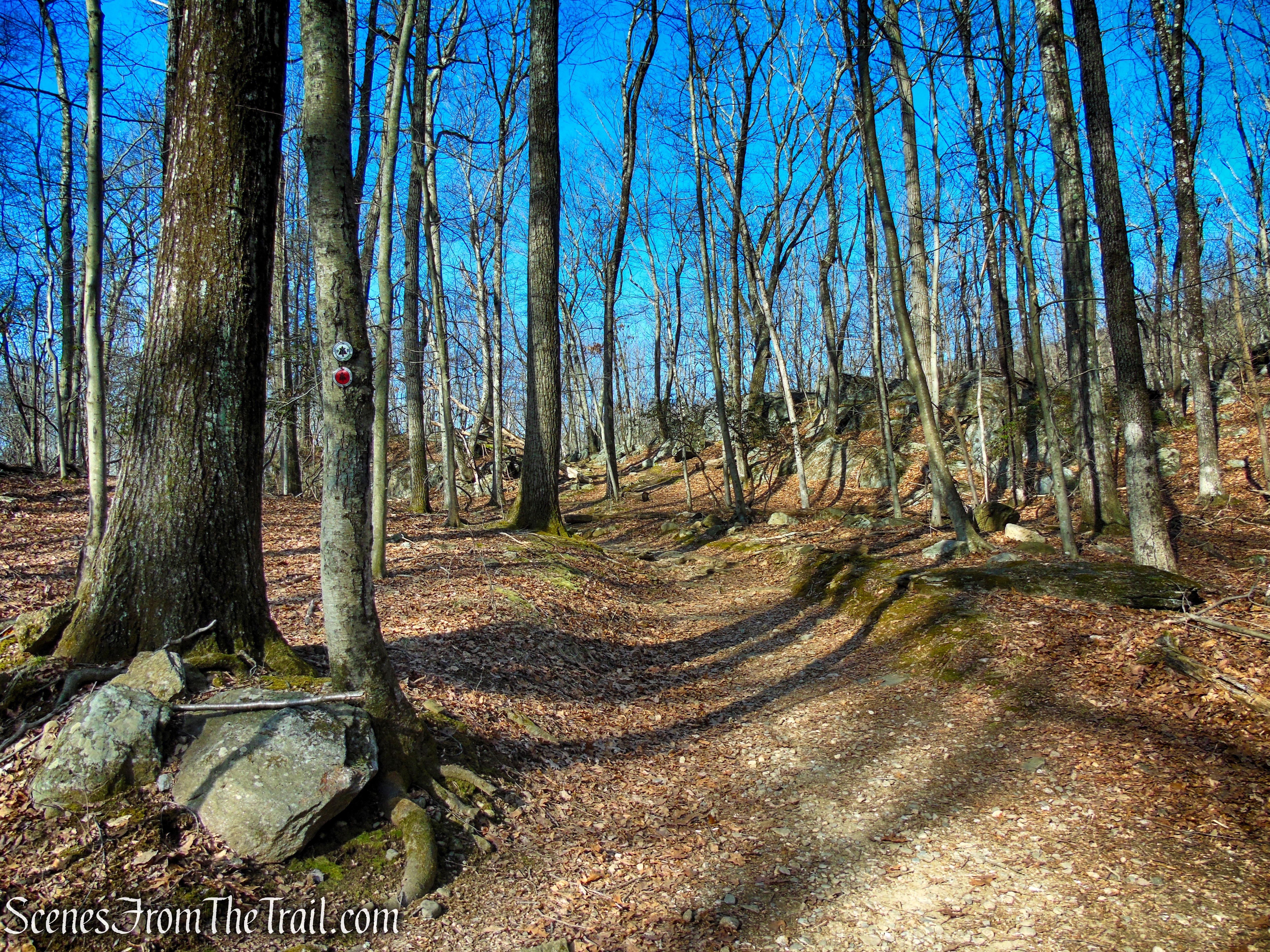
White Trail – Turkey Mountain Nature Preserve
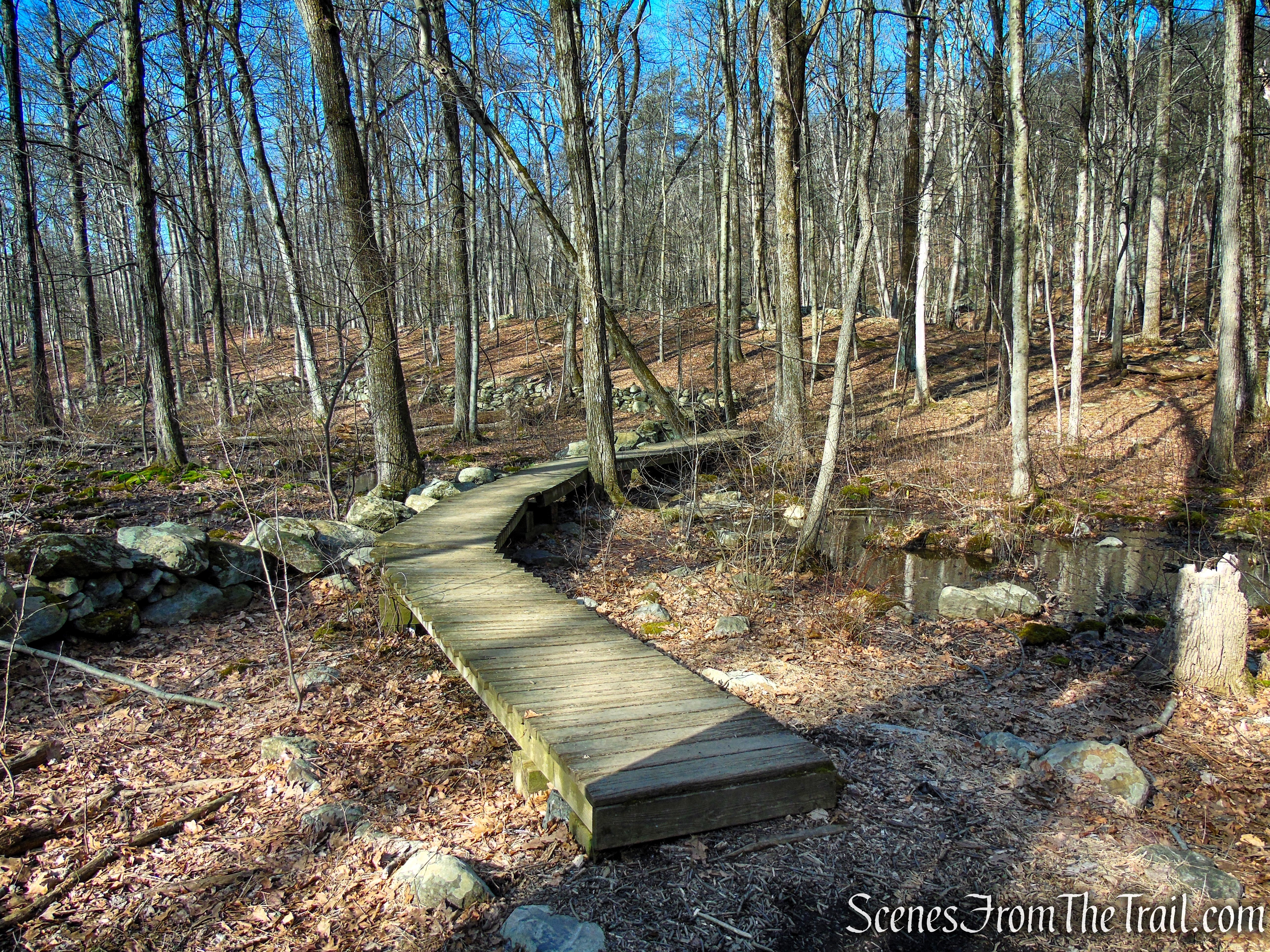
White Trail – Turkey Mountain Nature Preserve
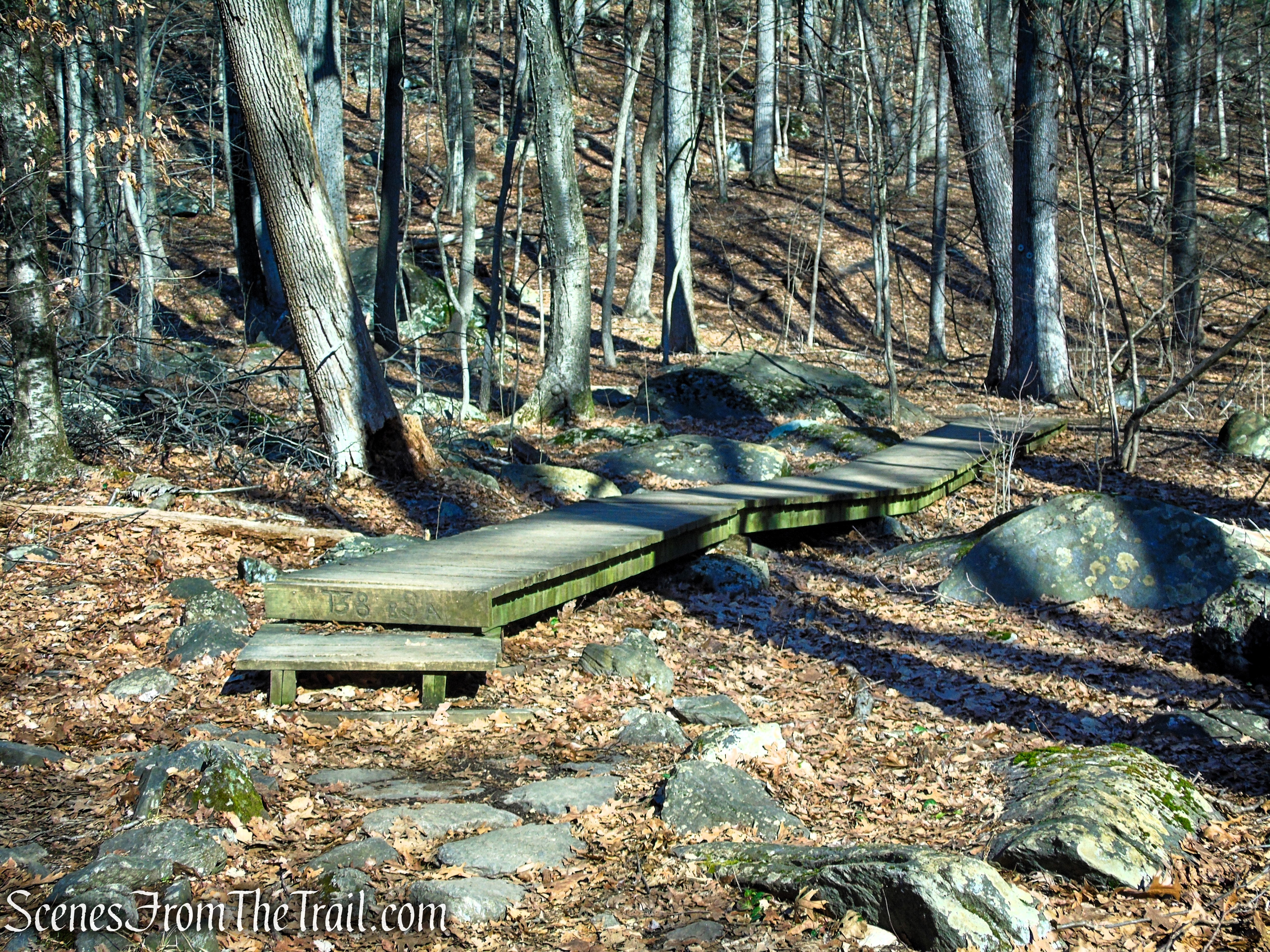
White Trail – Turkey Mountain Nature Preserve
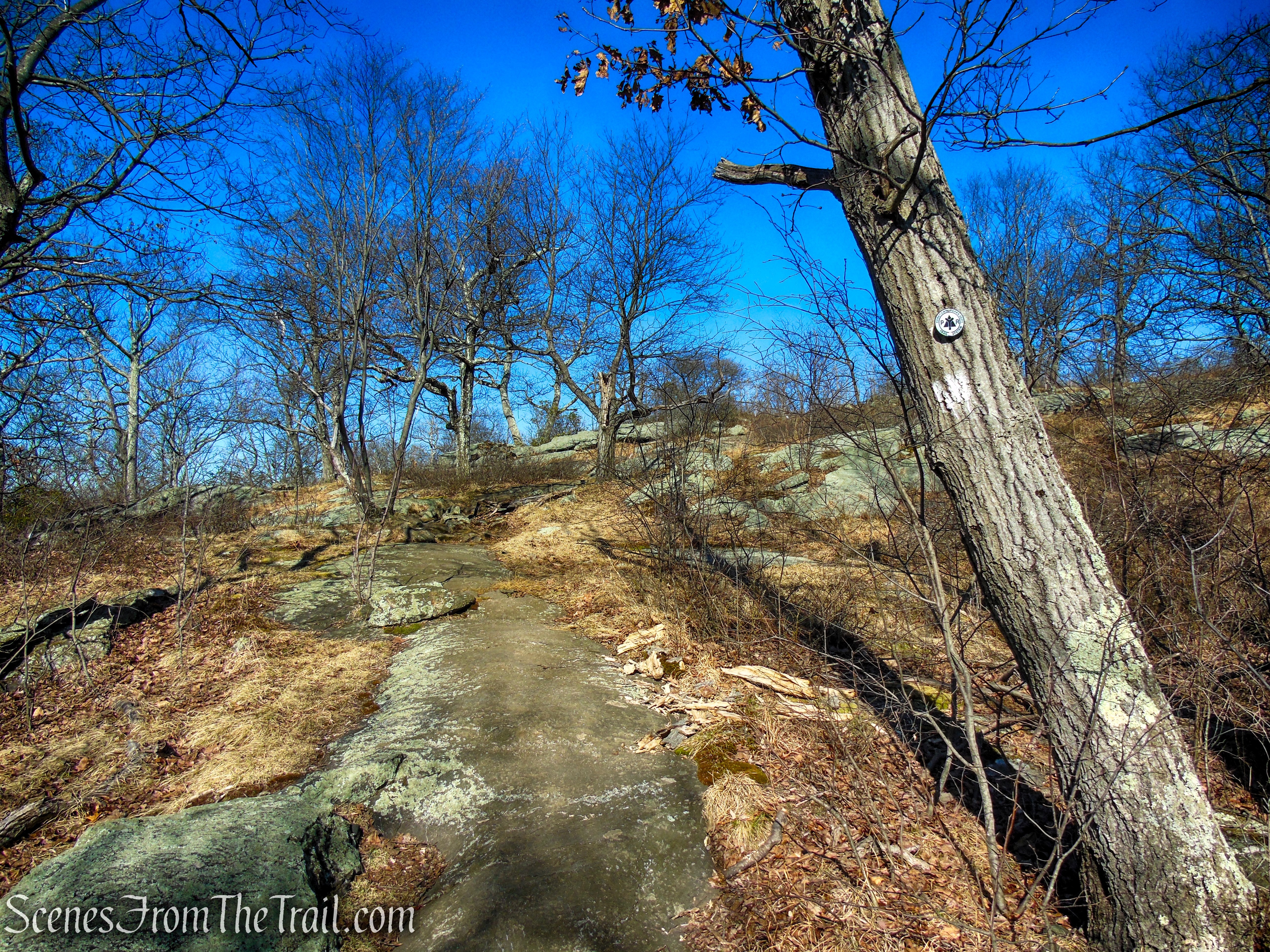
The White Trail then begins to climb, starting moderately before becoming steeper. The path moves onto rocky, uneven terrain, weaving around exposed roots and scattered boulders. As you ascend, short steep sections demand careful footing, while dense hardwoods provide shade and the trail curves past natural rock formations and small ledges.
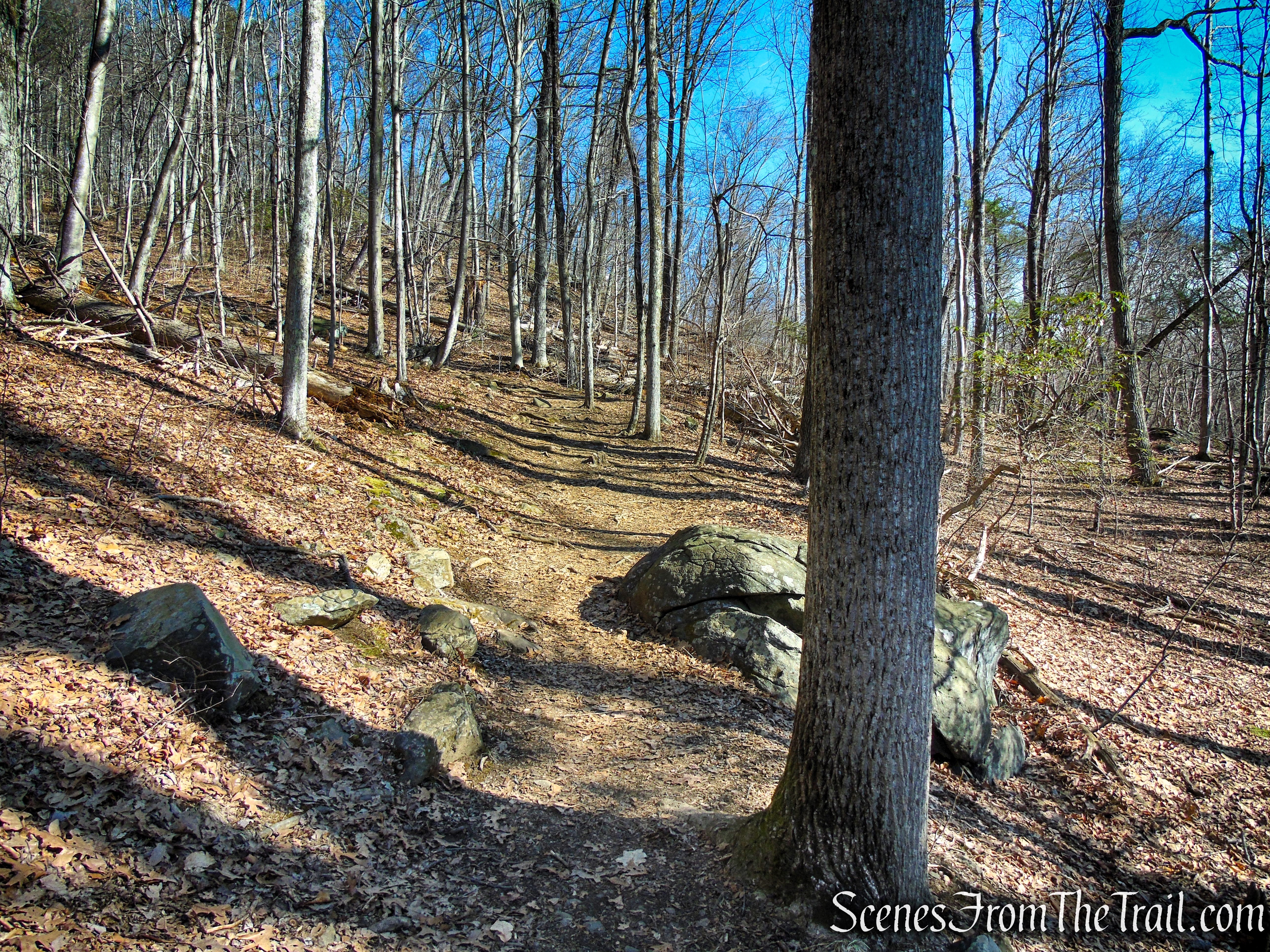
White Trail – Turkey Mountain Nature Preserve
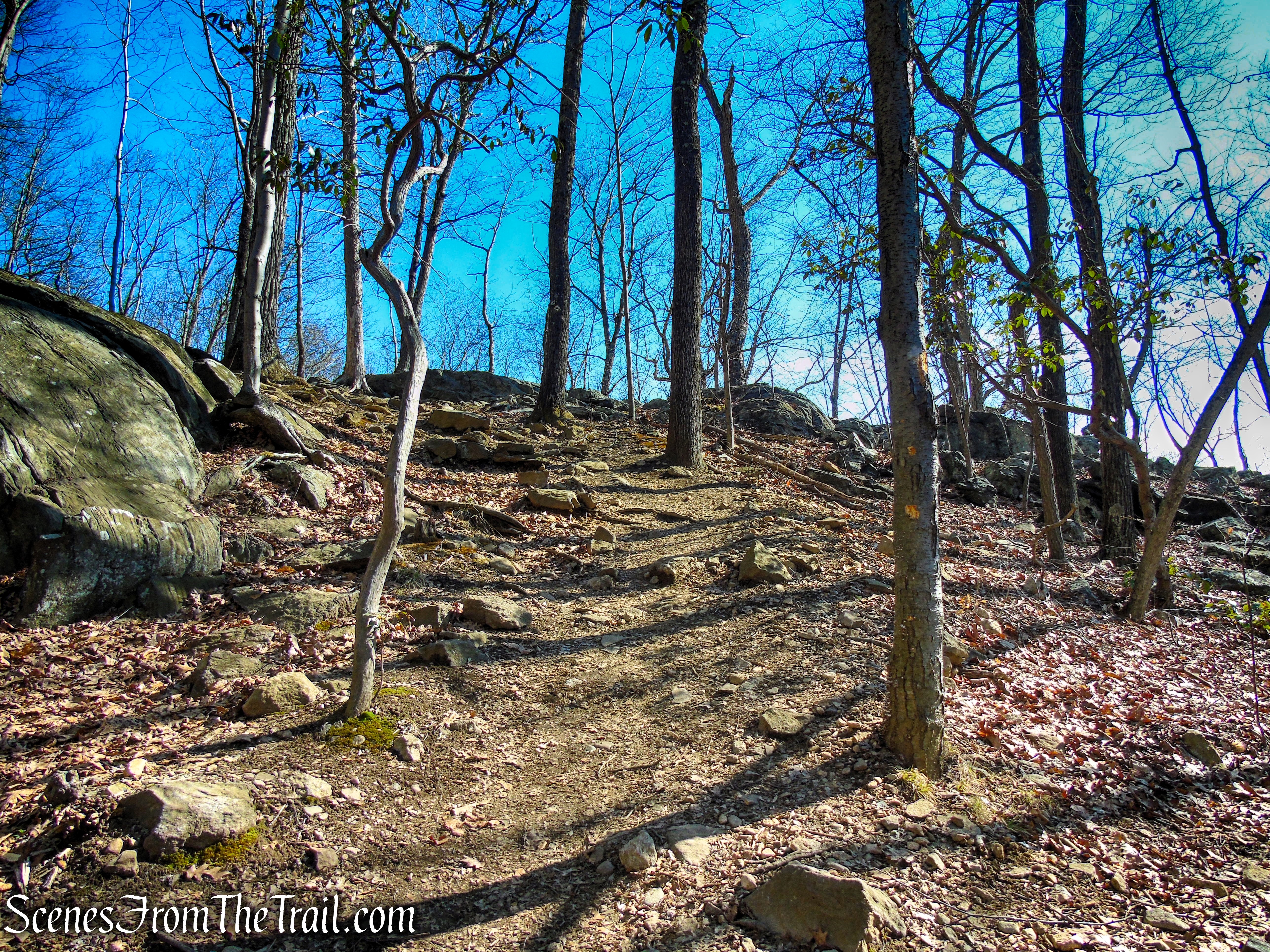
White Trail – Turkey Mountain Nature Preserve
White Trail – Turkey Mountain Nature Preserve
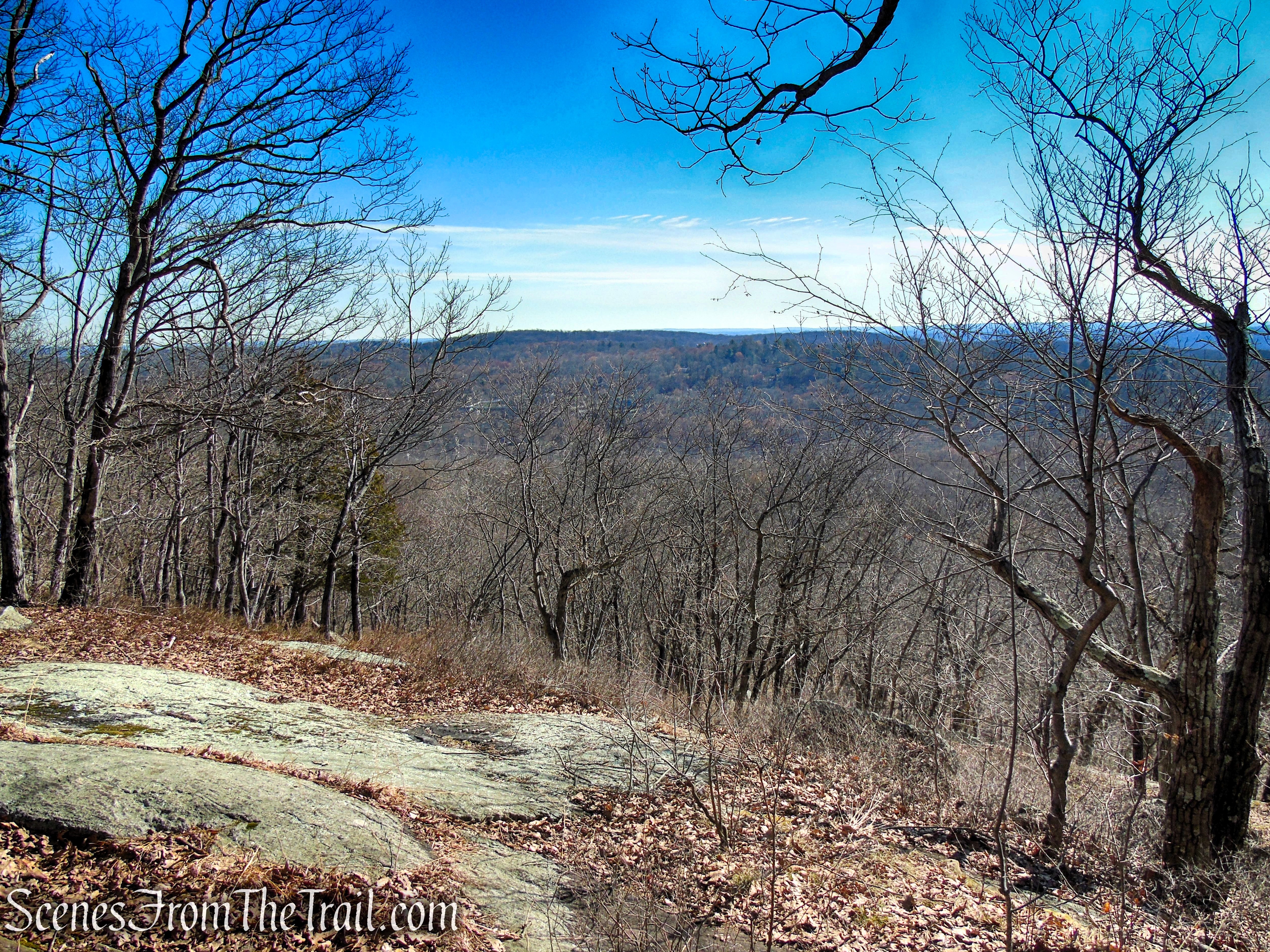
As the trail approaches the summit, glimpses of the surrounding hills appear through the trees. The final stretch crosses bare rock slabs, guiding hikers to the open, rocky summit.
White Trail – Turkey Mountain Nature Preserve
White Trail – Turkey Mountain Nature Preserve
White Trail – Turkey Mountain Nature Preserve
White Trail – Turkey Mountain Nature Preserve
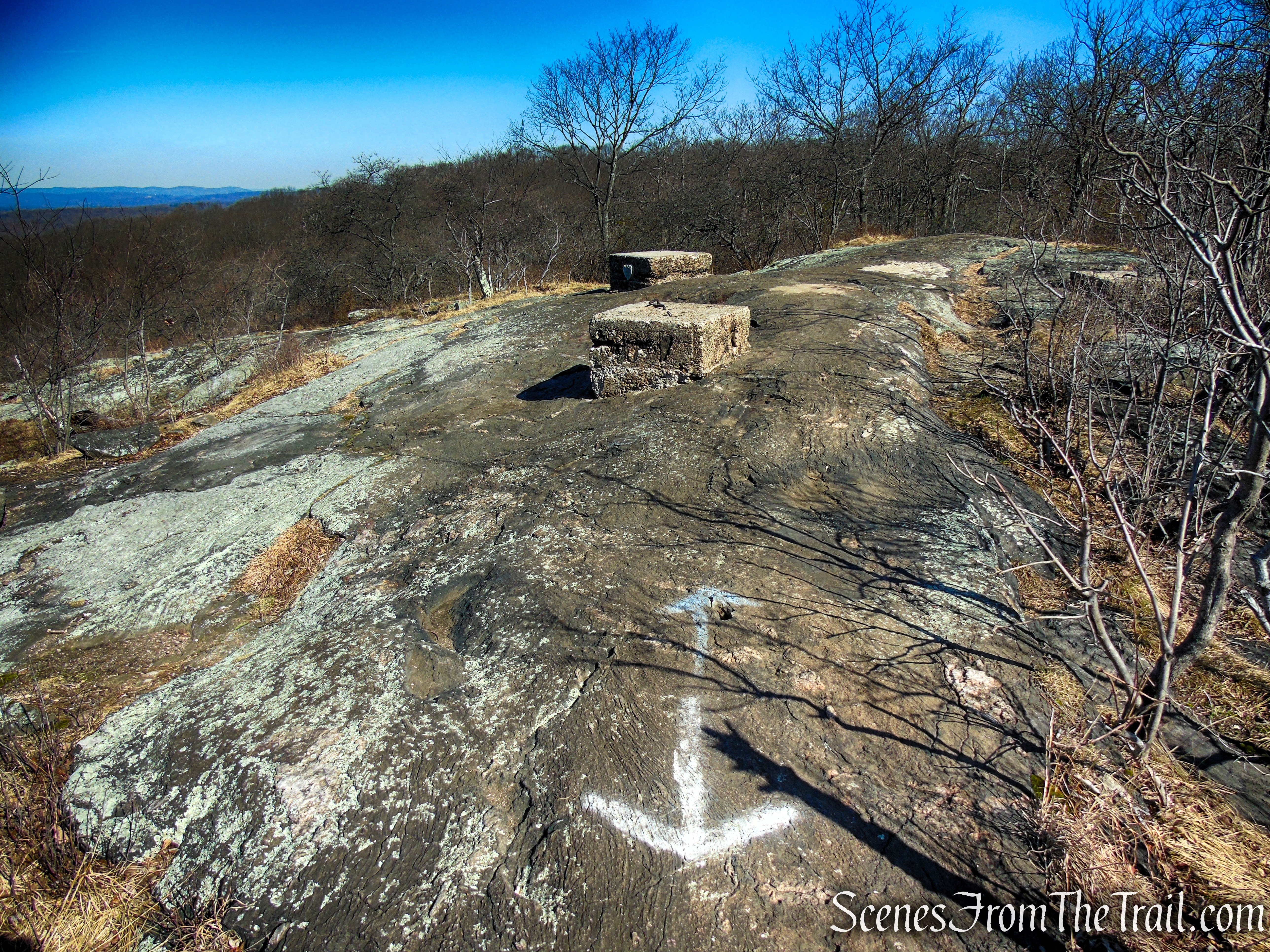
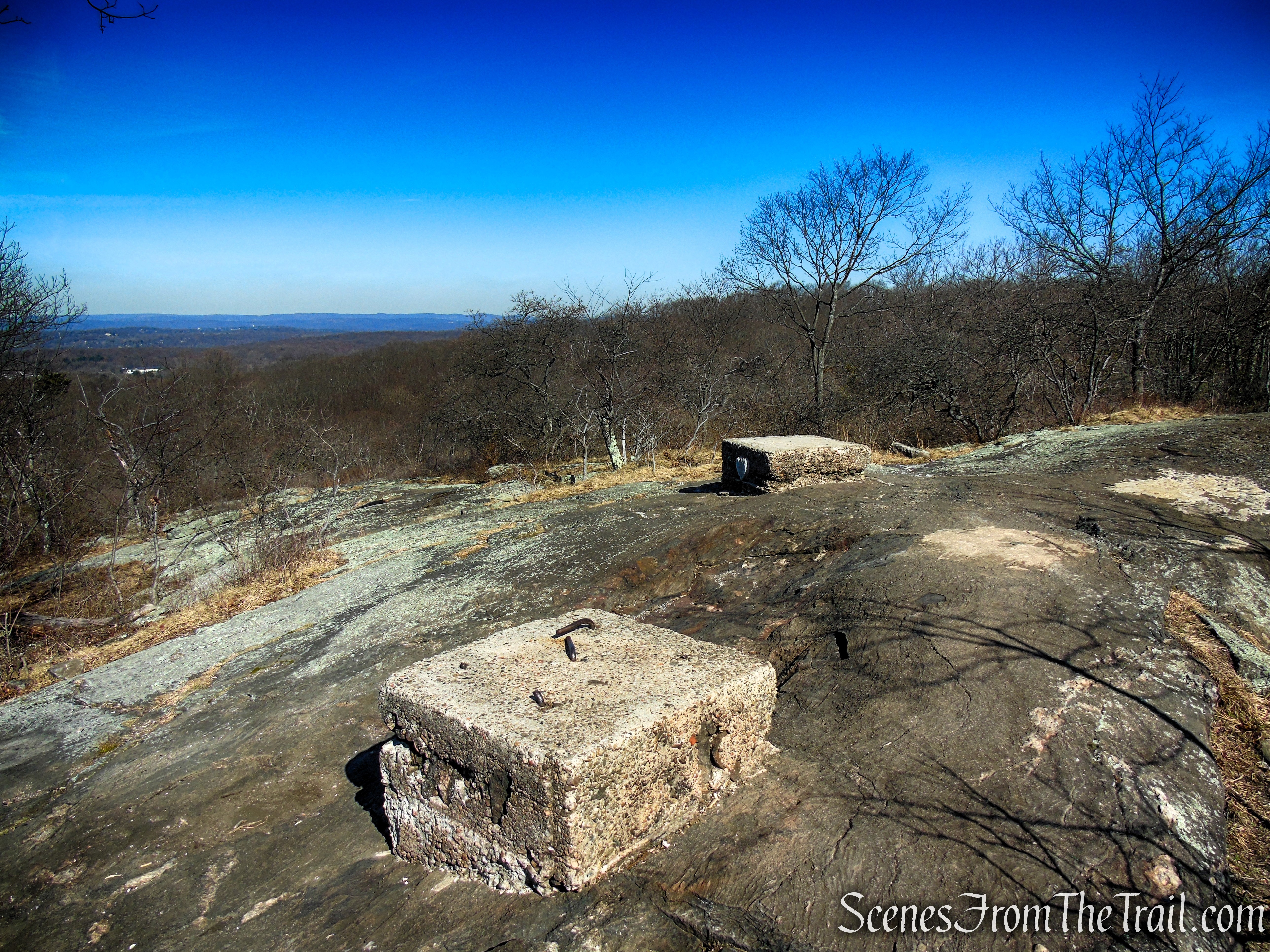
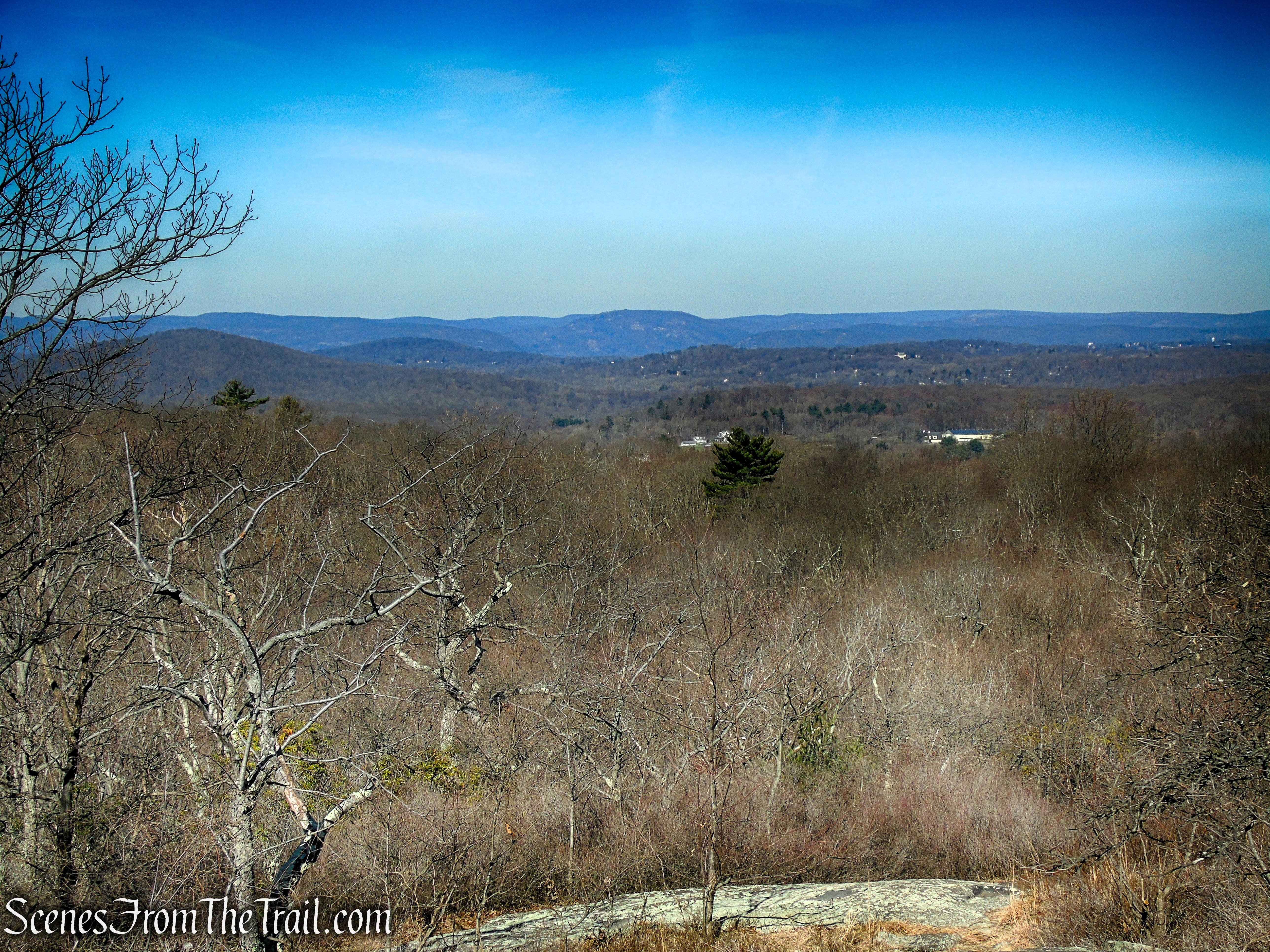
The White Trail ends at the 831-foot summit of Turkey Mountain, offering views of the Croton Reservoir, the Hudson Highlands, and distant ridges—making the steeper ascent well worth the effort. It’s a perfect spot to pause, catch your breath, and take in the scenery.
End of White Trail – Turkey Mountain summit
Turkey Mountain summit
From this vantage point, the Croton Reservoir glimmers below, framed by forested hills, while the Hudson River winds its way toward the horizon. Beyond the river, the steep, dark cliffs of the Palisades rise sharply, creating a striking contrast against the calm water and rolling landscape.
Turkey Mountain summit
To the northwest, a tapestry of rolling hills stretches across northern Westchester, with forested ridges, open clearings, and gently sloping valleys unfolding toward the horizon.
Turkey Mountain summit
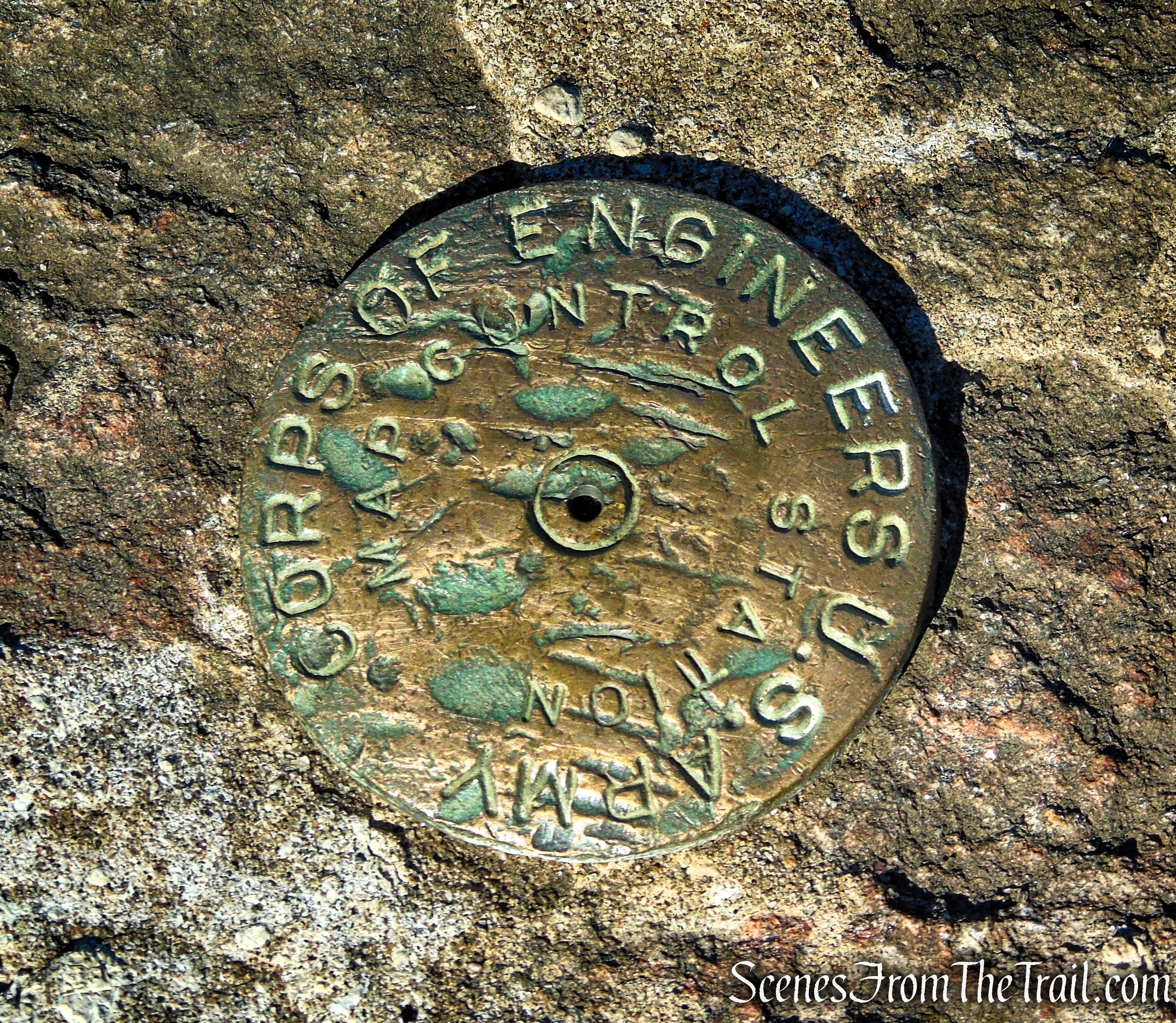
Also at the summit is a disc stamped by the U.S. Army Corps of Engineers (USACE). This spot once held a survey tower, and three concrete footings still remain. Survey towers were used by U.S. Coast and Geodetic Surveyors from the mid-1800’s through the 1980’s to establish the clear lines of sight needed for the surveys that form the backbone of the nation’s spatial reference framework. One of the most enduring and widely used designs was the Bilby Tower, created by Jasper Bilby in 1926.
Turkey Mountain summit
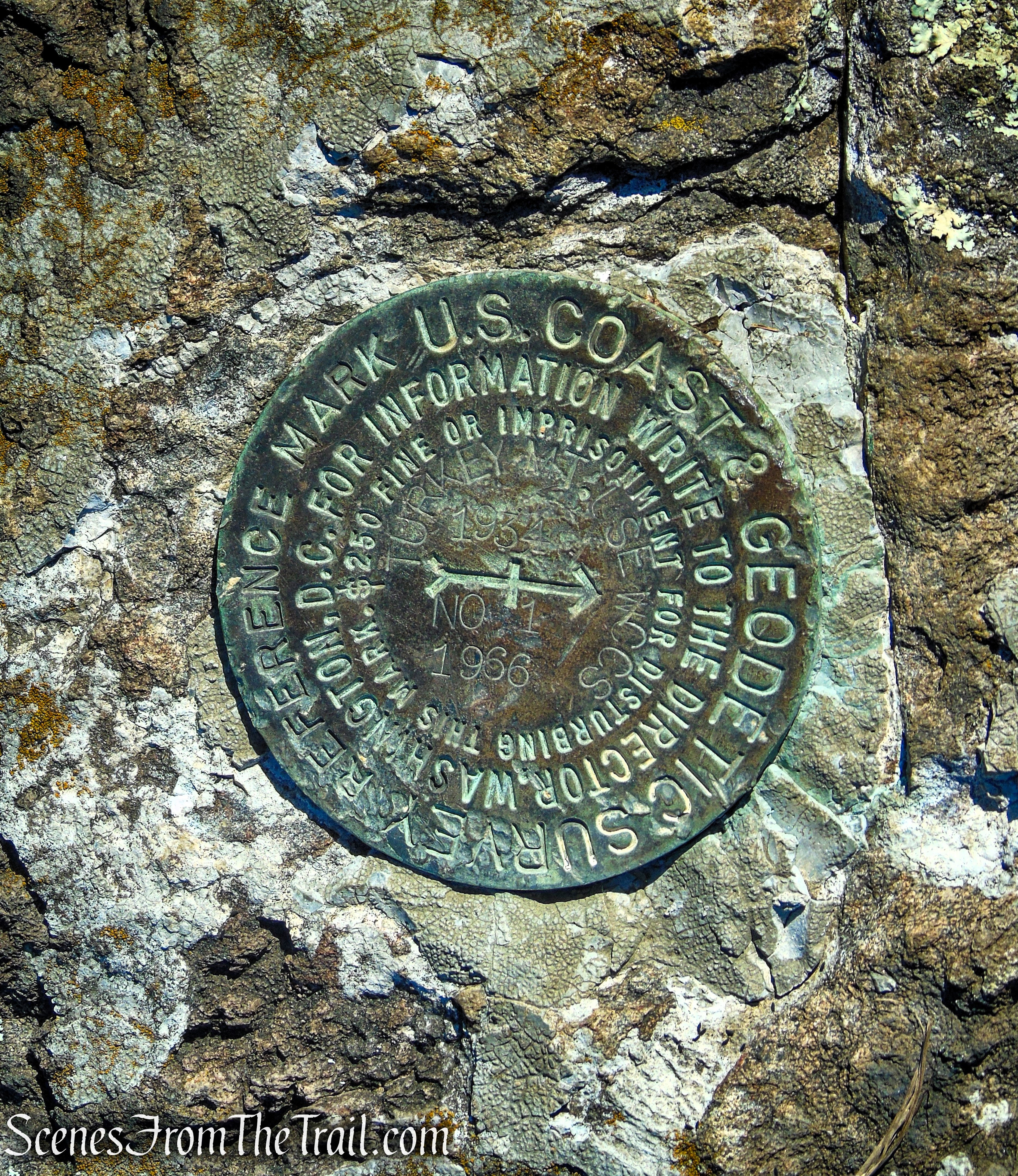
Nearby is a geodetic survey marker, which is a precisely placed reference point used to measure and map the Earth’s surface. These markers provide exact latitude, longitude, and elevation data, forming the foundation for accurate maps, property boundaries, and engineering projects. Often set in bedrock, these metal disks are part of a national network that ensures consistency in surveying and navigation.
Turkey Mountain summit
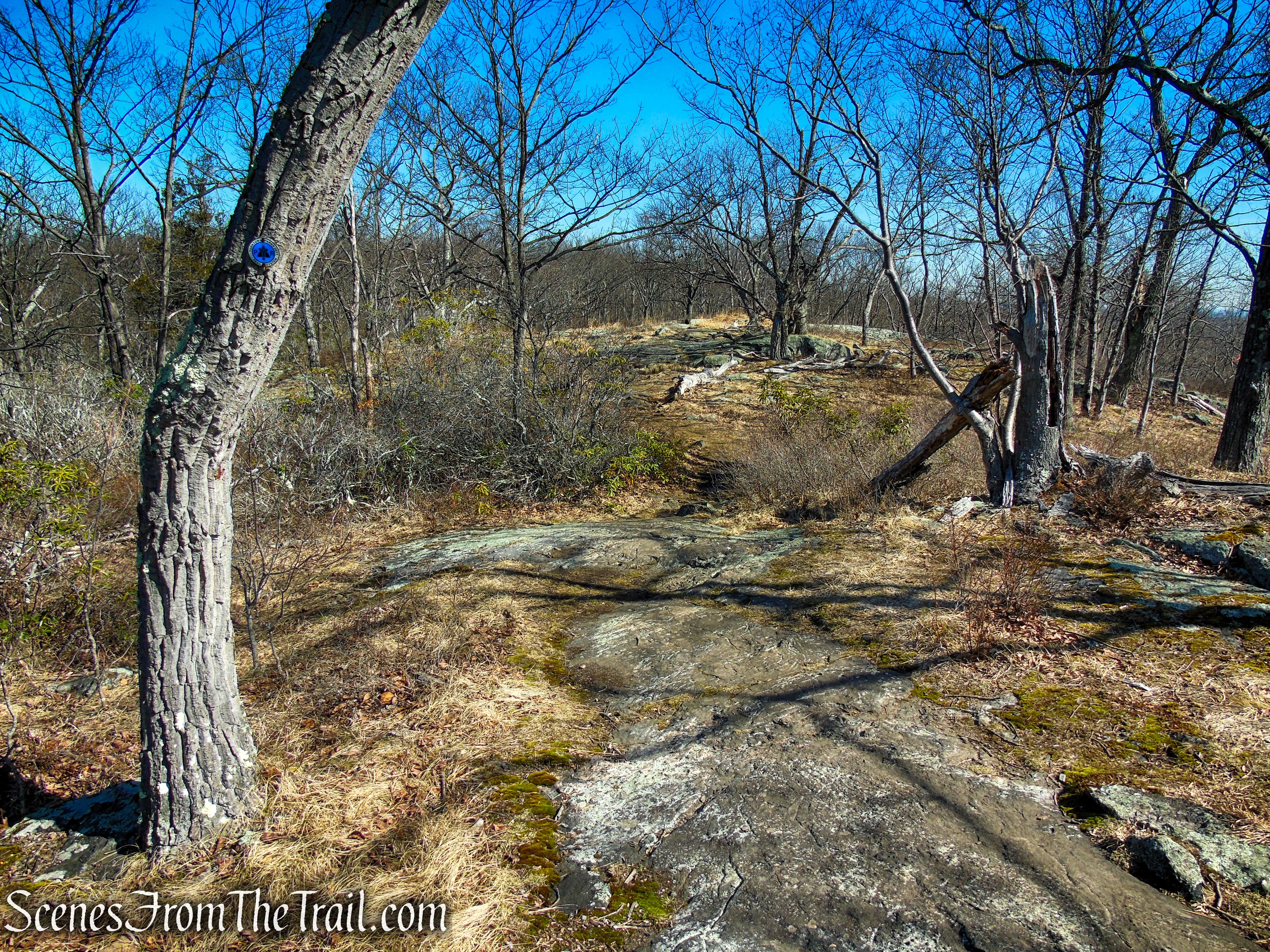
When you’re ready to continue, follow the Blue Trail, which starts directly at the end of the White Trail. The path begins heading north from the summit, winding along rocky ledges and through clusters of hardwoods, before gradually curving northeast and descending into the forested slopes below.
Blue Trail – Turkey Mountain Nature Preserve
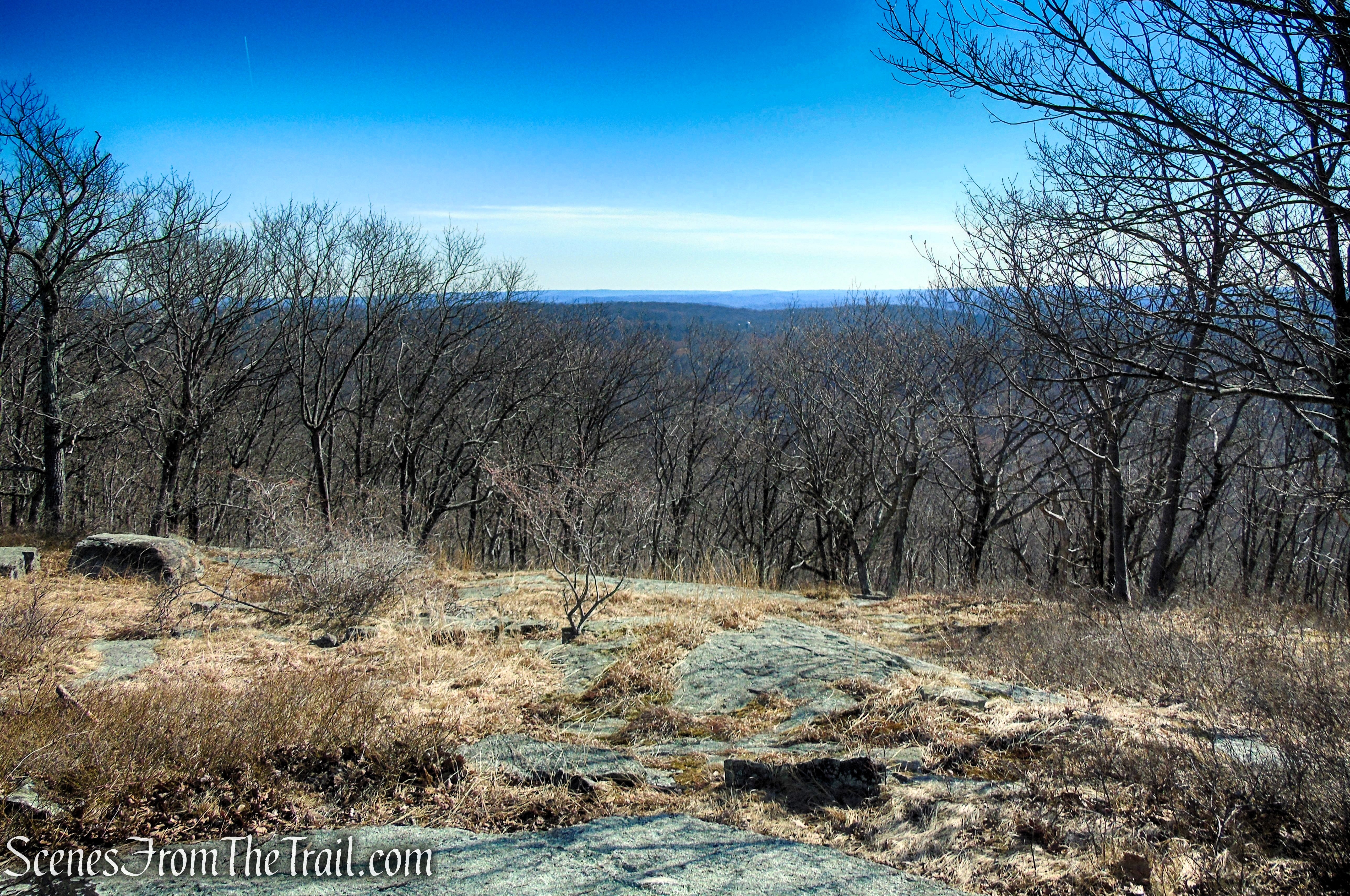
Blue Trail – Turkey Mountain Nature Preserve
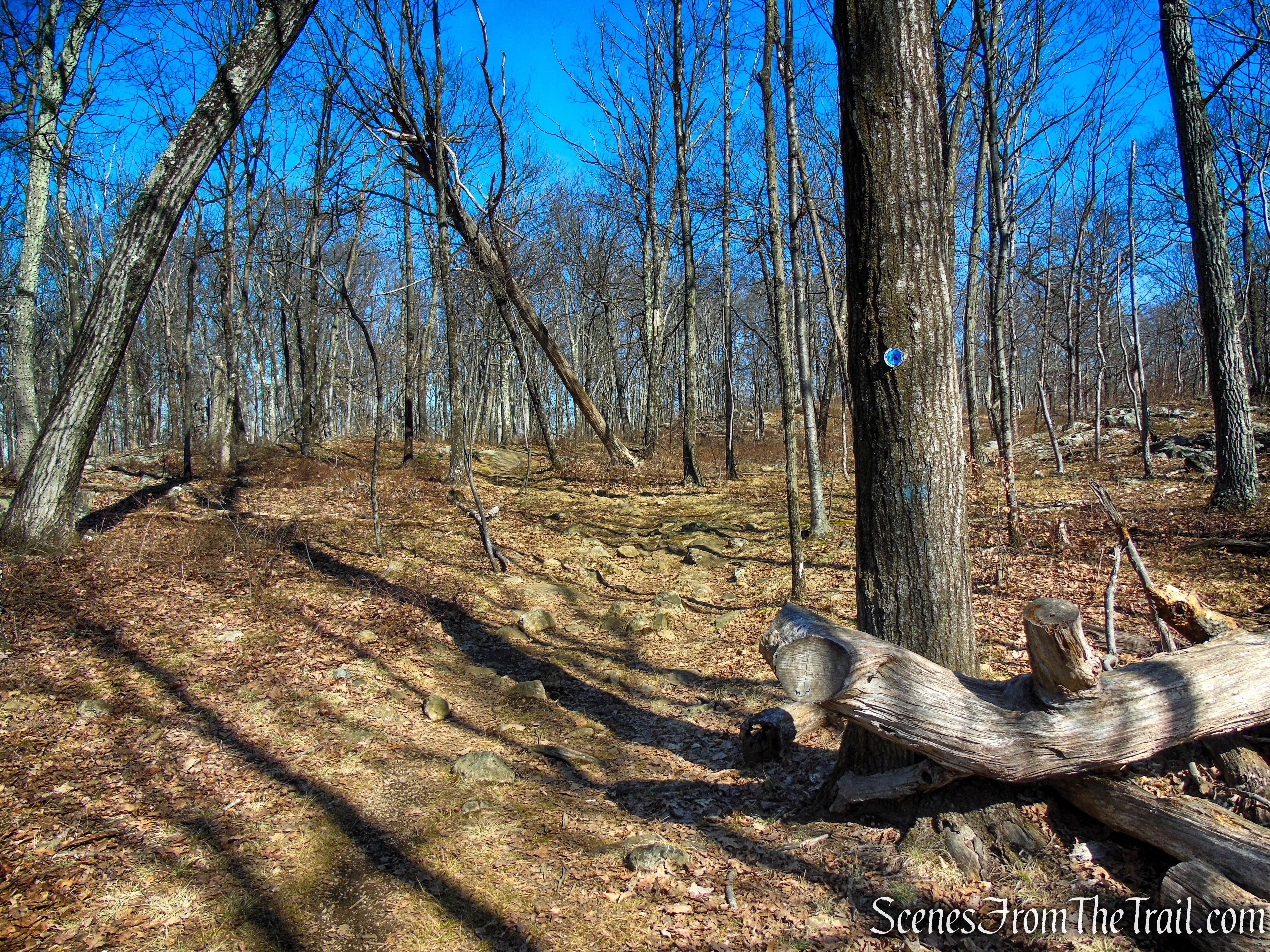
Blue Trail – Turkey Mountain Nature Preserve
The Blue Trail descends gradually, weaving through a canopy of mixed hardwoods. The footing alternates between soft leaf-covered soil, exposed roots, and occasional rocky sections, giving the trail texture and character without the intensity of the White Trail. As you lose elevation, small clearings and moss-covered boulders appear, offering glimpses of the surrounding forest and creating a peaceful, scenic descent that showcases the mountain’s varied terrain.
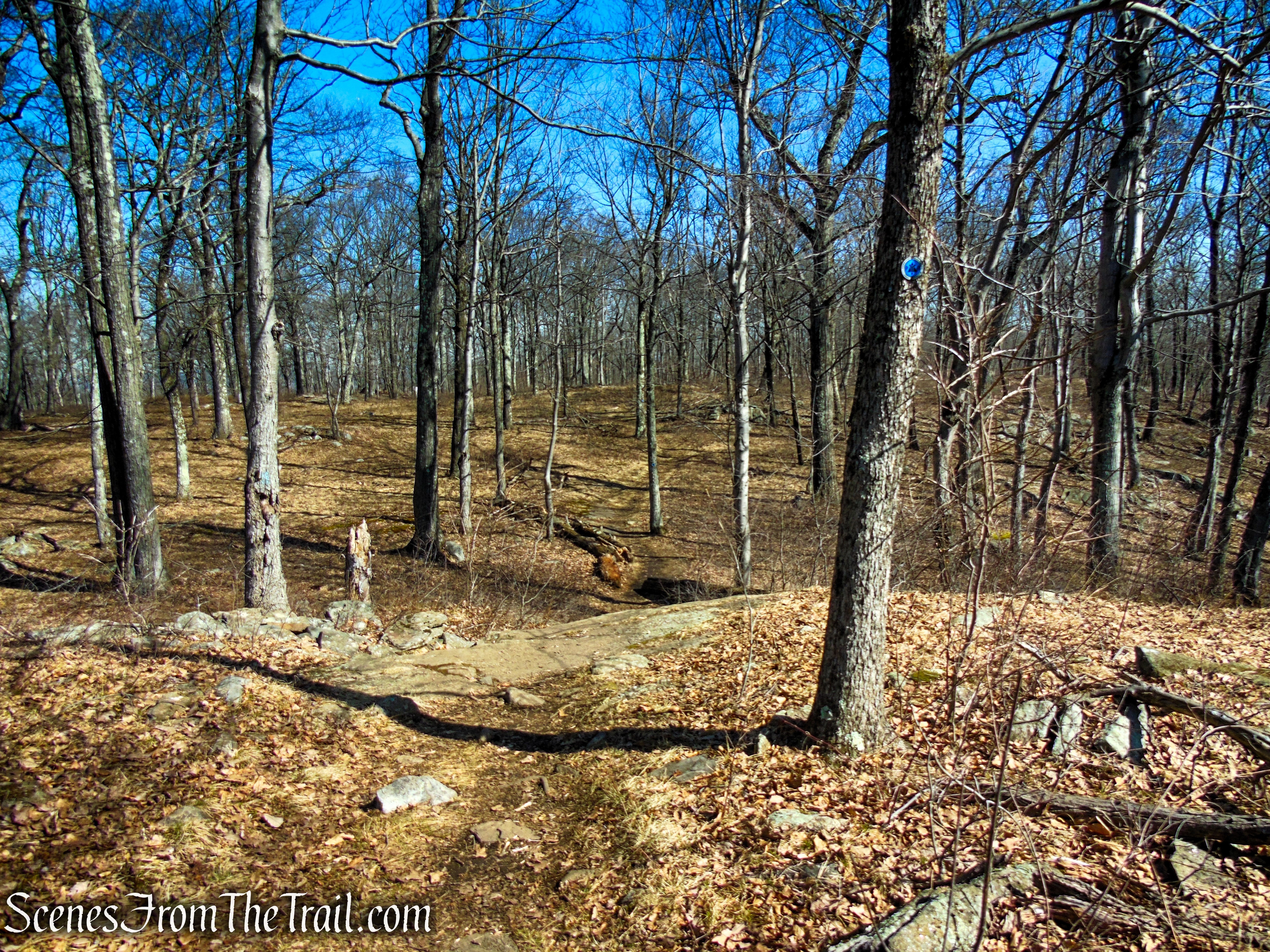
Blue Trail – Turkey Mountain Nature Preserve
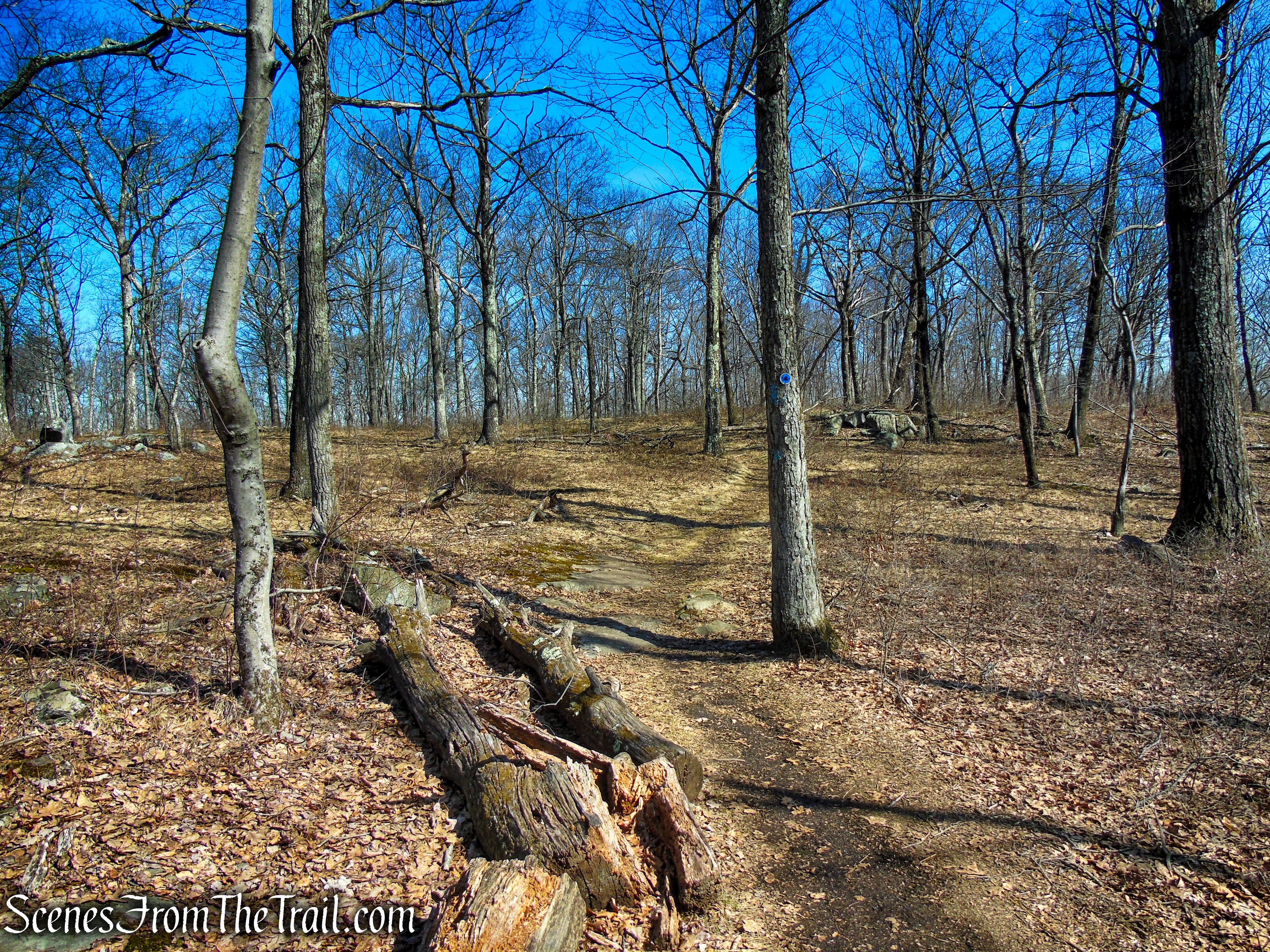
Blue Trail – Turkey Mountain Nature Preserve
Blue Trail – Turkey Mountain Nature Preserve
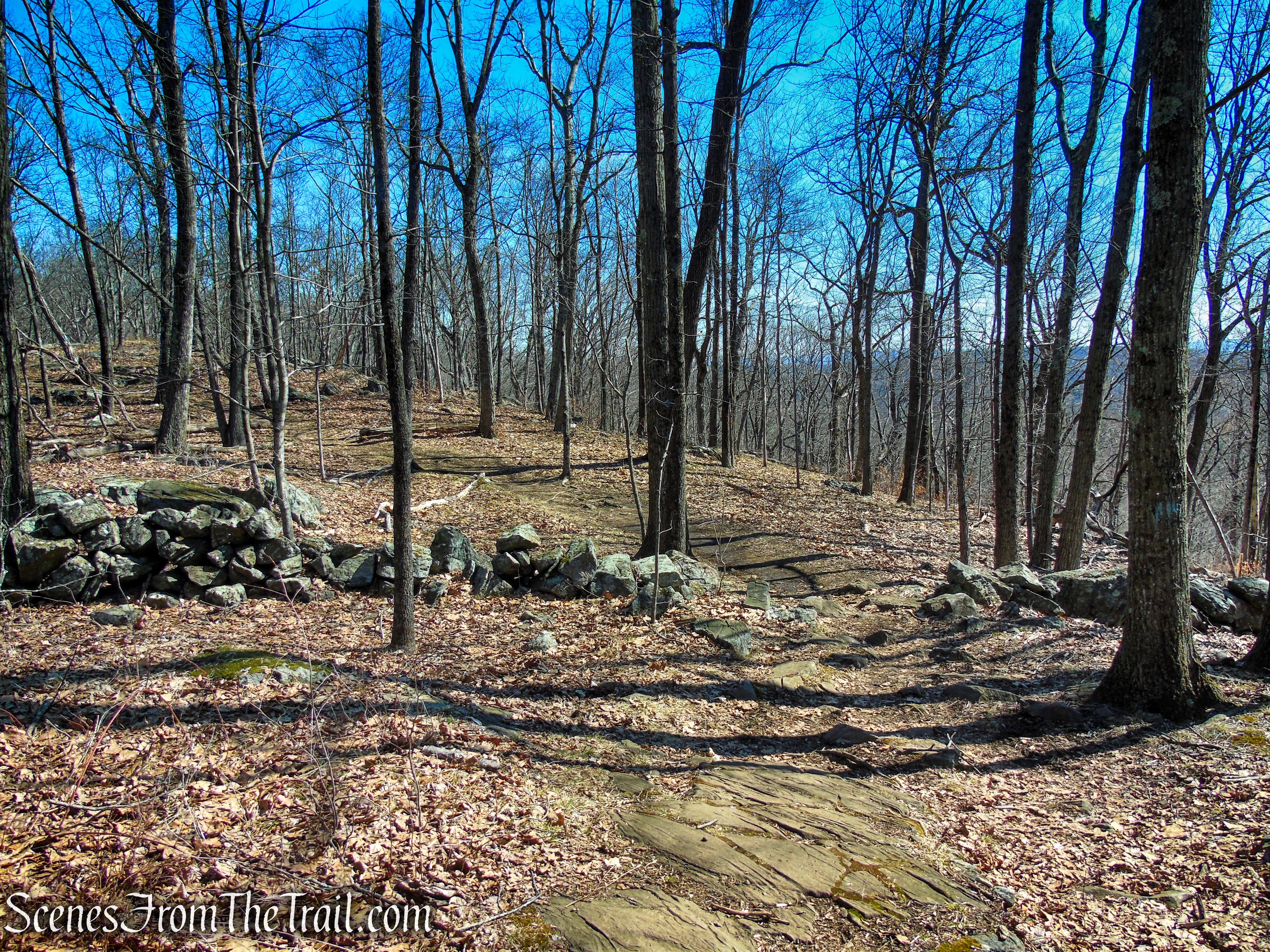
Blue Trail – Turkey Mountain Nature Preserve
As the Blue Trail winds down the mountain, it passes a series of intriguing rock formations that break through the forest floor. Weathered slabs, jagged boulders, and pockets of moss-covered stone create natural sculptures along the path. These formations add texture and interest to the hike, giving the trail a rugged, dynamic feel even on the gentler descent.
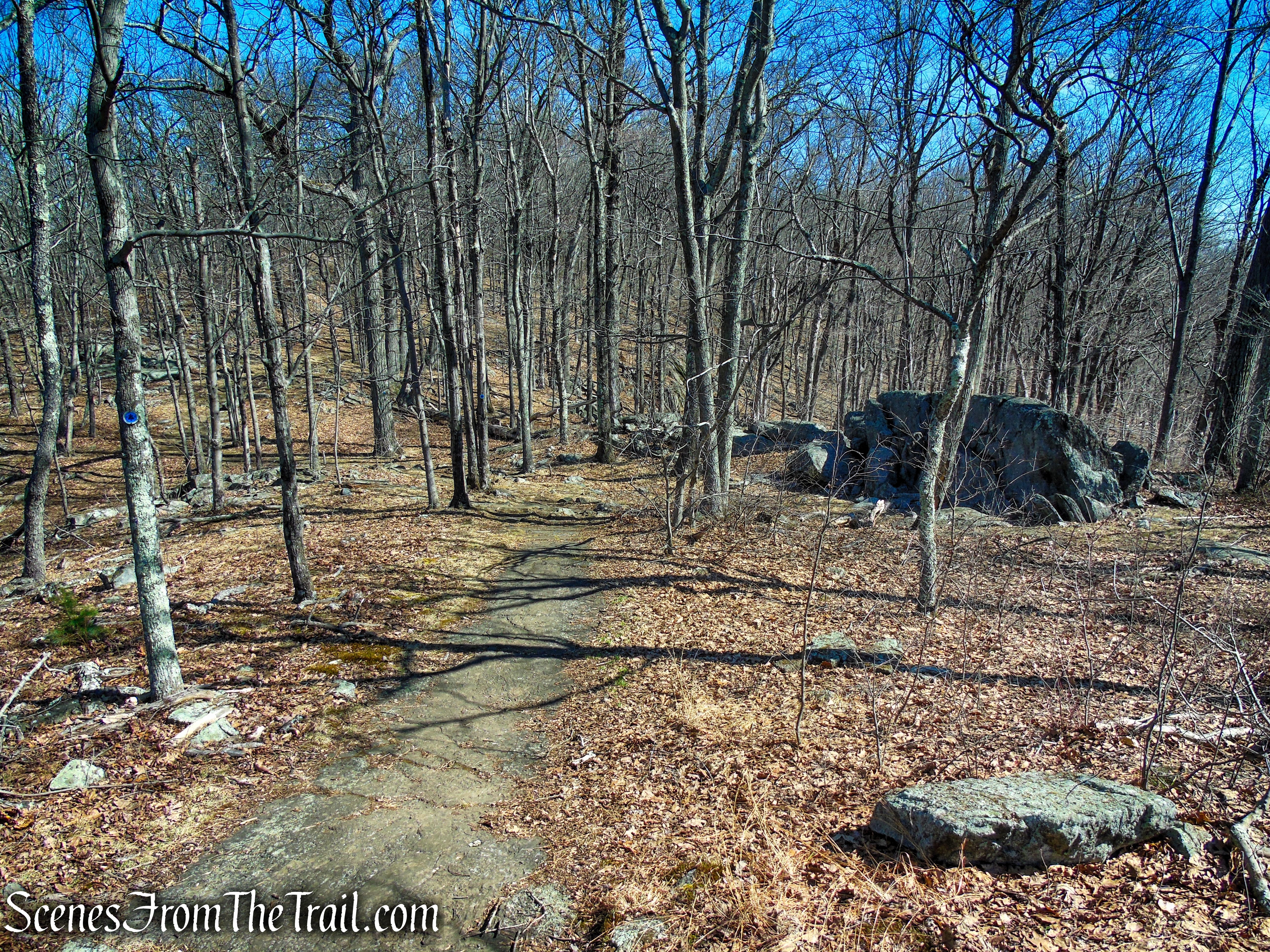
Blue Trail – Turkey Mountain Nature Preserve
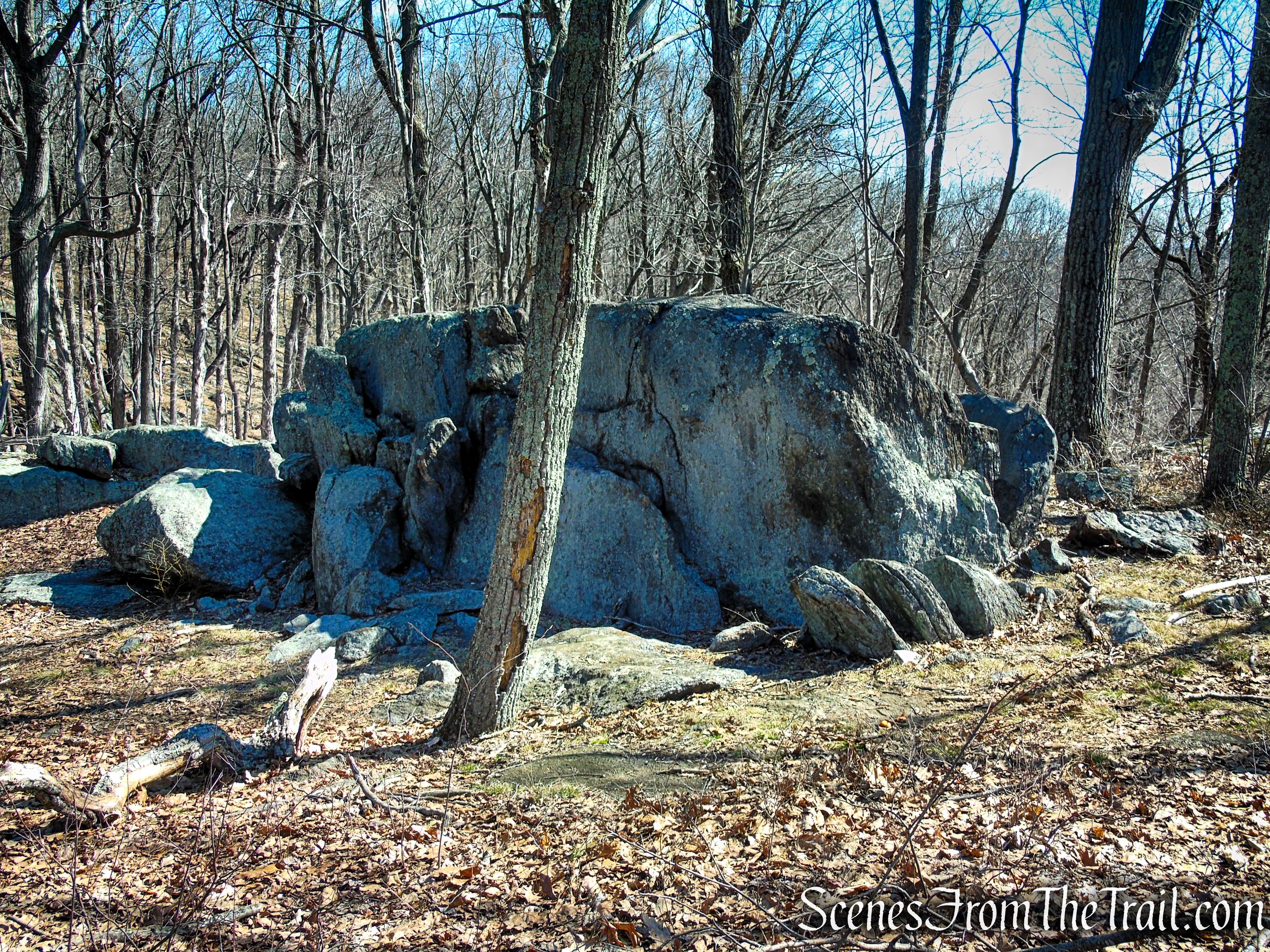
Blue Trail – Turkey Mountain Nature Preserve
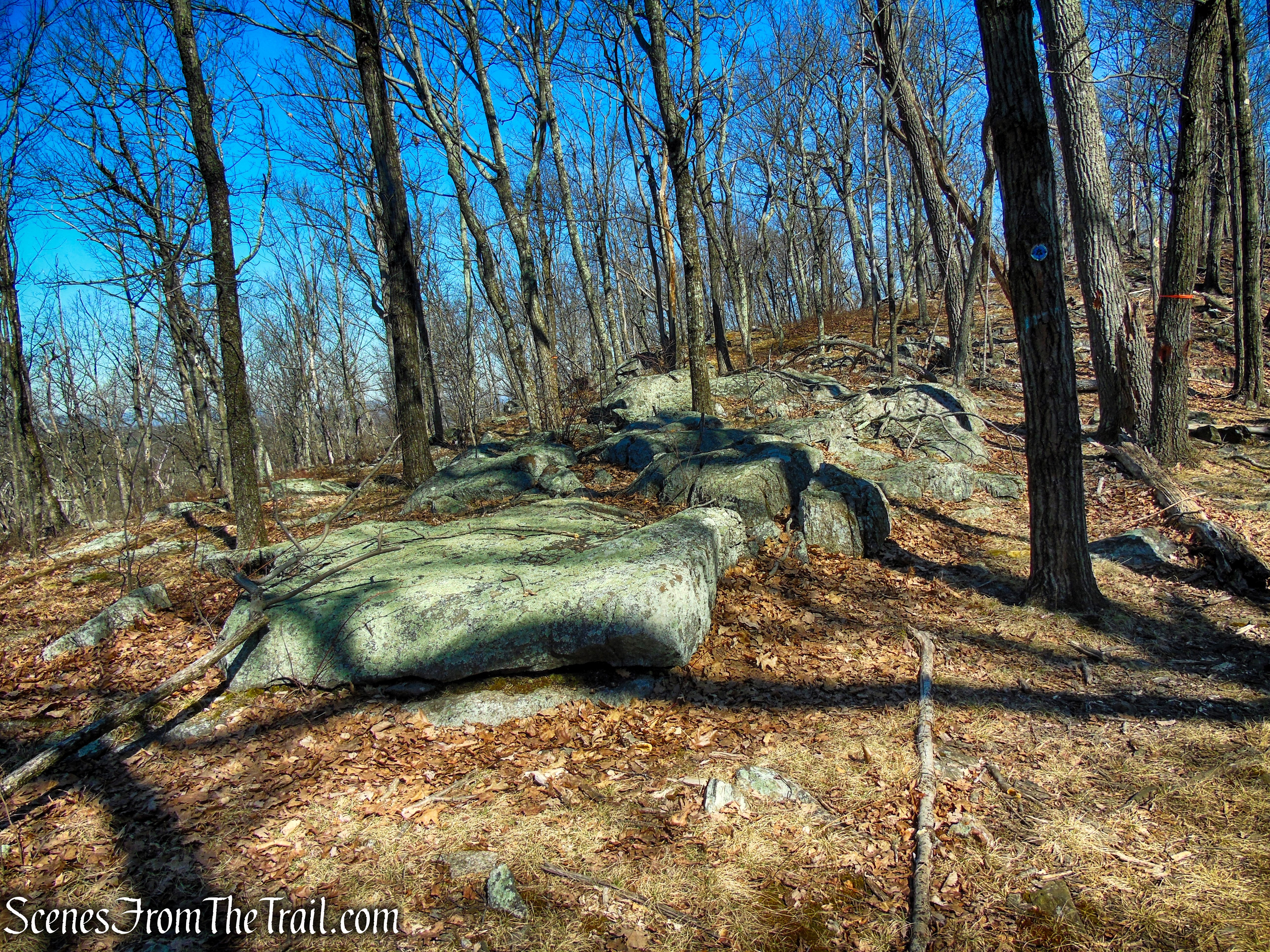
Blue Trail – Turkey Mountain Nature Preserve
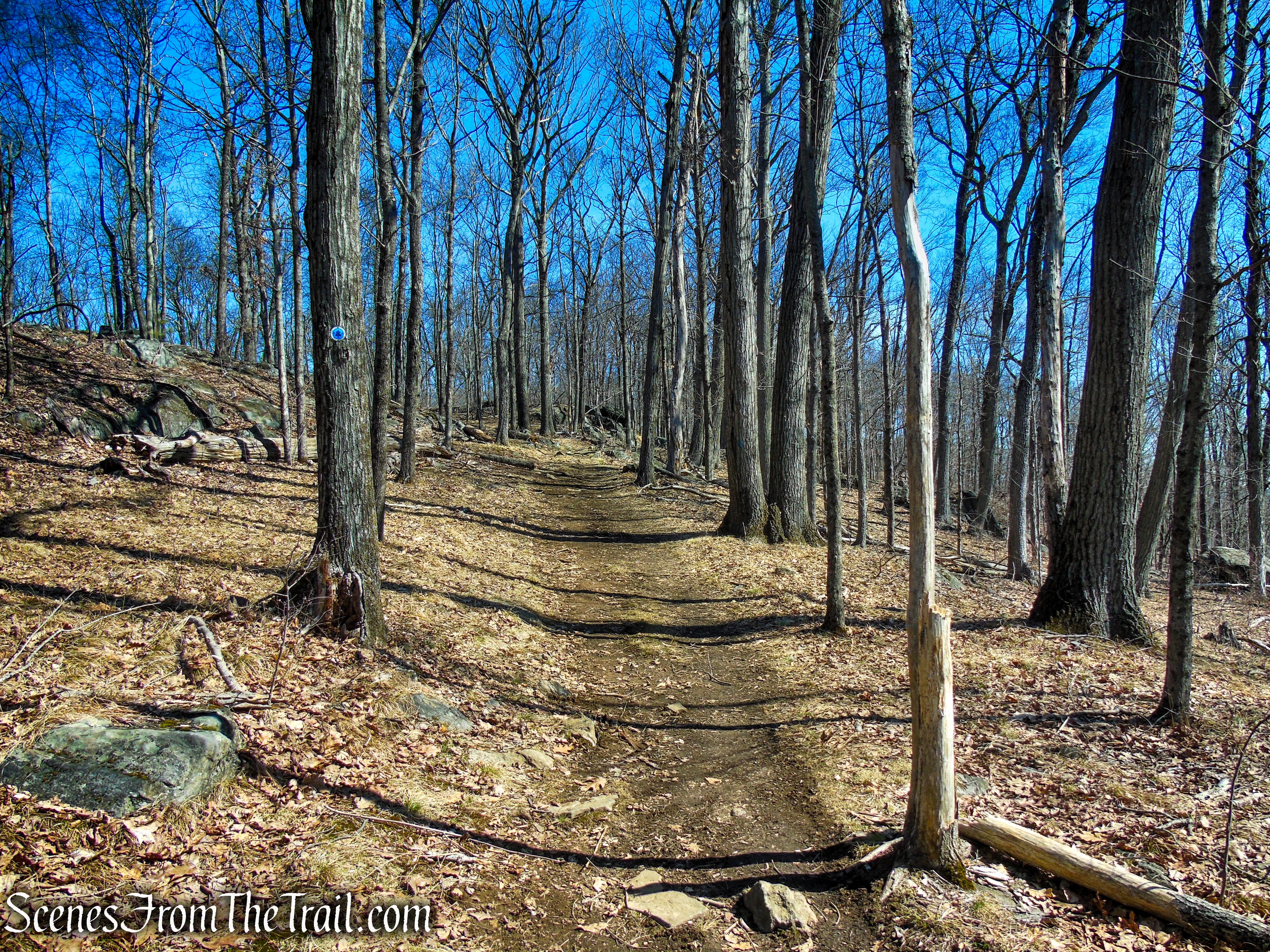
Blue Trail – Turkey Mountain Nature Preserve
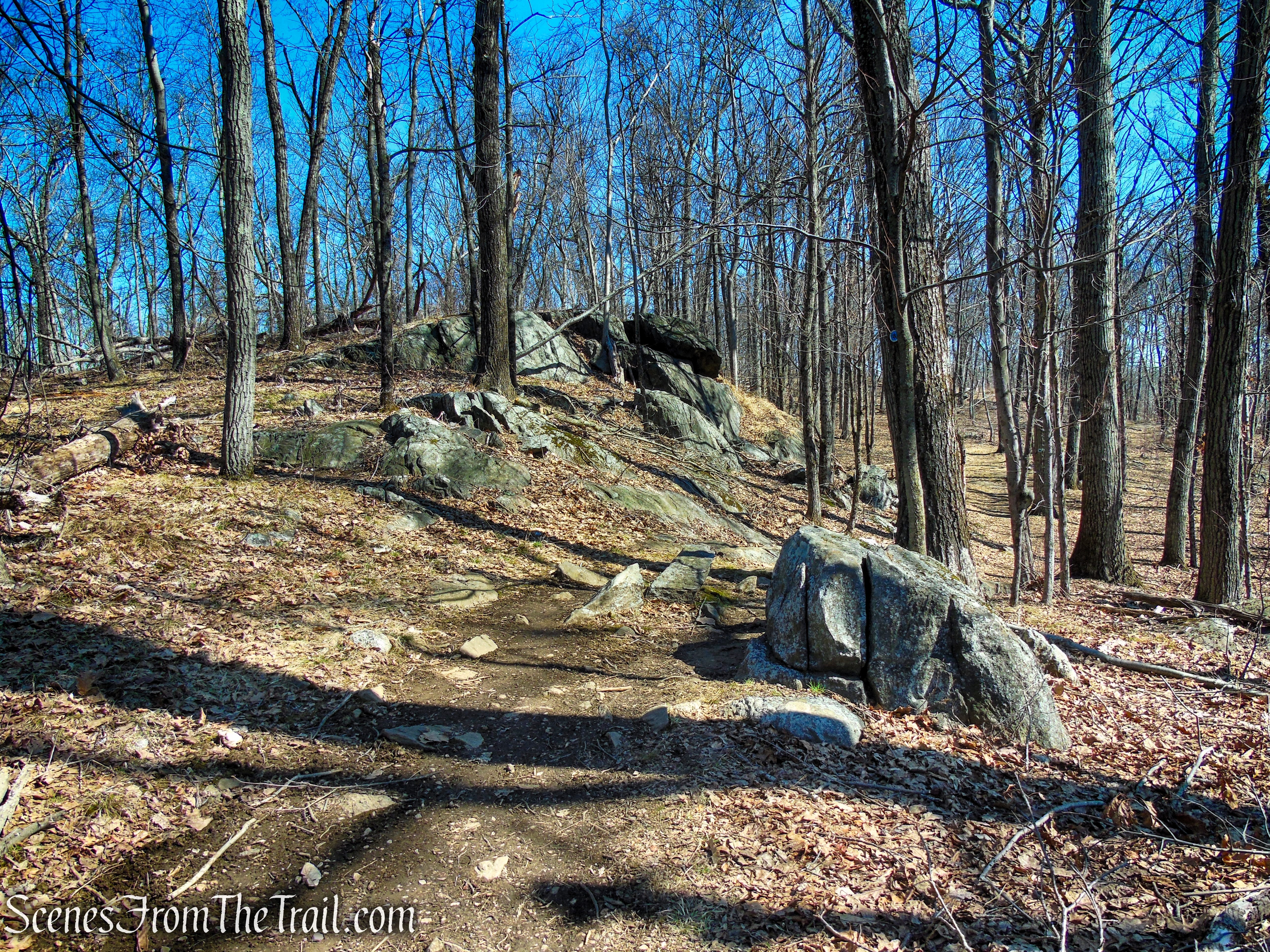
Blue Trail – Turkey Mountain Nature Preserve
As the trail reaches the far northeastern edge of the preserve, it makes a sharp right turn and descends more steeply along a wide woods road, running alongside the nearby powerlines.
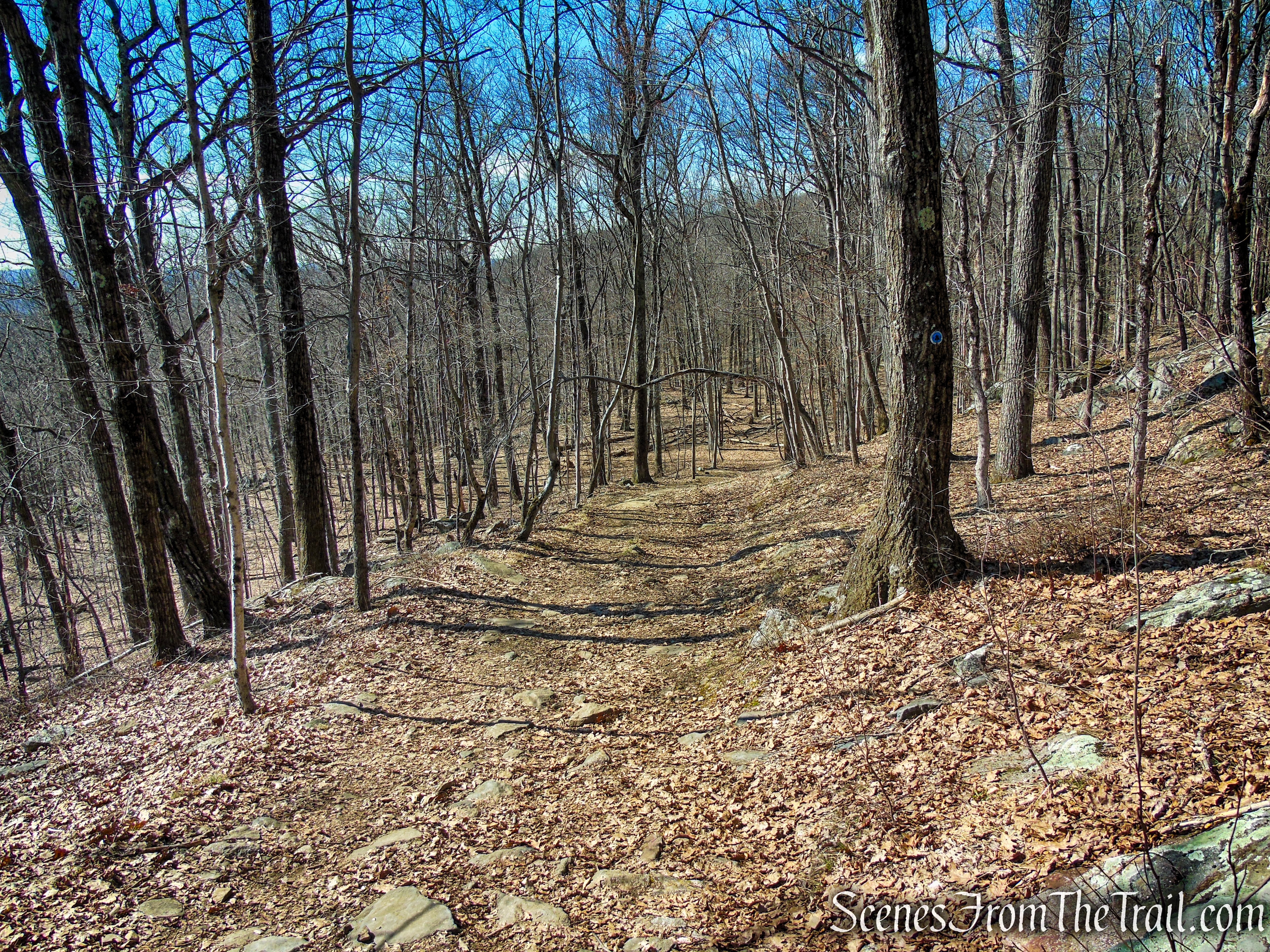
Blue Trail – Turkey Mountain Nature Preserve
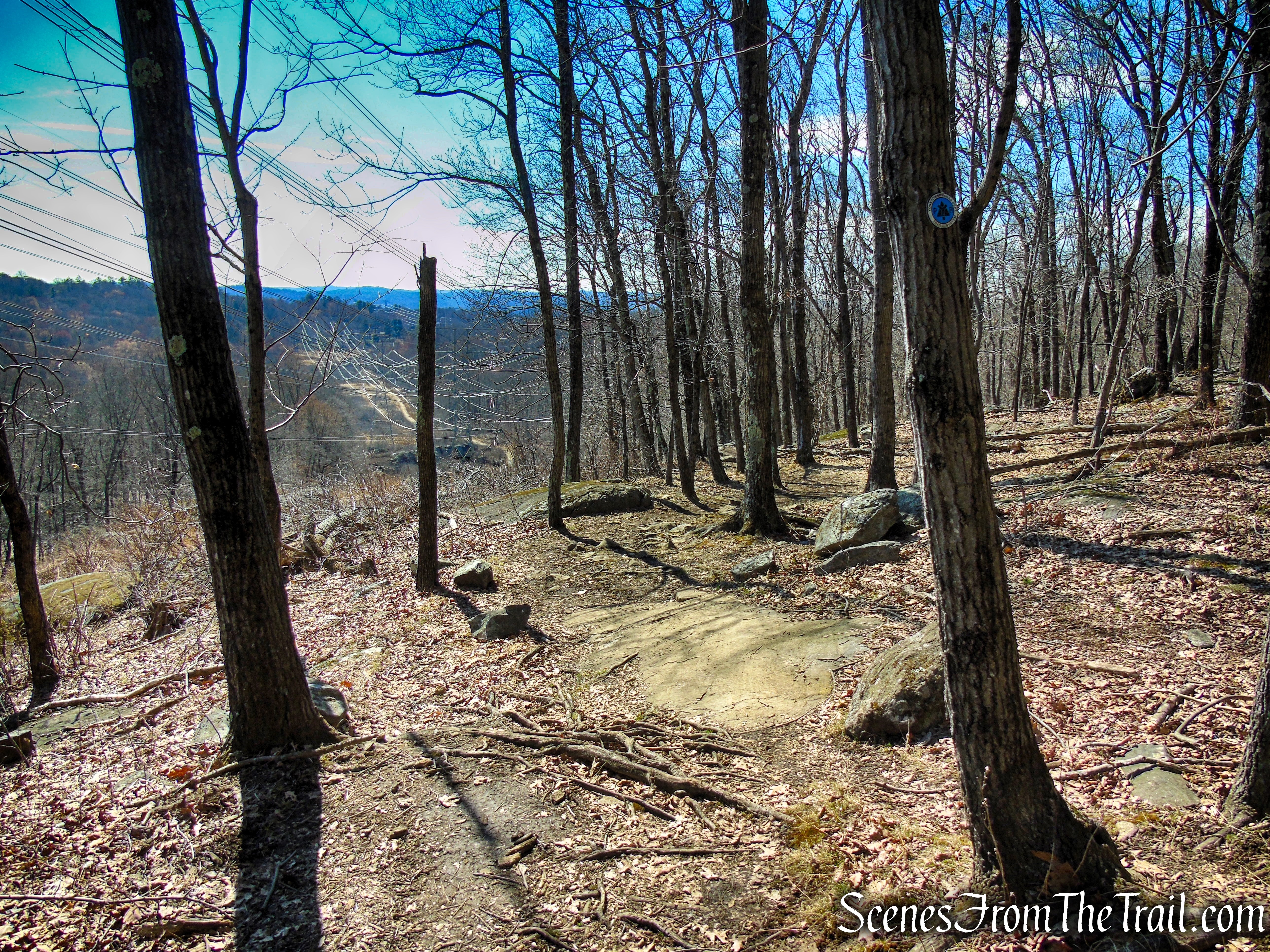
Blue Trail – Turkey Mountain Nature Preserve
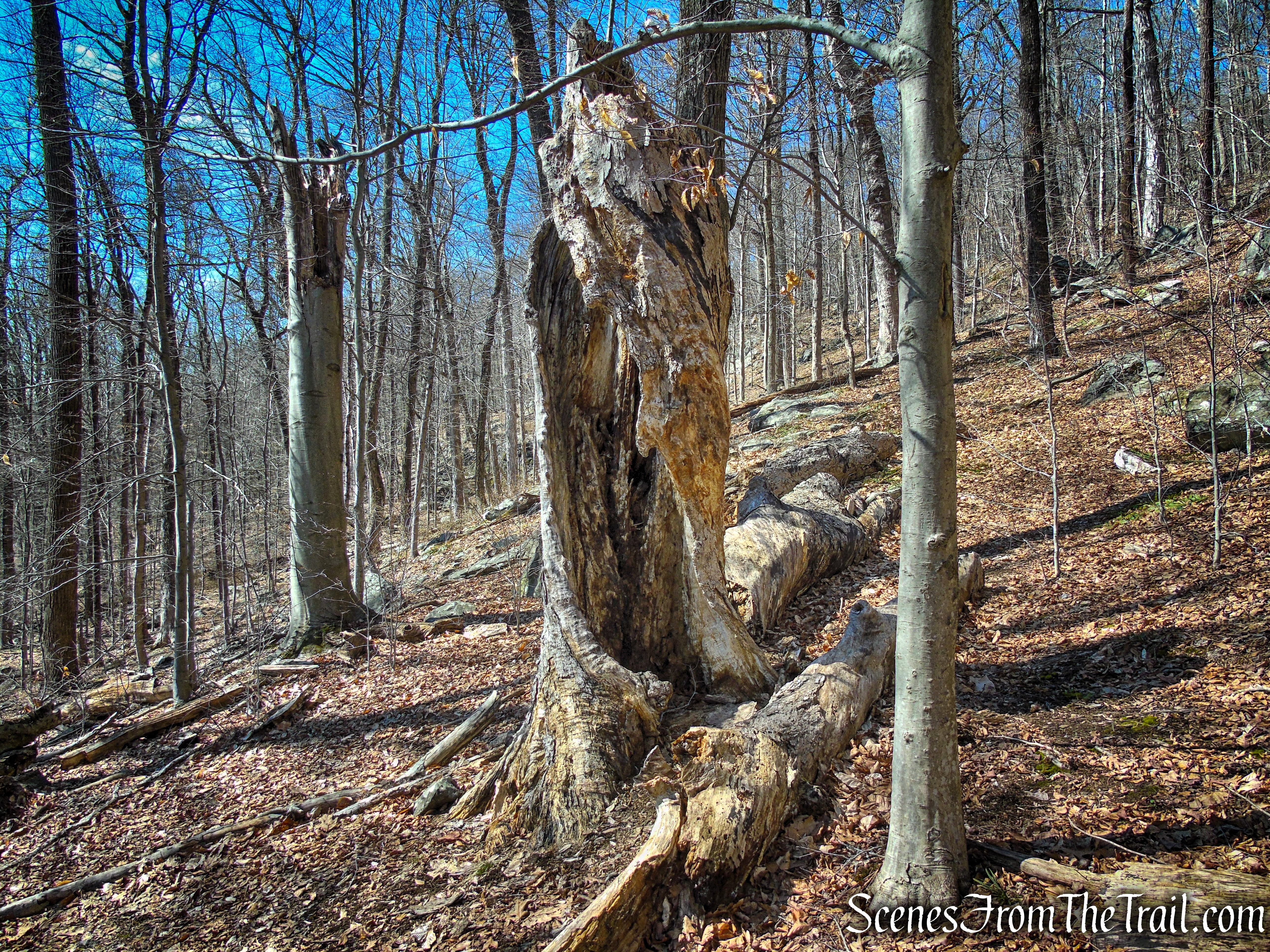
Along the Blue Trail, a tall, hollowed-out tree stump rises like a natural sculpture, its dark, cavernous interior contrasting with the rough, weathered exterior, hinting at decades of slow decay and the forest life thriving around it.
Blue Trail – Turkey Mountain Nature Preserve
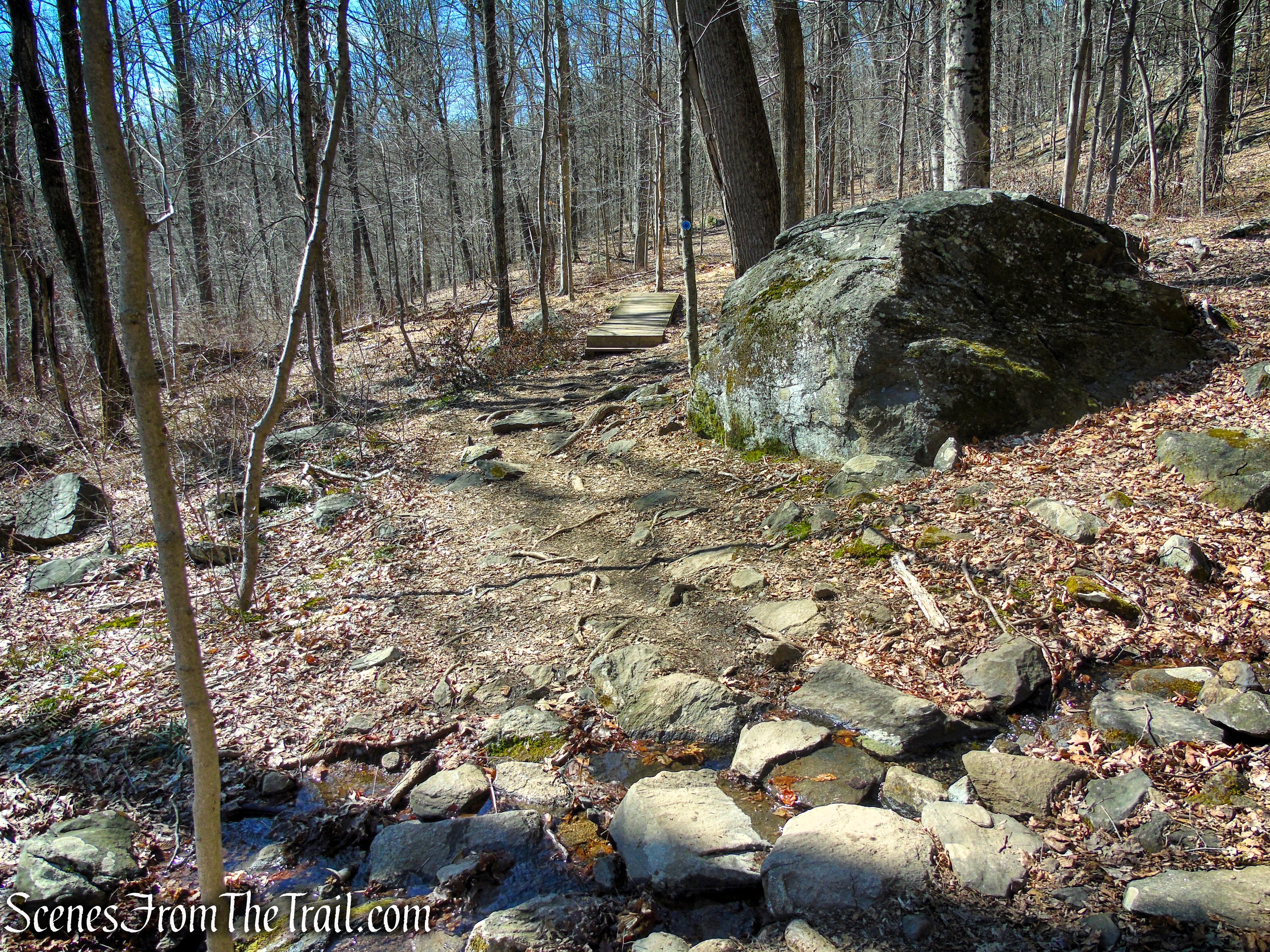
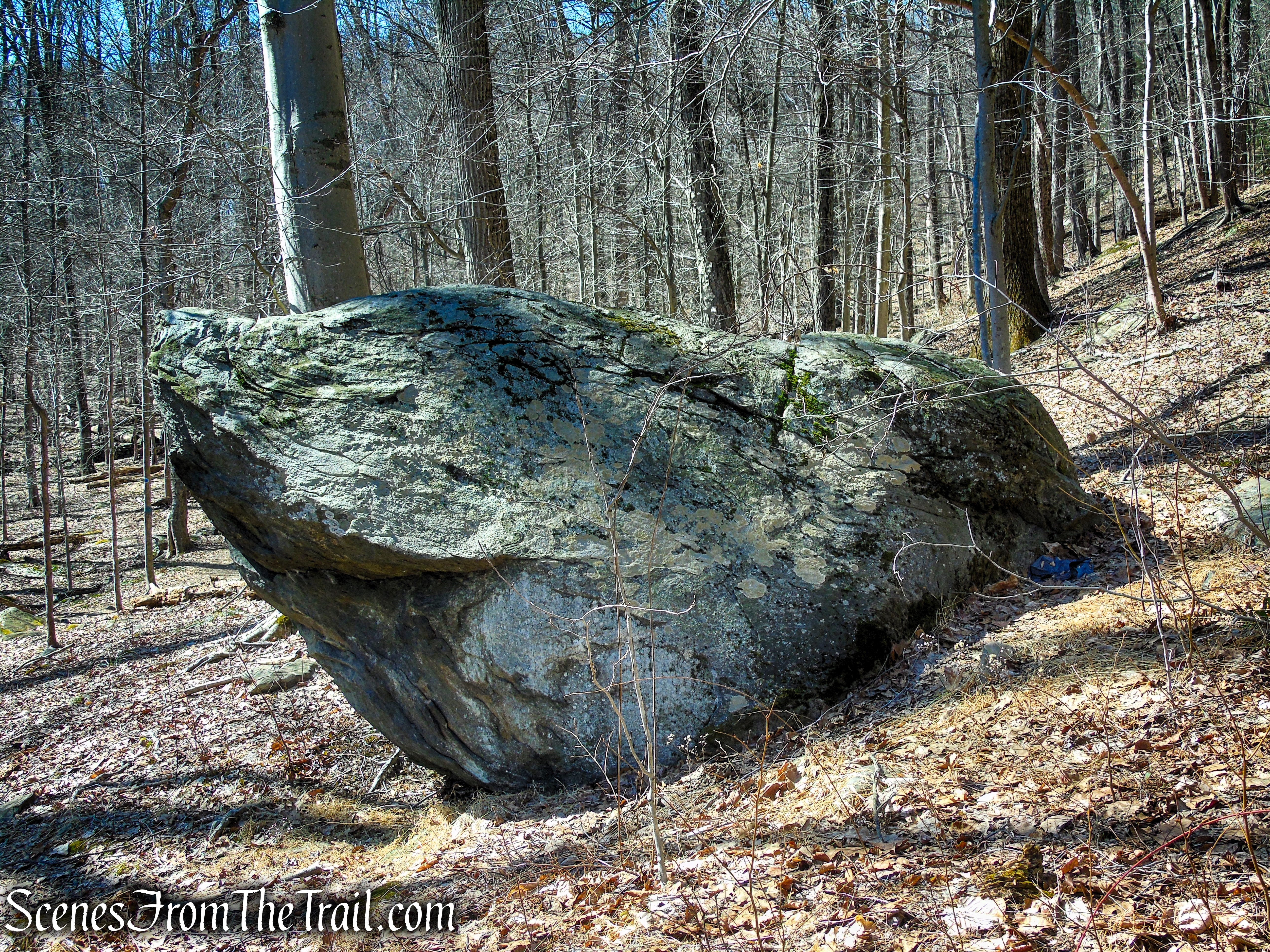
Further along the trail, clusters of rock formations emerge, from jagged outcrops to smooth, weathered slabs. Moss and lichen cling to their surfaces, and scattered boulders create natural obstacles and resting spots, adding visual interest to the forested path.
Blue Trail – Turkey Mountain Nature Preserve
Blue Trail – Turkey Mountain Nature Preserve
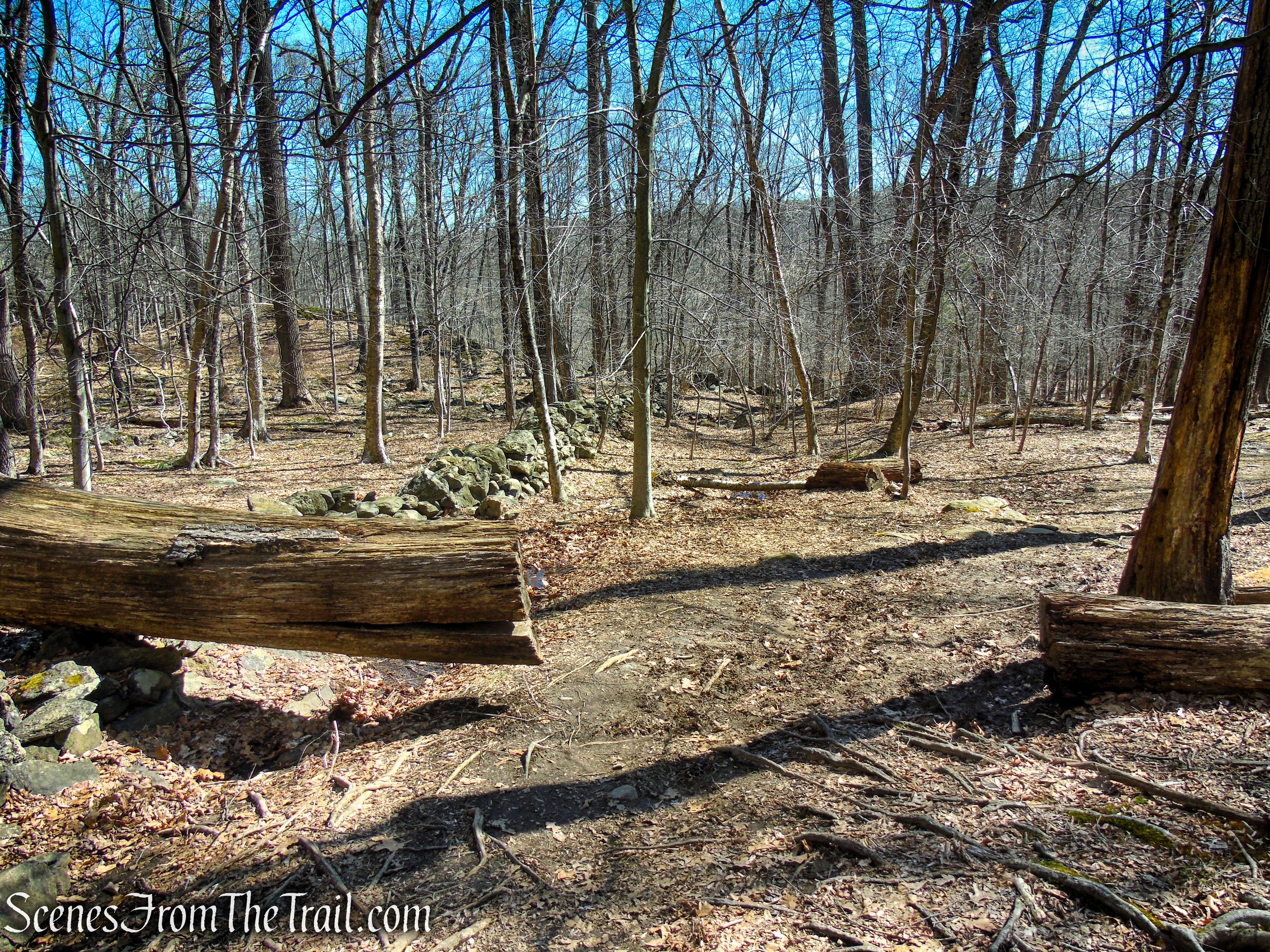
Scattered throughout the preserve are remnants of old stone walls, their weathered stones partially hidden by moss and undergrowth. These walls hint at the land’s agricultural past, winding through the forest like quiet, timeworn boundaries that blend seamlessly with the natural landscape.
Blue Trail – Turkey Mountain Nature Preserve
The Blue Trail soon winds past an old stone wall, its weathered stones nestled beside a towering rock formation, creating a striking contrast between human-made and natural features.
Blue Trail – Turkey Mountain Nature Preserve
Blue Trail – Turkey Mountain Nature Preserve
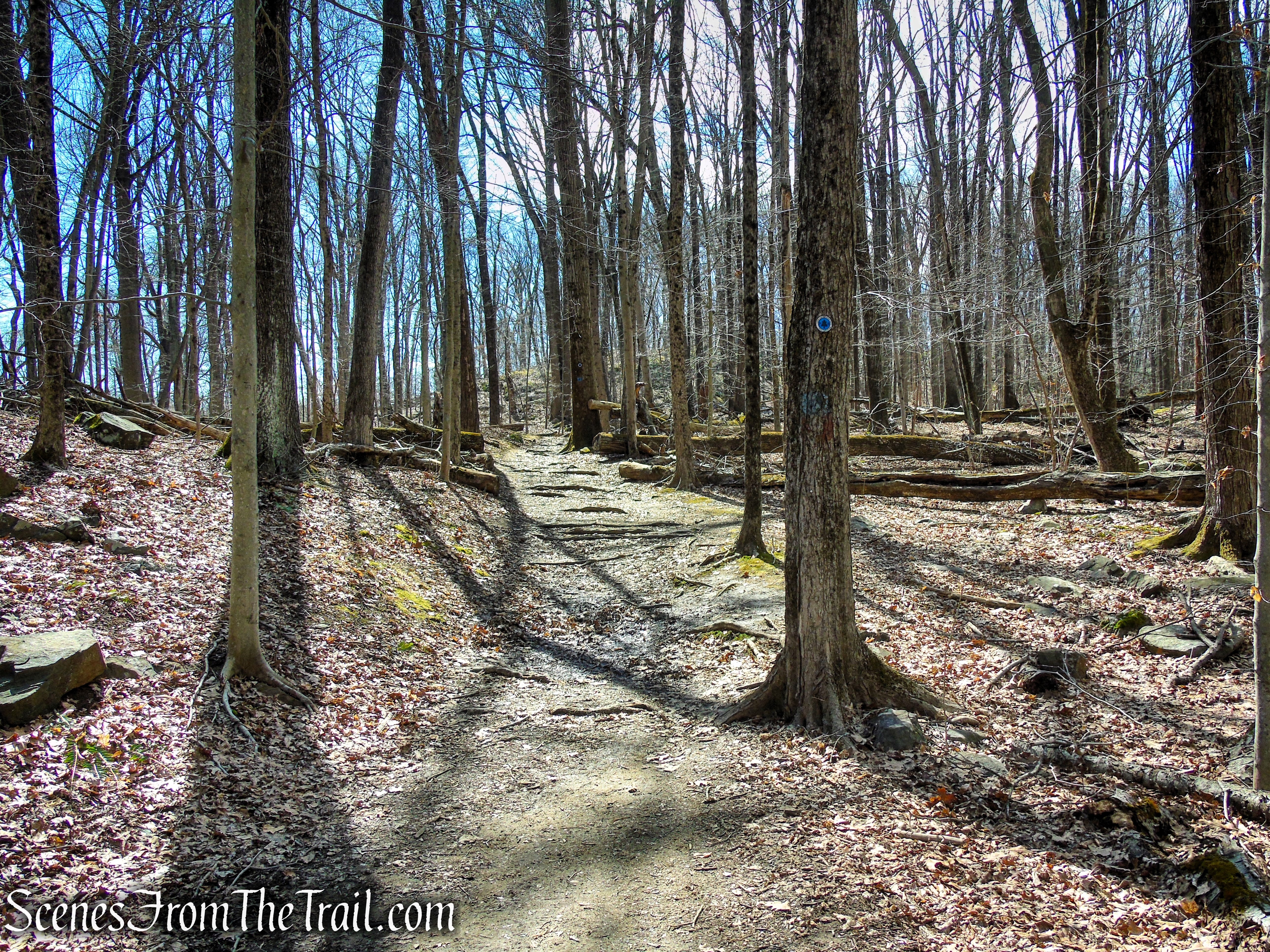
Blue Trail – Turkey Mountain Nature Preserve
Lower down, the path levels out and smooths slightly as it approaches the trailhead, making for a relaxed finish after the climb. It’s an ideal way to come down—steady, scenic, and just rugged enough to remind you that even the “easier” route on Turkey Mountain still feels like a true hike.
Blue Trail – Turkey Mountain Nature Preserve
End of Blue Trail – Turkey Mountain Nature Preserve
Review:
This enjoyable 3-mile moderate loop climbs the steeper White Trail before descending the gentler Blue Trail, making for a well-balanced and comfortable route. While the views are modest, the real highlight is the landscape itself—rocky outcrops, moss-covered boulders, and quiet forest that create a scenic and immersive hiking experience from start to finish. I highly recommend this hike, though it’s best enjoyed on a weekday during the warmer months to avoid the crowds.
Pros:
Scenic landscape, relatively well marked trails, shaded forest canopy, peaceful setting, interesting rock formations.
Cons:
Small unpaved parking lot, can get crowded on weekends, slippery footing when wet or leaf-covered, limited views, trail intersections may be slightly confusing for first-time visitors.
Take a hike!
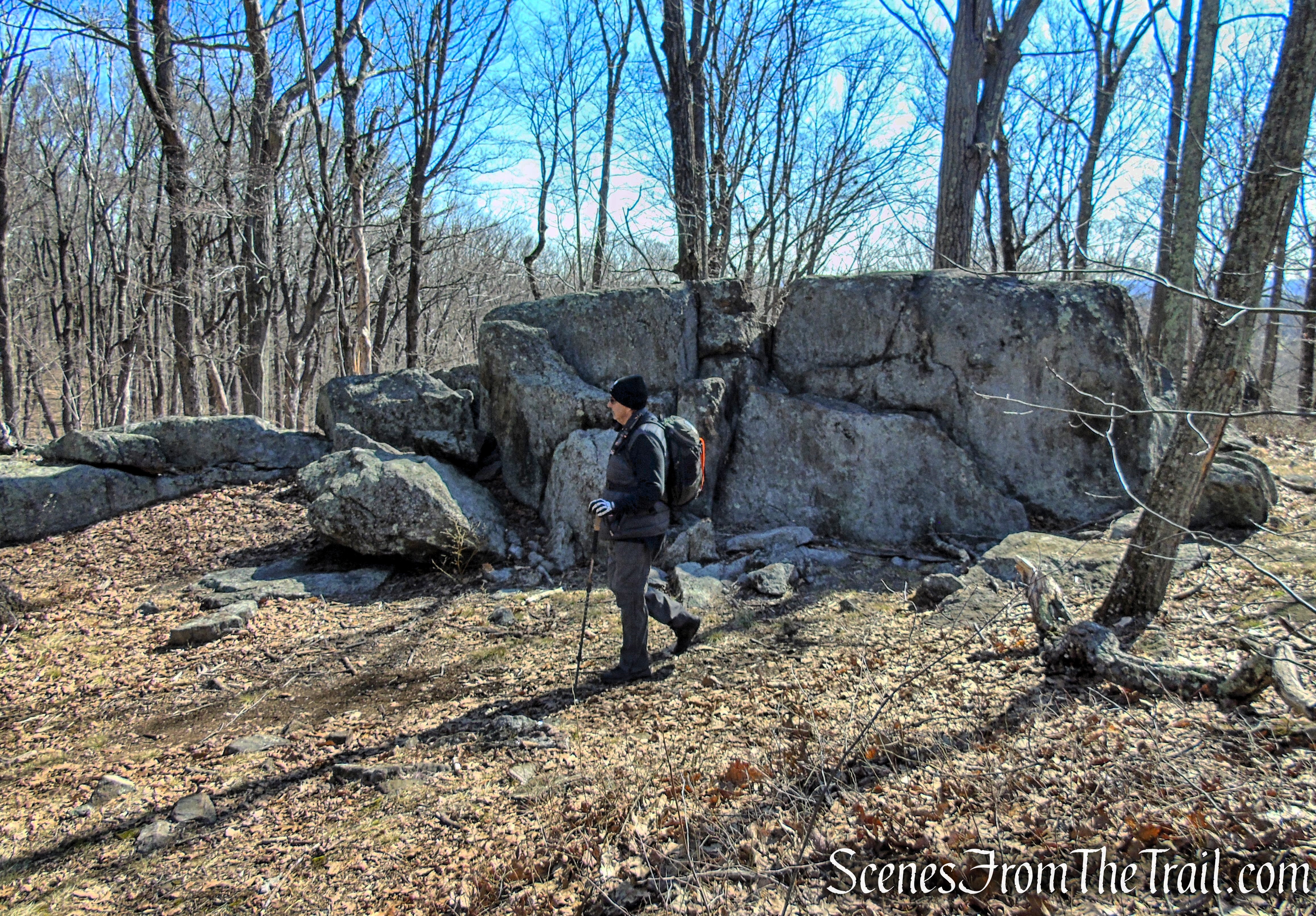
Turkey Mountain Nature Preserve Loop
Sources:
 Scenes From The Trail